6 More Exploitation Trailers: The Late Edition


Hi, Lisa Marie here.  I apologize for being a day late in continuing my series of posts devoted to some of my favorite exploitation and grindhouse film trailers.  Unfortunately, I got caught up having a fight with a troll over on my other blog and I ended up running behind.  The lesson here is that trolls are not worth the trouble.

But enough time wasted on dumbfugs and toadsuckers.  Let’s talk exploitation with six more of my favorite trailers.

1) The Candy Snatchers

Sadly, this DVD is now out-of-print and the people selling it on Amazon want you to pay something like $80.00 for it.  That’s a shame because The Candy Snatchers is, arguably, one of the greatest films ever made.  This is one of those movies that I desperately need to review but I’m still struggling to find the right words to express just how brilliant this movie is.

2) Django Kill

This trailer doesn’t really do justice to Django Kill which, quite frankly, is probably the strangest, most surreal western ever made.  Yes, this film is even stranger than El Topo.  However, I still like the pop art feel of this trailer.

3) The Raiders of Atlantis

This is one of Ruggero Deodato’s non-cannibal movies.  It’s actually surprisingly enjoyable in a very silly sort of way.

4) Burial Ground

Also known as The Nights of Terror, this is one of the more infamous examples of the Italian zombie genre.  To be honest, this is an amazingly trashy, stupid movie but once you start watching, you can not turn away.  This is another film I’ve been meaning to review for a while as I think it’s actually the most political of all the Italian zombie films.  People tend to get some caught up with the whole incest subplot that they miss the whole Marxist subtext.  And yes, the movie does include a title card that contains the word “profecy.”

5) The Teacher

I love this trailer.  It is such a relic that I almost feel like it should be put in a time capsule.  Plus, that whole “She corrupted the morals…” tag line is just so priceless.

6) Boss

When this 1975 movie was released on DVD, it was titled Boss.  Well, that’s only half of the original title.  I’ve never seen this movie (as the only westerns that interest me are Italian-made) but this trailer has always stuck with me because of the whole “Did I just hear that?” factor.  However, after I first saw this trailer, I did some research and discovered that the movie was actually written and produced by the film’s star, Fred Williamson.  So, that makes me a bit more comfortable with it.

6 More Wonderful Trailers


Here’s the latest installment of my series on some of my favorite grindhouse and exploitation trailers.

1) Death Has Blue Eyes This is actually a really, really bad Greek movie, a movie that is not only generally incoherent but deadly dull as well.  Of course, some of my reaction has to do with the fact that I’ve only seen a scratchy, fuzzy version of it on an imported VHS tape.  This film is also known as The Para-Psychics but I think Death Has Blue Eyes sounds so much better, don’t you?

2) Massacre Mafia Style — I haven’t seen this movie and, unlike Death Has Blue Eyes, coming across the trailer didn’t fill me with any real desire to track it down.  I really don’t even care much for the trailer but I’m including it here because its just so over-the-top and violent.  How many people get killed over the course of this trailer?  I lost count.

\

3) The Boogeyman (1980) — This is actually a pretty good and atmospheric little horror film.  Not to be confused with the terrible Barry Watson movie that came out a couple of years ago.

4) The Pack — This trailer once again establishes that I am right to be scared of dogs.  According to my paternal grandmother, Joe Don Baker is somehow related to me but I’ve never been sure how.   I’ve always been more interested in just how exactly grandma became a Joe Don Baker fan.

5) Switchblade Sisters — One of the ultimate “girl gang” films and a perfect example of how a movie can both be grindhouse and feminist at the same time.  I love this movie.

6) Strange Behavior — Finally, let’s wrap up this installment with the trailer for one of the greatest film’s ever made, 1981’s Strange Behavior (a.k.a. Dead Kids).

And Then There Were Six More…


I recently came to the realization that my destiny is to list and share 666 of my favorite grindhouse and exploitation film trailers.  Previously, I’ve shared 12.  Here’s 6 more.

Part One and Part Two of my trailer survey can be found here.

1) Liquid Sky — Have you seen Liquid Sky and if the answer is no, why not?  Liquid Sky is one of the great underground films of the early 80s, an epic about drugs, aliens, bisexuality, and performance art.  Quite simply put, you must see this movie.

2) BlaculaWhen I first saw this trailer, my first thought was, “Oh, that is sooooo wrong.”  But, the movie actually isn’t that bad.  William Marshall is wonderfully dignified and haunted as the tragic title character.

3) Bio-Zombie I haven’t actually seen this movie but I love this energetic trailer (and the Hello Kitty reference, as well).

4) Martin — This trailer for George Romero’s vampire movie features the film’s star, John Amplas, speaking to the audience in character.  Martin is one of the unacknowledged great vampire movies.  Supposedly, there’s a remake in the works which, needless to say, is not necessary in the least.  The original is more than good enough.

5) Near DarkSpeaking of vampire movies, here’s Near Dark.  Before Kathryn Bigelow won an Oscar for The Hurt Locker, she made her debut with Near Dark.  Of the two, Near Dark is the better film.

6) RabidThis is an early David Cronenberg film and probably one of his first stabs at being a “commercial” filmmaker (I would have to ask R-Lee for sure on this as he’s the resident Cronenberg expert).  The late Marilyn Chambers plays a young woman who gets infected with rabies and proceeds to spread the disease throughout Montreal.  As you might expect with a Cronenberg film, the Canadian government quickly turns fascist and a lot of Canadians die as a result.  The movie’s not totally succesful but the trailer is.  As a sidenote: in 2004, Marilyn Chambers Taylor was the vice-presidential candidate of the Personal Choice Party.  I cast my first vote ever for her.

Grindhouse Fans to Haute Campe, Stat!


HAUTE CAMPE

While I and Lisa Marie do review and focus on mainstream films and other forms of entertainment, we do enjoy writing about and discussing all things grindhouse and exploitation in this humble little blog. We could talk for hours about the subject if left to our own devices. Hell, I think I may have started up conversations about the subject with myself (yeah, a tad kooky but hey when bored).

One thing that fascinates me about the grindhouse and exploitation era of cinema wasn’t just the films being made in the hundreds, but the cinema posters created to help sell the films to the public. These posters were works of art themselves. Most were painted in garish primary colors with an abundance of skin exposed and/or violence being performed to better attract the passer-by to the many “grindhouse” cinemas, theaters and drive-ins which dotted the American landscape from seedy downtown corridors of the major cities to the rural town thoroughfares and fairgrounds. It was difficult to avoid seeing these pieces of artwork.

The interesting thing about these grindhouse and exploitation film posters was how successful they were in bringing in butts into the cigarette-smoke saturated theaters and the even more sticky floors (don’t even ask what made them sticky for it could drive one mad). The posters were so in your face that even the most puritan teenager and young adult had to succumb at least once (only took one time to get people hooked to wanting more) and purchase a ticket or two (if a date was present) and a bucket of three-day old popcorn and watered-down sodas.

For those looking to re-live those glory days of enjoying these posters would be paying quite a pretty penny to find original one-sheets. They’ve become collector items and would be priced according to their rarity. If one doesn’t have thousands to spend searching for their favorite vintage grindhouse posters then look no further than an on-line site which caters to the aficionados of such artwork.

Haute Campe has a nice collection of these rare and vintage grindhouse and exploitation poster one-sheets. One thing about these posters is that they are original and authentic. No reprints, fakes or reproductions of original pieces. The lovely Sioux Sinner is the curator of Haute Campe and she’s just not a purveyor of these pieces of film history artwork, but a fan of grindhouse and exploitation cinema herself. So, when one inquires about one of the pieces on the site they will get truthful answers born out of extreme knowledge of the subject matter and also a love of it.

The site also will take the show on the road as evidence of Haute Campe’s presence in the many comic book conventions throughout the country from Wonder-Con in San Francisco to Comic-Con International in San Diego.

So, for those who consider themselves connoisseurs of the grindhouse and exploitation cinema experience I highly recommend they check out Haute Campe.

Official Site: Haute Campe

Too Sordid To Ever Be Corrupted


“How could you have possibly enjoyed that movie?”

I hate that question.  I hate the self-righteous tone of it.  I hate the demand that I justify anything that I choose to do with my life.  I hate the implication of the question, the suggestion that somehow there is some sort of moral force at the center of the universe that determines whether or not a movie can be enjoyed.

Unfortunately, no matter how obviously justified I am in loathing that question, it’s still one that I am frequently asked.  How can I not only enjoy watching old school exploitation and grindhouse films (the majority of which were made before I was even born) but also devote a good deal of my time to not only watching these movies but tracking them down and then telling the rest of the world how much I love them?

(Of course, what they’re really asking is what are you doing watching exploitive trash like House On The Edge of the Park or Fight For Your Life when you should be out finding a husband, driving an SUV, and living a life of quiet desperation?)

First off, I should confess.  I have commitment issues, I know it.  I realize that, as a result of some personal experiences in the past, that I tend to beg for affection and attention even while I’m putting up my own invisible wall to keep anyone from getting too close.  It’s not easy for me to trust but, after writing for this site since May, I feel like maybe it’s time to share a little bit more about me.  Hi.  My name is Lisa Marie.  I’m 24.  I have three older sisters that I love.  I’m a proud to be an Irish-German-Spanish-Italian-American.  I lived in five different states before I was 13 and I’m rarely amused when people point out the country twang in my voice.  Up until I was 17, ballet was my life but then I fell down a flight of stairs, broke my ankle in two places, and that was the end of that.  I worked very hard to earn a degree in Art History.  Not surprisingly, my current job has nothing to do with art or history.  I have asthma and heterochromia (my right eye is a darker shade of green than the left).  I’m blind without my contacts.  I like cats, driving fast, and being single.  I dislike dogs, needy men, and those tiny little smart cars.  The only thing that can equal my love for the Grindhouse is my hatred for the Mainstream.

Here’s a few reasons why.

1) Before Independent Film, there was the Grindhouse.

Today, if a young director wants to show what he’s capable of doing, he makes his own little film and enters it into various film festivals and, if he’s made something interesting, he might sign a distribution deal and his film might pop up down here in Dallas at the Angelika theater.  In the 70s, that young director would make an exploitation film, hope that it had enough sleaze appeal to make back its budget by playing in a New York Grindhouse (or a Southern drive-in) and, if he had made something interesting, his cheap, exploitation film might eventually end up being released on DVD by Anchor Bay or Blue Underground.  The best Grindhouse films were made by director who were eager to show what they were capable of doing.  These movies were not made by multimillionaires with houses on both coasts of the country.  Grindhouse movies were made by director who had to work to create something memorable, filmmakers who knew that they might never get another chance to put their vision on-screen.

2) The Mainstream Lies.  The Grindhouse is honest.

Mainstream films are just that.  They are films designed to appeal to the widest possible audience.  A mainstream movie is not made for you.  A Mainstream movie is made to appeal to the brain-dead suburbanites who can be easily recruited at the local mall to be a part of a test screening.  A Mainstream movie is made to be inoffensive.  A Mainstream movie is edited and re-edited to remove anything that could possibly negatively reflect on the bottom line.

Grindhouse movies, however, didn’t have time for that.  Grindhouse movies were made to exploit the moment.  As a result, there was no time to worry about appealing to everyone.  There was no time to constantly edit until not a single rough edge remained.  Grindhouse films are messy.  Grindhouse films are not always pleasant.  They don’t always have the perfect ending.  In short, Grindhouse movies are like life itself.

In the end, safe and inoffensive mainstream movies are made to appeal to the who we wish we were.  Grindhouse movies — sordid, sometimes uncomfortable, and always appealing to the audience’s most primal thoughts, fears , and desires — are made to appeal to who we actually are.

3) The Mainstream is bland.  The Grindhouse is dangerous and unpredictable.

Where else but in a Grindhouse film could you hear a killer who speaks like a duck like in Lucio Fulci’s The New York Ripper?  Because the Grindhouse was free of the need to try to fit in with what the mainstream decreed to be normal, the Grindhouse had the freedom to come up with some of the most brilliantly demented plots in the history of film.  When was the last time that the plot of a Mainstream film really caught you off guard?  I’m not talking about safe, inoffensive surprises like Avatar‘s 3-D effects.  I’m talking about a plot where, halfway through, you look at your fellow viewer and you both say, “What the fuck was that!?”  Anything can happen in the Grindhouse.  As soon as things start to feel safe and a little boring, the Grindhouse has the ability to make things exciting again.  The Mainstream, meanwhile, just asks you to get married.

4) The Mainstream always condescends.  The Grindhouse occasionally empowers.

Here’s a story of two movies.  In the mainstream Brave One, Jodie Foster gets a gun after she’s raped and her dog is stolen.  (In typical mainstream fashion, the movie doesn’t seem to be sure which crime is supposed to be worse.)  In the grindhouse Ms. 45, Zoe Tamerlis gets a gun after she’s raped twice in one day.  In the Brave One, Foster passively sits on the New York subway and waits until she threatened with rape a second time before she kills the potential rapist.  In Ms. 45, Tamerlis shoots every man she sees because she knows that every man she sees is a potential rapist.  In The Brave One, Foster gets her revenge by remaining the victim.  In Ms. 45, Tamerlis becomes the aggressor.  Both Foster and Tamerlis act in self-defense but Foster is wracked with guilt because the mainstream cannot risk losing its audience.  Tamerlis becomes stronger and more confident with each murder as, for the first time, she has found a way to control her own destiny.  At the end of The Brave One, Foster is not only rescued by a man but she gets her dog back too.  At the end of Ms. 45, Tamerlis goes on a shooting rampage at a Halloween party and is finally killed by another woman.  The Brave One‘s tag line was “How many wrongs to make it right?”  Ms. 45’s tagline: “She was used and abused and it will never happen again!”

I know this is probably going to be my most controversial argument.  Don’t get me wrong, I’m not advocating that we should just go out and start randomly shooting men.  But, I will say this — in Ms. 45, Zoe Tamerlis refuses to be a victim and she — and the film — refuses to let society off the hook.  When I think about Ms. 45, it doesn’t inspire me to hate men (because, trust me, I don’t) and it certainly doesn’t inspire me to grab a gun and start shooting.  It does, however, inspire me to not allow myself to fall into that never-ending cycle of victimhood.

I’m not attempting to argue that Grindhouse films are secretly feminist films.  Grindhouse films are infamous for exploiting women.  However, so does the mainstream.  (Of the two films, The Brave One features nudity.  Ms. 45 does not.)  Both the Grindhouse and the mainstream obviously get off on victimizing women.  However, in the Grindhouse, women were occasionally (though certainly not often) allowed to fight back with the same aggression and determination that the mainstream, for the most part, usually reserves just for men.

(If The Girl With The Dragon Tattoo had been released in the 70s, it would have played at the Grindhouse.)

5) Lastly, and most importantly, the Grindhouse is still our little secret.

Let’s just admit it — independent films are trendy.  Contemporary independent films have, to a large extent, become the new mainstream.  The earnest film students who had a Sundance hit are now going to Hollywood to make the next Benjamin Button.  Sundance is just ShoWest with more facial hair.  However, the old school grindhouse will never sell out because it no longer exists.  It was destroyed by the morality police before it could sacrifice its soul.  While an independent filmmaker is just a director who will eventually grow up and break your heart, the great Grindhouse films are frozen in time, too sordid to ever be corrupted.  The Mainstream will never embrace the Grindhouse and for that reason, the Grindhouse will always be the ultimate statement of freedom.

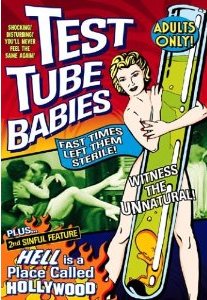
Review: Test Tube Babies (dir. by W. Merle Connell)


If I haven’t already made it clear in my previous reviews on this site, I love exploitation films.  Regardless of whether they’re blaxploitation or gialli or whether they’re about zombies or cannibals or just people looking for revenge, I love everything about them.  I love them because they’re shameless, they’re frequently incoherent, and occasionally, they’re works of pure (if fractured) genius. 

However, I have a special place in my heart for the old school exploitation films of the 1930s and 40s.  These are the exploitation movies that came out while the American film industry still operated under the puritanical production code.  While the mainstream film industry was still struggling with the idea of Clark Gable saying “damn” onscreen, the underground B-movie makers were making the movies that everyone saw but few people ever talked about.  These were low-budget movies, filmed on the cheapest stock available and often times edited with all the skill of a chainsaw-wielding maniac.  And while these movies were not necessarily impressive technically, they continue to serve as proof that even our elders occasionally enjoyed a dirty joke.

For the most part, these exploitation films were disguised as being public service announcements.  Hence, a film like Ruined Souls wasn’t just a movie about young people skinny dipping and having sex.  No, it was a warning about the dangers of venereal disease.  Typically, once the film had finished showing off all the bad behavior it could, an authority figure (usually a doctor) would show up and explain why those in the audience shouldn’t do any of the things they had just watched.  There’s a shamelessness to these old school exploitation films that reminds me why I admire panhandlers who go through the trouble to come up with an entertaining way to ask me for my money.

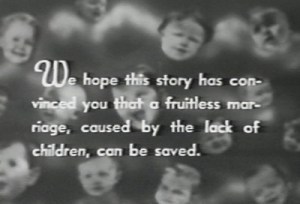
1948’s Test Tube Babies (directed by W. Merle Connell and produced by George Weiss, who would produce most of Ed Wood’s early films) is a typical example of an old school exploitation film.  Now the title might lead you to think that this is going to be another horror film about demonic children.  However, the exact opposite is true.  The message of Test Tube Babies (the film’s PSA) is that any marriage — regardless of how drab and dull — can be saved by forcing the wife to go through hours of excruciatingly painful labor.

The first half of Test Tube Babies plays out roughly like the 1st half of Revolution Road.  A boring young man named George meets a frumpy young woman named Cathy.  They’re attracted to each other and, since this is the 1940s after all, they get married so that they can have sex.  George and Cathy go on a whirlwind honeymoon.  They get a house in the suburbs.  George gets a job and Cathy settles into the life of being a slave (or “housewife,” as it was apparently known in the 1940s.)

However, is it possible that there is trouble in paradise?  Shortly after the honeymoon is concluded, we start to get hints that maybe Cathy isn’t entirely satisfied being an indentured servant.  At the breakfast table, Cathy and George talk about how boring their social life is.  When George’s womanizing friend Frank comes to visit, Cathy greets him in her nightie and proceeds to dance with him while a simmering George watches.  What’s wrong with Cathy?  Could it be that she’s suddenly realized that she’s surrendered her own identity just to be someone’s wife?  Perhaps it has dawned on her that marriage is really just a societal invention that’s designed to keep anyone from truly challenging the status quo.  Or maybe she just needs a child to give her an excuse to remain in a loveless charade of a marriage.

Regardless of the reason why, Cathy is clearly dissatisfied with her new life.  Soon, once George is off at work, Cathy invites all of her decadent friends over to the house for a party.  This party appears to be the 1940s version of a key party.  As Cathy plays hostess, Frank proceeds to make out with another man’s wife and then, from out of nowhere, an elderly lady with bleached blond hair shows up and starts talking about her former life as a burlesque dancer.  As Cathy watches in horror (no doubt wondering why she couldn’t have just listened to her husband like a good, dutiful slave), the dancer starts to dance and things quickly escalate until Cathy is finally forced to call George at work and beg him to come home.

One of the reasons I love these old school exploitation films is that they provide a chance to see what our grandparents considered to be risqué.   It’s a chance to peer into the repressed sexuality of our elders.  So, what can we learn from watching the party scene in Test Tube Babies?

1)  To judge from the leering reaction given to the frumpy clothing worn by the female guests, Sears was apparently the Victoria’s Secret of the 1940s.

2) The entire party sequence ends with a bizarre catfight between two women, over the course of which both women somehow end up naked.  This serves to prove that, much as I always suspected, men have always been the same.

In a plot development that was later shamelessly ripped off by Revolution Road, all of this suburban decadence leads to Cathy and George realizing how empty their “perfect” sham of a marriage really is.  Whereas Kate Winslet decided that this emptiness was linked to her sacrificing her own identity to be a wife, Cathy decides that the marriage is empty because she’s not yet a mother.  After all, what could be better than bringing another human being into the world for the sole purpose of justifying a failed marriage?  Never mind that neither George nor Cathy comes across like the type of people who could actually raise a happy child.  What’s important here is to go through the societal motions.

Cathy, of course, wants to get pregnant immediately because you know us women.  We’re just slaves to the old biological clock.  However, despite George’s best efforts, Cathy simply cannot get knocked up.  She wonders if maybe something’s wrong with her.  George is quick to agree that something could be wrong with her so, like any good American couple, they go to a doctor to specifically find out what’s wrong with the wife.

(Interestingly enough, just to judge from the movie’s dialogue and the fact that Cathy is shocked when told to undress before being examined, it would appear that this is not only the first time that she’s ever been to a gynecologist but perhaps the first time she’s even heard the term “gynecologist.”  To judge from this movie, apparently women in the 40s were simply locked up in the attic until some idiot came by and paid their dowry.)

It’s here that the movie takes a truly shocking turn as it is revealed that — gasp! — nothing is wrong with the wife.  Instead, George is sterile.  And this, of course, leads us to the whole concept of test tube babies and how they can even save the most pointless of marriages.

Now, the filmmakers obviously knew that this would a bitter pill for a 1948 audience to swallow so, in order to make sure we understand that this sort of thing actually does happen, we are introduced to Dr. Wright.  If for no other reason, see this movie for Dr. Wright.  With his oily hair, his ever-present smirk, and an equally ever-present cigarette, Dr. Wright is probably the creepiest gynecologist this side of Jeremy Irons in Dead Ringers.  As played by exploitation vet Timothy Farrell, Dr. Wright is the only character in the film to seem to realize that he’s surrounded by idiots.

In the great tradition of old school exploitation, Dr. Wright is used to explain and justify the concept of a test tube baby.  By doing so, Dr. Wright justifies and excuses all of the “decadence” that has previously been put up on-screen.  Dr. Wright also makes a good argument for the health benefits of cigarettes.  Seriously, I have never seen a doctor smoke as much as Dr. Wright.  Literally, his every scene is enveloped in a cloud of smoke.  He smokes while conducting a consultation, he smokes in between operations, and apparently he even smokes while conducting his examinations.  (Which reminds me of a story concerning an ex-boyfriend but the less said about that the better…)  Perhaps his best scene comes when, spying a nervous George in a hospital waiting room, Dr. Wright suggests that George “smoke a cigarette and relax.”  (“I’ve already gone through two packs!” George replies and everyone shares a cancerous laugh.)

In the end, what can you really say about this odd little time capsule?  As far as old school exploitation is concerned, it’s not a classic in the way that a movie like Reefer Madness is.  Still, the movie holds a strange fascination for me.  Some of it, of course, is the whole “so-good-that-its-bad” factor.  This movie has that in spades.  However, I think an argument can be made that movies like Test Tube Babies provide a view into the American subconscious that more mainstream films simply can not.  Freed up from the confines of the Hollywood production code, the old school exploitation movies could give the people what they wanted to see as opposed to what they felt they should want to see.

Perhaps that’s the real appeal of a movie like Test Tube Babies.  Its proof that people were fucked up before any of us were born and that they’ll continue to be fucked up long after we’re gone.

Then again, perhaps I’m just reading too much into an amusingly bad B-movie.

Perhaps it would be best to give the movie the final word…

6 Exploitation Film Trailers That I Love


The only thing I love more than a good exploitation film is a good exploitation film trailer.  I’ve been known to buy Anchor Bay DVDs of films that I hate just to see what trailers will be included in the extras.  Often times, when I find myself suffering from writer’s block, I cure it by watching 42nd Street Forever.

Below are 6 exploitation film trailers.  They are six of my personal favorites though I could easily list 666. 

Enjoy!

1) Teenage Mother (1967)This trailer (if not the actual film, which is pretty dull) is pure exploitation perfection.

2) They Call Her One Eye (1974)They Call Her One Eye is the American title for a Sweedish film called Thriller, A Cruel Picture.  It’s an appropriate title but its also one of the best movies ever made in the history of cinema.

3) Ms. 45 (1981)I love this movie.  Whenever I break up with a boyfriend or just find myself annoyed with men in general, this is the movie that I end up popping into my DVD player.  Consider yourself warned. 🙂

4) The House With The Laughing Windows (1976) This giallo, directed by Pupi Avati, is probably one of the best films ever to come out of Italy period.  The trailer only begins to hint just how girm, dark, depressing, disturbing, and downright odd this little gem really is.

5) Starcrash (1979) — Starcrash was Luigi Cozzi’s attempt to cash in on Star Wars.  For what its worth, Starcrash is actually a lot more fun and, as played by Caroline Munro, intergalactic priate Stella Starr is actually one of the few truly strong women to appear in Italian exploitation cinema.  (The next Halloween party I’m invited to, I’m going to go as Caroline Munro in Starcrash.)  The special effects pretty much define the whole concept of “That’s a great movie when you’re stoned.”

6) Spasmo (1974) Our final trailer is for that rarest of things, a good movie directed by Umberto Lenzi. 

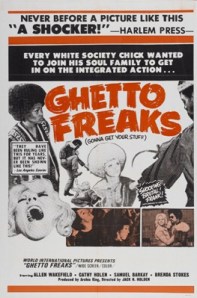
Review: Ghetto Freaks (dir. by Robert J. Emery)


During my freshman year of college, my roommate Kim often used to tell me that we were born several decades too late.  If only, she often lamented, we could have grown up in the 1960s and been part of that legendary counter-culture.  Her logic was that we both considered ourselves to be anti-establishment, we both felt society needed to be changed, and we both liked to get high on occasion.

I can see her point but honestly, I would never had made it as a hippy or, for that matter, even as a quasi-hippy.  For one thing, I hate being outdoors.  I’ve got too many allergies and crickets freak me out.  While I support free love, I don’t support practicing it with people who don’t shower on a regular basis.  I’m not going to argue with any woman who feels the need to burn her bra but quite frankly, I don’t want to wake up one day and discover that I can touch my boobs with my big toe.  Actually, that whole idea of running around day after day without any underwear on is just gross.  I don’t even want to think about it.

So, no, I could never have been a member of the 60s counter-culture.  But that doesn’t mean that I can’t watch the hundreds of films — some well-known but most incredibly dated and obscure — that have been made about and during that era.  Indeed, whatever knowledge I have the 1960s pretty much comes from my movie collection and movies like Ghetto Freaks.

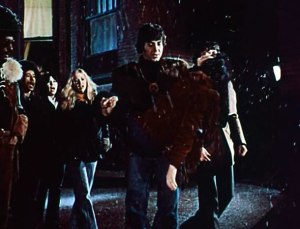
The production history of Ghetto Freaks is rather obscure.  Just to judge from the clothes and the dated lingo, it was originally filmed in 1969 or 1970.  The film, which is nearly plotless, was shot in Cleveland, Ohio.  I’ve never been to Cleveland (or Ohio, for that matter) and Ghetto Freaks — with its cold and gray urban landscape — hardly makes it look inviting.  Still, the fact that it was shot on location and that no attempt was made to hide the decay there, does bring an unexpected rawness to the movie.  Whether it was by intention or just the result of a low budget, director Robert Emery does manages to make the film’s ugliness oddly compelling.

The movie opens up with a bunch of hippies talking to a bunch of older people.  If you’ve seen any of the protest films of the 60s or 70s then you’ve already seen this scene a hundred times.  The hippies are told to get haircuts.  The hippies make the standard response about Jesus having long hair.  Fortunately, the cops arrive before the scene turns into the 2nd act of Bye Bye Birdie

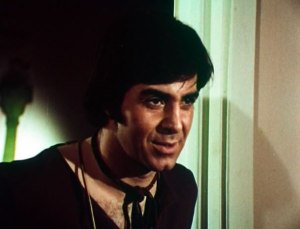
This is the 1st of many awkward, predictable scenes in Ghetto Freaks.  Fortunately, this movie was smart enough to follow its bad scenes with good ones.  So, once the pigs have released him, the head of the hippies (a ruggedly handsome former drug dealer named Sonny) spends his night hanging out at a rather dingy club.  

How to describe the Club Sequence?  Well, you really have to see it to understand why I can’t get it out of my head but it all comes down to the a rather hyperactive singer who performs at the club.  This singer performs two songs.  The first features the immortal lyrics “My name is Mousey and I feel lousy.”  The second is an odd cover of the MC 5’s seminal “Kick Out The Jams,” (though, in the film, the song is kicked off by the singer shouting “Kick out the jams, brothers and sisters!” as opposed to the actual “Kick out the jams, motherfucker!”)  The two musical performances are energetic and — as opposed to the earlier “protest” scene — entertaining to watch and the singer’s flamboyance contrasts interestingly with the club’s drabness.

Of course, there’s more going on in the bar than just the music.  Sonny talks to the other members of his hippy commune.  He also turns down a chance to return to his old career of dealing drugs on the street.  These conversations have a rather nice, breezy air to them.  For the most part, the actors all give surprisingly natural performances and the dialogue — no longer full of platitudes — is occasionally even memorable.

One other important thing happens at the bar.  Sonny spots a pretty young woman named Diane who is fighting with her obviously upper class parents.  Sonny finds the time to invite her to drop by the old commune before she is dragged away by mom and dad.

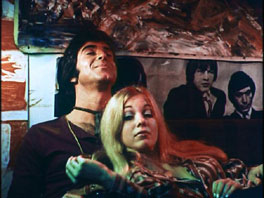
Later that night, Diane makes her way to the hippie pad currently occupied by Sonny and 14 other hippies.  She and Sonny have a long talk about why Sonny and friends live the way that they do.  And I do mean long.  The conversation seems to drag on forever and it doesn’t help that everything Sonny says is a platitude along the lines of “War is bad for children and other living things.”  Fortunately, this scene is made barely tolerable by the fact that Sonny and Diane are both played by likable performers.  Sonny’s has a rugged charisma about him and Diane comes across as sincerely nice.  I haven’t ever seen either one of these actors (or for that matter, anyone in Ghetto Freaks) in any other movies and that’s a shame because the movie does boast some memorable performances.

Anyway, even as Sonny explains his world view to her, Diane is dropping acid for the first time.  Naturally this leads to a huge orgy in which the members of the commune dance around naked while Sonny and Diane make love on the floor.

(I have to admit I got a little bit jealous of Diane here because, back when I used to do that sort of thing, I never had a trip that resulted in an orgy.  I saw my face melting occasionally but never an orgy.  It makes me wish I had a “I Dropped Acid and All I Got Was A Lousy Flashback” t-shirt.)

As you might guess, the Ghetto Freaks orgy is the film’s best known scene.  Along with all the nude hippies dancing (and, credit to the film, all the hippies are seen nude and not just the females), we also get a lot of dark blue lighting and psychedelic music playing the background.  While undeniably erotic, there’s also something rather disturbing about the whole scene.  First off, with all the weird camera angles and nude onlookers, the scene immediately made me think about the Satanic “dream” sequence from Rosemary’s Baby.  Secondly, seen today, it’s painfully obvious that the film’s hero is essentially taking the virginity of a girl who has been drugged. 

Oh, there’s one other interesting thing about the orgy sequence.  Are you wondering yet why this movie about a bunch of white hippies is called Ghetto Freaks?  Well, it’s because of what happens towards the end of the orgy.  Suddenly, we’re no longer watching Sonny rape Diane while a bunch of nude hippies dance.  Instead, we’re confronted with the image of a tall, glowering black man who handles a knife while several women we’ve never seen before parade past him.  I don’t know how to explain just how odd and jarring this two-minute sequence is.  Beyond the fact that we’ve never seen any of these characters before (and we won’t see them after), the scene itself is obviously shot on completely different film stock from the rest of the movie.  The only thing that connects it to anything we’ve seen before is that droning orgy music which continues to play (albeit in rather muted form) in the background.  Yes, this sequence was inserted into the movie after it had already been filmed.  The producers, obviously wondering how they’d ever make their money back, inserted this scene featuring this unnamed black man so that they could then market this nearly entirely white film as a blaxploitation film.  That man and his “followers” are the Ghetto Freaks of the title and they’re in the film for all of two minutes.

Following the orgy, we are treated to a day in the life of a hippy commune.  Diane accompanies Sonny, Mousey, and the whole gang on a day full of passing out an underground newspaper, panhandling, and getting harassed by the pigs.   Meanwhile, the neighborhood drug dealers, angry that Sonny won’t agree to push their drugs, are plotting their own revenge on our counter-culture Adonis.  If you think all of this eventually leads to a tragedy you can see coming from miles away, you’re right.

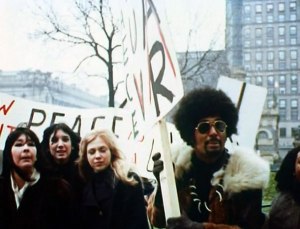
Even though it’s hard (actually impossible) to top a drug-induced orgy sequence, the second part of the film does feature two memorable scenes.  The 1st one features the members of the commune (what should one call them?  Communers, maybe?  Communists?) standing out in the street, trying to convince people to give them money for copies of a free, underground paper.  Shot in a documentary,cinéma vérité -style, this scene is appears to unscripted and features the cast interacting with actual human beings.  As such, the reactions (most negative but some surprisingly positive) are authentic as opposed to idealized.  The cast themselves turn out to be surprisingly skilled at improvisation and this sequence features the film’s best dialogue (which could be considered back-handed praise when you consider that the scene was unscripted).  It helps that the scene was obviously shot on a very cold day and the cast was obviously suffering for their “art.” (Diane, in a surprisingly endearing moment, keeps asking people to look at how blue her frozen hands are.)  I’m not a big fan of panhandlers in general but this film does succeed in making it look like very hard work.

The 2nd sequence occurs at the end of the film, even as the end credits are rolling.  If the panhandling sequence represents the best of Ghetto Freaks, this 2nd sequence represents, perhaps, the worst.  Following the film’s sudden violence of the movie’s “tragic” conclusion, the actors suddenly go from grim-faced to smiling like a bunch of Broadway understudies who have just learned that the entire cast of the latest Grease revival was aboard a plane that crashed while landing.  They start hugging each other (except, of course, for the character who dies at the end of the film.  She just keeps lying there on the sidewalk) and giving each other high fives as the camera pulls back to reveal — yes, you guessed it! — the movie’s director and his crew.  There’s a forced whimsy to this and it’s hard not to imagine the director smirking as he talks about how much he loves Jean-Luc Godard.  Reminding the audience that they’re actively watching a movie (as opposed to reality) was, of course, one of the French New Wave’s major contributions to the language of cinema.  Unfortunately, in Ghetto Freaks, it just feels like a forced attempt at trendiness.  (If Ghetto Freaks was made today, it would be in 3-D.)

As I stated previously, my entire knowledge of the 60s counter-culture pretty much comes from how it was depicted in the movies of the era.  One of the things that I’ve always found interesting about these movies is that, regardless of whether the movie is a classic like Easy Rider or a big budget misfire like Getting Straight or even a Roger Corman B-movie like Psych-Out, they are all essentially so middle class in their attitude towards women.  Again and again, the message of many of these films seems to be that everyone should be allowed to “do their own thing” as long as they don’t have a vagina.  However, those of us who do were continually portrayed in much the same way that we were portrayed in almost every film released before and after 1967.  To be female means that you can either be worshipped or you can be punished but never dare to be an individual.  (For the most obvious example of this, check out Getting Straight, a film in which activist Elliott Gould pretty much spends two hours screaming at Candice Bergen for daring to have opinions of her own.)

This is a trend that continues in Ghetto Freaks.  For all the talk about how Sonny and his commune are all about freedom and allowing people to be themselves, it doesn’t change the fact that the female members are pretty much there to be pretty and sexually available to whoever wants them for the night.  Diane is accepted into the group not because she rejected the values of society but because she has sex with Sonny.  Add to this a scene earlier in the film in which our hero Sonny jokes about how his best friends “big-titted” sister was raped by a black man (“She was asking for it,” Sonny assures her brother who eventually agrees) and you end up with a very contradictory message.  I don’t necessarily have problem with the characters themselves being sexists.  To be honest, I prefer an honest sexist to a liberated liar.  What’s annoying is that this movie, like a lot of other so-called “counter-culture” films, does not seem to be aware of the double standard.

In true exploitation film-tradition, Ghetto Freaks was released and re-released under several different names.  Seeing as how much of the film plays out like a community theater production of Hair, the film originally had the much more appropriate title of The Age of Aquarius.  When that title didn’t exactly work wonders, the film was retitled The Love Commune.  Again, this was an appropriate (if rather banal) title that failed to attract an audience.  Finally, the film’s producers spliced that footage into the middle of the orgy scene and, hoping to appeal to the blaxploitation audience, renamed the movie Ghetto Freaks.

And it worked.

When it comes to exploitation, freaks will beat lovers any day.

Ghetto Freaks was released on DVD by one of my favorite companies, Something Weird Video.  As is typical with SWV, the DVD is actually a double feature.  The second movie is an earlier, drug-centered movie called Way Out.  Technically, it’s a far better movie than Ghetto Freaks but it’s also a lot less fun.

Review: Grindhouse (dir. by Robert Rodriguez and Quentin Tarantino)


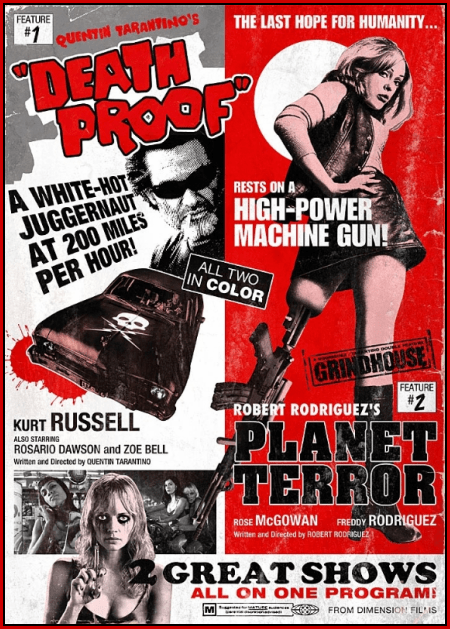
Robert Rodriguez and Quentin Tarantino have always professed to anyone within hearing distance their extreme and fanboyish love for the grindhouse days of filmmaking. Both directors’ resume of work look like a modern grindhouse films but with better writing, effects and directing. Anyone who grew up watching grindhouse film’s of the 70’s and 80’s can see it’s heavy influence on films such as From Dusk Til Dawn, Desperado, Pulp Fiction and Kill Bill. With 2007’s Grindhouse, both Rodriguez and Tarantino take their fanboy love for all things grindhouse and exploitation to a whole new level with personal take on the cheap John Carpenter-knock offs, zombie gorefests, slasher film and revenge-driven flicks that made being a young kid during the 70’s and 80’s quite enjoyable.

For those who do not know what grindhouse films are they’re the ultra-cheap and, most of the time, very bad, shlocky horror, revenge, softcore porn, badly-dubbed kung fu flicks and a myriad of other B- to Z-grade movies. These movies were shown in dingy, decrepit (usually former burlesque stagehouses) movie houses which showed double to triple-bills of titles for a low, cheap price all day long (where the popcorn and concession snacks were as stale as week-old coffee). These places and their films were book-ended by the cheap drive-in theaters which grew out of the suburban sprawl boom era of the 60’s and 70’s. One could not avoid the fact that the projector equipment were in bad shape and in desperate need of maintenance while the films played out. Then there’s the film reels themselves with their washed out sequences, out of focus scenes, burnt-in spots and missing film reels where the sex scenes would’ve been. This was the grindhouse experience and with the rise of Hollywood as a corporate entity even moreso than it’s been in the past and urban renewal projects by big city leaders, the grindhouse experience has pretty much faded away and kept alive only in the memories of its fans worldwide.

What Robert Rodriguez and Quentin Tarantino have cranked out with their three-hour long opus to those grindhouse days has been both a literal and thematic homage to an era long since gone. Grindhouse also has allowed Rodriguez and Tarantino to pull out all the stops in filming their respective halves of the film. Rodriguez went all-out in paying literal homage to the zombie gore-fests of George A. Romero, Lucio Fulci and Umberto Lenzi. Planet Terror plays like a hodgepodge of all the zombie movies from these masters of the walking dead but Rodriguez has the use of digital effects to match the over-the-top feel of the past zombie-fests without making the effects look too cheap.

The story for Planet Terror is quite simple yet full of so many incoherent subplots that trying to keep track with whats going on would just confuse a viewer even more. Rodriguez gets the grindhouse feel with such a ludicrous storyline. Whether it was done on purpose or not, the feeling of confusion in addition to the non-stop zombie action was only compounded even more by the digitally-added film stock scratches, burns to the edges of the reel and when the movie was about to get all hot and sexy, missing reel footage. Anyone who watched movies in grindhouse theaters would recognize the look quite well. Rodriguez goes all out in letting his zombie fanboy out. The violence in Planet Terror begins strong and just gets stronger and even more over-the-top right up to the final frame. Zombie’s getting their heads blown apart is shown in scratchy, loving detail with an impossible amount of blood, bone and brain for people to gawk at. The female characters are hot and sexy. Rose McGowan as Cherry Darling holds Planet Terror together with her spunky go-go dancer dreaming to be a stand-up comedienne turning into Ellen Ripley minus a leg but gaining an M16A3 w/ M203 grenade launcher as a leg prosthetic. Freddy Rodriguez as El Wray, her wayward and mysterious lover, almost seem to be channeling a hilariously bad version of Snake Plissken. These two make for quite the explosive couple as they must try and save their small Texas town from the infected townspeople turned pus-oozing, boil-ridden zombies.

Planet Terror sports a nice collection of current B-list actors like Josh Brolin (making like a Nick Nolte at his growliest) and Marley Shelton as a pair of married doctors with marital problems compounded by the increasing amount of zombies their hospital seem to be bringing in for medical help. There’s also genre veterans Michael Biehn, Jeff Fahey and Tom Savini to give Planet Terror the appropriate grindhouse look and feel to it. Ever the good friend and buddy collaborator, Rodriguez even gives Quentin Tarantino a role in his half of the film. He’s shown in the credits for Planet Terror as The Rapist. If any director seem destined to be one, if their love for movies didn’t steer them on the right path, Tarantino seem to look just like one to be called “Tha Rapist”.

There’s explosion and gore galore in Rodriguez’s ode to the zombie genre. Some who sees it might say there’s too much and they would be right if the title of the whole film wasn’t Grindhouse. I, for one, am glad Rodriguez decided to not hold back with what he threw onto the screen. I’m sure that when the dvd finally comes out and the unedited full version of Planet Terror is shown it’ll even surpass the 85-minute running time in the film. I think I can forgive Rodriguez for his gore excess and at times I actually wished for more, but then that would mean taking even more time before I get to Tarantino’s half of the movie. Planet Terror truly got the look of a grindhouse flick, but it’s Tarantino’s Death Proof half which got the spirit of grindhouse down to near-perfect.

Before Tarantino’s Death Proof half of Grindhouse begins the audience gets treated to a sort of intermission involving three fake trailers for movies which celebrate just how ridiculously fun grindhouse movies really were during the 70’s and 80’s. There’s Rob Zombie’s Werewolf Women of the SS which was this weird mish-mash of the women-in-prison flicks with that of the infamous Ilsa: She-Wolf of the SS films that brought about the exploitation in grindhouse. This trailer was great just for the inspired casting of Nicolas Cage as Fu Manchu and Sybil Danning as one of the so-called SS women werewolves. There’s also Edgar Wright’s fake trailer for Don’t (director of Shaun of the Dead and Hot Fuzz) which parodies the trailers for all the gothic, European haunted and horror movies where none of the actors in the trailer speak a word to make sure the film doesn’t get labeled as a “foreign film”. But it’s the third trailer in that intermission trio which had everyone in the audience reacting wildly.

Eli Roth’s Thanksgiving is a throwback to the seasonal-themed slasher flicks like Black Christmas but this time turns the yearly, turkey day and Pilgrim celebration into a trailer with some of the most disturbingly inventive scenes for a fake slasher movie. I don’t know what the Pilgrim serial killer was doing with that turkey at the end of the trailer but I’m sure it will have many people talking about it afterwards. It’s this Eli Roth trailer which fully captures the gritty and gratuitious nature of what makes a grindhouse horror movie. It’s also the one fake trailer I hope Roth would re-visit and turn into a full-length movie.

Now, with the trailers out of the way, Tarantino’s half of Grindhouse begins and we’re treated to a different take on the grindhouse experience. Death Proof begins as if it will continue Rodriguez’s literal examination and homage to the grindhouse experience, but after messing with the film’s focus, adding a few film scratches to the celluloid and even adding a missing reel gag, Tarantino suddenly slows all those grindhouse trickeries and actually ends up making a rip-roaring slasher-revenge-carchase flick. Tarantino takes one part slasher movie adds in a heavy dose of his own Reservoir Dogs (the talking between the female characters in Death Proof are as foul-mouthed and trivial as the diner scene in Reservoir Dogs) then mixes in equal amounts of Vanishing Point, Faster Pussycat! Kill! Kill! and I Spit On Your Grave. Instead of just mimicking these particular grindhouse classics, Tarantino uses his own flair for extended dialogue to slow down the pace of the film thus lulling the audience for the two pay-offs which happen in the middle and the end of Death Proof. Tarantino’s half of Grindhouse could’ve went nowhere with all its estrogen-laced talkies, but Kurt “I AM SNAKE PLISSKEN” Russell really saves the day once he makes his appearance as the automotive-themed serial killer, Stuntman Mike. Where Jason uses farming and bladed implements as his tool of the serial killing trade, Stuntman Mike uses both a 1971 Chevy Nova SS and a 1970 Dodge Charger R/T 440 as his weapons of choice. Both vehicles have been made death proof for filming violent car stunt sequences, but in order to appreciate it’s unique life-saving properties then one has to sit where Mike sits.

Kurt Russell can now add Stuntman Mike to his classic list of badass roles. Mike would feel quite welcome amongst the like of Snake Plissken, John J. MacReady, and Jack Burton to name a few of Russell’s classic characters. Mike comes across as cooly and slickly dangerous, yet not psychotic. His charm is quite disarming until it turns deadly. He really takes the slasher-character stereotype and turns it on its ear. Death Proof once again shows that when Tarantino gets to work with one of his boyhood idols he really gives them a role that they could sink their teeth into.

Death Proof captures the spirit of what makes a grindhouse exploitation film. Even with the heavy references to Vanishing Point, especially with a white 70’s Dodge Challenger used just like in that movie, Tarantino still injects his own brand of craziness to the whole movie. I know many who have complained that Death Proof was too much talk with only the car chase in the end being the saving grace. I politely disagree and say that it’s that very long periods of dialogue between the women in Death Proof that brings some of the spirit of grindhouse to the story. Many forget or don’t remember that most grindhouse cheapies had so much extraneous dialogue to hide the fact that the budget was low to none when the movies were being made so they had to fill-up the movie’s running time with as much nonsensical dialogue before the big effect shots payoff.

The final chase-scene between the Russell’s Stuntman Mike and the female-trio of Rosario Dawson, Tracie Thoms (channeling Jules from Pulp Fiction) and real-life stuntwoman Zoe Bell (she doubled as Uma Thurman in the more dangerous stunts in Kill Bill) has to go down as one of the craziest, whiteknuckling, barnburning car chase sequences of the modern times. No CGI-effects trickery and fancy MTV-style editing was used. George Miller, John Frankenheimer and Richard Sarafian would be proud of what Tarantino was able to accomplish with Death Proof‘s 20-minute long car chase. By the time Death Proof ends the audience have bee put through the wringer and one was hard-pressed not to cheer and root for Stuntman Mike even though we know we shouldn’t. Death Proof proves that “hell hath no fury like a woman scorned” or at least a trio of women endangered.

Grindhouse is a film not for everyone. There’s going to be quite a few people who won’t “get” the film homages and references by both Robert Rodriguez and Quentin Tarantino. Some would say that the movie was too over-the-top, badly made and just out there, but then they would be missing the point of the whole project altogether. For those who grew up watching these kind of films as kids and teenagers, it’s a belated Valentine’s gift from two fanboy filmmakers who finally were able to do the films they grew up idolizing and enjoying. For the rest who are not as well-versed in the grindhouse cinema, this is a good enough starter before they move on to try the classic ones which are now on video (I would suggest they find a worn-out VHS copy of it instead of the cleaned up DVD version). The film is over three-hours long, but one who goes in really can’t say that they didn’t get their money’s worth when they went in to watch Grindhouse.

10 Reasons Why I Hated Avatar


(The opinions in this review are mine and mine alone.  They reflect the feelings of Lisa Marie Bowman and not the feelings of any other editor on this site.  To prove that the opinions below are solely mine, check out this very positive review of Avatar that was posted on this very site last December.)

In case you didn’t already know this from my previous reviews, I’m going to confess something here.  I hated Avatar.  It was probably my least favorite film of 2009.  How much did I hate Avatar?  Well, I didn’t care much for The Hurt Locker either but I still cheered when it won best picture because it meant that Avatar didn’t. 

Most of my friends and family loved Avatar and, I’m proud to say, that none of them have allowed our difference of opinion to effect our relationship.  Indeed, most Avatar fans have been very tolerant of my dissenting views.  However, there’s always an exception.  From the 1st time I ever openly admitted to disliking Avatar, I have had to deal with a small but vocal group of people who not only disagree but apparently feel that I’ve committed a crime against humanity.  So, why bring it up now?  Because on Thursday, Avatar is going to be released on DVD and Blu-ray.  In honor of that event, here are 10 reason why I personally hated Avatar

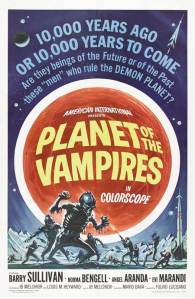
1) Ironically enough, most people who love Avatar will probably agree with the majority of my criticisms.  They’ll argue that yes, the story is predictable and yes, James Cameron is heavy-handed as both a writer and a director but none of that matters because of all the brilliant visual effects.  They’ll argue that Cameron made a whole different world, Pandora, come to life.  To a certain extent, they’re right.  Cameron does manage to make Pandora believable and wow, Pandora certainly turns out to be a boring planet.  Seriously, does that jungle cover the entire freaking planet?  However, regardless of my personal feelings about Pandora, James Cameron is hardly the 1st director to make an alien world believable.  Peter Jackson did it with his Lord of the Rings trilogy and the same can, arguably, be said of the Narnia films.  Even earlier, Mario Bava did it with Planet of the Vampires and he did it with a lot less money.  Of course, none of these films were in 3-D but so what?  Just because the mundane appears to be inches in front of your nose doesn’t make it any less mundane.
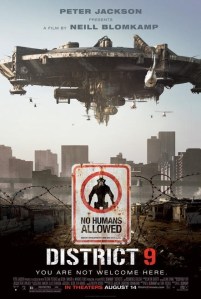
2) Speaking of mundane, wouldn’t you be let down if, when you first met the members of a totally alien race, they all turned out to be a bunch of movie stereotypes?  The Na’vi appear to have developed their entire culture as the result of a steady diet of Hollywood westerns, New Age self-help books, and some 16 year-old’s half-assed understanding of what it means to be a Pagan.  I remember when I first saw Avatar, it was impossible for me not to compare it unfavorably with District 9, a film that addressed many of the same themes and issues as Avatar but did it with a much lower budget and a much more intelligent script.  This was especially evident when one compares Avatar’s Na’vi with District 9’s prawns.  While the prawns were believable as both individual characters and as representatives of a totally alien race, the Na’vi are essentially the reflections of James Cameron’s sophomoric noble savage fantasies.

3) District 9 wasn’t the only great science fiction film to come out in 2009.  There was also Moon, which featured a great performance by Sam Rockwell and excellent direction from Duncan Jones.  When /Film asked Jones for his opinion of Avatar, Jones replied, “…at which point in the film did you have any doubt what was going to happen next?”  It’s a good question. 

In all honesty, I’m a horror girl.  I haven’t seen much science fiction and therefore, I’m not as well acquainted with the genre’s clichés as I am with horror.  However, I can still say that, at no point, did anything that happened in Avatar take me by surprise.

Of course, some of my favorite movies were (and are) very predictable.  Georges Polti argued that there were really only 36 basic plots available to use in fiction so its understandable that you’re going to come across the same one used several times.  However, a predictable plot can be forgiven if maybe that plot features at least a few interesting characters or maybe an occasional unexpected line of dialogue.  Avatar, however, can’t even manage this.  Our hero is an impulsive man of action.  The villains are all evil because … well, they just are.  In the manner of most oppressed races in American film, the Na’vi are noble savages who require a white guy to come save them.  The only lines of dialogue that I remember are the ones that made me roll my eyes.  I’m talking about stuff like a bunch of 22nd century marines being greeted with “You’re not in Kansas anymore.”  Well, that and “I see you,” which was apparently included in the script so that it could serve as the title of a syrupy theme song.

4) Strangely enough, even though the movie took absolutely no narrative risks, it was still full of plot holes and things that just didn’t make much sense. 

For instance, why does Quaritich promise to give Jake back his legs (“your real ones”)?  I mean, does Quaritich have them sitting in a freezer somewhere? 

As part of his deal with Quaritich, Jake agrees to make videos about the Na’vi.  Oddly enough, it appears that he’s still making the videos even after he turns against Quaritich and you have to wonder exactly why.  Also, Jake records many of these videos in an isolated, apparently one-room outpost occupied by him and two other scientists yet the scientists are later shocked and outraged when told that Jake was making the videos.  Okay, what did they think he was doing all that time?  Were they just not listening to what he was saying? 

What exactly was the backstory of Sigourney Weaver’s character and when exactly did she join Sully in the Na’vi camp?   And why were the Na’vi willing to let her into their tribe when they would only grudgingly accepted Sully even after the Goddess selected him?  I mean, if Weaver already had such a great relationship with the Na’vi, it seems like she could have saved a lot of time by just taking Sully straight to them.  (Editor’s Note: According to the comments below, this issue actually was addressed in the film. — LMB)

Sully, after the final battle, decides to stay on Pandora and he might as well since the Tree of Souls (good God!) transferred his soul into his Na’vi body.  But what’s in it for Max and Norm?  We seem them at the end (though really, Norm should be dead) standing there pointing guns at all the humans that are leaving.  Norm, at least, could still probably hang out in his avatar but what about Max?  Why is Max, who has had nothing to do with Na’vi, so quick to join the revolution?

I’m sure a lot of this is because scenes were edited out and I know that Cameron has a reputation for reinserting those scenes once his movies come out on DVD and blu-ray.  Well, more power to him.

5) The film suffers from a really bad case of the white man’s burden disease.  This is another one of those films where a caucasian character befriends an oppressed minority and, with remarkably little dissent, manages to appoint himself as the leader of that minority.  It’s a fantasy, one in which members of the bourgeoisie (like James Cameron) can live out their childhood fantasies of being outlaws without having to worry about  (unlike actual “outlaws,”) being punished for taking their stand.

Once again, it’s hard not to compare Avatar with District 9.  Both of them feature lead characters who are transformed into aliens.  The difference is that, with the exception of one brief scene, Jake Sully accomplishes the transformation rather easily and quickly becomes the best Na’vi there is while in District 9, poor Sharlto Copley is terrified by the process and, even though it does lead to him understanding the prawns (and ironically, learning how to show a little humanity), the movie never pretends that Copley isn’t losing his own individuality in the process of transforming.
6) The lead character is named Jake Sully.  Did James Cameron get frustrated and just use a Random Generic Movie Hero Name Generator to come up with that?  I wonder if Nick Sully was Cameron’s 2nd choice.  It’s not that there’s anything wrong with either name.  It’s just that it feels so generic.  Of course, the leader character is going to be named Jake and, of course, he’s not going to be an intellectual and, of course, Sigourney Weaver’s going to spend the whole movie making sarcastic comments about how stupid he is.  Speaking of which…

7) Sigourney plays Dr. Grace Augustine.  Her character and her performance are typical of a rather annoying Hollywood tradition, that of portraying any “strong” female as a total and complete bitch.  If you want the audience to know they’re supposed to take a woman seriously, have that woman spend the entire movie pissed off about something, as if the only way a woman can be strong is by sacrificing anything that might make her unique.  Now, there’s a lot I could say about why, from a cultural perspective, American movies often seem to be so conflicted about how to portray any woman who is neither an Eve nor a Lillith.  But in the case of Avatar, its hard not to feel that it comes down to screenwriter Cameron’s inability to make any of his characters interesting unless something nearby is exploding.

8 ) And while we’re on the subject of misunderstood women…okay, let’s say you discover a planet and this planet is a lush, beautiful paradise.  Why the Hell would you then call it Pandora?  Yes, I understand that newly discovered planets are usually named after mythological figures.  But there’s still usually some sort of vague logic behind the names.  For instance, Mars was named after the God of War because of its red hue.  Venus was often considered to be the most beautiful star in the sky.  Mercury has the fastest orbit.  Jupiter’s the biggest planet.  Pluto (before it got downgraded) was considered the darkest and coldest of the planets.  Pandora, however, was the woman who opened up the jar that released everything terrible, evil, and destructive into the world.  Why would anyone name a planet after her?  It’s possible, of course, that all the good names were taken.  Of course, it’s also possible that this is just another example of how thuddingly obvious Avatar is in its symbolism and subtext.

9) Speaking of obvious, what about the villain played by Stephen Lang?  More specifically, what about that accent?  It’s true that Cameron doesn’t exactly encourage his villains to be subtle.  Just check out Billy Zane in Titanic.  Zane, however, at least appeared to be having a little fun at his director’s expense.  He, alone among the cast, seemed to realize that Titanic was a silly melodrama and so he gave something of a silly performance.  It’s no great secret that it’s often more important to have a good villain than to have a good hero.  A good villain usually has some sort of motivation beyond just being the villain.  This is something that Cameron has never seemed to be able to grasp.  Whenever I see a military figure show up in a James Cameron movie, I get the same feeling that I get whenever a preacher shows up in a Stephen King novel.  Automatically I know that they’re going to turn out to be evil and I find myself dreading having to even waste the time with the “shocking” discovery of that evil. 

10) Perhaps most importantly, this is a movie that wants to preach peace but celebrate war.  Avatar contains all the trendy environmental messages that you’d expect from a Hollywood film but — even though director Cameron seems to be in a state of denial about it — the film’s heart is with its villanous soldiers.  Much as how Titanic, for all the rhetoric about the passengers in third class, was really only interested in portraying the lives (and deaths) of those in first class, Avatar spends a lot of time talking about trees but is much more interested in blowing them up with the destruction of the Home Tree serving as the money shot.

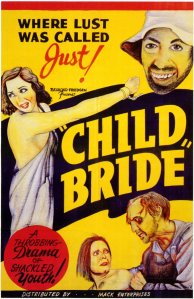
To be honest, I don’t mind a little hypocrisy when it comes to movies.  Most exploitation films celebrate hypocrisy.  The filmmakers knew it and, for the most part, the audiences knew it.  The fact that a movie like Child Bride could be advertised as “an important movie every parent must see!” became something of a shared joke between the filmmaker and his audience.  Rather than being hypocritical, the exploitation filmmaker is simply inviting his audience to join in a conspiracy against the forces of dullness.
Unfortunately, Avatar is not an exploitation film.  If Avatar was simply a B-movie, none of the my previous complaints would matter.  They would add to the film’s rogue charm.  Avatar, however, is too expensive to be considered an exploitation film.  And James Cameron, as he proved when he went ballistic over Kenneth Turan’s negative review of Titanic and as he has continued to prove with his recent comments regarding global warming, does not have the sensibility of a B-movie maker.  Arguably, he once did.  This is a man who, after all, did the special effects for Galaxy of Terror and made his directorial debut with Piranha IIThe Terminator was a great B-movie, right down to the accusations of plagiarism from Harlan Ellison.  However, as he’s become the most financially succesful director in history, Cameron has lost that B-movie sensibility. 

In other words, James Cameron takes himself seriously now and that, ultimately, is the main reason I hated Avatar.  It just takes itself too damn seriously.

Yes, I’ve read quite a few favorable reviews that have argued that Avatar‘s sole purpose is to entertain and that people like me who occasionally expect unique characters and an interesting story should just lie back and enjoy it.  I’ve seen the term “popcorn epic” used in quite a few reviews. 

I’m sorry but I’m not buying it.  If Avatar was truly setting out to be a “popcorn epic,” than I’d be a lot more willing to cut it some slack.  However, when the script contains lines about how on Earth, humans have “destroyed all the green,” and when the villains are accused of launching a “shock and awe” campaign, it’s ludicrous to then argue that Avatar isn’t setting itself up to be judged by a higher standard. 

It becomes hard to escape the fact that Cameron, regardless of how well he handles the special effects, has essentially made a stupid movie about deep issues.

As I said before, the majority of the people I know love Avatar.  I don’t hold it against them or think any less of them because, ultimately, movies are a subjective experience.  Whether or not a movie is good has less to do with the actual movie and more to do with the person watching it.

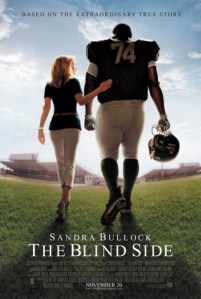
It would be nice to have the same courtesy extended to me .  Since I first revealed my opinion of Avatar on a non-Avatar related message board, I have found myself frequently attacked by little fanboys who apparently cannot handle the fact that one human being didn’t enjoy Avatar.  I’ve been told that, as a female, I can’t be expected to understand Avatar.  I’ve been accused of being “unimaginative,” “a snob,” “a bitch,” and my personal favorite “the type of cunt who cried at the end of the Blind Side.” 

I realize the risk I’m taking by openly admitting my dislike of Avatar but then again, movies are supposed to inspire conversation and not just pavlovian agreement.  So, in conclusion, I’ll just admit that yes, I am female and yes, I did cry at the end of The Blind Side, and yes, I hated Avatar.