The TSL Grindhouse: Grizzly (dir by William Girdler)


In 1976’s Grizzly, something is making a national park a lot less inviting.

Campers are turning up dead.  Bloody body parts are being found buried underneath leaves.  It’s obvious that a bear is to blame but reports seem to indicate that this isn’t just any bear.  This is a super bear, standing 8 feet tall and capable of knocking down an observation tower and picking up a helicopter.  This is the most dangerous bear known to man and the park has to be closed.

Closing the park during tourist season!?  Surely not!

Does this all sound familiar?  Grizzly came out a year after Jaws.  In all fairness to Grizzly, there were a lot of movies that ripped-off Jaws.  As a matter of fact, there are still movies ripping off Jaws.  The Jaws films eventually ended up ripping off themselves with three sequels.  Still, it’s hard to ignore just how blatantly Grizzly rips off Jaws.  We get shots from the bear’s point of view.  Christopher George plays the sheriff who keeps demanding that the park be closed down until the bear has been taken care of.  Andrew Prine is the hippie bear expert.  Richard Jaeckel is the crotchety old man who knows more about bears that just about anyone else in the world.  In Jaws, they needed a bigger boat.  In Grizzly, they need a bigger helicopter.  Jaws features scenes of people fleeing from the water.  Grizzly features an unintentionally funny shot of hundreds of panicked campers fleeing down the side of a mountain.

Grizzly is Jaws, without the water and without the wit.  And yet, in its own grim way, it works well enough.  The fact of the matter is that bears are scary and the bear in Grizzly is really, really big.  The gore effects are memorably grotesque and, perhaps even more so than Jaws, Grizzly goes out of its way to establish that anyone can die.  As for the actors, I’ve always enjoyed seeing Christopher George in films like this.  He was one of those actors who always seemed to try to give a convincing performance, even when he was appearing in a film that no one would mistake for a classic.  Richard Jaeckel and Andrew Prine also do their best to bring their characters to life.

Finally, I should mention that the film ends on a properly silly and over-the-top note.  Actually, it’s not that much different from the ending to Jaws.  It’s just that Jaws was made with such skill that even the silly moments worked.  Grizzly was directed by William Girdler, who was no Steven Spielberg.  At the end of Grizzly, I found myself shouted, “Why didn’t someone just do that in the first place!?”  Then again, if they had, we never would have gotten all of those point of view shots of the bear wandering through the forest while growling like an 70s obscene phone caller.

As a final note, I defy anyone to watch Grizzly without imagining Werner Herzog narrating the bear’s activities.  It cannot be done!
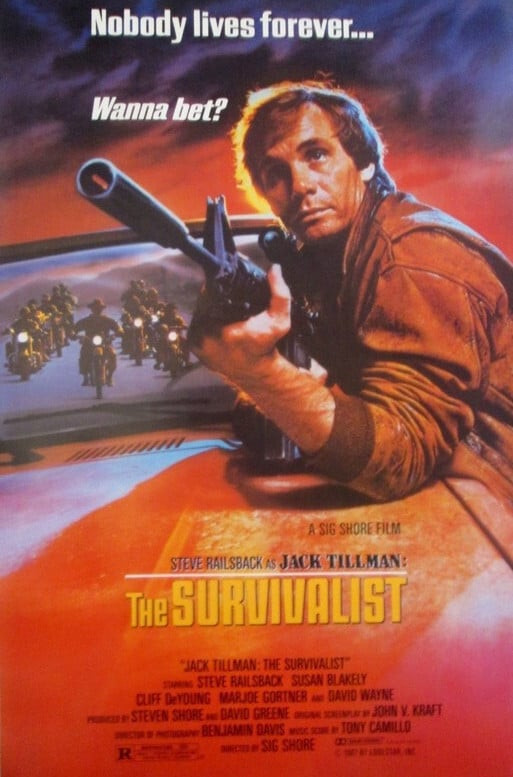
The TSL Grindhouse: The Survivalist (dir by Sig Shore)


1987’s The Survivalist opens with a mushroom cloud forming over a frozen landscape.

In America, a nervous-looking newscaster announces that someone has set off a nuclear bomb in Siberia.  The bomb was apparently a “suitcase bomb” and it was probably set off by a group of terrorists who figured bombing one of the most desolate and sparsely-populated places on Earth would make their point.  However, the Russians are convinced that America was behind the bomb.  Nuclear war is eminent.

People go into a panic.  Civil disorder breaks out.  Even a small town in South Texas finds itself in the grip of societal collapse.  Fortunately, independent builder Jack Tilman (Steve Railsback) has spent his life preparing for this moment.  He has hundreds of guns and explosives and he’s prepared to take his family into the desert while civilization collapses.  When a desperate neighbor comes back Jack’s house and asks for a gun, Jack gives him a shotgun and then reacts with shocks when his friend reveals that he’s never fired a gun before.  Considering that they live in South Texas, I’m surprised too.

(Seriously, how do they scare off the coyotes?)

Jack leaves his home to get some gasoline for their trip.  While he’s out, he’s harassed by the motorcycle riding Lt. Youngman (Marjoe Gortner).  Youngman is with the National Guard and, apparently, the National Guard has turned into a motorcycle gang.  Youngman is declaring martial law and setting himself up as a warlord.  With his perpetual smirk and his feathered hair, Lt. Youngman epitomizes the arrogance of authority.  Jack has no use for him.  Jack also has no use for anyone who wants to keep him from getting his money out of the bank.  Jack has access to a bulldozer, after all.

Unfortunately, while Jack is arguing with Youngman and smashing into the bank, a group of hippies are breaking into his house and killing his family.  A half-crazed Jack kidnaps two of his friends — Dr. Vincent Ryan (Cliff DeYoung) and his wife, Linda (Susan Blakely) — and he takes them into the desert with him.  When Vincent demands to know why they’ve been kidnapped, Jack says that he’s trying to protect them.  Linda gets it.  Unfortunately, Vincent doesn’t.

Last night, I was searching for some Marjoe Gortner films to review.  I came across The Survivalist on Letterboxed and I also came across some amazingly vitriolic reviews, largely from Leftists who accused the film of being a paranoid right-wing fantasy.  I read those reviews and I thought to myself, “It stars Steve Railsback and Marjoe Gortner and it annoys the commies?  I have to watch this!”  I was able to track the film down on YouTube and I proceeded to spend 90 minutes watching civilization collapse.

Is it a good film?  It depends on how you define good.  It’s a low-budget, unashamedly trashy film that was clearly meant to appeal to people with a very definite worldview, one that the filmmakers may not have shared.  (Most films are made solely to make money and any message that is selected is selected out of the hope that it will be profitable.)  The government is corrupt.  Most of the citizens have become complacent and aren’t prepared to handle any sort of crisis.  When civilization collapses, only men like Jack Tilman and Lt. Youngman will thrive because they’re willing to be ruthless.  To try to rationalize the situation, as Dr. Ryan does, is an often fatal mistake.  In short, The Survivalist is a very paranoid film.  That said, its story and its worldview really isn’t all that different from One Battle After Another.  

I enjoyed The Survivalist, precisely because it is such a shameless film.  This is the type of movie where the National Guard rides motorcycles and blow up random buildings for fun.  It’s the type of film where one gunshot can cause a car to explode.  It’s the type of film where actors like Cliff DeYoung and Susan Blakeley attempt to find some sort of deeper meaning in their awkward dialogue while Steve Railsback does his Clint Eastwood impersonation.  Best of all, it’s got Marjoe Gortner going totally over-the-top as a smug authority figure.  It’s a fun movie, a trashier version of Red Dawn.

What’s not to love?

The TSL Grindhouse: Record City (dir by Dennis Steinmetz)


1977’s Record City opens with a montage of rear-focused close-ups of women wearing short shorts and that pretty much tells you all that you really need to know about the film.  It’s crass, shameless, and very much a product of its time.

The film takes place over the course of one day at a California vinyl record shop.  It’s tempting to compare the film to something like Empire Records but, unlike Empire Records, Record City suggests that working in a record store is perhaps the worst thing that could ever happen to anyone.  The store is dirty and grimy.  The customers are rude and played by vaguely familiar comedy actors, all of whom seem to have been bitten by the overacting bug before stepping in front of the camera.  The employees all seem to hate each other.  Marty (Tim Thomerson) keeps getting slapped and kicked by Vivian (Deborah White).  Vivian keeps getting groped by almost every customer and employee who walks by her.  The only thing that Vivian hates more than men is other women.  The store’s owner (Jack Carter) is in trouble with the mob.  The store’s manager (Michael Callan) is lech who wears gold chains, keeps his shirt unbuttoned, and who expects the new cashier, Lorraine (Wendy Schaal), to sleep with him because, after all, he did hire her.  Danny (Dennis Bowen) is the shy guy with a crush on Lorraine.  Rupert (Stuart Goetz) is the nerdy virgin who goes from wearing a bowtie to dressing like a swinger but he still can’t get laid.  Both the customers and the employees are paranoid about “fairies” coming into Record City.  Pokey (Ed Begley, Jr.) wants to hold the place up and who can blame him?  Really, the only likable employee is a black man known only as The Wiz and that’s just because he’s played by Ted Lange.  (Yes, Isaac the Bartender from The Love Boat.)  Lange gets to perform a song at the end of the film.

When the film isn’t focused on the antics inside Record City, it’s all about the talent show that’s taking place in a nearby parking lot.  The talent show is hosted by radio DJ Gordon Kong (Rick Dees) and it gives the film an excuse to trot out a bunch of cameos, some of whom are more recognizable than others.  For instance, Gallagher — the comedian with the sledgehammer — shows up.  Kinky Friedman also shows up, playing himself and looking for records at Record City.  When he spots a woman with a blonde bowl cut and glasses, he accuses her of being John Denver and then grabs her breasts.  And to think — less  than 30 years later, Kinky Friedman would run for governor of my homestate.

Anyway, this is a terrible and rather boring movie but I did find it interesting for one reason.  It’s the reason why I find so many grindhouse films to be interesting.  Shot on location and for no other reason than to make money, Record City is a true product of its time.  There’s no attempt to try to make the 70s look nicer than they were.  There’s no attempt to try to make the record store look like anything more than a tacky establishment.  There’s an honesty to how low-rent the whole thing is.  Watching the movie is like stepping into a time machine and getting a chance to experience the past firsthand.  I was born long after the 70s but, after watching this film, I now feel like I’ve been there.

6 Bronsonrific Trailers


Today is Charles Bronson’s birthday!  I sent the trailer kitties out to gather the trailers for this week’s edition of Lisa Marie’s Favorite Grindhouse and Exploitation Film Trailers with one mission in mind.  Make it Bronsonriffic!  Let’s see how they did!

1) Once Upon A Time In The West (1968)

2) Someone Behind The Door (1970)

3) Death Wish (1974)

4) From Noon Till Three (1976)

5) Telfon (1977)

6) 10 to Midnight (1983)

What do you think, Trailer Kitty?

6 Roger Corman Trailers For Halloween


Happy Halloween!  Today, in order to celebrate, we have a special Roger Corman-themed edition of Lisa Marie’s Favorite Grindhouse and Exploitation film trailers!  Here are 6 Roger Corman trailers for Halloween!

1. The Day The World Ended (1955)

2. Bucket of Blood (1959)

3. Little Shop of Horrors (1960)

4. The Terror (1963)

5. The Masque of the Red Death (1964)

6. Frankenstein Unbound (1990)

6 Terrifying Trailers For October 25th, 2025


It’s only 6 days until Halloween!

Are you still struggling to get into the mood?

Don’t you worry!  The latest edition is Lisa Marie’s Favorite Grindhouse Trailers is here to help you out!

Presented without comment, here are 6 classic trailers that are guaranteed to get you in the scary season mood….

  1. Carnival of Souls (1962)

2. Night of the Living Dead (1968)

3. The Texas Chainsaw Massacre (1974)

4. Halloween (1978)

5. Dawn of the Dead (1978)

6. Zombie (1979) (a.k.a. Zombi 2)

What do you think, Trailer Kiity?

I agree!  Those trailers gave us a lot to think about!

The TSL Horror Grindhouse: The Fifth Floor (dir by Howard Avedis)


In 1977’s The Fifth Floor, Dianne Hull plays Kelly McIntyre.

Kelly is a college student by day and a disco dancer by night!  Unfortunately, after someone spikes her drink at the discotheque and she suffers an overdose, she becomes a full-time patient at a mental asylum.  Neither the head doctor (Mel Ferrer) nor the head nurse (Julia Adams, who once swam with The Creature From The Black Lagoon)  believes her claim that her drink was spiked.  Judged to be suicidal and delusional, Kelly is sent to the Fifth Floor!

While her boyfriend (John David Carson) tries to convince the authorities that she’s not insane, Kelly adjusts to life on the Fifth Floor.  She befriend Cathy (Patti D’Arbanville).  She encourages her fellow patients to dance and enjoy themselves.  She tries to escape on multiple occasions.  She draws the unwanted attention of a male orderly named Carl (Bo Hopkins, giving a wonderfully sinister performance).  A sadist equipped with down-home country charm, Carl has got all of his co-workers convinced that he’s a great guy.  The patients, though, know that Carl is a petty authoritarian who enjoys showing off his power.  (“I’m just doing my job,” is the excuse whenever he’s challenged.)  Carl takes an obsessive interest in Kelly and soon, Kelly is not only trying to get her life back but also trying to escape from Carl’s cruel intentions.

Most film directories list The Fifth Floor as being a horror film and certainly, there are elements of the horror genre to be found in the film.  The smooth-talking and nonchalantly cruel Carl is certainly a horrific character and Kelly’s attempts to escape from the asylum capture the very primal fear of not having any control over one’s life.  That said, The Fifth Floor owes greater debt to One Flew Over The Cuckoo’s Nest than to the typical slasher film.  Kelly is a rebel who brings the patients in the ward together.  Much as in Cuckoo’s Nest, the nurses and the orderlies use the threat of electro-shock treatment to keep the patients under control.

It’s not a bad film, though it definitely has its slow spots and I do wish the film had embraced its own sordidness with a bit more style.  I’m a history nerd so I appreciated the fact that The Fifth Floor was so obviously a product of its time.  Any film that features the heroine showing off her disco moves before being taken to a mental hospital is going to hold my interest.  That said, the most interesting thing about the film are some of the familiar faces in the cast.  For instance, Earl Boen — who played so many authority figures over the course of his career and appeared as a psychiatrist in the early Terminator films — plays a patient who wears a NASA jacket.  The always intimidating Anthony James plays the most violent patient.  Michael Berryman and Tracey Walter appear as background patients.

And then you’ve got Robert Englund, cast here as Benny.  Benny is the most gentle of the patients, a prankster who befriends Kelly.  It’s always so interesting to see the type of roles that Englund played before he was cast as Freddy Krueger in A Nightmare On Elm Street.  In this film, Englund is so goofy and friendly that you actually find yourself worrying about something happening to him.  Englund’s role is small but his amiable nerdiness definitely makes an impression.

The Fifth Floor opens and ends with a title card telling us that the film is based on a true story.  Sure, it was.

The TSL Horror Grindhouse: The Dunwich Horror (dir by Daniel Haller)


Look at me/I’m Sandra Dee….

First released in the groovy and psychedelic year of 1970, The Dunwich Horror stars Sandra Dee as Nancy, an somewhat innocent grad student at Massachusetts’s Miskatonic University.  When the mysterious Wilbur Wheatley (Dean Stockwell) comes to the university and asks to take a look at a very rare book called The Necronomicon, Nancy agrees.  She does so even though there’s only one edition of The Necronomicon in existence and it’s supposed to be protected at all costs.  Maybe it’s Wilbur’s hypnotic eyes that convince Nancy to allow him to see and manhandle the book.  Prof. Henry Armitage (Ed Begley) is not happy to see Wilbur reading the book and he warns Nancy that the Wheatleys are no good.

Nancy still agrees to give Wilbur a ride back to his hometown of Dunwich.  She finds herself enchanted by the mysterious Wilbur and she’s intrigued as to why so many people in the town seem to hate Wilbur and his father (Sam Jaffe).  Soon, she is staying at Wilbur’s mansion and has apparently forgotten about actually returning to Miskatonic.  She has fallen under Wilbur’s spell and it soon becomes clear that Wilbur has sinister plans of his own.  It’s time to start chanting about the Old Ones and the eldritch powers while naked cultists run along the beach and Nancy writhes on an altar.  We are in Lovecraft county!

Actually, it’s tempting to wonder just how exactly H.P. Lovecraft would have felt about this adaptation of his short story.  On the one hand, it captures the chilly New England atmosphere of Lovecraft’s work and it features references to such Lovecraft mainstays as Miskatonic University, the Necronomicon, and the Old Ones.  As was often the case with Lovecraft’s stories, the main characters are students and academics.  At the same time, this is very much a film of the late 60s/early 70s.  That means that there are random naked hippies, odd camera angles, and frequent use of the zoom lens.  The film makes frequent use of solarization and other psychedelic effects that were all the rage in 1970.  Lovecraft may have been an unconventional thinker but I’m still not sure he would have appreciated seeing his fearsome cult transformed into a bunch of body-painting hippies.

Really, the true pleasure of The Dunwich Horror is watching a very earnest Sandra Dee act opposite a very stoned Dean Stockwell.  Stockwell was a charter member of the Hollywood counterculture, a friend of Dennis Hopper’s who had gone from being a top Hollywood child actor to playing hippie gurus in numerous AIP films.  As for Sandra Dee, one gets the feeling that this film was an attempt to change her square image.  When Wilbur tells Nancy that her nightmares sound like they’re sexual in origin and then explores her feelings about sex, Nancy replies, “I like sex,” and it’s obviously meant to be a moment that will make the audience say, “Hey, she’s one of us!”  But Sandra Dee delivers the line so hesitantly that it actually has the opposite effect.  Stockwell rather smoothely slips into the role of the eccentric Wilbur.  Wilbur is meant to be an outsider and one gets the feeling that’s how Stockwell viewed himself in 1970.  Sandra Dee, meanwhile, seems to be trying really hard to convince the viewer that she’s not the same actress who played Gidget and starred in A Summer Place, even though she clearly is.  It creates an oddly fascinating chemistry between the two of them.  Evil Wilbur actually comes across as being more honest than virtuous Nancy.

Executive produced by Roger Corman, The Dunwich Horror is an undeniably campy film but, if you’re a fan of the early 70s grindhouse and drive-in scene, it’s just silly enough to be entertaining.  Even when the film itself descends into nonsense, Stockwell’s bizarre charisma keeps things watchable and there are a few memorable supporting performances.  (Talia Shire has a small but memorable roll as a nurse.)  It’s a film that stays true to the spirit of Lovecraft, despite all of the hippies.

6 Trailers For October 13th, 2025


For today’s edition of Lisa Marie’s Favorite Grindhouse And Exploitation Film Trailers, we share some trailers from the maestro of Italian horror, Mario Bava!

  1. Black Sunday (1960)

After starting his career as a cinematographer and a visual effects engineer, Mario Bava made his directorial debut with 1960’s Black Sunday, starring Barbara Steele!

2. Black Sabbath (1963)

In 1963, Bava directed one of his most popular films, the horror anthology Black Sabbath.  The trailer put the spotlight on the great Boris Karloff.

3. Planet of the Vampires (1965)

One of Bava’s best films, Planet of the Vampires, was later cited by many as an influence on the Alien films.

4. Bay of Blood (1971)

One of the first slasher films, Bay of Blood was also a social satire that featured Bava’s dark sense of humor.

5. The House of Exorcism (1974)

When it was released in the United States, Bava’s Lisa and the Devil was re-titled House of Exorcism and, after new scenes were filmed, sold as a rip-off to The Exorcist.

6. Shock (1977)

Bava’s final film as a director was Shock, which starred Daria Nicolodi as a woman who is being haunted by the ghost of her first husband.

The TSL Horror Grindhouse: The Sadist (dir by James Landis)


1963’s The Sadist opens with three teachers driving to a baseball game.

Ed (Richard Alden), Doris (Helen Hovey), and Carl (Don Russell) are planning on just having a nice night out but their plans change when they have car trouble out in the middle of nowhere.  They pull into a gas station/junkyard that happens to be sitting off the side of the road.  The teachers look for the owner of the gas station or at least someone who works there.  Instead, what they find is Charlie Tibbs (Arch Hall, Jr,) and bis girlfriend, Judy Bradshaw (Marilyn Manning).

Charlie is carrying a gun and he demands that the teachers repair their car and then give it to him so that he and Judy can continue their journey across the country.  Charlie has been switching cars frequently, largely because the cops are looking for him.  That’s because Charlie has been killing people all up and down the highway.  The intellectual teachers find themselves being held hostage by Charlie and Judy, two teenagers who may not be as smart as them but who have the killer instinct that the teachers lack.

It’s interesting to watch The Sadist after watching Eegah!  Arch Hall, Jr. and Marilyn Manning played boyfriend and girlfriend in that one as well but neither Hall nor Manning were particularly credible in their roles.  Hall seems uncomfortable with the whole teen idol angle of his role while Manning seemed a bit too mature for the role of a teenager.  In The Sadist, however, they’re both not only believable but they’re terrifying as well.

Charlie and Judy are almost feral in their ferocity, with both taking a disturbing glee in taunting the teachers.  Charlie kills without blinking and Judy enjoys every minute of it.  It’s easy to imagine Charlie and Judy at a drive-in showing of Eegah!, laughing at the sight of the caveman getting gunned down by the police and never considering that violence in real life is different from killing in the movies.  The teachers discover that it’s impossible to negotiate with Charlie and that Charlie’s promise not to try to kill them if they fix the car is ultimately an empty one.  And yet the teachers, dedicated to education and trying to reach even the most difficult of students, struggle to fight back.  They’re held back by their conscience, something that Charlie does not possess.  It’s intelligence vs instinct and this film suggests that often, intelligence does not win.

It’s a pretty intense and dark film, one that makes great use of that junkyard setting and which is notable for being the first film to feature the cinematography of Vilmos Zsigmond.  For those who appreciate B-movies, it’s memorable for showing that, when he wasn’t being pushed to be a squeaky-clean hero who sang sappy ballads in films directed by his father, Arch Hall, Jr. actually was capable of giving a very good performance.

The Sadist was based on the true-life crimes of Charlie Starkweather and Caryl Ann Fugate.  Interestingly enough, their crimes also inspired Terence Malick’s  Badlands.