Retro Television Reviews: The George McKenna Story (dir by Eric Laneuville)


Welcome to Retro Television Reviews, a feature where we review some of our favorite and least favorite shows of the past!  On Sundays, I will be reviewing the made-for-television movies that used to be a primetime mainstay.  Today’s film is 1986’s The George McKenna Story!  It  can be viewed on Netflix, under the title Hard Lessons!

George Washington High School is a school that has defeated many well-meaning principals.  The hallways are full of drugs and gang members.  A good deal of the student body never shows up for class.  Fights are frequent.  The police are a common sight.  The majority of the teachers are men like Ben Proctor (Richard Masur), burned-out and content to hide in the teacher’s lounge.

New Orleans-raised George McKenna (Denzel Washington) is the latest principal and, from the minute that he shows up at the school, he seems a bit more confident than the other principals that the school has had.  He barely flinches when a raw egg hits his suit.  When he hears a fight occurring, he doesn’t hesitate to head down the hall to investigate.  McKenna is determined to make George Washington High into a worthwhile institution and that means inspiring both the students and the teachers.

When it comes to films about dedicated educators trying to reform a troubled school, most films tend to take one of two approaches.  One approach, the well-intentioned but not always realistic liberal approach, features the teacher or the principal who demands respect but who also treats the good students and teachers with equal respect and who turns around the school through the power of benevolence.  The other approach is the one where the principal or teacher grows frustrated and turns into an armed vigilante who forces the students to shut up and learn.  Think of The Principal or The Substitute or Class of 1984.  The first approach is the one that most teachers claim that they try to follow but I imagine that, for most of them, there’s an element in wish-fulfillment to be found in watching the second approach.  In the real world, of course, neither approach is as automatically successful as it is in the movies.

The George McKenna Story was made for television and it’s based on a true story so, not surprisingly, it follows the first approach.  Denzel Washington plays McKenna as someone who could probably handle himself in a fight if he ever got into one but, for the most part, the film portrays McKenna as succeeding by treating his students with more empathy and respect that they’ve gotten from anyone else in their lives.  Though cranky old Ben Proctor thinks that McKenna’s methods are foolish and that he’s asking the teachers to do too much, McKenna starts to turn the school around.  One student, whose father was threatening to make him drop out, ends up getting nearly straight A’s and reciting Shakespeare.  Unfortunately, not everyone can be rescued.  One student is arrested for murder and taken away by the cops but McKenna is still willing to be there for that student.  McKenna doesn’t give up on his students and, unlike that music teacher in The Class of 1984, he doesn’t allow them to fall through a skylight either.

The George McKenna Story is a predictable film.  It’s easy to guess which student will be saved by McKenna’s approach and which student will end up getting stabbed in a gang fight and which student will end up in prison.  That said, the film definitely benefits from Denzel Washington in the lead role.  Washington exudes confidence from the minute that he appears on screen and you’re left with little doubt that if anyone could reform a school simply through good intentions, it would definitely be Denzel Washington.

Cleaning Out the DVR: Scared Straight! Another Story (dir by Richard Michaels)


Who is ready to be scared straight … again!?

Scared Straight!  Another Story is a made-for-television movie from 1980.  As you can tell by the name, the movie was inspired by the documentary Scared Straight! and the addition of Another Story to the title would lead one to suspect that this was actually a follow-up or continuation to that documentary and I guess it kind of is.  A group of teenagers, all of whom have been in trouble with the law, are sent to a prison where they are finger-printed, forced to stay in a cell, and then yelled at by a bunch of prisoners who assure them that they don’t have what it takes to survive in prison.  Then, just as in the documentary, the teenagers leave the prison.  Some of them continue to get in trouble and some of them are scared straight.  As for the prisoners, they remain imprisoned.

The main difference is that, instead of featuring real prisoners and real delinquents, Scared Straight! Another Story is a dramatization.  As a result, the prisoners are saying the same thing that they said in the first Scared Straight! but now the prisoners themselves are played by actors who will be familiar to anyone who has watched enough old TV shows.  The prisoners may be yelling about how much life sucks but the viewer knows that they are all actors and, as a result, Scared Straight!  Another Story lacks the rough authenticity of the first film.  (It also doesn’t help that most of the profanity from the original documentary has been replaced with softer expressions of disgust.)  The film again makes the argument that the Scared Straight program can turn someone’s life around but it’s not as effective because, again, the troubled teens are all actors.  The viewer knows that they’re actors.  Their lives have already been turned around.

Surprisingly, the scenes of the prisoners yelling are the least effective parts of this film.  Instead, Scared Straight!  Another Story works best when it is exploring everyone’s life before and after the trip to the prison.  Stan Shaw, in particular, is effective as a prisoner who is inspired to take part in the program after he comes across the body of an inmate who has been driven to suicide.  Also well-cast is Terri Nunn, playing Lucy, the girlfriend of a small-time drug dealer.  Both she and her boyfriend are scared straight but it turns out to be too little too late as her boyfriend is eventually sent to jail for the crimes that he committed before the program.  (There’s an interesting scene, one that I wish had been explored in greater detail, where Lucy’s father observes the scared straight program and, instead of understanding that prison is a terrible place to send a kid, reacts by saying that the prisoners are all getting what they deserve.)  Finally, Cliff De Young, who has played a lot of corrupt government agents and out-of-touch teachers over the course of his career, gets a sympathetic role as Paul, the idealistic juvenile probation officer who sends three of his clients to the program.  The program works for two of them while the other eventually ends up joining the inmates who previously tried to warn him.  If nothing else, the film deserves some credit for admitting that the Scared Straight program isn’t going to magically reform everyone who attends.

Despite some good performances, Scared Straight! Another Story lacks the rough edged authenticity of the documentary.  It’s just not as effective when you know that everyone, including the prisoners, could go home at the end of the day.  Today, this is one of those films that is mostly interesting as a historical artifact.  Apparently, there really was a time when anything could inspire a TV movie.

A Force of One (1979, directed by Paul Aaron)


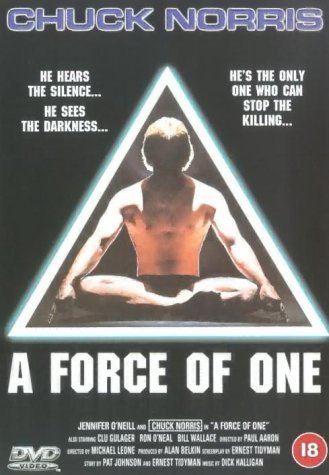
Someone is targeting a squad of undercover narcotics detectives, killing them by taking them by surprise and breaking their necks before they even have a chance fight back.  Lt. Dunne (Clu Gulager) doesn’t like seeing his best detectives getting murdered so he orders all of them — including Mandy Rust (Jennifer O’Niell) and Rollins (Superfly himself, Ron O’Neal) — to take martial arts training so that they can defend themselves.  And who better to train them than karate champ and dojo owner, Matt Logan (Chuck Norris)?  The no-nonsense Logan teaches the detectives a few moves and even starts a tentative romance with Mandy.  But when his adopted son (played by future director Eric Laneuville) is murdered by the drug dealers, Logan goes from being a teacher to being an avenger.

Since today is Chuck Norris’s 80th birthday, it only seems appropriate to review one of Chuck Norris’s better films.  A Force of One was made at a time when Chuck was still trying to make the transition from being the karate instructor to the star to being a star himself.  Norris had been disappointed by his previous few starring vehicles, all of which strangely played down Norris’s martial arts skills.  After his friend and student, Steve McQueen, told Chuck that he needed to specialize in playing strong, silent types, Norris followed his advise with A Force Of One, which features considerably less dialogue than Norris’s previous films but also a lot more fighting.

Though the character may be named Matt Logan, Chuck Norris is basically playing himself in A Force of One.  In the scenes where he’s training the detectives and talking about why he’s personally so opposed to drugs, Chuck comes across as so earnest that it doesn’t matter that he’s not much of an actor.  What he’s always lacked in range, Chuck makes up for in general badassery and A Force Of One features him at his most badass.  Chuck’s final fight with the ninja assassin is one of his best.

Jennifer O’Neill got top billing in A Force Of One and she and Chuck actually have decent romantic chemistry.  She seems to bring him a little bit out of his shell and she’s also actually believable as a tough cop.  Because this was early in Chuck’s career and the script was co-written by police procedural specialist Ernest Tidyman, A Force Of One spends as much time following round the other cops as it does with Chuck and the squad’s camaraderie is believable.  The cops are all played by good character actors like Ron O’Neal, Clu Gulager, Pepe Serna, and James Whitmore Jr. and they all give pretty good performance while, at the same time, not upstaging Chuck.

One final note: There’s a scene where Chuck and Jennifer O’Neill are in an evidence room.  Keep an eye out for a box that is labeled K. Reeves.  That’s a reference to director Paul Aaron’s stepson, Keanu Reeves, who worked as a production assistant on this film.

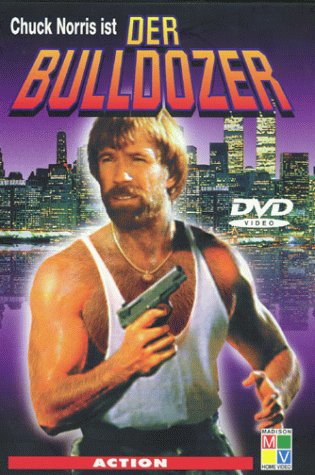
The German version of A Force Of One

Bronson’s Revenge: Death Wish (1974, directed by Michael Winner)


To quote “Dirty” Harry Callahan, “I’m all broken up about his rights.”
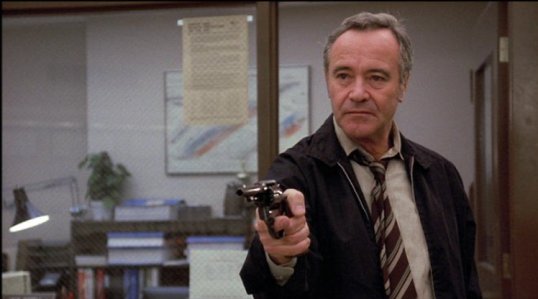
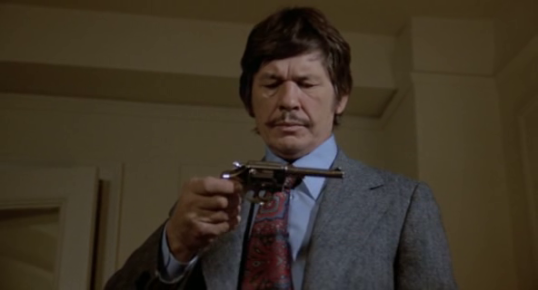
In 1972, a novel by Brian Garfield was published.  The novel was about a meek New York City accountant named Paul Benjamin.  After Paul’s wife is murdered and his daughter is raped, Paul suffers a nervous breakdown.  A self-described bleeding heart liberal, Paul starts to stalk the streets at night while carrying a gun.  He is hunting muggers.  At first, he just kills the muggers who approach him but soon, he starts to deliberately set traps.  Sinking into insanity, Paul becomes just as dangerous as the men he is hunting.  Garfield later said that the book was inspired by two real-life incidents, one in which his wife’s purse was stolen and another in which his car was vandalized.  Garfield said that his initial response was one of primitive anger.  He wondered what would happen if a man had these rageful thoughts and could not escape them.

The title of that novel was Death Wish.  Though it was never a best seller, it received respectful reviews and Garfield subsequently sold the film rights.  At first, Sidney Lumet was attached to direct and, keeping with Garfield’s portrayal of Paul Benjamin, Jack Lemmon was cast as the unlikely vigilante.

Lumet, ultimately, left the project so that he could concentrate on another film about crime in New York City, Serpico.  When Lumet left, Jack Lemmon also dropped out of the film.  Lumet was replaced by Michael Winner, a director who may not have been as thoughtful as Lumet but who had a solid box office record and a reputation for making tough and gritty action films.

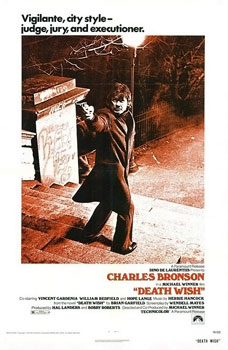
Winner immediately realized that audiences would not be interested in seeing an anti-vigilante film.  Instead of casting an actor with an intellectual image, like Jack Lemmon, Winner instead offered the lead role (now named Paul Kersey and no longer an accountant but an architect) to Charles Bronson.  When Winner told Bronson that the script was about a man who shot muggers, Bronson replied, “I’d like to do that.”

“The script?” Winner asked.

“No, shoot muggers.”

At the time that he was cast, Charles Bronson was 52 years old.  He was the biggest star in the world, except for in America where he was still viewed as being a B-talent at best.  Bronson was known for playing tough, violent men who were not afraid to use violence to accomplish their goals.  (Ironically, in real life, Bronson was as much of an ardent liberal as Paul Kersey was meant to be at the beginning of the movie.)  Among those complaining that Charles Bronson was all wrong for Paul Kersey was Brian Garfield.  However, Bronson accepted the role and the huge box office success of Death Wish finally made him a star in America.

To an extent, Brian Garfield was right.  Charles Bronson was a better actor than he is often given credit for but, in the early scenes of Death Wish, he does seem miscast.  When Paul is first seen frolicking with his wife (Hope Lange) in Hawaii, Bronson seems stiff and awkward.  In New York City, when Paul tells his right-wing colleague (William Redfield) that “my heart does bleed for the less fortunate,” it doesn’t sound natural.  But once Paul finds out that his wife has been murdered and his daughter, Carol (Kathleen Tolan), has been raped, Paul gets mad and Bronson finally seems comfortable in the role.

In both the book and the original screenplay, both the murder and the rape happened off-screen.  Never a subtle director, Winner instead opted to show them in a brutal and ugly scene designed to get the audience as eager to shoot muggers as Bronson was.  Today, the power of the scene is diluted by the presence of Jeff Goldblum, making his screen debut as a very unlikely street thug.  Everyone has to start somewhere and Goldblum got his start kicking Hope Lange while wearing a hat that made him look like he belonged in an Archie comic.

With his wife dead and his daughter traumatized, Paul discovers that no one can help him get justice.  The police have no leads.  His son-in-law (Steven Keats) is a weak and emotional mess.  (As an actor, some of Bronson’s best moments are when Paul makes no effort to hide how much he loathes his son-in-law.)  When a mugger approaches Paul shortly after his wife’s funeral, Paul shocks himself by punching the mugger in the face.

When Paul is sent down to Arizona on business, he meets Ames Jainchill (Stuart Margolin), a land developer who calls New York a “toilet” and who takes Paul to see a wild west show.  Later at a gun club, Paul explains that he was a conscientious objects during the Korean War but he knows how to shoot.  His father was a hunter and Paul grew up around guns.  When Paul returns to New York, Ames gives him a present, a revolver.  Paul is soon using that revolver to bring old west justice to the streets of New York City.

As muggers start to show up dead, the NYPD is outraged that a vigilante is stalking the street.  Detective Frank Ochoa (Vincent Gardenia) is assigned to bring the vigilante in.  But the citizens of New York love the vigilante.  Witnesses refuse to give an accurate description of Paul.  When Paul is wounded, a young patrolman (Christopher Guest, making almost as unlikely a film debut as Jeff Goldblum) conspires to keep Paul’s revolver from being turned over as evidence.

The critics hated Death Wish, with many of them calling it an “immoral” film.  Brian Garfield was so disgusted by how Winner changed his story that he wrote a follow-up novel in which Paul is confronted by an even more dangerous vigilante who claims to have been inspired by him.  Audiences, however, loved it.  Death Wish was one of the top films at the box office and it spawned a whole host of other vigilante films.

Death Wish is a crude movie, without any hint of subtlety and nuance.  It is also brutally effective, as anyone who has ever felt as if they were the victim of a crime can attest.  In a complicated and often unfair world, Kersey’s approach may not be realistic or ideal but it is emotionally cathartic.  Watching Death Wish, it is easy to see why critics hated it and why audiences loved it.

It is also to see why the movie made Bronson a star.  Miscast in the role or not, Bronson exudes a quiet authority and determination that suggests that if anyone could single-handedly clean-up New York City, it’s him.  An underrated actor, Bronson’s best moment comes after he punches his first mugger and he triumphantly reenters his apartment.  After he commits his first killing, Bronson gets another good scene where he is so keyed up that he collapses to the floor and then staggers into the bathroom and throws up.  Garfield may have complained that the Death Wish made his madman into a hero but Bronson’s best moments are the ones the suggest Paul has gone mad.  The real difference between the book and the movie is that the movie portrays madness as a necessary survival skill.

This Friday, a new version of Death Wish will be playing in theaters.  Directed by Eli Roth, this version starts Bruce Willis as Dr. Paul Kersey.  Will the new Death Wish be as effective as the original?  Judging from the trailer, I doubt it.  Bruce Willis or Charles Bronson?  I’ll pick Bronson every time.

Tomorrow, Bronson returns in Death Wish II!