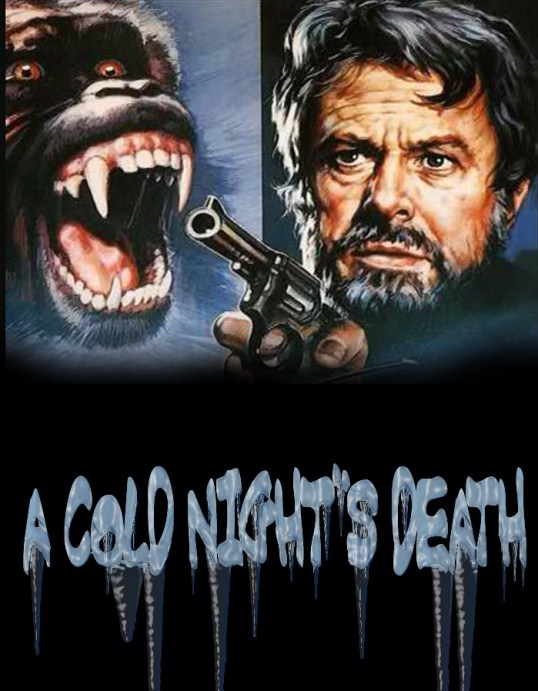
Horror on TV: A Cold Night’s Death (dir by Jerrold Freedman)


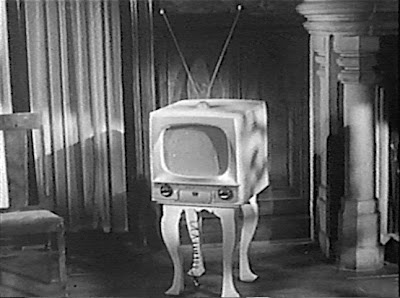
For today’s Horror on the Television, we have a made-for-TV movie from 1973.  As you can tell from the video below, it originally aired as a part of ABC’s Tuesday Night At The Movies.

A Cold Night’s Death tells the story of two scientists (Eli Wallach and Robert Culp) who are sent to a remote research station to investigate the apparent disappearance of another scientist.  They soon come to suspect that they may not be alone and soon, paranoia rears its ugly head.  With its frozen landscape and its ominous atmosphere, this movie feels like a distant cousin to John Carpenter’s The Thing.

Monday Night Mayhem (2002, directed by Ernest Dickerson)


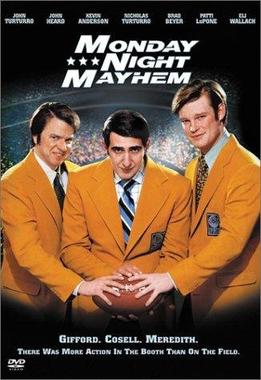
In the late 1960s, television coverage of football is dull and boring.  The games are played during the day and the announcers have no personality.  An executive at ABC named Roone Arledge (John Heard) changes all of that by convincing the NFL to start scheduling games for Monday night.  Arledge launches Monday Night Football, a broadcast that puts the viewers at home in the stadium.  Arledge explains that he wants cameras everywhere.  He wants the sidelines and the stands to be mic’d up.  And he wants announcers who will make the game interesting.  He picks an experienced radio announcer named Keith Jackson (Shuler Hensley), former Dallas quarterback Don Meredith (Brad Beyer), and finally an egocentric, loquacious, and opinionated sports reporter named Howard Cosell (John Turturro).  The straight-laced Jackson only lasts a season and finds himself overshadowed by Meredith’s good ol’ boy charisma and Cosell’s eccentricities.  Arledge brings in Frank Gifford (Kevin Anderson) as a replacement and changes both sports and television forever.  Monday night football becomes huge but so do the egos of the men involved.

Based on a non-fiction book by Bill Carter, Monday Night Mayhem is a look at the early days of Monday Night Football, with most of the attention being given to the mercurial Howard Cosell.  As a work of history, it’s pretty shallow.  There’s a lot of montages set to familiar 70s tunes and there’s plenty of familiar stock footage.  Beyer and Anderson do adequate impersonations of Meredith and Gifford without really digging for much under the surface.  Monday Night Mayhem is dominated by John Turturro’s performance as Howard Cosell.  Turturro doesn’t look like Cosell and he really doesn’t sound that much like Cosell but he does capture the mix of arrogance and bitterness that made Howard Cosell such a memorable and controversial announcer.  In its breezy manner, the film hits all the well-know points of Cosell’s life and career, from defending Mohammad Ali to considering a run for the Senate to trying to reinvent himself as a variety show host to the controversy when he was though to have uttered a racial slur during one of the games.  I wish the film had a bit more depth but John Turturro’s committed but bizarre performance keeps it watchable.

The Adventures of the Man With No Name: A Fistful Of Dollars, For A Few Dollars, The Good, The Bad, and the Ugly


Originally, Sergio Leone envisioned none other than Henry Fond as The Man With No Name.

The year was 1964 and Sergio Leone was searching for the right actor to star in the movie that would become A Fistful Of Dollars.  The film, which reimagined Akira Kurosawas’s Yojimbo as a western, centered around a mysterious, amoral gunslinger whose name was unknown.  Leone needed an American or a British name to star in the film so that it could get distribution outside of Italy.  Leone had grown up watching Henry Fonda movies, all dubbed into Italian.  He later said he wanted to cast Fonda because he always wondered what Fonda’s voice actually sounded like.

After realizing that a major Hollywood star would never agree to star in a low-budget Italian western, Leone then offered the role to Charles Bronson.  Bronson read the script and said it didn’t make sense to him.  Leone went on to offer the role to Henry Silva, Rory Calhoun, Tony Russel, Steve Reeves, Ty Hardin, and James Coburn.  Everyone was either too expensive or just not interested.  Finally, it was actor Richard Harrison who, after tuning down the part himself, suggested that Leone offer the role to Clint Eastwood.  Eastwood, then starring on the American western Rawhide, could play a convincing cowboy.  Leone followed Harrison’s advice and Eastwood, eager to break free of his nice guy typecasting and hoping to restart his film career, accepted.  The rest is history.

Eastwood would only play The Man With No Name in three films but, in doing so, he changed the movies and the popular conception of the action hero forever.

All three of the Man With No Name movies have been reviewed on this site.  But, since today is Clint’s birthday, I thought I’d take a look at how these classic films are holding up, over 60 years since the Man With No Name made his first appearance.
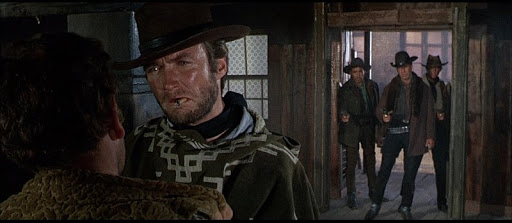
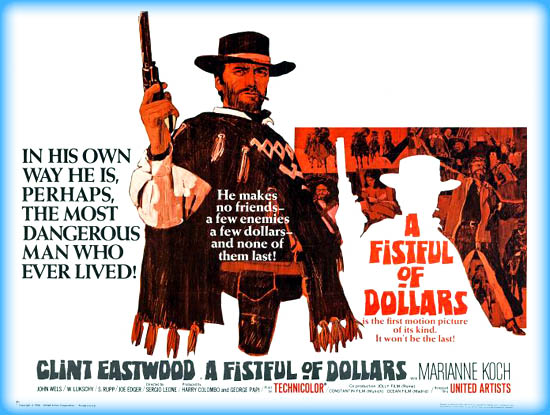
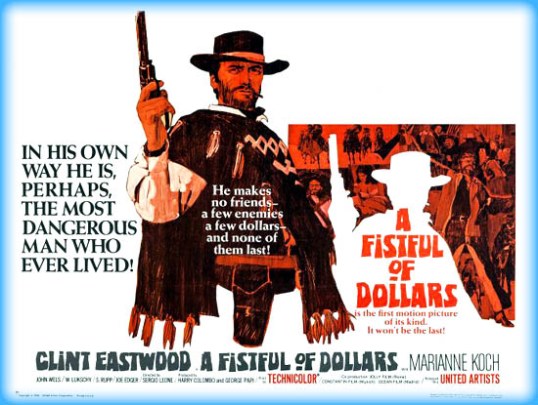
A Fistful Of Dollars (1964)

Having now seen both this film and Yojimbo, it’s remarkable how closely A Fistful of Dollars sticks to Kurosawa’s original film.  Interestingly, it’s clear that Eastwood patterned his performance of Toshiro Mifune’s in Yojimbo and yet, at the same time, he still managed to make the role his own.  The Man With No Name rides into a western town, discovers that there are two groups fighting for control of the area, and he coolly plays everyone against each other.  Whether it’s planting the seeds of distrust, exploiting an enemy’s greed, or being the quickest on the draw, the Man With No Name instinctively knows everything that he has to do.  Even when he’s getting beaten up by the bad guys, The Man With No Name always seems to be one step ahead.  Today, a western in which everyone is greedy and looking out for themselves isn’t going to take anyone by surprise.  But if you’ve watched enough westerns from the 40s and 50s, you’ll understand how unique of a viewpoint Leone brought to the genre.  Eastwood’s amoral gunslinger was such a surprise that, when the film aired on television, a scene was shot by the network in which Harry Dean Stanton played a prison warden who released The Man With No Name (seen only from behind) on the condition that he clean up the town.
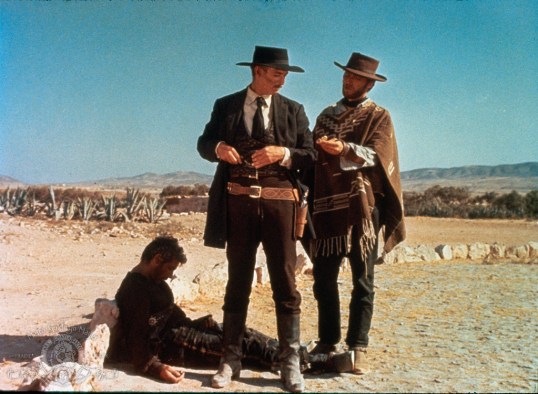
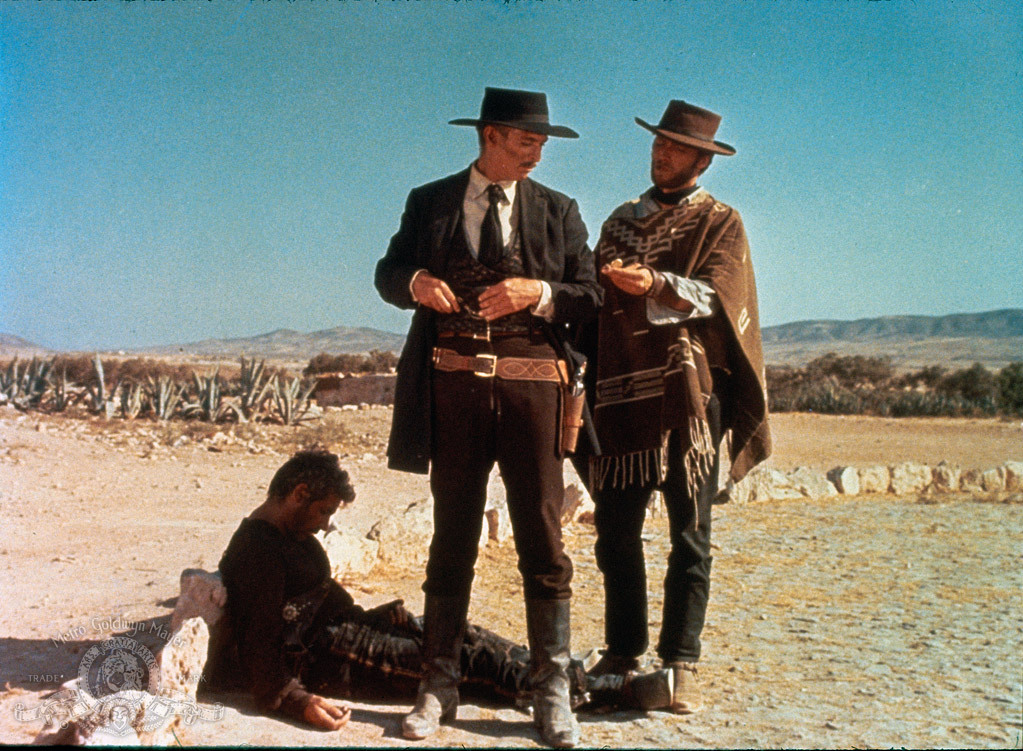
For A Few Dollars More (1965)

For A Few Dollars More finds The Man With No Name working as a bounty hunter and teaming up with Colonel Mortimer (Lee Van Cleef) to take down El Indio (Gian Maria Volonte) and his gang (including Klaus Kinski as a hunchback.)  This is my least favorite of the trilogy but that doesn’t mean that For A Few Dollars More is a bad film.  Being the least of three masterpieces is nothing to be ashamed of.  Eastwood and Van Cleef were two of the best and it’s interesting to see them working together.  El Indo is a truly loathsome villain and the members of his gang are all memorably horrid.  If it’s my least favorite, it’s just because I prefer the wit of A Fistful of Dollars and the epic storytelling of The Good, The Bad, and The Ugly.  Speaking of which…
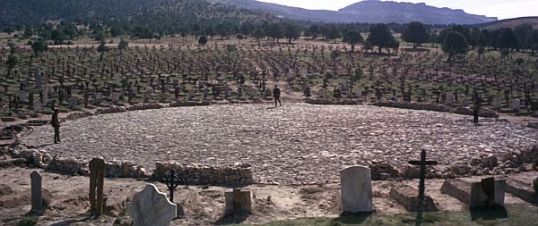
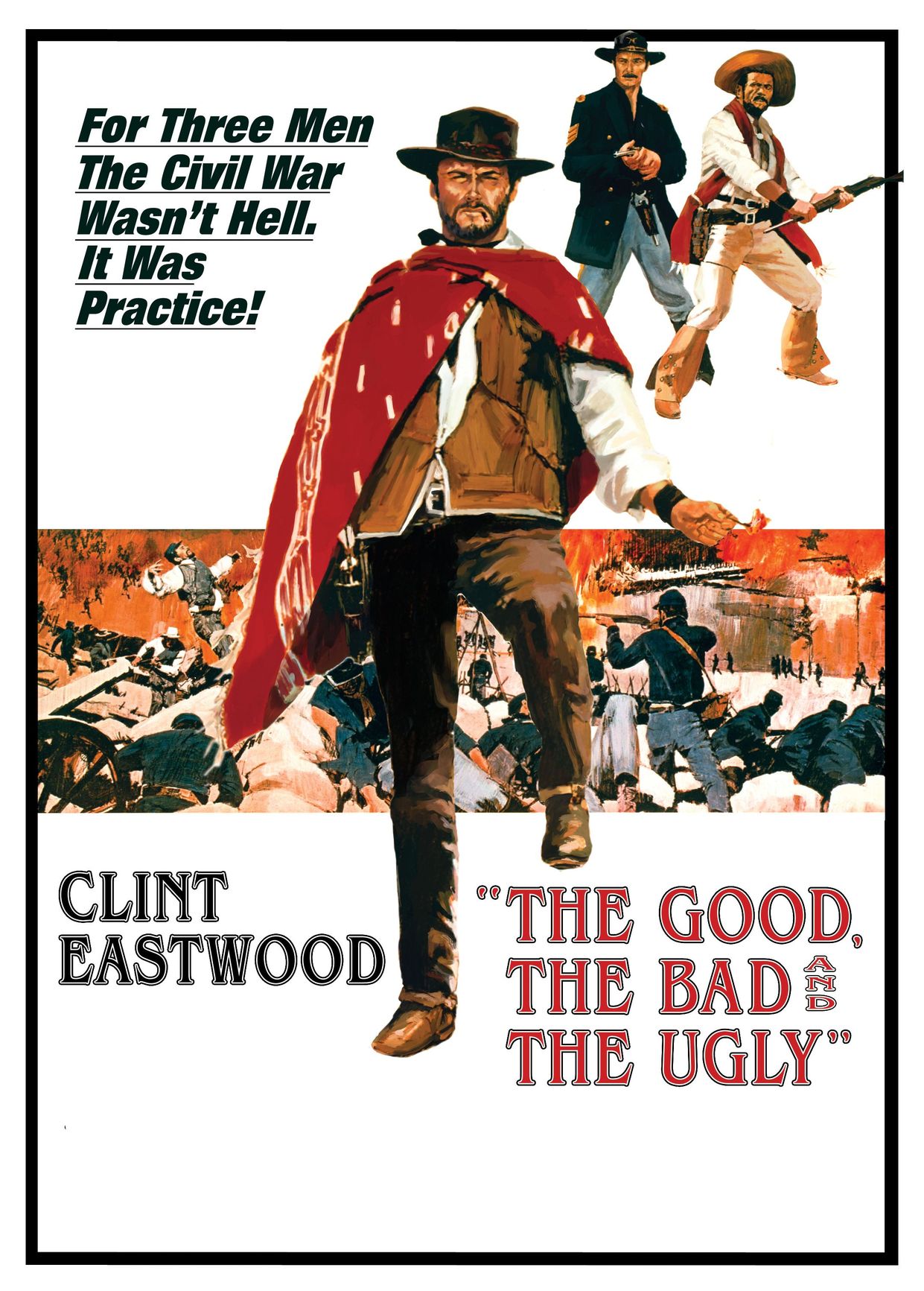
The Good, The Bad, and The Ugly (1966)

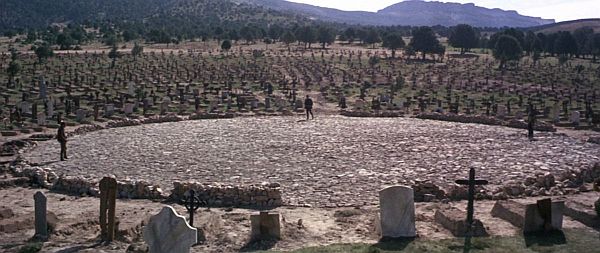
This is it.  The greatest western ever made, an epic film that features Leone’s best direction, Ennio Morricone’s greatest score, and brilliant performances from Eastwood, Van Cleef, and especially Eli Wallach.  It’s hard to know where to start when it comes to praising The Good, The Bad, and The Ugly.  It’s a nearly three-hour film that doesn’t have a single slow spot and it has some of the most iconic gunfights ever filmed.  Leone truly found his aesthetic voice in this film and that it still works, after countless parodies, is evidence of how great it is.  I appreciate that this film added a historical context to the adventures of The Man With No Name.  (Personally, I think this film is meant to be a prequel to A Fistful of Dollars, just because The Man With No Name is considerably kinder in this film than he was in the first two movies.  The Man With No Name that we meet in A Fistful of Dollars would never have gotten Tuco off that tombstone.)  The Good, The Bad, and The Ugly takes place during the Civil War and, along with everything else, it’s an epic war film.  While America fights to determine its future, three men search for gold.  The cemetery scene will never be topped.

American critics did not initially appreciate these films but audiences did.  Clint Eastwood may have been a television actor when he left for Italy but he returned as an international star.  And, to think, it all started with Sergio Leone not being able to afford Henry Fonda.

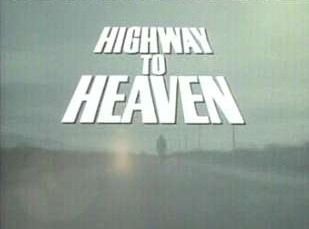
Late Night Retro Television Review: Highway to Heaven 3.22 “A Father’s Faith”


Welcome to Late Night Retro Television Reviews, a feature where we review some of our favorite and least favorite shows of the past!  On Thursdays, I will be reviewing Highway to Heaven, which aired on NBC from 1984 to 1989.  The entire show is currently streaming on Tubi and several other services!

This week brings us a touching episode.

Episode 3.22 “A Father’s Faith”

(Dir by Michael Landon, originally aired on March 4th, 1987)

Jonathan and Mark visit an old friend of Mark’s, a fisherman named Gene Malloy (Eli Wallach).  The Malloy family has been struggling ever since Gene’s son slipped into a coma after risking his life to save Gene’s daughter, Michele (Katherine Wallach), from drowning.  Gene neglects his business and his family to spend all of his time visiting his comatose son.  Gene’s wife (Anne Jackson) is feeling neglected and, because she blames herself for the accident, Michele has never visited her brother.  Everyone tells Gene that his son is never going to wake up but Gene has faith.

This was a simple but effective episode, one that worked largely because of the cast.  Eli Wallach and Anne Jackson were married in real life and Katherine Wallach was their daughter.  Watching this family drama being played out by a real family made it all the more touching.  In the end, Gene’s faith is rewarded.  It’s a little bit implausible but it doesn’t matter.  I still teared up a little.  For that matter, so did Michael Landon and Victor French and I’m pretty sure those tears were real.  Eli Wallach really poured his emotions into his performance as Gene.  This was a very heart-felt episode where the sincerity of the emotions carried the viewer over any rough spots in the narrative.

As I watched this episode, it occurred to me that, if it was made today, the story would probably be used to promote assisted suicide or euthanasia.  For whatever reason, there’s a lot of people who have really fallen in love with the idea of killing people who are sick or disabled.  Personally, I prefer this episode’s approach.  Sometimes, good things do happen.


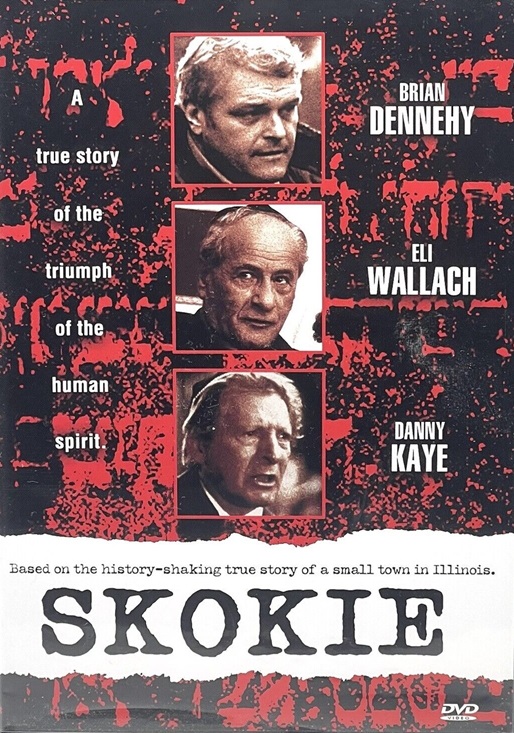
Made-For-Television Movie Review: Skokie (dir by Herbert Wise)


Skokie, a 1981 made-for-television movies, opens in a shabby Chicago office.

A group of men, all wearing brownshirts and swastika armbands, listen to their leader, Frank Collin (George Dzundza).  Collin says that they will be holding their next rally in the town of Skokie.  Collin explains that Skokie has a large Jewish population, many of whom came to the United States after World War II.  Collin wants to march through their town on Hitler’s birthday.

If not for the swastika and the brownshirt, the overweight Collin could easily pass for a middle-aged insurance salesman, someone with a nice house in the suburbs and an office job in the city.  However, Frank Collin is the head of the American National Socialist Party. a small but very loud group of Nazis who specialize in marching through towns with large Jewish populations and getting fee media attention as a result of people confronting them.  Making Frank Collin all the more disturbing is that he isn’t just a character in a made-for-television movie.  Frank Collin is a real person and Skokie is based on a true story.

The Mayor (Ed Flanders) and the police chief (Brian Dennehy) of Skokie are, needless to say, not happy about the idea of modern-day Nazis marching through their city.  Though they inform Collin that he will have to pay for insurance before he and his people will be allowed to hold their rally, they know that the courts have been striking down the insurance requirement as being a violation of the First Amendment.  While the mayor and the police chief worry about the political fallout of the rally, the Jewish citizens of Skokie debate amongst themselves how to deal with the Nazis.  Bert Silverman (Eli Wallach) and Abbot Rosen (Carl Reiner) argue that the best way to deal with Collin and his Nazis is to refuse to acknowledge them, to “quarantine” them.  As Rosen explains it, Collin is only marching to get the free publicity that comes with being confronted.  If he’s not confronted, he won’t make the evening news and his rally will have been for nothing.  However, many citizens of Skokie — including Holocaust survivor Max Feldman (Danny Kaye) — are tired to turning their back on and ignoring the Nazis.  They demand that the Nazis be kept out and that, if they do enter the city, they be confronted.

With the support of the ACLU, Collin sues for his right to march through Skokie.  The ACLU is represented by Herb Lewishon (John Rubinstein), a Jewish attorney who hates Collin and everything that he stands for but who also feels that the First Amendment must be respected no matter what.  When Lewishon is asked how he, as a Jew, can accept a Nazi as a client, Lewishon relies that his client is the U.S. Constitution.

Skokie is a thought-provoking film, all the more so today when there’s so much debate about who should and should not be allowed a platform online.  (Indeed, Collin and his Nazis would have loved social media.)  Lewishon argues that taking away any group’s First Amendment rights, regardless of how terrible that group may be, will lead to slippery slope and soon everyone’s First Amendment rights will be at risk.  Max Feldman, and others argue that the issue isn’t free speech.  Instead, the issue is standing up to and defeating evil.  The film gives both sides their say while, at the same time, making it clear that Frank Collin and his Nazis are a bunch of fascist losers.  It’s a well-acted and intelligently written movie, one that rejects easy answers.  Needless to say, at a time when so many people feel free to be openly anti-Semitic, it’s a film that’s still very relevant.

As for the real Frank Collin, he would eventually be charged with and convicted of child molestation.  After three years in prison, he changed his name to Frank Joseph and became a writer a New Age literature.  He’s looking for Atlantis but I doubt they’d want him either.

Late Night Retro Television Review: Highway to Heaven 2.18 “To Bind The Wounds”


Welcome to Late Night Retro Television Reviews, a feature where we review some of our favorite and least favorite shows of the past!  On Thursdays, I will be reviewing Highway to Heaven, which aired on NBC from 1984 to 1989.  The entire show is currently streaming on Freevee and several other services!

This week, Jonathan and Mark invade people’s dreams.

Episode 2.18 “To Bind The Wounds”

(Dir by Michael Landon, originally aired on February 19th, 1986)

Timothy Charles (Eli Wallach) sits in a cemetery, the only person to show up for the burial of his son, Timothy Charles, Jr.  The younger Charles died nearly twenty years earlier, while serving as a helicopter pilot in Vietnam.  Only recently have his remains been returned to the U.S.A.

The elder Charles is himself a veteran and lives in an airplane graveyard that sits in the desert.  He served in World War II.  The United States won World War II and Timothy Charles was celebrated as a hero.  The United States lost Vietnam and, as a result, most people want to pretend like it never happened and ignore the sacrifice of men like Timothy Charles, Jr.

Jonathan and Mark show up at the funeral.  Though he doesn’t know them, the elder Timothy Charles is touched by their presence and invites them back to his airplane.  The elder Charles, bitter about how his son has been forgotten, wishes there was some way he could memorialize him.  Jonathan and Mark suggest setting up a scholarship.

Unfortunately, a scholarship requires money and none of the wealthy people in town are willing to contribute.  They all want to forget the trauma of the war.  So, Jonathan and Mark pop up in their dreams and show them what a hero Timothy Charles, Jr. (played by Moosie Drier, Jr.) truly was.  They agree to set up the scholarship.  At the announcement ceremony, the elder Charles gives a heartfelt speech thanking them.

Timothy Charles, Sr. returns to his airplane.  Suddenly, the plane is flying into heaven and his son is sitting beside him.  Awwwww!

As I mentioned two weeks ago, I’m binging Highway to Heaven while in an emotional state.  My father died in the early morning hours of August 19th and I’m still very much in mourning.  As a result, while the logical side of me can watch this show and realize that it’s shamelessly sentimental and manipulative, the emotional side of me doesn’t care.  Eli Wallach was a great actor who had a tendency to go a bit overboard.  There’s nothing subtle about his performance here.  And the ending, with father and son literally flying to Heaven, was absolutely shameless.  But dammit, it made me cry.

And, to be honest, this episode makes an important point.  The people in Timothy’s town are reluctant to honor him because he served in an unpopular war that America lost.  It’s similar to the attitude that a lot of people now seem to have to those who served in Afghanistan and Iraq.  One sees it in the relentless gaslighting about the disastrous withdraw from Afghanistan and the refusal to honor the 13 service members killed at Abbey Gate.  Instead of holding our leaders to account, the American people often seem to blame those who served.  Hopefully, someday, that will change.

Retro Television Review: Indict & Convict (dir by Boris Sagal)


Welcome to Retro Television Reviews, a feature where we review some of our favorite and least favorite shows of the past!  On Sundays, I will be reviewing the made-for-television movies that used to be a primetime mainstay.  Today’s film is 1974’s Indict & Convict!  It  can be viewed on YouTube.

There’s been a murder!

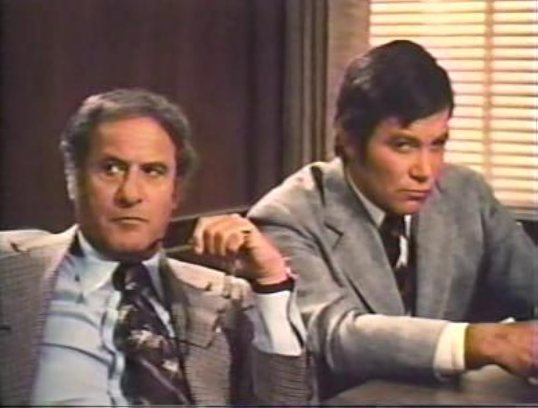
The wife of Assistant District Attorney Sam Belden (William Shatner) has been found, shot to death.  Making things especially awkward is that the body of her lover is found next to her.  Though Belden is the obvious suspect, he has an alibi for the time of the murders.  He claims that he was in Las Vegas, attending a convention.  Two gas station attendants remember seeing him filling up his car with gas at around the same time that his wife and her lover was being shot.

Attorney General Timothy Fitzgerald (Ed Flanders) is not so sure that Belden is innocent.  He instructs two of his top prosecutors to check out Belden’s story and to see if there’s enough evidence to not only indict but also to convict.  Bob Matthews (George Grizzard) is a veteran prosecutor and he’s the one who narrates the story for us.  Assisting him is Mike Belano, who is played by the always likable Reni Santoni.  Just three years before this movie aired, Santoni played Harry Callahan’s partner in Dirty Harry.  There was just something about Santoni’s friendly but determined demeanor that made him perfect the role of the supportive partner or assistant.

The film is very much a legal procedural, with the emphasis on not only the investigation but also on the strategies and the techniques that are used in the courtroom by Matthews and defense attorney DeWitt Foster (Eli Wallach).  In many ways, it feels like a forerunner to Law & Order.  Usually, I love court procedurals but Indict & Convict was a bit too slow and high-minded for its own good.  Maybe it’s because I’ve been spoiled by all of the legal shows that I’ve seen but I have to admit that I spent a good deal of Indict & Convict wanting the prosecutors to get on with it.  Flanders, Grizzard, Santoni, and Wallach were all ideally cast but the film itself sometimes got bogged down with all the debate about the best way to win a conviction.  It’s a shame because the story itself is an intriguing one and I actually enjoyed the movie’s use of spinning newspaper headlines to let us know what had happened in between scenes.  Also, as a classic film fan, I enjoyed seeing Myrna Loy as the judge.  She didn’t get to do much other than say, “Sustained” and “Overruled,” but still …. Myrna Loy!

Most people who watch this film will probably do so out of the hope of seeing some trademark Shatner overacting.  William Shatner doesn’t actually get to say much in this film.  He spends most of the running time sitting silently at the defense table.  Towards the end, he does finally get a chance to deliver a brief speech and it’s everything you could hope for.  Shatner takes dramatic pauses.  Shatner emphasizes random words.  Every line is delivered with the subtext of, “Pay attention, Emmy voters!”  Eventually, Shatner would learn the value of laughing at oneself but apparently, that lesson had not yet been learned when he did Indict & Convict.

Retro Television Reviews: Houston, We’ve Got A Problem (dir by Lawrence Doheny)


Welcome to Retro Television Reviews, a feature where we review some of our favorite and least favorite shows of the past!  On Sundays, I will be reviewing the made-for-television movies that used to be a primetime mainstay.  Today’s film is 1974’s Houston, We’ve Got A Problem!  It  can be viewed on YouTube!

The year is 1970 and Apollo 13 is the latest manned NASA mission into space.  The head of the mission of Jim Lovell and the destination is the Moon.  Unfortunately, the American public has gotten so used to the idea of men going to the Moon that hardly anyone is paying attention to Apollo 13.  That changes when Lovell contacts mission control in Houston and utters those famous words, “Houston …. we’ve had a problem.”  An oxygen tank has exploded, crippling the spacecraft and leaving the three men in danger.  If Houston can’t figure out how to bring them home, Apollo 13 could turn into an orbiting tomb.

Yes, this film tells the story of the same crisis that Ron Howard recreated in Apollo 13.  The difference between Houston, We’ve Got A Problem and Apollo 13 (beyond the fact that one was a big budget Hollywood production and the other a low-budget made-for-TV movie), is that Apollo 13 largely focused on the men trapped in space while Houston, We’ve Got A Problem is totally Earthbound.  In fact, Jim Lovell does not even appear in the ’74 film, though his voice is heard.  (The film features the actual communications between the crew and Mission Control.)  Instead, the entire film follows the men on the ground as, under the leadership of Gene Kranz (Ed Nelson), they try to figure out how to bring the crew of Apollo 13 home.  Houston, We’ve Got A Problem is a far more low-key film than Apollo 13, one that features narration from Eli Wallach to give it an effective documentary feel but one that also lacks the moments of wit and emotion that distinguished Apollo 13.  

NASA cooperated with the making of the film and it works best when it focuses on the men brainstorming on how to solve the biggest crisis that the American space program had ever faced to that date.  The film is less effective when it tries to portray the effects of the men’s work on their home lives.  Sandra Dee is wasted as the wife who can’t understand why her engineer husband (reliably bland Gary Collins) can’t spend more time at home.  Clu Gulager plays the guy who fears he’s missing out on time with his son.  Robert Culp plays the man with a heart condition who places his hand over his chest whenever anything stressful happens.  Steve Franken has to choose between his religious obligations and his obligation to NASA.  The melodrama of those fictional moments are awkwardly mixed with the based-in-fact moments of everyone calmly and rationally discussing the best way to save the crew.  Jim Lovell, as a matter of fact, complained that Houston, We’ve Got A Problem did a disservice to the flight controllers by presenting them all as being hopelessly inept in their lives outside of mission control.  (Lovell was reportedly much happier with Apollo 13.)

Because it features the actual conversations between the crew and Mission Control, Houston, We’ve Got A Problem is interesting as a historical document but it never escapes the shadow of Ron Howard’s better-known film.

Horror on the Lens: A Cold Night’s Death (dir by Jerrold Freedman)


For today’s Horror on the Lens, we have a made-for-TV movie from 1973.  As you can tell from the video below, it originally aired as a part of ABC’s Tuesday Night At The Movies so it’s only appropriate that we are also sharing it on Tuesday.

A Cold Night’s Death tells the story of two scientists (Eli Wallach and Robert Culp) who are sent to a remote research station to investigate the apparent disappearance of another scientist.  They soon come to suspect that they may not be alone and soon, paranoia rears its ugly head.  With its frozen landscape and its ominous atmosphere, this movie feels like a distant cousin to John Carpenter’s The Thing.

Enjoy!

The Domino Principle (1977, directed by Stanley Kramer)


Roy Tucker (Gene Hackman) loyally served his country as a part of a “search and destroy” team in Vietnam but when he returned home, he discovered that America didn’t appreciate his sacrifice.  When he was convicted of murdering his wife’s abusive first husband, he was tossed in prison.  But now, two mysterious men (Richard Widmark and Edward Albert) have offered Tucker a chance to escape from prison and reunite with his wife (Candice Bergen) in Costa Rica.  The only catch is that they also expect Tucker to do a job for “the Organization” and assassinate an unidentified target.  As Tucker discovers, The Organization has been watching and manipulating him entire life, setting him up for this very moment.  Every small event in Tucker’s life led to another event that eventually sent him to both the war and to prison.  It’s almost like a game of dominos.  And we have a title!

The Domino Principle gets off to a good start, with a black-and-white montage of actual assassinations and then an opening credit sequence that features someone placing dominos over pictures of Roy Tucker at different ages.  (I am guessing that actual childhood photos of Gene Hackman were used because even the baby pictures feature the Hackman squint.)  However, the scene immediately following the credits features Gene Hackman and Mickey Rooney as cellmates and the film never really recovers.  Though they were both talented actors, Gene Hackman and Mickey Rooney don’t seem as if they belong on the same planet together, let alone sharing a prison cell in a grim and downbeat political thriller.  Hackman is his usual surly self, while Mickey seems like he’s going to try to get the entire prison to put on a show.  The film tries to do some unexpected things with Mickey’s character but it doesn’t change the fact that he’s Mickey Rooney and he just doesn’t belong here.

As for the rest of The Domino Principle, it’s slow and ponderous.  Best known for earnest social issue films like The Defiant Ones and Guess Whos’ Coming To Dinner, Stanley Kramer is the wrong director for a film that aspires to duplicate the conspiracy-themed atmosphere of other 70s thrillers like The Parallax View and Three Days of the Condor.  For all the time that film takes to build to its obvious conclusion, Kramer doesn’t even bother to identify who Tucker is supposed to kill or why the Organization wants him dead.  Though he seems like he should be a good choice for the lead role, Gene Hackman goes through the movie on autopilot.  Perhaps he was overwhelmed to be sharing a prison cell with Mickey Rooney or to be playing the husband of Candice Bergen, who the film unsuccessfully attempts to deglamorize.

Sadly, this would be one of Kramer’s last films.  He followed it up with The Runner Stumbles, which starred Dick Van Dyke (!) as a conflicted priest, and then went into semi-retirement.  (A few attempts to return to directing failed.)  Kramer spent his twilight years writing about movies for The Seattle Times.  Before his death in 2001, he also published a very entertaining autobiography, A Mad Mad Mad Mad World: A Life in Hollywood, which I recommend to anyone interested in the history of Hollywood.