30 Days of Noir #30: The Stranger (dir by Orson Welles)


“No, you must not miss the newsreels. They make a point this week no man can miss: The war has strewn the world with corpses, none of them very nice to look at. The thought of death is never pretty but the newsreels testify to the fact of quite another sort of death, quite another level of decay. This is a putrefaction of the soul, a perfect spiritual garbage. For some years now we have been calling it Fascism. The stench is unendurable.”

Those words were written in 1945 by director Orson Welles.  He was writing about the footage that had been filmed at the Nazi concentration camps during the final days of World War II.  These films not only revealed the crimes of the Third Reich but they also proved the existence of evil.  With World War II finally ended and Hitler dead, many people were eager to move on and forget about the conflict.  Many even claimed (and some continue to do to this very day) that the reports of the Nazi death camps were exaggerated.  Writing in his syndicated column for the New York Post, Welles told those doubters that the reports of the Nazi death camps were not exaggerated and that, unless people confronted the horrors of the Nazi regime by watching the newsreels and seeing for themselves, history would repeat itself.

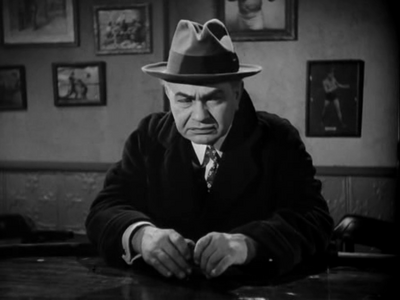
A year later, Welles would use that documentary footage in a key scene of his 1946 film, The Stranger.  A government agent named Mr. Wilson (Edward G. Robinson) shows the footage to Mary Longstreet Rankin (Loretta Young), the daughter of a Supreme Court justice.  Wilson is hoping that, by showing her the footage, he’ll be able to convince her to help him bring a Nazi war criminal to justice.  Complicating things is that Wilson believe that the Nazi war criminal is Mary’s new husband, Professor Charles Rankin (played by Orson Welles, himself).

In this shot, the horrors of the Holocaust are literally projected onto Edward G. Robinson’s face, a reminder that is on us to prevent it from ever happening again.

Rankin’s real name is Franz Kindler.  One of the architects of the Holocaust, he escaped from Germany at the end of World War II and, after making his way through Latin America, he ended up in a small town in Connecticut.  He got a job at the local prep school, where he instructs impressionable young minds.  He also found the time to work on the town’s 300 year-old clock.

When we first see Kindler/Rankin, he’s walking out of the school and it’s obvious that all of his students love him.  Rankin has a quick smile, which he uses whenever he has to talk to Mary or any of the other townspeople.  However, that smile disappears as soon as he’s approached by another Nazi fugitive, Konrad Meinike (Konstantin Shayne).  Rankin assures Meinike that he’s merely biding his time until he can establish a Fourth Reich.  Meinike, meanwhile, announces that he’s found God and he suggests that Rankin should turn himself in.  Correctly deducing the Meinike is being followed by Wilson, Rankin promptly strangles his former collaborator and spends the rest of the movie trying to cover up his crimes.

Welles was best known for playing characters who had the potential for greatness in them but who were ultimately brought down by their own flaws.  Think about Charles Foster Kane or Harry Lime or the detective in Touch of Evil or even Falstaff in Chimes at Midnight.  The Stranger is unique as one of the few instances in which Welles played an outright villain.  Unlike Kane or Falstaff, there’s no greatness to be found in Rankin/Kindler.  He’s fooled the town into thinking that he’s a good man but, instead, he’s a soulless sociopath who is even willing to murder his wife if that’s what he has to do to protect his secret.  Franz Kindler is the Third Reich and, by having him thrive under a new name in America, Welles argues that the Nazi threat didn’t end just because Hitler killed himself in Berlin.

And that’s an important message.  It was an important message in 1946 and, I would argue, it’s an even more important message today.  Anti-Semitism is on the rise in both America and Europe, with activists on both the Left and the Right embracing the type of bigotry and conspiracy-mongering that previously allowed madmen like Adolf Hitler to come to power.  Just today, I read a story about a Jewish professor at Columbia who arrived at work on Wednesday, just to discover that someone had vandalized her office with anti-Semitic graffiti.  Watching The Stranger today, it’s important to remember that the Franz Kindlers of the world are still out there and many of them are just as good at disguising themselves as Charles Rankin as Kindler was.

The Stranger was Welles’s third completed film as a director.  It was a film that he reportedly agreed to direct in order to prove that he was capable of bring in a film on budget and ahead-of-schedule.  Because Welles was largely acting as a director-for-hire on this film, there’s a tendency to overlook The Stranger when discussing Welles’s films.  While that’s understandable, The Stranger is clearly a Welles film.  From the use of shadow to the skewed camera angles, the film has all of Welles’s visual trademarks.  Thematically, this is another one of Welles’s films about a man who is hiding a secret underneath his ordinary facade.

It’s a good film, with Welles giving an appropriately evil performance as Kindler and Loretta Young providing strong support as Mary.  That said, the film’s soul is to be found in Edward G. Robinson’s performance.  Robinson was born Emmanuel Goldenberg in Romania.  In 1904, his family fled to America after one of his brothers was attacked by an anti-Semitic mob.  As someone who had experienced anti-Semitism firsthand, Robinson brought a righteous fury to the role of Mr. Wilson.  Wilson isn’t just pursuing a fugitive in The Stranger.  Instead, he’s seeking justice for the six million Jews who were murdered by men like Franz Kindler.

The Stranger is an important film and it seems like the right film with which to end my 30 Days of Noir.  Noirvember is ending and so ends our 30-day walk through the shadowy streets of noir cinema.

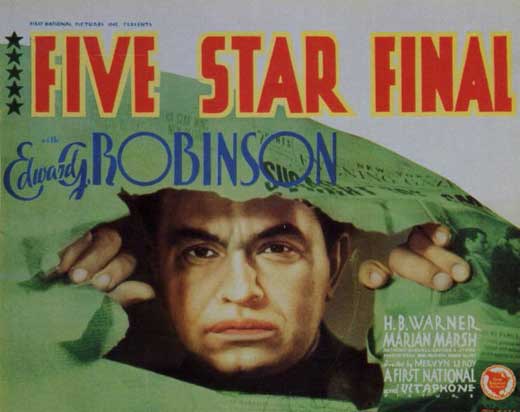
Pre Code Confidential #18: FIVE STAR FINAL (Warner Brothers 1931)


gary loggins's avatarcracked rear viewer

Tabloid journalism has been around far longer than the cable “news” channels of today, with their 24 hour a day barrage of nonstop sleazy scandals and “fake news”. A circulation war between publishers Joseph Pulitzer (New York World) and William Randolph Hearst (New York Journal) in the 1890’s, filled with sensationalized headlines and mucho muckraking, gave birth to the term “Yellow Journalism”, derived from Richard Outcault’s guttersnipe character The Yellow Kid in his comic strip Hogan’s Alley, which appeared in both papers. This legacy of dirt-digging and gossip-mongering continued through the decades in supermarket rags like The National Enquirer and World Weekly News, leading us to where we are today with the so-called “mainstream media” stretching credibility to the max and bogus Internet click-bait sites abounding. All of which leads me to FIVE STAR FINAL, a Pre-Code drama about headhunting for headlines starring Edward G…

View original post 608 more words

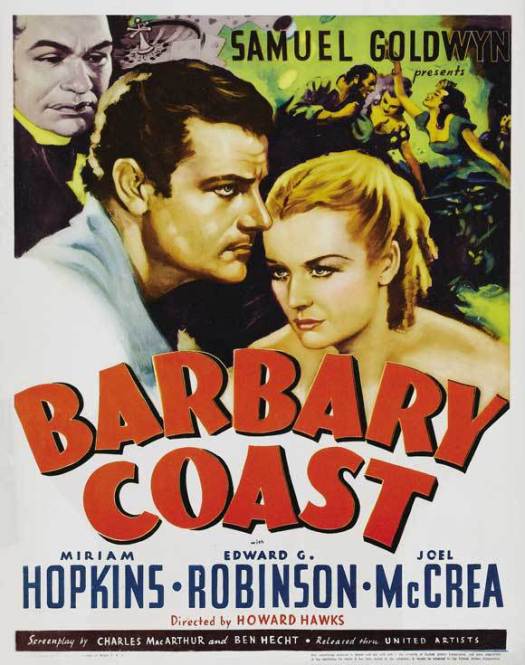
Fool’s Gold: BARBARY COAST (United Artists 1935)


gary loggins's avatarcracked rear viewer

BARBARY COAST probably would’ve been better had it been made during the Pre-Code era. Don’t misunderstand; I liked the film. It’s an entertaining period piece directed by Howard Hawks , with his trademark overlapping dialog and perfect eye for composition, rivaled by only a handful (Ford and Hitchcock spring immediately to mind). But for me, this tale of rowdy San Francisco during California’s Gold Rush was too sanitized by Hays Code enforcer Joseph Breen, who demanded major script changes by screenwriters Ben Hecht and Charles MacArthur.

The result is a film that’s just misses the classic status mark. It’s 1849, and Susan Rutledge arrives in Frisco to marry her rich boyfriend, who has struck it rich in the gold strike. When she finds out he’s been killed by gambling czar Luis Chandalis, owner of the Bella Donna saloon, avaricious Susan sets her sights on him. Chandalis becomes enamored of her…

View original post 495 more words

Moanin’ Low: On Claire Trevor and KEY LARGO (Warner Brothers 1948)


gary loggins's avatarcracked rear viewer

John Huston’s filmnoir KEY LARGO is a personal favorite, and a bona fide classic in its own right that works on many different levels. Much of its success can be credited to the brilliant, Oscar-winning performance of Claire Trevor as Gaye Dawn, the alcoholic ex-nightclub singer and moll of gangster Johnny Rocco (played with equal brilliance by Edward G. Robinson ). The woman dubbed by many “Queen of Noir” gives the part a heartbreaking quality that makes her stand out among the likes of scene stealers Robinson, Humphrey Bogart , Lauren Bacall , and Lionel Barrymore .

Claire Trevor (1910-2000) arrived in Hollywood in 1933, and almost immediately became a star. Her early credits include playing Shirley Temple’s mom in BABY TAKE A BOW (1934), the title role in the Pre-Code drama ELINOR NORTON (also ’34), Spencer Tracy’s wife in the bizarre DANTE’S INFERNO (1935), and the reporter out…

View original post 685 more words

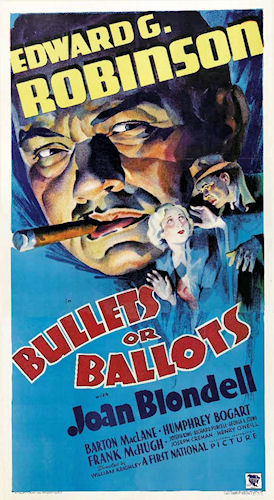
A Movie A Day #180: Bullets or Ballots (1936, directed by William Keighley)


Johnny Blake (Edward G. Robinson) was one of the toughest cops in New York City, until he punched out his new captain (Joe King) and was kicked off the force.  That punch was witnessed by racketeer Al Kruger (Barton McLane).  Kruger has long wanted to get Blake to join his organization and, with Blake now out of work, Kruger makes an offer.  Blake goes to work for Kruger, much to the consternation of Kruger’s second-in-command, Bugs Fenner (Humphrey Bogart).  Bugs says that anyone who was once a cop will always be a cop.  Bugs is right.  Blake is working undercover, trying to expose and take down the mob from the inside.

Bullets or Ballots is an entertaining if predictable gangster film from the 1930s.  After making his career playing bad guys, Robinson makes the transition to the side of law and order without losing any of his trademark attitude.  Bogart plays one of the many remorseless killers that he played before Casablanca reinvented him as a hero.  Bullets or Ballots may be predictable but it’s impossible not to enjoy watching Robinson and Bogart snarl hard-boiled insults at each other.

Second-billed Joan Blondell does not have much screen time but her role is still an interesting one, as a tough businesswoman who runs a numbers racket with her former maid (played by Louise Beavers).  I would have enjoyed seeing a full movie just about Blondell’s character but she mostly takes a back seat to Robinson and Bogart.

Unfortunately, unlike Little Caesar, The Public Enemy, and Scarface, Bullets or Ballots was made after Hollywood started to enforce the infamous Production Code and, as a result, Bullets or Ballots never reaches the gritty, violent heights of those earlier films.  Still, fans of Robinson, Bogart, and Blondell will find much to enjoy here.

Never Nominated: 16 Actors Who Have Never Been Nominated For An Oscar


Along with being one of the greatest actors who ever lived, the late Peter O’Toole had another, far more dubious achievement.  He holds the record for being nominated the most times for Best Actor without actually winning.  Over the course of his long career, Peter O’Toole was nominated 8 times without winning.

But, at least O’Toole was nominated!

Below are 16 excellent actors who have NEVER been nominated for an Oscar.  10 of these actors still have a chance to get that first nomination.  For the rest, the opportunity has sadly past.

Quicksilver-photo_625px_8col

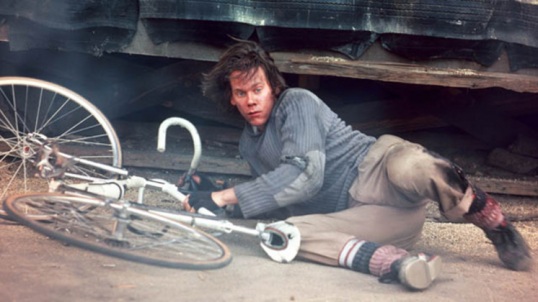
  1. Kevin Bacon

Is there anyone out there who doesn’t like Kevin Bacon?  Amazingly, despite several decades of good performances in good films, Kevin Bacon has yet to be nominated.  That said, he seems destined to be nominated some day.  If nothing else, he deserved some sort of award for being the most successful cast member of the original Friday the 13th.  (As well, 40 years after the fact, his cry of “All is well!” from Animal House has become one of the most popular memes around.)

2. Brendan Gleeson

This brilliant Irish actor deserved a nomination (and probably the win) for his brave performance in Calvary.  But, even if you ignore Calvary, his filmography is full of award-worthy performances.  From The General to Gangs of New York to 28 Days Later to In Bruges to The Guard, Gleeson is overdue for some recognition.

3. John Goodman

John Goodman deserved to be nominated this year, for his performance in 10 Cloverfield Lane.  He brought warmth to both Argo and Inside Llewyn Davis.  And he was absolutely terrifying in Barton Fink.  John Goodman is one of the most underrated actors working today.

4. Malcolm McDowell

It’s obviously been a while since Malcolm McDowell had a truly great role.  But who could forget his amazing performance in A Clockwork Orange?  For that matter, I liked his sweetly gentle performance in Time After Time.  Someone give this man the great role that he deserves!

5. Ewan McGregor

Ewan McGregor is an actor who is oddly taken for granted.  His performance in Trainspotting remains his best known work.  But, really, he’s been consistently giving wonderful performances for twenty years now.  Sometimes — as in the case of the Star Wars prequels — the films have not been worthy of his talent but McGregor has always been an engaging and compelling screen presence.  When it comes to playing someone who is falling in love, few actors are as convincing as Ewan McGregor.

6) Franco Nero

Franco!  If for nothing else, he deserved a nomination for playing not only Lancelot in Camelot and not only the original Django but also for playing Intergalactic Space Jesus in The Visitor.  I also loved his work in a little-known Italian thriller called Hitchhike.  Nero is still active — look for him in John Wick 2 — and hopefully, he’ll get at least one more truly great role in his lifetime.

7) Sam Rockwell

Let’s just get this out of the way.  In a perfect world, Sam Rockwell would already have an Oscar.  He would have won for his performance in 2009’s Moon.  He also would have received nominations for The Way, Way Back and Seven Psychopaths.  Sadly, Sam’s still waiting for his first nomination.  Again, the problem may be that he’s such a natural that he just makes it look easy.

Andy Serkis

8) Andy Serkis

Andy Serkis has never been nominated, despite giving some of the best performances of this century.  He should have been nominated for Lord of the Rings: The Return of the King.  He should have won for Rise of the Planet of the Apes.

9) Harry Dean Stanton

Harry Dean Stanton has been around forever and he’ll probably outlive everyone else on the planet.  He often seems to be indestructible.  Harry Dean is the epitome of a great character actor.  He’s a modern-day John Carradine.  And, just as John Carradine was never nominated, Harry Dean seems to destined to suffer the same fate.  Oscar may have forgotten him but film lovers never will.

10) Donald Sutherland

It’s hard to believe that Donald Sutherland has never been nominated for an Oscar but it’s true.  He probably should have been nominated for his work in Ordinary People and JFK.  Even his work in The Hunger Games franchise was an absolute delight to watch.  I imagine that Sutherland will be nominated someday.

Donald Sutherland and Kristen Stewart

Finally, here are 6 actors who sadly were never honored by the Academy and who are no longer with us:

  1. John Carradine

I mentioned John Carradine earlier.  Carradine was a favorite of many directors and he brought his considerable (and rather eccentric) talents to a countless number of films.  Among his best performances: Stagecoach and The Man Who Shot Liberty Valance.

2. John Cazale

Before his untimely death, John Cazale acted in 5 films: The Godfather, Godfather Part II, The Conversation, Dog Day Afternoon, and The Deer Hunter.  All five of them were nominated for best picture.  12 years after his death, archival footage of him was used in The Godfather Part III.  It was also nominated for Best Picture.  Not only is Cazale alone in having spent his entire career in films nominated for best picture but, in each film, Cazale gave a performance that, arguably, deserved to be considered for a Best Supporting Actor nomination.  Cazale was an amazing actor and it’s a shame that he wasn’t able to give us more great performances.

3. Oliver Reed

Oliver Reed was a legendary drinker but he was also an amazingly entertaining actor.  I’m not a huge fan of Gladiator but his final performance was more than worthy of a posthumous nomination.

Alan Rickman

4. Alan Rickman

When it comes to the late Alan Rickman, it’s not a question of whether he should have been nominated.  It’s a question of for which film.  I know a lot of people would say Rickman deserved a nomination for redefining cinematic villainy in Die Hard.  Personally, I loved his performance in Sense and Sensibility.  And, of course, you can’t overlook any of the times that he played Snape.

5. Edward G. Robinson

Edward G. Robinson was never nominated for an Oscar!?  Not even for Double Indemnity?  Or his final performance in Soylent Green?  Horrors!

6) Anton Yelchin

It’s debatable whether or not Anton Yelchin ever got a chance to give a truly award-worthy performance during his lifetime.  I would argue that his work in both Green Room and Like Crazy were pretty close.  But, if Yelchnin had lived, I’m confident he would have eventually been nominated.  We lost a wonderful talent when we lost him.

like-crazy-still02


The Fabulous Forties #7: The Red House (dir by Delmer Daves)


40s

Last week, I started on my latest project — watching all 50 of the movies included in Mill Creek’s Fabulous Forties box set!  I started things off with Port of New York and then I was lucky enough to discover two excellent low-budget gems: The Black Book and Trapped.

And now, we come the 7th film in the Fabulous Forties box set: 1947’s The Red House.

Redhouseposter

The Red House takes place is one of those small and seemingly idyllic country towns that always seem to harbor so many dark secrets and past crimes.  Everyone in town is friendly, cheerful, and quick to greet the world with a smile.

Well, almost everyone.

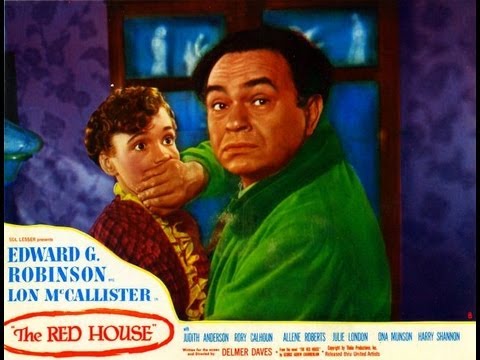
Pete Morgan (Edward G. Robinson) is the exception to the rule.  A farmer who moves with a pronounced limp, Pete lives on an isolated farm and refuses to have much to do with any of the other townspeople.  He lives with his wife, Ellen (Judith Anderson), and his niece, 17 year-old Meg (Allene Roberts).  Pete and Ellen are extremely overprotective of Meg.  Pete, especially, is always quick to tell her not to associate with any of boys in the town and not to enter the dark woods that sit next to the farm.  He tells her that there’s a red house hidden away in the woods and the house is haunted.  Going into the red house can only lead to death.

Despite Pete’s eccentricities, Meg is finally able to convince him to hire one of her classmates to help do chores around the farm.  Nath (Lon McAllister) is a good and hard worker and soon, even Pete starts to like him.  Meg, meanwhile, is falling in love with Nath.  However, Nath already has a girlfriend, the manipulative Tibby (Julie London), who cannot wait until they graduate high school so that she and Nath can leave town together.  When Nath starts to also develop feelings for Meg, Tibby responds by flirting with the local criminal, Teller (Rory Calhoun).

Though things seem to be getting better on the Morgan Farm, Nath eventually makes the mistake of admitting that, when he goes home, he takes a short cut through the old woods.  Pete angrily forbids Nath from entering the woods.  Of course, this has the opposite effect.  Soon, Nath and Meg are spending all day sneaking away into the woods so that they can look for the red house.

Once Pete learns of what they’re doing, he decides to hire Teller to keep them from even finding and entering the red house.  Needless to say, love, melodrama, murder, and tragedy all follow…

Despite the fact that the DVD suffered from a typically murky Mill Creek transfer, I enjoyed The Red House.  It’s one of those films that is just so over the top with all of the small town melodrama that you can’t help but enjoy it.  (If M. Night Shyamalan had been a 1940s filmmaker, he probably would have ended up directing The Red House.)  Nath and Meg were kind of boring but Julie London was a lot of fun as Tibby.  If I had ever starred in production of The Red House, I would want to play Tibby.

Plus, the film’s got Edward G. Robinson doing what he does best!  Robinson was an interesting actor, in that he could be both totally menacing and totally sympathetic at the same time.  He has some scary scenes as Pete but they’re also poignant because Robinson suggests that Pete hates his behavior just as much as Ellen and Meg.  Robimson was a powerhouse actor, the type who could elevate almost any film.

And that’s certainly what he does in The Red House!

red

The Art of Noir: Fritz Lang’s SCARLET STREET (Universal 1945)


gary loggins's avatarcracked rear viewer

scarlet1

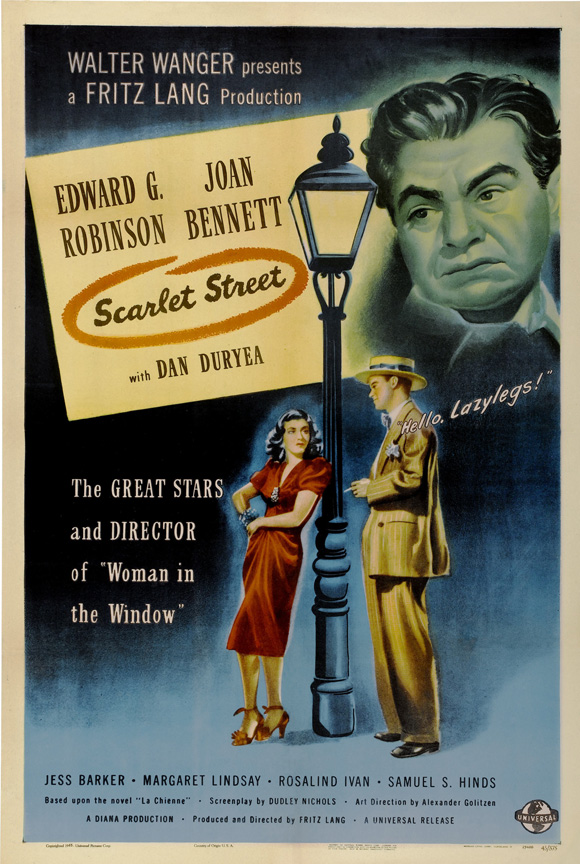
One of my favorite movies of any genre has always been SCARLET STREET. I used to watch the grainy Public Domain print on my local cable access channel over and over. When I saw that TCM was running the film last October, I recorded it for future reference, as I was in the midst of my “Halloween Havoc” marathon. I finally got the chance recently to sit down and enjoy this beautiful, crispy clear print and watch the film as it was meant to be seen.

scarlet2

Meek, mousey cashier Christopher Cross receives a gold watch at a party honoring his 25 years of service to J.J. Hogarth’s company. Chris has done his boring, repetitious job without complaint, though his dream has always to be a successful painter. When Hogarth leaves the party, Chris watches him get into a car with a pretty young girl. Walking home with friend and co-worker Pringle, Chris muses aloud what it would be like…

View original post 502 more words

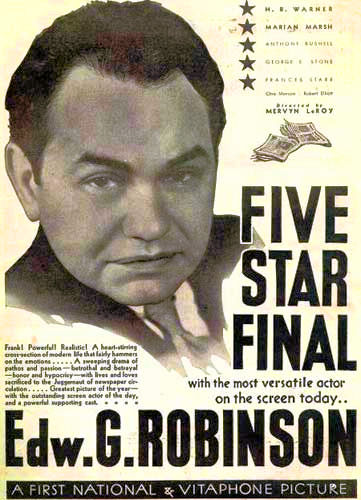
Lisa Reviews An Oscar Nominee: Five Star Final (dir by Mervyn LeRoy)


Five_Star_Final_1931_poster

In 1911, a pregnant secretary named Nancy Voorhees (Frances Starr) shot and killed her boss and lover.  It was quite a scandal at the time but, twenty years later, it has largely been forgotten.  Nancy has married a successful businessman named Michael Townsend (H.B. Warner) and is a respected member of society.  Her daughter, Jenny (Marian Marsh), has no idea about Nancy’s past and believes Michael to be her father.  Jenny is now engaged to marry the handsome and rich Phillip Weeks (Anthony Bushnell).

Everything seems to be perfect but you know what they say about perfection.

Bernard Hincliffe (Oscar Apfel) is the publisher of a struggling tabloid newspaper.  He is frustrated by city editor Joseph Randall (Edward G. Robinson) and Randall’s refusal to do whatever it takes to boost circulation.  “Why, he won’t even print pictures of women in their underwear!” one of Hincliffe’s assistants exclaims.  Finally, Hincliffe orders Randall to publish a series of articles that will take a retrospective look at both the scandal and what has happened to those involved in the years since.  At first, the cynical Randall refuses but eventually, he gives in.

He assigns two reporters to crack the story.  One of them, Kitty Carmody (Ona Munson) is first introduced showing off her legs and bragging about how there’s no way that she won’t be hired to work at the newspaper.  (By the way, if anyone ever remakes Five Star Final and needs someone to play Kitty, I am ready and available.)  The other is the incredibly creepy T. Vernon Isopod (Boris Karloff).  Isopod was a divinity student until he was arrested on a “morals charge.”  Now, he pretends to be a minister as a way to fool people into revealing their deepest secrets to him.  Kitty and Isopod dig into the life of Nancy and Michael.  The stories appear on the front page.  Suicide and melodrama follow and Randall is forced to finally take a stand.

Released in 1931, Five Star Final was nominated for best picture but lost to Grand Hotel.  Seen today, Five Star Final is undeniably stagey (it was based on a play) but it’s still a compulsively watchable melodrama, featuring good performances and a lot of memorably snappy 30s dialogue. Five Star Final is one of several films about journalism to have been nominated for best picture.  Most of these films — like All The Presidents Men, The Front Page, and this year’s front-runner, Spotlight — have featured journalists as heroic seekers of the truth.  Five Star Final, on the other hand, plays more like a pre-Code version of Network set at a newspaper.  It’s a deeply angry film and, when Randall finally tells off Hincliffe, it feels like the 30s equivalent of Peter Finch shouting that he’s mad as hell and not going to take it anymore.

Finally, the best part of the film, for me, was Boris Karloff as the sleazy Isopod.  Karloff made Five Star Final right before he played the creature in Frankenstein and it’s interesting to see him play a totally different type of monster here.  If I had to choose which character is scarier, I’m going with T. Vernon Isopod.

http://www.youtube.com/watch?v=a0qL1fs1c6k

Embracing the Melodrama Part II #16: Double Indemnity (dir by Billy Wilder)


Double_indemnity

The 1944 best picture nominee Double Indemnity is probably one of the most imitated films ever made.  While it may not be the first film noir, it is one of the most influential and its plot has been duplicated in countless films.  In fact, it’s such an influential film that all one has to do is say, “Indemnity” and you automatically know that they’re talking about murder.

Most people assume that the film is the story of Walter Neff (Fred MacMurray), an insurance agent who thinks that he’s smarter and smoother than he actually is.  When Phyllis Deitrich (Barbara Stanwyck) approaches him with questions about how much her husband’s life insurance would pay off if his death was accidental, Walter immediately figures out that she’s talking about murder.  At first, Walter tells her that he’s not interested but actually he’s very interested.  Soon, he and Phyllis are lovers (though Walter, from the start, seems to know that Phyllis is just using him) and he’s plotting out her husband’s murder.  After he does kill Phyllis’s husband, Walter makes it look as if he fell from a train.  At first, the death is ruled a suicide but, just as Walter hoped, his best friend and fellow insurance agent, Barton Keyes (Edward G. Robinson), announces that it wouldn’t make any sense for a suicidal man to jump from a slow-moving train.  Instead, Keyes successfully argues that the death should be ruled an accident and, as a result, the life insurance pays out for double of its value.

However, the money makes Walter paranoid.  He starts to worry that Phyllis will betray him.  Even worse, he’s approached by the dead man’s daughter, Lola (Jean Heather).  Lola tells Walter that she believes that Phyllis not only killed her father but her mother as well.  Soon, Walter is involved with both Lola and Phyllis.  Walter claims that he feels guilty and protective of Lola but MacMurray’s wonderfully ambiguous performance leaves us wondering just how much we should trust anything that he has to say.

Now, as I said before, the film may be narrated by Walter Neff and it may be set into motion by his affair with Phyllis but ultimately, the film is not about his relationship with Phyllis.  Instead, it’s about Walter’s friendship with Barton Keyes.  When we first see Walter, he’s recording a confession specifically for Keyes to hear and the film ends not with Walter and Phyllis but instead with Walter and Keyes.

In many ways, Keyes is the opposite of Walter.  Whereas Walter is slick and amoral, Keyes is rather nerdy and ethical to a fault.  Walter respects Keyes for his brilliant mind and, to a large extent, he does what he does because he wants to prove that he’s just as smart as Keyes.  Keyes is the type of man that Walter aspires to be while Walter is the dark side of Keyes’s own obsession with mystery.  It’s only appropriate that the film ends with Walter and Keyes because, ultimately, their friendship is the heart of the film.

Double Indemnity is a classic.  Barbara Stanwyck and Fred MacMurray set the standard by which all future illicit couples would be judged.  But really, the film is stolen by Edward G. Robinson.  Over the course of his long and remarkable career, Robinson was never once nominated for an Oscar.  Watching Double Indemnity, you can’t help but wonder how such an injustice could have happened.