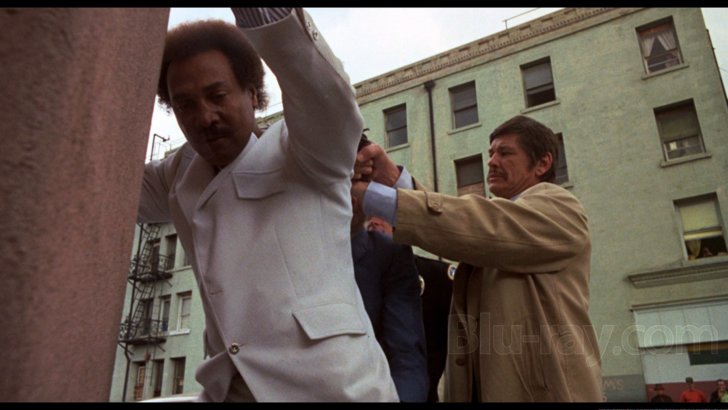
Brad reviews THE STONE KILLER (1973), starring Charles Bronson!


THE STONE KILLER opens in Spanish Harlem with detective Lou Torrey (Charles Bronson) following a young man, who had just shot a cop, into an abandoned building. When the young man refuses to turn himself in, and even tries to shoot Torrey, he gets blown away. In trouble with his superiors on the force, and being dragged in the press for the shooting, Torrey decides to change locations and continue his law enforcement career under his friend Les Daniels (Norman Fell) in Los Angeles. Soon after he arrives in Los Angeles, Torrey and his partner Mathews (Ralph Waite) are working a case against a drug dealer, when they arrest “Bootlace” Armitage (Eddie Firestone), a drug addict, but also a well-known hitman from New York. Torrey is delivering the “mechanic” back to New York for outstanding warrants when Armitage says that he is willing to give up some big information on “Wexton” in exchange for a reduced sentence. When Armitage is gunned down in what is obviously a professional hit, it’s clear that there is something going on that involves the name Wexton. We soon learn more as we meet mafia leader Al Vescari (Martin Balsam). As Vescari walks through a cemetery, he tells the leader of his operation, Lawrence (Stuart Margolin), of his plans to get revenge for a string of mafia killings that occurred 42 years earlier by using “stone killers,” in this case, former military men with no connection to the mob. As the film moves forward, Detective Lou Torrey and his fellow cops will eventually put the pieces together and find themselves taking on these “stone killers” and the mob! 

I’ll just go ahead and say up front that I’m a big fan of THE STONE KILLER these days, but that’s because the movie has grown on me over the years with repeat viewings. When I first watched the film as a teenager in the 1980’s, I enjoyed it as a tough cop film, but it wasn’t one of my favorites. I think that part of the reason I didn’t appreciate it as much back then is the more convoluted plot of the film. Most Bronson films have simple and easy to follow plot lines, but THE STONE KILLER includes a somewhat complicated mafia assassination plan, and it also sends the cops on wild goose chases that have nothing to do with the actual story. Watching the film as an adult, I appreciate Director Michael Winner taking us with him on some of those 1970’s flavored tangents that include getting to hang out with some hippies at an ashram, as well as some unjustly accused black militants. 

Even though the plot is more complicated than the average Charles Bronson film, director Michael Winner gives us some of the best action sequences of Charles Bronson’s career. There are two sequences in particular that stand out to me. After the impressive opening scenes where Torrey blows away the gun wielding young man in Spanish Harlem, it takes a while to get to the next extended action sequence, but it’s definitely worth the wait. The scene involves Detective Torrey in a car chase where he’s after one of the stone killers, Albert Langley (Paul Koslo), who’s on a motorcycle. In an era of great car chases, this is a doozy that features many amazing and dangerous stunts. The late 60’s and early 70’s are an embarrassment of riches for cinematic car chases and this one stands the test of time. The next great action sequence occurs later in the film when Detective Torrey and the cops bust the home and facility where the killers have trained for the planned massacre. Bronson is still in his physical prime in 1973, and his athletic prowess is clearly on display as he slides across floors, jumps on tables, and does anything else that is required to take down the bad guys. The film is not wall to wall action, but what’s here is as badass as it gets. 

Detective Lou Torrey is a really good role for Charles Bronson. In his best roles, Bronson is tough, but you can also tell that he cares about other people. That’s definitely the case here as he consistently shows empathy for some of the people he’s after. For example, at the beginning of the film, he has to shoot the young man in Spanish Harlem in self-defense, but he later explains to his sister that he didn’t want to do it, even expressing some understanding of how the young man may have found himself in that situation. A little later while arresting a drug dealer with his partner Mathews, Torrey is clearly disgusted when his partner uses racial slurs during the arrest. Torrey then talks to the man with respect and gets the needed information to arrest the man buying the drugs. There are further examples later in the film as he deals with other drug addicts and militants. I say none of this to insinuate that Bronson’s character is weak in any way. Rather, he seems to want to do his job and arrest criminals in a professional manner. He’s also a complex character in some ways as he will bend the rules to get what he needs if he has to. He does end up punching the car thief, Jumper (Jack Colvin), a couple of times during an interview. While this is definitely not legal, in the context of this film, it’s required in order to get to the facts of the case. Bronson is actually quite great in the film. 

Besides international superstar Charles Bronson, Michael Winner put together an amazing cast for THE STONE KILLER. Martin Balsam had won an Oscar a few years earlier, and he’s good here as the mafia boss with four decades worth of patience for revenge. Ralph Waite is also excellent as Bronson’s incompetent, racist partner Mathews. It’s hard to believe the guy would go on to play Papa Walton based on the ignorance he shows in both this film and in the Bronson/Winner collaboration CHATO’S LAND from the prior year. It’s fun watching both Norman Fell and John Ritter work together in this film, especially knowing that they would be making television history a few years later on the classic TV sitcom “Three’s Company.” The last two actors I want to mention are Stuart Margolin as the leader of the stone killers, Lawrence, and Paul Koslo as the bi-sexual badass musician Albert Langley. Both actors, especially Koslo, are good here and would have important roles with Bronson the next year as well. Margolin was an important character in DEATH WISH, and Koslo may have even outdone his work here the next year as a particularly slimy weasel in MR. MAJESTYK. Oh yeah, be sure to look for a short, uncredited cameo from B-movie queen Roberta Collins! I also want to shout out the musical score from Roy Budd, who also did the score for GET CARTER (1971). Thanks to Budd’s work, the opening credits are very cool and memorable. 

THE STONE KILLER was marketed as Charles Bronson’s “Dirty Harry” and meant to be his breakout hit in America. Unfortunately, while the film was an international hit, the actual grosses in the United States were respectable but not as much as the filmmakers had hoped for. As such, we didn’t get any more entries in the case log of Detective Lou Torrey and Bronson would have to wait another year for his American box office breakout with DEATH WISH. But that’s okay because THE STONE KILLER has stood the test of time as an excellent 1970’s cop film, emerging in my personal rankings as a major feather in the cap of Charles Bronson’s career. 

Scalplock (1966, directed by James Goldstone)


In this comedic western, gambler Benjamin Calhoun (Dale Robertson) wins big in a poker game.  Not only does he walk away with several thousand dollars but he also now owns his own railroad, the BP;S&D.  Calhoun celebrates the biggest win of his career by tossing ten dollar bills at the townspeople, recruiting a worshipful young assistant (Bob Random), and commandeering a private railcar that belongs to wealthy Burton Standish (John Anderson).  In the car, he finds Marta Grenier (Diana Hyland), a “working woman,” who has been hired to provide company for Standish.

Calhoun and Marta ride off to check out Calhoun’s new railroad.  What he discovers is that the railroad that he won is not only not completed but the workers are striking because they haven’t been paid in two weeks.  The quick-thinking Calhoun offers to make all of the workers part-owners of the railroad.  With construction once again starting, Calhoun tries to figure out how to keep his new business open.  He also meets a strong-headed storekeeper named Joanna Royce (Sandra Smith).

When Standish finally shows up, it turns out that he was originally planning on buying the BP;S&D.  Will Calhoun hold onto the railroad and honor the promise he made to the workers or will he sell out to Standish?

For all the talk about completing the railroad, Scalplock ends with most of the work undone.  That’s because Scalplock was a pilot for The Iron Horse, a television series that lasted for two seasons in the 60s.  Scalplock (and The Iron Horse) is mostly a showcase for Dale Robertson, a low-key but always convincing actor who specialized in westerns.  Usually, Robertson was cast as an upstanding citizen and law enforcement agent.  In Scalplock, he’s playing the type of genial rogue that James Garner played on Maverick and later in The Rockford Files.  Robertson is likable in Scalplock and even convinces us that Calhoun would choose his workers over a quick payday.  Fan of the genre will enjoy Scalplock, as long as they don’t get too invested in witnessing that last track of rail laid into the ground.

Dale Robertson, who started his career in the 40s, continued to act through the 90s, though usually as a guest star instead of a series lead.  Robertson eventually retired to Oklahoma where he owned a ranch that was home to over 200 horses.  He passed away in 2013 at the age of 89.

Horror Film Review: The Astral Factor (dir by John Florea)


Filmed in 1978 but not released until 1984, The Astral Factor tells the story of Roger Sands (Frank Ashmore).

Known as the Celebrity Killer, Roger is a serial killer who murdered women who reminded him of his famous mother.  It may seem like Roger is destined to spend the rest of his life in prison but what the legal system didn’t consider is that Roger has the ability to not only move things with his mind but to also turn himself invisible.  How did Roger get those powers?  Who knows?  At one point, Roger’s psychiatrist mentions that Roger was a student of the paranormal.  Later, it’s revealed that he had several books about the supernatural in his bedroom.  Apparently, Roger figured out how to do it himself.

Anyway, Roger is now invisible and soon, he has escaped from prison.  He is determined to kill the five women who testified against him at his trial, both because they remind him of his mother and also because he blames them for sending him to prison.  Roger strangles his victims, which in this case means that the actresses playing them have to pretend like they’re struggling with someone who can’t be seen.  In fact, Roger spends almost the entire film in a state of invisibility.

How do you catch a killer who can’t be seen?  It’s a fair question but police Lt. Charles Barnett (Robert Foxworth) might have the answer.  Barnett’s solution involves grabbing a gun and keep firing it until you hit something.  That’s a straight-forward solution but The Astral Factor is a pretty straight forward film.  The film begins with Roger turning invisible and, to its credit, it doesn’t spend too much time trying to justify or explain Roger’s magical powers.  The film understands that all the audience really needs to know is that Roger can’t be seen and that it’s up to Lt. Burnett to find a way to stop his killing spree.

The Astral Factor is a low-budget film, one that is full of formerly prominent performers who obviously showed up to get a quick paycheck.  Sue Lyon, Marianne Hill, Leslie Parrish, and Elke Sommer all play potential victims and all of them look like they would rather be doing anything other than appearing in The Astral Factor.  Robert Foxworth, to his credit, does his best to give a convincing performance as a level-headed cop who is forced to accept the reality of the paranormal.  Not only is he having to investigate a series of murders but he’s having to do it on his birthday.  Stefanie Powers plays his girlfriend, Candy.  Candy often refers to herself in the third person whenever she’s having a conversation with her boyfriend.  I tend to do the same thing so at least there was a character in this movie to whom I could relate.  Knowing the rules of the genre, I spent the entire movie expecting Candy to be put in danger and I was actually impressed when my expectations were subverted and that didn’t happen.

With the exception of a few atmospheric scenes and an entertainingly garish and tacky dance number, the film itself has the rather flat look of a made-for-TV movie, though the occasional hint of nudity indicates that it was meant to be a theatrical release.  As I mentioned at the start of this review, The Astral Factor was originally filmed in 1978 but it sat on the shelf until 1984.  That’s when a slightly shortened version was released under the title The Invisible Strangler.  Today, the film is available in countless Mill Creek Box Sets, under its original title and with its original run time restored.

Retro Television Reviews: Dragnet 1966 (dir by Jack Webb)


Welcome to Retro Television Reviews, a feature where we review some of our favorite and least favorite shows of the past!  On Sundays, I will be reviewing the made-for-television movies that used to be a primetime mainstay.  Today’s film is 1969’s Dragnet 1966!  It can be viewed on YouTube!

“This is the city….”

So begins Dragnet, a television movie version of the classic cop show that was the Law & Order of it’s day.  Dragnet began as a radio program in 1949 before making it’s way over to television in 1951.  Each episode starred (and the majority were directed by) Jack Webb, who played a no-nonsense cop named Joe Friday.  Friday narrated every episode, dropping trivia about the history of Los Angeles while also showing viewers how the cops went about catching criminals.  Despite what is commonly believed, Joe Friday never said, “Just the facts, ma’m,” but he did investigate each case with the cool determination of a professional who kept his emotions under control.  The majority of Dragnet’s episodes were based on actual cases that were worked by the LAPD, hence the opening declaration of, “The story you are about to see is true.”

On television, Dragnet originally ran from 1951 to 1959, during which time Dragnet also became the first television series to be adapted into a feature film.  Jack Webb decided to relaunch Dragnet in 1966 and he produced a made-for-television movie that followed Friday and his latest partner, the far more talkative Bill Gannon (Harry Morgan), as they worked multiple cases over the course of one long weekend.  The pilot movie did lead to a new show, one that lasted from 1967 to 1970 and which is today fondly remembered for scenes of Friday and Gannon debating the merits of the legal system with hippies.  However, for whatever reason, the 1966 pilot movie was not actually aired until 1969.

The made-for-TV movie features Friday and Gannon searching not for LSD dealers and draft dodgers but instead for a crazed photographer (Vic Perrin) who hires women to pose for him and then ties them up and takes their picture right before her murders them.  The photographer is based on real-life serial killer Harvey Glatman and Perrin is perfectly creepy in the role.  Though Friday never loses his composure, his disgust at the photographer and his crimes is palpable and it adds an extra charge to the scene where, in the middle of a drenching rain storm, Friday tries to sneak up on the trailer where he believes the photographer is holding his latest victim.  It’s actually a pretty exciting scene and definitely one that will take by surprise anyone who thinks of the 60s Dragnet as just being a campy exercise in establishment resentment.

Of course, catching a serial killer is not all that Friday and Gannon deal with.  It’s a long weekend so Friday and Gannon end up investigating the murder of a French tourist and Friday helps a younger, black detective deal with a racist criminal.  (The scene where Friday stands up to the racist was obviously meant to answer those who claimed the LAPD was a racist organization.)  At the start of the film, Joe almost gets collared into working security for a visiting Russian diplomat and the Russian’s paranoid security team is contrasted to the level-headed and capable men of the LAPD.  Some of these scenes are better than others.  The French tourist subplot features some truly risible acting and the scene with the racist is well-intentioned but still feels a bit condescending in its portrayal of the black detective needing Friday to help him deal with the suspect.  That said, I did enjoy listening to Bill Gannon talking about his plans for retirement and how working for the LAPD was destroying his teeth.  Harry Morgan’s folksy humor was always the perfect counterpart to Jack Webb’s perpetually rational Friday.

Finally, I appreciated that the movie featured a scene with Friday and Gannon went undercover at a lonely hearts club.  If you’ve watched the 1960s version of Dragnet, you know that, for all the times that Friday and Gannon went undercover, they never really put much effort into it.  I mean, they didn’t ever bother to take off their jackets!

Though I was disappointed by the lack of hippies, Dragnet 1966 was still not only a good police procedural but also a fun time capsule of its era.

Horror on TV: Kolchak: The Night Stalker 1.19 “The Youth Killer” (dir by Don McDougall)


Tonight on Kolchak….

There’s a new dating service in Chicago!  It’s only for the hot, single, and young!  So, why are some of the members turning up dead and suddenly old?  Could it be that the owner of the dating service has a less-than-ethical way of remaining young!?

Carl Kolchak is going to find out!

This episode aired on March 14th, 1975.  It’s not one of the better episodes but, as always, Darren McGavin is a lot of fun in the role of Kolchak.

Enjoy!

Cleaning Out The DVR Yet Again #24: Duel (dir by Steven Spielberg)


(Lisa recently discovered that she only has about 8 hours of space left on her DVR!  It turns out that she’s been recording movies from July and she just hasn’t gotten around to watching and reviewing them yet.  So, once again, Lisa is cleaning out her DVR!  She is going to try to watch and review 52 movies by the end of Tuesday, December 6th!  Will she make it?  Keep checking the site to find out!)

duel

On November 5th, I recorded the 1971 film Duel off of MeTV!

Duel tells the story of David Mann (played by Dennis Weaver).  The name is probably not a coincidence.  David is an “everyman,” if your idea of an everyman is a workaholic who is incapable of expressing his emotions.  David is driving through the California desert.  When he calls his wife (apparently, he left home in the morning without ever bothering to wake her), he tells her that he’s on a strict schedule and that he might lose an important sale if he’s delayed in any way.  You get the feeling, however, that David’s trip is less about business and more about a desire to get away from his life.  His conversation with his wife is strained and, when we watch him interact with a gas station attendant, we’re struck by how awkward David is.

Indeed, the only time that David seems to be really comfortable and relaxed is when he’s safely inside of his car.  When we first see him, he’s listening to a radio talk show and occasionally commenting on what he’s hearing.  David Mann has a better rapport with an unseen talk show host than he does with his own family.

Later, in the film, David is flagged down by a school bus that has stalled on the side of the road.  The bus driver asks David to give him a push.  For his part, David reacts with visible panic at the sight of several hyperactive children rushing towards his car. When they hop on his hood, David starts to frantically order them off.  It makes sense really.  The car is what he loves.

Of course, it’s not just bratty children that David has to deal with.  There’s also a gigantic truck traveling up and down the highway.  When David gets stuck behind the truck, he honks his horn.  He yells at the unseen driver.  He passes the truck at one point, just to have the truck promptly pass him so that it can continue to block him.  When the driver finally does motion for David to pass him, David changes lanes just to discover another car coming straight at him.

The truck’s driver, it turns out, wants to kill David.  Why does he want to kill David?  We’re never quite sure.  For that matter, we’re never quite sure what the truck is transporting, beyond the fact that it’s apparently flammable.  But the brilliance of Duel is that it doesn’t matter why the truck’s driver is trying to kill David. All that matters is that he’s determined to do so.

And David — the man who can’t even figure out how to have a conversation with his wife — must now try to figure out how to defeat a seemingly unstoppable predator…

Today, Duel is probably best known for being Steven Spielberg’s first film.  (It was a made-for-television production that got a theatrical release in Europe.)  Watching Duel (and Jaws, for that matter) it’s easy to imagine an alternative universe where, instead of becoming America’s best known creator of mainstream entertainment, Spielberg instead became one of America’s best horror director.  Duel is a suspense-filled thrill ride, one that’s scary because it remains rooted in reality.  Seriously, who hasn’t gotten nervous when they’ve found themselves sharing the road with a gigantic truck?

(If anything, I’d argue that Duel is scarier than Jaws.  I mean, I live in Dallas so it’s not like I have to worry about getting attacked by a shark.  On the other hand, I drive my car nearly every day.)

Dennis Weaver plays the archetype of what would become the typical Steven Spielberg protagonist and he does an excellent job in the role.  Weaver is on screen throughout the entire movie.  We see the entire story unfold through his eyes and Weaver gives a harrowing performance as a man who is slowly but steadily pushed to the verge of a breakdown by an enemy that he cannot even begin to comprehend.

If you haven’t seen Duel, you need to.