Musical Film Review: Heartbeat (dir by John Nicolella)


1987’s Heartbeat opens with Don Johnson in an unidentified Central American country.

Rebels are moving through the jungles.  Helicopters are flying over villages and firing off missiles.  In the middle of it all is Don Johnson, playing a character identified as being “The Documentary Filmmaker.”  Johnson carries a large movie camera with him, recording all of the violence and the carnage.  Is Johnson trying to expose the evils of the government?  Is he trying to expose the rebels?  Is he just an adrenaline junkie who can’t help but go to the most dangerous places in the world?  I have no idea and I’m not sure that the film does either.

A bomb explodes.  Johnson is thrown back.  Soon, Don Johnson is being carried into a dark room on a stretcher.  It appears that he might be dying but, even as his heartbeat is slowing down, his spirit is still hanging around and having flashbacks to the attack on the village, which we just saw less than a minute ago.  Eventually, Johnson’s spirit has other flashbacks.  He remembers talking to Paul Shaffer.  He remembers his strained marriage to an unnamed woman played by Lori Singer.  He remembers his youth as the son of a Las Vegas showgirl who is played by Sandahl Bergman.  (Bergman also played a showgirl in Bob Fosse’s All That Jazz and her scenes in this film often feel as if they’ve been directly lifted from Fosse’s classic film.)  David Carradine shows up as someone who might be Johnson’s father or who might just be some random guy rolling dice in the backroom of a strip club.  Johnson remembers his friendship with a graffiti artist (Giancarlo Esposito), who has a sister (Angela Alvarado) who was a prostitute.  The main message seems to be that the Documentary Filmmaker recorded the dangers of the world while also trying to remain emotionally detached, much like Robert Forster in Medium Cool.  Now that he’s dying, he’s left to wonder whether he made the right choice in refusing to get personally involved.

Oh, and did I mention that this film is basically a 65-minute music video?  Don Johnson sings through the entire movie, in a style that does its best to imitate the tough growl and soulful yearning of Southern rock and roll but which ultimately only serves to show that Johnson made the right decision in focusing on acting instead of singing?

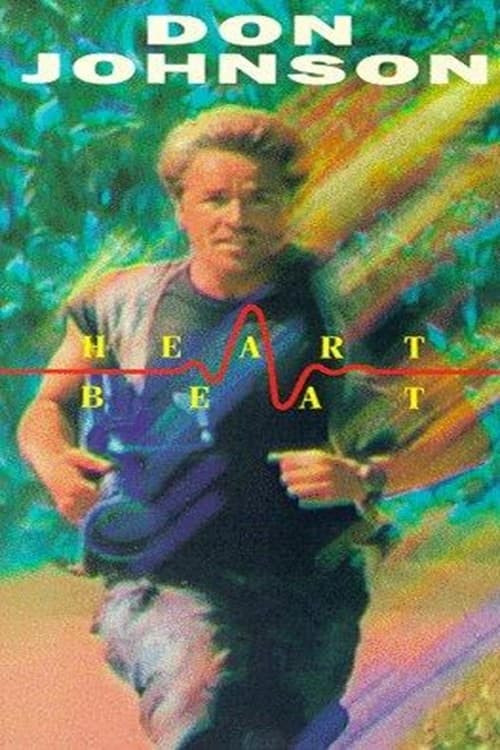
After I came across this film on Lettrboxd and then watched it on YouTube, I did a bit of research (which is a fancy way of saying that I spent a minute reading a Wikipedia entry) and I discovered that, at the height of his Miami Vice success, Johnson released his debut country rock album, Heartbeat.  Heartbeat the film was something that Johnson made in order to promote Heartbeat the album.  Directed by frequent Miami Vice director John Nicollela, Heartbeat the film is so self-indulgent and determined to prove that Don Johnson is a soulful artist that it becomes oddly fascinating to watch.  Johnson’s Documentary Filmmaker is a bit of a cad but the film seems to argue that 1) it’s not really his fault because women find him to be irresistible, 2) it’s really his mom’s fault for getting a job, and 3) it ultimately doesn’t matter because the Filmmaker is a great artist whose work will live on even after he dies.  It’s a vanity film for a vanity album and it’s all so vain that it becomes hard to look away from.

In the end, both the music from the album and the promotional film leave one feeling that, in 1987, Don Johnson might have had an unreasonably high opinion of his musical abilities.  That said, as anyone who has seen Cold In July can tell you, Don Johnson eventually did become a very good actor.

JACK FROST – should Frosty the Snowman be worried?


My wife and I have been watching a Christmas movie every night for the last week or so. We’ve already watched DIE HARD 1 and 2, LETHAL WEAPON, HOME ALONE 1 and 2, CHRISTMAS VACATION, YES VIRGINIA THERE IS A SANTA CLAUS, FOUR CHRISTMASES and a Hallmark movie called THE MOST WONDERFUL TIME OF THE YEAR with Fonzi. She’s been wanting me to watch JACK FROST with her for a while now. I’ve been somewhat hesitant because a movie about a talking snowman not named Frosty doesn’t seem that appealing to me. I was explaining this reluctance to a couple of my co-workers at the accounting office, and they both assured me that it’s a good movie. With this newfound confidence that I would enjoy the film, my wife and I settled in to watch JACK FROST a couple of nights ago…

JACK FROST is about a guy named Jack Frost who is having a difficult time with his work life / home life balance. He loves his wife Gabby (Kelly Preston) and his son Charlie (Joseph Cross) very much, but his musical group, The Jack Frost Band, is taking up a lot of his time. He’s one of those dads who says he’ll “for sure” be at his son’s hockey game but then misses it because the band’s recording session runs late. It’s always something like that with Jack Frost. Tragically, before Jack can get this stuff figured out, he dies in a car accident on Christmas Eve. Jump forward a year later where a depressed Charlie decides to build a snowman like he and his dad always did together for Christmas. Just go with me here… through the magic notes of Jack’s old harmonica as played by his son Charlie, Jack’s spirit is transferred to the snowman, and the two have another chance to bond like they always wanted to. Will Jack be the father he should have been now that he’s a magical snowman dad? How long will he be around this time? Will an abnormally warm Colorado winter melt him? Will he get to watch Charlie play one more hockey game? These are just a few questions to be answered over the course of the film’s 100-minute running time.

I have always been drawn to movies that focus on the relationships between fathers and their sons. For example, FIELD OF DREAMS and FREQUENCY are two of my very favorite films. The reason I love both films is that dads and their boys are able to reconnect and experience each other in a way that resolves pain or regret from the past. The movies may not be realistic in how that happens, but I think each of the films tap into a universal truth about the connections between kids and their parents. If you want to see me cry, just watch either of those movies with me. JACK FROST seems to have this noble intention of magically re-connecting a father and his son for a second chance, and I give it credit for that. Only the most cold-hearted cynic would blow off the scene where Jack’s wife and son get to see him in his human form just one last time. It was touching. I also enjoy some of the songs on the soundtrack. I was able to take my wife to see Stevie Nicks in concert here in Little Rock earlier this year. I enjoyed when her “Landslide” played as Charlie made a snowman for the first time after his dad passed away. I thought that was a strong scene. With that said though, for me, JACK FROST doesn’t come together in a way that packs much of an emotional punch even though it’s clearly going for the heart. Part of that could be the fact that Michael Keaton turns into a snowman, and statements like “snow-dad is better than no-dad” are made. When I think of the other films, sure there are supernatural elements at play, but they’re still set in the real world, even if that place is in Iowa! In the case of JACK FROST, neither the comedy nor the drama worked well enough for me to get emotionally invested. The filmmakers overestimated the comedic nature of a snowman in general, and they seemed to dwell on that one note way too long, and to the film’s detriment. I did think a scene where Charlie’s hockey coach, played by Henry Rollins, refuses to allow the word “snowman” to be spoken in his presence was funny, but that was the exception and not the norm. 

After watching JACK FROST, I do understand why Frosty has retained his place as the world’s favorite talking snowman even after this film’s 1998 release. I think the idea of a talking snowman works much better in Frosty’s context. As a matter of fact, I think I’ll go ahead and watch Frosty the Snowman again when I’m done here. But you never know, JACK FROST just may grow on me. Since my wife loves it, I know we’ll be watching it this same time next year! 

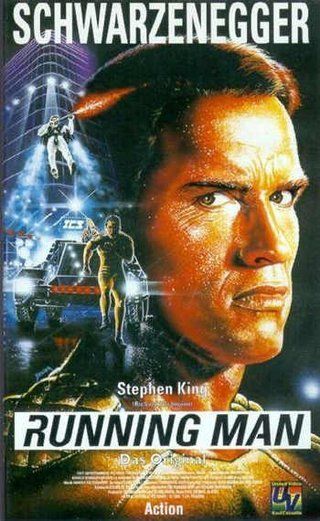
Guilty Pleasure No. 60: The Running Man (dir by Paul Michael Glaser)


“Killian, here’s your Subzero… now plain zero!”

Uhm, excuse me, Mr. Schwarzenegger, but a man just died.  He probably had a family who just watched you kill him on national television….

Oh well, it happens!  In the role of Ben Richards, Arnold Schwarzenegger kills quite a few people over the course of the 1987 film, The Running Man, but they were all bad.  In fact, when we first meet Ben Richards, he’s a cop who is trying to save lives.  His superiors want him to open fire on a bunch of protestors who simply want enough food to eat.  When Richards refuses to do it, he is framed for perpetrating “the Bakersfield Massacre” and is sent to prison.  When he is recaptured after escaping, he is given a chance to compete on America’s number one game show, The Running Man!  Hosted and produced by Damon Killian (Richard Dawson, oozing smarm in a performance that — in a fair world — would have received Oscar consideration), The Running Man is a show in which prisoners are given a chance to win prizes like a trial by jury or maybe even a pardon.  While the audience cheers and puts down bets, the prisoners are stalked by professional killers like Buzzsaw (Gus Rethwisch), Dynamo (Erland Van Lidth), Fireball (Jim Brown), and Sub-Zero (Professor Toru Tanaka).  Along with Killian, Captain Freedom (Jesse Ventura) provides commentary and analysis on how the game is going.  Ben soon finds himself joined by Amber (Maria Conchita Alonso), who proves herself to be just as tough as he is.

Seen today, The Running Man feels more than a bit prophetic.  Due to worldwide economic collapse, the poor are getting poorer while the rich are getting richer.  The American government has become both increasingly corporate and increasingly authoritarian.  The citizens are entertained and manipulated by “reality” programming.  On camera, Killian is a charismatic host who delivers his lines with faux sincerity and who loves to meet and give away prizes to the public.  (There’s something both undeniably creepy and also rather familiar about the way that Killian sniffs the hair, rubs the shoulders and holds the arms of the audience members to whom he’s speaking.  It’s all very calculated and one gets the feeling that Killian washes his hands as soon as the camera are off of him.)  Behind the scenes, he drinks, smokes, curses, and is full of contempt for everyone around him.  He may not be happy when Ben outsmarts and kills the show’s stalkers but he definitely cheers up when he hears how good the ratings are.  The film is set in 2017, which was 30 years in the future when The Running Man was first released.  Seen today, The Running Man’s 2017 feels a lot like our 2017….

That said, The Running Man is also a big, flamboyant, and undeniably entertaining film.  It’s also surprisingly funny, at times.  Living in a dystopia ahs turned everyone into a quip machine.  None of the bad guys die without Schwarzenegger making a joke about it.  (“Buzzsaw?  He had to split.”  Yes, he did.)  The show’s vapid studio audience, who go from cheering the prospect of witnessing a bloody death to crying when their favorite stalker is killed, is both disturbing and humorous.  (Also memorable is the faux somber dance number that is performed while the show memorializes all the dead stalkers.)  For all the costumed heroes and villains, the film is practically stolen by an older woman named Agnes who becomes Ben Richards’s favorite fan.  The gaming “quads” may be dark and dangerous and full of angry people but they’re also full of advertisements for Cadre Cola.  Dey Young of Rock and Roll High School and Strange Behavior fame has a cameo as Amy, who pays six dollars for a can of Cadre.  (That may seem like a lot for a can of anything but Cadre is the official cola of The Running Man!  Damon Killian endorses it!  And, of course, when The Running Man was produced, the studio was owned by Coca-Cola so the jokes about Cadre’s corporate dominance also serve as a “take that” towards the corporation who put up money for the film.  Either that or Cadre is stand-in for Pepsi.)

It’s easy to compare The Running Man to The Hunger Games films but The Running Man is infinitely more fun, if just because it doesn’t make the mistake of taking itself as seriously as The Hunger Games did.  (Add to that, The Running Man manages to wrap up its story in 90 minutes, whereas The Hunger Games needed four movies.)  Like The Hunger Game, The Running Man is based on a book, in this case a very loose adaptation of one of the pulpy novels that Stephen King wrote under the name of Richard Bachman.  While King said that he enjoyed the film, he also asked that his real name not be listed in the credits because the film had little in common with his book, which is fair enough.  The Running Man may have been inspired by a Stephen King novel but it’s an Arnold Schwarzenegger production through-and-through.

Previous Guilty Pleasures

  1. Half-Baked
  2. Save The Last Dance
  3. Every Rose Has Its Thorns
  4. The Jeremy Kyle Show
  5. Invasion USA
  6. The Golden Child
  7. Final Destination 2
  8. Paparazzi
  9. The Principal
  10. The Substitute
  11. Terror In The Family
  12. Pandorum
  13. Lambada
  14. Fear
  15. Cocktail
  16. Keep Off The Grass
  17. Girls, Girls, Girls
  18. Class
  19. Tart
  20. King Kong vs. Godzilla
  21. Hawk the Slayer
  22. Battle Beyond the Stars
  23. Meridian
  24. Walk of Shame
  25. From Justin To Kelly
  26. Project Greenlight
  27. Sex Decoy: Love Stings
  28. Swimfan
  29. On the Line
  30. Wolfen
  31. Hail Caesar!
  32. It’s So Cold In The D
  33. In the Mix
  34. Healed By Grace
  35. Valley of the Dolls
  36. The Legend of Billie Jean
  37. Death Wish
  38. Shipping Wars
  39. Ghost Whisperer
  40. Parking Wars
  41. The Dead Are After Me
  42. Harper’s Island
  43. The Resurrection of Gavin Stone
  44. Paranormal State
  45. Utopia
  46. Bar Rescue
  47. The Powers of Matthew Star
  48. Spiker
  49. Heavenly Bodies
  50. Maid in Manhattan
  51. Rage and Honor
  52. Saved By The Bell 3. 21 “No Hope With Dope”
  53. Happy Gilmore
  54. Solarbabies
  55. The Dawn of Correction
  56. Once You Understand
  57. The Voyeurs 
  58. Robot Jox
  59. Teen Wolf

Back to School #41: Pretty In Pink (dir by Howard Deutch)


pretty_in_pink-2

“Blane!  That’s not a name, that’s a major appliance!” — Duckie (Jon Cryer) in Pretty In Pink (1986)

(SPOILERS!)

Blane or Duckie?  Duckie or Blane?  Which one should Andi have gone to the prom with?

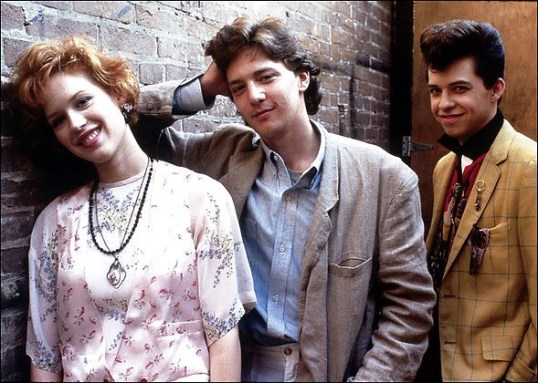
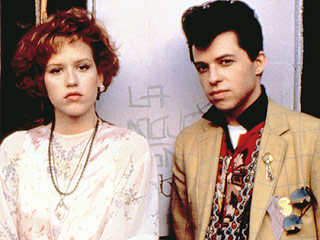
That’s the question at the heart of the 1986 film Pretty In Pink.  In Susannah Gora’s excellent book You Couldn’t Ignore Me If You Tried (which, incidentally, has been an important source of information for this entire Back to School series of reviews), a good deal of space and debate is devoted to whether or not Andi (played by Molly Ringwald) should have ended up going to the prom with either Duckie (Jon Cryer) or Blane (Andrew McCarthy).  What’s interesting is just how passionate the arguments on both side of the debate get.  Those in the pro-Duckie camp, like producer Lauren Shuler Donner and director Howard Deutch, frame the debate as almost being a moral one.  Those on the pro-Blane side — people like John Hughes (who wrote the film’s script) and Andrew McCarthy — make a convincing argument that the audience wanted to see Andie with Blane.

Perhaps most importantly, Molly Ringwald — who not only played Andie but upon whom the character was largely based — makes little secret of which suitor she preferred.  Molly Ringwald is pro-Blane all the way.

Myself — well, I’m going to hold off on saying which side I come down on.

pinkdvd5

Both Blane and Duckie have their flaws and their strengths.  Blane, for instance, comes from a wealthy family and spends too much time worrying about what his loathsome friend Steff (James Spader, who gives a wonderfully evil performance that justifies why he is quoted in Gora’s book as saying, “I figure I got a lock on this whole teen asshole thing,”) thinks.  But, at the same time, Blane is obviously more sensitive than the rest of his rich friends.  There’s a soulful sincerity to McCarthy’s performance and, until he breaks Andi’s heart by giving into peer pressure, he truly is every girl’s dream boyfriend.

124139__pretty_in_pink_l

And then there’s Duckie.  As played by Jon Cryer, Duckie is the type of best friend that we all hope we’re lucky enough to have.  You never have any doubt that he’ll always be there for Andie and it just takes one look at how he’s dressed to understand that Duckie doesn’t care about peer pressure.  Duckie may be an outcast but, unlike Steff and Blane, he’s confident in himself.  And whereas Blane is always wrestling with doubt, Duckie knows that he loves Andie.  And if your heart doesn’t hurt a little when he confesses that fact to Andi, then you probably don’t have one to begin with.  Add to that, as cute and charming as Blane is, you know he’d never break out into a random dance routine.  Blane is no Duckie but, at the same time, Duckie is also no Blane.

And who Andie should take with her to the prom (or if she should even go at all) is an important question because, if anyone deserves to have the perfect prom, it’s Andie.  Not only does she work hard to support her alcoholic and depressed father (the great Harry Dean Stanton) but she has great taste in music (or, at least, she does for someone living in the 80s) and she makes her own clothes.  One reason why we love Blane is because he discovers that, even if Andie isn’t rich, she’s still the most interesting girl in the entire school.  One reason why we love Duckie is because he didn’t have to discover this.  He already knew it.

Pretty-in-Pink-pretty-in-pink-21203179-497-278

The film, of course, originally ended with Blane giving into peer pressure and canceling his date with Andie.  Andie is heart-broken but refuses to surrender.  Wearing the pink dress that she specifically made for the event, Andie still goes to the prom and, as the film ends, she shares a dance with Duckie, the one who, all along, loved her unconditionally.

As is recounted in Gora’s book, test audiences loved the movie but hated that ending.  And so, a new ending was shot.  Blane shows up at the prom without a date.  He apologizes to Andie.  He shakes Duckie’s hand.  He tells Andie that he always believed in her, he just didn’t believe in himself.  (Watching at home, Lisa says, “Oh my God!” and wipes away a tear.)  As he leaves, even Duckie realizes that Andie belongs with Blane.  Andie and Blane are reunited in the parking lot and Duckie goes off with Kristy Swanson.

And you know what?  That ending — that ending is perfect.  Because yes, Duckie did love Andie but Andie loved Blane and the prom is a time to be with someone who you think you’ll love forever.  (Little realizing, of course, that you’ll eventually only think of your former prom date as being that guy who keeps inviting you to play games on Facebook.)  Pretty in Pink is one of the most romantic high school movies ever made and one reason it works is because the ending is all about celebrating that romance.  It may not be realistic and yes, it might even be borderline immoral to allow Blane to be so easily redeemed after breaking Andie’s heart but who cares?

The wonderful thing about romance is that it doesn’t have to make sense.

It just has to be.

61SL9To9GLL._SY300_