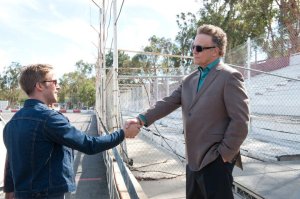
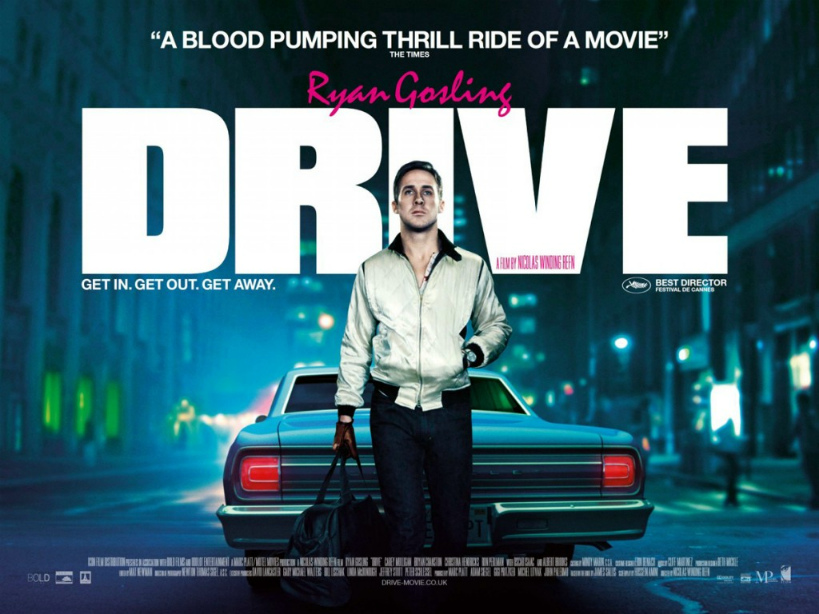
And finally…The Independent Spirit Award Nominations


In one final bit of Oscar Season news, the 2011 Independent Spirit Award nominations were announced on Tuesday.  Because of the sheer number of nominees and awards, I’m just going to post the nominees and refrain from offering up any commentary beyond noting that 1) it’s nice to see Drive, Take Shelter, and 50/50 recognized and 2) that the Independent Spirit Award nominations have a pretty iffy record when it comes to predicting and/or influencing the actual Oscar nominations. 

Best Feature
50/50
Beginners
Drive
Take Shelter
The Artist
The Descendants

Best Director
Mike Mills, Beginners
Nicolas Winding Refn, Drive
Jeff Nichols, Take Shelter
Michel Hazanavicius, The Artist
Alexander Payne, The Descendants

Best First Feature
Another Earth
In The Family
Margin Call
Martha Marcy May Marlene
Natural Selection

Best Male Lead
Demian Bichir, A Better Life
Jean Dujardin, The Artist
Ryan Gosling, Drive
Woody Harrelson, Rampart
Michael Shannon, Take Shelter

Best Female Lead
Lauren Ambrose, Think of Me
Rachel Harris, Natural Selection
Adepero Oduye, Pariah
Elizabeth Olsen, Martha Marcy May Marlene
Michelle Williams, My Week With Marilyn

Best Supporting Male
Albert Brooks, Drive
John Hawkes, Martha Marcy May Marlene
Christopher Plummer, Beginners
John C. Reilly, Cedar Rapids
Corey Stoll, Midnight in Paris

Best Supporting Female
Jessica Chastain, Take Shelter
Anjelica Huston, 50/50
Janet McTeer, Albert Nobbs
Harmony Santana, Gun Hill Road
Shailene Woodley, The Descendants

John Cassavetes Award for films made under $500,000
Bellflower
Circumstance
Hello Lonesome
Pariah
The Dynamiter

Best Documentary
An African Selection
Bill Cunningham New York
The Interrupters
The Redemption of General Butt Naked
We Were Here

Best Cinematography
Joel Hodge, Bellflower
Benjamin Kasulke, The Off Hours
Darius Khondji, Midnight in Paris
Guillaume Shiffman, The Artist
Jeffrey Waldron, The Dynamiter

Best First Screenplay
Mike Cahill & Brit Marling, Another Earth
J.C. Chandor, Margin Call
Patrick DeWitt, Terri
Phil Johnston, Cedar Rapids
Will Reiser, 50/50

Best Screenplay
Joseph Cedar, Footnote
Michel Hazanavicius, The Artist
Tom McCarthy, Win Win
Mike Mills, Beginners
Alexander Payne, The Descendants

Best International Film
A Separation
Melancholia
Shame
The Kid With a Bike
Tyrannosaur

Piaget Producer’s Award
Chad Burris, Mosquita y Mari
Sophia Lin, Take Shelter
Josh Mond, Martha Marcy May Marlene

Someone to Watch Award
Simon Arthur, Silver Tongues
Mark Jackson, Without
Nicholas Ozeki, Mamitas

Truer Than Fiction Award
Heather Courtney, Where Soldiers Come From
Danfung Dennis, Hell and Back Again
Alma Ha’rel, Bombay Beach

Robert Altman Award for ensemble
Margin Call (Penn Badgley, Simon Baker, Paul Bettany, Jeremy Irons, Mary McDonnell, Demi Moore, Zachary Quinto, Kevin Spacey, Stanley Tucci)
The New York Film Critics Circle Names “The Artist” Best Picture of 2011


This is my favorite time of year.  It’s Oscar season, the time when films and actors manuever to win nominations and awards.  This is the time of year when anything seems possible, when you think that maybe Exit Through The Gift Shop will get a best picture nomination or perhaps Christopher Nolan will be nominated for best director for Inception.  In short, this is the month and a half before bitter disillusionment sets in.

During Oscar season, several mysterious groups hand out awards of their own.  These groups are made up of critics desperately trying to convince themselves that they matter and the awards that they hand out are often seen as an indicator of what will eventually end up getting nominated.  Last year, just about every single critical group named The Social Network as best picture and David Fincher as best director and we all remember how little that actually meant once it came time for the actual Academy Awards to be handed out. 

Earlier today, the New York Film Critics Circle helped to start things off by announcing their picks for the best of 2011.  Reportedly, they held off a day on selecting their picks so that they could attend a special screening of David Fincher’s remake of The Girl With The Dragon Tattoo.  And how did that work out?  Well, check out what won:

Best picture: “The Artist”

Best director: Michael Havanavicius, “The Artist”

Best actor: Brad Pitt (“Moneyball,” “Tree of Life”)

Best actress: Meryl Streep (“The Iron Lady”)

Best supporting actor: Albert Brooks (“Drive”)

Best supporting actress: Jessica Chastain (“The Tree of Life,” “The Help” and “Take Shelter”)

Best screenplay: Steve Zaillian and Aaron Sorkin, “Moneyball”

Best cinematography: Emmanuel Lebezki, “Tree of Life”

Best non-fiction film (documentary): “Cave of Forgotten Dreams”

Best foreign language film: “A Separation”

Best first feature: “Margin Call”

Just a few comments on these awards: I have yet to see The Artist but I’m really looking forward to it.  I have a feeling I’m either going to love it or else I’m going to hate it with a passion.  It just appears to be one of those films.  I also haven’t seen Margin Call because its subject matter — Wall Street — makes me go “Bleh!”  But I may have to see it now because it appears to be becoming a bit of an awards dark horse.

I have a feeling that Brad Pitt’s going to win an Oscar for his performance in Moneyball but I really didn’t think it was anything that special.  I thought Pitt was likable but not much else.  Some of that could have had a bit to do with the fact that I couldn’t really follow the film as I’m about as interested in baseball as I am in Wall Street.  Hopefully, I won’t have to sit through another Aaron Sorkin acceptance speech at next year’s Oscar ceremony.  Seriously, there’s only so much time I can spend listening to a pompous millionaire talking about how he thinks the world works.

I haven’t seen The Iron Lady yet but its going to be boring and people are going to feel obligated to pretend like they got something out of it.

Finally, yay to the NYFCC for awarding both Albert Brooks and Werner Herzog’s The Cave of Forgotten Deams


Review: Drive (dir. by Nicolas Winding Refn)


Danish filmmaker Nicolas Winding Refn has made just a handful of films with most staying under the radar of most of the general film-going public. He first caught the attention of indie film fans with his Pusher Trilogy over in Denmark, but he really caught the attention of these fans with his explosive collaboration with Tom Hardy on the Bronson biopic. He would follow that film with the violent existentialist Viking film Valhalla Rising. It would take another major collaboration with another rising star in Ryan Gosling for Winding Refn to finally have his major breakout film which has caught the attention of not just the indie film fans and cineaste crowd, but the general public at-large.

Drive was first screened over at this year’s 2011 Cannes Film Festival where it premiered “in competition” for the Palme d’Or. While the film didn’t win the top prize for best film at Cannes it didn’t garner Nicolas Winding Refn “Best Director” award and his work on this film more than merits such an accolade. The film would begin to screen at other major film festivals before landing at the Toronto International Film Festival before making it’s major public release in North America. Everywhere the film went the consensus reaction to the film has ranged from positive to calls for the film as one of 2011’s best.

So, it would seem most everyone has been quite positive with their reaction to Refn’s Drive. Is this film just another indie arthouse title which the elitist film fans have begun to hype up to levels that would border on cosmic? Or is this film actually as good as it has been talked up to be by such film fans and those of the general public who have seen it? I think the answer lies somewhere in-between.

Drive has been called an action-drama to crime-thriller to film noir and even an existentialist meditation of the film variety. Some have even called it a modern urban fairy tale from the many traditional tropes and themes inherent in fairy tales. The film actually seems to defy genre labels as it’s all those and even more. Nicolas Winding Refn has made a film with so much variety in its cinematic DNA from other classic films and storytelling styles that watching the film once is not enough to find them all.

The film makes a strong statement with it’s introduction of the character who remains nameless but could be called “The Driver” or “The Kid”. Ryan Gosling’s performance in this opening sequence will set the foundation for his character from beginning to end. His driver role is not much for chit-chat and unnecessary talking with those who have hired him to be their expert getaway driver. He’s meticulous with his equipment and intractable when it comes to the rules he has set down for his clients. He would be theirs for the five minutes they need him to drive them away from their criminal acts. Whatever they do before or after those five minutes doesn’t matter to him and he sticks to this rule explicitly. Another rule which he lays down is that he will not be carrying a firearm. These rules have had some audiences bring to mind Jason Statham’s Transporter character and they would not be totally wrong to say so. What Gosling’s driver has over Statham’s is the air of realism to the role. It’s a realism that borders on hyper-reality as the film moves on to it’s climactic conclusion, but real nonetheless. Gosling’s “driver” will not do extensive and elaborate fighting skills the way Statham’s would.

The film would move from it’s powerful introduction and into a much more calm and somewhat serene section as the nameless driver gradually gets to know his next door neighbor in the form of Irene as played by Carey Mulligan. Their relationship will form the core of the film’s narrative and it’s the driver’s growing affection not just for Irene but her young son that would dictate some of the decisions he would make right up to the end of the film. It’s a relationship built not on extensive dialogue banter but mostly on meaningful glances and silent understanding between two characters who seem to have found a kindred kinship between them. It’s this growing relationship between the two and Irene’s son which almost look like a familial unit forming until the return of Irene’s incarcerated and newly-released husband Standard. This is a character played by Oscar Isaac as a man desperate to take full advantage of his last chance at normalcy and redemption, but ultimately doomed to fail.

Standard doesn’t just become the only wrench in the happy life Gosling’s character seems to want to have with Irene and her son. Into the picture also happens to come in is his mentor and business partner Shannon (Bryan Cranston doing a great job as the good-natured, but opportunistic fool character many Shakespearean tragedies always seem to have) and Shannon’s even seedier acquaintances in Hollywood mogul-turned-mob boss Bernie Rose (Albert Brooks in a chilling performance) and his more boisterous, but not as smart partner in Nino (Ron Perlman).

The film seems to settle on the low gears for the first hour of the film, but it’s during a botched robbery attempt where the driver becomes embroiled in that Drive finally moves into the high gears and stays there until the very end. Refn’s decision to use the first hour to round out and build the characters in this film definitely pays off in the end. The audience becomes quite clear as to who the players are and what motivates them to do what they do the rest of the film. Even the most secondary and tertiary roles in this film has a part to play. Even Christina Hendricks in the role of a low-level moll to a gang of criminals gets to have her time to shine if just briefly.

Once the narrative shifts from character study to an almost Cronenbergian exercise in violence and brutality does the film finally able to hook in the last few audiences who may have still been iffy about Drive. Not to say that the final 45-minutes of the film was a non-stop action film, but it does move at a consistently higher gear pace than the first hour. We see the driver having to show to the audience that he’s not just an expert wheelman for Hollywood (stunt driver by day) and the criminal underground (getaway driver by night). It serves the film well that Gosling’s character has the barest minimum of lines of dialogue. We see all we need to know about this character through his behavior that brings to mind roles played by such past luminaries as Steve McQueen and Clint Eastwood.

Most likely it would be in the second half of the film that should satisfy the action junkies. While the action scenes are not of the Michael Bay-type they do show that Refn has a fine grasp of what makes an action scene thrilling. Whether the scene calls for some of the most well-done car chase on film since Frankenheimer showed everyone how to properly do it in Ronin or scenes of sudden brutal violence which calls to mind similar scenes from Cronenberg’s last two films (A History of Violence and Eastern Promises). Both types of action were done efficiently with little to no glamour to gloss over things. The burst of violence actually adds to the mystique of Gosling’s “Man With No Name” role. One particular scene in the apartment elevator where Gosling, Mulligan and a goon sent by the mob makes for one of the best scenes in the film and of 2011.

As much as these scenes of action and violence will be the ones to get the most attention from the general film-going public in the end it’s the excellent screenplay by Hossein Amini of the James Sallis’ novel of the same name which really holds everything together in conjunction with some top-notch performances from everyone involved. The film makes or breaks itself on Gosling’s performance as the driver and he delivers on all cylinders. His performance was quite reminiscent of past performances such as James Caan as Frank in Michael Mann’s Thief, Steve McQueen also as Frank in Bullitt, but in my opinion Gosling’s work in this film brings to mind young Clint Eastwood as “The Man With No Name” in Sergio Leone’s spaghetti western trilogy. Both characters were the type to let their actions speak for them and were both full of quiet confidence not to mention restrained violence which would erupt when needed.

Much has been said about Albert Brooks’ turn as the mob boss Bernie Rose. how the role was quite the 180-degrees from people’s perception of the actor who usually did comedic roles. I say that Albert Brooks always had a dark side to his comedic talent. I mean he was and is megamaniacal villain Hank Scorpio from The Simpsons. In all seriousness, Brooks’ as the mob boss was the other pillar which held all the other performances focused. In fact, Gosling’s character and Brook’s Bernie Rose could almost be considered mirror-images of each other. They were characters who had found their place in the world and the role they would play and didn’t struggle against it. Everyone else in the film struggled against their lot in life. It was also these characters who had the bulk of the film’s dialogue.

Drive has been hyped (for some overhyped) since it first premiered at this year’s Cannes Film Festival, but it’s one of those rare films which has more than earned and surpassed the hype which has preceded it’s general release to the general public. It’s a film which bucks traditional genre labels by combining the themes, ideas and foundations from many different film and storytelling genres. For fans of action there’s enough thrilling action to sate them. For those who are fans of film noir this film definitely carries within it the DNA set down by the film noir of the 40’s, 50’s and 60’s. For some who wish to watch a film which explore existential themes then Refn’s film has that too. In the end, Drive manages to be a film which caters to so many different audiences without ever pandering to them or dumbing the story down. It’s a film made by a filmmaker who continues to impress and who has made his best film to date.

Drive is a film that is not for everyone, but it’s also a film that everyone should see and experience at least once. It is also one of the year’s best films and, so far, my top film of 2011.

Drive Review


This review is not one filled with spoilers but I’d just warn that one can better understand the points I’m trying to make if they have seen the film. Obviously everything I say below is my own opinion and interpretations of the film and many will disagree. I’m writing this second review because in order to sustain my recent obsession with Nicolas Winding Refn’s latest film ‘Drive’, I have been reading a lot of interviews with the director so that I could both  better understand the motivation and ideas surrounding its creation as well as to better appreciate its style and themes so that I can add that onto my already huge admiration and love for the film to better articulate how I felt and express why I think it is the second best film of the year, the first being ‘The Tree of Life’ which was the only other I have seen in 2011 that has caused me to do a second write up like this one and although ‘Drive’ might not be as “deep”, I do believe it is much more complex than some make it out to be and a second viewing caused me to think about it none stop and there are just something’s I need to say.

Since this past weekend when I did see it that second time, the thing that I have come to understand that really caused me to view the entire film in a much different perspective was that my very simple explanation in my other review of it being some sort of character study in the vein of ‘The American’ mixed with ‘Taxi Driver’, though in some ways true, does not even begin to acknowledge the fact that what ‘Drive’ really is, and what Refn decided to create, is a film with a fairy tale archetype guided by an old fable whose themes of love, nature, brutality and heroism shed a new light on the character’s romance and exploits, as well as makes the stories ending that much more emotional.

Refn considers this idea of it being a fairytale to be true, and has said it multiple times, because that is ultimately what he wanted to create. In his words ‘Drive’ is a fairytale set in Los Angeles, whose characters are larger than life figures representing “pure emotion” as he put it; which explains why the love is so pure and the violence is so brutal and there is rarely a middle ground, they are exaggerations of real emotions to add to its fantastical tone.

The first half is the serene and pure story of the innocent young maiden lost in the woods who falls for a “Knight in shining armor”. When evil appears and violates their world of purity and love and threatens the young maiden’s wellbeing, they must be punished by the Knight which brings out a much darker side to the story, in the vein of the Grimm fairytales. The young maiden of course being Irene (Carey Mulligan), a single mother raising her son alone while her husband is in prison. The Knight she falls for has no name but is referred to as simply the Driver (Ryan Gosling). A quiet and mysterious man who is a mechanic and stuntmen by day and a getaway driver by night. He is lonely and most enjoys being out on the road, but easily falls for the beautiful Irene and her son, who offer a chance to be human and evoke emotions he rarely feels. This simple story of love is interrupted when Standard (Oscar Isaac), Irene’s husband, reappears. Not only does he cause a divide but his past resurfaces which has connections to two dangerous gangsters (Albert Brooks, Ron Perlman). In order to do whatever he can to protect Irene and her son, the Driver offers his services to Standard for a heist. It ultimately goes horribly wrong and the two gangsters look to cover it all up by getting rid of all involved, which includes the Driver and Irene.

From here that much darker side appears as the Driver is forced to fight back and protect the things he cares about. This half of the story is guided by the fable of “The Scorpion and the Frog”, about a scorpion who asks a frog to carry him across a river. The frog is afraid to do so because he does not want to be stung but the scorpion tells him that if he were to sting the frog they’d both drown, so the frog agrees. Halfway across the scorpion does in fact sting the frog dooming them both and when the frog asks why he did so the scorpion replies that it is in his nature. The idea being for some creatures their behavior is irrepressible and so cannot be controlled no matter what the consequences. For the scorpion his nature was to sting, he does things instinctively and without much thought. When in a situation where this instinctive nature must come to the surface, when cornered or in this case when those people the Driver cares for are threatened, he reverts to that aggressive scorpion nature and stings, hard and violent no matter the consequence which in this case means losing himself or the ones he cares for.

The elevator scene is really that tipping point where the stinger comes out and not surprisingly one of the best scenes in the entire film. It is when he puts his human emotion and love aside in order to fully protect Irene. After he kisses her goodbye he knows he is about to reveal his true nature. After viciously killing the man who had put him into that corner he looks at Irene and knows it is over which is his ‘great sacrifice’, letting the one he loves go in order to protect her, and what makes him a true hero. The elevator door closes and the two are separated for good. He must now do whatever he can to distance himself and all this evil from Irene and her son.

What is interesting about the idea of the Driver as being a hero is the sort of duel personalities he evokes. One could say he is human by day, working a normal job, shopping and falling in love but a “hero” by night, though not helping the right people. When the story really becomes interesting is when he has to blend the two personas to become something more which is why Refn and Gosling have described it as their ‘superhero’ film. He is a man with the capacity to be a “real hero” and it is only when he can bring his human emotion to that more aggressive and skillful side that he does become this sort of superhero-like character. Obviously it is difficult for him. It isn’t a smooth transition and at times he has trouble controlling it, which comes through as he shakes as his anger and adrenaline builds when talking to Nino on the phone and of course when he brutality stomps the life out of one of Nino’s hitmen in the elevator scene mentioned earlier. This is that scorpion nature coming through, this aggressive nature is the key to his power, and why it is most fitting that his ‘custom’ is a jacket with a scorpion logo on the back.

Though his actions seem necessary he still does not want to lose his ‘human’ side and puts on the mask towards the end because he must fully embrace this more aggressive side to get the job done, to quell his emotions and settle the battle raging between both persona’s and essentially become a lifeless and aggressive vessel with one objective. This way he can do what needs to be done, evoke a bit of fear from his target, but cover up and shield his human persona and not completely lose himself. Throughout this he becomes someone we empathizes with, even if his methods seem to be so extreme. The outcome to it all, although somewhat ambiguous, is a fitting and emotional conclusion where some people do in fact live happily ever after.

What makes this all work so effectively is the fact that ‘Drive’ is a film in which things don’t need to be spoken to be said. One where characters express more through silence, short but poignant dialogue and the interactions they have together. Refn brilliantly creates a dreamlike and contemplative exploration of the serene and the hyper violent set within a fairytale like story that happens to be a slow burning character study of the ‘scorpion’ where everything is just below the surface and it all builds up, through a series of quiet and calm moments, only to erupt into brutal violence. Nothing is handed to you, there is no blatant exposition, you don’t always know what is going on in a characters head and it helps create a level of tension and actually requires one to think. This isn’t some sort of mindless action thriller, it’s much more contemplative and complex than one would expect. He polishes it all off with a retro varnish evoking a different time, helping to set it apart from reality and add to its moody atmosphere, but still keeping it grounded enough to feel real and have that emotional punch. Add onto that all of that the fantastic performances: Ryan Gosling’s brilliantly effective and charismatic performance as the Driver, Carey Mulligans charming and sweet portrayal of Irene, Ron Perlman’s brutish and aggressive Nino, Albert Brooks as the ruthless but understandable Bernie, Bryan Cranston as the downtrodden but humorous Shannon, Oscar Isaac as Irene’s husband who needs help to avoid his past; and what you are left with is a masterful, beautiful and complex film. It truly is a modern day fairytale, perfect in every way, and a film that I couldn’t help but fall in love with.

Song of the Day: Nightcall (by Kavinsky & Lovefoxxx)


The latest “Song of the Day” choice is the other song used in the film Drive which made quite an impression on while I watched the film. It’s the 2010 electro house track “Nightcall” from a similarly titled EP from electro house artist Kavinsky.

“Nightcall” was the song chosen by Drive filmmaker Nicolas Winding Refn and it’s film composer Cliff Martinez to begin the film. The choice of this song was pretty much a perfect one as it made for a great intro to the film. The song plays as the film introduces us to the lead character (played by Ryan Gosling) as he drives down the late-night streets and alleys of Los Angeles. The song’s 80’s sound gives the film an almost old-school drama feel to it. For anyone who grew up in the 1980’s this song definitely would sound familiar as it style was used many times over to score many action-dramas.

With “A Real Hero” this song helps bookend song-wise one of the more interesting and, in my opinion, one of the best films of 2011.

Nightcall

I’m giving you a night call to tell you how I feel
I want to drive you through the night, down the hills
I’m gonna tell you something you don’t want to hear
I’m gonna show you where it’s dark, but have no fear

There something inside you
It’s hard to explain
They’re talking about you boy
But you’re still the same

There something inside you
Its hard to explain
They’re talking about you boy
But you’re still the same

I’m giving you a night call to tell you how I feel
I want to drive you through the night, down the hills
I’m gonna tell you something you don’t want to hear
I’m gonna show you where it’s dark, but have no fear

There something inside you
It’s hard to explain
They’re talking about you boy
But you’re still the same

There something inside you
It’s hard to explain
They’re talking about you boy
But you’re still the same

There something inside you (there something inside you)
It’s hard to explain (it’s hard to explain )
They’re talking about you boy (they’re talking about you boy)
But you’re still the same

Quick Review: Drive (dir. by Nicolas Winding Refn)


Here at the Shattered Lens, we’ve been eagerly awaiting Nicolas Winding Refn’s Drive, which has picked up some major buzz over the last few months. So note that this will not be the only review you’ll see for the film. As the other reviews come in, I’ll update this paragraph to link to them.

Addendum: 

Leonth3duke has added his Drive Review, which examines the film from a lens closer to the director’s point of view and remains spoiler free. Definitely worth reading!

Arleigh has also added his Drive Review – which compares the film to both Michael Mann and David Cronenberg’s styles.

*  *   *   *  *

I was so excited by Drive that I treated my extended family to it (just in case the film went sour, it would be easy to apologize). This is going to be a quick review, because I’m going to ramble.

To quickly sum it up, Drive is a beautiful, artistic film that hits all the right buttons when it comes to the crimes it showcases. It occasionally explodes between quiet reflection and ultra violent action. Even the music was sweet. It’s just a shame though that all that coolness is wrapped up in dialogue and scenes where the pacing……moves……as……………slow…………..as………………this. Honestly, the book this was adapted from felt like it must have been about 50 pages, at best.

Drive is the tale of Driver (Ryan Gosling), a stuntman for the movies by day, and a Wheelman by night. His partner, Shannon (a nice performance by Breaking Bad’s Bryan Cranston) gets involved with a mobster (Albert Brooks) on a business venture. After getting caught up in a heist that goes awry, Driver has to try to protect himself along with the woman and child he’s recently befriended.

Drive has a fantastic sequence before we actually see the opening credits. Everything about that opening is downright sharp and creative. I haven’t seen that cool an opening to a film in quite a while. What a way to hook the audience in.

Overall, the film feels great and unique, but it suffers from one problem that I’ve only seen a few people actually mention. It feels like there’s this pause between every statement between Driver and Irene (Carey Mulligan). Imagine having one character say “Hello”, and then having someone pause the movie for a few minutes before picking it up from there. Drive ended up doing this quite a bit.  I can understand if Driver is a soft spoken, man of action,  but there were moments where I wanted to shake both Gosling and Mulligan to communicate more. I’m not saying they had to move in a particular direction, but they had a lot of patience waiting for replies from each other.  There were other scenes where I felt Refn should have considered adding just a few cuts to the film to increase the speed of the film. The slow pace keeps it from becoming The Transporter, but most of this movie felt like that 3rd act in Heat after the robbery (or the multiple endings in Return of the King) to me. The film felt more like it was in love with itself than anything.

I understand that Drive is an independent film, and with independent filmmaking, there’s a bit more freedom to do things artistically instead of having movie marketers breathe down your throat. While I may lack the film appreciation skills to effectively grasp the artistic impact of Drive on screen, I can say that as a dialog or story driven piece, the movie suffers that one hiccup. Others may see the movie differently than I did.

Pacing aside, Drive is easily worth seeing, and is in some ways similar to some of Michael Mann’s films like Thief and the aforementioned Heat. Ryan Gosling was cool, but knowing that you’re not going to get the kind of emotion from his character compared to maybe Blue Valentine helps to brace you. Working from Mann’s concept of movies, you could relate Driver to a Neil McCauley. In Heat, DeNiro’s McCauley took action when he needed to. If someone forced his hand, the response was harsh. Driver felt like he had something of the same approach, which I really did like.

Visually speaking, I loved it, but it just has areas where Refn appears to be in love with a shot so much that he lingers longer than he needs to. If you never told me who directed this, I might assume it was David Lynch.  The driving scenes themselves are done very well, and the action is also explosive, breaking the silence in the film a number of times. The silence is so strong that something as simple as a gunshot caused most of the audience to jump, which I found interesting.

The other performances in Drive are interesting, especially Albert Brooks and Oscar Issac, particularly. I didn’t even recognize him in this film, compared to his bad guy role in Sucker Punch. Christina Hendricks, though nice to see, didn’t really do too much here.

So with Drive, you can go see it. I may see it again myself. I’m not saying you shouldn’t, but if you yawn somewhere down the line, don’t say I didn’t warn you.

One other thing I had to add here. The Marketing for this film a few months ago (including the original trailer) is closer to the impact of the actual film than some of the marketing that’s being done now. Most of the recent posters and tv ads push Drive as something of an action piece. I would consider it more of a Drama with action occasionally spliced in.

Song of the Day: A Real Hero (by College feat. Electric Youth)


For the latest “Song of the Day” I only had one choice in mind. No other song has wormed it’s way into my waking consciousness than the song I chose. It’s the 80’s-like synth-pop song “A Real Hero” by the band College feat. Electric Youth.

To say that Nicolas Winding Refn’s first Hollywood film (though still quite modestly budgeted) was something that stuck to me would be an understatement. One of the factors which just made the film one of the best films of 2011 has to be the 80’s retro synthpop soundtrack by Cliff Martinez and some perfectly chosen licensed songs. The one song which definitely has become a favorite and also one which has stuck itself in my mind since I saw the film is “A Real Hero” which we fully hear in the end of the film and into the end credits (the song get a brief appearance in the middle of the film).

This song perfectly encapsulates the restrained love story between the characters played by Ryan Gosling and Carey Mulligan. It explores the dynamic between The Kid (Gosling’s role) and Irene the young mother (Mulligan’s role) as heard through the song’s sparse lyrics which intersperse itself between the electronic synth keyboard play. It’s inclusion in two spots in the film adds different meanings to the song. The first time we hear it the song adds a soft layer of old-school romanticism to Gosling and Mulligan’s characters, but when we finally hear it in full in the end that romanticism takes on an ambiguous tone with just a tinge of bittersweet to the romance.

There’s another song from the Drive soundtrack which also made quite an impact not just in the film’s overall quality but in me as a listener and an audience. That would be explored in a day or so.

Poll: Which Films Are You Most Looking Forward To Seeing In October?


Last month, at this time, we asked you which films you were most looking forward to seeing in September.  The results are in and it would appear that September is going to be all about Drive, Contagion, Moneyball, and Warrior for most of our readers.   Thank you to everyone who voted.

Below, you’ll find the poll for October. Let us know which October films you’re most looking forward to seeing.  As always, please feel free to vote for up to four films.

(As for me, I voted for The Rum Diary, Footloose, In Time, and The Skin I Live In.)

Poll: Which Films Are You Most Looking Forward To Seeing In September?


One month ago, we asked you which films you are most looking forward to seeing in August.  The results of that poll can be found here but, in short, it would appear that, for the majority of our readers, August is going to be all about The Rise of the Planet of the Apes, Don’t Be Afraid of the Dark, Conan the Barbarian, and Fright Night

(Though for me personally, August is all about One Day.)

So, what’s September going to be all about?  Well, why not let us know by voting in our latest poll?  As always, you can vote for up to four films and write-in votes are always allowed.  Happy voting!

(Personally, I’ll be voting for 50/50, Drive, Contagion, and A Good, Old-Fashioned Orgy.)

SDCC 2011: Drive (dir. Nicolas Winding Refn) Red Band Trailer


One of the films I’ve really been following since last year and can’t wait to see this September is the latest film from Danish filmmaker Nicolas Winding Refn. I’ve loved his work since I first got introduced to his Pusher Trilogy and saw his two most recent work with Bronson and Valhalla Rising. He is following up the latter with what I could only describe as his own take on the neo-noir genre film, Drive.

At San Diego Comic-Con 2011, the latest trailer for Drive was introduced during the FilmDistrict panel which also had Guillermo Del Toro and his upcoming produced horror film, Don’t Be Afraid of the Dark. This latest trailer for Refn’s Drive is of the red band variety but from what I could tell from the trailer it shouldn’t be NSFW.

The trailer really doesn’t delve too much into all the plot points of the film. It does give a sense that the film has been influenced by past genre crime films and some of the classic grindhouse chase films of the 70’s. One thing I’m sure of is that this film’s cast looks to be one of the best for any film being released in 2011: Ryan Gosling, Carey Mulligan, Ron Perlman, Oscar Isaac, Albert Brooks, Bryan Cranston and Christina Hendricks just to name a few.

Drive is set for a September 16, 2011 release here in the United States.

Source: IGN