Who would’ve thought that a comic book named Cowboys & Aliens will end up being one of the most anticipated tentpole films for the Summer of 2011. It’s a fun little book from Platinum Studios created by Scott Mitchell Rosenberg and written by Fred Van Lente and Andrew Foley with the artwork done by one Luciano Lima. The premise of the comic book is literally about cowboys and aliens. With the latter attempting to enslave humanity during the 1870’s and starting with the Wild West. In their plans for world conquest are a band of cowboys and Indians who band together despite their many conflicts and issues to combat a shared and greater threat.
The film was announced prior to the release of Favreau’s Iron Man 2 and was a surprising one. Many insiders thought he was a shoo-in to helm the planned Avengers film for Marvel, but instead he chose this project instead.
To say that Cowboys & Aliens steamrolled into production with so many heavyweights behind it would be an understatement. Favreau was already in the director’s chair and producing the project behind the scenes were giants of the industry like Steven Spielberg, Brian Grazer and Ron Howard. The cast roped in for the film was also quite impressive with Daniel Craig taking on the lead role with Olivia Wilde, Harrison Ford, Clancy Brown, Keith Carridine, Walton Goggins and Paul Dano supporting Craig.
The very first teaser trailer has been released and could be seen above. While the trailer only shows only a little bit it does confirm that it will have cowboys and, from the brief glancing images, aliens. Cowboys & Aliens has a tentative release date of July 29, 2011 and joins other comic book-based films for that summer like Thor, Captain America and Green Lantern.
It will be interesting to see if Favreau keeps the bulk of the books storyline in the film or will he just loosely base the story on the books. One thing for sure, he and his crew have a tall order to try and tell this story and do it well enough that it stands out amongst the many comic book blockbusters and sequels set to appear in the same season. This film could be a real fun, action-adventure or it could easily turn into the second coming of Wild, Wild West. Here’s to hoping it’s the former and not the latter.
“I may have dropped into Normandy on D-Day, but I still had Liberty in Paris or London. You Gyrenes had jungle rot and malaria.”
In 2001, HBO came out with a mini-series that detailed the experiences of the men of Easy Company, 506th Parachute Regiment of the 101st Airborne. This series was produced with loving care by Tom Hanks and Steven Spielberg. Two men who were instrumental in the success of an earlier World War 2 project called Saving Private Ryan. This series was called Band of Brothers and became one of the most critically-acclaimed mini-series of its time and has become part of the staple of military-themed shows and films that gets shown on Memorial and Veterans Day in the United States.
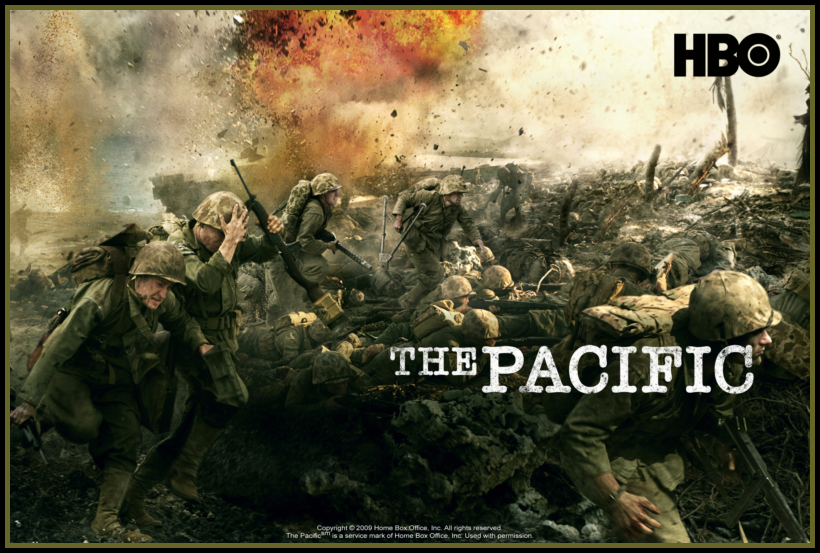
Even as this series was only a year old there was talk from some of its admirers about whether HBO and the team of Hanks and Spielberg would re-visit this era Tom Brokaw called “The Greatest Generation”. To re-visit and tell the stories of the men who fought on the other side of the European Theater in what was an even more hellish battlezone in the Pacific. It took almost 9 years, but the ending result is the mini-series called simply The Pacific.
The Pacific tells the story of three Marines of the 1st Marine Corps Division from their time before their unit ships out to the Pacific Theater of Operations and through some of the bloodiest and most savage battlefields of World War 2. There’s Gunnery Sgt. John Basilone (played by Jon Seda) who would show the sort of stoic heroism people nowadays would dismiss as a figment of Hollywood writers, but who actually did all the things only seen in action films. Bookending Basilone would be two newcomers to the art of war in PFC Robert Leckie (James Badge Dale of AMC’s recently cancelled series, Rubicon) and Cpl. Eugene “Sledgehammer” Sledge (Joseph Mazzelo from Jurassic Park). These two Marines are our guide through the unending hell that were the battles in Gen. MacArthur’s island-hopping campaign to beat back the Army and Naval forces of Imperial Japan.
It’s also these two men and their memoirs which detail their experiences during the war in the Pacific which make up the bulk of the narrative for the series. One would be Sledge’s With the Old Breed: At Peleliu and Okinawa which many consider as one of the best first-hand accounts of combat in the Pacific. The other one is Helmet for My Pillow by Leckie which was a more personal account of his time from Marine boot camp and experiencing a type of warfare in the Pacific which was new to a young man from the States. A type of warfare where the enemy didn’t surrender and would sacrifice his life in the service of one’s Emperor.
Basilone, Sledge and Leckie’s stories never come together but were told in concurrent fashion to show the audience the differing views of each. All three would go through the same meat-grinder that were the battles in immortalized places named Guadalcanal, Cape Gloucester, Peleliu, Iwo Jima and Okinawa.
We see Basilone’s heroism on Guadalcanal make him into a Stateside hero and taken away from those he fought beside to help push war bonds for the government. This change in environment for him doesn’t sit well with Basilone as we see the survivor’s guilt in him. Why does he get all the celebrity attentions when others like him were still fighting and dying the same battles he was just in months before. His story is the most poignant of the three as he finds happiness while training new Marines for the war only for his need to get back into the fight win out. The fact that all this happened for real makes his story even more memorable. Hollywood writers have tried to capture such moments and often-times fail. It was great to see Basilone’s story told for everyone to see that the world past, present and future has real-life heroes that Hollywood could never replicate but only imitate.
Jon Seda’s performance was in-line with what one thinks a gung-ho Marine should be but he brought a sense of realism to the role. He didn’t try to make Basilone more a hero than he already was. I like to compare his performance to that of Tom Hanks’ Capt. Miller in Saving Private Ryan and Damian Lewis’ Maj. Dick Winters in Band of Brothers. He was a man who did acts of bravery as seen by others on the battlefield and one which made him a celebrity to the civilians Stateside. But in the end he just saw it as him doing his job as he was trained and trying to keep his men alive. He didn’t see himself as a hero and while his Stateside role of war hero pushing war bonds did bring some perks he never fit in. Seda’s work in Part Eight where he meets his future wife was some of the best work in this series.
In Leckie’s story we see a man swept up in the great enlistment drive which happened right after the Japanese attack on Pearl Harbor. His story sees a cocky and smart young man wanting to do his part for the war effort yet not knowing the sort of sacrifices he’ll have to make or the horrors he will witness and inflict to survive day-to-day. We see Leckie quick to make friends in his unit during their training and then through their baptism of fire in the Battle of Tenaru before seeing the real horror of the war in the Pacific as his unit and the rest of the 1st Marine Division land of the island of Guadalcanal.
His time on Guadalcanal would soon erase any romanticized notion of honor and glory in battle Leckie may have had when he decided to enlist. As a writer in his civilian life prior to the war’s start he would continue to write his experiences in-between battles and skirmishes with the Japanese. Even when friends in his unit would die each and every day it seems Leckie seemed to want to keep that savagery at bay with his writing which would become a basis for his wartime memoirs. His story ends midway through the series and we won’t see him again until the final denouement as we see Leckie’s life as a civilian once again after the war. His final time in the warzone would be on the Battle of Peleliu (one of the bloodiest battles in USMC history and one that would be steeped in tragedy afterwards) where a severe concussive blast would render him unable to fight. It’s scenes on one of the hospital ships off the coast of Peleliu where Leckie’s own survivor’s guilt is temepered by the realization that any more time out in the battlefield would surely strip him of his humanity and turn him into the growing examples of battle-scarred and psychologically damaged Marines who have seen and done too many horrible things to ever return back to their civilian life intact.
The final episode shows Leckie (with James Badge Dale in a confident and cocky turn) the one who seem to adjust to the life back to civilian life with a modicum of ease. While he still carries the scars of battle in his psyche its that time in the Pacific which has also given Leckie the confidence to get his old job back at the local paper he used to work for and woo the pretty girl next door he had been shy and awkward with in the very first episode. While his performance wasn’t as good as Seda it was still a noteworthy one which brought the person of PFC Robert Leckie to the masses watching this series.
Lastly, we come to the third of the three whose story the series revolves around. The story of one Cpl. Eugene Sledge who, like Leckie, wanted to do his part for the war effort. While his young age at the start of the war prohibited him from enlisting without his parents’ consent he finally gets a chance a year later when he is of age and just in time for him to join the Corps, train and see his first taste of combat in the Pacific on the killing grounds of Peleliu then the hellish nightmare battlefields of Okinawa.
Sledge’s story is the most complex and runs the gamut of dark emotions a young man should never have to take. His young idealism in helping his country in its time of need will get some tempering even before he ships out to become a Marine. His father tells him of having to treat young men from an earlier era from another major war which had engulfed the world. His father spoke about how some of these young men who came back whole physically didn’t do so psychologically. He spoke about how the horrors of war seemed to have “ripped the souls” from these returning young men and how he didn’t want his son to go through the same thing. But as young, headstrong men who think they’re invincible are wont to do he enlists anyway.
The performance by Joseph Mazzello (hard to believe this young man is the same young boy who ran and escaped from CGI raptors and T-Rex on Spielberg’s Jurassic Park) tops all other performances in this cast full of noteworthy and great acting work. We don’t just see his Sledge go through each horrific scene after scene of battle and its aftermath with is emotional and psyche gradually sliding down into the abyss, but we could actually see Mazzello’s body, mannerisms and the look in his eyes make the same changes. I fully bought into his performance as the young idealistic young man from Mobile, Alabama slowly turned into the same uncaring, savage Marine one had to become to survive the war in the Pacific. He had seen enough bodies of Marines and enemy Japanese torn apart and strewn about everywhere one looked that one became inured to them.
One of the most powerful scenes in the series has Sledge confronted by the aftermath of what he and his mortar-team might have been responsible for. It was deep into the campaign to take the island of Okinawa and Sledge and his fellow Marines have been brought to the edge of insanity by all the fighting. A fight which has some of them questioning why the enemy just doesn’t surrender. An enemy willing to suicide charge into heavily armed Marines and also willing to herd Okinawan civilians into the line of fire. It’s this brutality by the enemy and mirrored by his fellow Marines which brings Sledge to a darker side of his nature which we as an audience don’t see a way out for him. But in the scene close to the very end of Part Nine brings Sledge back from the abyss and reminds him that there’s still humanity in him and the very Marines he has been with since the beginning. His reaction afterwards to a group of new Marines killing a young Japanese soldier for sport sickens him. We see Sledge realizing how just days and months before he was spouting the very same savage hate for the enemy as these newly arrived Marines looking for their first kill.
Of the three it’s Sledge who will carry the deepest scars of the Pacific for the rest of his life. We see the extreme difficulty he has in adjusting back to civilian life. Nightmares haunt his nights and flashbacks of the battlefields hound his steps in the daytime. His mental and emotional breakdown as he tries to go back to hunting with his father encapsulates this series at its most basic core. This series doesn’t have the camaraderie and brotherhood established between fellow soldiers that its predecessor had. While Band of Brothers also showed the horrors of war in Europe it was balanced by the hope that everyone in Easy Company had their brothers in arms to back them up when the bullets flew and shells exploded. This wasn’t the case in the Pacific.
Sure the were the same camaraderie and brotherhood, but the type of enemy fought in abject conditions which made downtime from battle almost as bad as the battle themselves didn’t bring hope. It only brought misery and a fatalistic view of the world Sledge and his fellow Marines existed right there and then. His breakdown in the final episode shows how those who fought in the Pacific definitely bore deeper scars and returned more damaged than their European brothers. Scars not just inflicted by the enemy but those they’ve inflicted on themselves by fighting savagery with their own form of savagery. It was a kill or be killed world and returning back from that brink didn’t happen to everyone and those who were able to return did so not whole.
I understand that some were disappointed by how The Pacific turned out. How it didn’t live up to the standards created by Band of Brothers. Some have said that there was no main focus to the narrative the way its predecessor strictly followed the men of Easy Company through the battles in Europe. They’ve pointed out how some episodes took too much time to get to the battle scenes. I think trying to compare The Pacific to Band of Brothers is foolish and a doesn’t give this follow-up mini-series the proper due it deserves.
The Pacific wasn’t trying to tell Band of Brother in the Pacific. While the two series do take place in the same world war the circumstances surrounding the storylines in both series diverge to take different paths. The first series almost seem like men fighting for a common cause and the good fight against tyranny. The Pacific is all about revenge. Revenge and payback for Pearl Harbor at first then as the series moves forward it becomes revenge and brutality for seeing their buddies die. This series showed nothing noble about the fighting in the Pacific. It was just a struggle to survive from one day to the next.
So, while this series may not be the second coming of Band of Brothers it does stand on its own merits and I think was the more powerful of the two. It didn’t flinch away or dismiss the darker side of the “good guys” and showed that war truly is hell and that those who fight and live through it were truly never the same. I say watch The Pacific and stop trying to compare it to Band of Brothers or any of the several shows dealing with the current wars. The Pacific should be watched as seen as the bookend to Band of Brothers. A darker journey to seeing the war of the “Greatest Generation” from the eyes of those who fought and died on the islands and jungles of the Pacific.
Steven Spielberg’s War of the Worlds shows that he hasn’t lost his touch when it comes to creating blockbuster spectacle. While he has spent much of the 2000’s creating dramatic films (The Terminal, Catch Me If You Can and Munich) he hadn’t made a film which spoke epic in both spectacle and themes. He had made two unique films with sci-fi themes with A.I. and Minority Report, but still they lacked the size and oomph of Spielberg’s past blockbusters. It took him remaking for the current generation a classic sci-fi story to bring us back the Spielberg many grew up with. His take on H.G. Wells tale of aliens invading Earth was both grandiose in it’s set-up, but he was also able to deftly weave a very personal story within the larger scheme of the narrative.
Working from David Koepp and Josh Friedman’s adaptation of the classic H.G. Wells novel, Spielberg goes back to his roots as a maker of thrillers that first showed his talents as a director. War of the Worlds has its spectacular CG moments when the alien Tri-Pods first rise up and out of the ground to the look of awe and fear from people witnessing the event. Spielberg begins the film’s unrelentless tension from these scenes and never lets go. Once the Tri-Pods start unleashing their death-rays on the populace and whatever else is in their way the film starts moving at breakneck speed. It’s these same apocalyptic scenes of the alien’s extermination of humans that has prompted critics (both positive and negative) to bring up Spielberg’s use of 9/11 imagery. From the clouds of ash and floating pieces of clothes to the sight of people running in panic as destruction rains upon them from out of nowhere.
Some critics have labeled Spielberg’s film as exploiting the horror of 9/11 and its aftermath, yet when a film like 28 Days Later use the same imagery and themes these same critics applaud the director of this film as daring. Its an unfair criticism of Spielberg and just shows how some people just seem to use the events of 9/11 as a crutch. Yet, it is this same use of people vaporised into nothing but ash and clothng that adds to the tension and horror. It is easy to use blood and gore to bring up a feel of horror, but Spielberg one up’s this and forgo grand guignol scenes. His technique actually brings an inhuman and alien quality to the death and destruction on the screen. From the moment the aliens arrive Spielberg lets us know that this is a war that has not been seen on Earth.
Spielberg and his writers have stuck pretty close to what Wells’ wrote in the original novel, but have decided to look at the story through the eyes of a father and his son and daughter. This gives the film a more personal, disjointed and chaotic feel. There’s no scenes of the government powerbrokers debating and deciding how best to combat the aliens and their machines. No scenes of scientists trying to figure out how best to fight and get through the aliens’ defenses. In fact, War of the Worlds is the anti-Independence Day. What we get instead is a story of a man and his children trying to just survive the apocalypse occuring around them as best as they can. This choice by Spielberg and his writers to go this route is best shown in a scene where Tom Cruise’s character with his kids run into a convoy of military vehicles heading towards the frontline. We see Humvees, M1A2 Main Battle Tanks and other assorted military hardware and hundreds of soldiers. We can hear the sound of the battle just over the ridge of a hill, but just like Cruise’s character we do not actually see the battle happening. We hear snippets of commands and reports from the soldiers around Cruise. Spielberg could’ve easily panned the camera up over the ridge to see how the battle was progressing, but he stays his hand focuses instead on the dad and his family. It’s easier to go the route that Bay or Emmerich would take and show the sturm und drang, but that wasn’t the story Spielberg was trying to tell.
ILM’s work in creating the alien Tri-Pods and the subsequent terraforming the aliens begin were some very good work from an FX company with a history of impressive work. The Tri-Pods kept the original H.G. Wells description from the novels but gave them a modern take. While the George Pal version of the alien ships remain classic sci-fi icons these new Tri-Pods in Spielberg’s War of the Worlds definitely conveyed alien menace and destruction the moment they began to come out of the ground. It was a joy as a sci-fi fan to actually see that Spielberg and the writers decided to show just how menacing the alien invaders were in the way they began to terraform the planet to suit their needs. It definitely put a new definition to the term “the blood is life”.
The acting is what you expect from a Spielberg/Cruise collaboration. Cruise is actually very believable as a loser father who seem to look at his kids as more of a hindrance and a scheduled paternal duty than something he actually enjoys and looks forward to. Some of the best scenes Cruise has in the film are quiet ones between him and his daughter (played by Dakota Fanning) where he realizes that he really doesn’t know his daughter that well and can’t even remotely figure out how to calm her down and make her feel safe. When his daughter asks him to sing her a lullaby, the look of incomprehension at not knowing any showing on Cruise’s face is just brilliant. The one misfire in terms of characters in the film is Tim Robbins. The sequence in the film where they meet up with his paranoid and slowly going nuts character is actually very good in terms of ratcheting up the tension, but Robbins’ performance was more funny than anything else. Spielberg had created such a doom and gloom atmosphere that Robbins’ character’s appearance ruins it abit.
One other thing which kept me from calling this film an outright great film are the kids of Cruise’s character. While the performances by Dakota Fanning as the daughter and Justin Chatwin as the son were quite good the way they were written left them annoying and baffling. Either the daughter was a shrieking and emotional mess or the son was written as a rebellious teen who wanted to get into the fight despite knowing he was his sister’s lone protector to begin the film. It made Cruise’s character seem less of an unattentive father and boor, but more of a parent who tried his best with children who defied and talkbacked at every turn. If the writers just made the kids even remotely sympathetic it definitely would’ve rounded out their characters as real people.
Overall, I think Spielberg’s War of the Worlds succeeds in what it set out to do despite some flaws with some of the characters. It entertains and it also shows that when it comes to blockbuster filmmaking he is still the master and everyone else just pretenders to his throne. As for the ending that some think as being short, abrupt and just a tad deus ex machina in execution, well I suggest they read or reread the book again. The ending fit the film perfectly. If the film was an all-out blast to the senses then a different one may be a better fit, but for the type of story Spielberg decided to film the ending made sense in its execution.
This week we saw news that the potential live-action Battle Angel Alita was one-step closer to becoming reality as script collaborator Laeta Kalogridis was working on a draft for James Cameron. Now comes more news of another manga classic getting closer to getting it’s own live-action adaptation being made with her about to turn in a script in a few weeks. This classic manga is Ghos in the Shell.
Masamune Shirow’s Ghost in the Shell has always been one of those manga/anime works which has continued to gain fans despite all the new anime/manga properties churned out in the dozens every year in Japan. It, like Katsuhiro Otomo’s Akira, has become one of the classics in the medium and plans to create a live-action version has been rumored and talked about for over a decade. With hollywood hungry for new properties and ideas to put on film they’ve suddenly turned to the Japanese manga and anime well for such ideas.
The rights to develop a live-action adaptation of GitS was acquired by Dreamworks a couple years ago with Steven Spielberg being the main engine to get the project up and running. In a couple weeks we’ll find out just how feasible this adaptation will be as the script by Laeta Kalogridis will be delivered to Dreamworks and Spielberg. If they like what they see of Kalogridis’ work then production can quickly begin as a planned 2011 release is still on the table. As a blowback to the success of Cameron’s Avatar, it looks like Dreamworks plans to have the film done in 3D right from the start and not something tacked on after production. If this is the case then Spielberg gets it when it comes to 3D and exactly how Cameron thinks 3D should be used.
I wonder if the oft-rumored and planned Akira live-action will get new traction and finally get made. That’s another anime/manga live-adaptation that will probably look great in 3D.



 Through the Shattered Lens