Musical Film Review: Let It Be (dir by Michael Lindsay-Hogg)


Hey, it’s the Beatles!

The 1970 documentary Let It Be, which is now streaming on Disney+ after being impossible to see for decades, follows the Beatles as they record music, occasionally argue, occasionally laugh, collaborate on songs, and ultimately play the famous rooftop concert that was eventually ended by the London police.  Paul McCartney smiles and laughs and jokes but he also obsesses over every little musical detail and often seems to be talking in order to keep anyone else from getting a cross word in.  John Lennon dances with Yoko Ono and occasionally smiles but often seems like his mind is elsewhere.  George Harrison smiles whenever he know that the camera is on him but, when glimpsed in the background, he doesn’t seem happy at all.  Ringo patiently waits for his chance to perform, sometimes bored and sometimes amused but always the most likable of the bunch.  He and George work on Octopus Garden and it’s a charming moment, if just because it’s obvious that both men would rather be there than in the studio.

Even if you haven’t seen Peter Jackson’s The Beatles: Get Back (which was constructed out of material that was shot for but not used in this documentary), Let It Be is often time one of the most depressing behind-the-scenes documentaries ever made.  The more the individual members of the Beatles smile and perform for the camera, the more one can see the cracks that have formed in their relationships.  With Lennon spending most of his time with Yoko, it’s Paul who dominates the documentary.  Paul comes across as being charming and talented but his habit of nonstop talking gives the impression of someone who is desperately trying to hold together a sinking ship.  At one point, George snaps that he’ll play the guitar however Paul tells him to and it’s obvious that, for George and probably the others as well, being the world’s most popular band has gone from being a thrill to just being another job.  When Paul and John talk about how much fun they had when they first started playing live in  Hamburg, it’s obvious that the conversation is at least partially staged to set up the rooftop concert but there’s a genuine sadness to their voices.  Even as they write and record new songs, they’re realizing that all things must pass.

But then the Beatles give a rooftop concert and they bring London to a halt and, for a few minutes, it seems like everything is going to be alright.  Standing on the roof and performing a wonderful version of Get Back, the Beatles are suddenly a band just having fun and it’s delightful to see.  Later, John Lennon gets a devilish gleam in his eyes as he sings the raunchy (for 1969) lyrics for I’ve Got A Feeling.  Even George looks happy for a few moments.  People gather in the street below to watch and the camera is quick to show us that both young and old love the Beatles.  Of course, eventually, the police show up and shut down the show.  (Of course, being British police, they’re very polite about it.  One has to breathe a sigh of relief that the Beatles didn’t try to do their rooftop show in New York or Los Angeles.)  It’s a reminder that nothing lasts forever.  Eventually, every concert comes to an end.

It’s interesting to compare Let It Be to another 70s documentary about a famous British rock band.  In Gimme Shelter, the Altamont Free Concert ends with a murder as Mick Jagger pleads with the crowd to stop fighting and just sit down.  In Let It Be, things end with a random joke from John Lennon, who would himself be murdered in just ten years.  Both Gimme Shelter and Let It Be are about the end of an era and both are full of regret and a longing for a simpler and more idealistic era.  For those of us who want to understand history, they’re essential.


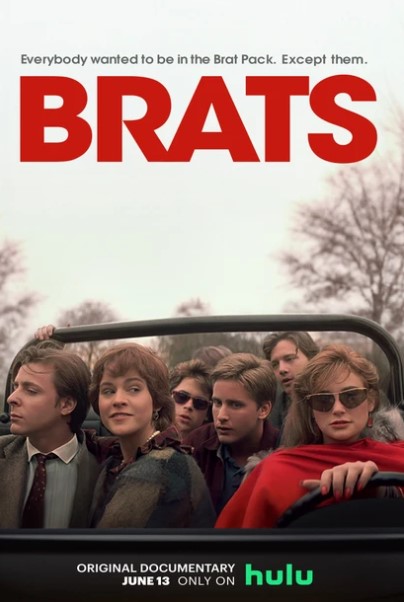
Documentary Review: Brats (dir by Andrew McCarthy)


The documentary Brats opens with actor and travel writer Andrew McCarthy in New York City.

He’s obsessing over his film career, which featured him starring in several classic 80s films, like Pretty In Pink, Class, and Less Than Zero.  If you love those films as much as I do, you’ll be happy to know that, physically, McCarthy has aged well.  If he was adorably cute during his teen idol days, Andrew McCarthy now looks like a distinguished and handsome creative writing teacher.  McCarthy talks about how he was briefly a star and now, he has a busy career as a writer.  To be honest, it seems like everything should be going pretty well for Andrew McCarthy.

The only problem is that Andrew McCarthy has spent the last 30 years obsessed with an article that he feels led to him being labeled as one of the “Brat Pack,” along with Emilio Estevez, Rob Lowe, Judd Nelson, Molly Ringwald, Demi Moore, and Ally Sheedy.  Interestingly enough, McCarthy is only mentioned once in the article, when Nelson dismissively describes him as playing every role “with the same intensity.”  Still, McCarthy feels that the article led to him being unfairly labeled “a brat,” and it also led to his film career fizzling.

Over the course of the documentary, McCarthy travels to California and tracks down some of his co-stars (with both Ringwald and Nelson being notable for their absence) and he also talks to the author of the article.  He talks about what it means to be identified with the Brat Pack and how the label still haunts him.

Seriously, this is one of the most depressing documentaries I’ve ever seen.

It’s not just that McCarthy, who really does seem like he should be enjoying his second act as a successful and respected travel writer, is still obsessed with an article that came out 30 years ago.  It’s also the fact that, judging from the scenes in which he drops in on Estevez, Lowe, Moore, and Sheedy, it doesn’t appear that anyone has wanted to talk to McCarthy since they all did St. Elmo’s Fire.  Emilio Estevez, especially, seems to be uncomfortable with having McCarthy in his kitchen.  As for the others, Ally Sheedy is polite, Demi Moore comes across as if she’s visiting from another planet, and Rob Lowe is once again the most likable and laid back person in the room.  Everyone that McCarthy interviews has dealt with the Brat Pack legacy in their own different way.  The thing they all have in common is that they’ve all dealt with it better than McCarthy.

The saddest part of the film is that Molly Ringwald never returns Andrew McCarthy’s call.  Seriously, the main reason I watched this documentary was because I wanted to see Andie and Blane reunited.  Instead, I had to settle for Blane and Duckie having an awkward conversation.  It’s nice to see that McCarthy and Jon Cryer are apparently now on friendly terms (which apparently they weren’t during the filming of Pretty in Pink), but seriously, Molly is the one that most viewers will probably want to see reunited with Andrew.  That it doesn’t happen is kind of heart-breaking.

I hope someone gives Andrew McCarthy a good hug and tells him that we’re all Team Blane.  He deserves it.

Documentary Review: Lock-Up: The Prisoners of Rikers Island (dir by Jon Alpert and Nina Rosenblum)


Rikers Island is one of those places that we all know about, even those of us who have never been there.

Rikers Island is an island that sits in the East River in the Bronx.  It is also home to New York City’s largest and most notorious jail.  It’s a jail that has a reputation for violence and corruption.  Over 100,000 people are admitted into Rikers per year and, on most days, the complex has a population of 10,000 prisoners.  (For comparison, my mom was born in a town that currently has a population of 1,200.)  Rikers Island is notorious for the number of prisoners who have died while in the jail.  It is estimated that 85% of the inmates are pre-trial defendants, people who have yet to be convicted of anything but who either didn’t get or couldn’t afford bail.  The other 15% are serving short sentences.  Rikers Island is a county jail that has a reputation for being as bad as any state prison.  You don’t have to be from New York City to know about Rikers Island.  The jail has become so notorious that Rikers Island has developed an international reputation and is often held up as a symbol of everything that’s wrong with the way that incarceration is handled.

Lock-Up: The Prisoners of Rikers Island was filmed for and aired on HBO in 1994.  The documentary is now 30 years old and the population of the jail has grown considerably since it first aired.  That’s a frightening thought because the jail that is seen in the documentary was already overcrowded, dirty, and dangerous.  The documentary features interviews with both guard and prisoners.  We follow the guards as they search cells and confiscate weapons and drugs.  We meet a prisoner who has AIDS and who is hoping to be transferred to a drug rehab.  (He explains that he was born addicted and he’ll probably die addicted if he’s left in Rikers.)  We meet several of the pregnant women who are incarcerated in the jail and listen as they wonder what would happen if they went into labor when there’s not a guard around.  We watch as the guards uneasily deal with the prisoners who have asked to be incarcerated in the jail’s “gay wing.”  We meet several inmates who are obviously dealing with untreated mental illness.  A lawyer tries to talk to his client and gets in a shouting match with another prisoner.  We meet a notorious criminal named Eddie White, who explains that a life sentence means that he no longer has to follow the rules.  We meet a lot of people in this documentary and what they all agree on is that being locked up is Hell.

It’s hardly a balanced documentary.  The filmmakers are clearly on the side of the inmates but that’s okay.  Considering that the inmates have essentially no control over their own lives while they’re in Rikers, it can be argued that they deserve to have someone on their side.  Most of the inmates talk about their regrets but, as the documentary ruefully observes, most of them will eventually end up returning to Rikers even after they’re released.  One woman cries when she learns her baby might be ill but, when we see her during her second stint at Rikers, she blithely comments that her baby was taken away by “the city.”  As with so many inmates, she explains that she was set free with no training as to how to remain free.  As an addict, she has discovered the system is more interesting in punishing her addiction than treating it.

The biggest problem with the criminal justice system is that it rarely rehabilitates but instead creates a situation where no one can get or take advantage of a second chance.  30 years after it was released, Lock-Up reminds us that this is hardly a new problem.

Documentary Review: Sly (dir by Thom Zimmy)


Now streaming on Netflix, Sly is a documentary about the life and career of Sylvester Stallone.

The documentary opens with Stallone watching as all of his belongings in his Hollywood mansion are packed in boxes so they can be shipped to his new home in New York.  As I listened to Stallone talk about how you sometimes have to return to your roots to discover who you truly are, it occurred to me that Stallone is one of those people who is never not playing a role.  Even when he’s not Rocky Balboa or John Rambo or any of the other characters that he’s played in the movies (or, less frequently on television), he’s still playing Sylvester Stallone, the bigger-than-life movie star who has been an inescapable part of the American pop cultural landscape for longer than I’ve been alive.  Watching Stallone talk about what it’s like to go, overnight, from being an unknown to being a celebrity, I never doubted his sincerity but I was always aware of how carefully chosen his words seemed to be.  Sylvester Stallone lets the audience in but he’s still careful about how much he reveals about himself.

The same can be said of the documentary, which largely focuses on Rocky, Rambo, and The Expendables, with a little Lords of Flatbush, F.I.S.T., Paradise Alley, and Cop Land trivia tossed in as well.  Stallone admits that he’s not proud of all of the films that he’s made, citing Stop!  Or My Mom Will Shoot! as his biggest regret.  (Arnold Schwarzenegger pops up to brag about how he was smart enough to turn down the script when it was originally sent to him.)  That said, there’s not much attention given to Stallone’s films with Roger Corman or for the films that he did for Cannon.  Sorry, there’s no Over The Top trivia.  There are a few clips from Cobra and Rhinestone but not much more.  If you’re looking for a documentary about the B-movies of Sylvester Stallone, this is not it.  (Interestingly enough, even films like Demolition Man — which was one of Stallone’s better non-Rocky and non-Rambo films — are also glossed over.)  Beyond talking his troubled relationship with his father, mentioning his love for daughters, and a moment where he gets noticeably emotional while talking about his late son, there’s not much information here about Stallone’s private life.  And again, it’s not that Stallone owes anyone any of that information.  At one point, Stallone says that he hasn’t had a moment of privacy since the release of Rocky and he’s probably right.  He’s earned the right to keep some things private.

Also interviewed in the documentary are Frank Stallone, Quentin Tarantino, film critic Wesley Morris, director John Herzfeld, and Talia Shire.  Frank comes across as a lot more genuine here than he did in his own documentary while Talia does the best job of understanding the appeal of Rocky.

This is a documentary that will probably best be appreciated by people who are already fans of Stallone.  Stallone doesn’t attempt to win over his doubters but, having been a star for nearly 50 years, Stallone can definitely argue that his doesn’t owe his doubters any effort.  Watching the documentary, it became clear to me that Stallone is one of those pop cultural figures who it is impossible not to love.  Everything about him, from the rough Hell’s Kitchen childhood to his decision to write a movie for himself to his decision to move into the director’s chair, is pure Americana.  There’s a reason why Rocky Balboa often appears with an American flag.

(That said, I still think that Stallone’s best performance was in First Blood and, in this documentary, Stallone gets genuinely emotional as he discusses when he discusses why he felt it was important for Rambo to survive the end of the film.)

He’s a survivor and he’s confident enough to admit that he got a bit arrogant after the success of Rocky.  Stallone still has that confidence that borders on arrogance but he’s aging well and it’s hard not to feel that he’s earned the right to brag on himself.  (It helps, of course, that he’s become a better actor as he’s aged.)  Stallone may not totally open up but he still has his movie star charisma.  When he talks, you listen.  When he moves, you watch.  We’ll miss him when he’s gone.


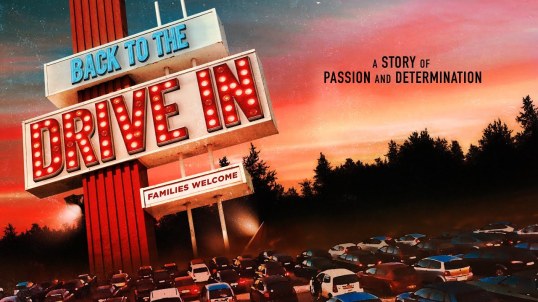
Documentary Review: Back to the Drive-In (dir by April Wright)


When I was 11 years old, I spent about a month and a half living in a motel with my mom and my sisters.

We were between homes and, since my mom didn’t really have the money to pay for our rooms, she and my two oldest sisters would work as maids during the day while my sister Erin and I stayed in our own room and watched stuff on the television that we probably shouldn’t have been watching.  (“What are you watching!?” mom would say as either Erin or I grabbed the remote and tried to get the TV off of HBO as quickly as possible.)  In retrospect, I know that all probably sound very dramatic and traumatic but I have to admit that, at the time, it just felt like an adventure.  I was jealous of my mom and my sisters getting to wear uniforms every day and basically go anywhere they wanted to go in the motel.  I would ask my mom and sisters about what they found in the rooms that they had to clean and I would beg for a chance to go with them because I figured it had to be fun to see how other people lived.  They always refused and years later, my sister Megan would tell me that they usually just found discarded underwear, used condoms, and half-eaten fast food.  Sometimes, I would sit in the front lobby, bothering whoever was working behind the desk and trying to overhear conversations.  I would love watching the various people who checked in and out of the motel and I would imagine amazing identities and life stories for them.  At night, I would listen for sounds coming from other rooms.  One time, the police were called because the people below us were fighting and I remember watching the reflection of the red lights flashing across the walls of my room.

That said, I think my main memory of living at that motel was that there was a creek right next to the hotel (though I always envision it as being a raging river whenever I think back to those days) and, on the other side of that creek, there was a drive-in movie theater.  Every night, I would go out on the balcony and look into the distance, at the silent images flickering across the giant screens.  The fact that I couldn’t actually hear what Stallone and Schwarzenegger were saying only made the experience more enjoyable.  I could make up my own stories to go along with the images.  Watching those movies became a bit of a ritual for me.  I had to watch every night and at the same time and if anyone tried to keep me from doing so, I would throw a fit.  Though I didn’t fully realize it at the time, for me, that drive-in came to represent stability.

I found myself thinking about that drive-in as I watched the documentary Back To The Drive-In.  Shot in 2021 and 2022, Back To The Drive-In cut backs and forth to tell the stories of drive-ins around the country and how they dealt with the pandemic.  Every owner has their own reason for owning and loving their drive-in.  Some of them are friendly eccentrics.  Some of them are full of nostalgia and recreating the past.  Some of them are hard-nosed businessmen who make sure to enforce the rules.  My favorite was the guy who decided to that his backyard was the perfect location for a drive-in.  (He calls it The Field of Dreams.)  However, they all have the same basic story.  Business was suddenly good during the Pandemic because their competition was closed down.  However, in the post-Pandemic world, they’re facing an uncertain future.

The documentary, of course, was made before box office successes of Top Gun: Maverick, Oppenheimer, and Barbie proved that people are willing to return to theaters but the fate of America’s drive-ins are still up in the air.  And that’s a shame because, as this funny and wonderfully humanistic documentary shows, the drive-in is more than just a theater.  It’s an experience and once they go away, our culture is going to be just a little bit more dull.  As I watched the documentary, I made note of which drive-ins are within driving distance of my home.  I’ll do my part to support these temples of Americana and I hope everyone else will as well.

Save the Drive-In!

Documentary Review: Kids Who Kill (dir by Andy Genovese)


It’s currently True Crime Week on A&E, with every day being filled with programming about murders, court cases, and unsolved mysteries.  It’s all a bit icky but I do have to admit that I have a weakness for true crime.  That’s why, when A&E aired the 2017 documentary Kids Who Kill yesterday, I ended up watching.

As soon as Kids Who Kill started, I found myself wondering if I had watched it before.  It turned out that I hadn’t.  Instead, my sense of Deja Vu was due to the face that I had seen all of the stories featured in Kids Who Kill on numerous other true crime programs.  One reason why there are so many true crime programs is that they’re cheap and easy to make.  Most of the information is in the public domain and you can always grab footage from the local news broadcasts of the time.  The reporters who covered the murders and the trials are always willing to build their brand by appearing on the program and saying stuff like, “Things like this just didn’t happen in our town.”  If the actual murderer is still alive and willing to be interviewed, chances are that his story will be told on at least a dozen different programs.

That’s certainly the case with Eric Smith, who was 13 years old when he murdered a 4 year-old boy.  Smith has been incarcerated since 1994 and his willingness to be interviewed has led to him being featured on several different programs, including this documentary.  In every interview, Smith says, not surprisingly, that he was an abused and emotionally neglected child who, having been bullied his entire life, lashed out in one terrible moment and that he’s no longer that child and that he deserves to be released from prison.  (You can always tell if the program is sympathetic to Smith by whether or not they include the fact that he sodomized the boy that he killed.  Kids Who Kill leaves out that fact.)  What Smith always seems to miss is that one can very legitimately say, “That sucks you were abused and you never really had a chance but, at the same time, you strangled and beat a four year-old to death so fuck you.”

Kids Who Kill tells several stories about people like Eric Smith, who committed murder when they were just a minor and who were subsequently sent to prison, often for life.  It’s full of contemporary news footage and psychoanalysts offering up theories about why kids kill but it never really digs too deeply into the subject.  There are several prison interviews with the killers.  At least two of them blame “first shooter video games.”  (While I would certainly be concerned about someone who spent 24 hours a day playing a violent video game, it’s also hard to buy that a 16 year-old couldn’t tell the difference between Doom and real life.  If you thought Doom — or Halo, as another shooter claims — was real life then you obviously had issues before you even picked up your first controller.)  Every killer interviewed expresses remorse but, with the exception of Nathan Brazill, who was convicted of shooting a teacher, none of them seem particularly sincere about it.  Then again, one could argue that they seem insincere because a lifetime in prison has conditioned them not to express any emotions that could be mistaken for weakness.  Perhaps I was being too quick to expect tears from men who live in a confined society where tears can lead to being targeted.

It’s a complex subject, kids who kill.  Can we forgive?  Can murderers be rehabilitated?  Can someone mature into becoming a different person than they were when they were 16?  Is it more important to punish or to rehabilitate?  These are important questions and, unfortunately, they’re not the type of questions that are really explored in any sort of depth by most true crime shows and documentaries.  Kids Who Kill offers up some disturbing stories but it never scratches beneath the surface.

The Films of 2020: Athlete A (dir by Bonni Cohen and Jon Shenk)


By now, we all know who Larry Nassar is and what he did.

Nassar was the USA Gymnastic Team doctor, the guy who worked with some of America’s top gymnasts.  For several years, he was the guy who you would see standing in the background of televised gymnastic events, including the Olympics.  If any of the gymnasts were injured during a competition, he was the man who television audiences would see running out to the mat.  He was the man who both viewers and gymnasts were conditioned to see as being a protector.  In the documentary Athlete A, there’s footage of Nassar kneeling down beside an injured gymnast while a commentator assures the people watching at home that there’s no reason to be worried.  If anyone is going to know what to do, the commentator explains, it’s going to be Larry Nassar.

In 2015, USA Gymnastics cut ties with Larry Nassar, citing “athlete concerns.”  In 2016, the Indianapolis Star broke the story that two gymnasts had accused Nassar of sexual abuse.  (Despite the accusations, Nassar still received 27% of the vote when he ran for his local school board that same year.)  When Nassar was arrested in 2016 and put on trial, more gymnasts came forward.  It is currently estimated that there are over 265 identified victims of Nassar’s abuse and an infinite number who may never be identified.  After Nassar pled guilty to charges of possessing child pornography, he was sentenced to 60 years in federal prison.  After pleading guilty to seven counts of sexual assault against minors, Nassar was given a state sentence of 175 years.  This was followed by an additional state sentence of 40 to 125 years when he pled guilty to three more assaults.  At the time of his sentencing, the judge said, “I just signed your death warrant.”  At the time, I remember being more than a little worried that Nassar would attempt to cite those words as proof that the judge was biased against him and that he would request a new sentencing hearing.  Of course, that’s exactly what Nassar did.  Fortunately, that request was denied and Larry Nassar will die in prison.

Athlete A is hardly the first documentary to be made about Larry Nassar and the USA Gymnastics sex abuse scandal but it is the first one to truly explore how a monster like Larry Nassar was not only able to thrive but also why he was shielded by the very people who should have been protecting his victims.  As the documentary shows, USA Gymnastics is a brand and it’s champions — especially it’s female champions — are expected to be the perfect ambassadors for the brand.  That means following orders, winning gold medals, and not complaining.  Despite all of the footage that we see of various commentators rhapsodizing about the special relationship between the gymnasts and their coaches, the gymnasts themselves are treated as just being a commodity that’s valuable as long as they can keep winning medals and keep bringing money into USA Gymnastics.  Once they can no longer win, those coaches no loner have any use for them.

At the legendary Karolyi Ranch in Huntsville, Texas, young girls were separated from their parents and trained by Béla Károlyi, a strict taskmaster who had no hesitation about slapping a gymnast who he felt hadn’t done well.  Into this harsh environment came Larry Nassar, a seemingly dorky and friendly guy who claimed to only be concerned with the health and the safety of the gymnasts.  Nassar would assure the gymnasts, most of whom had yet to even reach puberty, that everything he was doing was for their benefit.  Some of them, he abused for years, from the moment they came in for their first check-up until the day that they finally retired from competition.   And, when many of the gymnasts grew older and realized that what Nassar was doing was not okay, they would discover that no one was willing to listen to them.  Though the first complaints agaist Nassar were made in the 90s, it wasn’t until 2015 that anything was done about him.  In fact, parents were often lied to.  As is recounted in this film, the president and CEO of USA Gymnastics, Steve Penny, assured at least one gymnast and her parents that he had forwarded their concerns about Nassar when he had done no such thing.  Though Nassar’s trial got the majority of the coverage, Steve Penny would also be arrested and charged with deliberately tampering with evidence in order to protect him.

As I said a few paragraphs ago, this is hardly the first documentary about what went on behind the scenes at USA Gymnastics.  It probably won’t be the last.  But this may be the most important one because, through heart-wrenching interviews with Nassar’s victims, Athlete A shows how a man like Nassar was able to abuse young girls for years while those who should have been protecting the athletes were making the decision to look away.  Some of the most powerful moments in the film come from the contrast between the reality of what was happening and the way that USA Gymnastics presented itself in public.  The doctor who was supposed to take care of the athletes was a monster and the coaches, who were presented as being strict but caring, were his enablers.  Everyone wanted to benefit from the success of the athletes but no one was willing to stand up for them.

Athlete A is not easy to watch.  It’s a harrowing documentary but it’s also an important one.


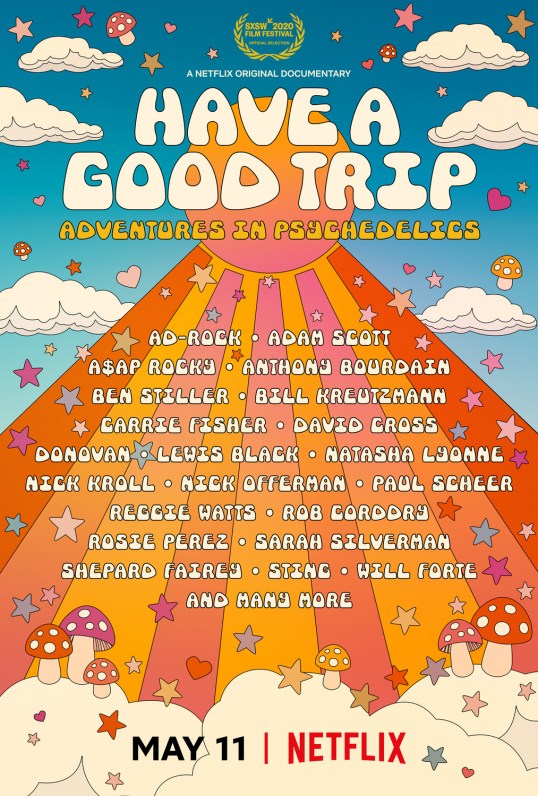
The Films of 2020: Have a Good Trip: Adventures in Psychedelics (dir by Donick Cary)


Since this Netflix documentary features people talking about their experiences with hallucinogens, I debated whether or not I should begin this review by discussing my own limited experience with psychedelics.  I went back and forth on whether or not to write about it.  It’s not that I feel any shame about having “experimented.”  Instead, it’s just that my experiences were all so damn boring.

I mean, which one should I tell you about?  Do you want to hear about the time that I went to the mall and I marveled at how all of the shoppers seemed to be moving at a different speed than me?  How about the time that I was sitting in a lecture and the professor’s voice kept getting really loud and then really soft?  Maybe I could tell you about the time my friends and I were driving around the Texas countryside and I kept seeing the same man standing on the side of every single road, watching us as we drove by?  He was wearing a black trenchcoat and a black cowboy hat and I was convinced that he was Death….

(Okay, that last experience was kinda freaky.)

Have A Good Trip is a film about people discussing their experiences with hallucinogens and some of them had more interesting experiences than I did.  Of course, all of the people who were interviewed were celebrities.  Sting talks about helping a cow give birth while tripping on peyote.  Lewis Black talks about doing acid and then forgetting his name.  Sarah Silverman recounts how she and a friend did acid and then ended up befriending a bunch of homeless people.  In interviews recorded before their death, Carrie Fisher and Anthony Bourdain both discuss their LSD experiences.  Probably the best story comes from Ben Stiller, who called his father during his first (and it’s implied only) acid trip.  Jerry Stiller is described as being very understanding, which is sweet.  “I know what you’re going through,” Jerry says, “I smoked a Pall Mall cigarette once and was sick for days.”

Have a Good Trip is 100% pro-hallucinogenic drug, which gives it a nice subversive feel.  The film humorously dramatizes the drug stories, sometimes with animation and sometimes by hiring other celebrities to play the celebrities telling their story.  In between the celebs, we get an interview with a researcher who explains how hallucinogenics can be used to help people dealing with depressing and anxiety.  The film doesn’t downplay the fact that bad trips happen but, at the same time, it also makes a convincing argument that the dangers have been overstated.

Yet, I have to admit that Have A Good Trip is never quite as much fun as you’re hoping it’ll be.  I think part of the problem is that most of the celebrities interviewed in the film are exactly who you would expect to interviewed in a film like this.  I mean, learning that Sarah Silverman, Judd Nelson, and Lewis Black have tried acid is not exactly an earth-shattering discovery.  When you’re watching a documentary in which celebrities talk about their drug experiences, you want to be surprised.  You want to see or hear about someone who you’re not expecting to see or hear about.  You want to hear about the time that the cast of Saved By The Bell went on a six-day coke binge in Vegas.  Learning that peyote makes Sting somehow even more pretentious just doesn’t have the same subversive bite as hearing from someone who you wouldn’t normally expect to have any good drug stories.

Anyway, Have a Good Trip is an amusing film, even if it’s never quite as subversive as it thinks it is.  It’s currently on Netflix.

Documentary Review: Lord Lucan: My Husband, The Truth (dir by David O’Neill)


Who was Lord Lucan?

He was a British aristocrat, born not only wealthy but also with all the right connections.  His birth name was John Bingham but he eventually inherited the title of Lord Lucan when his father died in 1964.  At the time, the new Lord Lucan was 30 years and had been married for less than a year.  Lord Lucan was handsome and charming, so much so that Cubby Broccoli considered him for the role of James Bond in On Her Majesty’s Secret Service.  Lucan had no formal acting experience but he had the right look.  Nothing, of course, ever came of the idea of casting Lucan as Bond.  It’s rumored that he may have done a screen test but nothing can be said for sure.  Would Lord Lucan have had better luck with the role than George Lazenby?  Well, it’s hard to imagine how he possible could have had worst luck.

Like James Bond, Lord Lucan loved to gamble.  Unlike Bond, who was rarely seen to lose a hand whenever he sat down at the poker table, Lucan was not a particularly good gambler.  In fact, he lost so often that he was often broke.  Fortunately, his rich friends usually took care of him whenever he needed money or someone to testify as to his courage whenever he was accused of neglecting his wife, Lady Lucan.  When Lord and Lady Lucan separated in 1972, it forced the members of British high society to pick sides and most of them sided with Lord Lucan.  That remained true even in 1974 when Lord Lucan was accused of murdering his children’s nanny, Sandra Rivett.  Rivett, who bore a superficial resemblance to Lady Lucan, was bludgeoned to death with a piece of lead pipe while making a cup of tea in Lady Lucan’s home.  Lady Lucan claimed that she came across Lord Lucan in the house and that he admitted to having attacked Sandra in a case of mistaken identity.  Meanwhile, shortly after the murder, Lord Lucan reportedly called his mother and told her that he had just happened to be driving by his old home when he saw an unidentified man fighting with his wife.

The same night that Sandra Rivett was murdered, Lord Lucan vanished.  Both the police and Lady Lucan speculated that Lord Lucan had committed suicide by drowning himself in the Thames.  However, for years after Sandra Rivett’s murder, there were regular sightings of Lord Lucan around the world.  While many of those sightings were undoubtedly due to hysteria caused by the extensive press coverage surrounding the case, there were other sightings that seemed to be a bit more credible.  There was much speculation that Lucan’s powerful friends had helped him escape from Britain and he had relocated to either southern Africa or Australia.  As late as 2012, sightings of Lord Lucan were still being investigated.  If Lucan were still alive, he would be 86 years old today.

The story of Lord Lucan and the murder of Sandra RIvett is a fascinating one and the 2017 documentary, Lord Lucan: My Husband, The Truth, is a must-see for everyone interested in the case.  Produced for British television, this documentary is essentially an hour-long interview with Lady Lucan, during which she discusses not only her abusive marriage but also her feelings about the question of whether or not Lucan was still alive.  (For the record, she felt that he committed suicide “as a nobleman would do.”)  The documentary also features video that was shot by Lucan himself in the 60s, showing himself, his wife, and their wealthy friends touring Europe and basically acting like members of the idle rich.  Lady Lucan discusses how the notoriety surrounding the case affected her own life, leading to her becoming estranged from her children.  When asked if she was a “cold” towards her children, Lady Lucan chillingly replies, “All of my relationships are cold.”  When asked why she once claimed that Lord Lucan was still alive and hiding out somewhere in either Europe or Africa, Lady Lucan replies that she was “drugged up” when she said it and, as such, had no control over anything she said.  The documentary than shares a clip of a very stoned-looking Lady Lucan being interviewed in 1981 and saying that her former husband was still alive.

It’s an interesting story and a rather sad one.  Lord Lucan: My Husband, the Truth is a documentary that should appeal to anyone who is interested in true crime, missing fugitives, and the scandals of the very rich.  Despite the rumors of him still being alive, Lord Lucan was declared dead in 2016 so that his son could inherit his title and his place in the House of Lords.  As for Lady Lucan, she committed suicide shortly after being interviewed for this documentary.

Lord Lucan: My Husband, The Truth can be viewed on Amazon Prime.


Documentary Review: Ernie & Joe: Crisis Cops (dir by Jennifer McShane)


The new documentary Ernie & Joe: Crisis Cops opens with police body cam footage of a man getting gunned down in the doorway of his own house.

Why was the man shot?  Because he was holding a screwdriver and he apparently didn’t drop it quickly enough.  Why were the police there in the first place?  They had been called by the man’s mother, who warned the police that her son was schizophrenic and that he was hearing voices.  When the cops shoot him, the man’s mother can be heard screaming in the background, begging the cops not to kill her son.  But kill him, they did.  He died for the crime of holding a screw driver while having mental health crisis.

Unfortunately, that’s a scenario the seems to be happening more and more frequently in the United States.  The police are trained to quickly take control of dangerous situations, to show no emotion, and to bark out orders.  How many times do we hear it whenever someone is gunned down for not immediately dropping whatever they were holding their hands?  “If he had just done what the police said, he’d still be alive.”  We hear that a lot but what if, like the man holding that screwdriver, you’re already hearing voices before the police start screaming at you to show them your hands.  What if you’re already disorientated and not sure what’s real and what’s not?  What then?

Unfortunately, it’s rare that the police are trained on how to deal with someone suffering from mental issues.  Ernie Stevens and Joe Smarro are two cops in San Antonio who are trying to change that.  As members of the SAPD’s mental health unit, Ernie and Joe are advocates for changing the way that the police deal with the most vulnerable members of society.  As they explain at one of their training sessions, the police academy will spend days teaching recruits how to draw and fire their weapon without devoting one minute to discussing how to deal with someone who might be hearing voices or who might be suicidal.  Ernie and Joe argue for compassion over brute force.  (Unfortunately, while some cops are seen nodding along with Ernie and Joe’s lessons, several others are seen smirking and rolling their eyes.)

Shot in the style of cinéma vérité, the film follows Ernie and Joe as they deal with cases and attempt to teach their fellow cops that brute force is not always the solution.  At one point, we watch them deal with someone who is threatening to jump off an overpass.  We also listen as Joe, a former Marne, discusses seeing a child blown up in Iraq and how he is still haunted by PTSD.  Ernie, meanwhile, is a family man who goes to church every Sunday and who is looking forward to soon retiring from police work.  The film follows them as they talk, joke, and occasionally bicker like an old married couple.  It’s a good, if somewhat low-key, documentary.  One watches it and hopes that other police departments will learn from San Anotnio’s success.

As I watched the film, I found myself thinking about Vanessa Marquez.  Vanessa was a former actress and a longtime member of the #TCMParty on twitter.  Vanessa was always very open about her own health struggles.  14 months ago, the police showed up at Vanessa’s house in South Pasadena, California.  They say they were doing a welfare check.  They say that Vanessa was in obvious mental distress and that Vanessa resisted their attempts to force her to go to the hospital to be checked out.  The police say that Vanessa pointed a BB gun at them.  Unfortunately, we only know what the police said happened but Vanessa is not her to tell her side of the story.  She was shot and killed.  At the time, it was big news but, as always happens, the media eventually moved on to something else.  After all this time, we still don’t know what really happened the day that Vanessa Marquez was killed in her own home.  We probably never will.

Watching the documentary, I found myself wondering what would have happened if it had been Ernie and Joe or, at the very least, a cop with a similar outlook and compassion who showed up at her house on that day.  Would Vanessa still be with us, watching movies on TCM and tweeting about her experiences in Hollywood?  No one can say for sure but I think she would be.

Hopefully, this documentary will serve as a wake up call for some people.  One need not lose their compassion just because they put on a uniform.  In fact, it’s essential that they don’t.