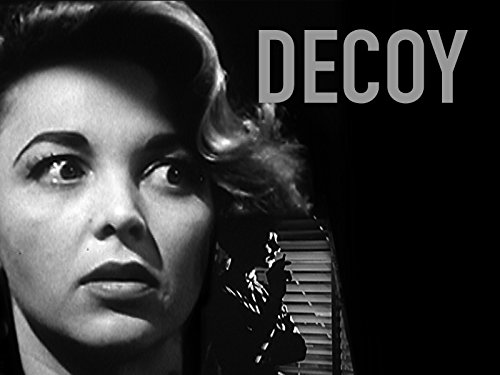
Welcome to Retro Television Reviews, a feature where we review some of our favorite and least favorite shows of the past! On Thursdays, I will be reviewing Decoy, which aired in Syndication in 1957 and 1958. The show can be viewed on Tubi!
This week’s episode is really, really good!
Episode 1.11 “Two Days To Kill”
(Dir by Stuart Rosenberg, originally aired on December 23rd, 1957)
Selma Richmond (played by a young Diane Ladd!) is the girlfriend of gangster Johnny Troy (Michael Strong). Johnny is about to go on trial and Selma’s testimony about his crimes is the key piece of evidence against him. Knowing that Johnny wants Selma dead, the police put her up in an apartment. Casey is assigned to protect her.
At first, Casey and Selma seem to become unlikely friends. Selma is flighty and obsessed with Hollywood. Even though she’s testifying against him, she claims that Johnny is just misunderstood. Casey, taking some sympathy on her, tells Selma about the man that she loved. For the first time, we learn something about Casey’s background. We learn that her husband was a cop and he died in a shoot out. It’s a surprising moment and one that’s poignantly played by Beverly Garland. (The camera closes in on her face while she slowly smokes a cigarette.) Not only does it help us understand why Casey sometimes to seems to be emotionally detached but it also shows the friendship between the two women. Casey doesn’t open up for many people but she does for Selma.
However, that friendship ends when Selma realizes that Johnny will be facing the death penalty. Selma manages to sneak a letter Johnny, letting him know where she’s being held. Johnny shows up at the apartment, carrying a knife. Casey is waiting for him with her gun drawn. During the stand-off, Johnny tells Selma that he loves her and Selma believes it. The Johnny uses his foot to unplug the apartment’s lamp. In the darkness, he lunges at Selma and Casey opens fire, killing Johnny. Selma’s response is to shout, “I bet you’re glad you killed him!”
This was an outstanding episode. Director Stuart Rosenberg, taking over from Teddy Sallis, makes good use of the gritty New York locations. Each scene is lit like a film noir, with Johnny literally emerging from the shadows at one point. Rosenberg also gets excellent performances from both Ladd and Garland. This was a strong episode and the best of the series so far.
Legendary actor Charles Bronson ended his five-decade career by starring in a series of made-for-TV movies, FAMILY OF COPS (1995), BREACH OF FAITH: A FAMILY OF COPS II (1997), and FAMILY OF COPS III: UNDER SUSPICION (1999). I was in my mid-twenties as this series played out, and I enjoyed each of the installments. Today, I’m going to take a look at the second film in the series.
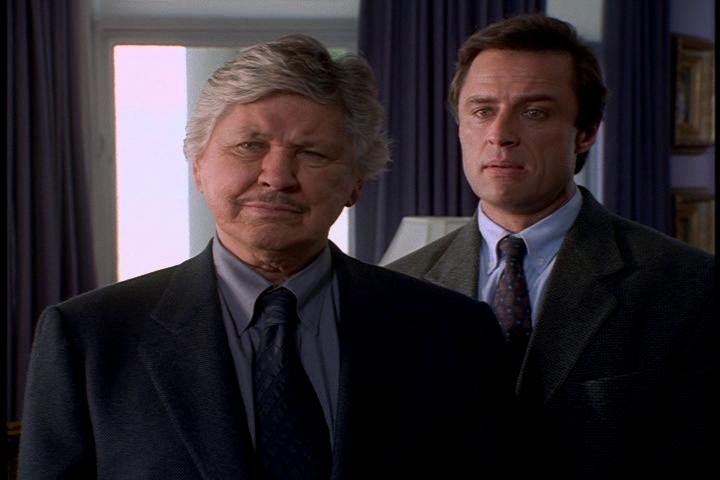
BREACH OF FAITH: A FAMILY OF COPS II picks back up with the Fein family a couple of years after the first installment. The main storyline follows Police inspector and family patriarch Paul Fein (Charles Bronson) as he supervises the investigation into the murder of a popular local Catholic priest. Of course, the investigation is a family affair, as his eldest son Ben (Joe Penny) is the lead detective on the case. Paul and Ben follow the clues that lead directly to the Russian mafia. As the investigation closes in, members of the Fein family find themselves targeted for beatdowns by Russian henchmen in order to get Paul to drop the case. Other storylines include the widower Paul’s blossoming relationship with detective Anna Meyer. Her “moves” on Paul, which began in the first installment, seem to finally be paying off. Paul’s eldest daughter Kate, the public defender, has her own set of problems when she successfully advocates for the parole of a 12-year-old criminal. On the little psychopath’s first night out, he robs a store, shoots and kills Eddie Fein’s partner, and then gets killed himself when Eddie fires back. Meanwhile, Paul’s youngest daughter Jackie (Angela Featherstone), who seems to be getting her life back on track after the events of the first film, decides she’s going to join the police academy against her dad’s wishes. Finally, Paul’s sister Shelly (Diane Ladd) visits the family, tells stories about her brother, shares a lot of wisdom, and even finds herself caught up in the crossfire of the Fein family / Russian mafia feud!
Charles Bronson was 75 years old when BREACH OF FAITH: FAMILY OF COPS II premiered on CBS on the night of February 2nd, 1997. He still handles the emotional scenes with his family well, gets to throw a couple of punches, and even gets to shoot some people, but the younger men (Joe Penny and Sebastian Spence) handle more of the action this time around. Charles Bronson is still the main reason to watch, but after all of these years, you can finally tell that he is slowing down. There is only one departure from the original cast, and that’s Joe Penny replacing Daniel Baldwin as the eldest son, Detective Ben Fein. I don’t think it hurts the film in any way, and to be completely honest, I prefer Joe Penny in the role. Sebastian Spence and Barbara Williams get to do a little more heavy lifting as Eddie Fein and Kate Fein deal with the aftermath of the young criminal, that Kate helped get released, shooting and killing Eddie’s partner. There is one exchange between Paul and his daughter Kate, who’s dealing with extreme guilt over the situation, that I always found unintentionally funny. It goes something like this:
Paul: “It’s not your fault.”
Kate: “Of course, it is.”
Paul: “Okay! So it is!”
Thanks a lot, Dad! Angela Featherstone, whose Jackie was the most interesting character in the first film, doesn’t have as much to do in this installment. She and Bronson have a great scene together when he tries to talk her out of becoming a cop, but once she heads to the academy, she pretty much disappears from the last half of the film. And finally, I like Diane Ladd as Bronson’s sister in the film. Her character brings another layer of warmth to the family dynamics and helps us get to know her brother Paul a little better.
As was the case with the original film, the central police investigation into the death of the priest at the hands of the Russian mafia isn’t all that interesting. The bad guys come right out of central casting for TV movies of the era, and the subdued violence and reduced action due to its TV roots can’t help but be compared negatively to the explosive action films that Charles Bronson once headlined. I never felt like the family was really in danger. And this is a completely personal preference, but I don’t care for the romantic relationship that develops between the characters played by Bronson and Kim Weeks. Bronson was dating Weeks in real life at the time of this movie, and they would be married the following year. Although I do hope that they were happy together in real life, I’m just not a fan of Weeks as an actress, and it’s hard for me to accept anyone but Jill Ireland as his on and off-screen love interest.
With BREACH OF FAITH: FAMILY OF COPS II being the penultimate film in Charles Bronson’s career, I definitely recommend it to his fans and to anyone else who enjoys TV movies of the era. While Bronson may be slowing down due to his age, Paul Fein is a perfect character for the icon that allows him to be tough and tender in equal measure. The final sequence of the film always brings a tear to my eye. The entire family is sitting down together to celebrate the weekly “Shabbat” meal when a misty-eyed Paul Fein raises a glass and says, “I’m proud of every one of you… my family.” I know just how much Bronson’s family meant to him, and I can’t help but see that come through in his performance.
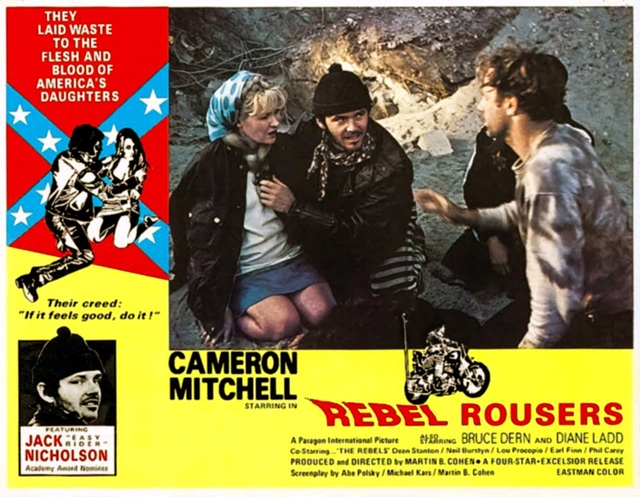
1970’s RebelRousers tell the story of what happens when Paul Collier (Cameron Mitchell) arrives in a small desert town, searching for his girlfriend, Karen (Diane Ladd). Karen ran away when she discovered she was pregnant because she was scared that Paul would attempt to force her to get an abortion. While Paul talks to Karen in a cheap motel, a motorcycle gang rides into town. The members of the gang include Randolph (Harry Dean Stanton) and Bunny (Jack Nicholson), who wears striped prison pants and a stocking hat. The leader of the gang is J.J. Weston (Bruce Dern), who went to high school with Paul. They even played on the same football team but their lives have since followed differing paths. (How exactly 30ish Bruce Dern and 50ish Cameron Mitchell could have been in the same high school class is not an issue that the film chooses to explore.)
Paul reunites with Karen and swears his love for her. However, when Paul and Karen run into the motorcycle gang, Karen is kidnapped. Bunny wants to force himself on Karen but J.J. wants to set her free. J.J. challenges Bunny to a series of motorcycle games on the beach. The winner decides what happens to Karen. Meanwhile, Paul heads back to the town in search of help but discovers that almost everyone is too much of a coward to help him out. Only Miguel (Robert Dix), the leader of a rival gang is willing to step up and save the community from the Rebels!
RebelRousers was filmed in 1967 but was considered to be so bad that it was put on a shelf and forgotten about until Jack Nicholson suddenly became a star in EasyRider. RebelRousers was released on the drive-in circuit as a Jack Nicholson movie, even though Nicholson is barely in the film and he gives a pretty one-note performance as Bunny. The movie’s star is Cameron Mitchell, who usually played villains and doesn’t seem to be too invested in this film. (Mitchell has such a naturally sinister screen presence that I was actually worried about Paul finding Karen. Bruce Dern and Diane Ladd are the sole members of the cast who really stand out, with Dern taking on the type of cool rebel role that was usually played by Peter Fonda while Ladd (pregnant at the time with Laura Dern) actually manages to bring some real emotional depth to her character. The movie itself was obviously made for next to nothing and it seems like it was shot in a hurry. Everything feels like a first take or, even worse, like a rehearsal that was deemed “good enough.” The competition between Bunny and J.J. ultimately feels mostly like filler than anything else.
RebelRousers is one of the more obscure entries in Jack Nicholson’s filmography. If not for the success of EasyRider, it never would have been released at all. By the time RebelRousers did come out, Jack Nicholson was too busy establishing himself as one of the best leading men of the 70s to spend too much time looking back. Today, watching this film can make it easier to understand why Nicholson was considering dropping out of Hollywood all together before he was cast in EasyRider. That said, the film today serves as a reminder that everyone started somewhere and sometimes, the somewhere is the second feature at the grindhouse.
“What is it exactly that you want?” a preacher (Frank Maxwell) asks a congregation of leather-clad bikers.
“We want to get loaded!” Heavenly Blues (Peter Fonda) replies, “And we want to have a good time!”
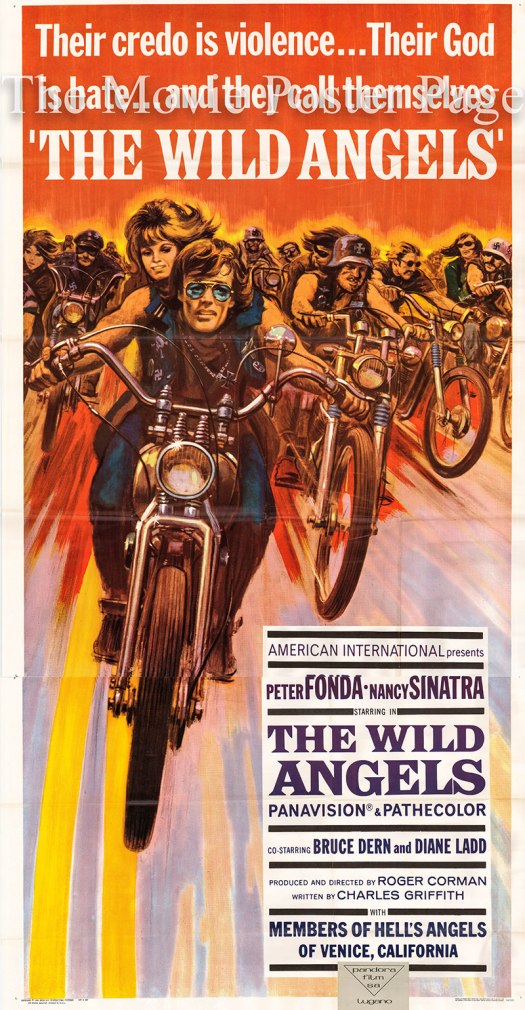
And have a good time, they proceed to have. Of course, it’s a good time for them. Everyone else who meets the bikers at the center of 1966’s The Wild Angels are horrified by this collection of rebellious and violent outsiders. Sure, Heavenly Blues might actually be a soulful guy who mistakenly believes that he can control the gang’s more excessive tendencies. His girlfriend, Mike (Nancy Sinatra), actually seems rather reserved and conservative when compared to the rest of the gang. But make no mistake about it, the majority of the members of the gang are into violence for its own sake. They are bullies who couldn’t make the football team so, instead, they hopped on a motorcycle and formed their own society. They’re self-styled rebels but what are they rebelling against? What have you got?
I know, I know. That famous line comes from Marlon Brando and it was uttered in The Wild One. Peter Fonda, to put it lightly, was no Marlon Brando and, as directed by Roger Corman, The Wild Angels doesn’t have the societal concerns that lay at the hear of The Wild One. As Corman was often the first to admit, his main concern when it came to making movies was to make money. Corman wasn’t necessarily against message films. He often stated that, as a director, 1962’s The Intruderwas the film in which he took the most pride. The Intruder took a firm stand against racism and it let everyone know where Corman stood on when it came to the Civil Rights Movement. It was also one of his few films to lose money. The Wild Angels celebrates rebellion but one gets the feeling that celebration is motivated by the fact that younger filmgoers would be happy to pay to see a movie about a bunch of “youngish” people telling the old folks to shut up and get out of the way. The Wild Angels themselves don’t seem to be motivated by any sort of grand ideology. Heavenly Blues preaches about getting loaded and having a good time and celebrating freedom but he also allows the members of the gang to drape a Nazi flag over a casket. What does Heavenly Blues actually believe in?
Heavenly Blues believes in loyalty to his friends. For all the fights and the orgies and the scenes of motorcycles roaring down country roads, this is ultimately just a film about a guy who wants to give his best friend a decent burial. The Loser (Bruce Dern) dies about halfway through the film and one gets the feeling that he probably would have lived if the gang hadn’t kidnapped him from the hospital. Heavenly Blues wants to give The Loser the type of wild funeral that Blues thinks he would have wanted though I think The Loser probably would have been happier not have been killed by the actions of his idiot friends. Diane Ladd, who was married to Bruce Dern at the time and who has said Laura Dern was conceived during the filming of The Wild Angels, is heart-breaking as The Loser’s girlfriend, Gaysh. Gaysh wants to mourn her boyfriend while the rest of the gang is more concerned with figuring out who her next boyfriend is going to be.
Does Heavenly Blues ever realize that he’s traveling with a bunch of animals? He does but one gets the feeling that he’s accepted his fate. There’s no going back. The past can’t change and the future cannot be controlled so Heavenly Blues is content to live in the present. All he can do is try to give his friend a decent burial while the sirens of cops shriek in the distance.
The Wild Angels was a controversial film when it was first released. It also made a lot of money and led to a whole cycle of outlaw biker films, culminating with Easy Rider. Seen today, it’s a portrait of a society coming apart, with the establishment and the bikers not even willing to stop fighting long enough to allow for a simple burial. It’s definitely a time capsule film, one of those productions that epitomizes an era. There’s not much going on underneath the surface and most of the film’s bikers really are awful people but there is something touching about Blues giving it all up just to try to give his friend a decent burial.
I’ve been called “Charles Bronson’s biggest fan” on multiple occasions and by people I greatly respect. It’s possible that’s close to being true, but I chose to buy the entire TV series of SHANE on DVD because I wanted to watch Bronson’s wife, Jill Ireland, in a role that doesn’t include her more famous husband. I also wanted to see a young David Carradine as Shane. It doesn’t hurt that the 1953 film starring Alan Ladd is one of my absolute favorite movies.
The very first episode of SHANE starts off with Mr. Starett (Tom Tully) and the new schoolmarm (Diane Ladd) riding into town. They immediately run into Mr. Ryker (Bert Freed) and his henchman Harve (Lawrence Mann), who tells them in no uncertain terms that there will never be a school in this town. Enter Shane (David Carradine), who works for Mr. Starett. He tells Harve to get out of the way, and Mr. Starett, the school teacher and Shane head out to their ranch.
The new school is going to be in Ed Howell’s (Karl Lukas) barn. Mr. Howell is concerned about the school and his own personal safety since he’s heard of Ryker’s threats. Mr. Starett reassures him that everything will be okay so they head to Grafton’s general store to purchase supplies. Mr. Ryker shows up there and tries some more intimidation. When they leave the store, they notice a fire off in the distance. It’s Ed Howell’s barn. Appalled by all of this violence, the schoolteacher catches the next stage out of town.
Marian Starett (Jill Ireland), old man Starett’s daughter, decides she will teach the school. She knows her son Joey (Christopher Shea) needs to be educated along with the other children in the area. Since the barn was burned down, Marian asks Mr. Grafton if they can use the saloon to hold their classes since men don’t come to drink until 4:00 or later. Of course, now Mr. Ryker decides to come early and start drinking. They break bottles and glasses on the floor while the kids try to do their multiplication tables. Scared for the children, Marian takes the kids out and the future of the school appears to be in doubt again.
Shane decides he’s had enough of this crap. He begins building a school out in the country and tells Marian that school will start there tomorrow. He’s prepared to defend the school against Ryker, Harve and anyone else who gets in the way. The next morning, Shane tells Marian & Mr. Starett to listen for the school bell. If they hear it, come on. If they don’t, there will be no school. Harve confronts Shane at the new school building. If Shane is defeated, the idea for the school and the education of the kids in the valley will be dead with him…
I enjoyed this first episode. The main cast does a fine job. David Carradine is a solid Shane. He has the confidence of a man who knows his true value is his ability with a gun. He doesn’t lead with the gun, but he’ll go there when it’s required. Jill Ireland is also good as Marian Starett. There’s a nice bit of sexual tension between her and Shane, and she’s also good as the doting mother to Joey. It is nice to see her in a role that doesn’t involve Charles Bronson, and she’s good in this first episode. Tom Tully is good as old man Starett, Marian’s father-in-law. His character is necessary as a guy who provides some needed relief between Shane and Marian. Finally, Joey is played by Christopher Shea. I’ll have to see how he grows on me as the series progresses. He’s fine in the first episode. Interestingly, he voiced Linus in the classics, “A Charlie Brown Christmas” and “It’s the Great Pumpkin, Charlie Brown” so I’m willing to give him some space to grow!
I’m looking forward to seeing where the series goes. It’s a total of 17 episodes so it won’t take too long to get there!
I love watching movies that are filmed in my home state of Arkansas. There’s something cool about seeing places I’ve been before showing up on the big screen, and if I haven’t been there before, I can go visit. We’ve had our share of big stars show up in the Natural State. Burt Reynolds, Billy Bob Thornton, Bill Paxton, Robert De Niro, Dennis Quaid, Matthew McConaughey, Tom Cruise, and Andy Griffith have all filmed really good movies here. Heck, Martin Scorsese directed one of his very first movies in southern Arkansas. It’s going to be fun revisiting some of my favorites and sharing them with you!
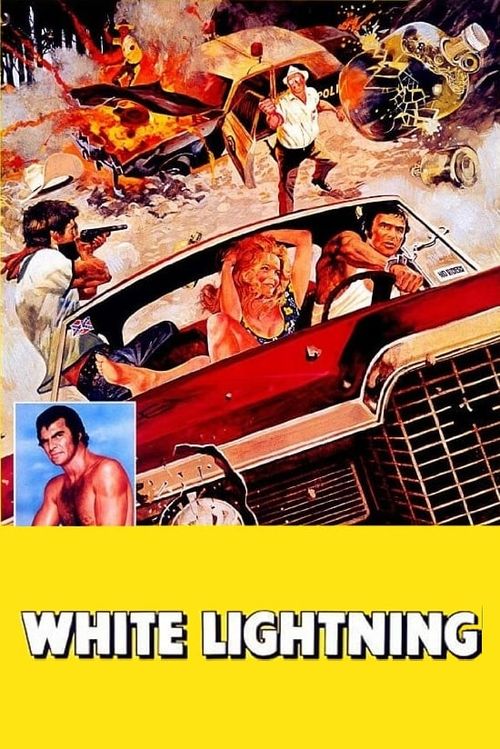
I’m kicking off #ArkansasMovies with WHITE LIGHTNING, the 1973 film from director Joseph Sargent that was filmed almost entirely within 30 minutes of my house in central Arkansas. Burt Reynolds is Gator McKlusky, a good ol’ boy who happens to find himself serving a stint in prison for “stealin’ cars, runnin’ cars, and runnin’ moonshine whiskey.” One day a cousin comes to visit him in prison and tells him that his younger brother Donny has been killed in Bogan County. Suspecting foul play, Gator first tries to escape. When that doesn’t work, he agrees to go stool pigeon and work with the federal authorities to infiltrate the world of illegal moonshining in Bogan County and provide them the names of the big money people in the area. This includes the crooked county Sheriff J.C. Connors (Ned Beatty), who Gator immediately zeroes in on as the key person responsible for his brother’s death.
In my opinion, WHITE LIGHTNING is one of the best of the good ‘ol boy, southern redneck films that were so popular in the 1970’s. One of the main reasons I like WHITE LIGHTNING so much is that while it does has some of the clowning that’s expected in these types of films, the tone gets deadly serious as McKlusky zeroes in on what happended to his brother. Reynolds is especially badass when he stops his signature laughing and goes into vengeance mode. And Ned Beatty is perfect casting as the small-town sheriff who is completely and irredeemably evil. The opening scene shows Beatty boating a couple of bound and gagged young men out into the middle of the lake, shooting a hole in the their boat, and then casually paddling away as the boat sinks. If you came up on him a little later, you’d think he was just heading in from a day of crappie fishing. For a guy that doesn’t look menacing at all on first glance, we know just how dangerous Sheriff J.C. Connors is. And so does Gator. We have a rooting interest in seeing Gator get his revenge.
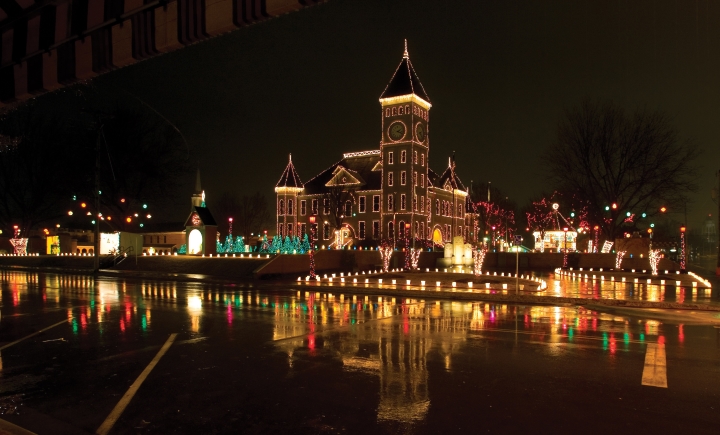
The primary filming locations in WHITE LIGHTNING are practically in my backyard. My wife and I got married at the Saline County Courthouse in downtown Benton, which is featured very prominently in the film. It’s a beautiful courthouse, with a distinctive clock tower. They decorate it so beautifully for the Christmas season (see picture below). Burt also spends time at the “Benton Speedway” in the film. This is actually the old I-30 Speedway that was in operation in Little Rock for 66 years. Sadly, the Speedway held its final race on October 1, 2022, which is almost 50 years after filming completed. The rest of the locations used were also in central Arkansas in the towns of North Little Rock, Keo, Scott, Wrightsville, and Tucker. FYI, I don’t recommend poking around Tucker if you’re into film tourism. Tucker is the primary prison unit for the Arkansas Department of Corrections. If you do head that way, just don’t pick up any hitchhikers!
All in all, WHITE LIGHTNING is a movie I whole-heartedly recommend, and it’s especially meaningful to me since it’s so close to home. Billy Bob Thornton would be back in this same area in 1996 to film SLING BLADE.
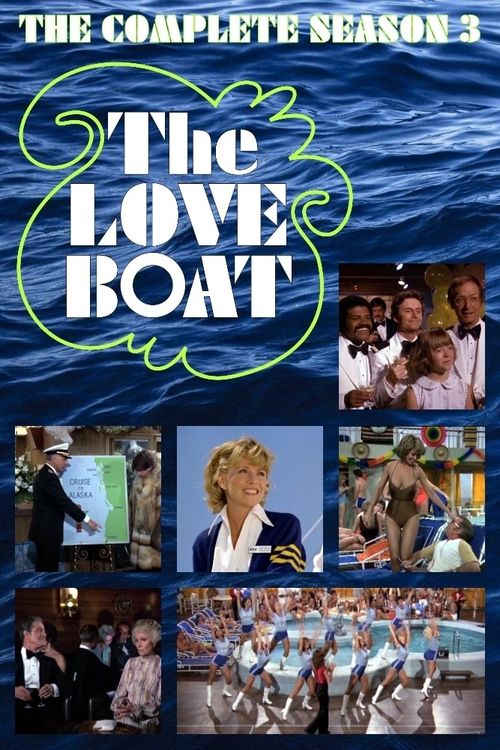
Welcome to Retro Television Reviews, a feature where we review some of our favorite and least favorite shows of the past! On Wednesdays, I will be reviewing the original Love Boat, which aired on ABC from 1977 to 1986! The series can be streamed on Paramount Plus!
This week, special guest star O.D. Warbux brings The Love Boat to life!
Episode 3.21 “The Remake/The Perfect Match/The Captain’s Ne’er Do Well Brother”
(Dir by Richard Kinon, originally aired on February 2nd, 1980)
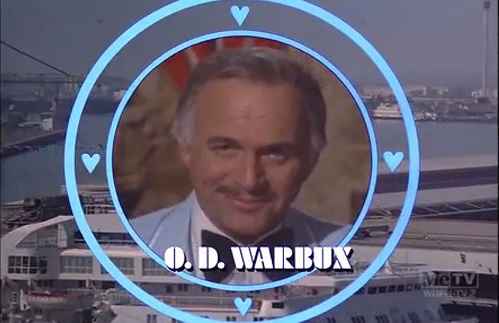
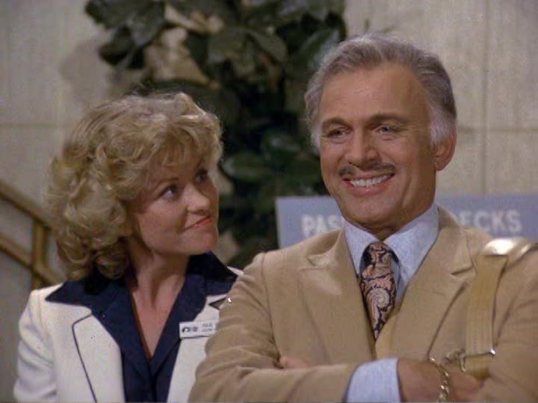
At the start of this week’s episode, Marshall Stubing boards the ship. As you can guess by his last name, Marshall is Captain Stubing’s brother. He bears a pretty strong resemblance to Merrill, except he’s a little thinner and he has more hair and a pencil-thin smile. He wears suits and has a quick smile and is quick to flirt with every woman the he sees. He’s played by an actor named O.D. Warbux and….
Wait a minute….
That’s not O.D. Warbux! That’s Gavin MacLeod! Yes, in this episode, Gavin MacLeod plays both the serious Captain Stubing and his carefree, free-loading brother. And you know what? MacLeod/Warbux actually does a pretty good job playing the two roles. In the scenes in which the brothers argue, MacLeod really does seem to be sincerely annoyed with himself. Seriously, though, you have to give MacLeod some credit. If he had joked his way through the double role, I doubt anyone would have called him out on it. Instead, MacLeod gives two believable and emotionally nuanced performances.
As for why Marshall is on the boat, he’s looking for a woman to continue to fund his life. Merrill threatens to kick Marshall off the cruise but Marshall reveals that he bought a ticket and he has ever right to be there. As Merrill watches with a disapproving frown, Marshall meets and romances Ruby Gibson (Diane Ladd), who is the millionaire widow of an Oklahoma oilman. Marshall actually does fall in love with Ruby but he fears that he’s not good enough for her. Ruby announces that Marshall is perfect for her and even Merrill says that Marshall is actually a good guy. Marshall leaves the boat with Ruby and I assume they got married a few weeks later. That’s good. Hopefully, Ruby will help to pay for Vicki’s college education (assuming Vicki is actually allowed to leave the boat to attend school).
Marshall Stubing is not the only family member on the boat. Julie’s aunt, Christine (Florence Henderson), is also on the boat. When she meets Neal Rich (James Broderick), he immediately reminds her of her late husband. Neal and Christine fall in love on the boat but will Christine ever stop trying to make Neal behave just like her late husband? Of course, she does. This is The Love Boat! Back when I was reviewing The Brady Bunch Variety Hour, I said some fairly negative things about Florence Henderson as an actress but she’s actually really good in the episode and she has great chemistry with James Broderick so I guess it was really the Brady children who were holding her back on the Variety Hour. This was a sweet story and I have to say that I actually found myself really hoping that Christine and Neal would work things out.
Finally, Holly Christopher (Connie Stevens) boards the ship because she’s spent the last few weeks stalking Howard Samuels (Kent McCord), the man who she has decided will be the father of her child. As Holly explains it to Doc, she doesn’t want to get married. She doesn’t want a family. She just wants a baby. Doc, who has like a dozen ex-wives and whose entire life seems to revolve around searching for one-night stands on the boat, tells her that marriage and traditional courtship are wonderful and that she should consider them. Holly realizes that she agrees with Doc and she decides that she wants an old-fashioned romance after all. This whole storyline felt like it could have come from one of those old 1950s films that would star Troy Donahue and Sandra Dee as teenagers learning the facts of life. Kent McCord was pretty dull as Howard but Connie Stevens brought a lot of energy to the role of Holly. Out of the three couples who left the ship at the end of the cruise, Howard and Holly is the one that’s definitely not going to last.
With this episode, The Love Boat kept it all in the family and, overall, this was a pretty good cruise. Both Gavin MacLeod and O.D. Warbux deserve a lot of credit for giving performances that elevated the entire episode.
It’s become a bit of a cliché that all Lifetime and Hallmark Christmas movies take place in a small town and feature someone returning to visit relatives for the holidays. Christmas Lost and Found, however, breaks with tradition. While it is true that film begins with Whitney Kennison (Tiya Sircar) returning to her former hometown so she can spend the Christmas with her grandmother (Diane Ladd), the hometown in this case is Chicago.
(Of course, in all fairness, I guess we should keep in mind that Whitney left Chicago for New York City, where she found employment as an event planner. And, from what I’ve seen, it does appear that a lot of people in New York consider almost every other city in America to be a small town by comparison. That being said, I live in Dallas and I spend my holidays in Fort Worth so, to me, both New York and Chicago are huge metropolises.
Anyway, where was I?)
Whitney is an extremely successful in event planner in New York City but her success has come at a cost Whitney is so driven to succeed and such a workaholic that she’s running the risk of forgetting about the things that make life worthwhile, things like love and family.
Fortunately, Grandma’s here with her box of ornaments!
The ornaments are several years old, each one representing a different Christmas that Whitney spent with her grandmother. (For instance, a snow flake ornament represents that Christmas when they got snowed in.) Grandma gives Whitney the box of ornaments and tells her to keep them safe until it’s time to decorate the tree. However, the very next morning, Whitney is cleaning the house and the ornaments accidentally get thrown out!
Terrified that she’s lost the ornaments and ruined Christmas foever, Whitney puts off telling Grandma what happened. However, then the notes start to show up, rhyming riddles that inform Whitney that she’s going to have to go on a scavenger hunt across Chicago to get the ornaments back. Now, this may sound like the set up for a holiday-themed horror movie but have no fear! The first riddle says that it might sound like a stunt but promises that it will be fun.
Working with the neighbor, Brian (Edward Ruttle), Whitney goes searching for both the ornaments and, in a larger sense, Christmas itself. With each ornament that she finds, she’s reminded of yet another Christmas. The unseen letter writer continues to give Whitney tasks, making her write a letter to Santa Claus at one point. While Whitney searches for the ornaments, she also tries to figure out the identity of the letter writer. And, of course, she also has to finish designing a department store display window because …. well, why not?
How you react to this movie will probably depend on how much tolerance you have for Lifetime holiday movies in general. This is an unabashedly sentimental film and it takes place in a world that’s almost devoid of cynicism. You have to be willing to accept that someone was somehow able to put together an extremely elaborate scavenger hunt and have it play out without a hitch. Is the film implausible? Kinda. And if that matters to you, you’re probably not into Lifetime Christmas movies.
As for me, I always get sentimental around this time of year so I enjoyed Christmas Lost and Found. Edward Ruttle was likable as the neighbor and he and Tiya Sircar had enough chemistry to make them pleasant to watch on screen. And, of course, you’ve got the great Diane Ladd playing Whitney’s grandmother. It’s hard to think of anyone who could have done a better job with the role.
If you’re not naturally inclined to like these type of movies, Christmas Lost and Found probably won’t convert you. But if you enjoy sentimental holiday entertainment, Christmas Lost and Found delivers exactly what it promises.
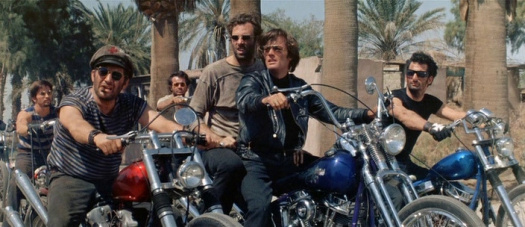
Roger Corman kicked off the outlaw biker film genre with THE WILD ANGELS, setting the template for all biker flicks to come. Sure, there had been motorcycle movies before: Marlon Brando in THE WILD ONE and the low-budget MOTORCYCLE GANG spring to mind. But THE WILD ANGELS busted open box offices on the Grindhouse and Drive-In circuits, and soon an army of outlaw bikers roared into a theater near you! There was BORN LOSERS , DEVIL’S ANGELS, THE GLORY STOMPERS , REBEL ROUSERS, ANGELS FROM HELL, and dozens more straight into the mid-70’s, when the cycle cycle revved its last rev. But Corman’s saga of the freewheeling Angels was there first; as always, Rapid Roger was the leader of the pack.
Our movie begins with the classic fuzz-tone guitar sound of Davie Allen, as Angels president Heavenly Blues (Peter Fonda ) rolls down the road to pick up club…
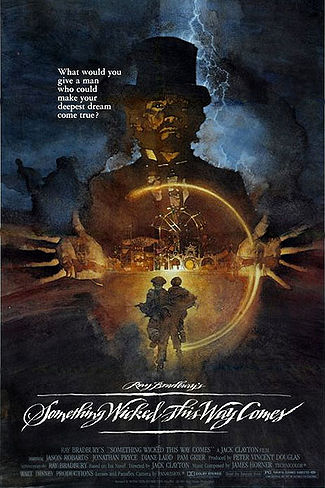
Something Wicked This Way Comes is one of my favorite films.
The place is Green Town, Illinois. The time is the 1920s. The carnival has come to town but this is no normal carnival. Led by the sinister, Mr. Dark (Jonathan Pryce), this carnival promises to fulfill everyone’s dreams but at what cost? Double amputee Ed (James Stacy) gets his arm and his leg back. The lonely teacher, Miss Foley (Mary Grace Canfield), is young and beautiful once again. Mr. Dark may bring people what they want but he gives nothing away for free. Only two young boys, Will (Vidal Peterson) and Jim (Shawn Carson), realize the truth about the carnival but no one in town will listen to them. Mr. Dark wants Jim to be his successor and Will’s only ally is his elderly father, the town librarian (Jason Robards).
As much a coming of age story as a horror film, Something Wicked This Way Comes takes the time to establish Green Town and to make it feel like a real place and its inhabitants seem like real people. When Mr. Dark shows up, he is not just a supernatural trickster. He is not just stealing the souls of Green Town. He is also destroying the innocence of childhood. Jonathan Pryce is both charismatic and menacing as Mr. Dark while Jason Robards matches him as the infirm librarian who must find the strength to save his son. The confrontation between Pryce and Robards, where Pryce tears flaming pages out of a book, is the best part of the movie. Along with Robards and Pryce, the entire cast is excellent. Be sure to keep an eye out for familiar faces like Royal Dano, Jack Dodson, Angelo Rossitto, and especially Pam Grier, playing the “Dust Witch,” the most beautiful woman in the world.
Based on a classic novel by Ray Bradbury, Something Wicked This Way Comes is one of the only Bradbury adaptations to do justice to its source material.



 Something Wicked This Way Comes is one of my favorite films.
 Through the Shattered Lens