A few days ago, Arleigh shared the theme song from 1976’s The Omen as Monday’s horror song of the day. As I sat there and listened to Jerry Goldsmith’s award-winning hymn to Satan, it occurred to me that I happen to have all five of the Omen films sitting in my movie collection. Seeing as how this is Halloween and how the world seems to be getting closer to ending with each passing day, I decided that this would be the perfect time to rewatch the entire franchise and consider whether or not The Omen films are truly as scary as a lot of people seem to think.
So, that’s what I did.
How did things turn out?
Well, in the long history of sequels and remakes, The Omen franchise is one of the more uneven collections. This is one of those franchises where things tend to get less impressive with each subsequent entry. However, 38 years after its initial release, the first Omen remains effective and, in its way, genuinely scary.
If you’re a horror fan, you probably know the general plot of The Omen regardless of whether you’ve actually watched it or not. It’s one of those films that has been so frequently imitated that it’s almost possible to watch it by osmosis.
The film opens in Rome with diplomat Robert Thorn (Gregory Peck) being rushed to the hospital where his wife, Kathy (Lee Remick), has just given birth. A priest (Martin Benson) tells him that his son died shortly after being born but that he can always just go home with an orphaned newborn that he just happens to have handy. Robert agrees and decides not to tell his wife the truth about the child. Robert and Kathy raise the boy and they name him Damien. Four years later, the politically ambitious Robert is named as Ambassador to the Court of St. James.
The Thorns move to London and soon, odd things start to happen. Damien (now played by Harvey Spencer Stephens) is a quiet boy with a piercing stare who throws a fit whenever he’s taken inside of a church. When Kathy takes Damien to the zoo, they’re attacked by angry baboons. A large Rottweiler mysteriously appears on the grounds of the Ambassador’s estate. A mysterious and sinister nanny (Billie Whitelaw) shows up and explains that she’s been sent by an “agency.” A crazed priest (Patrick Troughton) starts to stalk the Ambassador, demanding a chance to speak with him and insisting that Damien’s mother was actually a jackal.
Even more mysteriously, people start dying in the strangest of ways. A young woman (Holly Palance) smiles as she shouts, “Damien, it’s all for you!” and then hangs herself, thoroughly ruining Damien’s fifth birthday party. A freak lightning storm leads to a man being impaled by a weather vane. Another person who suspects that there might be something wrong with Damien ends up losing his head in a graphic sequence that — even in this age of Hostel and Saw — is difficult to watch.
The Ambassador is contact by Keith Jennings (David Warner), a nervous photographer who fears that Damien may be planning on killing him. Soon, Thorn and Jennings are flying to Italy and to the Middle East and discovering evidence that five year-old Damien might very well be the Antichrist. Speaking of Damien, he and that nanny have been left alone with poor, victimized Kathy.
(“Oh, leave her alone,” I muttered as Damien attempted to kill Kathy for the hundredth time…)
As I watched The Omen, I tried to figure out why this film has held up so well. It certainly wasn’t due to the performance of Gregory Peck who, quite frankly, seemed to mostly be going through the motions. David Warner, on the other hand, gave such a good performance that it was almost difficult to watch. (Don’t get attached to any character who appears in an Omen film.) Some of the film’s effectiveness was undoubtedly due to Jerry Goldsmith’s intense score. Anything’s scary when you’ve got a hundred voice shouting “Ave Satani” at you.
But, ultimately, I think the reason why The Omen still works is because the film generates such a palpable sense of doom. This is one of those films that leaves you convinced that anyone can die at any minute and, considering that happens to be true in both this movie and in real life, that makes the horror of The Omen feel very real. By the time the film ends, you’re left with little doubt that nobody in the film had the least bit of power or control over his or her own destiny. Instead, they were all just pawns in a game that they had no hope of ever winning or understanding. Is there anything scarier than feeling powerless?
All I know is that, having rewatched The Omen, I will never look at a plane of glass the same way again.
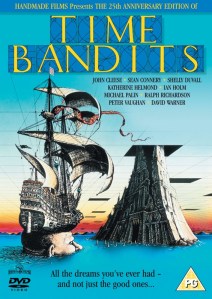
My parents used to have some strange movies growing up. Time Bandits is one of those films that I kind of stumbled on, but grew to be one of my favorite British films. It was my gateway drug to all things Monty Python.
Produced by former Beatle George Harrison and his company, Hand Made Films and running off the success of Monty Python’s Life of Brian, Time Bandits runs off of a simple premise. The Supreme Being once had a map of all the points in time on Earth. A group of his servants steal this map in order to travel through time and use it to plunder various historical figures of their loot. Granted, it’s a strange story, but if you’ve watched anything Gilliam’s done, this film actually works (or did for me when I saw it).
Our story opens with a boy named Kevin (Craig Warnock), who dreams of a more interesting life than the one he shares with his parents while watching tv. One night, a set of little people dressed in steampunk attire climb out of his closet and threaten him bodily harm unless he tells them how to escape his dimension. They manage to locate an exit, only to be pursued by The Supreme Being, who warns them to return the map they’ve stolen from him. If I remember nothing else from this film, that one scene will always stay with me.
The crew, led by Randall (David Rappaport) arrive during Napoleon’s time (played quite convincingly by Ian Holm) and manage to become generals in his army after impressing him with a rendition of “Me and My Shadow”. This, coupled with their size helped out, I’m sure. As thanks for being part of his army, they get Napoleon drunk until he passes out and collect most of his loot before finding another time portal and leaping into Robin Hood’s time. Unfortunately for the Time Bandits, Robin Hood (John Cleese) assumes they’ve arrived to give their ill begotten goods to the poor and promptly gives it all away to them.
In the midst of figuring out their next step, the Bandits run into The Supreme Being again and distract him, giving Kevin a chance to escape on his own. However, when two portals open before him, he chooses the wrong one and ends up in Ancient Greece with King Agememnon (Sean Connery), who adopts Kevin as a Prince. Before he can fully enjoy it, however, the Bandits show up and “free” from the time period he doesn’t belong in.
There’s more to the tale, but let’s just say that the Evil Genius (one of David Warner’s best roles in my opinion – he had a knack for playing bad guys) gets wind of the Map and hatches his own plan to acquire it and use it for nefarious deeds.
The beauty of Time Bandits is the world it creates. Though grounded in real time periods, the fantasy elements are pretty interesting, much like Brazil was. Giants who wear ships on their heads, Ogres and creates with cow skulls for heads make up some of the strange visions Terry Gilliam brings to this story. Overall, it’s a fun and unique tale that’s good for at least a late night viewing, and one that I return to from time to time.
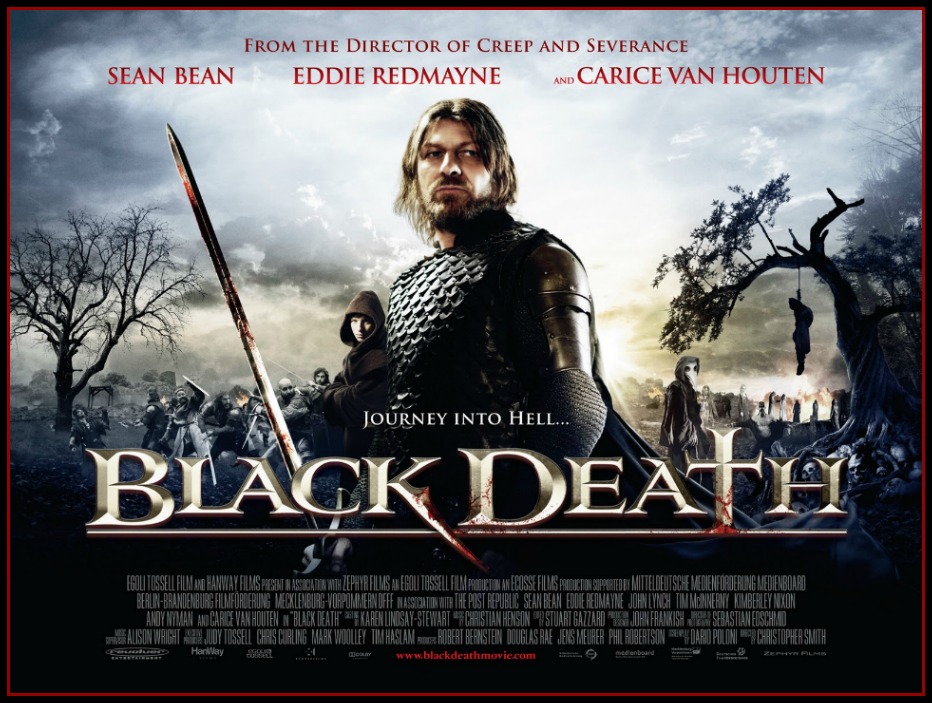
British filmmaker Christopher Smith has been flying under the radar of most of the film-going public. He’s already a filmmaker with five films to his credit of varying quality, but each showing his growth as a director with each successive release. In 2010, Christopher Smith released his sixth film in the UK with some film festival showings in the US soon thereafter. Black Death continues Smith’s work in the horror genre with this latest film a historical horror piece which tries to take a look at the subject matter of the Black Death of medieval Europe in a realistic, gritty light.
The film is set during in 1348 plague-ravaged England where a Osmund, a young monk, has a crisis of faith as he agonizes over his celibate vows to God and his love for Avrill, a young woman in town who also has feelings for Osmund. Avrill gives Osmund a week to find the answer to his dilemma and will wait for him at the marshes in that alloted time. Osmund finds his answer as templar knight Ulric (played by Sean Bean) and a group of his soldiers arrive at the monastery on a mission to find a village said to be untouched by the plague and one which might be providing a safe haven for a necromancer who has brought the dead back to life. Osmund seizes on this chance to leave the monastery and lead Ulric and his men through the marshes and to this village.
During their travel the group loses a couple men to bandit attacks and to the plague itself. They also come across a band of villagers about to burn a young woman for witchcraft. At first, Ulric seems to take pity and show compassion to this young woman, but instead kills her himself for the crime she is accused of. Ulric reminds Osmund and his men that they have no time for such distractions as they a much more important task ahead of them. A task which soon brings them to the very village which seem to be free from the plague many attribute to God punishing the sinners and other’s as the Devil tormenting the faithful.
It’s this ambiguous theme of how the Black Death was seen by villagers, soldiers and faithful which becomes an overriding theme in the film. Smith, using Dario Poloni’s screenplay, goes about exploring how those in power on both sides of the question — of whether God or the Devil was responsible for the plague — hold such a major influence on the minds of the uneducated populace. Ulric, Osmund and the group do find their necromancer, but it’s not all what they’ve expected and, for Osmund, this mission becomes a tragic one which tests his faith in God, his church and all that he’d been taught (indoctrinated some would call it) to believe. Osmund becomes the spiritual battleground from which Ulric and the necromancer fight over his eternal soul and the effect this has on the young monk turns out a surprising fashion which brings to mind Michael Reeves own historical piece and one of the greatest horror films of all-time in Witchfinder General.
Christopher Smith’s direction continues to improve and shows in Black Death as he’s able to make not just the subject of this horrific era in Europe’s medieval past, but at the same time use a deft hand to explore themes of faith, spirituality, role of religion as control and how fundamentalism doesn’t just affect those with religious conviction but also those who follow the secular path. It helps that Smith had a capable ensemble cast led by Sean Bean’s usual strong performance. Eddie Redmayne as Osmund seemed to be a one-note cipher through the first-half of the film, but once he arrives in the village his character begins to open up in complex ways that we’re never sure if he’ll fall on the side of the angels or the demons even right up to the end and even then it’s left ambiguous.
Black Death marks the latest in Christopher Smith’s tour of the horror genre and it’s many varying subjects to hone his growing craft as a filmmaker. The film ended up being entertaining despite having such an oppressive atmosphere and tone to not just the story, but to the very setting. There’s enough blood and gore spilled (using practical effects and not a sign of CGI to be seen) during scenes of fighting and torture to satisfy gorehounds who might come across the film. It also should work the mind of those also looking not just for the grue but also something to stimulate the mind. It’ll be interesting to see what Christopher Smith has next to follow-up this well-done and executed historical horror film.
There’s a film called Black Death that came out sometime around 2010 that seems to have fallen below the radar of most everyone. It’s a British historical horror film from upcoming genre filmmaker Christopher Smith. The film stars Sean Bean in the role of a knight during the Black Death era of Europe.
From what I’ve seen of the trailer and read about the film it seems to be a horror film that looks at the Black Death era of history with a slightly supernatural bent to it. Even the trailer gives gives the film a certain Wicker Man vibe to it. Holy warriors of the Christian faith coming into a village untouched by the Black Death. A village whose inhabitants might be dabbling with powers from a much older and earthy religion to keep the village safe. It definitely sounds like this film might have been influenced by that classic horror film starring Edward Woodward.
I like the look of the film as seen through the trailer. It almost looks black and white with splashes of vibrant colors here and there. Black Death hasn’t been announced as having a North American theatrical release date so this film looks like it will be a blu-ray release for me to finally see it.
“There are things in this world that go beyond human understanding.”
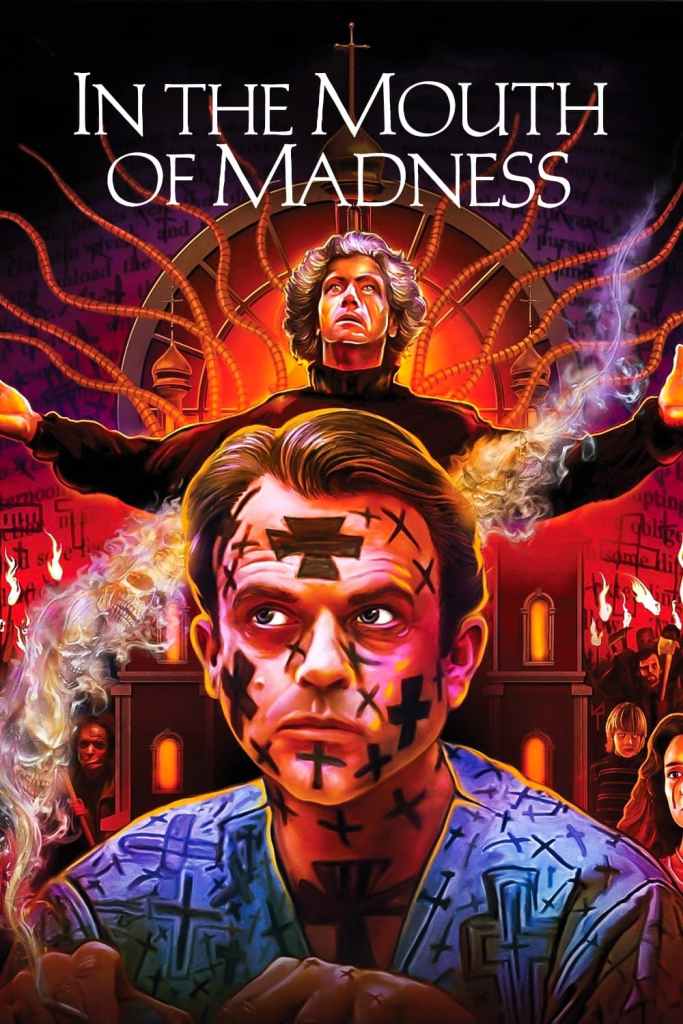
John Carpenter’s reputation as one of the great American horror directors rests on his ability to merge the cinematic with the philosophical—to craft films that stay frightening not because of what they show, but because of what they suggest. Yet by the early 1990s, Carpenter’s once unshakable relationship with audiences had weakened. His influence remained undeniable, but several of his later films seemed to miss the spark that defined Halloween, The Fog, or The Thing. Then arrived In the Mouth of Madness (1995), a work that signaled a late creative resurgence. It paid intelligent homage to two pillars of horror literature—Stephen King and H. P. Lovecraft—while offering a disturbing reflection on authorship, sanity, and the power of belief. The film reasserted Carpenter’s command not only over frightening imagery but also over the psychological territory that underpins enduring horror.
At a narrative level, In the Mouth of Madness follows John Trent (Sam Neill), an insurance investigator known for exposing fraud and deception. His skepticism becomes both his strength and undoing. Trent is hired by publishing executive Jackson Harglow (played by the legendary Charlton Heston) to locate Sutter Cane, a best-selling horror novelist whose disappearance threatens both the company’s finances and the stability of Cane’s obsessed fanbase. Every sign points to something far stranger than a publicity stunt. Cane’s readers are exhibiting troubling behavior, as though the author’s new book has triggered more than just entertainment—it has become contagion.
Carpenter crafts Trent’s descent into uncertainty with meticulous pacing. At first, Neill’s character regards the assignment as routine, dismissing the hysteria surrounding Cane’s novels as marketing excess. But when his investigation hints that the locations and events in Cane’s fiction may correspond to real places and real disturbances, the film begins to twist the rational into the uncanny. The story’s sense of unreality builds with deliberate restraint—incidents grow progressively stranger, but never so overt that Trent can confidently identify what’s madness and what’s truth. Carpenter thrives on this ambiguity, pulling both protagonist and viewer into an atmosphere where logic erodes and fiction itself seems to rewrite reality.
Accompanying Trent on his search is Linda Styles (Julie Carmen), the publisher’s editor assigned to ensure the investigation runs smoothly. While her performance has sometimes been considered subdued, Styles functions as the audience’s second perspective: observant, mildly skeptical, and gradually aware that the world around her no longer behaves according to its former rules. Carpenter positions her as a necessary counterpoint to Trent’s brittle rationalism, highlighting the conflict between recognizing patterns and succumbing to fear. As they move closer to locating Cane, their surroundings take on the familiar haunted quality of an archetypal New England town—Hobb’s End—built from the shared DNA of King’s Castle Rock and Lovecraft’s Arkham. The town becomes more than setting; it is a physical embodiment of literary influence and psychological instability.
The choice of Sam Neill proves essential to the film’s success. His trademark combination of intelligence and emotional vulnerability allows Trent’s transformation from calculating skeptic to disoriented seeker to feel natural rather than theatrical. Few actors could portray a man so evidently rational who nonetheless finds himself seduced by forces his disciplined mind cannot resist. Neill’s body language carries much of the horror; his expressions shift between dry disbelief and quiet terror, suggesting that intellect offers no protection once perception itself begins to betray you. Carpenter exploits this performance with close framing and asymmetric compositions, visually trapping Trent in spaces that subtly curve or distort. The director’s technical command ensures that even ordinary scenes seem charged with quiet wrongness.
While In the Mouth of Madness never references the mythos of Lovecraft by name, its influence saturates the film. Lovecraft’s hallmark—cosmic indifference—exists here not through tentacled gods but through the crumbling borders between fiction and the human mind. The suggestion is that the very act of creating and consuming stories might awaken something ancient and uncontrollable. When Trent confronts the nature of Cane’s work, Carpenter’s direction avoids overstatement. Instead of grand confrontations, he conveys horror through disorientation—the feeling that language, images, and even memory are slipping toward incoherence. Reality itself becomes a character, unstable and untrustworthy.
Jürgen Prochnow’s portrayal of Sutter Cane adds another layer of unease. His calm, confident manner diverges from standard portrayals of deranged genius. Prochnow makes Cane unnerving precisely because he appears so certain of his vision. The author views himself not as a mere storyteller but as a conduit, claiming that what he writes merely reveals a preexisting truth. Through him, Carpenter explores a potent question that haunts all creators: does imagination serve human purpose, or is it an independent force that uses human minds as tools? Cane’s conviction blurs that line, turning the creative process into possession. To audiences familiar with the concept of “mad artists” in literature, his belief offers both fascination and dread.
Carpenter imbues this theme with visual invention. The cinematography and set design combine the mundane with the surreal—painted walls pulse, corridors bend, horizons vanish. Rather than relying on excessive gore or digital spectacle, the director emphasizes textures and shadows, creating optical unease rather than overt shock. The town of Hobb’s End seems perpetually detached from time, its streets looping back on themselves. By employing low, creeping camera movements and deliberate color desaturation, Carpenter evokes a dreamscape decaying from within. The film’s sound design—especially Carpenter’s own pulsating score, co-composed with Jim Lang—heightens that tension with rhythmic basslines reminiscent of a heartbeat slowing to a stop. Every technical choice reinforces the narrative’s central sensation: uncertainty.
Michael De Luca’s screenplay deserves particular credit for its clever structure. The film is framed as a story told from inside an asylum, immediately hinting that the perspective may be unreliable. This framing allows Carpenter to shift between psychological thriller and cosmic horror without losing cohesion. As viewers, we are made complicit in Trent’s investigation but warned not to trust his perceptions. The resulting experience is disorienting yet coherent—a cinematic maze where each turn feels inevitable once taken. The writing never lingers long on exposition, instead suggesting connections through implication and repetition. In this way, De Luca’s script succeeds in translating Lovecraftian dread into visual terms: a fear of knowledge itself.
Very few directors have managed this particular tone as successfully. Lovecraft’s fiction often resists cinematic adaptation precisely because its greatest horror lies in what cannot be shown. In the Mouth of Madness solves this problem by making the act of storytelling itself the subject of terror. By focusing on an author whose imagination reshapes reality, Carpenter transforms literary horror into filmic language. In doing so, he edges close to achieving what decades of other attempts had failed to capture—a true Lovecraftian mood rendered on screen, grounded not in spectacle but in existential dislocation.
Despite its craftsmanship and intelligence, In the Mouth of Madness struggled at the box office upon release. Its ambiguity, self-reflexivity, and intellectual leanings proved challenging for mid-1990s audiences who expected more conventional scares. Yet over time, the film’s reputation has flourished. Today, it is often regarded as the concluding entry in Carpenter’s loosely connected “Apocalypse Trilogy,” following The Thing (1982) and Prince of Darkness (1987). All three films share a fascination with humanity confronting forces it cannot comprehend—scientific, metaphysical, or divine. In each, Carpenter presents apocalypse not as fiery destruction but as revelation: the moment when human understanding collapses under greater cosmic truth. That philosophical core links these works across more than a decade of filmmaking.
Revisiting In the Mouth of Madness now, one is struck by how prophetic it feels. Its concerns about cultural contagion and media-induced madness anticipate contemporary conversations surrounding viral misinformation, fandom extremism, and the blurring between online identity and reality. The “disease” in the film—ideas that rewrite perception—mirrors our present anxiety about the stories and images that shape collective belief. Carpenter’s horror, always grounded in social awareness, here expands into a warning about a world unable to distinguish narrative invention from lived experience.
Even limited in budget, Carpenter demonstrates confident control of visual tone and rhythm. His filmmaking reminds viewers that suggestion often unsettles more deeply than spectacle. Rather than overwhelming audiences with jump scares, he leads them through gradual disintegration, where each logical step seems to justify the next until coherence itself fractures. The film invites reflection rather than relief, leaving viewers haunted by the possibility that the boundaries between art and life are far thinner than comfort allows.
While Carpenter would go on to direct more films after 1995, In the Mouth of Madness stands as one of his last profoundly accomplished achievements. It encapsulates the elements that made his earlier works enduring: tight pacing, minimalist storytelling, and ideas that resonate beneath genre tropes. The film’s legacy continues among filmmakers who explore metafictional or cosmic horror, from Guillermo del Toro’s long-sought adaptation of At the Mountains of Madness (a feat that may never come to fruition outside of concept art and videos) to the psychological labyrinths of contemporary horror auteurs. Though Carpenter’s film never directly adapts Lovecraft, it succeeds where many literal adaptations fail—by preserving the essence of incomprehensible terror rather than translating it into spectacle.
Ultimately, In the Mouth of Madness remains a rare horror film that asks not just what we fear, but why we need fear in the first place. Its central notion—that imagination itself can undo reality—strikes at the heart of storytelling. Carpenter’s mastery lies in letting that idea linger long after the credits roll. What begins as an investigation grows into a philosophical nightmare, compelling viewers to question how much of their world is built from collective belief. In that sense, the film transcends its genre to become one of Carpenter’s most unsettling reflections on human perception. Decades later, its message still resonates: the stories we consume may shape us more profoundly than we realize.

 Through the Shattered Lens