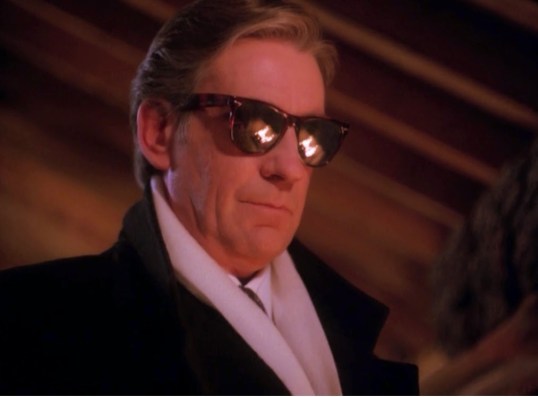
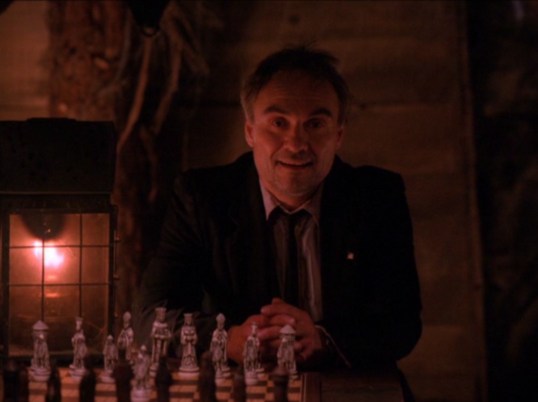
Horror Film Review: Waxwork II: Lost In Time (dir by Anthony Hickox)


1992’s Waxwork II opens with the finale of the first Waxwork.  The cursed waxwork is burning to the ground, taking out the monsters within, along with Sir Wilfred (Patrick Macnee) and Wilfred’s army of do-gooders.  Only Mark (Zach Galligan) and Sarah (now played by Monika Schnarre) are able to escape.  Fleeing the burning building, they manage to catch a cab.  Sarah wonders what they’re going to do now.  Mark replies that they’re going to go back to school and pretend that none of this ever happened.

Good luck with that!  It turns out that one other thing did escape from the waxwork.  A disembodied hand follows Sarah home and murders her abusive stepfather.  Sarah manages to drop the hand down the garbage disposal, destroying it but also destroying the only proof she had that she didn’t kill her stepfather.  Sarah is put on trial for murder and the jury does not appear to be impressed with her “It was a supernatural creature” defense.

What she and Mark need is proof that the waxwork was full of monsters.  Fortunately, a trip to Sir Wilfred’s house reveals not only a recording of Sir Wilfred explaining how there’s an alternative universe known as the Kartagra but also a compass that can be used to find portals into the Kartagra.  Mark and Sarah enter the Kartagra, searching for proof of Sarah’s innocence.

Mark and Sarah go from one universe to another, meeting iconic horror characters along the way.  Just as with the exhibits in the first film, each universe features it own set monsters and its own distinctive style.  For instance, Mark finds himself suddenly cast in the role of Henry Clerval, best friend of Baron Frankenstein (Martin Kemp) and the lover of the Baron’s wife, Elizabeth (who is actually Sarah).  Of course, the Baron has more to worry about than his wife cheating with his best friend.  There’s also the angry monster living in the basement and the angry villagers that are due to start pounding on the front doors of the mansion.

Later, Mark finds himself in a black-and-white recreation of The Haunting of Hill House, working with a researcher (Bruce Campbell) and two psychics to investigate reports of a ghost at an old house.  Mark must bring peace to the ghost while avoiding all of the slapstick complications that one might expect when Bruce Campbell shows up as a paranormal researcher.  While Mark is dealing with that, Sarah is floating in space, trying to protect the crew of her dingy spaceship from an acid spewing alien.

You get the idea.  Waxwork II is essentially an affectionate collection of homages to other, better-known horror films and it must be said that Waxwork II does an excellent job of recreating each film, from the crisp black-and-white of haunted house scene to the grittiness of the Alien sequences to the over-the-top swordplay of a trip to a medieval world.  There’s even a trip to the mall from Dawn of the Dead!  Wisely, Waxwork II doesn’t take itself particularly seriously, with many scenes developing into outright comedy.  Zach Galligan gives an enjoyable and nicely modulated comedic performance, even holding his own with Bruce Campbell.

At 104 minutes, Waxwork II runs a bit too long for its own good but it ends on a sweet note that nicely wraps up the entire saga.  It’s a film that works as both a continuation of Waxwork and as an entertaining film on its own.

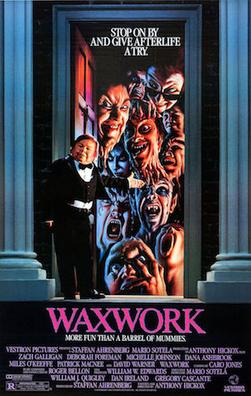
Horror Film Review: Waxwork (dir by Anthony Hickox)


First released in 1988, Waxwork asks the audience with a very important question.

Let’s say that you and your best friend were walking to school one day when you suddenly noticed a gigantic mansion that you had never seen before, sitting in the middle of your neighborhood.  And what if a tall, somewhat sinister Englishman (played by David Warner, none the less) suddenly appeared out of nowhere and told you that the mansion was actually a waxwork.  And what if that Englishman than invited you to come to the waxwork at midnight and specifically asked you to come in a group of 6.  Would you do it?

Now, I know that your first instinct is to say, “Of course, I wouldn’t!”  That’s the type of answer that we’ve been conditioned to give because no one wants to admit that they can be as dumb as a character in a horror movie.  But really, I would go.  Especially if, like the characters in Waxwork, I was a teenager.  (Actually, most of the characters in Waxwork are described as being college students but they all act like high school students and their college appears to be a high school so draw your own conclusions.)  When you’re a certain age, you feel like you’re immortal and an invitation to hang out in a creepy building with a bunch of strangers at midnight feels totally reasonable.

Anyway, four rich kids — Mark (Zach Galligan), China (Michelle Johnson), Sarah (Deborah Foreman), and Tony (Dana Ashbrook, a year before he was cast as Laura Palmer’s boyfriend in Twin Peaks) — visit the waxwork at midnight.  What they discover is that the building is full of macabre exhibits that recreate various moments from horror history.  There’s werewolves, vampires, and Jack the Ripper.  There’s also the Marquis de Sade, a figure that the seemingly innocent Sarah becomes fascinated with.  And, as two of the visitors discover, stepping past the red rope and entering an exhibit transports them into an alternate world where they become the victim of the star of each display.

Not surprisingly, the film is at its best when imagining the world inside each exhibit.  Each exhibit has its own backstory and its own set of guest stars.  John Rhys-Davies shows up as a werewolf.  Miles O’Keeffe is a properly urbane Count Dracula.  J. Kenneth Campbell plays the Marquis de Sade, who the film imagines as a swashbuckling sadist.  That said, I think the most effectively frightening exhibit was one that featured no special guest stars but a very determined and very strong mummy.

What’s going on at the waxwork!?  As explained by Sir Wilfred (Patrick Macnee, bringing some welcome wit and style to the film), it’s all a part of a scheme to bring the most evil beings ever back into existence so that they can conquer the world.  It’s important that none of the waxworks be allowed to enter the real world and soon, Sir Wilfred and his ragtag army are laying siege to the waxwork and bringing things to an apocalyptic conclusion.  The final battle is a bit haphazardly edited and it’s impossible to really keep track of who is fighting on which side.  (Indeed, I’m still not sure where Sir Wilfred even found his army.)  But it does feature plenty of in-jokes for horror fans, including a cameo appearance by the carnivorous plant from Little Shop of Horrors.

Waxwork is entertaining film.  It doesn’t take itself particularly seriously and, indeed, Mark, China, Sarah, Tony, and all of their friends feel as if they could just as easily have been found in the pages of a Bret Easton Ellis novel about pretty but vapid alcoholics.  Mark is the type who gets his maid to write his term papers.  Tony just wants to drink (but, because he’s played by the adorable Dana Ashbrook, he’s still the most likable character in the film).  China says, “I do what I want, when I want,” when confronted about cheating on her boyfriend.  Sarah is the “innocent” one but just seeing the words “Marquis de Sade” causes her to swoon.  Dropping these four idiots into a situation where the fate of the world is at stake feels like a wonderfully sardonic cosmic joke.

In the end, the true pleasure of Waxwork is watching old pros like David Warner, Patrick Macnee, and the exhibit guest stars hamming it up.  Macnee, in particular, seems to enjoy leading the final charge against the forces of evil and, indeed, it’s hard not to wish that he had even more screen time than he did.  David Warner, meanwhile, rolls his eyes at just how difficult it can be to bring the 18 most evil figure in history back to life.  It’s hard work but I guess someone has to do it!

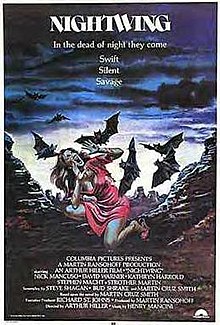
Nightwing (1979, directed by Arthur Hiller)


Cattle and humans are dying in New Mexico at an alarming rate.  Scientist Phillip Payne (David Warner) thinks that the local bat population has become infected with the plague.  Deputy Youngman Duran (Nick Mancuso) thinks that the bats may be attacking because of a curse that was cast by a Hopi medicine man.  Meanwhile, the corrupt tribal chief (Stephen Macht) just wants to sell the land to an evil land developer (Ben Piazza) and be done with it.  Dr. Anne Dillion (Kathryn Harrold) tries to spread the word about the bats but the authorities don’t want the bad publicity.  They’ve never seen Jaws.  And, finally, a group of missionaries camp in the desert with no idea what’s about to swoop down on them.

I don’t know about you but I would never think of missing an Arthur Hiller horror movie!  While many directors in the 70s proudly wore the auteur and rebel label, Arthur Hiller went the opposite route.  He oversw conventional, Hollywood productions, the best known of which was Love Story.  Arthur Hiller was so mainstream that he eventually served as President of the Academy.  This is all to say that Arthur Hiller directed some good films and he directed some bad films but, with his total lack of any sort of personal vision, he was absolutely the wrong director to do a horror movie.  Hiller’s direction is flat.  He’s not mean-spirited enough to enjoy the bat attacks and instead, he focuses on the debate over whether white developers should be buying native land, as if the people watching this movie are going to be watching for the human drama.  By the end of the film, the bats have almost been abandoned and the movie turns into an action film, with a group of survivors fighting off Stephen Macht’s security force.

The most interesting thing about Nightwing is catching Strother Martin, the veteran western actor who memorably talked about a failure to communicate in Cool Hand Luke, as an ex-missionary.  Otherwise, the film pales in comparison to The Birds and Wolfen, the two films which it must resembles in theme and action.

Horror on the Lens: Cast a Deadly Spell (dir by Martin Campbell)


For today’s horror on the lens, we have a real treat!

Produced for HBO in 1991, Cast a Deadly Spell takes place in an alternate 1948, where magic is used regularly and zombies are used as slave labor but the streets of Los Angeles are just as mean as they’ve ever been.  Fred Ward gives a fantastic performance as Harry Phillip Lovecraft, a hard-boiled P.I. who refuses to use magic on general principle.  Lovecraft, however, may have no choice when he finds himself embroiled in a case involving a magic book, Julianne Moore, and Clancy Brown!

Enjoy!

(If you want to know more about the film, check out this review that I wrote for Horror Critic.)

Film Review: The Island (dir by Michael Ritchie)


Last night, after I watched Cutthroat Island, I continued to prepare for Talk Like A Pirate Day by watching The Island, a pirate movie from 1980.

Michael Caine has appeared in some truly bizarre films over the course of his long career but The Island may be the strangest.  (According to the imdb, it’s also one of the few films that he refuses to discuss in interviews, which is kind of amazing when you consider some of the films that Caine will discuss.)  In The Island, Caine is plays Blair Maynard, a cynical New York journalist who happens to have a cockney accent.  Looking to do a story about the Bermuda Triangle, Maynard heads down to Florida.  He takes along his 12 year-old son, Justin (Jeffrey Frank), because what father wouldn’t unnecessarily put his only child’s life in danger?  Of course, Justin isn’t happy when he finds out that his father lied about visiting Disney World but all is forgiven after Maynard buys him a gun.  Justin does love to shoot guns, which will become a plot point soon enough.

Anyway, Maynard and Justin soon discover that the reason people are disappearing in the Bermuda Triangle is because they’re being kidnapped by … wait for it … PIRATES!

David Warner and the Pirates

That’s right, real-life pirates!  Apparently, centuries ago, a group of French pirates set up a colony on an uncharted island in the Caribbean.  Now, under the leadership of the savage Nau (played by the very British and not very savage David Warner), these pirates spend their time attacking boats, murdering people, and speaking in an odd combination of English, French, and Portuguese.  However, centuries of in-breeding have weakened the bloodline.  So, while Nau brainwashes Justin and turns him into a little buccaneer, Maynard is given to Beth (Angela Punch McGregor) and told to “thrust thrust.”

Yes, that’s right.  This is a film in which a middle-aged Michael Caine — complete with his trademark glasses and his “what the bloody Hell?” attitude — is turned into a sex slave.  (Again, this is one of the few films that Caine apparently refuses to discuss.)  The scene in which Beth strips the chained Maynard naked and then starts to rub Vaseline on him would be strange regardless of who played the main role but when it’s Michael Caine, it goes beyond the merely strange to becoming almost a work of outsider art.

Anyway, the movie only gets stranger from there as Justin grows to love the pirate life style and, eventually, both he and his father even get to take part in a raid on a schooner.  It’s during this raid that, from out of nowhere, a guy in extremely tight shorts pops up and starts doing all sorts of elaborate kung fu moves.  (He also makes all of the expected kung fu sounds while David Warner has a good laugh.)  It’s also during this raid that the pirates come across several packets of white powder.

“It’s a drug called cocaine,” Maynard says.

“What does it cure?” Beth asks.

“Insecurity,” Maynard answers.

It all leads to not only an impromptu wedding ceremony but also to the sight of Michael Caine screaming his head off while firing a machine gun.  I think we’re supposed to feel that the ordeal has driven Maynard somewhat mad but it’s hard to tell.  Caine has always been open about the fact that, for many years, he basically just accepted any role that was offered to him and The Island would appear to be a perfect example.  Maynard may have been trying to rescue his son but Caine’s main concern was obviously getting his paycheck and moving on to the next role.

Michael Caine in The Island

The Island is one of those movies that’s so odd that it really doesn’t matter whether it’s any good or not.  Between the strange plot and Michael Caine’s almost comically detached performance, this one of those films that, once you start watching, you really can’t look away from it.  In the end, The Island is so weird and misjudged that it becomes brilliant despite itself.

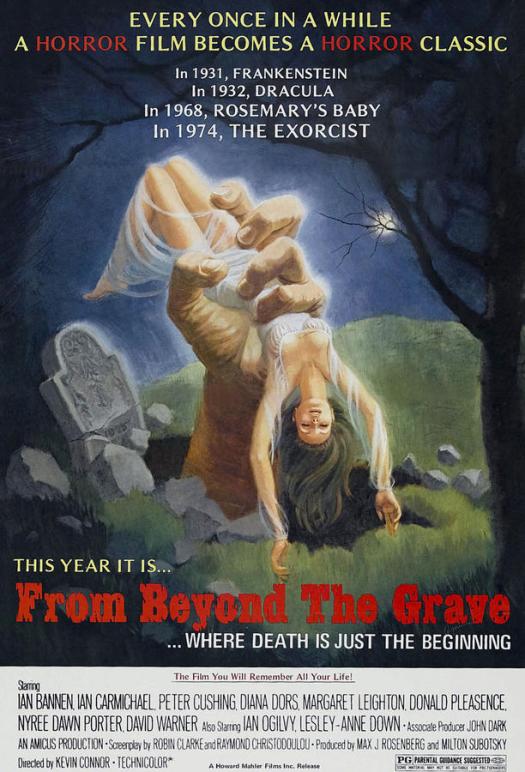
Moldy Horror: FROM BEYOND THE GRAVE (Warner Bros/Amicus 1973)


gary loggins's avatarcracked rear viewer

I’ve discussed the Max Roseberg/Milton Subotsky Amicus horror anthologies before on this blog. All are good, if uneven, little entries in the genre, and FROM BEYOND THE GRAVE is no exception. This was the last of the Amicus tales of terror, a quartet of creepiness based on the work of British horror writer R. Chetwynd-Hayes. I’ll admit I’m not familiar with Mr. Cheywynd-Hayes’s work, so I couldn’t tell you if the movie’s faithful to it or not. I can tell you FROM BEYOND THE GRAVE is about 50/50 in the chills department.

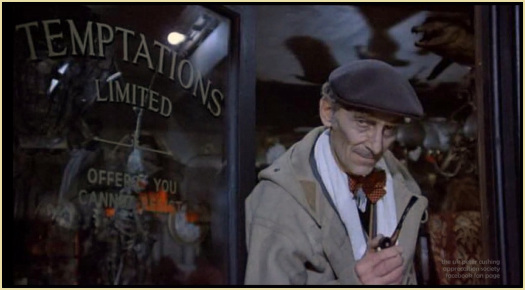
An all-star British cast gives it a game try, though. The segments are linked by horror icon Peter Cushing , looking rather gaunter than usual as the proprietor of Temptations Ltd., an antique shop which serves to set the stories in motion. Unfortunately, the part is a waste of Cushing’s talent; I could see him in any of…

View original post 367 more words

TV Review: Twin Peaks 2.15 “Slaves and Masters” (dir by Diane Keaton)


“Get a life, punk!”

— Albert Rosenfield (Miguel Ferrer) in Twin Peaks 2.15 “Slaves and Masters”

Well, it had to happen some time.

We have reached the “Slave and Masters” episode of Twin Peaks.  Judging from what I’ve read online, most fans seem feel that this episoode was the worst in the show’s history.  Myself, I don’t know whether it is or isn’t.  I’m writing this introduction before watching the episode.  I guess I’ll know soon enough.

Interestingly enough, this episode was directed by actress Diane Keaton.  When I first saw Keaton’s name listed as director, I assumes that she must have been a fan of the show and that she lobbied for the chance to direct an episode.  However, according to Relections: An Oral History of Twin Peaks by Brad Dukes, the opposite was true.  While the cast all liked and respected Keaton as a director, there was also a feeling that she didn’t seem to actually know much about the show.  Considering that the show had suffered a severe ratings decline during the 2nd season, it seems probable that Keaton was hired to direct in an attempt to generate some new interest in the once hot show.

If that was the plan, it didn’t work.  Apparently, the ratings for this episode were so low that Twin Peaks was put on hiatus a week after it aired.  It was only due to a letter-writing campaign that ABC decided to air the last six episodes of the season.  In short, it can be argued that this episode was truly the beginning of the end for Twin Peaks‘s original network run.

So, with all that in mind, let’s take a look at the 23rd episode of Twin Peaks, “Slaves and Masters.”
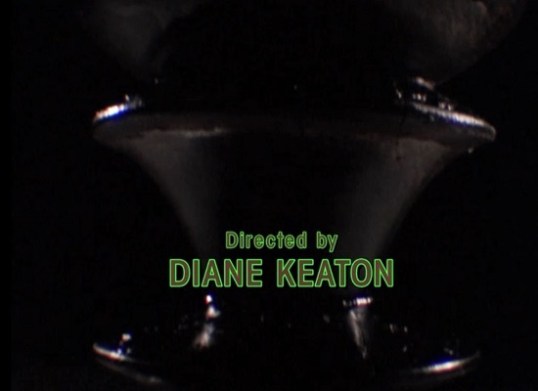
As always, we begin with the haunting opening credits and Angelo Badalamenti’s lushly romantic (yet ominously threatening) score.  The mood has been set.  We have returned to the world of Twin Peaks.

After the credits, we immediately cut to a close-up of a chess board.  In slow motion, the camera glides over all of the pieces.  The Queen, The pawns, the King, the Bishop, the little horsey guy.  (I don’t know much about chess, sorry.)

Suddenly, we’re no longer looking at chess pieces.  Instead, the camera is panning up the legs of Evelyn Marsh (Annette McCarthy), who is dressed in black and even wearing a black veil and — OH MY GOD, HAS THIS STORYLINE NOT BEEN RESOLVED YET!?  Seriously, when people talk about Season 2 not being as inspired as Season 1, they’re talking about this half-assed film noir rip-off that James (James Marshall) rode into after he hopped on his motorcycle and left Twin Peaks.  From the minute that Evelyn first showed up, I knew exactly what was going to happen with her, James, and her husband.  Much like the whole Audrey kidnapping subplot, the Evelyn Marsh subplot should not have lasted any longer than an episode and a half.  Instead, it’s still going on!

Anyway, the cops are talking to Evelyn and Malcolm (Nicholas Love) about how someone might have killed her husband.  Malcolm is quick to blame James but Evelyn seems a little bit more conflicted about it.  There is a funny moment when Malcolm says that James was hired to fix the Jaguar and the cop can’t figure out how to spell Jaguar.  That made me laugh but, otherwise, this whole scene felt predictable and unnecessary.

Meanwhile, at Wallie’s Bar, a dozen cops are sitting at the bar, smoking cigars and listening to opera music.  (Weird image is weird but it’s just weirdness for the sake of weirdness.)  James and Donna (Lara Flynn Boyle) are in a corner of the bar.  Donna says that they need to get help but James is all like, “I don’t need nobody!”  He says that Malcolm framed him and that he just needs to talk to Evelyn.

Donna goes to call Ed but ends up having to talk to Nadine instead.  Though we only hear Donna’s side of the conversation, it sounds like Nadine is talking about her new boyfriend.  If her new boyfriend is Mike (Gary Hershberger) than that means that Nadine is now dating Donna’s ex and yet, Donna seems to be remarkably okay with that.

Back at the Sheriff’s station, Harry (Michael Ontkean) and Cooper (Kyle MacLachlan) are interrogating Bobby (Dana Ashbrook) and Shelly (Madchen Amick).  Bobby wants to know why Harry and Cooper aren’t making more of an effort to track down Leo.  Cooper asks Bobby about the night that the mill burned down.  Bobby lies and says that Hank Jennings shot Leo.

Harry says that he’ll have some deputies watch the house.  Bobby claims that he’s all the protection that Shelly needs.  (For some reason, Bobby is acting like a methhead in this scene.)  When Bobby and Shelly leave, they pass Albert Rosenfield (Miguel Ferrer), who takes one look at Bobby and shouts, “Get a life, punk!”

(We love you, Albert!)

After giving Harry an out-of-character bear hug (but that’s okay because I like it when dudes hug it out), Albert explains that he’s been sent to Twin Peaks by Gordon Cole.  He has brought with him a picture of Windom Earle, in which Windom looks like an extra in a 1930s gangster movie.  He also brings the news that Windom has been mailing different pieces of clothing to police agencies across the country.

Windom has mailed:

1. A white veil

2. A garter

3. A pair of white slippers

4. A peal necklace

5. A wedding dress

Oh my God, I said as Albert listed the items, Windom Earle is marrying Pippa Middleton!

Cooper says that the clothing belonged to Windom’s dead wife (and Cooper’s ex-lover), Caroline.  Albert says that Windom is definitely making his move and then says that Cooper looks good in the muted earth tones of a flannel shirt.  That was nice of Albert.

Meanwhile, in his cabin, Windom Earle (Kenneth Welsh) plays a flute while Leo (Eric Da Re) lies on the floor.  (I have to be honest that these cabin scenes between Windom and Leo made me think about Peter Boyle burning down Gene Hackman’s hut in Young Frankenstein.)  Once Leo wakes up, Windom — who was previously described as having a mind like a diamond, cold and precise — starts acting like a Satanic little wood sprite.  He jumps around the cabin.  He says a lot of evil quips.  He beats Leo with a flute and then reveals that he’s placed a collar around Leo’s neck.  Windom can electrocute Leo whenever he feels like it.  Windom forces Leo to eat gruel while Windom pretends to be a kitty cat.  “Purrrr,” he says.

(Windom’s a genius so why is he acting like a sadistic towel manager?)

We cut to Ed (Everett McGill) laying in bed with Norma (Peggy Lipton) and talking about how it’s been twenty years since they first fell in love.  They agree that it’s sucked not being together.  Suddenly, they hear Nadine (Wendy Robie) arriving home.  Norma starts to leave but Ed says, “No, no.  We may as well talk to her now.”  Sure, Ed — have this conversation with Nadine while you and Norma are laying in bed in your underwear.  That’ll really avoid any hurt feelings.
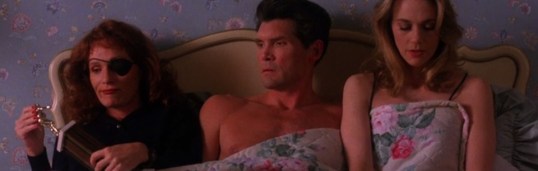
Suddenly, Nadine rips the bedroom door off of its hinges.  She comes into the room, carrying a wrestling trophy, and then jumps into bed with Ed and Norma.  Nadine apologizes for beating up Hank and then says that she knows about the two of them.  Nadine says it’s okay because she’s in love with Mike now.

Cut to the Martell house, where Harry and Cooper are talking to Josie (Joan Chen) about what happened to her in Seattle.  Josie says she doesn’t know who killed Jonathan.  Harry begs Josie to tell him the truth.  Out of nowhere, a surprisingly cheerful Cooper announces, “I think I’ll get another cup of Joe!”

(Somewhere, Joe Biden looks up and says, “Oh my God, they’re talking about me in an old episode of Twin Peaks!”  No, Joe, they’re not.  Sorry.  Maybe later.)

While Cooper’s getting more coffee, Pete (Jack Nance) stumbles in.  He has picked up the dry cleaning and can barely see above all of the clothes that he’s holding.  He and Cooper do that thing where, instead of being smart and putting the clothes somewhere first, they stand around and attempt to have a conversation, despite the fact that Pete is about fall over backwards.  When the phone rings, Pete gives the clothes to Cooper and now its Cooper’s turn to struggle to remain standing.  Eventually, Cooper puts the clothes on a chair (was that so hard!?) and then picks one thread off of a jacket.

Speaking of Josie, the phone call was for her.  It turns out that the call is from Thomas Eckhardt (David Warner) and he is wondering if he and Josie could get together.  Thomas reveals that he is responsible for Jonathan’s death.

After hanging up the phone, Thomas and his assistant, Jones (Brenda Strong), stare at a black trunk.

Meanwhile, Ben Horne (Richard Beymer) is apparently still convinced that he’s a Civil War general because he’s talking to Dr. Jacoby (Russ Tamblyn) about Stonewall Jackson.  Much like all that stuff with Evelyn Marsh, this is a plotline that should have been resolved after an episode and a half.  Instead, it’s been dragged out way past the point of being amusing.  The Ben-Goes-Crazy storyline is the epitome of how Season 2 abandoned surrealism in favor of just being weird for the sake of being weird.

It turns out that Ben and Jacoby have an audience.  Audrey (Sherilyn Fenn) and Jerry (David Patrick Kelly) are listening.  Johnny Horne (Robert Bauer) is rocking back and forth while wearing a Native American headdress.  And there’s a few members of the Hotel Staff, who have been transformed into some sort of marching band.

While Ben rants in his really crummy Southern accent, Jerry and Audrey leave the office.  Audrey is worried about her father but Jerry seems to be fairly indifferent.  (Needless to say, this goes against everything that we’ve previously seen about Jerry and his relationship with Ben.)  Audrey points out that, conveniently enough, she is set to inherit the entire Horne business empire if anything happens to Ben and that Jerry better do what she says or she’ll cut him off.

Audrey returns to Ben’s office, where Dr. Jacoby looks perplexed.  Audrey walks up to him and says she wants her father to turn back to normal. Jacoby says that he’s got it all taken care of.  Bobby shows up, dressed like a Confederate soldier.  Ben sings Dixie.  Can this storyline just end, please!?

Meanwhile, at Walli’s, Evelyn is still dressed in black.  Though the bar appears to be closed (there are chairs on the tables and everything), Evelyn is drinking.  Suddenly, Donna walks up to her.  Why is Donna still there?  How much school can you miss in Twin Peaks?  Why are Evelyn and Donna both hanging out in a bar that appears to be closed?

Suddenly, the bartender wanders by, lingering just long enough for Evelyn to order Donna a drink, “one that has a little umbrella in it.”  Okay, is this bar closed or open?  If it’s open, why are the tables covered in chairs?  This stuff is confusing, especially for a non-drinker like me.

Anyway, Donna gets mad when Evelyn says that she won’t help James.  Evelyn explains that life is crap.  (Her words.)  Suddenly, Malcolm (Nicholas Love) shows up and tells Evelyn to go home.  He then threatens Donna and Donna reacts by yelling and then crying.

Back at the station, Albert reveals that the thread that Cooper found was from the carpet outside of Cooper’s hotel room.  Apparently, this proves that it was Josie who shot Cooper at the end of Season 1.  Bad Josie!

After swearing Albert to secrecy, Cooper heads to Harry’s office, where Harry is playing darts.  Harry tells Cooper that the dead vagrant has been identified as being Eric Powell, a former member of the Merchant Marines.

“Powell was Caroline’s maiden name!” Cooper says.

Cooper says that this is all a big chess game to Windom.  Harry says that, if Cooper needs a chess expert, they have one of the best right in town.  And his name is Pete Martell!

At the diner, Pete shows of his mad chess skills by playing and winning four games at once.  Cooper is impressed and invites Pete to help him play Windom’s chess game.  Pete better be good because, every time that Cooper loses a piece, Windom is going to kill an innocent person.

Shelly walks into the diner and asks Norma if she needs any help.  Norma hires her back.  Then Harry shows up and says that he needs to talk to Norma.  They slip into the kitchen where Harry explains that Hank is going away for a long time.  Norma’s okay with that but I’m not.  Hank may be a sociopath but he’s hella charming.

That night, Thomas shows up at the Martell house, where he is greeted by Catherine (Piper Laurie).  Thomas appears to be slightly surprised by the sight of Josie in her maid’s uniform.  Thomas and Catherine drink wine, eat dinner, and discuss art and killing.  It quickly becomes apparent that Thomas has shown up to take Josie and that Catherine is more than willing to allow him to do that, for a price.

Meanwhile, at the Marsh house, Evelyn is stunned when James shows up in the living room and demands to know why Evelyn killed her husband and attempted to frame him.  James says that it was hella lame to manipulate him with everything that he’s been going through.  Evelyn confesses to everything.  She says that she set James up.  She says she did it for the money and also just because she felt like doing it.

Suddenly, Malcolm barges into the room and knocks James out.  Malcolm says that they can now kill James and claim that it was self-defense.   And you know what?  He has a point.  Bye, James.
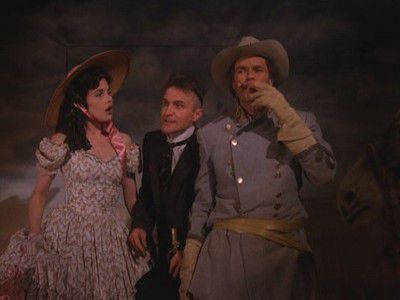
Meanwhile, Ben and the gang recreate another Civil War battle.  This whole Civil War subplot is so freaking stupid that I don’t even feel like talking about it anymore.  While pretending to be General U.S. Grant, Dr. Jacoby announces that he’s surrendering.  Having won the Civil War, Ben proceeds to faint.  When he wakes up, Ben says that he had the strangest dream about being a general during the Civil War.  He even does the whole “And you were there …. and you … and you!” thing.  Anyway, Ben appears to be back to normal.

At the cabin, Windom is putting on a disguise.  He continues to torment Leo with the electroshock collar.

At the Marsh mansion, James is still unconscious on the floor while Malcolm and Evelyn look down on him.  Donna watches from outside the window.  When Malcolm repeats that they can kill James and make it look like self-defense, Donna runs into the living room and screams, “NO!”

As Evelyn watches Donna cry over a motionless James, she stands up.  Uh-oh, she’s got a gun.  Evelyn shoots Malcolm and then says that she’ll frame Malcolm for her husband’s death though I don’t think it’ll be that difficult a frame-up because Malcolm is actually guilty.
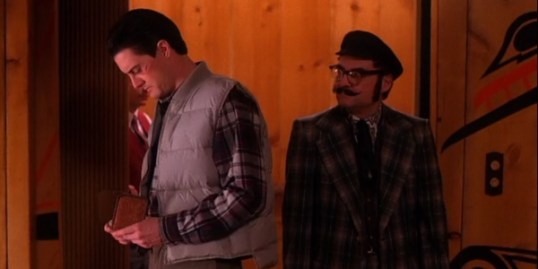
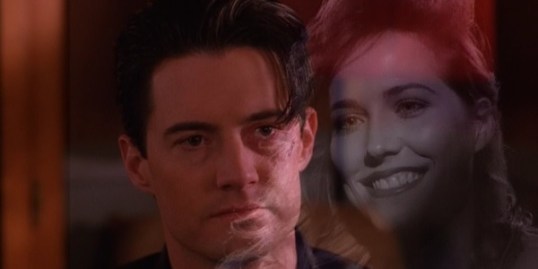
At the Great Northern, Cooper walks down a hallway and stops in front of an elevator.  He looks at a picture of Caroline that he has in his wallet.  As he does this, a poorly disguised Windom Earle steps off the elevator.  Windom goes to the front desk an drops off a note for Audrey.  (Oh, goddamnit, is this going to be the start of yet another Audrey-gets-kidnapped storyline?)  He also notices several postcards that all feature owls.  “Owls,” he says.

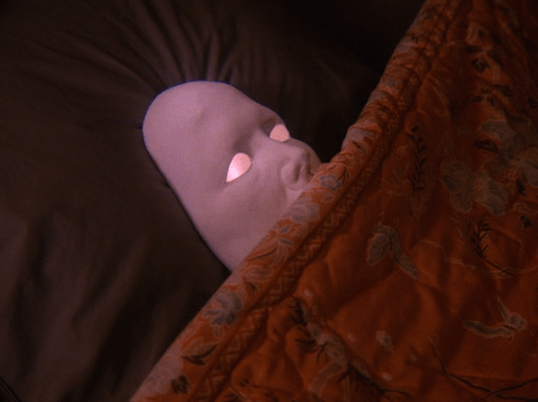
Cooper arrives back at his room.  He finds a white mask on his bed.  Windom Earle has been there and he’s left a taunting message.  The episode ends with Windom’s line: “It’s your move.”

Agck!
As for this episode, it definitely felt a bit off.  The main problem is that it focused on two largely uninteresting subplots — Evelyn Marsh and the Civil War — and portrayed Windom Earle as so cartoonishly evil that it’s hard to believe that he could also be the villainous mastermind that Cooper’s spent the last few episodes describing.  It was a weak episode but at least it finished off the whole Evelyn Marsh thing.

Always look on the bright side of life.

Previous Entries in The TSL’s Look At Twin Peaks:

  1. Twin Peaks: In the Beginning by Jedadiah Leland
  2. TV Review: Twin Peaks 1.1 — The Pilot (dir by David Lynch) by Lisa Marie Bowman
  3. TV Review: Twin Peaks 1.2 — Traces To Nowhere (directed by Duwayne Dunham) by Jedadiah Leland
  4. TV Review: Twin Peaks 1.3 — Zen, or the Skill To Catch A Killer (dir by David Lynch) by Lisa Marie Bowman
  5. TV Review: Twin Peaks 1.4 “Rest in Pain” (dir by Tina Rathbone) by Leonard Wilson
  6. TV Review: Twin Peaks 1.5 “The One-Armed Man” (directed by Tim Hunter) by Jedadiah Leland
  7. TV Review: Twin Peaks 1.6 “Cooper’s Dreams” (directed by Lesli Linka Glatter) by Lisa Marie Bowman
  8. TV Review: Twin Peaks 1.7 “Realization Time” (directed by Caleb Deschanel) by Lisa Marie Bowman
  9. TV Review: Twin Peaks 1.8 “The Last Evening” (directed by Mark Frost) by Leonard Wilson
  10. TV Review: Twin Peaks 2.1 “May the Giant Be With You” (dir by David Lynch) by Leonard Wilson
  11. TV Review: Twin Peaks 2.2 “Coma” (directed by David Lynch) by Jedadiah Leland
  12. TV Review: Twin Peaks 2.3 “The Man Behind The Glass” (directed by Lesli Linka Glatter) by Jedadiah Leland
  13. TV Review: Twin Peaks 2.4 “Laura’s Secret Diary” (dir by Todd Holland) by Lisa Marie Bowman
  14. TV Review: Twin Peaks 2.5 “The Orchid’s Curse” (dir by Graeme Clifford) by Lisa Marie Bowman
  15. TV Review: Twin Peaks 2.6 “Demons” (dir by Lesli Linka Glatter) by Leonard Wilson
  16. TV Review: Twin Peaks 2.7 “Lonely Souls” (directed by David Lynch) by Jedadiah Leland
  17. TV Review: Twin Peaks 2.8 “Drive With A Dead Girl” (dir by Caleb Deschanel) by Lisa Marie Bowman
  18. TV Review: Twin Peaks 2.9 “Arbitrary Law” (dir by Tim Hunter) by Lisa Marie Bowman
  19. TV Review: Twin Peaks 2.10 “Dispute Between Brothers” (directed by Tina Rathbone) by Jedadiah Leland
  20. TV Review: Twin Peaks 2.11 “Masked Ball” (directed by Duwayne Dunham) by Leonard Wilson
  21. TV Review: Twin Peaks 2.12 “The Black Widow” (directed by Caleb Deschanel) by Leonard Wilson
  22. TV Review: Twin Peaks 2.13 “Checkmate” (directed by Todd Holland) by Jedadiah Leland
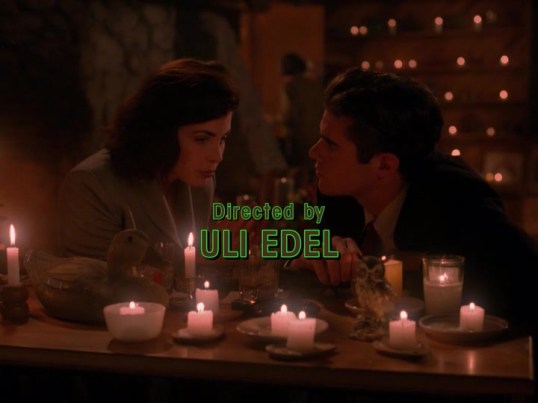
  23. TV Review: Twin Peaks 2.14 “Double Play” (directed by Uli Edel) by Jedadiah Leland


TV Review: Twin Peaks 2.14 “Double Play” (directed by Uli Edel)


Welcome back to Twin Peaks!

Last episode, Major Briggs (Don S. Davis) returned from the land of missing and brought with him a tale of the White Lodge.  Ben Horne (Richard Beymer) obsessed over the Civil War.  James Hurley (James Marshall) found himself trapped in a second-rate film noir.  Jean Reanult (Michael Parks) was finally killed but, when Cooper (Kyle MacLachlan) and Harry (Michael Ontkean) returned to the sheriff’s station, they discovered that someone had left them a present: a dead man sitting in front of a chess board.

Things start with the station still in darkness.  Doctor Hayward (Warren Frost), Harry, and Cooper are looking over the dead man’s body.  The first thing that they discover is that a chess pawn has been stuffed in his mouth.  When Cooper correctly guesses that the dead man will have a stab wound in his chest, severing the aorta, Harry deduces that this is not the first time that Cooper has seen something like this.

Cooper says that he knows that his former partner, Windom Earle, is responsible.  He guesses that the victim was a vagrant who was offered a lift by Earle.  (In reality, the victim was played by Craig MacLachlan, brother of Kyle.)  Earle stabbed the man and then set off the explosion in the woods.  When everyone was distracted, Earle carried the body into the station.  “Windom Earle has been in this room,” Cooper says, “I can still feel his presence.”

At the Great Northern, Audrey (Sherilyn Fenn) makes a deal with Bobby (Dana Ashrbook).  She wants Bobby to help her bring her father back from “limbo land.”  “From now on, Bobby,” Audrey says, “I’m the one you suck up to.”

“What about Shelly?” Bobby asks.

“What about Shelly?” Audrey replies.

Speaking of Shelly, she is in trouble because Leo (Eric Da Re) has suddenly woken up and now she’s trapped in a dark house, with no power and a very angry husband.  Fortunately, Bobby arrives home right when Leo is about to attack Shelly with an axe.  When Leo attacks Bobby instead, Shelly stabs Leo in the leg with a kitchen knife.  Like an unmasked Jason Voorhees, the wounded Leo staggers off into the woods while Bobby and Shelly embrace.

The next morning, back at the station, Cooper watches as the body is wheeled away.  Harry gives Cooper a cup of coffee and tells Cooper that, until he is reinstated in the FBI, he is still a deputy.  “If you want this case,” Harry says, “it’s yours.”

Out in the front lobby, Andy (Harry Goaz) tells Lucy (Kimmy Robertson) that he has to talk to her about Nicky.  Andy explains that he and Dick have been doing some detective work and they think that Nicky may have murdered his parents.

“He’s nine years old,” Lucy says.

“We know,” Andy nods, “we think he was six at the time of the crime.”

Lucy is not amused.

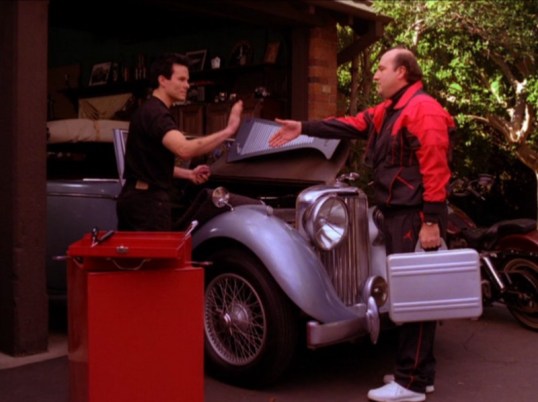
At the Marsh place, James is working on another one of classic cars when Jeffrey Marsh (John Apicella) walks up and introduces himself.  He says that he’s envious of James’s carefree lifestyle.  He says that he’d love to talk to James about the cars later in the day but James says that he should probably be moving on.  Evelyn (Annette McCarthy) walks up and says that she is sure that she can find all sorts of things for James to do around the house.  James walks back inside the garage and Jeffrey drives away in the car that James just finished working on.  As Evelyn looks off in the distance, there is the sound of screeching tires and a car crash.

At the diner, Ed (Everett McGill) is having a cup of coffee of Doctor Hayward.  Ed is worried because Nadine wants to start dating boys and, since she’s She-Hulk now, Ed worries that Nadine could kill them with her sex drive.  Doctor Hayward suggests that Ed tell her to be home by 9:00 on school nights.  I could be wrong but I don’t think Doctor Hayward is taking Nadine’s condition very seriously.

Doctor Hayward is actually more concerned about Donna, who took the van that morning to go see James.  Ed explains that Donna is taking James some money, presumably all twelve of the dollars that were in James’s bank account.

After the doctor leaves, Norma (Peggy Lipton) sits down across from Ed.  She says that Hank is in the hospital.  He says that a tree fell on him but Ed tells her that Nadine actually beat him up.  Norma is happy because, once Hank gets out of the hospital, he will be going back to prison for violating his parole.

At the sheriff’s station, Cooper and Harry are staring at the chess board that Windom Earle placed in front of the dead man.  Cooper explains that he and Earle played a game of chess every day for three years.  Earle thought that all the answers to life’s mysteries could be found in the game of chess.

Cooper explains that Windom Earle was his first partner.  Everything that he learned about the law and the bureau he learned from Windom Earle.  Cooper tells the story (the same one that he told Audrey earlier) of how, four years ago, he fell in love with a woman named Caroline who was a material witness to a federal crime and how, when she was attacked, Cooper was not prepared and could not save her life.  Cooper adds the detail that she was stabbed, in the same way as the vagrant.  Cooper also reveals that Caroline was Windom Earle’s wife.

Donna (Lara Flynn Boyle) arrives at a bar called Wallies, looking for James.  James is not there but Evelyn is.  “You look like someone who needs help,” Evelyn says.  When Donna says she’s looking for James, Evelyn says that James did some work for her and then left for Mexico.  Donna leaves, presumably taking James’s twelve dollars with her.

At the Great Northern, Dr. Jacoby (Russ Tamblyn), Audrey, and Jerry (David Patrick Kelly) watch as Ben continues to play with his little army men.  Ben thinks that Jerry is General J.E.B. Stuart.  Ben assures everyone that they are marching forward and only God can stop them.  “The almighty is a Southerner,” Ben declares.  Dr. Jacoby explains that if Ben can reverse the defeat of the Confederacy then he will also reverse his own recent mental defeats.  Jacoby and Ben start to sing Dixie.

At the sheriff’s station, Major Briggs stumbles in, says that he needs to see Harry, and then collapses.

When he comes to, Major Briggs explains to Harry and Cooper that, when his superiors questioned him about his disappearance, they exhibited a degree of “intolerance and suspicion” that apparently left Briggs feeling traumatized.  Briggs goes on to explain that, during his disappearance, he believes that he was taken to the White Lodge.  Briggs goes on to say that there will be much trouble ahead.  “I will return,” Briggs says, “but until that time, I will be in the shadows if you need me.”

As Briggs leaves, Andy enters the office and tells Cooper and Harry that he needs to show them something.  He leads them to the conference room, where Dr. Jacoby announces that he has spent the last few hours talking to Lana Milford (Robyn Lively) and he has found no evidence of her being crazy or cursed.  There is no way that Lana is responsible for Dougie’s death, Jacoby says.  Jacoby goes on to say that Lana has a heightened sexual drive and skills that few men could ever hope to experience.  Jacoby announces that he and Lana are going to go bowling but, as soon as they step out of the office, they run into Mayor Milford (John Boylan), who was a rifle and who demands that nobody move.

The Mayor wants blood but Cooper has a solution.  He takes the rifle and then locks Milford and Lana in the conference room together.  After a few minutes, Lana and the Mayor are in love and talking about adopting a child.

At the Martell house, Pete (Jack Nance) tells Catherine (Piper Laurie) that they forgot to pick up the hot dogs.  Catherine is more interested in telling Pete the true story of how she survived the fire and marshaled the resources to defeat Ben.  She reveals that her brother (and Josie’s husband), Andrew Packard (Dan O’Herlihy), is not actually dead and he’s sitting in the study.  Andrew explains that he and Catherine faked his death in a boating accident because a contract had been taken out on Andrew’s life by Andrew’s former business partner, Thomas Eckhardt.  Catherine also reveals that Josie works for Thomas Eckhardt and that Eckhardt will be returning to Twin Peaks to rescue her from having to work as Catherine’s maid.

At the exact same time, Thomas Eckhardt (DAVID WARNER!) and his assistant, Jones (Brenda Strong), are checking into the Great Northern.

At the sheriff’s station, Lucy is sick of both Andy and Dick (Ian Buchanan) so she brings Doctor Hayward in to talk to both of them.  Doctor Hayward explains that he called the orphanage and that Nicky is no murderer.  Nicky’s mother was a chamber maid at the Great Northern and his father was a man who fled back to Canada following the back alley assault that led to Nicky’s conception.  Hayward explains that Nicky’s mom died in childbirth.  Nicky was adopted by a loving couple who died in an icy car crash.  Six year-old Nicky heroically attempted to pull his adoptive parents to safety but failed.  Andy and Dick both start to cry.

Harry gets an alert from Seattle, telling him that the man who Josie left with, the one who Josie claims that she merely escaped from, has been found murdered.  Since Cooper is now a deputy, Harry orders Cooper to find out if Josie killed him.  For once, Harry gets to order Cooper around.

At the Marsh house, James is packing his stuff when Evelyn comes in and swears the she is in love with him.  Evelyn says that there’s been an accident and Jeffrey’s dead.  James immediately figures out that Evelyn killed her husband and set him up to take the fall.  Evelyn says that it was Malcolm’s idea and that Malcom isn’t really her brother.  As the police arrive outside, Evelyn tells James to run and go find “that young girl who loves you.”

As James tries to sneak out of the house without being spotted by the cops, he runs into Donna, who is hiding behind a tree.  They run off while Evelyn talks to the police.

In the woods, a dazed and confused Leo comes across a cabin.  Inside the cabin, a man (Kenneth Welsh) plays a flute and invites Leo to enter.  The man sits down in front of a chess board and introduces himself as Windom Earle.

End credits.

This episode shares the same flaws as a lot of season 2.  There are a lot of good scenes, like Leo menacing Shelly and Bobby or the introduction of Windom Earle, but there are also scenes that are just too cartoonish, like anything involving the Mayor and Lana.  This episode was the first and only episode to be directed by German director Uli Edel and he does a pretty good job, putting his own unique spin on the show’s signature style.

Tomorrow: “Slaves and Masters,” in which Cooper gets unexpected help in his chess game against Windom Earle.

Previous Entries in The TSL’s Look At Twin Peaks:

  1. Twin Peaks: In the Beginning by Jedadiah Leland
  2. TV Review: Twin Peaks 1.1 — The Pilot (dir by David Lynch) by Lisa Marie Bowman
  3. TV Review: Twin Peaks 1.2 — Traces To Nowhere (directed by Duwayne Dunham) by Jedadiah Leland
  4. TV Review: Twin Peaks 1.3 — Zen, or the Skill To Catch A Killer (dir by David Lynch) by Lisa Marie Bowman
  5. TV Review: Twin Peaks 1.4 “Rest in Pain” (dir by Tina Rathbone) by Leonard Wilson
  6. TV Review: Twin Peaks 1.5 “The One-Armed Man” (directed by Tim Hunter) by Jedadiah Leland
  7. TV Review: Twin Peaks 1.6 “Cooper’s Dreams” (directed by Lesli Linka Glatter) by Lisa Marie Bowman
  8. TV Review: Twin Peaks 1.7 “Realization Time” (directed by Caleb Deschanel) by Lisa Marie Bowman
  9. TV Review: Twin Peaks 1.8 “The Last Evening” (directed by Mark Frost) by Leonard Wilson
  10. TV Review: Twin Peaks 2.1 “May the Giant Be With You” (dir by David Lynch) by Leonard Wilson
  11. TV Review: Twin Peaks 2.2 “Coma” (directed by David Lynch) by Jedadiah Leland
  12. TV Review: Twin Peaks 2.3 “The Man Behind The Glass” (directed by Lesli Linka Glatter) by Jedadiah Leland
  13. TV Review: Twin Peaks 2.4 “Laura’s Secret Diary” (dir by Todd Holland) by Lisa Marie Bowman
  14. TV Review: Twin Peaks 2.5 “The Orchid’s Curse” (dir by Graeme Clifford) by Lisa Marie Bowman
  15. TV Review: Twin Peaks 2.6 “Demons” (dir by Lesli Linka Glatter) by Leonard Wilson
  16. TV Review: Twin Peaks 2.7 “Lonely Souls” (directed by David Lynch) by Jedadiah Leland
  17. TV Review: Twin Peaks 2.8 “Drive With A Dead Girl” (dir by Caleb Deschanel) by Lisa Marie Bowman
  18. TV Review: Twin Peaks 2.9 “Arbitrary Law” (dir by Tim Hunter) by Lisa Marie Bowman
  19. TV Review: Twin Peaks 2.10 “Dispute Between Brothers” (directed by Tina Rathbone) by Jedadiah Leland
  20. TV Review: Twin Peaks 2.11 “Masked Ball” (directed by Duwayne Dunham) by Leonard Wilson
  21. TV Review: Twin Peaks 2.12 “The Black Widow” (directed by Caleb Deschanel) by Leonard Wilson
  22. TV Review: Twin Peaks 2.13 “Checkmate” (directed by Todd Holland) by Jedadiah Leland

Cleaning Out The DVR #20: Tom Jones (dir by Tony Richardson)


(For those following at home, Lisa is attempting to clean out her DVR by watching and reviewing 38 films by this Friday.  Will she make it?  Keep following the site to find out!)

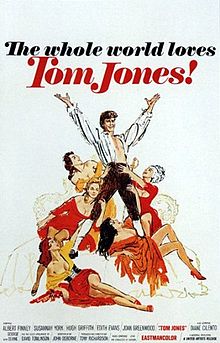
220px-Poster_-_Tom_Jones_01

Oh, how I wanted to love Tom Jones!

No!  Not that Tom Jones.

I’m talking about Tom Jones, the British film from 1963.  Based on a novel by Henry Fielding, Tom Jones was a huge box office success and it was one of the few comedies to ever win the Oscar for best picture.  Whenever you watch a documentary about the British invasion of the early 60s, chances are that you’ll see at least a clip or two from Tom Jones.  The film (or perhaps I should say the film’s box office success) is a part of 60s pop history, right up there with The Beatles on The Ed Sullivan Show and Sean Connery shooting that guy in cold blood in Dr. No.

Up until last night, I had heard about Tom Jones but I had never seen it.

And I really wanted to love it.

The film takes place in 18th century England and it tells the story of young Tom Jones (Albert Finney).  It starts with a lengthy sequence that plays out like a silent film, complete with title cards.  Upright Squire Allworthy (George Devine) comes home and discovers that a baby has been left in his bed.  He assumes that the child was born to two of his servants and declares that he will raise Tom Jones to be a good and worthy man.

Two decades later, Tom Jones has grown up and now he’s being played by Albert Finney (who, it must be said, was quite a handsome man when he was young).  Because Tom is good-looking and kind-hearted, every woman in England lusts after him.  But Tom is in love with innocent Sophie Western (Susannah York).  However, Sophie is a member of the upper class and Tom is a “bastard,” at a time when that actually means something.

Indeed, Sophie’s aunt and uncle (played by Edith Evans and Hugh Griffith) demand that Sophie have nothing to do with Tom Jones.  They decide that she will marry Blifil (David Warner, young but already typecast as a villain).  Through clever lies and manipulations, Blifil convinces Squire Allworthy that Tom has turned bad and must therefore be exiled from his home.  Does Blifil want to get rid of Tom just so he can marry Sophie or is it possible that there’s more to Blifil’s scheming?

Before we get the answer to that question, we spend a while following the exiled Tom as he wanders around England and attempts to prove himself worthy of Sophie.  Along the way, Tom serves briefly in the army, gets into numerous fights, and has several affairs.  One of those affairs is with Mrs. Walters (Joyce Redman), who he briefly thinks might be his mother.  Eventually, Tom ends up as the lover to the decadent Lady Bellaston (Joan Greenwood).  Through Blifil’s scheming, he also ends up framed for attempted murder and facing the gallows…

And, as melodramatic as that may all sound, Tom Jones is definitely a comedy.  It doesn’t take itself seriously and there’s hardly a single scene that isn’t played for laughs.  Director Tony Richardson goes out of his way to make sure that you never forget that you’re watching a movie.  There are freeze frames.  There’s plenty of characters around to supply sarcastic commentary.  There’s even a few cases of fourth wall breaking.

As I watched Tom Jones, it was hard for me not to compare it to Stanley Kubrick’s Barry Lyndon.  After all, both films take place during the same period of time and both deal with a young man making his way through European society.  I would even argue that, in its way, Barry Lyndon is far more satirical than Tom Jones.  The main difference between the two films is that Barry Lyndon is all about subtext whereas everything that happens in Tom Jones happens right on the surface.

As I said, I really wanted to like Tom Jones but, seen today, the entire film seems to be trying a little bit too hard.  Tony Richardson’s direction is so manic that it gets a bit exhausting after a while.  That said, I can understand why the film was such a success when it was first released.  I’m sure in 1963 — after having to deal with decades of pompous costume dramas — viewers probably found Tom Jones to be a breath of fresh air.  Not only was it a British film released at a time when all things British were in style but it was also a film that, by the standards of 1963, dealt frankly with sex.  In short, Tom Jones is definitely a film of its time.  If it doesn’t hold up as well today, that’s because it wasn’t made for 2016.  It was made for 1963.

And obviously, if the judgment of the Academy is to be trusted, Tom Jones was the perfect film for 1963.  That said, I would have given best picture to another British film, From Russia With Love.

Embracing the Melodrama Part II #62: Time After Time (dir by Nicholas Meyer)


TimeAfterTime79So, I just gave the 1979 film Home Before Midnight a fairly negative review but I simply cannot end the 70s section of Embracing the Melodrama on such a negative note!  So, before we move on to the 80s, allow me to suggest another film from 1979 that you could watch while you’re not watching Home Before Midnight!

Time After Time opens in London.  The year is 1893.  Writer H.G. Wells (Malcolm McDowell) is having a dinner party so that he can show off his latest invention, a time machine.  Among his guests is a surgeon named John Stevenson (David Warner).  What nobody at the party suspects is that Stevenson also goes by the name Jack the Ripper and that he enjoys killing prostitutes.  When a detective from Scotland Yard shows up at Wells’s home, Stevenson jumps into the time machine and escapes into the future.  Since Stevenson does not have the “non-return key,” the machine returns back to 1893 but Stevenson has apparently escaped.

Wells uses the machine to pursue Stevenson and soon finds himself in 1979 San Francisco.  Wells had expected to find that the future would be a utopia but instead, he discovers the world of 1979 is loud, polluted, violent, angry, and dangerous.  (Kinda like the world of 2015…)  As Wells pursues Stevenson, he struggles to adjust to the world of the “future,” and he also meets a bank clerk, Amy Robbins (Mary Steenburgen).

Time After Time is probably the sweetest movie ever made about Jack the Ripper and that’s largely because of the romance between both Wells and Amy and the two actors who played them.  After watching Time After Time, I was not surprised to learn that McDowell and Steenburgen got married shortly after appearing in this film.  They were so incredibly sweet together!

Add to that, considering the he’s best known for playing villains and other menacing types, it’s interesting to see Malcolm McDowell plays such a gentle and nice character.  Wells’ befuddlement is charming to watch.  There’s a great scene where Amy calls Wells on a landline phone and Wells stares down at the receiver in frightened amazement.

Time After Time is a really good and likable movie.  It’s sweet and it proves that even hunting for Jack the Ripper can be a romantic experience if it’s done with the right person.  Watch it and enjoy!