44 Days of Paranoia #30: Nixon (dir by Oliver Stone)


For our latest entry in the 44 Days of Paranoia, we take a look at Oliver Stone’s 1995 presidential biopic, Nixon.

Nixon tells the life story of our 37th President, Richard Nixon.  The only President to ever resign in order to avoid being impeached, Nixon remains a controversial figure to this day.  As portrayed in this film, Nixon (played by Anthony Hopkins) was an insecure, friendless child who was dominated by his ultra religious mother (Mary Steenburgen) and who lived in the shadow of his charismatic older brother (Tony Goldwyn).  After he graduated college, Nixon married Pat (Joan Allen), entered politics, made a name for himself as an anti-communist, and eventually ended up winning the U.S. presidency.  The film tells us that, regardless of his success, Nixon remained a paranoid and desperately lonely man who eventually allowed the sycophants on his staff (including James Woods) to break the law in an attempt to destroy enemies both real and imagined.  Along the way, Nixon deals with a shady businessman (Larry Hagman), who expects to be rewarded for supporting Nixon’s political career, and has an odd confrontation with a young anti-war protester who has figured out that Nixon doesn’t have half the power that everyone assumes he does.

Considering that his last few films have been W., Wall Street: Money Never Sleeps, and SavagesI think it’s understandable that I’m often stunned to discover that, at one point in the distant past, Oliver Stone actually was a worthwhile director.  JFK, for instance, is effective propaganda.  Nixon, which feels a lot like an unofficial sequel to JFK, is a much messier film than JFK but — as opposed to something like Savages — it’s still watchable and occasionally even thought-provoking.  Thanks to Hopkins’ performance and, it must be admitted, Stone’s surprisingly even-handed approach to the character, Nixon challenges our assumptions about one of the most infamous and villified figures in American history.  It forces us to decide for ourselves whether Nixon was a monster or a victim of circumstances that spiraled out of his control.  If you need proof of the effectiveness of the film’s approach, just compare Stone’s work on Nixon with his work on his next Presidential biography, the far less effective W.

(I should admit, however, that I’m a political history nerd and therefore, this film was specifically designed to appeal to me.  For me, half the fun of Nixon was being able to go, “Oh, that’s supposed to be Nelson Rockefeller!”)

If I had to compare the experience of watching Nixon to anything, I would compare it to taking 10 capsules of Dexedrine and then staying up for five days straight without eating.  The film zooms from scene-to-scene, switching film stocks almost at random while jumping in and out of time, and not worrying too much about establishing any sort of narrative consistency.  Surprisingly nuanced domestic scenes between Anthony Hopkins and Joan Allen are followed by over-the-top scenes where Bob Hoskins lustily stares at a White House guard or Sam Waterston’s eyes briefly turn completely black as he discusses the existence of evil.  When Nixon gives his acceptance speech to the Republican Convention, the Republican delegates are briefly replaced by images of a world on fire.  Familiar actors wander through the film, most of them only popping up for a scene or two and then vanishing.  The end result is a film that both engages and exhausts the viewer, a hallucinatory journey through Stone’s version of American history.

Nixon is a mess but it’s a fascinating mess.

Other Entries In The 44 Days of Paranoia 

  1. Clonus
  2. Executive Action
  3. Winter Kills
  4. Interview With The Assassin
  5. The Trial of Lee Harvey Oswald
  6. JFK
  7. Beyond The Doors
  8. Three Days of the Condor
  9. They Saved Hitler’s Brain
  10. The Intruder
  11. Police, Adjective
  12. Burn After Reading
  13. Quiz Show
  14. Flying Blind
  15. God Told Me To
  16. Wag the Dog
  17. Cheaters
  18. Scream and Scream Again
  19. Capricorn One
  20. Seven Days In May
  21. Broken City
  22. Suddenly
  23. Pickup on South Street
  24. The Informer
  25. Chinatown
  26. Compliance
  27. The Lives of Others
  28. The Departed
  29. A Face In The Crowd

44 Days of Paranoia #13: Quiz Show (dir by Robert Redford)


For today’s entry in the 44 Days of Paranoia, I want to take a look at a film that I recently caught on cable — 1994’s Quiz Show.

Directed by Robert Redford and based on a true story, Quiz Show was nominated for the Academy Award for best picture but lost to Forrest Gump.  Among those of us who obsess over Oscar history, Quiz Show is often overshadowed by not only Forrest Gump but two of the other nominees as well, Pulp Fiction and The Shawshank Redemption.  When compared to Pulp Fiction, Quiz Show certainly feels old-fashioned.  At the same time, it’s not quite as much of a sentimental crowd-pleaser as Gump or Shawshank.  Perhaps for those reasons, Quiz Show never gets quite as much attention as some other films that have been nominated for best picture.  However, taking all of that into consideration, Quiz Show is still one of the best films of the 90s.

Quiz Show takes us back to the 1950s.  The most popular show on television is 21, a game show in which two contestants answer questions, win money, and try to be the first to score 21 points.  The American public believes that all of the questions asked on 21 are locked away in a bank vault until it’s time for the show.  What they don’t know is that the show’s producers have instead been rigging the show, giving the answers to contestants who they feel will be good for ratings.

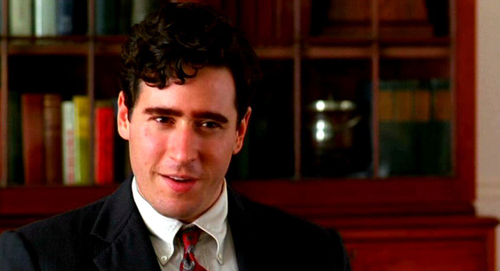
When Quiz Show begins, nerdy Herbie Stempel (John Turturro) has been the champion for several weeks.  However, both the show’s producers and sponsors feel that the untelegenic Herbie has peaked.  Hence, the handsome and charismatic Charles Van Doren (Ralph Fiennes) is brought on the show and Herbie is ordered to lose to him.  Reluctantly, Herbie does so.

john_turturro_quiz_show

Charles is initially reluctant to cheat but, as he continues to win, he finds himself becoming addicted to the fame.  Charles is the son of the prominent academic Mark Van Doren (Paul Scofield) and his success on television finally gives him a chance to escape from his father’s shadow.  Indeed, the film’s subtle and nuanced portrait of Charles and Mark’s loving but competetive relationship is one of the film’s greatest strengths.

ralph_fiennes_quiz_show

Herbie, however, is bitter over having to lose and has subsequently gambled away all of his winnings.  When 21′s producer (David Paymer) refuses to help Herbie get on another TV show, Herbie reacts by going to the New York County district attorney and publicly charging 21 as being fixed.  Though the grand jury dismisses Herbie as being obviously mentally unbalanced, his charges come to the attention of a congressional investigator, Richard Goodwin (Rob Morrow).

rob_morrow_quiz_show1

Goodwin launches his own investigation into 21 and discovers that the show is fixed.  (As the ambitious Goodwin puts it, he wants to “put television on trial.”)  Along the way, he also meets and befriends Charles Van Doren and finds himself torn between his desire to expose the show and to protect Charles from the bad publicity.  Again, the film is to be applauded for the subtle way that it uses Goodwin’s investigation of both Charles and Herbie as a way to explore issues of both class resentment and class envy.  Goodwin may have come from the same ethnic background of Herbie but it quickly becomes obvious that Goodwin has more sympathy for the genteel (and very WASPy) world that produced Charles Van Doren.  When Goodwin tries to justify protecting Charles, his wife (played by Mira Sorvino) responds by calling him “the Uncle Tom of the Jews” and it’s hard not to feel that she has a point.

1quiz3

While I greatly enjoyed Quiz Show, I do have to say that, on one major point, the film fails.  Try as he might, director Redford never convinces us that a rigged game show is really as big of a crime as he seems to be believe it to be.  Perhaps in the 1950s, people were still innocent enough to be shocked at the idea of television reality being fake but for cynical contemporary viewers, it’s hard not to feel that the “scandal” was more about Richard Goodwin’s ambition and less about any sort of ethical or legal issue.  Towards the end of the film, one character suggests that television will never be truly honest unless the government steps in to regulate it.  “What?” I yelled back at the TV.

Seriously, it seemed like a bit of an overreaction.

As I watched Quiz Show, I found it hard not to think about the reality shows that I love.  For instance, I know that The Bachelor and The Bachelorette are largely staged.  I know that the previous season of Big Brother was largely set up so that Amanda could win.  (And, believe me, if Amanda hadn’t sabotaged her chances by turning out to be a mentally unstable racist bully, she would have won and she would probably would have been invited back for the next all-stars season.)  I know that shows like Storage Wars and Dance Moms are “unscripted” in name only.  I know that reality shows aren’t real but my attitude can basically be summed up in two words: “who cares?”  Perhaps I would be more outraged if I lived in the 50s which, to judge from both Quiz Show and a host of other movies, was apparently a much more innocent time.

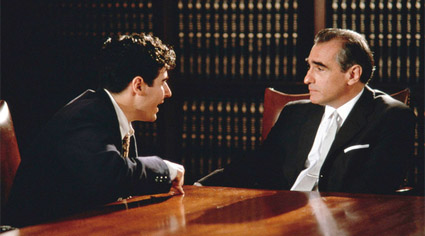
quiz-show-morrow-scorsese

That said, I really enjoyed Quiz Show.  A lot of that is because I’m a history nerd and, therefore, I have a weakness for obsessively detailed period pieces.  But even beyond that, Quiz Show is a well-made, entertaining film that features three excellent lead performances and several strong supporting turns.  If you love to watch great actors playing great roles then Quiz Show is the film for you.  Rob Morrow lays his Boston accent on a bit thick but otherwise, he does a good job of suggesting both Goodwin’s ambition and the insecurities that lead him to desire Charles’s friendship even as he tries to expose him as a fraud.  John Turturro brings an odd — if manic — dignity to Herbie Stempel while Johann Carlo is well-cast as his wife.  Best of all, Ralph Fiennes makes Charles Van Doren into a sad, frustrating, and ultimately sympathetic character while Paul Scofield is the epitome of both paternal disappointment and love as his father.  The film is full of great supporting turns as well, with David Paymer and Hank Azaria perfectly cast as the show’s producers and Christopher McDonald playing the show’s host with the same smarmy charm that he brought to a similar role in the far different Requiem For A Dream.  Perhaps best of all, Martin Scorsese shows up as the owner of Geritol and gets to bark, “Queens is not New York!”

Even if Robert Redford doesn’t quite convince us that the quiz show scandal was as big a deal as he obviously believes it to be, Quiz Show is still an uncommonly intelligent film and one that deserves to rediscovered.

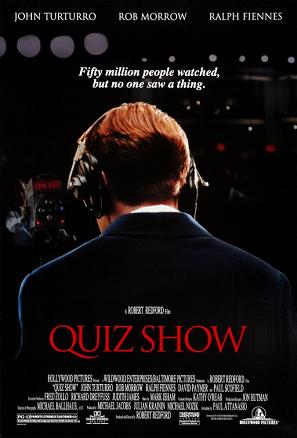
QuizShowPoster

Other entries in the 44 Days Of Paranoia:

  1. Clonus
  2. Executive Action
  3. Winter Kills
  4. Interview With The Assassin
  5. The Trial of Lee Harvey Oswald
  6. JFK
  7. Beyond The Doors
  8. Three Days of the Condor
  9. They Saved Hitler’s Brain
  10. The Intruder
  11. Police, Adjective
  12. Burn After Reading

Film Review: Drag Me To Hell (directed by Sam Raimi)


There are exactly two things that keep Sam Raimi’s otherwise entertaining 2009 horror romp Drag Me To Hell from being a classic.

The first is that, about halfway through the movie, Alison Lohman murders her pet kitten.  Admittedly, Lohman’s character is trying to thwart a gypsy curse at the time and the action does show just how terrified she’s become.  But that doesn’t change the fact that it’s a cute kitten and quite frankly, I’m getting sick of seeing cats being killed in horror films.  There’s something truly hypocritical about how far most filmmakers are willing to go to assure an audience that a dog has somehow survived the end of the world while cats are continually killed on-screen without a second thought.

Am I saying that the film would have been better is Lohman had murdered a cute puppy instead?  Yes, I am.  At least that would have been unexpected.  That would have let the audience know that all the rules no longer applied.  Quite frankly, whenever you see a cat in a horror film, you know that cat is going to end up either pinned to a door or hanging in the closet.  Dogs, however, always make it to the end.

I imagine this is because there’s more “dog people” than “cat people” in the world.  People — especially men of a certain age — just love dogs and I’ve never really understood why.  I guess there’s a charm to a loud, smelly, slobbering beast eating its own fecal matter that I’ve never been able to pick up on.

The second thing that keeps Drag Me To Hell from reaching classic status is the fact that Bruce Campbell is nowhere to be found, making this the 1st Raimi film not to feature Bruce in at least a cameo.  Regardless of how well-made or entertaining the movie may have been, I sat through the entire thing waiting for Bruce to show up and, when he didn’t, it was hard not to feel as if perhaps an era in filmmaking had come to an end.

However, despite these two issues, Drag Me To Hell is probably one of the best horror movies to have been released in the past few years.  If nothing else, it proves that, even after directing three Spiderman films, Raimi is still a B-movie director at heart and a brilliant one at that.

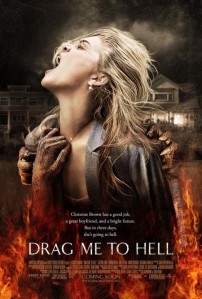
In Drag Me To Hell, Alison Lohman plays Christine, a young bank loan officer who, attempting to impress her boss and win a promotion, refuses to give a loan to a decrepit old gypsy woman (played, wonderfully, by Lorna Raver as the type of grotesque character who could only appear in a Raimi film).  The gypsy woman responds by promptly dying but before doing so, she puts a curse on Christine.  In three days, Christine will be dragged to Hell.

What makes this is so effective is that Raimi, as opposed to a less adventurous director, sets the film up to suggest that perhaps Christine deserves to be dragged to Hell.  As disgusting as the old woman is, she clearly doesn’t deserve to be treated as badly as she is by Christine and Christine herself (even before she kills that poor kitten) is a bit of a fake, a former “fat girl” who, when she lets her guard down, reverts back to a country hick accent that she’s obviously spent a lot of time trying to lose. 

Lohman does an excellent job in the lead role, giving a likeable performance as an unlikeable character.  Speaking as a former country girl who still occasionally feels a twinge of shame when I hear myself say “git” instead of “get,” one of my pet peeves is when an actor or actress trots out an unconvincing, patronizing attempt at a rural accent.  However, Lohman captures the accent perfectly and, unlike most actors who try to play country, never allows her performance to just be about doing dialect.  Instead, both she and Raimi show how Christine’s insecurities lead to her actions without ever suggesting that they excuse them.

Though absence of Bruce Campbell is painfully obvious, Raimi still surrounds Lohman with a very strong supporting cast who all bring just the right amount of B-movie seriousness to their roles.  As Raver’s daughter, Bojana Novakovic appears in one the film’s best scenes in which she tauntingly explains the cure to Lohman.  Dileep Rao (who would be wasted later that year in Avatar) steals almost every scene he’s in as a friendly psychic who tries to help Lohman.  Lohman’s boyfriend is played by Justin Long (of the “I’m a Mac” fame) and he’s perfect as a somewhat nerdy guy who, quite frankly, seems like he might be a little bit too nice for his own good.  Plus, the film’s final scene proves that Long can shed a tear with the best of them.  Bruce Campbell would have been ideally cast as Lohman’s boss but, in Campbell’s absence, David Paymer fills the role well enough.

When Drag Me To Hell was first released in 2009, the majority of reviews described it as being an entertaining throwback to the old school horror films of the 50s and 60s.  And, in many ways, this is a totally correct assessment.  What wasn’t often mentioned was that Drag Me To Hell is one of the very few Hollywood horror films to capture the chaotic spirit of H.P. Lovecraft.  Countless filmmakers have attempted to bring Lovecraft’s Cthulhu mythos to the screen and they’ve failed because they could never translate to the screen Lovecraft’s theme of mankind as a bunch of powerless pawns, existing and dying at the whims of a bunch of “demons” whose motivations could never be understood or questioned.  Though Drag Me To Hell is not based on Lovecraft’s work, it perfectly captures the feeling of helplessness in the face of metaphysical chaos that runs through Lovecraft’s best stories.  As the movie progresses, it becomes apparent that Christine isn’t going to be dragged to Hell so much because of the gypsy curse as much as just because the movie’s demon has decided to drag her to Hell.  It’s this theme (and the way that Raimi relentlessly develops it) that takes Drag Me To Hell to a whole other level and which makes its final scene so powerful and effective.

When first released, Drag Me To Hell’s special effects were criticized by some and it is true that the film’s demon, when he does show up, is an obvious CGI creation but who cares?  If anything, the obvious fakeness of the demon adds to the film’s exploitation charm (though the demon is probably another role that Bruce Campbell could have done wonders with).  If you want perfect CGI devoid of subtext or originality, Avatar’s out on DVD.  Me, I’ll take Drag Me To Hell any day.