Take this one in now if you can, because if Wikipedia is to be believed, it “has never been released.”
I don’t know enough about X Japan to speak about them beyond that they are a Japanese heavy metal band with a tragic backstory that is documented in the film, We Are X (2016).
This particular song appears to have had three different versions made of it. This is the third one whose music video was recorded in Los Angeles and shot at Coyote Dry Lake in San Bernardino County, California.
Wikipedia says that Lynch also shot a commercial for the song shot on a beach in Malibu. To the best of my knowledge, the video below is that ad.
This is as good a place as any to mention that Lynch has had a career in commercials. My personal favorites are his own versions of the Taster’s Choice commercials, but in the Twin Peaks universe, with some of the actors from the show. I have included a collection of his commercials below, which includes the coffee ones.
Traces to Nowhere is an episode defined by two accidents.
The first is Pete Martell serving Agent Cooper (Kyle MacLachlan) and Sheriff Truman (Michael Ontkean) fish-tainted coffee while Cooper and Truman are asking Josie (Joan Chen) about Laura Palmer (Sheryl Lee) tutoring her in English. Pete runs into the room, saying, “Fellas, don’t drink that coffee! A fish fell into the percolator!” Hours later, sitting at the Double R Diner, Cooper says that he still has “the taste of that fish-flavored coffee in my mouth.”
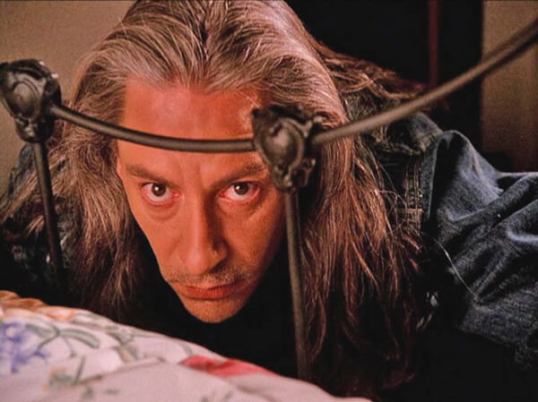
The other accident was Killer Bob, who makes his first appearance when Mrs. Palmer (Grace Zabriskie) has a vision of him in the corner of a room. Bob and his sudden appearances would become one of the best known things about Twin Peaks but, ironically, he wasn’t even a part of the show’s original conception. Bob was played by Frank Silva, a prop master and set decorator who was working on the pilot episode of Twin Peaks when David Lynch accidentally caught his reflection on camera. Lynch was so taken by the accidental image that he created the role of Killer Bob specifically for Silva. Silva made a strong and undeniable impression as the growling Bob but, unfortunately, it would be his only role as an actor. Silva died of AIDS in 1996, four years after appearing in Twin Peaks: Fire Walk With Me.
Frank Silva as Killer Bob
Traces to Nowhere was the first regular episode of the series, following the pilot. Probably in order to reassure nervous television executive and viewers who were on the fence about whether or not Twin Peaks was for them, this episode is more quirky than actively strange. A lot of time is devoted to the show’s more soapy plot threads, like the affairs between Ben Horne (Richard Beymer) and Catherine Martell (Piper Laurie) and Donna Hayward (Lara Flynn Boyle) and James Hurley (James Marshall) and the abusive marriage of Leo (Eric Da Re) and Shelley (Madchen Amick).
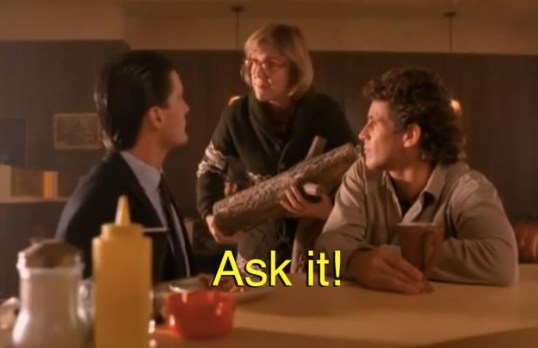
There are a lot of first in Traces to Nowhere. This is the episode where Audrey first talks to Cooper, Cooper first says that the Great Northern serves a “damn fine cup of coffee,” where Cooper first has a slice of cheery pie, and where Cooper first talks about Albert Rosenfield. This episodes also features the first mention of the Bookhouse Boys and, most importantly for fans of the series, the first appearance of Catherine Coulson as everyone’s favorite Log Lady. When the Log Lady first shows up and tells Cooper to ask her log who killed Laura Palmer, the character seems like just a throw away joke. But fans of the show know how important the Log Lady will become.
Catherine Coulson, was passed away in 2015, was the ex-wife of Jack Nance, who played Pete Martell. Coulson and Nance both worked with David Lynch on his first film, Eraserhead. It is said that during the shooting of Eraserhead, Lynch looked over at Coulson and said that he had just suddenly had a vision of her holding a log. (Nance and Coulson were not the only Eraserhead alumni to later appear on Twin Peaks. Charlotte Stewart, who played the weak mother of Bobby Briggs on Twin Peaks, earlier played Mary X, Nance’s strange girlfriend in Erasherhead.)
Seeing as the site is going through each episode of Twin Peaks, I thought I might as well go through the music videos where David Lynch has been directly involved. I say “directly” because there is a music video from 1982 for a song called I Predict, by the group Sparks, which is often credited to David Lynch, even though everything I’ve seen says it was directed by Douglas Martin in the style of David Lynch.
There’s another video for Unfinished Sympathy by Massive Attack that is credited to Lynch over on mvdbase, but probably only got that way because the stedicam operator on the video, Dan Kneece, worked on Blue Velvet (1986). He also worked on other David Lynch stuff, including 29 of the 30 episodes of Twin Peaks’ original run. Wikipedia says it was directed by Baillie Walsh.
We all know the other version of Wicked Game. I’ll do that someday. This is the version that intercuts footage from Wild At Heart (1990) with Isaak’s performance. What is there to say? It’s in Lynch black-and-white. It has a flame. It has Chris Isaak looking like Henry Spencer from Eraserhead (1977) if he were a young Roy Orbison, which I’m sure is on purpose since Orbison’s In Dreams is prominently featured in Blue Velvet. It’s probably what most people would expect.
One last thing, Lynch is again credited for a music video that I don’t think he did. He is credited for directing Dangerous by Michael Jackson. I have no reason to believe that’s true. However, both the video below and IMDb do credit him with directing a short teaser for the album called Dangerous.
(In anticipation of the upcoming revival on Showtime, we’re rewatching and reviewing every single episode of the original Twin Peaks all through April! Enjoy!)
“She’s dead, wrapped in plastic.”
— Pete Martell (Jack Nance) in Twin Peaks 1.1 “The Pilot”
When I was thinking about how I was going to open this review of the pilot episode for David Lynch’s iconic (and soon to be revived television series), Twin Peaks, I thought that I would start with this simple statement:
Twin Peaks opens with tears.
Then I rewatched the pilot on Netflix and I discovered that I was actually very incorrect. Though I always think of the tears whenever I think of Twin Peaks, the pilot does not open with them. Instead, it opens in a very David Lynch-like fashion — with signs of normalcy while Angelo Badalmenti’s ominous theme music provides hints that all is not as safe as it seems.
Really, it’s silly to try to talk about the pilot of Twin Peaks without including the opening credits because, in their deceptively simple way, they really do provide a road map of what’s to follow:
The opening credits, with their mix of shrouded atmosphere, man-made machinery and seemingly placid nature, are about as Lynchian as you can get.
Then again, the town of Twin Peaks is about as Lynchian as you can get. Located only a few miles from the Canadian border in Washington State and surrounded by beautiful mountains and glorious wilderness, Twin Peaks is a town that seems strangely out of time. Twin Peaks takes place in 1990s but, at times, the town seems to be stuck in the 50s. Not the real 50s, of course. Instead, it’s the 1950s of television, movies, and the popular imagination. It’s a town where soulful loner James Hurley (James Marshall) wears a leather jacket and drives a motorcycle while teenage vixen Audrey Horne (Sherilyn Fenn) dresses like Natalie Wood in Rebel Without A Cause and waits until she’s safely at her locker to slip on a pair of red high heels. Audrey’s father, ruthless Ben Horne (Richard Beymer), makes plans to sell the town to the Norwegians while, at the local diner, wise Norma Jennings (Peggy Lipton) wearily watches over her customers. It’s a world that could only exist in a dream and what a dream it is.
So no, the pilot of Twin Peaks does not open with tears. Instead, it opens with Pete Martell (played by Jack Nance, the star of Lynch’s Eraserhead) going out to fish. He tries to get a kiss from his wife, Catherine (Piper Laurie), but is coolly — but not cruelly — rebuffed. One gets the feeling that this is a ritual that they go through every morning. It’s only after Pete has stepped outside that he sees the girl on the shore, naked and wrapped in plastic.
That girl, of course, is Laura Palmer (Sheryl Lee). The high school homecoming queen. The girl who did volunteer work. The girlfriend of football player Bobby Briggs (Dana Ashbrook). The daughter of Leland Palmer (Ray Wise), Ben Horne’s lawyer. The best friend of Donna Hayward (Lara Flynn Boyle) and the occasional rival of Audrey Horne. The secret girlfriend of James Hurley.
It’s after Laura is discovered that the tears begin and those tears dominate the first 30 minutes of this 90-minute pilot. Deputy Andy (Harry Goaz) is the first to cry. Laura’s mother (Grace Zabriskie) cries when she gets the news. Leland cries. Donna cries. At the high school, a girl runs by a window, screaming. The school principal announces that Laura has been found dead and breaks down into tears. Only a few people don’t cry. Ben doesn’t cry, knowing that a murder could ruin his business deal. Bobby doesn’t cry, even when he’s arrested under suspicion of having committed murder. (He was the last person known to have been with Laura.) Audrey doesn’t cry and instead, appears to faintly smile at the chaos around her.
And Sheriff Harry S. Truman (Michael Ontkean) doesn’t cry. However, that’s to be expected. Harry is the rock on which Twin Peaks is built, both as a show and town. He’s the least quirky character in the series. He is law and order. He’s got a murder to solve and making things even more urgent is that a classmate of Laura’s, Ronette Pulaski, is also missing.
The first 37 minutes of the pilot do a perfect job of establishing both the town and it’s inhabitants. Everyone has a secret. Everyone has a motive. Along with those that I’ve already mentioned, we also meet waitress Shelly (Madchen Amick), who is married to an abusive trucker named Leo (Eric Da Re) and who is having an affair with Bobby. We meet Bobby’s best friend and fellow football player, a real idiot named Mike (Gary Hershberger). We meet Donna’s father, Doc Hayward (Warren Frost). We meet the police dispatcher, the sweetly off-center Lucy (Kimmy Robertson). We meet Deputy Hawk Hill (Michael Horse) who is as stoic as Andy is emotional. We meet James’s uncle, Ed Hurley (Everett McGill) and Ed’s one-eyed, drapery-obsessed wife, Nadine (Wendy Robie). We meet Josie Packard (Joan Chen), who inherited the mill from her late husband and who is secretly Harry’s lover.
And, after Ronette is discovered wandering, zombie-like on a bridge, we meet FBI Special Agent Dale Cooper (Kyle MacLachlan). More than anything else, Cooper is who people think of whenever they think of Twin Peaks. MacLalchlan plays the quirky FBI agent with just the right combination of earnestness and eccentricity. Speaking into his ever-present tape recorder and praising everything from the trees to the pie to the coffee, Cooper quickly establishes himself as the perfect man to figure out what’s going on in Twin Peaks.
David Lynch once famously described his previous collaboration with MacLachlan, Blue Velvet, as being the “Hardy Boys Go To Hell,” and the same can be said of Twin Peaks. If the first 37 minutes of the pilot were dominated by sadness and secrets, the final 60 are dominated by Dale Cooper’s enthusiasm and cheerful positivity. The town may be strange but Dale loves the trees. Dale may be investigating horrible and brutal crimes but at least he’s found a good slice of pie and damn fine cup of coffee.
“You know why I’m whittling?” Dale asks Harry at one point. “Because that’s what you do in a town where a yellow light means slow down instead of speed up.” Dale smiles after he says it. It doesn’t take him long to fall in love with Twin Peaks.
Throughout the rest of the pilot, we get more hints of a world that’s threatening to spin off of its axis. Dale and Harry run into Dr. Lawrence Jacoby (Russ Tamblyn, who co-starred with Richard Beymer in West Side Story), who was Laura’s psychiatrist and appears to be in need of some therapy himself. When they look at Laura’s body in the morgue, the lights flicker on and off. When Dale finds a scrap of newspaper — featuring the letter “R” — underneath Laura’s fingernail, he grins as if he’s just made it through his first Communion. When Harry and Dale go to the local bank, a moose’s head just happens to be lying on the table in the conference room. It fell, they’re told. Despite all the strangeness, they go about their business. They’ve got a murder to solve.
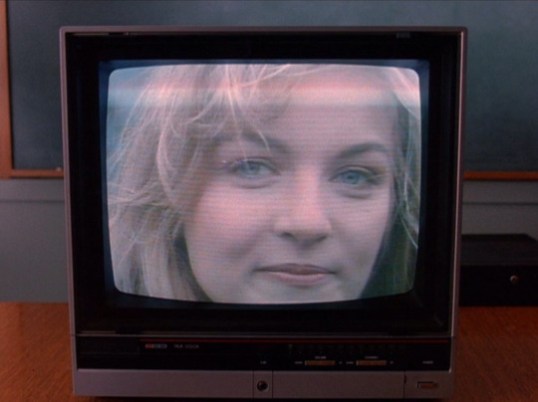
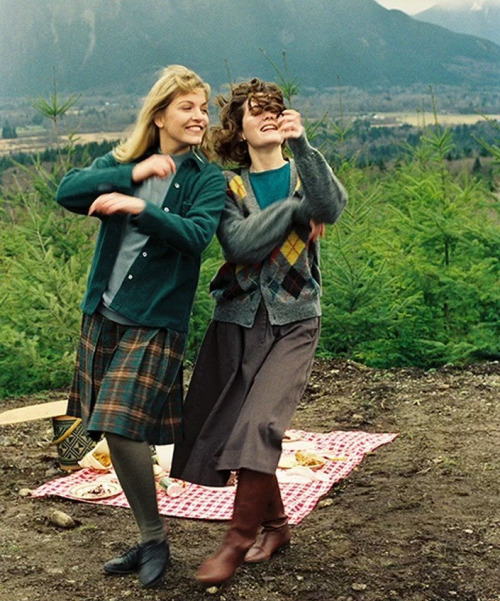
“Mr. Cooper,” Harry says, at one point, “you didn’t know Laura Palmer.” But, as quickly becomes obvious, no one knew Laura Palmer. No one, for instance, knew that she was doing cocaine. And Bobby didn’t know that she was seeing James, or at least he doesn’t until he watches a video that Donna, James, and Laura shot inn the mountains over looking the town. Laura, who we’ve previously just seen as a dead body, is so happily alive in that video that it’s a bit jarring to see her. You half expect her to come out of the TV, like the girl in The Ring. The video ends with her smiling, as if she’s daring both Cooper and the show’s viewers to try to figure out who she actually was. Only later is it revealed that, in a plot twist reminiscent of Dario Argento’s Four Flies on Grey Velvet, James’s motorcycle is reflected in Laura’s eye.
Life goes on in Twin Peaks. Audrey, the character to whom I most relate whenever I watch this show, sits in her father’s hotel and penetrates a styrofoam cup of coffee with a pencil. “What would happen if I pulled this out?” she asks before doing just that. Audrey walks into the hotel’s conference room and tells the Norwegians that she’s feeling sad because her best friend was just brutally murdered, destroying her father’s business deal. (“The Norwegians are leaving! The Norwegians are leaving!” a hotel concierge vainly yells.)
(Perhaps not coincidentally, Norway was also the home of Henrik Ibsen, whose theatrical melodramas often dealt with many of the same themes — greed, infidelity, the corruption that comes with progress — that are present in Twin Peaks. An Enemy of the People could have just just as easily taken place in the American Northwest.)
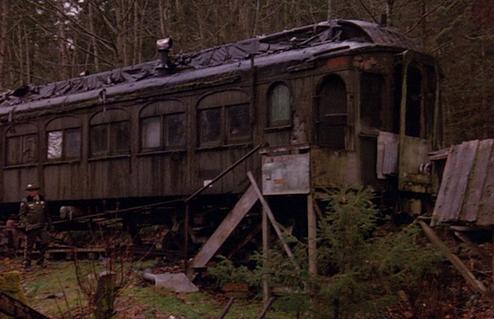
Meanwhile, the local police come across the abandoned railroad car where Laura was murdered and Ronnette raped. Andy calls the sheriff’s office, in tears. “Tell Harry I didn’t cry,” he begs Lucy, “but it’s so horrible!” It’s a moment of very real humanity in the middle of this odd and disturbing mystery. When Andy begs Lucy not to reveal his very human reaction, it’s more than just shame on his part. It’s an indication that perhaps the only way to solve this mystery is to sacrifice one’s emotions.
And, as Andy said, it is horrible. When Dale and Harry walk through that railway car, we are reminded that, as quirky at the show may be, a very disturbing crime is still at heart of it. Among other things, they find a half-heart necklace (the other half is with James) and, written in blood in the debris, a message: “Fire Walk With Me.” As disturbing as this is in the pilot (and this scene really is Lynch at his best), it’s even more disturbing if you know who will ultimately be revealed to have been Laura’s murderer. But that information will have to wait for a later review.
It easy to believe that arrogant Bobby Briggs killed Laura but Cooper only has to talk to him for a few minutes to realize that he didn’t do it. Bobby may be a jerk and a drug dealer. And Cooper is surely correct when he says that Bobby never loved Laura. But Bobby is a bully, not a murderer. When Bobby is released, he and Mike go looking for James. As unlikable as Bobby is, Mike — with his blonde hair and all-American looks — is somehow even worse. At least Bobby is open about being an bad guy. Mike hides his darker instincts behind a carefully cultivated facade of blandness. Looking at Mike in his red letterman jacket, you really do want someone to claw his eyes out.
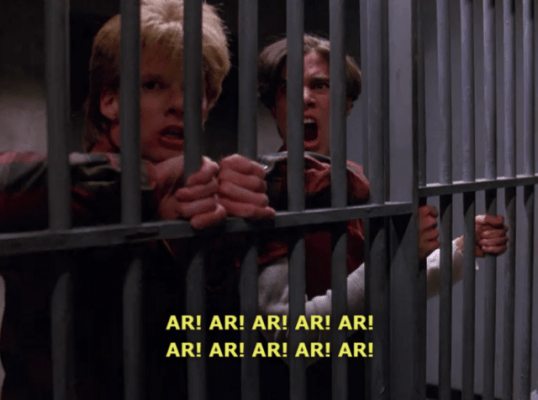
Mike and Bobby look for James at the Roadhouse, one of the most important locations in Twin Peaks. It’s a place where illicit lovers (like Norma and Ed) meet and where Julee Cruise sings haunting songs. Bobby and Mike may not find James but they do find a fight with Ed. This leads to Bobby and Mike spending the night in jail, which, ironically, is where they eventually find James. James has been arrested as a suspect in the death of Laura Palmer. In their cell, Bobby and Mike start to bark like wild dogs.
And so, a pilot that started with the humanity of tears ends with animalistic howls of anger, hate, and jealousy.
And so, Twin Peaks begins.
If I haven’t already made it clear, I am huge fan of the pilot for Twin Peaks. Say what you will about where the series eventually went, the pilot was and remains an absolutely brilliant dream of dark and disturbing things. Having rewatched the pilot, I am definitely looking forward to rewatching the rest of the series for this site and I hope you’ll enjoy the rest of our reviews!
Twin Peaks started with Marilyn Monroe. It sounds like a bad April Fools joke but it’s true.
In 1986, after the success of Blue Velvet, David Lynch was hired to direct a biopic of Marilyn Monroe. Lynch would later say that the Monroe film never happened because, while he liked the idea of doing a story about “a woman in trouble,” he was not comfortable with telling a true story. Even though the film was never made, it did lead to David Lynch meeting and befriending a screenwriter named Mark Frost. Frost, who had written for ground-breaking TV shows like Hill Street Blues, was one of the many screenwriter who would take a stab at the screenplay for the Monroe project.
Even after it became obvious that the Monroe biopic was never going to be produced, Lynch and Frost continued to look for projects that they could work on together. After several film proposals that failed to generate much interest, they followed the advice of Lynch’s agent and worked on a project that, like Blue Velvet, would look at the underbelly of life in small town America.
Lynch and Frost started with an image, a body washed up on the shores of the lake. The body was Laura Palmer who, like Marilyn Monroe, was a woman in trouble. Originally called North Dakota (because that was where it was originally meant to take place), this is the project that eventually became Twin Peaks.
Twin Peaks premiered on ABC on April 9th, 1990 and, for its first season, it was a phenomena. Though critics were often baffled, audiences were intrigued by the combination of Lynch’s surrealistic vision and Frost’s serialized storytelling. Twin Peaks was nominated for 14 Emmys at the end of its first season. The second season, however, saw rating sharply decline as audiences, critics, and executives all decided that the show was just too strange. After just 30 episodes, Twin Peaks was canceled.
Even after it ended, Twin Peaks lived on. There was a feature film. There were frequent reruns on stations like Bravo. Twin Peaks‘s quirky style changed the face of television. Shows like Picket Fences and Northern Exposure were basically Twin Peaks-lite, quirky without ever being truly surreal.
Despite the unceremoniously way that it ended, Twin Peaks never went away and new audiences discover it every day. In May, 26 years after it went off the air for the first time, Twin Peaks will be returning. with new episodes, to Showtime. Before it starts again, we are going to take a look back at the original Twin Peaks on this site. Look for Lisa’s review of the pilot tomorrow.
To quote Dale Cooper, “I have no idea where this will lead us, but I have a definite feeling it will be a place both wonderful and strange.”
4 Shots From 4 Films is just what it says it is, 4 shots from 4 of our favorite films. As opposed to the reviews and recaps that we usually post, 4 Shots From 4 Films is all about letting the visuals do the talking.
Happy birthday, David Lynch!
4 Shots From 4 Films
The Elephant Man (1980, directed by David Lynch)
Blue Velvet (1986, directed by David Lynch)
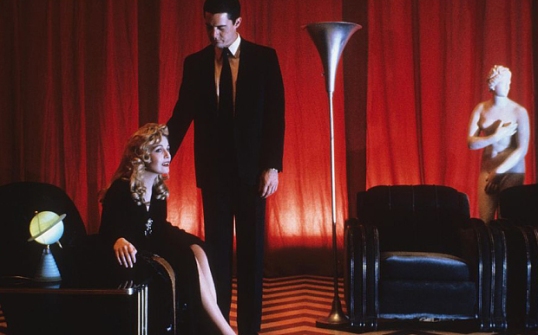
Twin Peaks: Fire Walk With Me (1992, directed by David Lynch)
We’ve reviewed a lot of science fiction and we’ve got a lot more left to go. (Keep an eye out for my reviews of Starcrash and The Humanoid over the upcoming few days.) However, from the beginning, this month has always been centered around Star Wars. You may have heard that there’s a little movie called Star Wars: The Force Awakens and it’s opening this week. Apparently, a few people are excited about it. Since we love reviewing little known art films here at the Shattered Lens, we decided why not review all of the previous Star Wars films during the week leading up to the release of The Force Awakens? Jeff (a.k.a. the blogger known asJedadiah Leland) started us off by reviewing The Phantom Menace.Then Alexandre Rothier took a look at Attack of the Clones, followed by Jeff’s look at Revenge of the Sith.Leonard Wilson was the next to step up to the plate, reviewing both A New Hope and The Empire Strike Back.
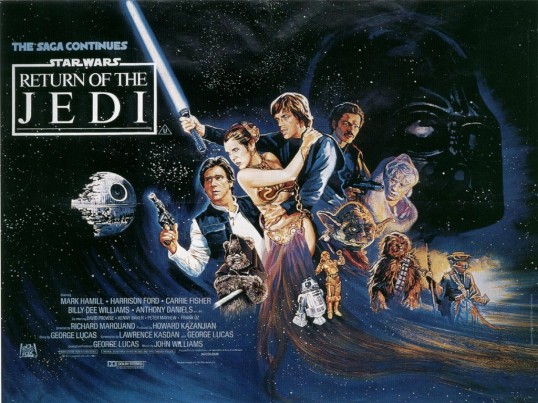
And now, it’s my turn to add my thoughts to this project. It’s time to review the 1983 film, Return of the Jedi. And I have to admit that, when I first thought about what I wanted to say in this review, I was totally intimidated. Unlike my fellow writers here at the Shattered Lens, I’m hardly an expert when it comes to Star Wars. Don’t get me wrong — I know the basics. I know that Darth Vader is Luke’s father. I know that Han Solo flies the Millennium Falcon and that Princess Leia is in love with him. I know there’s an evil Empire and I know that there are rebels. I’m not a virgin when it comes to Star Wars but, at the same time, I’m definitely not as experienced (with Star Wars) as most of my friends and fellow movie bloggers.
“Dang, Lisa, get over it!”
So, late this afternoon, when I sat down to watch Return of the Jedi, it was with more than a little trepidation. My obvious panic and welling tears convinced Jeff to watch the movie with me and I was happy for that. He loves Star Wars so I knew he could explain to me what was going on.
Finally, we watched Return of the Jedi and I discovered that I was panicking over nothing. Return of the Jedi may be the third part of trilogy and I may not be an expert on the films that came before it. But, even with all that in mind, Return of the Jedi is not a difficult film to figure out. As opposed to the finales of Harry Potter, The Hobbit, and The Hunger Games, Return of the Jedi keeps things simple. A good guy has been kidnapped by a bad guy. The other good guys come to the rescue and then go to another planet so that they can fight an even bigger bad guy. It’s not complicated.
As I watched Return of the Jedi and realized that I was having absolutely no problem following the film’s plot, I also realized that the Star Wars films are such a huge part of our culture that, regardless of how many of them we’ve actually sat through, everyone has absorbed them by osmosis. Bits and pieces of it are everywhere, showing up in everything from TV sitcoms to political commentary. (Remember how everyone used to compare Dick Cheney to Darth Vader?) The Star Wars franchise is almost biblical in that respect. At the same time, the fact that everyone knows about these movies makes them a little difficult to review. You don’t so much watch a Star Wars film as you join in a universal experience. As a reviewer, you definitely find yourself wondering what you can add to a conversation that everyone else has already had.
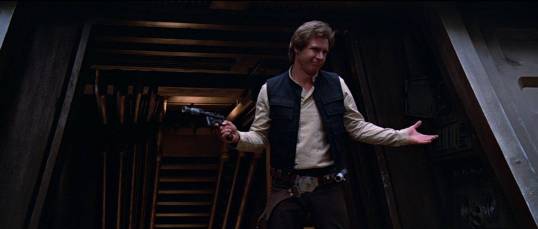
As a stand alone movie, Return of the Jedi is actually three separate films mixed together. The first film deals with Luke Skywalker (Mark Hamill) showing up at Jabba the Hutt’s palace and rescuing Han Solo (Harrison Ford), Princess Leia (Carrie Fisher), Chewbacca (Peter Mayhew), and two robots from being tossed into a creature called the Sarlacc, which is basically a giant vagina out in the middle of the desert. The second film deals with the rebels teaming up with a bunch of teddy bears and fighting the Empire on a jungle planet. And the third film features Luke and Darth Vader (body of David Prowse, voice of James Earl Jones, face of either Sebastian Shaw and Hayden Christensen, depending on which version of the film you’re watching) dealing with their family issues while the Emperor (Ian McDiarmid) cackles in the background. Some parts of the film work better than others. The end result is entertaining but definitely uneven.
Jedi‘s heart belongs to that third film, the one dealing with Luke and Darth Vader. I’ve read some pretty negative online comments about Mark Hamill’s performance in New Hope and Empire Strikes Back but, in Return of the Jedi, he brings an almost haunted intensity to the role of Luke. In theory, it’s easy to be snarky about all the talk about the “Dark Side of the Force,” but, when you look in Hamill’s eyes, you totally understand what everyone’s going on about. You see the fire and the anger but, even more importantly, you see the struggle between good and evil. There’s a very poignant sadness to the scenes where he and his father prepare to meet the Emperor.
And speaking of the Emperor, he is pure nightmare fuel! AGCK!
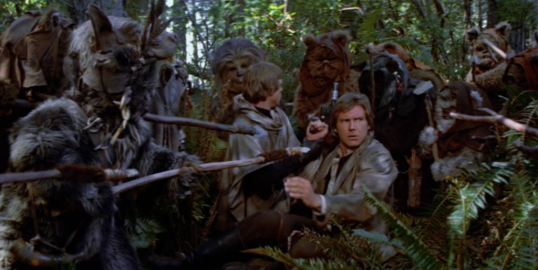
As for the other two films to found within Return of the Jedi, the jungles of Endor didn’t do much for me. Don’t get me wrong. I thought the action scenes were handled well and, unlike apparently everyone else in the world, I was not annoyed by the inclusion of the Ewoks, the killer teddy bears who helped to the Rebels to take down the Empire. I thought the Ewoks were cute and I actually got pretty upset when one of them was killed in battle. If I had been alive when Return of the Jedi had been released, I probably would have wanted a stuffed Ewok and, I imagine, that was the main reason they were included in the film. (I also imagine that’s the main reason why a lot of people can’t stand them.)
So, no, the Ewoks did not bother me. What did bother me was that under-construction Death Star floating out in the middle of space. It bothered me because I really couldn’t imagine any reason why — after the first Death Star was apparently such a colossal failure — the Empire would insist on trying to do the exact same thing all over again. This, along with the fact that they were rather easily defeated by a bunch of teddy bears, leads me to wonder whether the effectiveness of the Empire was just a little overrated. I mean, the Emperor was scary but otherwise, everyone involved with the Empire was pretty incompetent.
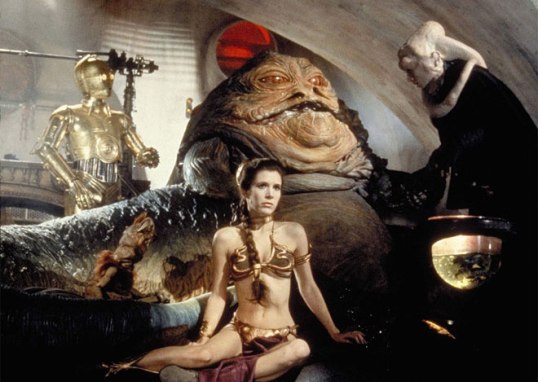
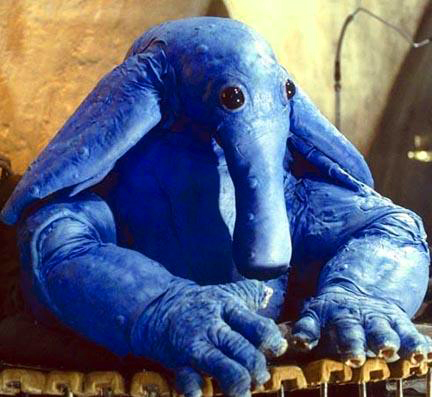
Far more impressive, as far as villains go, was Jabba the Hut. In fact, Jabba and his decadent entourage were so memorable and colorful and evil and icky that they pretty much overshadowed almost everything else in the film. I mean, Jabba even had a blue elephant playing music for him! And I know that I’m supposed to be critical of the film for putting Leia in that gold bikini but you know what? Leia may have been forced to wear a gold bikini but she never gave up her dignity or her defiance. And when it came time to take out Jabba, Leia used the tools of her oppression to do so, strangling him with his own chains. In that one scene, Leia proved herself to be a true rebel.
There’s a lot that’s good about Return of the Jedi but, as I said earlier, it’s definitely an uneven film. Richard Marquand’s direction is perhaps the epitome of workmanlike. It’s efficient and it’s dependable and there’s absolutely nothing surprising or particularly challenging about it.
It’s interesting to note that, before Richard Marquand was selected as director, the job was offered to both David Lynch and David Cronenberg, two directors who are all about surprising and challenging the audience. What would David Lynch’s Return of the Jedi been like? Well, here’s one possibility:
As for David Cronenberg’s Return of the Jedi, it might have looked something like this:
For better or worse, the world got Richard Marquand’s Return of the Jedi, which I imagine was pretty close to what George Lucas wanted the film to be.
As I sit here finishing up this review and wondering just why exactly I was so intimidated earlier (seriously, this turned out to be one the easiest reviews that I’ve ever written), I estimate that 75% of the people that I know are currently sitting in a theater and watching The Force Awakens. Keep an eye out for Arleigh’s review in the next few days!
And in closing, here’s that blue elephant that I mentioned earlier. Dance!
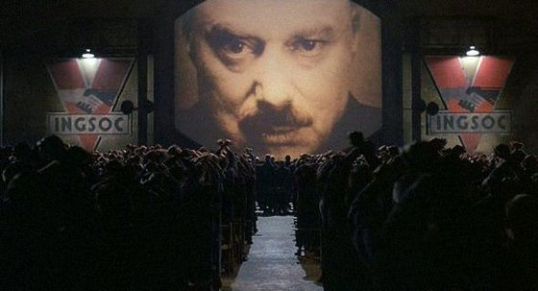
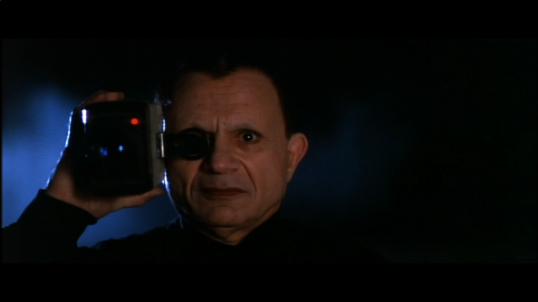
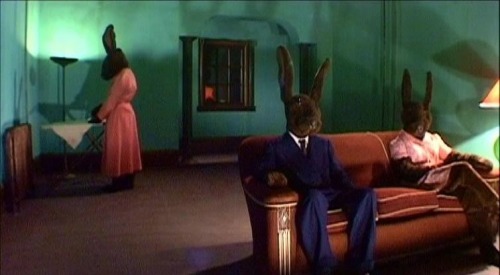
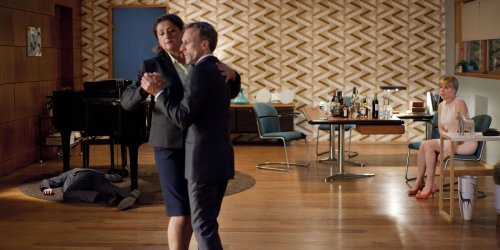
4 Shots From 4 Films is just what it says it is, 4 shots from 4 of our favorite films. As opposed to the reviews and recaps that we usually post, 4 Shots From 4 Films is all about letting the visuals do the talking.
4 Shots From 4 Films is just what it says it is, 4 shots from 4 of our favorite films. As opposed to the reviews and recaps that we usually post, 4 Shots From 4 Films is all about letting the visuals do the talking.








 Through the Shattered Lens