Wolf (1994, directed by Mike Nichols)


Will Randall (Jack Nicholson), the editor-in-chief of a New York Publishing house, doesn’t get much respect, not from his wife (Kate Nelligan), not from his boss (Christopher Plummer), and certainly not from Stuart Swinton (James Spader), the sleazy executive who is plotting to steal his job and destroy his marriage.  But then, one night, Will runs over a black wolf on a country road.  When he tries to helps it, the wolf bites him.  Soon after, Will starts to feel different whenever the moon is full.

I remember that, when Wolf came out in 1994, some people said that casting Jack Nicholson as a werewolf seemed like typecasting.  Nicholson apparently understood this as well so he actually downplays his usual mannerisms for the first part of the movie and gives a convincing performance as a harried executive who is worried he’s about to lose his job.  It’s only after he is bitten that Will Randall starts to come alive.  Not only does he develop the predator instinct necessary to survive in New York City but he also, without fear, pursues his boss’s daughter, Laura (Michelle Pfeiffer, at her most beautiful).  Typecast or not, Jack Nicholson is excellent in Wolf.  Equally good is James Spader as Will’s business rival, who starts to show some predator-like aspects of his own.

Director Mike Nichols was not normally a horror director and, around the midway point, his direction falters and there are times when he just seems to be going through the motions.  He gets good performances from his cast but doesn’t know how to craft a good jump scare.  The best parts of the movie are when Wolf uses lycanthropy as a metaphor for petty office politics, with Will “marking” his territory while talking to Stewart and showing a renewed killer instinct.  Wolf works better as a social satire than as a horror movie.

Fans of Frasier will be happy to see David Hyde Pierce in a small but key role.  He delivers the film’s best line.  Fans of Friends may also notice David Schwimmer in a small role.  He says nothing worth remembering.  Their presence, though, is a reminder of just how much American culture changed in 1994.  By the end of the year, both went from small roles in Wolf to co-starring in the two of the most popular sitcoms in America.
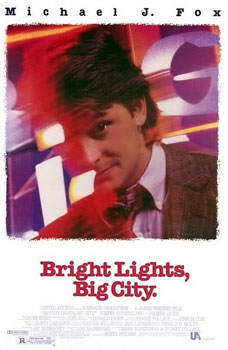
Embracing the Melodrama Part II #80: Bright Lights, Big City (dir by James Bridges)


Bright_Lights_Big_CityThe 1988 film Bright Lights, Big City is one of the many films from the late 80s in which Kiefer Sutherland plays a demonic character.  In this case, his character is so demonic that his name is — seriously, check this shit out — Tad Allagash.  Nobody named Tad Allagash has ever been a good guy!

Tad is the best friend of Jamie Conway (Michael J. Fox), an aspiring writer who has moved to New York City from some middle-America farm state and who now has a job as a fact checker at the New Yorker.  Jamie is still struggling to deal with both the death of his mother (played in flashbacks by Dianne Wiest) and the collapse of his marriage to Amanda (Phoebe Cates).  Tad helps out his depressed little friend by taking him out to the clubs and supplying him with so much cocaine that Jamie literally spends the entire film on the verge of having a geyser of blood shoot out from his powder-coated nostrils.

And the thing is, Tad knows that he’s not a good influence on Jamie’s life but he doesn’t care.  Whenever Jamie starts to get a little bit too wrapped up in his self-pity, Tad is there to make a tasteless joke.  Whenever Jamie tries to argue that he and Amanda aren’t really broken up, Tad is there to remind him that Amanda wants nothing to do with him.  Whenever Jamie starts to think that doing all of this cocaine is potentially ruining his life, Tad is there to cheerfully cut another line.  Tad makes no apologies for being Tad Allagash.  He’s too busy having a good time and it’s obvious that Sutherland’s having an even better time playing Tad.  As a result, Tad Allagash becomes the perfect antihero, the bad guy that you like despite yourself.

Unfortunately, Bright Lights, Big City isn’t about Tad Allagash.  You’re happy whenever Kiefer shows up but he doesn’t show up enough to actually save the film.  No, Bright Lights, Big City is the story of Jamie Conway and that’s why the film is a bit of a pain to sit through.  Despite having a great Irish name, Jamie Conway is one of the whiniest characters that I have ever seen in a film.  From the minute he first appears on screen and starts complaining about the failure of his marriage, you want someone to just tell him to shut up.  When he tells an alcoholic editor (Jason Robards) that his latest short story was autobiographical, you nod and think, “So, that’s why it hasn’t been published.”

Of course, since Jamie is the main character, everyone in the film feels sorry for him but he really is just insufferable.  There’s a lengthy scene where Jamie delivers a drunken monologue to a sympathetic coworker, Megan (played by Swoosie Kurtz).  And while Jamie goes on and on about how he first met Amanda and how their marriage fell apart (and how it was all her fault), poor Megan has to sit there and try to look sympathetic.  Personally, I would have kicked Jamie out of my apartment after the first minute of that whiny diatribe.  Megan has the patience of a saint.

There is some curiosity value to watching Michael J. Fox snort cocaine.  (I wonder if contemporary audiences shouted, “McFly!” as they watched Fox sniffing up the devil’s dandruff.)  But otherwise, Bright Lights, Big City is a relic of 80s cinema that can be safely forgotten.

44 Days of Paranoia #30: Nixon (dir by Oliver Stone)


For our latest entry in the 44 Days of Paranoia, we take a look at Oliver Stone’s 1995 presidential biopic, Nixon.

Nixon tells the life story of our 37th President, Richard Nixon.  The only President to ever resign in order to avoid being impeached, Nixon remains a controversial figure to this day.  As portrayed in this film, Nixon (played by Anthony Hopkins) was an insecure, friendless child who was dominated by his ultra religious mother (Mary Steenburgen) and who lived in the shadow of his charismatic older brother (Tony Goldwyn).  After he graduated college, Nixon married Pat (Joan Allen), entered politics, made a name for himself as an anti-communist, and eventually ended up winning the U.S. presidency.  The film tells us that, regardless of his success, Nixon remained a paranoid and desperately lonely man who eventually allowed the sycophants on his staff (including James Woods) to break the law in an attempt to destroy enemies both real and imagined.  Along the way, Nixon deals with a shady businessman (Larry Hagman), who expects to be rewarded for supporting Nixon’s political career, and has an odd confrontation with a young anti-war protester who has figured out that Nixon doesn’t have half the power that everyone assumes he does.

Considering that his last few films have been W., Wall Street: Money Never Sleeps, and SavagesI think it’s understandable that I’m often stunned to discover that, at one point in the distant past, Oliver Stone actually was a worthwhile director.  JFK, for instance, is effective propaganda.  Nixon, which feels a lot like an unofficial sequel to JFK, is a much messier film than JFK but — as opposed to something like Savages — it’s still watchable and occasionally even thought-provoking.  Thanks to Hopkins’ performance and, it must be admitted, Stone’s surprisingly even-handed approach to the character, Nixon challenges our assumptions about one of the most infamous and villified figures in American history.  It forces us to decide for ourselves whether Nixon was a monster or a victim of circumstances that spiraled out of his control.  If you need proof of the effectiveness of the film’s approach, just compare Stone’s work on Nixon with his work on his next Presidential biography, the far less effective W.

(I should admit, however, that I’m a political history nerd and therefore, this film was specifically designed to appeal to me.  For me, half the fun of Nixon was being able to go, “Oh, that’s supposed to be Nelson Rockefeller!”)

If I had to compare the experience of watching Nixon to anything, I would compare it to taking 10 capsules of Dexedrine and then staying up for five days straight without eating.  The film zooms from scene-to-scene, switching film stocks almost at random while jumping in and out of time, and not worrying too much about establishing any sort of narrative consistency.  Surprisingly nuanced domestic scenes between Anthony Hopkins and Joan Allen are followed by over-the-top scenes where Bob Hoskins lustily stares at a White House guard or Sam Waterston’s eyes briefly turn completely black as he discusses the existence of evil.  When Nixon gives his acceptance speech to the Republican Convention, the Republican delegates are briefly replaced by images of a world on fire.  Familiar actors wander through the film, most of them only popping up for a scene or two and then vanishing.  The end result is a film that both engages and exhausts the viewer, a hallucinatory journey through Stone’s version of American history.

Nixon is a mess but it’s a fascinating mess.

Other Entries In The 44 Days of Paranoia 

  1. Clonus
  2. Executive Action
  3. Winter Kills
  4. Interview With The Assassin
  5. The Trial of Lee Harvey Oswald
  6. JFK
  7. Beyond The Doors
  8. Three Days of the Condor
  9. They Saved Hitler’s Brain
  10. The Intruder
  11. Police, Adjective
  12. Burn After Reading
  13. Quiz Show
  14. Flying Blind
  15. God Told Me To
  16. Wag the Dog
  17. Cheaters
  18. Scream and Scream Again
  19. Capricorn One
  20. Seven Days In May
  21. Broken City
  22. Suddenly
  23. Pickup on South Street
  24. The Informer
  25. Chinatown
  26. Compliance
  27. The Lives of Others
  28. The Departed
  29. A Face In The Crowd