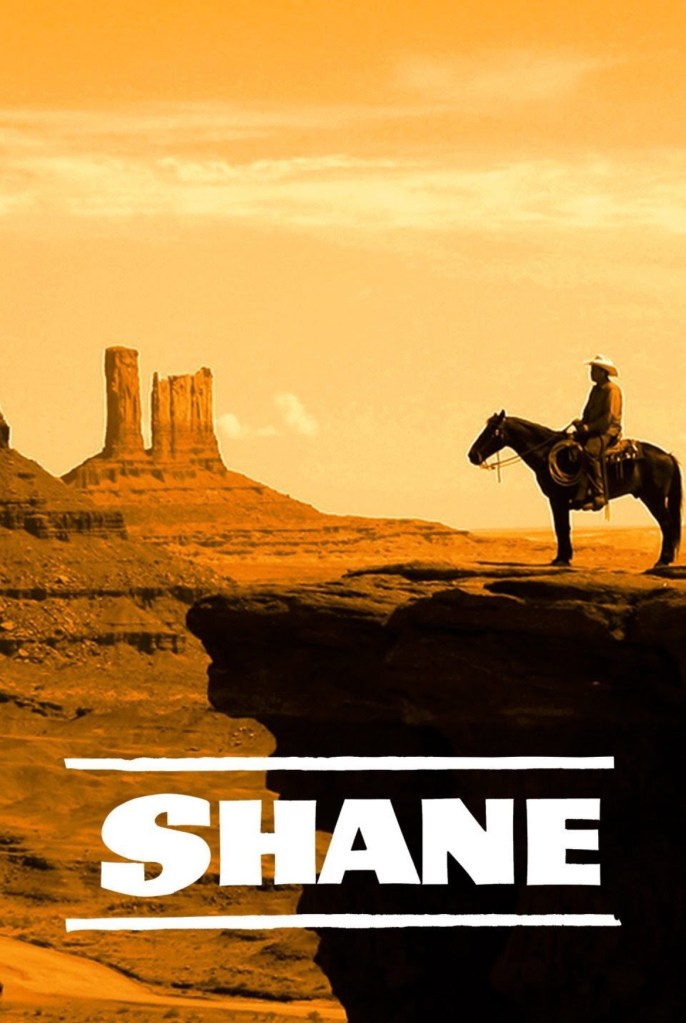
Kemp Spicer (Warren Oates) rides into town and runs into Marian Starett (Jill Ireland) and her father-in-law Tom Starett (Tom Tully) who are there visiting the local blacksmith. Spicer likes what he sees when he looks at Marian, and proceeds to make some creepy advances. He then asks if they know a guy named Shane. When they ask Spicer why he wants to know, he says that him and his family are going to kill him. After Marian and Tom tell Shane (David Carradine) about what they were told, Shane heads into town. He wants to know why they want to kill him, as well as keep the Spicers away from the Starett ranch. When he arrives at Sam Grafton’s saloon, Boon Spicer (Charles Kuenstie) tells him that they are there to get vengeance for Shane killing their brother Joey four years earlier in Abilene. Shane never killed anyone in Abilene so he knows that someone is mistaken, or just flat out lying. Soon other members of the Spicer family arrive in town, led by their Bible-quoting uncle Joshua Spicer (Cliff Osmond). Shane knows he’s going to have to take on these men even though he’s innocent of their family member’s death. He just wants to make sure they don’t go out to the Starett ranch and put the family in danger.
Episode 4 of Shane has our biggest co-star yet, in Warren Oates. It’s fun seeing his Kemp Spicer creep around making threats against Shane, making advances towards Marian, and then questioning whether or not they’re even after the right guy. Cliff Osmond is memorable and interesting as Uncle Joshua Spicer who puts their family honor above everything else. This episode also sees Shane getting some help as he takes on the Spicer clan in the final shootout. This help comes from Tom Starett and Rufe Ryker (Bert Freed), the local foe of the family. I don’t expect this means Ryker has turned good, but he definitely prefers Shane over those “hillbillies” he ran out of the area years earlier. Finally, we continue to learn of Marian’s feelings for Shane in this episode. At one point, she’s willing to leave the entire ranch behind if it keeps Shane safe. Shane doesn’t hear her say this, but her father-in-law remarks that he never realized she loved Shane that much.
I found episode 4 to be an entertaining episode. It features good performances from interesting co-stars. It also makes a good point about how an innocent lie can take on a life of its own and lead to unintended consequences. I’ll be looking forward to Episode 5!
Episode 3 opens with Shane (David Carradine) and Joey (Christopher Shea) watching as geese are flying over the ranch on their way south. Joey wonders how the geese know to go south. Shane tells him that it’s instinct, almost like they have an internal clock telling them when it’s time to go. It seems like we’re supposed to be reading something deeper into this conversation, like maybe it’s time for Shane to be heading out.
In the next scene, Shane and Marian Starett (Jill Ireland) are at Sam Grafton’s General Store. Sam (Sam Gilman) agrees to loan the Starett’s money for the purchase of some hogs. It seems that disease has struck their stock. They offer a 20 acre stand of wheat to Sam as their collateral. Unfortunately, soon after the deal is made, a herd of cattle stampede the wheat, destroying any potential crop and leaving them with no ability to purchase the hogs. Shane and the Staretts immediately suspect that Rufe Ryker (Bert Freed) is behind the stampede based on his desire to have their land at any cost. Threats are made, but Ryker denies it.
With these financial difficulties as a backdrop, a group of men show up at Sam’s saloon looking for Shane. The leader of the bunch is Johnny Wake (Don Gordon), a guy Shane has ridden with in the past. He’s come to see if he can buy Shane and his gun for $300 to help with a range war they’re involved in. Normally, Shane would be able to say no, but with the Starett’s farm in trouble, it may now be time for Shane to leave. Is Shane like one of the wild geese? Did Ryker stampede the wheat field? Will Shane go back to his old ways with Johnny Wake and the funky bunch? We’ll soon find out.
I liked this episode. Ryker was set up to be such an A-hole in the pilot, but I found myself believing him when he told Shane that he was not responsible for the stampede that ruined the Starett’s wheat. He’s still an A-hole though. I also liked that there’s some tension between Shane and Marian in this episode. She makes it clear that no matter how bad things are financially for their family, she will never accept “blood money” as help. They look at each other longingly several times over the course of the episode’s 45 minutes. Is this heading towards a big smooch at some point? I like that little Joey gets to say “I love you, Shane” as he’s leaving the farm in this episode. Finally, I like that Shane gets to actually use his gun here. I won’t spoil who it’s used on, but I will admit that it’s satisfying.
Three episodes in, and I’m really enjoying the series! I can’t wait to check out Episode 4!
Shane (David Carradine) is awakened in the night by the sound of someone outside his bunk. He sees an old man (John Qualen) looking in the window. He grabs his gun and gets outside in time to see the old man driving off over the ridge in a horse drawn buggy. The next morning Shane is telling Mr. Starett (Tom Tully), Marian (Jill Ireland) and Joey (Chris Shea) about what had happened during the night. At this point, Shane seems unsure if it was even real. They muse that it may have been a “hant,” or a ghost.
Shane takes Joey to Grafton’s General store. While he’s trying on some new leather boots, he accidentally bumps into a drunk cowboy (Carl Reindel) causing his whiskey to spill. The drunk confronts Shane. Shane is able to beat up the cowboy without having to kill him. And then the same old man from the night before comes in and just looks at every man in the bar. He appears to be searching for someone. He comes up to Shane and says, “You’re Shane.” Shane doesn’t remember the old man, and the old man just turns and leaves.
That night, Marian, unable to sleep walks outside and sees Shane talking to the old man. Shane tells her he’s an old friend that she should go back to bed. Shane invites him into his bunkhouse. That night the old man tells Shane that he killed his son 4 years earlier in Black Falls, CO. He even shows Shane a picture of his son. Shane doesn’t remember him at first. As he looks at the picture, he begins to have short flashbacks of the young man. He’s eventually able to remember the entire exchange with the young man in a saloon in Colorado. He did kill the man, but it was in self defense. He tells the old man that he did kill his son and that he’s sorry. He tells him that it was either his son or him, and that’s the only reason he killed him. Shane then asks the old man what he wants…. I won’t spoil it for you, but the answer was surprising!
Episode 2 is all about Shane being haunted by his past. David Carradine does the heavy lifting as his character tries to come to terms with the fact that he’s killed so many men that he can’t even remember them all. He even considers leaving the Starett ranch because he’s concerned that other people could show up in the future wanting to get vengeance on him. Old man Starett isn’t involved in the action at all in this episode. Marian is mostly there to encourage Shane to not be so hard on himself. There is a scene where he puts a blanket on her when he’s about to leave the ranch for good. She’s sleeping and takes Shane by the hand like she’s touching her husband’s hand. It will be interesting to see how far the series takes their relationship, but that will be for another episode. And Joey is not very involved outside of telling the family about Shane kicking the drunk cowboy’s butt early in the episode. I could hear “Linus” a little bit in his voice since I know that he would be voicing the character that same year in “It’s the Great Pumpkin, Charlie Brown.” That was pretty cool. John Qualen is good in his guest starring role as the old man whose son was killed by Shane in the past. Qualen has been in so many TV shows and movies in his career going back to the early 30’s. He’s a very recognizable actor.
All in all, I thought this was a solid episode. There was some real tension built up at the end of the when Shane is confronted again by that same drunk cowboy, and I was a little surprised by the resolution.
Though the Academy of Motion Picture Arts and Sciences claim that the Oscars honor the best of the year, we all know that there are always worthy films and performances that end up getting overlooked. Sometimes, it’s because the competition too fierce. Sometimes, it’s because the film itself was too controversial. Often, it’s just a case of a film’s quality not being fully recognized until years after its initial released. This series of reviews takes a look at the films and performances that should have been nominated but were, for whatever reason, overlooked. These are the Unnominated.
“Honorable men go with honorable men.” — Giovanni Cappa
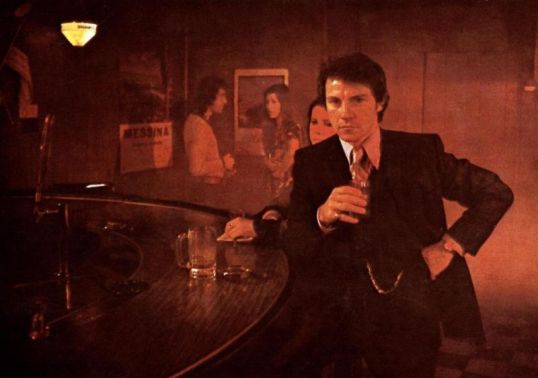
1973’s Mean Streets is a story about Little Italy. The neighborhood may only be a small part of the sprawling metropolis of New York but, as portrayed in this film, it’s a unique society of its very own, with its own laws and traditions. It’s a place where the old ways uneasily mix with the new world. The neighborhood is governed by old-fashioned mafiosos like Giovanni Cappa (Cesare Danova), who provide “protection” in return for payment. The streets are full of men who are all looking to prove themselves, often in the most pointlessly violent way possible. When a drunk (David Carradine) is shot in the back by a teenage assassin (Robert Carradine), no one bothers to call the police or even questions why the shooting happened. Instead, they discuss how impressed they were with the drunk’s refusal to quickly go down. When a soldier (Harry Northup) is given a party to welcome him home from Vietnam, no one is particularly shocked when the solider turns violent. Violence is a part of everyday life.
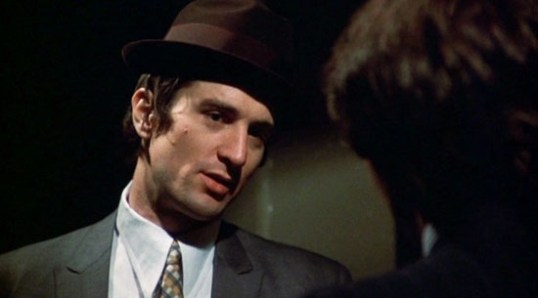
Charlie Cappa (Harvey Keitel) is Giovanni’s nephew, a 27 year-old man who still lives at home with his mother and who still feels guilty for having “impure” thoughts. Charlie prays in church and then goes to work as a collector for Giovanni. Giovanni is grooming Charlie to take over a restaurant, not because Charlie is particularly talented at business but just because Charlie is family. Giovanni warns Charlie not to get involved with Teresa (Amy Robinson) because Teresa has epilepsy and is viewed as being cursed. And Giovanni particularly warns Charlie not to hang out with Teresa’s cousin, Johnny Boy (Robert De Niro). Johnny Boy may be charismatic but everyone in the neighborhood knows that he’s out-of-control. His idea of a good time is to blow up mailboxes and shoot out street lamps. Charlie, who is so obsessed with sin and absolution that he regularly holds his hand over an open flame to experience the Hellfire that awaits the unrepentant sinner, finds himself falling in love with Teresa (though it’s debatable whether Charlie truly understands what love is) and trying to save Johnny Boy.
Charlie has other friends as well. Tony (David Proval) runs the bar where everyone likes to hang out and he seems to be the most stable of the characters in Mean Streets. He’s at peace with both the neighborhood and his place in it. Meanwhile, Michael (Robert Romanus) is a loan shark who no one seems to have much respect for, though they’re still willing to spend the afternoon watching a Kung Fu movie with him. Michael knows that his career is dependent on intimidation. He can’t let anyone get away with not paying back their money, even if they are a friend. Johnny Boy owes Michael a lot of money and he hasn’t paid back a single dollar. Johnny Boy always has an excuse for why he can’t pay back Michael but it’s obvious that he just doesn’t want to. Charlie realizes that it’s not safe for Johnny Boy in Little Italy but where else can he go? Brooklyn?
Mean Streets follows Charlie and his friends as they go about their daily lives, laughing, arguing, and often fighting. All of the characters in Mean Streets enjoy a good brawl, despite the fact that none of them are as tough as their heroes. A chaotic fight in a pool hall starts after someone takes offense to the word “mook,” despite the fact that no one can precisely define what a mook is. The fights goes on for several minutes before the police show up to end it and accept a bribe. After the cops leave, the fight starts up again. What’s interesting is that the people fighting don’t really seem to be that angry with each other. Fighting is simply a part of everyday life. Everyone is aggressive. To not fight is to be seen as being weak and no one is willing to risk that.
Mean Streets was Martin Scorsese’s third film (fourth, if you count the scenes he shot before being fired from The Honeymoon Killers) but it’s the first of his movies to feel like a real Scorsese film. Scorsese’s first film, Who’s That Knocking On My Door?, has its moments and feels like a dry run for Mean Streets but it’s still obviously an expanded student film. Boxcar Bertha was a film that Scorsese made for Roger Corman and it’s a film that could have just as easily been directed by Jonathan Demme or any of the other young directors who got their start with Corman. But Mean Streets is clearly a Scorsese film, both thematically and cinematically. Scorsese’s camera moves from scene to scene with an urgent confidence and the scene where Charlie first enters Tony’s bar immediately brings to mind the classic tracking shots from Goodfellas, Taxi Driver, and Casino. One gets the feeling that Pete The Killer is lurking somewhere in the background. The scenes between Keitel and De Niro are riveting. Charlie attempts to keep his friend from further antagonizing Michael while Johnny Boy tells stories that are so long and complicated that he himself can’t keep up with all the details. Charlie hold everything back while Johnny Boy always seems to be on the verge of exploding. De Niro’s performance as Johnny Boy is one that has been duplicated but never quite matched by countless actors since then. He’s the original self-destructive fool, funny, charismatic, and ultimately terrifying with his self-destructive energy.
Mean Streets was Scorsese’s first box office success and it was also the film that first brought him widespread critical acclaim. However, in a year when the totally forgotten A Touch of Class was nominated for Best Picture, Mean Streets did not receive a single Oscar nomination, not even for De Niro’s performance. Fortunately, by the time Mean Streets was released, De Niro had already started work on another film about the Mafia and Little Italy, The Godfather Part II.
I’ve been called “Charles Bronson’s biggest fan” on multiple occasions and by people I greatly respect. It’s possible that’s close to being true, but I chose to buy the entire TV series of SHANE on DVD because I wanted to watch Bronson’s wife, Jill Ireland, in a role that doesn’t include her more famous husband. I also wanted to see a young David Carradine as Shane. It doesn’t hurt that the 1953 film starring Alan Ladd is one of my absolute favorite movies.
The very first episode of SHANE starts off with Mr. Starett (Tom Tully) and the new schoolmarm (Diane Ladd) riding into town. They immediately run into Mr. Ryker (Bert Freed) and his henchman Harve (Lawrence Mann), who tells them in no uncertain terms that there will never be a school in this town. Enter Shane (David Carradine), who works for Mr. Starett. He tells Harve to get out of the way, and Mr. Starett, the school teacher and Shane head out to their ranch.
The new school is going to be in Ed Howell’s (Karl Lukas) barn. Mr. Howell is concerned about the school and his own personal safety since he’s heard of Ryker’s threats. Mr. Starett reassures him that everything will be okay so they head to Grafton’s general store to purchase supplies. Mr. Ryker shows up there and tries some more intimidation. When they leave the store, they notice a fire off in the distance. It’s Ed Howell’s barn. Appalled by all of this violence, the schoolteacher catches the next stage out of town.
Marian Starett (Jill Ireland), old man Starett’s daughter, decides she will teach the school. She knows her son Joey (Christopher Shea) needs to be educated along with the other children in the area. Since the barn was burned down, Marian asks Mr. Grafton if they can use the saloon to hold their classes since men don’t come to drink until 4:00 or later. Of course, now Mr. Ryker decides to come early and start drinking. They break bottles and glasses on the floor while the kids try to do their multiplication tables. Scared for the children, Marian takes the kids out and the future of the school appears to be in doubt again.
Shane decides he’s had enough of this crap. He begins building a school out in the country and tells Marian that school will start there tomorrow. He’s prepared to defend the school against Ryker, Harve and anyone else who gets in the way. The next morning, Shane tells Marian & Mr. Starett to listen for the school bell. If they hear it, come on. If they don’t, there will be no school. Harve confronts Shane at the new school building. If Shane is defeated, the idea for the school and the education of the kids in the valley will be dead with him…
I enjoyed this first episode. The main cast does a fine job. David Carradine is a solid Shane. He has the confidence of a man who knows his true value is his ability with a gun. He doesn’t lead with the gun, but he’ll go there when it’s required. Jill Ireland is also good as Marian Starett. There’s a nice bit of sexual tension between her and Shane, and she’s also good as the doting mother to Joey. It is nice to see her in a role that doesn’t involve Charles Bronson, and she’s good in this first episode. Tom Tully is good as old man Starett, Marian’s father-in-law. His character is necessary as a guy who provides some needed relief between Shane and Marian. Finally, Joey is played by Christopher Shea. I’ll have to see how he grows on me as the series progresses. He’s fine in the first episode. Interestingly, he voiced Linus in the classics, “A Charlie Brown Christmas” and “It’s the Great Pumpkin, Charlie Brown” so I’m willing to give him some space to grow!
I’m looking forward to seeing where the series goes. It’s a total of 17 episodes so it won’t take too long to get there!
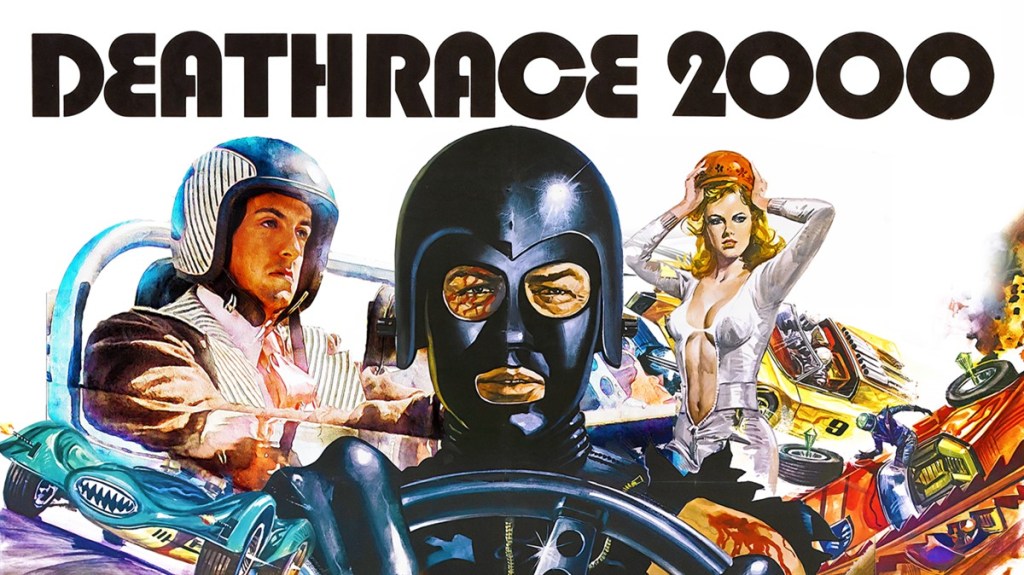
Every Monday night at 9:00 Central Time, my wife Sierra and I host a “Live Movie Tweet” event on X using the hashtag #MondayMuggers. We rotate movie picks each week, and our tastes are quite different. Tonight, Monday December 2nd, we’re watching DEATH RACE 2000 starring David Carradine, Sylvester Stallone, Simone Griffith, Mary Woronov, Roberta Collins, and Martin Kove.
So why did I pick DEATH RACE 2000, you might ask? It’s pretty simple. I think it will be a fun movie to watch with a group. Unlike most of my choices, which are movies I’ve seen many times, I’ve only seen DEATH RACE 2000 one time before and it’s been awhile. I’m looking forward to seeing it again myself. I like that it’s a B-movie from legendary producer Roger Corman. That’s usually a good thing. I like that it’s directed by Paul Bartel. Bartel’s EATING RAOUL was one of those movies that helped me appreciate black comedy when I was growing up. I really like the cast, especially David Carradine and Sylvester Stallone. And finally, I like that it’s 80 minutes long. In today’s world where every film feels the need to be between 2 and 3 hours, I’ve grown to really appreciate movies clocking in at 90 minutes or less!
It’s on Amazon Prime and Tubi. Join us if you’d like!
Though the Academy of Motion Picture Arts and Sciences claim that the Oscars honor the best of the year, we all know that there are always worthy films and performances that end up getting overlooked. Sometimes, it’s because the competition too fierce. Sometimes, it’s because the film itself was too controversial. Often, it’s just a case of a film’s quality not being fully recognized until years after its initial released. This series of reviews takes a look at the films and performances that should have been nominated but were, for whatever reason, overlooked. These are the Unnominated.
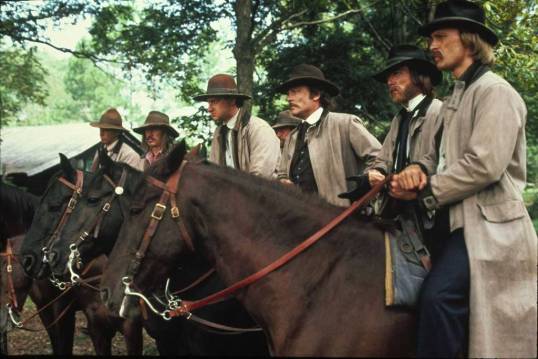
First released in 1980, The Long Riders is one of the many films to tell the story of the James/Younger Gang.
A group of former Confederate guerillas who became some of the most notorious bank robbers to roam post-Civil War America and who were based in Missouri, the brothers who made up the James/Younger Gang were hunted by the Pinkertons and beloved by the citizens who viewed them as being 19th Century Robin Hoods. Following a disastrous attempt to rob a bank in Northfield, Minnesota, the Younger brothers were captured by the government while Jesse and Frank James made it back to Missouri. Jesse was shot in the back by Bob Ford while Frank subsequently surrendered to authorities and made a good living on the lecture circuit.
The Long Riders tells the story of the gang, from their first encounter with the heavy-handed Pinkertons to the Northfield raid to Frank’s eventual surrender. Director Walter Hill both celebrates the legend of the James/Younger Gang while also emphasizing that all the members of the gang were also individual humans who had their strengths and their flaws. Hill emphasizes the idea of the gang being a group of post-war rebels, still fighting a war against a government that is more interested in protecting banks than looking after people. The Long Riders deconstructs the legend while also celebrating it.
The main thing that sets The Long Riders apart from other films about the James/Younger Gang is the fact that the brothers are played by actual brothers. David, Keith, and Robert Carradine plays the Youngers. Randy Quaid plays Clell Miller while Dennis Quaid assumes the role of the cowardly Ed Miller. Nicholas and Christopher Guest make a memorably creepy impression as Charley and Bob Ford. And finally, Jesse and Frank James are played by James and Stacy Keach. (The Keaches also worked on the film’s script). And while Stacy is definitely the more charismatic of the Keach brothers, the film makes good use of James’s rather stoic screen presence. While the rest of the gang enjoys the outlaw life, James Keach’s Jesse is rigid, serious, and ultimately too stubborn and obsessive for his own good.
Now, the casting might sound like a gimmick but it works wonderfully. When Clell chooses the gang over Ed, it carries an emotional weight because we’re watching real brothers reject each other. The comradery between the Carradines carries over to the comradery between the Youngers and it also informs their occasional rivalry with the better known James brothers. While it is Stacy Keach and David Carradine who ultimately dominate the film, every brother in the cast makes a strong impression. Also giving a memorable performance is Pamela Reed as a defiantly independent Belle Starr, who loves David Carradine’s Cole Younger but marries Sam Starr (James Remar). The knife fight between Carradine and Remar is one of the film’s highlights, as is the violent and disastrous attempt to rob the bank in Northfield.
The Long Riders is an exciting and ultimately poignant western but sadly, it received not a single Oscar nomination, not even for the stunning cinematography or Ry Cooder’s elegiac score. Fortunately, just like the legend of the James/Younger Gang, The Long Riders lives on.
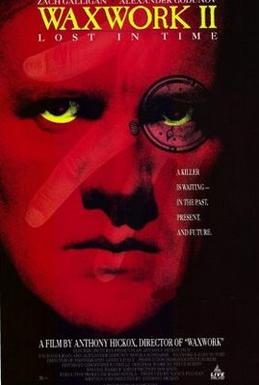
1992’s Waxwork II opens with the finale of the first Waxwork. The cursed waxwork is burning to the ground, taking out the monsters within, along with Sir Wilfred (Patrick Macnee) and Wilfred’s army of do-gooders. Only Mark (Zach Galligan) and Sarah (now played by Monika Schnarre) are able to escape. Fleeing the burning building, they manage to catch a cab. Sarah wonders what they’re going to do now. Mark replies that they’re going to go back to school and pretend that none of this ever happened.
Good luck with that! It turns out that one other thing did escape from the waxwork. A disembodied hand follows Sarah home and murders her abusive stepfather. Sarah manages to drop the hand down the garbage disposal, destroying it but also destroying the only proof she had that she didn’t kill her stepfather. Sarah is put on trial for murder and the jury does not appear to be impressed with her “It was a supernatural creature” defense.
What she and Mark need is proof that the waxwork was full of monsters. Fortunately, a trip to Sir Wilfred’s house reveals not only a recording of Sir Wilfred explaining how there’s an alternative universe known as the Kartagra but also a compass that can be used to find portals into the Kartagra. Mark and Sarah enter the Kartagra, searching for proof of Sarah’s innocence.
Mark and Sarah go from one universe to another, meeting iconic horror characters along the way. Just as with the exhibits in the first film, each universe features it own set monsters and its own distinctive style. For instance, Mark finds himself suddenly cast in the role of Henry Clerval, best friend of Baron Frankenstein (Martin Kemp) and the lover of the Baron’s wife, Elizabeth (who is actually Sarah). Of course, the Baron has more to worry about than his wife cheating with his best friend. There’s also the angry monster living in the basement and the angry villagers that are due to start pounding on the front doors of the mansion.
Later, Mark finds himself in a black-and-white recreation of The Haunting of Hill House, working with a researcher (Bruce Campbell) and two psychics to investigate reports of a ghost at an old house. Mark must bring peace to the ghost while avoiding all of the slapstick complications that one might expect when Bruce Campbell shows up as a paranormal researcher. While Mark is dealing with that, Sarah is floating in space, trying to protect the crew of her dingy spaceship from an acid spewing alien.
You get the idea. Waxwork II is essentially an affectionate collection of homages to other, better-known horror films and it must be said that Waxwork II does an excellent job of recreating each film, from the crisp black-and-white of haunted house scene to the grittiness of the Alien sequences to the over-the-top swordplay of a trip to a medieval world. There’s even a trip to the mall from Dawn of the Dead! Wisely, Waxwork II doesn’t take itself particularly seriously, with many scenes developing into outright comedy. Zach Galligan gives an enjoyable and nicely modulated comedic performance, even holding his own with Bruce Campbell.
At 104 minutes, Waxwork II runs a bit too long for its own good but it ends on a sweet note that nicely wraps up the entire saga. It’s a film that works as both a continuation of Waxwork and as an entertaining film on its own.
As some of our regular readers undoubtedly know, I am involved in hosting a few weekly live tweets on twitter and occasion ally Mastodon. I host #FridayNightFlix every Friday, I co-host #ScarySocial on Saturday, and I am one of the five hosts of Mastodon’s #MondayActionMovie! Every week, we get together. We watch a movie. We snark our way through it.
Tonight, for #MondayActionMovie, the film will be 1998’s Deep Rising! We’ll be paying tribute to the great Treat Williams.
Following #MondayActionMovie, I will be guest-hosting the #MondayMuggers live tweet! We will be watching 1983’s Lone Wolf McQuade, starring Chuck Norris and David Carradine! The film is on Prime and Tubi!
It should make for a night of fun viewing and I invite all of you to join in. If you want to join the live tweets, just hop onto Mastodon, pull up Deep Rising on YouTube, start the movie at 8 pm et, and use the #MondayActionMovie hashtag! Then, at 10 pm et, switch over to Twitter and Prime, start Lone WolfMcQuade, and use the #MondayMuggers hashtag! The live tweet community is a friendly group and welcoming of newcomers so don’t be shy.
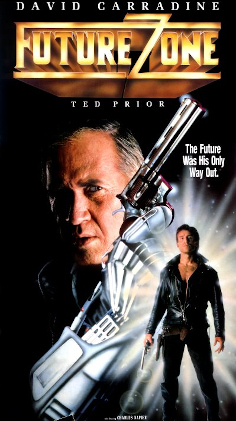
David Carradine is back as super glove-wearing bounty hunter John Tucker in this sequel to Future Force!
Once again, it’s the future. In the future, everyone drives a car that was made in the 70s and spends most of their time in the abandoned warehouses that are meant to represent their places of business. Hard-drinking John Tucker meets and starts to work with the newest C.O.P.S. recruit, Billy (Ted Prior). Billy can shoot just as fast as Tucker and seems to know all about Tucker and his wife, Marion (Gail Jensen). That’s because Billy is from the future. As he explains it, some “friends of mine built a time portal,” and Billy used it to come back to the past and save Tucker from being killed by a bunch of criminals. Why is Billy so concerned about saving John Tucker? Did I mention that Marion is pregnant?
Future Zone is just as dumb as Future Force but it is set apart from the first film by its use of time travel. The best part of the movie is that neither John nor Marion are surprised to hear that Billy’s friends just happened to build a time portal. Nobody asks why they built a time portal or even how they built a time portal. The time portal is the most important thing about the movie but everyone shrugs off its existence. Are time portals a common thing in the future? Does everyone have a time portal? How does the time portal work? How is Billy able to go into the past at exactly the right moment? When it is time for him to go back to his time, how does he let his friends know? These are all good questions that no one asks.
The other thing that no one asks is why Tucker doesn’t wear his super glove all the time. His super glove can do anything, from shooting lasers to blocking bullets. If I had a super glove, I would wear it all the time. Tucker keeps it in the trunk of his car and only summons it at the last possible moment. Why even have a super glove if you’re not going to use it?



 Through the Shattered Lens