The setting is the Korean War. After getting information that American POWs are being tortured and brainwashed in North Korean prisoner-of-war camps, Major Hale (Harry Morgan) assigns Webb Sloane (Ronald Reagan) to go undercover. After parachuting behind enemy lines, Webb spots a group of POWs being marched through the snow and joins the group. From the minute that Webb joins the march, he begins to observe war crimes. The death march itself, with the POWs being forced to move in freezing weather, is itself a war crime. At the POW camp, Webb discovers the presence of an arrogant Soviet interrogator (Oscar Homolka) and a routine designed to break the POWs down until their ready to betray their native country. Some POWS, like Captain Stanton (Steve Forrest), refuse to break. Others, like cowardly Jesse Treadman (Dewey Martin), break all too quickly. Webb sends the information back to Hale and eventually tries to make his escape.
It’s not terrible. That the North Koreans and, later, the North Vietnamese tortured their POWs and forced some of them to denounce America is a matter of the historical record and, for a 1954 film, PrisonerofWar doesn’t shy away from the brutality of the torture that POWs were often subjected too. Of all of Reagan’s film, PrisonerofWar had the strongest anti-communist message, though Reagan himself feels miscast as a hard-boiled secret agent. (Reagan’s affability comes through even in a film set in a POW camp.) Sending someone undercover into a prisoner of war camp and then hoping that they’ll find a way to escape doesn’t sound like the most efficient way to determine if the Geneva Convention is being violated.
The film features a dog who is found by one of the POWs. Don’t get attached.
The 1959 film, The Tingler, opens with a middle-aged man standing on a stage and speaking directly to the audience.
“I am William Castle, the director of the motion picture you are about to see. I feel obligated to warn you that some of the sensations—some of the physical reactions which the actors on the screen will feel—will also be experienced, for the first time in motion picture history, by certain members of this audience. I say ‘certain members’ because some people are more sensitive to these mysterious electronic impulses than others. These unfortunate, sensitive people will at times feel a strange, tingling sensation; other people will feel it less strongly. But don’t be alarmed—you can protect yourself. At any time you are conscious of a tingling sensation, you may obtain immediate relief by screaming. Don’t be embarrassed about opening your mouth and letting rip with all you’ve got, because the person in the seat right next to you will probably be screaming too. And remember this—a scream at the right time may save your life.”
When this film was first released in 1959, William Castle wasn’t lying in this warning. Certain audience members would feel the tingling sensation of fear because some theaters agreed to wire certain seats with buzzers that, when activated, would give the viewer a tingling sensation. Castle also arranged for certain theaters to fake an attack by the film’s monster, complete with the houselights coming up, a woman screaming and pretending to faint, and the voice of Vincent Price encouraging everyone in the audience to scream because “the Tingler is loose in the theater!”
Uhmm …. that sounds like fun. When it comes to William Castle’s gimmicks, there’s a lot of documentation concerning what Castle arranged but there’s not as much documentation about how people reacted to being buzzed while watching a movie. Hopefully, everyone screamed, played along, and had fun. Personally, I probably would have left the theater during the chaos and snuck into a showing of Anatomy of a Murder.
As for the film, it stars the great Vincent Price as Warren Chapin, a pathologist who is investigating the source of fear. As he explains to his colleague, Dave Morris (Dwayne Hickman), he believes that the tingling that people feel at the base of their spine is actually a living creature that is formed by fear. The only way to kill the creature is to scream. If you don’t scream, the creature will eventually snap your spine. Well, I guess you better scream then.
Anyway, Dr. Chapin confronts his wife Isabel (Patricia Cutts) over the fact that she’s cheating on him. He pulls a gun on her and, as she begs for his life, he fires. She collapses but fear not! The gun was loaded with blanks and Dr. Chapin just wanted to scare her so that he could x-ray her back and see if the Tingler was forming on her spine. Dr. Chapin is overjoyed when the Tingler shows up on x-rays but now, he needs to bring a Tingler into the real world….
(I’m not sure why you would want a Tingler but whatever….)
One of Chapin’s friends is Ollie Higgins (Philip Coolidge) who owns a movie theater with his wife, Martha (Judith Evelyn). Martha is deaf and mute and therefore cannot scream. When Ollie deliberately frightens her, the Tingler appears on her spine and snaps it. At the subsequent autopsy, Chapin is able to remove the Tingler from Martha’s spine. The Tingler, which is a giant centipede that likes to crawl up people’s legs, gets loose and needless to say, all tingling heck breaks out.
Wow, this is a silly film! There’s is absolutely nothing frightening about a plastic centipede being pulled across the screen by wires. But, at the same time, it’s a Vincent Price film and Vincent knew exactly how to play his mad-but-not-evil scientist, delivering his lines with the perfect combination of snark and melodrama. This film came out the same year as another Castle/Price collaboration, The House on Haunted Hill. It’s nowhere near as good as The House on Haunted Hill but The Tingler is still a lot of fun in its silly way. It won’t make you scream from fright but you might laugh really loudly.
(With the Oscars scheduled to be awarded on March 4th, I have decided to review at least one Oscar-nominated film a day. These films could be nominees or they could be winners. They could be from this year’s Oscars or they could be a previous year’s nominee! We’ll see how things play out. Today, I take a look at the 1940 best picture nominee, The Grapes of Wrath!)
How dark can one mainstream Hollywood film from 1940 possibly be?
Watch The Grapes of Wrath to find out.
Based on the novel by John Steinbeck and directed by John Ford, The Grapes of Wrath tells the story of the Joad family and their efforts to neither get sent to prison nor starve to death during the Great Depression. When they lose their farm in Oklahoma, they head for California. Pa Joad (Russell Simpson) has a flyer that says someone is looking for men and women to work as pickers out west. The 12 members of the Joad Family load all of their possessions into a dilapidated old truck and they hit the road. It quickly becomes apparent that they’re not the only family basing all of their hopes on the vague promises offered up by that flyer. No matter how much Pa may claim different, it’s obvious that California is not going to be the promised land and that not all the members of the family are going to survive the trip.
Tom Joad (Henry Fonda) is the oldest of the Joad sons. He’s just been released from prison and he’s killed in the past. Having been in prison during the start of the Great Depression, Tom doesn’t realize how bad things truly are until he arrives home and sees someone he grew up with using a tractor to knock down a house. (It’s just business, of course. The owners of the house can’t pay their bills so the house gets destroyed.) The film’s story is largely told through Tom’s eyes and Henry Fonda gives a sympathetic performance, one the gets the audience to empathize with and relate to a character who is a total outsider.
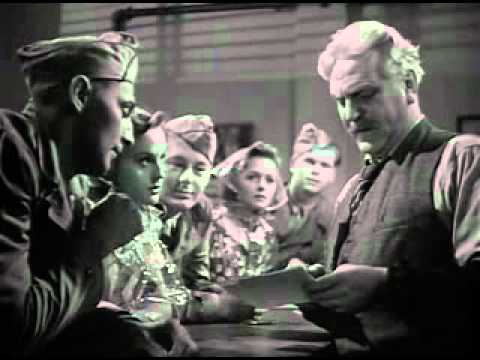
As for the rest of the Joad Family, Ma (Jane Darwell) is the glue who holds them together and who refuses to allow them to surrender to despair. (And yet even Ma is forced to make some tough choices when the starving children of one work camp ask her to share her family’s meal with them.) Rosasharan (Dorris Bowdon) is pregnant while Grandpa (Charley Grapewin) is too sickly for the trip but doesn’t have anywhere else to go. And then there’s Casy (John Carradine), the former preacher turned labor organizer. Casy is not blood-related but he soon becomes a member of the family.
The Joads have a healthy distrust of the police and other authority figures and that turns out to be a good thing because there aren’t many good cops to be found between Oklahoma and California. Instead, the police merely serve to protect the rich from the poor. Whenever the workers talk about forming a union and demanding more than 5 cents per box for their hard work, the police are there to break heads and arrest any troublemakers on trumped up charges. Whenever a town decides that they don’t want any “Okies” entering the town and “stealing” jobs, the police are there to block the roads.
The Grapes of Wrath provides a portrait of the rough edges of America, the places and the people who were being ignored in 1940 and who are still too often ignored today. John Ford may not be the first director that comes to mind when you think of “film noir” but that’s exactly what The Grapes of Wrath feels like. During the night scenes, desperate faces emerge from the darkness while menacing figures lurk in the shadows. When the sun does rise, the black-and-white images are so harsh that you almost wish the moon would return. The same western landscape that Ford celebrated in his westerns emerges as a wasteland in The Grapes of Wrath. The American frontier is full of distrust, anger, greed, and ultimately starvation. (Reportedly, the film was often shown in the Soviet Union as a portrait of the failure of America and capitalism. However, it was discovered that Soviet citizens were amazed that, in America, even a family as poor as the Joads could still afford a car. The Grapes of Wrath was promptly banned after that.) John Ford is often thought of as being a sentimental director but there’s little beauty or hope to be found in the images of The Grapes of Wrath. (Just compare the way The Grapes of Wrath treats poverty to the way Ford portrayed it in How Green Was My Valley.) Instead, the film’s only hint of optimism comes from the unbreakable familial bond that holds the Joads together.
As dark as it may be, the film is nowhere near as pessimistic as the original novel. The novel ends with a stillborn baby and a stranger starving to death in a barn. The film doesn’t go quite that far and, in fact, offers up some deus ex machina in the form of a sympathetic government bureaucrat. (Apparently, authority figures weren’t bad as long as they worked for the federal government.) That the book is darker than the movie is not surprising. John Steinbeck was a socialist while John Ford was a Republican with a weakness for FDR. That said, even though the film does end on a more hopeful note than the novel, you still never quite buy that things are ever going to get better for anyone in the movie. You want things to get better but, deep down, you know it’s not going to happen. Tom says that he’s going to fight for a better world and Fonda’s delivers the line with such passion that you want him to succeed even if you know he probably won’t. Ma Joad says the people will never be defeated and, again, you briefly believe her even if there’s not much evidence to back her up.
Even when viewed today, The Grapes of Wrath is still a powerful film and I can only guess what it must have been like to see the film in 1940, when the Great Depression was still going on and people like the Joads were still making the journey to California. Not surprisingly, it was nominated for best picture of 1940, though it lost to Alfred Hitchcock’s Rebecca.
Someone is murdering models and trying to frame Larry Roberts (Albert Finney), a plastic surgeon. Larry suspects that the actual murderer is somehow involved with the Digital Matrix research firm, a shadowy organization that is headed by James Coburn and Leigh Taylor Young. Digital Matrix has developed a new technique where they digitally scan a model’s body and then generate a 3-D duplicate that can be used in commercials and on film. The real-life models stand to make a fortune from the royalties, assuming that they are physically perfect and they do not end up getting murdered immediately after being scanned. Larry’s girlfriend, Cindy (Susan Dey), is just the latest model to have been scanned and now Larry suspects that she might be targeted for death as well.
When I was growing up, Looker was one of those movies that always seemed to be on HBO. I don’t know why this box office bomb was so popular on cable but I do remember seeing it several times. I guarantee you that anyone who has ever came across this movie on HBO in the 80s and 90s will remember it. They might not remember the title but they will remember that the bad guys used light guns that would cause people to briefly go into a catatonic state. Everyone who has ever seen this movie remembers the model standing frozen in the doorway of her apartment.
As for the movie itself, the guns are cool and so is the scene where Susan Dey gets scanned but otherwise, Looker is not very good. Michael Crichton later said that he had conflicts with Warner Bros during the editing of Looker and, as a result, there were some important scenes that did not make it into the final cut. For instance, it is never really explained why the models are being killed. Albert Finney was in one of his periodic career slumps when he starred as Larry and he looks uncomfortable going through the motions of being an action star. Two years after Looker came out, Finney’s career would be reinvigorated when he received an Oscar nomination for The Dresser and three years later, he would give his career best performance in Under the Volcano.
As it typical of Michael Crichton’s work, Looker was ahead of its time in predicting the use of CGI in media but otherwise, it’s nothing special. If you want to see a good Crichton-directed film, stick with Westworld and The Great Train Robbery.
After a drug bust goes wrong, Atlanta police detective Tom Sharky (Burt Reynolds, who also directed) is transferred from narcotics to the vice squad, the least desirable assignment in the Atlanta police department. Despite all of his honors and commendations, Sharky finds himself reduced to busting hookers with Papa (Brian Keith) and Arch (Bernie Casey). But then Sharky discovers evidence of a prostitution ring being run by Victor D’Anton (Vittorio Gassman), one that services the wealthiest and most powerful men in Georgia.
Working with Papa, Arch, and a burned-out bugging expert named Nosh (Richard Libertini), Sharky begins a surveillance of Domino (Rachel Ward), one of Victor’s girls. As the days turns into weeks, Sharky falls in love with Domino, who doesn’t even know that she’s being watched. Sharky also discovers that Domino is sleeping with Hotckins (Earl Holliman), who is about to be elected governor of Georgia. At the same time, a heroin-addicted assassin named Billy Score (Henry Silva) is assassinating anyone who could reveal Victor’s crimes.
There are two great sequences in Sharky’s Machine. One is the opening credits scene, in which a bearded Burt Reynolds walks through the roughest parts of Atlanta while Randy Crawford sings Street Life. This scene lets everyone know from the start that this is not another Burt Reynolds good ol’ boy comedy. The other is a cat-and-mouse chase through an Atlanta skyscraper, as Sharky and his partners try to track down Billy Score, who is so doped up on painkillers that he barely flinches whenever he’s shot. Billy Score is one of the most frightening movie villains of all time, seemingly indestructible and capable of moving like a ghost.
With the exception of maybe Deliverance, Sharky’s Machine is Burt Reynolds’s darkest movie. There are moments of humor and appearances by the usual members of the Burt Reynolds stock company, like John Fiedler and Charles Durning. But overall, this is one dark movie. Likable characters die. Sharky cries and loses two fingers when they are graphically chopped off by the bad guys. A woman’s face is literally blown off. Even when Sharky starts to talk about his childhood, a sentimental moment the occurred in almost every Burt Reynolds film, Domino tells him that she doesn’t care.
In other words, this ain’t The Cannonball Run.
Burt Reynolds’s first cut of Sharky’s Machine reportedly ran for 140 minutes. Twenty minutes were cut before it was released into theaters and, as a result, Sharky’s Machine sometimes seems to be rough around the edges. (One important supporting character is killed off-screen and if you don’t pay close attention to the dialogue, you might never know what happened to him.) Still, this violent film noir, which Reynolds once called “Dirty Harry in Atlanta,” is one of Burt’s best.
The 41st film in Mill Creek’s Fabulous Forties box set was the 1946 film noir, The Strange Love of Martha Ivers. While The Strange Love of Martha Ivers is definitely a superior example of noir and features Barbara Stanwyck in one of her best femme fatale roles, the film is best remembered for being the film debut of a Hollywood icon.
In December of this year, Kirk Douglas will turn 100 years old. He is one of the few stars of the Golden Age of Hollywood left. (Olivia De Havilland is another. She’ll be turning 100 on the 1st of July.) Though he’s had his share of health issues over the past few years, it is somehow not surprising that Kirk Douglas is going to make it to a hundred. In fact, it probably wouldn’t be surprising if he lasted for another hundred after that. Regardless of how old or young he may have been at any point in his career, Kirk Douglas has always epitomized virile masculinity. Whenever you see Kirk Douglas in a film, you know that you might not like or trust his character but you definitely want him around if things start to get tough. That remains true whether you’re watching Kirk in The Bad And The Beautiful or in Holocaust 2000.
That’s why it’s interesting to see Kirk cast very much against type in his very first film. In The Strange Love of Martha Ivers, Kirk Douglas plays Walter O’Neil. Walter is the district attorney of a Pennsylvania mining town called Iverstown. He is married to Martha Ivers (Barbara Stanwyck), the niece of the widow of the man who founded Iverstown. Walter owes almost all of his success to the influence of the Ivers family and he knows it. He’s also in love with Martha but she doesn’t love him. And he knows that as well. Walter deals with his insecurity by drinking.
Walter and Martha have a secret. Seventeen years ago, Walter witnessed Martha murder her abusive aunt. (The aunt is played by Judith Anderson, the creepy housekeeper from Rebecca.) Walter helped Martha to cover up the crime, lying that he saw a burglar beat the aunt to death. As a result of their lies, an innocent man was executed for the murder.
Now, many years later, Sam Masterson (Van Heflin) has returned to Iverstown. Sam was a friend to both Martha and Walter when they were younger. Sam came from the poor section of town and ran away shortly after the death of Martha’s aunt. Walter has always suspected that Martha truly loves Sam. When Sam — now a drifter and a gambler — shows up in town, Walter fears that he knows the truth about the aunt’s death. Walter is scared that Sam is going to blackmail him. Even worse, he’s scared that Sam is going to steal Martha away from him.
Walter has reason to be worried. Having met a troubled young woman named Toni (Lizabeth Scott), Sam believe he is no longer in love with Martha. However, Martha does claim to love Sam and Sam finds himself being drawn back to her. In fact, Martha loves Sam enough to suggest that maybe he should murder Walter…
The Strange Love of Martha Ivers is an entertaining melodrama, one that features great performances from Heflin, Stanwyck, and Scott. However, in the end, it’s mostly interesting because Kirk Douglas is not only making his debut in a totally atypical role but he also does a fantastic job. If The Strange Love of Martha Ivers had been made in the 50s, Kirk probably would have been cast as Sam but he’s unexpectedly perfect in the role of the angry, self-loathing, and ultimately tragic Walter.
You watch The Strange Love of Martha Ivers and, even with Kirk Douglas cast against type, you can’t help but think, “No wonder he made it to a hundred!”
Thanks to TCM’s 31 Days of Oscar, I now have several movies on my DVR that I need to watch over the upcoming month. Don’t get me wrong — I’m not complaining. I’m always happy to have any reason to discover (or perhaps even rediscover) a movie. And, being an Oscar junkie, I especially enjoy the opportunity to watch the movies that were nominated in the past and compare them to the movies that have been nominated more recently.
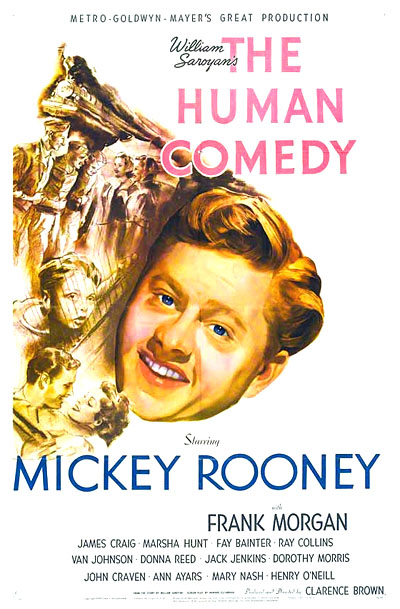
For instance, tonight, I watched The Human Comedy, a film from 1943. Along with being a considerable box office success, The Human Comedy won on Oscar (for Best Story) and was nominated for four others: picture, director (Clarence Brown), actor (Mickey Rooney), and black-and-white cinematography. The Human Comedy was quite a success in 1943 but I imagine that, if it were released today, it would probably be dismissed as being too sentimental. Watching The Human Comedy today is something of a strange experience because it is a film without a hint of cynicism. It deals with serious issues but it does so in such a positive and optimistic manner that, for those of us who are used to films like The Big Short and Spotlight, a bit of an attitude adjustment is necessary before watching.
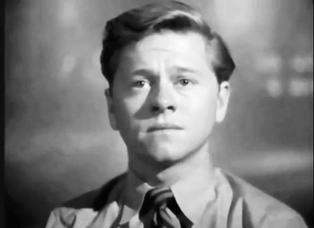
And yet that doesn’t mean that The Human Comedy is a bad film. In fact, I quite enjoyed it. The Human Comedy is a time capsule, a chance to look into the past. It also features a great central performance, one that was quite rightfully nominated for an Oscar. As I watched Mickey Rooney in this film, I started to feel guilty for some of the comments I made when I reviewed Mickey in The Manipulator last October.
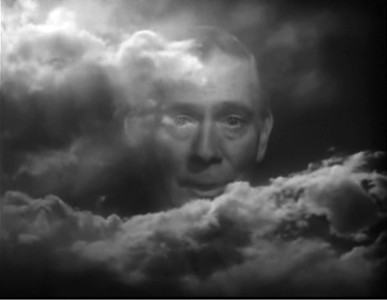
The Human Comedy opens with an overhead shot of the small town of Ithaca, California. The face of Mr. McCauley (Ray Collins, who you’ll recognize immediately as Boss Jim Gettys from Citizen Kane) suddenly appears in the clouds. Mr. McCauley explains that he’s dead and he’s been dead for quite some time. But he loves Ithaca so much that his spirit still hangs around the town and keeps an eye on his family. Somehow, the use of dead Mr. McCauley as the film’s narrator comes across as being both creepy and silly.
But no sooner has Mr. McCauley stopped extolling the virtues of small town life than we see his youngest song, 7 year-old Ulysseus (Jack Jenkins), standing beside a railroad track and watching a train as it rumbles by. Sitting on the cars are a combination of soldiers and hobos. Ulysseus waves at some of the soldiers but none of them wave back. Finally, one man waves back at Ulysseus and calls out, “Going home, I’m going home!” It’s a beautifully shot scene, one that verges on the surreal.
That opening pretty much epitomizes the experience of watching The Human Comedy. For every overly sentimental moment, there will be an effective one that will take you by surprise. The end result may be uneven but it’s still undeniably effective.
The majority of the film deals with Homer McCauley (Mickey Rooney). Homer may still be in high school but, with his older brother, Marcus (Van Johnson), serving overseas and his father dead, Homer is also the man of the house. Homer not only serves as a role model for Ulysseus but he’s also protector for his sister, Bess (Donna Reed). (At one point in the film, she gets hit on by three soldiers on leave. One of them is played by none other than Robert Mitchum.) In order to bring in extra money for the household, Homer gets a job delivering telegrams.
In between scenes of Homer in Ithaca, we get oddly dream-like scenes of Marcus and his army buddies hanging out. Marcus spends all of his time talking about how much he loves Ithaca and how he can’t wait for the war to be over so he can return home. One of his fellow soldiers says, “I almost feel like Ithaca is my hometown, too.” Marcus promises him that they’ll all visit Ithaca. As soon as the war is over…
With World War II raging, Homer’s job largely consists of delivering death notices (and the occasional singing telegram, as well). Telegraph operator Willie Grogan (Frank Morgan) deals with the burden of having to transcribe bad news by drinking. Homer, meanwhile, tries to do his job with compassion and dignity but one day, he has to deliver a telegram to his own house…
The Human Comedy is an episodic film, full of vignettes of life in Ithaca and Homer growing up. There’s quite a few subplots (along with a lot of speeches about how America is the best country in the world) but, for the most part, the film works best when it concentrates on Homer and Mickey Rooney’s surprisingly subdued lead performance. By today’s standards, it may seem a bit predictable and overly sentimental but it’s also so achingly sincere that you can’t help but appreciate it.
The Human Comedy was nominated for best picture but it lost to a somewhat more cynical film about life during World War II, Casablanca.
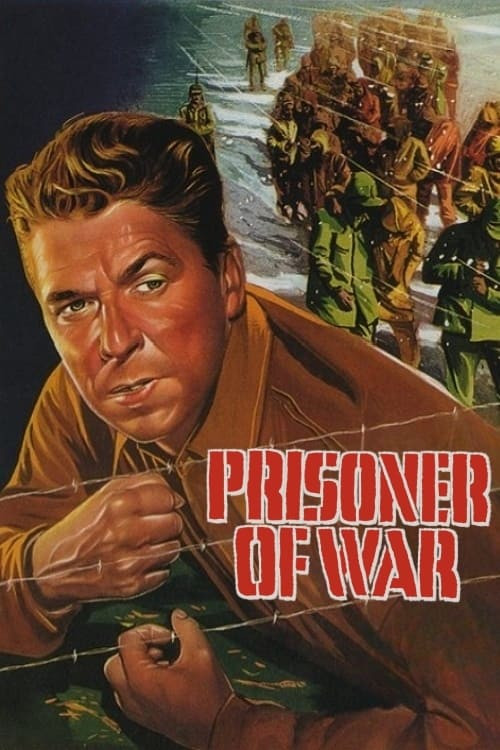 The setting is the Korean War. After getting information that American POWs are being tortured and brainwashed in North Korean prisoner-of-war camps, Major Hale (Harry Morgan) assigns Webb Sloane (Ronald Reagan) to go undercover. After parachuting behind enemy lines, Webb spots a group of POWs being marched through the snow and joins the group. From the minute that Webb joins the march, he begins to observe war crimes. The death march itself, with the POWs being forced to move in freezing weather, is itself a war crime. At the POW camp, Webb discovers the presence of an arrogant Soviet interrogator (Oscar Homolka) and a routine designed to break the POWs down until their ready to betray their native country. Some POWS, like Captain Stanton (Steve Forrest), refuse to break. Others, like cowardly Jesse Treadman (Dewey Martin), break all too quickly. Webb sends the information back to Hale and eventually tries to make his escape.
 Someone is murdering models and trying to frame Larry Roberts (Albert Finney), a plastic surgeon. Larry suspects that the actual murderer is somehow involved with the Digital Matrix research firm, a shadowy organization that is headed by James Coburn and Leigh Taylor Young. Digital Matrix has developed a new technique where they digitally scan a model’s body and then generate a 3-D duplicate that can be used in commercials and on film. The real-life models stand to make a fortune from the royalties, assuming that they are physically perfect and they do not end up getting murdered immediately after being scanned. Larry’s girlfriend, Cindy (Susan Dey), is just the latest model to have been scanned and now Larry suspects that she might be targeted for death as well.


 Through the Shattered Lens