Homicide: The Movie (2001, directed by Jean de Segoznac)


Before The Wire, there was Homicide: Life On The Streets.

Based on a non-fiction book by the Baltimore Sun’s David Simon, Homicide: Life on the Streets aired for seven seasons on NBC, from 1993 to 1999. For five of those seasons, Homicide was the best show on television. Produced and occasionally directed by Barry Levinson, Homicide was filmed on location in Baltimore and it followed a group of Homicide detectives as they went about their job. From the start, the show had a strong and diverse ensemble, made up of actors like Andre Braugher, Ned Beatty, Jon Polito, Melissa Leo, Kyle Secor, Clark Johnson, Richard Belzer, Daniel Baldwin, and Yaphet Kotto. When Polito’s character committed suicide at the start of the third season (in a storyline that few other shows would have had the courage to try), he was replaced in the squad by Reed Diamond.

Homicide was a show that was willing to challenge the assumptions of its audiences. The murders were not always solved. The detectives didn’t always get along.  Some of them, like Clark Johnson’s Meldrick Lewis, had such bad luck at their job that it was cause for alarm whenever they picked up the ringing phone. As played by Andre Braugher, Frank Pembleton may have been the most brilliant detective in Baltimore but his brilliance came with a price and his non-stop intensity even led to him having a stroke while interrogating a prisoner. Kyle Secor played Pembleton’s partner, Tim Bayliss.  Bayliss went from being an idealistic rookie to a mentally unstable veteran murder cop in record time, spending seven seasons obsessing on his first unsolved case. Homicide dealt with big issues and, much like its spiritual successor The Wire, it refused to offer up easy solutions.

Despite the critical acclaim and a much hyped second season appearance by Robin Williams (playing a father who was outraged to hear the detectives joking about the murder of his family), Homicide was never a ratings success. After five seasons of perennially being on the verge of cancellation, the producers of Homicide finally caved into NBC’s demands.  The storylines became more soapy and the cases went form being random and tragic to being what the detectives had previously dismissively called “stone cold whodunits.”   New detectives joined the squad and the focus shifted away from the more complex veterans. Not only did this not improve ratings but also those who had been watching the show from the start were not happy to see Pembleton and Bayliss being pushed to the side for new characters like Paul Falsone (Jon Seda) and Laura Ballard (Callie Thorne). Falsone, in particular, was so disliked that there was even an “I Hate Falsone” website. At the end of the sixth season, Andre Braugher left the show and that was the end. The seventh season limped along, with Bayliss growing increasingly unstable.  The show ended with the implication of Bayliss turning into a vigilante and resigning from the Baltimore PD. It was not a satisfying ending. Richard Belzer’s John Munch moved to New York and became a regular on Law & Order: SVU but the rest of the detectives and their fates were left in limbo.

Fortunately, on February 13th, 2000, NBC gave Homicide another chance to have a proper conclusion with Homicide: The Movie.

Homicide: The Movie opens with a montage of Baltimore at its best and its worst, a reminder that Homicide never abandoned the city that had supported it for seven years.  While other shows recreated New York or Chicago on a soundstage, Homicide was always an authentic product of Baltimore. Lt. Al Giardello (Yaphet Kotto) is now running for mayor on a platform calling for drug legalization. When Giardello is shot at a campaign stop, all of the current and former members of the Homicide Unit come together to investigate the case.   While Giardello fights for his life, Pembleton and Bayliss partner up for one final time.

Homicide: The Movie fixes the main mistake that was made by the final two seasons of the show. Though all of the detectives get their moment in the spotlight (and all true Homicide fans will be happy to see Richard Belzer and Ned Beatty acting opposite each other for one final time), the focus is firmly on Pembleton and Bayliss. It doesn’t take long for these two former detectives, both of whom left the unit for their own different reasons, to start picking up on each other’s rhythms. Soon, they’re talking, arguing, and sometimes joking as if absolutely no time has passed since they were last partnered up together. But, one thing has changed. Bayliss now has a secret and if anyone can figure it out, it will be Frank Pembleton. What will Pembleton, the moral crusader, do when he finds out that Bayliss is now a killer himself?

The movie follows the detectives as they search for clues, interview suspects, and complain about the state of the world.  However, in the best Homicide tradition, the investigation is just a launching point to investigate what it means to be right or wrong in a city as troubled as Baltimore.  In the movie’s final half, it becomes more than just a reunion movie of a show that had a small but fervent group of fans. It becomes an extended debate about guilt, morality, and what it means to take responsibility for one’s actions. The final few scenes even take on the supernatural, allowing Jon Polito and Daniel Baldwin a chance to appear in the reunion despite the previous deaths of their characters.

Despite being one the best shows in the history of television, Homicide: Life on the Streets is not currently streaming anywhere, not even on Peacock.   (Considering how many Homicide people later went on to work on both Oz and The Wire, it would seem like it should be a natural fit for HBOMax.) From what I understand, this is because of the show’s signature use of popular music would make it prohibitively expensive to pay for the streaming rights. Fortunately, every season has been released on home video.   Homicide: The Movie is on YouTube, with the music removed.  The movie’s final montage is actually more effective when viewed in complete silence.

The TSL’s Grindhouse: John Carpenter’s Vampires (dir by John Carpenter)


Wow, there certainly are a lot of vampires in New Mexico!

Well, I guess I can understand the logic behind it.  My family used to visit New Mexico frequently.  We even lived there for a few months when I was a kid.  If you’re looking for a place to hide out, New Mexico is a good place to do it.  You can drive for hours without seeing another car or another person.  Add to that, New Mexico is state where people respect your privacy.  No one’s going to show up at your house demanding to know why you only come out at night.

Of course, if I was a vampire, I might avoid New Mexico because of the bright sunlight.  Seriously, if you’re trying to escape being touched by the sun, the New Mexico desert might not be the ideal place to hide out.  I don’t know, though.  I’ve never been a vampire.

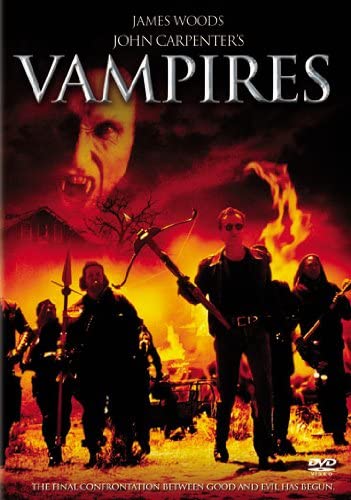
In John Carpenter’s 1998 film, Vampires (actually, John Carpenter’s Vampires because everyone know the power that the Carpenter name holds for horror fans), Jan Valek (Thomas Ian Griffith) is the world’s oldest vampire and he’s looking to perform a ceremony that will take care of that whole sunlight issue.  If he can perform the ceremony, he’ll be the most powerful creature in the world.

Fortunately, the Vatican has put together a team of ruthless vampire exterminators.  Led by Jack Crow (James Woods), these guys have no problem tracking down vampires and riddling their undead bodies with bullets that have probably been dipped in holy water.  Unfortunately, with the exception of Jack and his second-in-command, Tony (Daniel Baldwin), the vampires hunters aren’t too smart because Valek gets the drop on them while they’re partying at a hotel with a bunch of prostitutes.  The only survivors are Tony, Jack, and Katrina (Sheryl Lee), a prostitute who was previously bitten by Valek.

After teaming up with an enthusiastic but inexperienced priest named Father Guiteau (Tim Guinee), Jack tries to find a way to stop Valek. Meanwhile, Tony finds himself falling for Katrina despite the fact that Katrina will soon be transforming into a vampire and he and Jack have pledged to destroy every vampire that they come across.  It leads to several chases, several bloody shootouts, and a lot of panoramic shots of the New Mexico desert.

The first time I ever watched Vampires, I thought it had its moments of demented fun and I thought that James Woods gave a wonderfully frantic performance as Jack Crow but overall, I got a little bit bored with the film’s constant violence.  There’s only so many times that you can watch people die in slow motion before you get tired of it.  The second time I watched the movie, I was able to better appreciate the film’s self-awareness.  As directed by John Carpenter, it’s intentionally over-the-top in just about every regard and it’s definitely not meat to be taken seriously.  It’s a mix of a western and a vampire film and Carpenter is basically saying, “If we’re going to do this, let’s go crazy with it.”  The film still has its flaws, of course.  Daniel Baldwin seems lost in the role of Tony and the film is oddly paced,  It ends awkwardly, with the promise of a direct sequel that was never made.  (There were sequels, don’t get me wrong.  But Jon Bon Jovi is no substitute for James Woods at his most nervy.)  But the important thing is that, on a second viewing, those flaws were overshadowed by John Carpenter’s kinetic direction and the performances of James Woods, Sheryl Lee, and Thomas Ian Griffith.  

The first time I watched the film, I thought it was just another movie about modern-day vampires killing people while being hunted by unconventional extrerminators.  However, the second time that I watched it, I found myself considering that Vampires is actually a movie about Catholics kicking ass!  Yay!  The lesson here is to always do a second viewing.  Flaws and all, Vampires was far better than I remembered.

50 Shades of Obsession: The Boy Next Door and Bound


Happy Valentine’s Day!

Okay, I know.  It’s not Valentine’s Day yet.  But it will be soon.  50 Shades of Grey is opening tomorrow and I have a feeling that, come November, there will be hundreds of newborn babies being named Christian and Anastasia.  (And, in a few years, they’ll all have teenage babysitters named Bella…)

However, in case you can’t get into 50 Shades of Grey, here’s two other films that you could possibly watch on Valentine’s Day.  Much like 50 Shades, they both involve a woman having sex with a manipulative sociopath.  The Boy Next Door is still in theaters while Bound has just been released on video.

And they’re both reviewed below!
The-Boy-Next-Door-2015

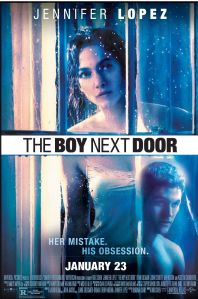
The Boy Next Door, which was released towards the end of January, was the first film of 2015 that I was really excited about seeing.  That’s not because I thought that the film was going to be any good.  Instead, it was because I literally couldn’t watch any movie on Lifetime without seeing about a dozen commercials for The Boy Next Door.  The commercials promised a lot of cheap thrills and sordid melodrama.

Anyway, my BFF Evelyn and I saw The Boy Next Door on the weekend that it was first released and we had a great time watching it.  Though the film may start slow, it eventually becomes a minor triumph of so-bad-its-good filmmaking.  This is the type of film that you would normally expect to see going straight to cable but, somehow, it managed to get a theatrical release.  Making it all the more fun is the fact that it stars Jennifer Lopez, playing the type of role that you would normally expect to see Jennifer Love Hewitt or Elizabeth Berkley playing in a Lifetime movie.

Jennifer Lopez plays an AP English teacher who has recently separated from her adulterous husband (John Corbett).  When a teenage boy (Ryan Guzman) moves in next door and starts standing naked in front of his bedroom window, can you really be surprised that he and Lopez end up spending one night making torrid love?  Well, unfortunately, Guzman turns out to be a bit obsessive and, when the new school year begins, he suddenly shows up as one of Lopez’s students.  And you can probably guess what happens from there…

As directed by Rob Cohen, there’s really nothing surprising or interesting to be found in The Boy Next Door but we still had a lot of fun watching it, if just because it gave us an excuse to be snarky.  Ryan Guzman was undeniably hot and, wisely, Jennifer Lopez didn’t seem to be taking the film that seriously.  The great Kristin Chenoweth showed up as Lopez’s best friend and the film’s climax was appropriately over the top.

And, three weeks after seeing the film, Evelyn and I are still laughing about the scene where Guzman gives Lopez a gift, a copy of The Illiad.   Looking down at the book, J. Lo says, “Oh!  A first edition!”  Evelyn and I were just like, “Really?  So, that book’s from 760 B.C!?”  Seriously, did the character have a time machine?

Now, that would have made for an interesting movie!

Bound

If, for some reason, you can’t find a theater showing 50 Shades of Grey this weekend, I would suggest instead watching the Asylum’s mockbuster version, Bound.  

(Personally, I would have titled the film 50 Shades of Charisma but anyway…)

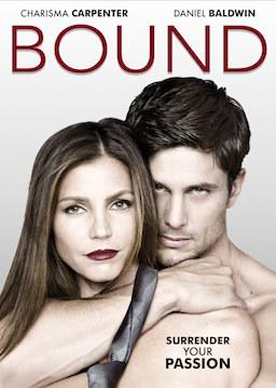
In Bound, Charisma Carpenter plays Michelle, a real estate broker who has an unsatisfying sex life and who finds herself regularly being bullied by her boss (Daniel Baldwin).  However, Michelle then meets Ryan (Bryce Draper), who is young, handsome, rich, and very much into domination  He even has a red room in his mansion where…

Oh wait, does this sound familiar?

Okay, so Bound pretty much tells the same story as 50 Shades of Grey but there are a few significant differences.  A big one is that, as played by Carpenter, Michelle is a much stronger character than Anastasia Steele.  For one thing, she’s not an innocent and naive girl being introduced to sex for the first time by a charming sociopath.  Instead, she’s significantly older than Ryan, which also brings an interesting dynamic to the film.  Michelle’s not a virgin, she doesn’t say things like “jeez” or “oh my,” and she’s capable of getting aroused without obsessing about what her inner goddess is doing as a result.  And, while her relationship with Ryan does head in a similar direction as Anastasia’s relationship with Christian Grey, Michelle never seems weak as a result.  Instead, she’s experimenting and there’s no way you can’t root for her as you watch the movie.

(Ryan, meanwhile, is ultimately portrayed as being the type of manipulative sociopath that Christian Grey would be in real life.)

Perhaps my favorite part of the film was Michelle’s relationship with her teenage daughter, Dara (Morgan Oberender).  The two actresses play off each other well and, from the minute they first interacted, I believed that they could be mother and daughter.  They’re relationship felt real and, as a result, you cared about both of them and found yourself hoping that things would work out for the best.  And, as a result, it made one of the film’s final plot twists feel very immediate and real.

Bound is the type of film that will be (and has been) dismissed by a lot of mainstream critics but it deserves more consideration than it’s been given.

Guilty Pleasure No. 8: Paparazzi


259791_ori

I once got into an argument with a friend of mine about whether or not a film could actually be so bad that it was good.

His argument was that bad, by its very definition, was the opposite of good and therefore, nothing bad could be good and vice versa.

My argument was Paparazzi.

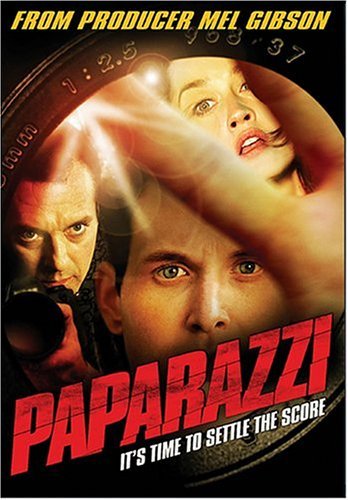
First released back in 2004, Paparazzi tells the story of Bo Laramie (Cole Hauser).  Bo is an up-and-coming super star.  As the film begins, we’re told — by a breathless correspondent from E! News — that Bo has arrived.  He’s starring in what promises to be “the world’s biggest action franchise.”  Bo has a wife (Robin Tunney), a son, and a beautiful house on the beach.  Whenever he goes jogging, huge groups of women magically materialize so that they can giggle as he runs by.

However, not everything is perfect in the world of Bo Laramie.  Like far too many defenseless celebrities, he’s being harassed by the paparazzi.  At first, Bo attempts to be polite.  However, a demonic photographer named Rex (Tom Sizemore) refuses to stop trying to take pictures of Bo at his son’s soccer game.  Things escalate until eventually, Bo’s son is in a coma and Bo is coming up with ludicrously elaborate ways to kill all of Rex’s colleagues.

The thing that distinguishes Paparazzi is not that it’s a revenge film.  What distinguishes Paparazzi is that it seems to seriously be arguing that celebrities have the right to kill people who annoy them.  Rex and his colleagues are portrayed as being pure evil (one even laughs maniacally after snapping a picture) while Bo is the victim who has to deal with the issues that come from being a multimillionaire.  Even the homicide detective played by Dennis Farina seems to be continually on the verge of saying, “Right on!” while looking over the results of Bo’s handiwork.

It’s so ludicrous and stupid and over-the-top that it can’t help but also be a lot of fun.

Don’t get me wrong.  Paparazzi is a terrible film.  In fact, it’s so terrible that, if a group of aliens ever somehow saw Paparazzi, they would probably hop in their spaceship and come to Earth specifically to wipe out the human race.  However, as bad as the film is, it’s also one of those films that you simply cannot look away from.  Watching this film is like witnessing a tornado of pure mediocrity coming straight at you.  You know that you should just stop watching and get to safety but it’s such an unexpectedly odd sight that you can’t look away.  Once you’ve seen it, you’ll never forget it and it becomes impossible not to become fascinated by the fact that such a terrible film could actually exist.

Consider the following:

1) When he’s not busy killing photographers, Bo Laramie is filming a movie called Adrenaline Force 2.  Seriously, that title is so generic that I couldn’t help but smile every time it was mentioned.  Can you imagine anyone saying, “I want to see that new movie, what’s it called, uhmm… Adrenaline Force 2?”

2) Speaking of generic, do you think that anyone named Bo Laramie could ever possibly become the biggest film star in the world?

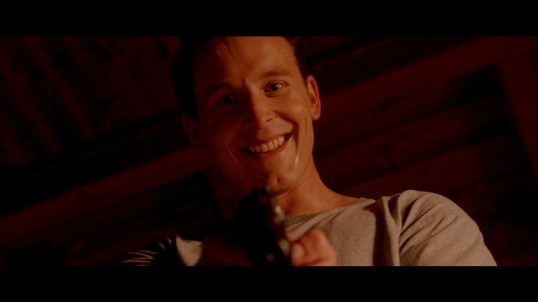
3) In the role of Bo Laramie, Cole Hauser seems like he’s as confused by this movie as everyone else.  However, towards the end of the film, he starts to flash a psychotic little grin and the contrast between that grin and Laramie’s previously stoic facade is oddly charming.

Hauser-in-Paparazzi-cole-hauser-12392470-853-480

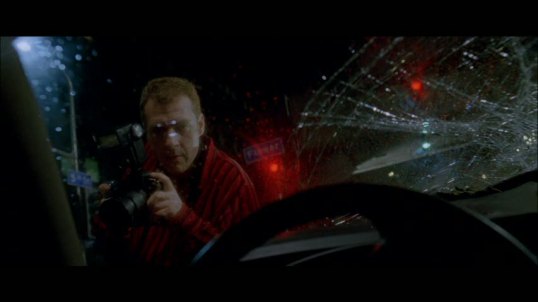
4) You haven’t lived until you’ve seen Tom Sizemore play the world’s sleaziest photographer.

5) Vince Vaughn has a cameo as himself!  He’s co-starring in Adrenaline Force 2.

6) Mel Gibson has a cameo as himself!  He’s seen sitting in a psychologist’s office.  (No, seriously…)

7) Matthew McConaughey has a cameo as himself!  He shows up out-of-nowhere, tells Bo that it’s a pleasure to meet him, and then goes, “Alright, alright…”

8) Chris Rock has a cameo as a …. pizza deliveryman!  At first, I assumed that Chris Rock was playing himself and I kept waiting for him to explain why he was delivering a pizza to Bo Laramie’s house.  However, according to the end credits, Vaughn, McConaughey, and Gibson were playing themselves while Rock was playing the role of “Pizza Guy.”

9) Plotwise, this film invites the viewer to play a game of, “What if everyone in this film wasn’t a total and complete idiot?”  For all the effort that Bo puts into plotting his revenge, it’s hard not to feel that he just got extremely lucky.

10) The film manages to be both silly and completely humorless at the same time.  As a result, it’s a good for more than a few laughs.

11) There’s a scene where, out of nowhere, Bo recites an inner monologue about the price of fame that will remind observant viewers of Tony Bennett’s classic narration from The Oscar.

12) At one point, Tom Sizemore says, “I am going to destroy your life and eat your soul. And I can’t wait to do it.”

13) The film’s director used to be Mel Gibson’s hairdresser.

14) Finally, the film was produced by Mel Gibson and that probably means that the film actually is making a sincere case for murdering members of the paparazzi.

If ever a film has deserved the description of being so bad that it’s good, it is Paparazzi.  Between the sense of entitlement, the feverish fantasies of revenge, and the out-of-nowhere celebrity cameos, Paparazzi is a film that has earned the title of guilty pleasure.

Tom-in-Paparazzi-tom-sizemore-26901287-853-480