Late Night Retro Television Review: Friday the 13th: The Series 3.10 “Mightier Than The Sword”


Welcome to Late Night Retro Television Reviews, a feature where we review some of our favorite and least favorite shows of the past! On Fridays, I will be reviewing Friday the 13th: The Series, a show which ran in syndication from 1987 to 1990. The entire series can be found on YouTube!

Another Friday, another cursed antique….

Episode 3.10 “Mightier Than The Sword”

(Dir by Armand Mastroianni, originally aired on January 8th, 1990)

Micki’s been possessed again!

This time, it’s the result of a writer named Alex Dent (Colm Feore, who appeared in quite a few episodes of this show, always as a different villain) using his cursed pen to write about Micki becoming a serial killer.  That’s how Alex makes his money.  He writes about people becoming serial killers and then, when they do exactly what he has written, Alex publishes a true crime book about them.

Johnny is a huge fan of Alex’s books.  Micki says that she’s seen enough death in real life without having to read about it.  Johnny doesn’t seem to take her seriously, which is odd.  Sometimes, Johnny seems to forget that he and Micki spend all of their time dealing with cursed antiques and battling the Devil.  I mean, has Johnny forgotten about the time that he spent in prison after he was wrongly convicted of murdering his father?  Johnny seems to go from being streetwise to naive rather abruptly, all depending on what the episode’s story requires of him.  It’s also a bit of an odd coincidence that Johnny would just happen to be a fan of someone who has one of the cursed antiques but, then again, this wasn’t the first time this happened on Friday the 13th and I imagine it will happen a few more times as well.

This episode had an interesting premise, though I do have to wonder how Alex found out about the curse in the first place.  It doesn’t seem like the most practical of curses.  Alex must write, sell, and publish his books in record time.  Micki always seems to be getting possessed, which usually leads to her posing in a doorway and delivering her lines like a 40s noir heroine.  (In this episode, she also takes up smoking.)  Fortunately, Robey always did a good job pulling off the whole suddenly possessed thing.  I imagine it must have been pretty traumatic for Micki but at least Johnny learned a lesson about reading trashy true crime paperbacks.

As for this episode, Colm Feore was a good villain, there was plenty of noirish atmosphere, and the episode didn’t take itself particularly seriously.  It kept me entertained!  Really, what more can you ask from a show?

Lisa Marie Reviews An Oscar Nominee: The Insider (dir by Michael Mann)


In the 1999 Best Picture Nominee, The Insider, the American media takes a beating.

Al Pacino plays Lowell Bergman.  Bergman is a veteran newsman who, for several years, has been employed as a producer at 60 Minutes.  He is a strong believer in the importance of the free press and he’s proud to be associated with both 60 Minutes and CBS News.  He’s one of the few people who can manage the famously prickly correspondent, Mike Wallace (Christopher Plummer).  When we first see Bergman, he and Wallace are in the Middle East and arranging a tense interview with the head of Hezbollah.  It’s easy to see that Bergman is someone who will go anywhere and take any risk to get a story.  It’s also apparent that Bergman thinks that the people that he works with feel the same way.

That all changes when Bergman meets Jeffery Wigand (Russell Crowe), a recently fired tobacco company executive who initially agrees to serve as a consultant for one of Bergman’s story but who leaves Bergman intrigued when he reveals that, due to a strict confidentiality agreement, he’s not allowed to discuss anything about his time as an executive.  As the tobacco companies are currently being sued by ambitious state attorney generals like Mississippi’s Mike Moore (who plays himself in the film), Bergman suspects that Wigand knows something that the companies don’t want revealed.

And, of course, Bergman is right.  Wigand was fired for specifically objecting to his company’s effort to make cigarettes more addictive, something that the tobacco industry had long claimed it wasn’t doing.  Wigand’s pride was hurt when he was fired but he knows that breaking the confidentiality agreement will mean losing his severance package and also possibly losing his marriage to Liane (Diane Venora) as well.  However, Wigand is angered by the heavy-handed techniques that his former employer uses to try to intimidate him.  He suspects that he’s being followed and he can’t even work out his frustrations by hitting a few golf balls without someone watching him.  When Wigand starts to get threats and even receives a bullet in the mail, he decides to both testify in court and give an interview to Wallace and 60 Minutes.

The only problem is that CBS, after being pressured by their lawyers and facing the risk of taking a financial loss in an upcoming sell, decides not to run the interview.  Bergman is outraged and assumes that both Mike Wallace and veteran 60 Minutes producer Don Hewitt (Philip Baker Hall) will support him.  Instead, both Wallace and Hewitt side with CBS.  Left out in the cold is Jeffrey Wigand, who has sacrificed almost everything and now finds himself being attacked as merely a disgruntled employee.

Directed by Michael Mann and based on a true story, The Insider is what is usually described as being “a movie for adults.”  Instead of dealing with car chases and super villains and huge action set pieces, The Insider is a film about ethics and what happens when a major media outlet like CBS News fails to live up to those ethics.  (No one is surprised when the tobacco company tries to intimidate and silence Wigand but the film makes clear that people — or at least people in the 90s — expected and hoped for more from the American press.)  Wigand puts his trust in Bergman and 60 Minutes largely because he believed Bergman’s promise that he would be allowed to tell his story.  It’s a promise that Bergman made in good faith but, in the end, everyone from the CBS executives to the tobacco companies is more interested in protecting their own financial future than actually telling the truth.  Wigand loses his family and his comfortable lifestyle and Bergman loses his faith in the network of Edward R. Murrow.  It’s not a particularly happy film but it is a well-made and thought-provoking one.

Pacino and Crowe both give excellent performances in the two lead roles.  Pacino, because he spends most of the film outraged, has the flashier role while Crowe plays Wigand as a rather mild-mannered man who suddenly finds himself in the middle of a national news story.  (Crowe’s performance here is one of his best, precisely because it really is the opposite of what most people expect from him.)  Crowe does not play Wigand as being a crusader but instead, as an ordinary guy who at times resents being put in the position of a whistleblower.  (Director Mann does not shy away from showing how Bergman manipulates, the reluctant Wigand into finally testifying, even if Bergman’s motives were ultimately not malicious.)  That said, the strongest performance comes from Christopher Plummer, who at first seems to be playing Mike Wallace as being the epitome of the pompous television newsman but who eventually reveals the truth underneath Wallace’s sometimes fearsome exterior.

The Insider was nominated for Best Picture.  Somehow, it lost to American Beauty.

Late Night Retro Television Review: Friday the 13th: The Series 2.23 “The Maestro”


Welcome to Late Night Retro Television Reviews, a feature where we review some of our favorite and least favorite shows of the past! On Fridays, I will be reviewing Friday the 13th: The Series, a show which ran in syndication from 1987 to 1990. The entire series can be found on YouTube!

This week, it’s personal for Jack!

Episode 2.23 “The Maestro”

(Dir by Timothy Bond, originally aired on May 22nd, 1989)

Famed choreographer Anton Pascola (Colm Feore) is fond of saying that great art requires pain and he would know.  A former dancer, Anton was injured in an accident and now walks with a pronounced limp.  He has devoted his life to choreography and he has a small company of dancers who are devoted to him, despite his fearsome temper.  Because Anton’s dancers tend to be accident prone and also suicide-prone, there are frequent openings in his company.

Pascola’s newest dancer is Grace Cowell (Cynthia Preston).  Grace is young and naive and she thinks her dreams are about to come true.  She is also the daughter of one of Jack’s best friends.  When she takes Jack, Ryan, and Micki to a Pascola-choreographed performance of Romeo and Juliet, they are shocked to hear that the lead actors recently leapt out of a window together.  When Jack discovers that one of the cursed antiques is a Victorian music box that plays an amazing symphony but also forces the listeners to dance until they die, he realizes that Grace is in danger.

For all the time that they spend searching for cursed antiques, it’s amazing how often Jack, Ryan, and Micki just happen to stumble across one being used by someone they know.  I understand, of course, that it’s meant to add an extra personal element to their adventures.  Trying to save the daughter of his (never-seen) best friend adds something to the story that wouldn’t be there if Jack was trying to save someone he wasn’t personally close to.  But, at times, the way that this show depends on coincidence can get to be a bit much.

That said, Jack’s personal connection to this week’s antique does lead to one of the show’s most devastating endings.  Proving that he practices what he preaches, Anton dances to the music box’s symphony while an audience watches.  He dances until he dies.  Unfortunately, Grace is dancing with him and she dies as well.  This is not the first time that someone close to the main characters has died on this show.  What makes this episode unique is Jack’s reaction.  Jack has always been the wise father figure who helps to keep Micki and Ryan strong.  But when Grace dies, Jack has a breakdown.  He goes from obsessively trying to clean Grace’s blood off the music box to throwing antiques across the shop.  For once, it’s Micki and Ryan who have to calm down the distraught Jack.

The episode has more than a few plot holes and Grace’s actions often don’t make sense.  Even after she discovers that Pascola is killing his dancers, she still wants to work with him.  The implication is that she’s been brainwashed by his claims that art requires pain but there’s a difference between pushing yourself and killing yourself.  If Grace had previously acted like someone who had a death wish, the episode would not only make more sense but it would actually be a good deal more interesting.  That said, as someone who grew up going to dance classes and rehearsing and performing, I’ve certainly known my share of Anton Pascolas.  This was an episode to which I could relate.

Horror on TV: Friday the 13th: The Series 2.23 “The Maestro” (dir by Timothy Bond)


Tonight, for our horror on the lens, we have the twenty-third episode of the 2nd season of Friday the 13th: The Series!

Yes, I did pick tonight’s episode specifically because it was about dancer and an insane choreographer. Sometimes, you just seen an episode of a show and you immediately relate. Colm Feore gives a great and menacing performance as this week’s villain.

This episode originally aired on May 27th, 1989.

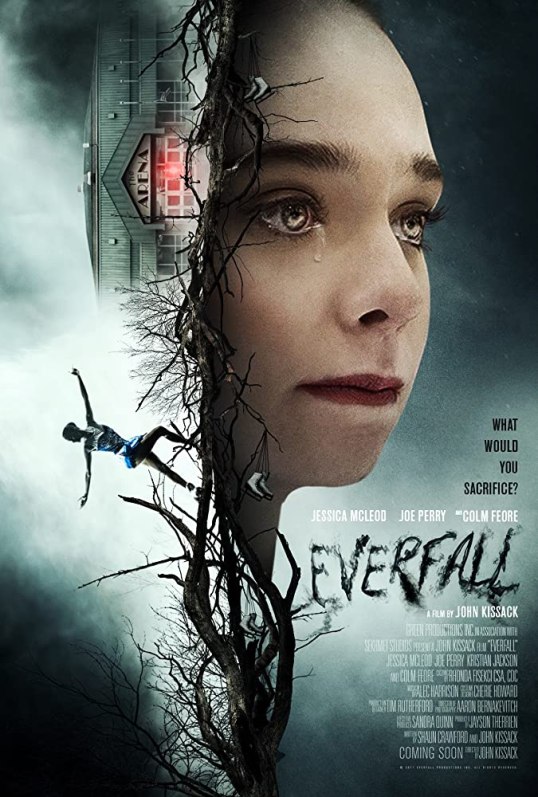
Horror Film Review: Everfall (dir by John Kissack)


The 2018 horror film, Everfall, tells the story of Eva and Daniel.

Eva Saint (Jessica McLeod) is a figure skater who, at one time, had a bright future.

Daniel (Joe Perry) is the world’s worst boyfriend.

Daniel is also the reason why Eva’s skating career get derailed.  Daniel hosts his own “extreme sports YouTube channel,” which he calls “The Daniel Show.”  Daniel is the type who tends to say things like, “This is going to be a totally new direction for the Daniel Show!”  One of Daniel’s new directions was to convince his girlfriend to stand on a ledge.  Unfortunately, while Daniel was showing off for the camera, Eva fell off that ledge and broke her leg.

A year later, Eva’s leg is scarred but healed.  She wants to get back into the world of competitive figure skating but she’s struggling.  She’s no longer as confident in herself as she once was.  None of her old partners want to work with her anymore.  Even worse, she’s still going out with Daniel.  I’m not sure why.  If I was dating a guy who was responsible for me falling off a roof, I’d probably break up with him as soon as I regained consciousness.

Eva’s coach gives her one last option.  She can go to an obscure little town called Everfall, where they have an annual skating competition.  Eva’s never heard of it before but she knows that she has to do something so she agrees.  And again, for some reason, she takes Daniel and Daniel’s cameraman, Jordan (Kristian Wang), with her.

The competition at Everfall turns out to be even worse than Eva was expecting.  First off, the ice skating rink appears to be on the verge of collapse.  Secondly, there don’t seem to be another other skaters around.  The mysterious Mrs. Redgrave (Catherine Gell) sends Eva to Dressing Room #5.  Dressing Room #5 turns out to be a not very pleasant place to be….

Everfall is an effectively creepy film, one that makes good use of its eerie location and which features an excellent performance from Jessica McLeod.  Everfall is also a film that never really makes much sense but, in this case, that’s acceptable.  When you’re dealing with a skating rink that may or may not be haunted by several ghosts, you can get away with a little incoherence.  The film is full of surreal moments and disturbing imagery.  Characters appear to die and then, just as quickly, they show back up again.  It’s a film that was obviously influenced by Kubrick’s The Shining — particularly the final few scenes — but it also manages to carve out its own rather odd identity.

While Eva, Daniel, and Jordan are wandering around the skating rink from Hell, there’s also wildfire raging around the town of Everfall.  Amazingly enough, Eva’s father is a fireman but he refuses to acknowledge that Eva’s in any sort of danger.  Eva’s parents are played by Jayson Therrien and Julie Orton.  They bicker through the entire film and, to be honest, I could have done without the majority of their scenes.  The scenes between Therrien and Orton wreck havoc on the film’s narrative momentum.  Whenever you’re really starting to get into whatever’s happening to Daniel, Eva, and Jordan, Eva’s parents pop up and start arguing with each other.  The main theme of these scenes is that Eva’s dad isn’t willing to rescue her from a fire despite the fact that he is a fireman and that’s literally his job.  You really can’t help but feel sorry for Eva.  She never had a chance.

Everfall has its flaws.  This is one of those films where the camera is always moving, even when it should be sitting still.  That said, there’s enough strange details and out-there plot twists to make it an effective head trip and it ends on a nicely surreal note.  That’s always a good thing.

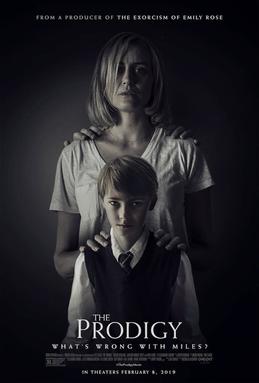
Horror Film Review: The Prodigy (dir by Nicholas McCarthy)


The Prodigy, which was released way back in February, is yet another creepy kid movie.

You know how these movies go.  There’s always some child who seems like a perfect little angel but is actually either psychotic or demon-possessed or maybe an alien.  Whatever it is, the important thing is that the child can get away with killing people because no one thinks that an eight year-old would do that something like that.  Inevitably, it’s the child’s mother who figure out what’s going on and it’s always up to her to try to stop her child’s reign of terror.  Sometimes, the mother is successful.  More often, she’s not and the movie ends with the little brat smiling at the camera or something.  Seriously, you know how it goes!

Because there’s been so many of them, it’s usually easy to predict what’s going to happen in these creepy kid movies.  At the same time, they’re effective because … well, let’s just be honest here.  Kids are creepy.  Even the ones that aren’t evil know that they can get away with stuff that no adult would be allowed to do.  Add to that, they’ve got those high-pitched voices that can give you a migraine if you get stuck on airplane anywhere near one of them.  Beyond that, these films also touch on every parent’s worst fear.  What if your child does grow up to be evil?  What if you mess up while you’re raising them and, as a result, other people suffer?  What if your child grows up to have bad hygiene or an obnoxious attitude?  I mean, I don’t have any children yet but these are the things that I imagine keep most parents up at night.

Anyway, in The Prodigy, the creepy kid is named Miles (Jackson Robert Scott).  Miles is super smart.  He started talking when he was just a toddler.  However, after Mile turns 8, he starts to behave strangely.  He pulls mean pranks on the babysitter.  He attacks other children.  He starts speaking Hungarian in his sleep and saying stuff like, “I’ll cut your eyes out and watch you die, whore.”  After Miles does something bad, he always claims that he has no memory of what he did.  Whenever Bad Miles takes control, Good Miles just seems to black out.  Needless to say, his parents — Sarah (Taylor Schilling) and John (Peter Mooney) — are concerned about what’s happening with their son.

Could it have something to do with the fact that, at the same time that Miles was being born, a Hungarian serial killer named Edward Scarka was getting gunned down by the cops?  Is it possible that Edward’s evil spirit is now inside of Miles and is trying to take control of him?  Sarah certainly comes to think so!  As for John — well, who cares?  John is mostly just there to get upset and pout.

The Prodigy does have some scary moments.  Director Nicholas McCarthy establishes an ominous atmosphere early on and the film remains remarkably bleak for the majority of its running time.  I mean, there are some really dark moments in The Prodigy.  But, at the same time, the whole crazy child plot is a bit too predictable and the film doesn’t really bring anything new to the terror tyke genre.  Add to that, this is yet another film in which a family pet is gruesomely murdered for no particular reason.  I guess we’re supposed to be shocked and say, “OH MY GOD, IF THEY’LL KILL THAT ADORABLE DOG, THEY’LL KILL ANYONE!” but the dog is so obviously doomed from the first moment that it appears that it just feels like lazy storytelling.

Outside of a few isolated moments, The Prodigy doesn’t really make much of an impression.  It’s an efficient horror film that’s never really memorable.

Film Review: Greta (dir by Neil Jordan)


http://www.youtube.com/watch?v=hMVgcxf5h_A

I always worry a little bit about Chloe Grace Moretz.

Seriously, it seems as if every film in which she appears features her either losing her entire family or getting stalked by some psycho or both.  It’s rare that she ever gets to play someone who is happy with their life.  Even when she was cast against type as a spoiled, vacuous brat in Clouds of Sils Maria, she still came across as being the saddest spoiled, vacuous brat imaginable.  Obviously, Mortez has the dramatic talent necessary to play these type of roles and, out of all the young actresses working today, she seems the most likely to still have an interesting career 30 years from now.  Still, it’s hard not to wish that she could just do a nice, romantic comedy at some point in the future, if just to give her a break from constantly being menaced on screen.

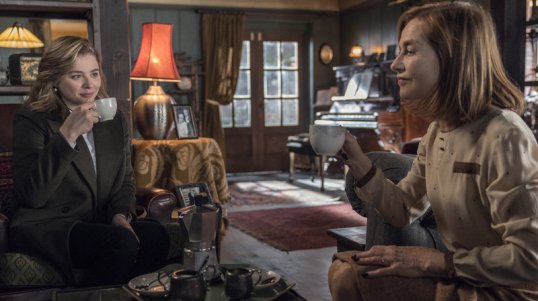
This year’s Chloe Moretz Gets Stalked film was Greta.  In this one, Moretz plays Frances McMullen, a waitress living in New York City.  Frances lives in a nice loft, has a fantastic roommate and best friend named Erica (Maika Monroe), and a strained relationship with her wealthy father (Colm Feore). As is typical of any character played by Chloe Moretz, Frances is still struggling to come to terms with the recent death of her mother.

After Frances finds an expensive handbag on the subway, she returns it to its owner, a piano teacher named Greta Hibeg (Isabelle Huppert).  Greta claims to be French and says that she’s been lonely ever since her daughter left home to study music in France.  Frances needs a substitute mother.  Greta needs a substitute daughter.

Can you tell where this is going?

If you said, “Together, they solve crimes!,” — well, you’re wrong but you’re still my hero.  Instead, what all this leads to is Greta becoming rather obsessed with Frances.  When Frances discovers that Greta has a whole closet full of handbags and that she’s not even French, Frances decides to end their friendship.  However, Greta will not take no for an answer.  Soon, Greta is following both Frances and Erica all around New York City.  Greta even goes to Frances’s place of employment and makes a scene that leads to Frances losing her job.  (Considering the amazingly ugly waitress uniform that Frances was required to wear, I’d say that Greta was doing her a favor.)  Eventually, it all leads to a kidnapping, a drugging, and an unexpected visual gag involving the Eiffel Tower.

About 30 minutes into Greta, there’s a scene in which Isabelle Huppert spits a piece of chewing gum into Chloe Moretz’s hair and it was at that moment that I knew that I was going to absolutely love this film.  I mean, there have been a lot of films made about people being stalked but it takes a certain amount of demented genius to have one of the world’s most acclaimed actresses actually spit a piece of gum into someone’s hair.  Brilliantly, the film follows this up with a scene of Frances and Erica trying to press assault charges against Greta, all because of the gum incident.  The cop is so cynical and unimpressed by their story that you just know that Frances is probably like the hundredth person to get attacked by chewing gum in just that day.

My point here is that there’s absolutely nothing subtle about Greta and we’re all the better for it.  As directed by Neil Jordan, Greta is a thoroughly excessive and deliberately campy little film and definitely not one to be taken too seriously.  Everything, from the lush cinematography to Greta’s sudden rages, is wonderfully over-the-top.  While Moretz wisely underplays her role (because, after all, someone has to keep things at least vaguely grounded in reality), Maika Monroe and especially Isabelle Huppert dive head first into the film’s melodramatic atmosphere.  Huppert, especially, deserves a lot of credit for her ferocious performance as Greta.  Whether she’s cheerfully celebrating a murder by doing an impromptu dance or suddenly screaming in Hungarian, Huppert is never less than entertaining while, at the same time, remaining credible as a very threatening individual.  One of the great joys of Greta is watching this masterful French actress play a Hungarian who is obsessed with Paris.  (It’s also probably not a coincidence that Greta is obsessed with someone named Frances.)

There’s an interesting subtext to the Greta and Frances relationship, one that goes beyond a girl who needs a mother and a woman who needs a daughter.  In many of the scenes where Greta stalks Frances, Huppert plays her as if she’s a spurned lover, crying out, “I love you!” and demanding that Frances return her phone calls.  As for Frances, she’s portrayed as being an almost absurdly repressed single girl who spends all of her personal time with two very different women, the accepting and fun-loving Erica and the predatory and destructive Greta.  (When Erica tells Frances that a guy who is interested in her is throwing a party, Frances says that she already has plans with Greta.)  Watching Greta, it occurred to me that the film was really about Frances coming to terms with her own sexuality, with Greta representing her fears and Erica representing the peace of accepting who you are.  The film may be about Greta stalking Frances but it’s also about Frances struggling to decide whether to give in to her fears or to accept her own identity.

Then again, it’s also totally possible that there’s no intentional subtext at all to this film.  It might just be an entertaining film about Isabelle Huppert stalking Chloe Moretz.  And that’s fine, too!  Either way, it’s a fun movie.

Embracing the Melodrama Part II #102: Chicago (dir by Rob Marshall)


ChicagopostercastIt’s strange to refer to a best picture winner as being underrated but that’s exactly the perfect description for the 2002 film Chicago.

When Chicago was named the best picture of 2002, it was the first musical to take the top prize since The Sound of Music won in 1965.  Until the box office success and Oscar triumph of Chicago, it was assumed by many that a musical had to be animated in order to be successful.  After Chicago won, the conventional wisdom was changed.  Dreamgirls, Nine, Rock of Ages, Hairspray, Jersey Boys,  Into the Woods, Les Miserables, none of these films would have been produced if not for the success of Chicago.  It’s also due to Chicago that television networks are willing to take chances on shows like Glee and Smash.  And while I think a very valid argument could be made that we would all be better off without Glee, Smash, and Rock of Ages, you still can not deny that Chicago both challenged and changed the conventional wisdom.

https://twitter.com/Delanynder/status/606251356136042496

And yet, despite its success and its continuing influence, Chicago is one of those best picture winners that often seems to get dismissed online.  Some of that’s because, by winning best picture, Chicago defeated not only The Two Towers (which is arguably the best installment in Peter Jackson’s Lord of the Rings trilogy) but also Roman Polanski’s searing masterpiece, The Pianist.  Critics often point out that The Pianist won for best adapted screenplay, best actor, and best director but Chicago somehow managed to win best picture.  They suggest that the Academy was either worried about the implications of giving best picture to a film directed by Roman Polanski or else they were blinded by Chicago‘s razzle dazzle.  They argue that Chicago was merely an adaptation of an iconic stage production, whereas The Pianist and The Two Towers were both the result of visionary directors.

Well, to be honest, I think those critics do have a point.  The Pianist is one of the most emotionally devastating films that I have ever seen.  The Two Towers is the perfect mix of spectacle and emotion.  And yet, with all that in mind, I still love Chicago.

And it’s not just because of scenes like this:

Or this:

Or even this scene of Richard Gere tap dancing:

If you’ve been reading this site for a while then you know my bias.  You know that I grew up dancing.  You know that I love to dance.  And you know that I automatically love any film that features a dance number.  And, since you know my bias, you may be thinking to yourself, “Well, of course Lisa likes this….”  And you’re right.

But you know what?  Even if nobody danced a step in this film, I would still enjoy it.  (Though it would be odd to see a musical with absolutely no dancing.)  Chicago is not just about spectacle.  Instead, it tells a very interesting story, one that is probably even more relevant today than when the film was first released.

Set in 1924, Chicago tells the story of Roxie Hart (Renee Zellweger).  Married to the decent but boring Amos (John C. Reilly), Roxie wants to be a star.  She has an affair with slrazy Fred Casely (Dominic West), believing that he has showbiz connections.  When Fred finally admits to her that he lied in order to sleep with her, Roxie reacts by murdering him.  Because Roxie is pretty and blonde and claims to have been corrupted by the big, bad, decadent city, she becomes a celebrity even while she sits in jail and awaits trial.

Also in the jail is Velma Kelly (Catherine Zeta-Jones), a nightclub singer who killed her husband and sister.  Roxie idolizes Velma but, after Velma snubs her, a rivalry forms between the two.  Roxie hires Velma’s lawyer, the slick Billy Flynn (Richard Gere).  During the trial, Roxie becomes even more popular, Velma grows jealous, and the only innocent women on death row — a Hungarian who can’t speak English — is ignored and executed because she doesn’t make for a good news story.

Chicago is a cynical and acerbic look at both the mad pursuit of celebrity and the pitfalls of the American justice system.  In its way, it’s the film that predicted the Kardashians.  (If Roxie had been born several decades later, it’s not difficult to imagine that she’d build her career off of a sex tape as opposed to murder.)  Renee Zellweger and Catherine Zeta-Jones are both sociopathic marvels in their respective roles.  Even Richard Gere, who, in other films, can come across as being oddly empty, is perfectly cast and surprisingly witty in the role of Billy.

Director Rob Marshall does a great job of making this stage adaptation feel truly cinematic.  At no point does Chicago feel stagey.  Perhaps Marshall’s smartest decision was to tell the entire film through Roxie’s eyes.  Every musical lives and dies based on whether it can convince the audience that it would perfectly natural for everyone onscreen to suddenly break out into song.  Chicago is convincing because, of course, Roxie would view her life as being a musical.

And did I mention that the film features a lot of great dancing?

Because it so seriously does….

So, yes, it can be argued that Chicago beat out some worthier films for the title of best picture of the year.  But, regardless, it’s still a good and memorable film.

Embracing the Melodrama Part II #100: Pearl Harbor (dir by Michael Bay)


Pearl_harbor_movie_poster

“And then all this happened…”

Nurse Evelyn Johnson (Kate Beckinsale) in Pearl Harbor (2001)

The “this” that Evelyn Johnson is referring to is the Japanese attack on Pearl Harbor.  You know, the date will live in infamy.  The attack that caused the United States to enter World War II and, as a result, eventually led to collapse of the Axis Powers.  The attack that left over 2,000 men died and 1,178 wounded.  That attack.

In the 2001 film Pearl Harbor, that attack is just one of the many complications in the romance between Danny (Ben Affleck), his best friend Rafe (Josh Hartnett), and Evelyn (Kate Beckinsale).  The other complications include Danny briefly being listed as dead, Danny being dyslexic before anyone knew what dyslexia was (and yet, later, he’s still seen reading and writing letters with absolutely no trouble, almost as if the filmmakers forgot they had made such a big deal about him not being able to do so), and the fact that Rafe really, really likes Evelyn.  Of course, the main complication to their romance is that this is a Michael Bay film and he won’t stop moving the camera long enough for anyone to have a genuine emotion.

I imagine that Pearl Harbor was an attempt to duplicate the success of Titanic, by setting an extremely predictable love story against the backdrop of a real-life historical tragedy.  Say what you will about Titanic (and there are certain lines in that film that, when I rehear them today, make me cringe), Leonardo DiCaprio and Kate Winslet had genuine chemistry.  None of that chemistry is present in Pearl Harbor.  You don’t believe, for a second, that Ben Affleck and Josh Hartnett are lifelong friends.  You don’t believe that Kate Beckinsale is torn between the two of them.  Instead, you just feel like you’re watching three actors who are struggling to give a performance when they’re being directed by a director who is more interested in blowing people up than in getting to know them.

Continuing the Titanic comparison, Pearl Harbor‘s script absolutely sucks.  Along with that line about “all this” happening, there’s also a scene where Franklin D. Roosevelt (Jon Voight) reacts to his cabinet’s skepticism by rising to his feet and announcing that if he, a man famously crippled by polio and confined to a wheelchair, can stand up, then America can win a war.

I’ve actually been to Pearl Harbor in Hawaii.  I have gone to the USS Arizona Memorial.  I have stood and stared down at the remains of the ship resting below the surface of the ocean.  It’s an awe-inspiring and humbling site, one that leaves you very aware that over a thousand men lost their lives when the Arizona sank.

I have also seen the wall which lists the name of everyone who was killed during the attack on Pearl Harbor and until you’ve actually been there and you’ve seen it with your own eyes, you really can’t understand just how overwhelming it all is.  The picture below was taken by my sister, Erin.

Pearl Harbor 2003If you want to pay tribute to those who lost their lives at Pearl Harbor, going to the Arizona Memorial is a good start.  But avoid Michael Bay’s Pearl Harbor at all costs.

Shattered Politics #59: Night Falls on Manhattan (dir by Sidney Lumet)


Night_falls_on_manhattan_poster

Oddly enough, right after I watched City Hall, I watched yet another 1997 film about politics and police corruption in New York.  And while Night Falls on Manhattan is definitely not one of Sidney Lumet’s best films, it’s still definitely an improvement on City Hall.

Night Falls on Manhattan tells the story of what happens when two veteran detectives — Liam Casey (Ian Holm) and Joey Allegreto (James Gandolfini) — attempt to arrest drug dealer Jordan Washington (Shiek Mahmud-Bey).  Liam ends up getting shot multiple times before Jordan, disguised as a police officer, flees the scene.  As the cops search for Jordan, they accidentally shoot and kill one of their own.

In short, Manhattan has gone crazy and only the prompt capture and conviction of Jordan Washington will set things right.

However, the police don’t have to spend too much time searching for Jordan because, the very next day, he turns himself in.  He’s accompanied by a veteran radical lawyer named Sam Vigoda (Richard Dreyfuss).  Vigoda announces that yes, Jordan is a drug dealer and yes, he did shoot Liam Casey.  However, Vigoda claims that Jordan has been paying off the cops and that Liam and Joey weren’t actually trying to arrest him.  Instead, they were specifically looking for an excuse to execute him.

Flamboyant District Attorney Morganstern (Ron Leibman) know that his office has to convict Jordan.  And luckily, he has a secret weapon.  Liam’s son, Sean (Andy Garcia), just happens to be a former cop and an assistant district attorney.  He assigns Sean to handle Jordan’s prosecution.

Sean, it turns out, has political ambitions of his own and, by prosecuting Jordan, he not only gets revenge for the shooting of his father but he also furthers his own career.  (He also gets a girlfriend, in this case an associate of Vigoda’s who is played by Lena Olin.)  When Morganstern has a heart attack, Sean suddenly finds himself being mentioned as a candidate to replace him in the upcoming election.

However, even as Sean appears to be shoo-in to be the next district attorney, he also discovers that neither Liam nor Joey were as innocent as he originally assumed..

Night Falls In Manhattan is an occasionally diverting legal and political thriller.  As a director, Sidney Lumet had an obvious feel for New York culture and, as a result, the film feels authentic even when the plot occasionally veers into melodrama.  As opposed to City Hall, you never doubt the plausibility of Night Falls On Manhattan.  Though Andy Garcia is a bit an odd choice to play an Irish-American (and it’s particularly difficult to imagine him being, in any way, related to Ian Holm), the rest of the film is well-cast.  Fans of The Sopranos will enjoy a chance to see James Gandolfini playing someone who, because he’s on the “right” side o the law, is actually more dangerous than Tony Soprano and Rob Leibman is thoroughly believable as a bullying crusader against crime.

After I watched Night Falls on Manhattan, I did some checking online and I was surprised to discover that the film is apparently not better known than it is.  While it definitely uneven, Night Falls On Manhattan is an interesting look at crime, ethics, and urban politics.