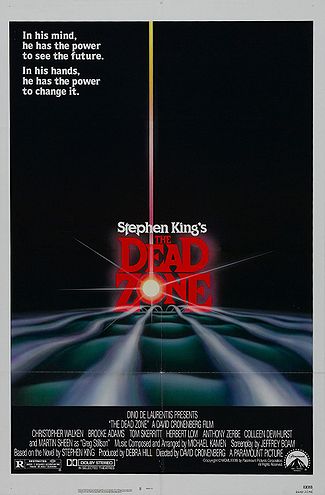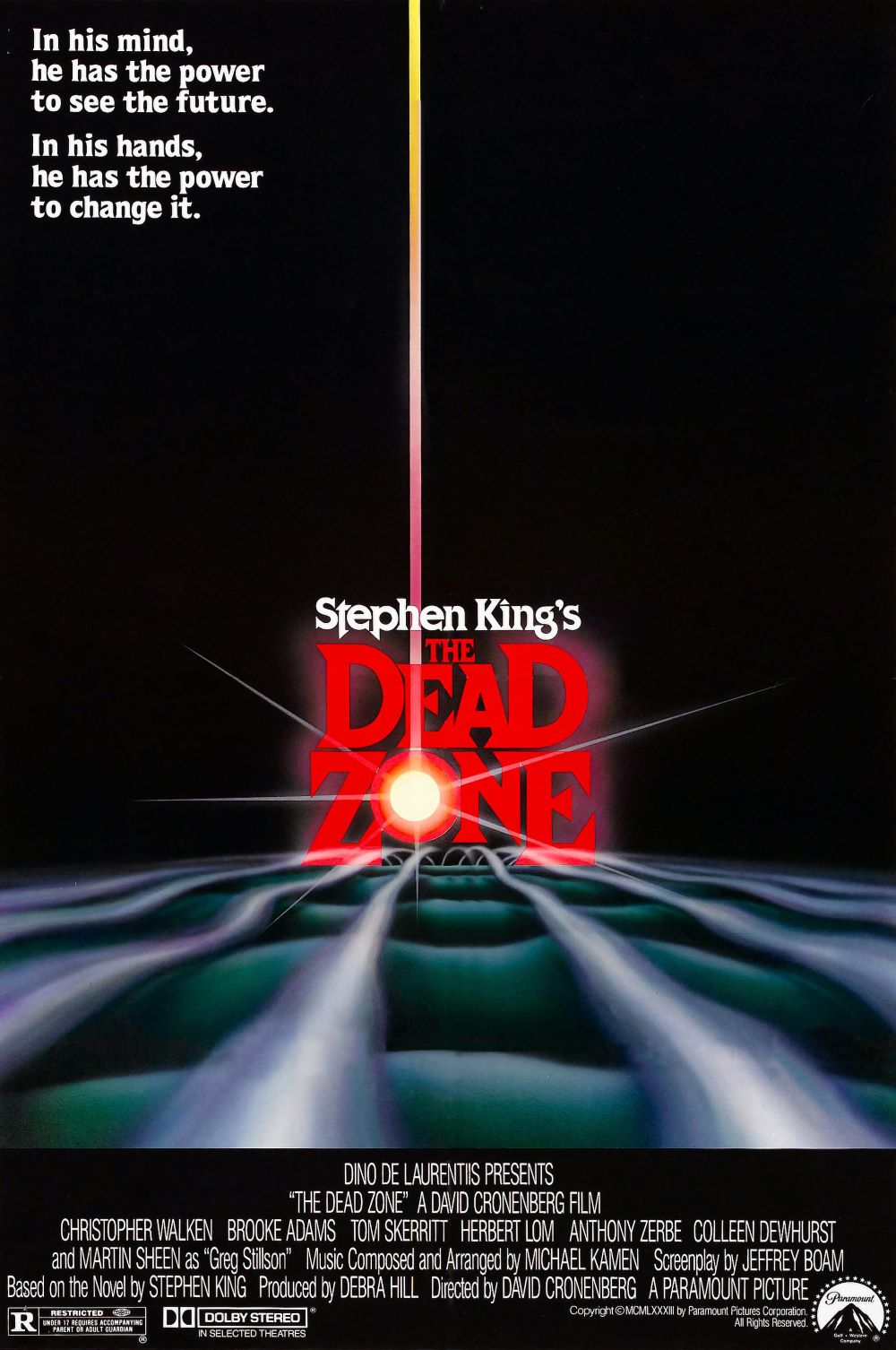
Horror Review: The Dead Zone (dir. by David Cronenberg)


“Bless me, Father, for I have sinned. I had the power… and I tried to prevent what I saw.”Johnny Smith

In 1983, David Cronenberg adapted Stephen King’s The Dead Zone with a distinctive emphasis on mood, morality, and psychological depth rather than traditional horror spectacle. The film follows Johnny Smith (Christopher Walken), a small-town schoolteacher whose life transforms irrevocably after a traumatic car accident leaves him in a five-year coma. Upon awakening, Johnny discovers he possesses psychic abilities that allow him to see the past and future by touch. Rather than a gift, this power becomes a heavy burden, isolating him and forcing him into wrenching moral choices.

Cronenberg’s direction is meticulous and deliberately restrained. The film’s muted color palette and stark winter landscapes visually echo Johnny’s emotional isolation and the fragility of human existence. His careful, often gliding camera movements create a mounting sense of quiet dread, while minimalistic sound design underscores moments of revelation with haunting subtlety. This subdued style elevates the film’s psychological impact, transforming it into a thoughtful and melancholy meditation on the cost of harrowing knowledge.

Significantly, The Dead Zone marks a departure from Cronenberg’s signature body horror. Instead of the grotesque physical transformations and visceral mutations that characterize much of his other work, here Cronenberg turns inward. The real horror lies in the malleability of the mind and the elusive nature of perception—how reality, memory, and the future are unstable constructs that can shift and fracture under psychic strain. This thematic focus on the impermanence and distortion of mental reality touches on some of Cronenberg’s deepest artistic fascinations.

The restrained treatment of body horror in The Dead Zone previews the director’s later, more psychologically driven films such as A History of ViolenceEastern Promises, and A Dangerous Method, where character studies and narrative depth take precedence over startling visuals. In this early pivot, Cronenberg demonstrates that his mastery lies not only in visual spectacle but in probing the profound emotional and moral dilemmas faced by his characters. The vision-focused horror here is cerebral and grounded, rooting supernatural phenomena in human frailty and ethical complexity.

Christopher Walken’s nuanced portrayal is the emotional heart of the film. He captures Johnny’s vulnerability, weariness, and profound solitude, portraying a man burdened by a cursed knowledge that isolates him from the world. Martin Sheen plays Greg Stillson, the ambitious and morally bankrupt politician whose rise Johnny must foretell and who embodies the film’s central threat. The supporting cast, including Brooke Adams as Johnny’s lost love Sarah and Tom Skerritt as Sheriff Bannerman, delivers compelling and authentic performances that humanize the film’s intimate, small-town environment.

Several changes from King’s novel sharpen the film’s thematic focus. The novel’s sprawling plot, including a serial killer subplot and a brain tumor storyline symbolizing Johnny’s mortality, is pared down or omitted. Despite this trimming, the serial killer element retained in the film remains chilling and effective. It highlights the darker repercussions of Johnny’s psychic gift and injects a tangible sense of dread, reinforcing the psychological weight Johnny carries. This subplot grounds the supernatural within a disturbing reality, illustrating the violent and tragic circumstances Johnny must grapple with as part of his burden.

The concept of the “dead zone” itself shifts in meaning. Originally, the term referred to parts of Johnny’s brain damaged by the accident, blocking certain visions. Cronenberg reinterprets it as a metaphor for the unknown and unknowable parts of the future—the gaps in psychic clarity that allow for free will and change. This subtle shift reshapes the narrative toward a more ambiguous, hopeful meditation on destiny and human agency.

Compared to King’s novel, Cronenberg’s Johnny is more grounded and isolated. The novel frames Johnny’s struggle within a broader spiritual and fatalistic context, highlighted by the looming presence of a brain tumor and a nuanced exploration of hope versus resignation. The film, by contrast, focuses on the emotional and moral fatigue induced by Johnny’s psychic gift, emphasizing his loneliness and reluctant responsibility rather than supernatural destiny.

Walken’s restrained, haunting performance strips away mythic grandeur to reveal a deeply human character. The film’s narrowed narrative tightens focus on Johnny’s internal anguish and his difficult ethical choices, making his plight intimate and richly relatable.

On a thematic level, The Dead Zone contemplates fate, free will, and sacrifice. Johnny’s psychic abilities act as a draining, almost chthonic force, transforming him into a reluctant prophet who is tasked with intervening in grim futures at great personal cost. The film’s bleak winter setting visually reflects Johnny’s alienation, while its deliberate pacing highlights the exhaustion and heartbreak that comes with such knowledge.

Ultimately, Cronenberg’s The Dead Zone goes beyond supernatural thriller conventions. It is a profound meditation on empathy, sacrifice, and the human condition—where the greatest horrors are internal, and the cost of knowledge is both psychic and emotional. Johnny Smith emerges as a tragic, flawed figure wrestling with unbearable burdens.

Cronenberg’s direction and the impeccable performances make The Dead Zone a standout in King adaptations. The film’s enduring impact lies in its rich thematic texture, its moral ambiguity, and its unflinching exploration of human frailty, all conveyed through a director shifting skillfully from physical body horror to psychological and existential terror. The film remains as haunting and resonant now as it was upon release, a testament to the synergy of Cronenberg and King’s extraordinary talents.
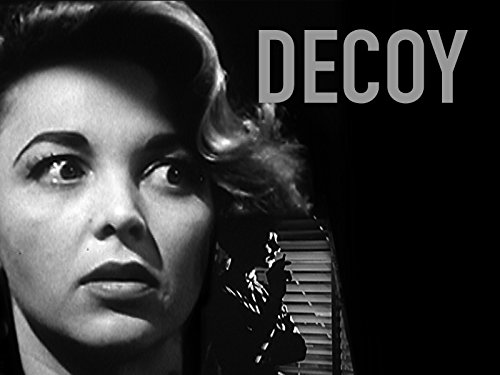
Retro Television Review: Decoy 1.7 “Deadly Corridor”


Welcome to Retro Television Reviews, a feature where we review some of our favorite and least favorite shows of the past!  On Thursdays, I will be reviewing Decoy, which aired in Syndication in 1957 and 1958.  The show can be viewed on Tubi!

This week, Casey goes to prison!

Episode 1.7 “Deadly Corridor”

(Dir by Teddy Sills, originally aired on November 25th, 1957)

A murder has occurred in the medium security wing of a woman’s prison.  The Warden (Agnes Young) and the District Attorney (John Newton) asks Casey to go in undercover to discover who killed a prisoner.  Casey will pretend to be a prisoner and only the Warden will know that she’s actually a cop.  Casey won’t have her gun, her badge, or her usual backup.  It’s a dangerous assignment but the medium security wing will be shut down if there’s another incident.  The District Attorney starts to explain the importance of rehabilitation.  Casey replies, “I’m a police woman, not a sociologist.”  Casey accepts the assignment because that’s her job.

Casey’s in jail!  She has a really nice cell.  It comes with a dresser, a vanity mirror, a bed, a lamp, and a desk!  She’s even allowed to wear makeup in prison.  Sign me up!  Casey comes to suspect that the murder was committed by the butch Taffy (Colleen Dewhurst) but instead, it turns out the killer was the mentally-fragile Lois (Lois Nettleton).  Lois is a kleptomaniac and killed the other prisoner after she ratted Lois out to the warden and caused Lois’s sentence to be lengthened.  Lois subsequently attacks Casey because she’s worried that Casey is also “a fink” and Lois doesn’t want to end up spending any more time in prison.  She wants to be released in three months so she can finally visit the grave of her baby.  (Awwww!)  Unfortunately, by the end of this episode, it’s looking like Lois will be lucky to escape the electric chair.

This episode has all of the usual women-in-prison cliches but they were all handed in a way so as to not upset the 1950s television viewing audience.  For instance, the episode never came out and said that Taffy was a lesbian but the way she stared at Casey and ordered her to “come and see me,” didn’t really leave much doubt.  When Taffy beats up Casey, she’s establishing her dominance and reminding the viewer that no one can walk away from a fight in prison.  When Casey snitches to the warden, it’s because she wants to get Taffy out of the way for 24 hours so that Casey can investigate the murder.  Casey can get away with that because she’s a cop and she can always just go to the Warden and ask to be released from the prison.  If Casey were an actual prisoner, being labeled a snitch (or a “fink” as they apparently put it back then) would be a fatal error.

This episode had its campy moments but Lois Nettleton and Colleen Dewhurst both gave excellent performances and the final confrontation between Casey and Lois was actually pretty suspenseful.  To my surprise, this turned out to be a good episode.

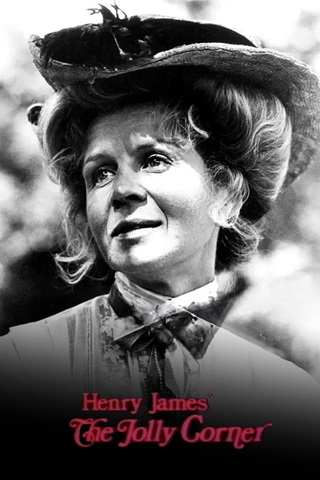
Retro Television Review: The American Short Story #3 “The Jolly Corner”


Welcome to Retro Television Reviews, a feature where we review some of our favorite and least favorite shows of the past!  On Saturdays, I will be reviewing The American Short Story, which ran semi-regularly on PBS in 1974 to 1981.  The entire show can be purchased on Prime and found on YouTube and Tubi.

This week, we have an adaptation of a Henry James short story.

Episode #3 “The Jolly Corner”

(Dir by Arthur Barron, originally aired in 1975)

In 1906, Spencer Brydon (Fritz Weaver) returns to America from Europe, where he’s spent the majority of his adult life.  Brydon has specifically returned to oversee some properties that he has inherited, including his childhood home and an adjacent building that’s going to be turned into an apartment complex.  The middle-aged Brydon reconnects with his old friend, Alice Shaverton (Salome Jens), and finds himself wondering what type of man he would have come if he had stayed and worked in America as opposed to living a life of leisure in Europe.

Soon, Spencer comes to feel that his alternate “American” self is actually haunting his childhood home, his so-called “Jolly Corner.”  His American self haunts him like a ghost, a menacing shadow that continually forces him to ask “what if?”  He becomes obsessed with both his former home and his shadowy alter ego.  But is this American version of Spencer Brydon real?  And if it is real, what does it want from the Spencer Brydon who went to Europe?

This was a really well-done adaptation of a Henry James short story, one that was full of gothic atmosphere and which featured a compelling lead performance from Fritz Weaver.  As directed by Arthur Barron, this episode did a good job of portraying the story’s horror elements while also reminding us that James’s story, for all of its talk of ghosts and alternate realities, is ultimately a portrait of a really bad midlife crisis.  Spencer did what a lot of rich Americans do.  He went to Europe to escape the responsibilities of his home country.  And now, in middle-age, he’s asking himself, “Is this all there is?”

If nothing else, watching this episode might inspire the viewer to read more Henry James.  That’s a good thing.


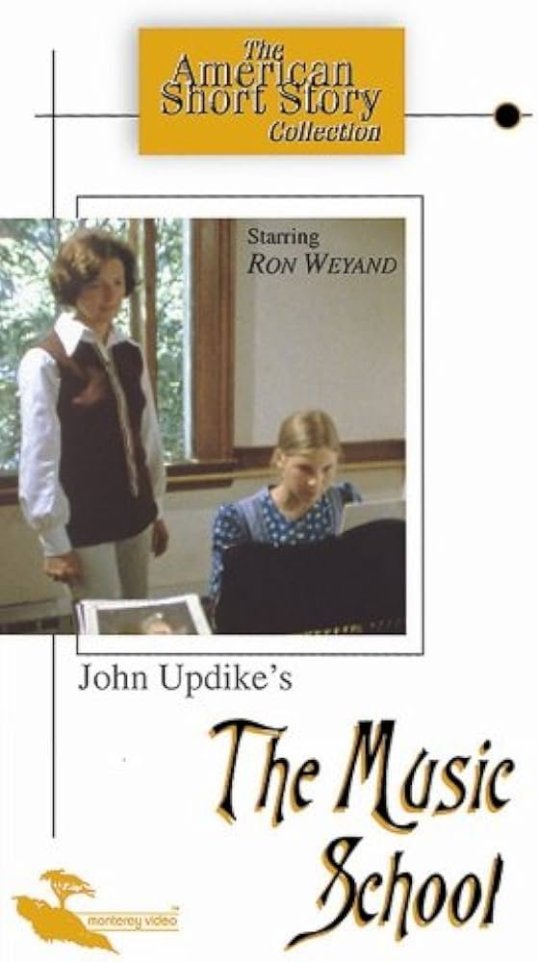
Retro Television Review: The American Short Story 1.1 “The Music School”


Welcome to Retro Television Reviews, a feature where we review some of our favorite and least favorite shows of the past!  On Saturdays, I will be reviewing The American Short Story, which ran semi-regularly on PBS in 1974 to 1981.  The entire show can be purchased on Prime and found on YouTube and Tubi.

Today, we start a new series of reviews with an adaptation of a John Updike short story!

Episode 1.1 “The Music School”

(Dir by John Korty, originally aired on January 1st, 1974)

The first episode of The American Short Story is based on a story by John Updike.  Alfred Schweigen (Ron Weyand) is a writer who sits at his typewriter and who occasionally looks out the window of his office.  His wife playfully sprays the window with a garden hose and the writer thinks about how she’s in therapy because of his affairs.  He remembers taking his daughter to her music school and thinks about the sounds of music floating through the building like ghostly memories.  He thinks about a priest who, while talking to a bunch of “Protestants and non-believers,” explained that it was now permissible to chew the Eucharist wafer instead of waiting for it to dissolve.  He thinks about a friend of his, a computer programmer, who was apparently assassinated by a random sniper while his family watched.  In his mind, Alfred takes the random thoughts and occurrences and builds a story around them.

It’s an interesting episode, even if it doesn’t quite work.  Tasked with bringing Updike’s words to visual life, this episode far too often falls back onto cliche and Ron Weyand often looks more annoyed that sincerely perplexed by life’s mysteries.  (The writer’s narration is provided by Henry Fonda, whose middle-American voice doesn’t quite match Weyand’s petulant performance.)  It’s a midlife crisis type of story, one in which the writer tries to deal with his own ennui and infidelities by turning them into fiction.  Unfortunately, this is a case of what was compelling on the page falling flat when it’s adapted for film.  I appreciated this episode’s ambition, even if it didn’t work in the end.

Next week, the American Short Story interprets a story by Ambrose Bierce!

Horror Film Review: When A Stranger Calls (dir by Fred Walton)


“Have you checked the children?” the stranger on the phone asks the terrified babysitter, who is unaware that the children are already dead and that the call is …. COMING FROM INSIDE THE HOUSE!

That’s the premise behind both an oft-repeated urban legend and the opening of the 1979 film, When A Stranger Calls.  I’ve often seen the original When A Stranger Calls described as being one of the scariest films ever made.  That’s not quite true, of course.  The first 20 minutes or so are effective.  The final scene has a few intense moments.  The majority of what lies in-between feels like filler, albeit well-acted filler.

When A Stranger Calls opens with Carol Kane as Jill, a teenage babysitter who is terrified one night by a caller who keeps asking her if she’s checked on the children.  This sequence — really, a mini-movie all of its own — is so well-executed and suspenseful that many people assume that the entire film is just Jill dealing with the mystery caller.  Actually, that’s just the first few minutes and, once the location of the killer has been revealed, Kane disappears from the film for an extended period.  That’s a shame since Kane’s empathetic performance is perhaps the best thing that When A Stranger Calls has going for it.  She’s so convincing as the emotionally shattered babysitter that it doesn’t matter that, at the start of the film, she’s obviously not a teenager.

Instead, the middle part of the film focuses on John Clifford (Charles Durning).  Clifford is a former policeman-turned-private investigator.  He is obsessed with Duncan (Tony Beckley), the man who called Jill at the start of the film.  Duncan has just escaped from a mental institution and Clifford has been hired to track him down.  Clifford is convinced that Duncan will try to find Jill.  Duncan, meanwhile, wanders through the sleaziest sections of downtown Los Angeles, briefly living with a pathetic alcoholic named Tracy (Colleen Dewhurst).  Clifford, of course, is right about Duncan wanting to find Jill.  And Clifford is so determined to kill Duncan that he might even be willing to use Jill as bait….

After the brilliantly horrific opening sequence, it’s impossible not to be disappointed with the drawn-out middle section of When A Stranger Calls.  Durning, Dewhurst, and especially Beckley all give good performances and downtown Los Angeles is so repellent that you’ll want to take a shower afterwards but, narratively, there’s really not much happening.  Clifford finds Duncan. Duncan runs away.  Duncan acts like a jerk and gets in a fight.  Tracy drinks.  The old school cop Clifford scowls at the sleaziness of the world while Duncan continues to lose what little sanity he has left.  Give the film some credit for not portraying Duncan as being some sort of charming, loquacious master criminal.  He’s a total loser, as all serial killers are despite the later popularity of fictional characters like Hannibal Lecter.  Duncan hates both himself and the world with equal fury.  But, that said, the narrative stalls during the middle part of the film.  There’s only so many time you can watch two men chase each other down a trash-strewn street before it gets dull.

Fortunately, Jill does eventually show up again and, after an hour of relentless sleaziness, you’re happy to see Carol Kane, again.  Jill is now married and has children of her own.  And soon, she’s again getting a phone call asking if she’s checked on the children….

And, again, the closing sequence is scary, even if it’s not quite as intense as the opening.  (The opening was scary because we didn’t know what the killer looked like.  By the time Duncan finds Jill a second time, we now know that Duncan is a sickly-looking alcoholic who can’t handle himself in a fair fight.)  The film does have one great jump scare left in its arsenal of tricks.  And yet, it’s impossible to watch When A Stranger Calls without wishing that the whole thing had just focused on Jill instead of getting sidetracked with Clifford searching Los Angeles.

When A Stranger Calls will always have a place in horror history.  “Have you checked the children?” will always produce chills.  It’s just unfortunate that the film spends a good deal of its running time ignoring what makes it scary in the first place.

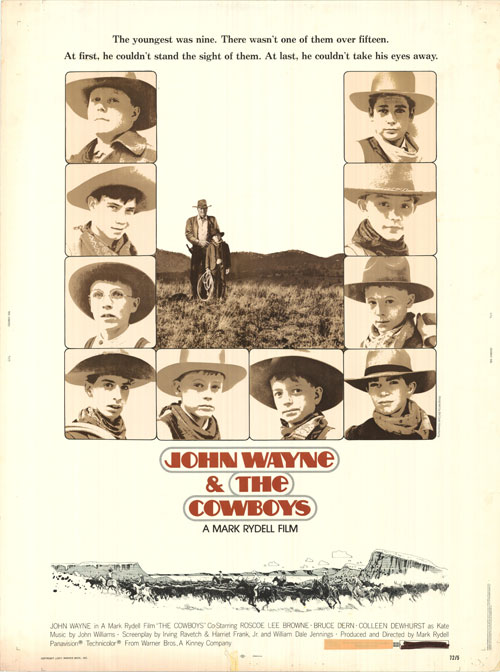
Young Frontier: John Wayne in THE COWBOYS (Warner Brothers 1972)


gary loggins's avatarcracked rear viewer

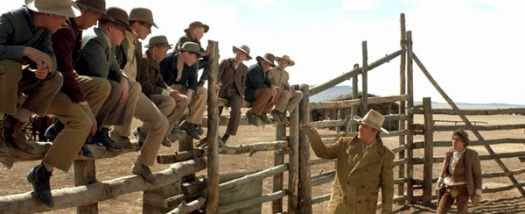
THE COWBOYS is not just another ‘John Wayne Movie’ from the latter part of his career. Not by a long shot. Duke had read the script and coveted the part of Wil Andersen, who’s forced to hire a bunch of wet behind the ears adolescents for a 400 mile cattle drive across the rugged Montana territory. Director Mark Rydell wanted George C. Scott for the role, but when John Wayne set his sights on something, he usually got what he wanted. The two men were at polar opposites of the political spectrum, and the Sanford Meisner-trained Rydell and Old Hollywood Wayne were expected to clash. They didn’t; putting their differences aside, they collaborated and cooperated  to make one of the best Westerns of the 70’s.

Andersen’s regular hands have all deserted him when gold is discovered nearby, leaving the aging rancher in the lurch. He heads for Boseman to look…

View original post 797 more words

Lisa Reviews An Oscar Winner: Annie Hall (dir by Woody Allen)


anniehallposterYou take a risk when you review a Woody Allen film, even an acknowledged, Best Picture-winning classic like 1977’s Annie Hall.  Do you address the accusations that have been made about him?  Do you ignore them and hope that they won’t be the Elephant in the Room, stomping through your review?  Do you try to justify reviewing (or, in some cases, even watching) Allen’s film?  Or do you just let the work speak for itself?

I love Annie Hall.  Quite frankly, I like a lot of Woody Allen’s films, even though I understand why his work is an acquired taste for quite a few other people.  I’ll address the elephant in the room in a paragraph or two but you know what?  I watched Annie Hall last night and I want to mention a few reasons why I enjoy this film.

First off, Annie Hall features one of Christopher Walken’s first (and best) performances.  He only has a few lines but he makes quite an impression.  He plays Duane, the brother of Annie Hall (Diane Keaton).  When Annie’s boyfriend, Alvy Singer (Woody Allen), is visiting the Hall family, Duane invites Alvy into his bedroom and tells him that, whenever he’s driving, he fantasizes about intentionally swerving into incoming traffoc.  In the very next scene, Duane is driving an oblivious Annie and a terrified Alvy to the airport.  It’s a wonderfully funny moment.  (If you keep your eyes open, you’ll notice that Annie’s apartment is full of pictures of Duane and his thousand yard stare.)

Secondly, this film also features an early role for Jeff Goldblum.  He only has one line — “I forgot my mantra” but my God, he does amazing things with that line.

Third, when Alvy and his agent, Rob (Tony Roberts), are driving through Los Angeles, they pass a theater.  According to the marquee, the theater is showing House of Exorcism, a Mario Bava film.  That’s right: Italian horror in a Woody Allen film.  How glorious is that?

Fourth, Annie Hall is an extremely dated film.  It was made in 1977 and, as to be expected about a film directed and written by a stand up comedian, it’s full of references that were probably hilariously on target then but rather obscure now.  As well, like almost all Woody Allen films, it’s a very New York film.  Alvy is an intellectual, left-wing Jew who suspects that everyone he sees is an anti-Semite and who is dating an aspiring actress and singer who hails from middle America.  (During the scene where Alvy meets her family, he immediately pegs Grammy Hall as a “classic Jew hater.”)  The film is very much told from Alvy’s point of view, which means jokes about New York periodicals and a flashback to an Adlai Stevenson rally.  That being said, I’m a Texas girl who was born long after Annie Hall was first released and I still enjoy the film because it’s a film that captures some universal truths about human relationships.

The first time I watched Annie Hall, I was 17 and I saw a lot of myself in Annie.  While I wouldn’t be caught dead wearing some of her outfits, I knew what it was like to be insecure.  I knew what it was like to be nervous.  I know what it was like to worry about being smart enough.  And, like Annie, I eventually learned that independence was the key to happiness.  Annie Hall has stood the test of time because both Annie and Alvy are relatable while still remaining wonderfully unique and neurotic individuals.

(If ever a film has been a ode to the joy of being neurotic, it’s Annie Hall.)

Fifth, I love the scene where Alvy asks a random couple of the street how they make their relationship work.  “I’m totally shallow and have no original thoughts,” the woman replies.  “And I’m the exact same way,” her husband cheerfully adds.

Sixth, I’m going to assume that Paul Simon was primarily playing himself.

Seventh, there are just so many great scenes.  Like when Alvy deals with a rude cop by ripping up his license.  And then, there’s that lobster scene.  And that moment when Alvy comes over to Annie’s apartment to kill a “spider the size of a buick.”  (Judging by the number of times Alvy has to hit the spider with that tennis racket, I assume buick’s are pretty big.)  There’s the two scenes of Annie singing, one when she’s still insecure and can’t compete with the sound of plates smashing around here and the other when she’s developed the confidence to dominate and control both the stage and the audience.  There’s the scenes where Alvy breaks the fourth wall and get advise from random people on the streets of New York.  And what about when Annie starts laughing while telling the horrible story of how her uncle died at the post office?  Or what about when Alvy tries to avoid having sex with his first wife by discussing the JFK assassination?  Or when we literally see Annie mentally check out of making love to Alvy?  Or how about the split-screen therapy sessions?  Or the sudden moment when Annie and Alvy become cartoon characters?  Or the scene with the pretentious blowhard at the movies?

(As a Southern girl, I have to admit that it’s always strange to me to hear Alvy and Annie talking about “waiting on line” at the movies.  Down here, we say “in line,” which makes a lot more sense.  Since a line is just a crowd of people standing in a certain order, saying that you’re “on line,” is the same as saying your standing on someone’s head.  You get in a crowd, not on them.  Whenever I hear someone from up north talking about “waiting on line,” I assume they must be bidding for something on Ebay.)

I like Annie Hall and I always will.  As for the accusations against Woody Allen, they don’t keep me from enjoying his better films because:

  1. I’ve always been a big believer that art can and should be judged separately from the artist.
  2. Having read what both sides have said about Woody Allen and the accusations that have been made against him, I don’t think he did it.

Obviously, some are going to disagree with me on both those points.  So be it.  Everyone has to make their own choice.  For me, though, what’s important is that Annie Hall is a film that I’ve loved since the first time I saw it and I’ll continue to love it.

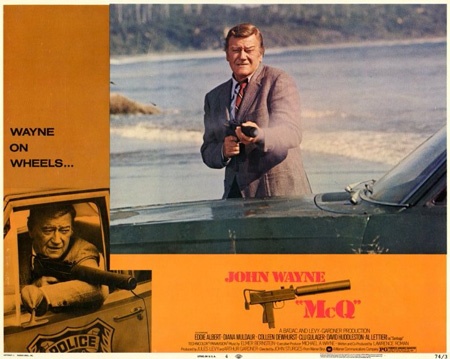
Out of the Saddle: John Wayne in MCQ (Warner Bros, 1974)


mcq1

John Wayne didn’t get off his horse very often in the latter part of his career. The Duke hadn’t done a non-Western since 1969’s HELLFIGHTERS, but cop pictures were in style in the early 70s due to the success of movies like THE FRENCH CONNECTION and DIRTY HARRY. Wayne was actually offered the part of Dirty Harry Callahan and turned it down. But in 1974, Big John traded in his horse for a Pontiac Firebird in the action packed MCQ, directed by veteran John Sturges (GUNFIGHT AT THE OK CORRAL, THE MAGNIFICENT SEVEN, THE GREAT ESCAPE).

mcq2

Wayne plays tough cop Lon McQ, who quits the force to investigate the murder of his former partner. He gets tangled up with drug dealers and corrupt officials, car chases and shootouts. Sound formulaic? It is, but the action scenes make up for a lame script. Duke basically plays the same character he did in most all his films, tough but tender, fair but firm. It’s kind of jarring to see Wayne in his (pretty bad) hairpiece instead of the usual cowboy hat, and tooling around the streets of Seattle in a muscle car rather than the dusty trail on his horse. He’s surrounded by a supporting cast full of familiar faces (Eddie Albert, Diana Muldaur, Colleen Dewhurst, Al Lettieri, David Huttleston, Clu Gulager), all of whom do their best with the clichéd script. MCQ plays like a TV movie of the week, which isn’t necessarily a bad thing, and fans of 70s action flicks will dig it.

John Wayne only made three more films after MCQ, including another cop movie, BRANNIGAN, and his swan song, 1976’s THE SHOOTIST, before succumbing to cancer in 1979. The Duke made much better movies then MCQ, but for a look at the star without his spurs and six-gun,  it’s definitely worth watching.

(This post originally appeared, in slightly altered form, on the 2015 TCM Summer of the Stars Blogathon, hosted by Journeys in Classic Film)

Lisa Watches An Oscar Nominee: The Nun’s Story (dir by Fred Zinnemann)


Nun_story

Happy Ash Wednesday!

So, earlier today, I got off work early so I could go to Noon Mass with my sister and we both got our ashes.  And I’m sure that will take some people by surprise because I’m not exactly the most faithful or devout of Catholics.  But what can I say?  I love the ornate ritual of it all.

And, as a part of my own personal ritual, I washed my forehead before I left the church.  Erin and I had a great vegetarian lunch at Cafe Brazil and then we came home and I turned on the TV and what should be finishing up on TCM but the 1959 best picture nominee, The Nun’s Story.  Fortunately, I had already set the DVR to record The Nun’s Story and so, on this most Catholic of days, I was able to watch this most Catholic of best picture nominees.

The Nun’s Story tells the story of Gaby (Audrey Hepburn), the daughter of a famous Belgian doctor (Dean Jagger).  At the start of the film, Gaby has entered a convent because she wants to become a missionary nursing sister in the Belgian Congo.  However, before Gaby can go to the Congo, she has to learn to give up her own rebellious streak and individual independence.  Taking the name Sister Luke, she excels at her medical training but, because it is felt that she is still too independently minded, she is not sent to the Congo but instead assigned to work in a mental hospital.  It’s there that her independent streak nearly gets her killed when she is fooled by a dangerous patient who claims to be the Archangel Gabriel.  It is only after she takes her final vows that Sister Luke is finally sent to the Congo and it is there that she’s forced to work with the abrasive agnostic Dr. Fortunati (Peter Finch).  Of course, as Sister Luke goes through her own spiritual struggles, the world inches closer and closer to the start of a second world war.  When war does break out, Sister Luke finds herself torn between her vow of obedience (which includes remaining political neutral) and the realities of living in a country that’s been occupied by the Nazis.

1959 was apparently a good year for religious films.  Not only did Ben-Hur win best picture, but The Nun’s Story also received 8 nominations.  Reportedly, The Nun’s Story was the most financially successful film to be released by Warner Bros, up to that point.  If Wikipedia is to be believed, it was also Audrey Hepburn’s personal favorite of the many movies that she made.

When seen today, probably the first thing that people notice about The Nun’s Story is that it’s extremely long and occasionally rather slow.  The film follows Gaby from the minute she enters the convent to the moment that she makes her final choice about whether to be obedient to herself or to her vows and, during that time, it examines every single detail of her life in glorious Technicolor.  A lot of emphasis is put on the rituals that Sister Luke goes through on her way to taking her final vows.  Now, if you’re like me, all of the rituals are fascinating to watch and produce a whole host of conflicting emotions.  Even as I found myself admiring Sister Luke’s dedication and her sacrifice, I still kept wondering — much as she did —  if it was all really worth giving up her independence.  But, I also have to admit that I found myself wondering if someone from a Protestant background would feel the same way.

To a certain extent, I really hate to say that you probably have to come from a Catholic background to truly enjoy any film.  But I certainly think that’s the case with The Nun’s Story.  But, even Protestants and skeptics will appreciate Audrey Hepburn’s wonderful lead performance.  She keeps this film grounded and makes her mostly internal conflict of faith compelling.  In a career that was full of great performance, this is one of Audrey’s best.

Shattered Politics #49: The Dead Zone (dir by David Cronenberg)


The_Dead_Zone

So, it seems like every time that I write a review of any film based on a novel by Stephen King, I always have to start out by explaining that I think, while King’s success is undeniable, the fact that he’s overrated is also undeniable.  It’s a comment that I always make and then I have to deal with people going, “But, Lisa, everyone loves Stephen King!  He’s the most commercially successful author ever!  He’s a modern-day Charles Dickens!”

Bleh.

Make no mistake, I think that Stephen King is a talented writer.  However, I don’t think that he’s the greatest writer that has ever lived and that’s where I often come into conflict with King’s fans.  (Stephen King fans tend to be like religious fanatics when it comes to defending their belief.)  Having read both King’s earlier work and his more recent books, it’s hard for me not to feel that Stephen King has been growing steadily complacent.  There’s a certain self-importance to his prose and his plotting that, for me, is the literary equivalent of nails on chalk board.  If anyone is guilty of believing the most fawning praise of his biggest fans, it would appears to be Stephen King who, to judge from his twitter feed, appears to also believe that he’s our most important cultural critic as well.

(To be honest, I’d probably have more tolerance for King’s attempts at cultural and political criticism if he wasn’t so  predictable about it all.  Stephen King may write best sellers but that doesn’t mean he has anything interesting or unique to say about current events.)

Anyway, since I don’t feel like having to deal with all of that shit all over again, I’m not going to start this review by saying that I think Stephen King is overrated.  In fact … whoops.

Okay, so much for that plan.

Even I have to admit that The Dead Zone is one of Stephen King’s better books.  First off, it’s less than a 1,000 pages long.  Secondly, the hero isn’t a writer who spends all of his time whining about the political preferences of his neighbors.  Third, it deals with all of the “big” issues of faith, destiny, and morality but it does so in a far less heavy-handed manner than most of King’s books.

The Dead Zone is also the basis for one of the better films to be adapted from a Stephen King novel.  Directed by David Cronenberg and starring Christopher Walken, the film’s plot closely follows the novel.  Johnny Smith (Christopher Walken) is a high school teacher who, after a horrific car crash, spends five years in a coma.  When he finally wakes up, he discovers that his girlfriend, Sarah (Brooke Adams), has married another man.  His mother has become a religious fanatic.  And, perhaps most importantly, whenever Johnny touches anyone, there’s a good chance that he’ll see either the person’s past or a possible future.

Needless to say, Johnny struggles with how to deal with his new powers.  After he helps to catch a local serial killer, Johnny goes into seclusion.  However, when he discovers that Sarah is now volunteering for ambitious politician Greg Stillson (Martin Sheen), Johnny goes to a Stillson rally, shakes the man’s hand, and has a vision.  Johnny discovers that, if Stillson is elected to the senate, he’ll eventually become President and then he’ll destroy the world.

Much like The Shining, The Dead Zone benefits from being directed by a filmmaker who was both confident and strong enough to bring his own individual style to the material.  (Usually, when a King adaptation fails, it’s because it followed the source material too closely, as if the film’s producers were scared of upsetting any of King’s constant readers.)  Though the film’s plot may closely follow the novel, the movie itself is still definitely more of a product of David Cronenberg than Stephen King.  Whereas King’s novel devoted a good deal of time to Johnny and Sarah’s relationship, it’s treated as almost an afterthought in Cronenberg’s film.  Whereas King’s novel presented Johnny Smith as being an everyman sort of character, Cronenberg’s film gives us a Johnny who, from the start of the film, is a bit of an outsider even before he starts to see the future.  Whereas King put the reader straight into Johnny’s head, Cronenberg approach is a bit more detached and clinical.  Cronenberg’s Johnny is a bit more of an enigma than King’s version.

Fortunately, Cronenberg was fortunate enough to be able to cast Christopher Walken in the role of Johnny Smith.  King’s preference for the role was Bill Murray.  As odd as it may sound, you can actually imagine Bill Murray in the role when you read King’s book.  But, for Cronenberg’s more detached vision, Walken was the perfect choice.  People tend to spend so much time focusing on Christopher Walken’s quirky screen presence that there’s a tendency to forget that he’s actually a very talented actor as well.  He’s very likable and sympathetic as Johnny and brings a humanity and a sense of humor to the role, which provides a good balance to Cronenberg’s sense of detachment.

The Dead Zone is a good book and it was later turned into an occasionally good (and, just as often, not-so-good) television series.  However, the film is still the best.

http://www.youtube.com/watch?v=lmC5oPc7L3M