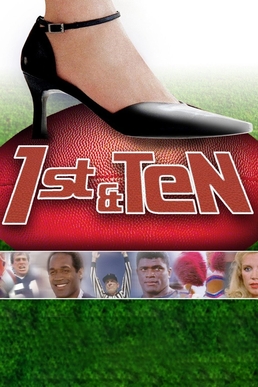
Welcome to Late Night Retro Television Reviews, a feature where we review some of our favorite and least favorite shows of the past! On Wednesdays, I will be reviewing 1st and Ten, which aired in syndication from 1984 to 1991. The entire series is streaming on Tubi.
Is this season over yet?
Episode 1.12 “Not Quite Mr. Right”
(Dir by Bruce Seth Green, originally aired on February 10th, 1985)
The Bulls are going to the “Championship Game!”
They should be getting ready for the game but instead, everyone’s distracted.
Wide receiver Mace Petty (Marshall R. Teague) has been cast in a movie where he will be co-starring with his favorite actor, Larry the Wonder Dog.
Diana is distracted when a former lover (Dennis Holohan) shows up and starts acting like he wants to get back together.
Denardo is distracted by the networks wanting to mic him up during the big game. Everyone agrees that Denardo curses too much to wear a microphone. Since this episode was edited for syndication, we don’t actually heard Denardo curse but we are assured that he does it.
This episode sucked. Right when the football part of the show finally starts to get interesting, 1st & Ten does an episode that takes everyone off the field. Now, I will add one caveat. On Tubi, it appears that they are largely using episodes that were edited for syndication. As a result, there was so pretty obvious dubbing (especially where Denardo was concerned) and some pretty abrupt jump cuts. So, it’s totally possible that the HBO version of this episode might have been a masterpiece. I doubt it, though.
Next week …. it’s not the Super Bowl. It’s the Championship Game!
Tonight’s episode of One Step Beyond features Jocelyn Brando (sister of Marlon) as a purported psychic who warns a skeptical man that he will soon be traveling by train, that he will meet a woman with an usual, snake-design ring, and that she will end up chasing him with a knife.
The man laughs her off. Why, he never travels by train! Sure, he has a trip coming up but he’s already paid for his plane tickets. This just proves what the man has always suspected, that psychic’s are all phony! But then he gets a message that his flight has been cancelled and he’s going to have to travel to his destination by …. TRAIN!
CAN YOU PROVE IT DIDN’T HAPPEN!?
This episode originally aired on February 3rd, 1959.
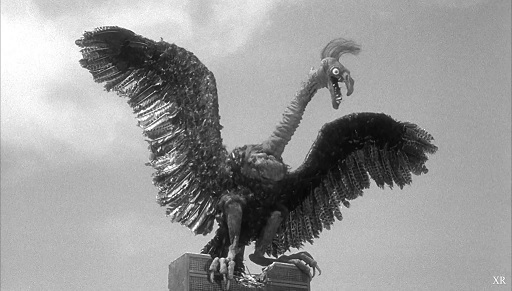
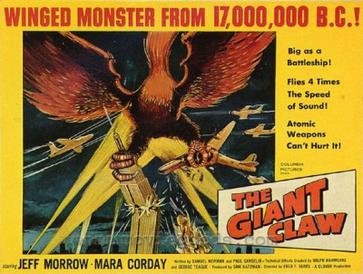
You know, a lot of people are a bit of dismissive of 1957’s The Giant Claw because they say that the monster — a big flying turkey from an anti-matter universe that has somehow slipped into our universe — is not convincing.
They make fun of the fact that, instead of hiring Ray Harryhausen like they were originally planning to do, the producers decided to save money by going for his non-union, Mexican equivalent.
They make fun of the scene in which a French-Canadian trapper announces that the Turkey Monster is actually a mythological beast that has the body of a woman, the head of a wolf, and the wings of a bat because the Turkey Monster certainly looks nothing like that.
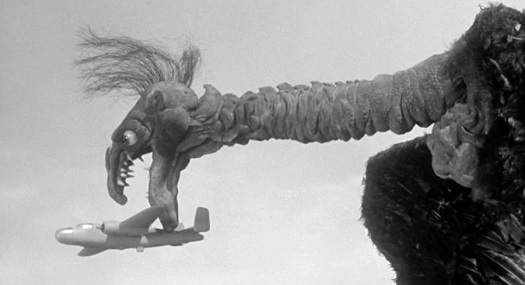
They laugh at the scene where the Turkey Monster chases an airplane, even though I think that would be pretty terrifying if I was actually on the airplane. I mean, the last time we were flying home from the UK, we hit a bit of turbulence and it traumatized me for days. I can only imagine how I would feel if I looked out the window and I saw a giant flying turkey chasing after the plane.
Critics will even make fun of how the turkey sounds, mocking it for its weird “caw caw” noises.
Well, alright. Let’s just admit it. The turkey isn’t the most menacing monster in the world and yes, it does sometimes sound a bit hoarse and it could definitely stand to put on a little weight but seriously, how can you not love this thing?
As for the film itself, it not only features one of the greatest monster of all time but it’s also a love story! Mitch MacAfee (Jeff Morrow) is a pilot who sees a UFO and who faces an attempt, by the government, to cover up what he’s seen. As happened to so many of the people who saw UFOs in the 50s, he’s accused of being either mistaken or an outright hoaxer. Meanwhile, Sally Caldwell (Mora Corday) is a mathematician who is originally skeptical of Mitch and his claims but who realizes that he was right when they’re attacked by the Turkey Monster. Their plane crashes in Canada, where they are rescued by a French-Canadian trapper named Pierre Brousssard (Lou Merrill). While the Turkey Monster is terrifying the world, Sally and Mitch are falling in love and since Jeff Morrow and Mara Corday are the most attractive people in the film, it only seems right. They’re a cute couple, who cares if the script makes any sense?
Anyway, back to the Turkey Monster. The Turkey Monster is protected by an anti-matter shield, which makes it impossible for it to be attacked by missiles and planes. A high-ranking general is left repeating, “Missiles and bombs,” after realizing that they’re all useless against the turkey.
Eventually, the Turkey Monster makes its way to New York City and announces that it’s not going anywhere!
Well, you know what, Giant Turkey? If you can make it there, you can make it anywhere!
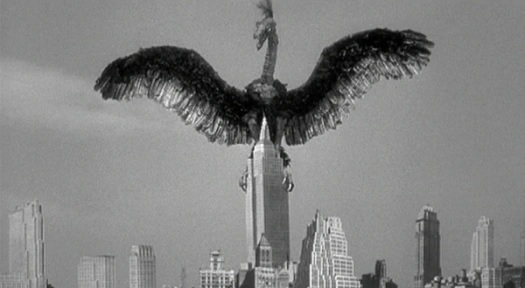
Sadly, the Turkey’s New York visit doesn’t end well and that’s a shame. Benjamin Franklin famously suggested that America’s official bird should have been the turkey as opposed to the eagle. Looking at the Giant Turkey sitting on the Empire State Building, how can you disagree?
Seriously, don’t listen to the critics. The Turkey Monster is one of the most entertaining monsters of all time and The Giant Claw is tons of fun!
Welcome to Retro Television Reviews, a new feature where we review some of our favorite and least favorite shows of the past! On Fridays, I will be reviewing Half Nelson, which ran on NBC from March to May of 1985. Almost all nine of the show’s episodes can be found on YouTube!
Last week, I took a look at the sixth episode of Half Nelson, which was called Nose Job and which featured Rocky (Joe Pesci) dealing with an obsessed plastic surgeon who was stalking a former girlfriend. That episode featured not only two villains (it turned out that the plastic surgeon wasn’t the only homicidal stalker in Hollywood) but is also ended with Victoria Jackson’s Annie O’Hara starting a romantic relationship with Gary Grubbs’s Detective Hamill.
Nose Job was followed by an episode called Chariots For Hire. It apparently aired on April 26th, 1985 and that’s really all I can tell you about the episode. Chariots For Hire is the only episode of Half Nelson that has not been uploaded to YouTube. I can’t even find a plot summary for it on the imdb. Chariots For Hire is apparently the lost episode of Half Nelson.
Fortunately, the eighth episode of Half Nelson is on YouTube. So, let’s pick up the adventures of Rocky Nelson in Malibu Colony!
Episode 1.8 “Malibu Colony”
(Dir by James Sheldon, originally aired on May 3rd, 1985)
Rocky, Annie, Beau (Dick Butkus), and Kurt (Bubba Smith) have been assigned to guard what Rocky claims is “one of the most valuable art collections in the world.” Fortunately, this job means that they get to spend a few days hanging out in a fabulous beach house in Malibu! Standing out on the deck of the beach house, Annie looks out at the ocean and says that she can hardly believe that China is on the other side of it.
“I wonder how the egg rolls stay fresh crossing over from that far,” Kurt says.
Before anyone can ponder that question for too long, a half-naked woman runs screaming down the beach while being pursued by two thugs in suits. Rocky saves the woman from the thugs and sends her into the beach house so that she can borrow some clothes from Annie. Once dressed, the woman explains that she’s Nancy Norton (Shari Shattuck) and that she was fleeing from a nearby yacht club. She claims that the owner of the club has some naked pictures of her and she needs to get them back. Rocky, deciding that the art can protect itself, helps Nancy sneak back into the club so that she can retrieve her photographs. However, when she sees the club’s president, Crane (John Beck), she suddenly holds up a gun and shoots at him. Rocky is able to push Crane out of the way of the bullets and then he chases after Nancy.
Fortunately, both Rocky and Nancy make it out of the club without anyone realizing that they’re together. Despite the fact that she nearly made him an accessory to murder, Rocky still wants to help Nancy. Nancy explains that there are no pictures and she wasn’t trying to kill Crane. (“I just wanted to scare him.”) Nancy’s father lost a lot of money while playing poker with Crane and now Crane is threatening to kill him if he doesn’t pay. But Nancy is convinced that the poker game was rigged. The reason she was in club earlier was to take a look at Crane’s cards.
(For some reason, she thought it would be smart to do that while wearing a bikini, the top of which was somehow lost while she was fleeing Crane’s guards. That explains that partial nudity, which I am sure was definitely viewed as being important to the plot and not just as an attempt to boost the show’s ratings.)
Having saved Crane’s life, Rocky is able to get Annie, Kurt, and Beau jobs at the club. Annie models clothes. Kurt and Beau work as waiters. Rocky’s boss, Chester (Fred Williamson), shows up at the club with Dean Martin and is shocked to see all of his employees working there. Dean demands that Chester give them all raises so that they can quit their second jobs.
Eventually, Rocky finds his proof that Crane is a criminal and, with Chester’s help, he takes Crane down. After being stuck in the office for the past few episodes, Chester actually gets to do something in this episode. It’s always nice to see Fred Williamson in action and making it even better is that he smokes a big cigar while he’s taking down the bad guys. Finally, after eight episodes, Half Nelson reminded everyone of why Fred Williamson was so cool to begin with.
This episode definitely earns some points for allowing the entire supporting cast — from Fred Williamson to Victoria Jackson to Dean Martin — to play a role in solving the case of the week. One of Half Nelson‘s biggest flaws was that the appealingly quirky supporting characters often felt underused and Malibu Colony finally gives them a chance to show what they could have done as an ensemble. The mix of Pesci’s wise guy nerve, Jackson’s spaciness, Williamson’s effortless coolness, and Butkus and Smith’s comedic relief is actually pretty entertaining. Unfortunately, as good as the heroes are, Crane is pretty boring villain and the case of the week isn’t particularly interesting. In particular, Nancy’s actions never really make that much sense.
Oh well. This was a flawed episode but it still offered up a hint of what Half Nelson could have been. Next week, I will be reviewing this show’s final episode. Until then, L.A. — you belong to me!
The intense 1953 film noir, The Hitch-Hiker, begins with news of a murderer at large.
His name is Emmett Myers (William Talman). He’s the rough-looking man who you might occasionally see standing by the side of the road, asking for a ride with his thumb outstretched. For me, it only takes one look at Myers’s unfriendly face and his shifty eyes to know that I would never slow down to give him a ride. However, The Hitch-Hiker takes place in a more innocent era, at a time when everyone wanted to be of help. Anyone who gives Emmett a ride ends up dead. He steals their cars and then drives across country, abandoning the car only when he learns that his previous murder has been discovered. Emmett has hitchhiked from Illinois to Southern California and he’s left a trail of dead bodies behind him.
Roy Collins (Edmond O’Brien) and Gilbert Bowen (Frank Lovejoy) don’t know who Emmett is. They’ve missed all of the reports about Emmett’s killing spree. They haven’t read the newspapers, all of which feature a picture of Emmett on the front page and a warning to never pick him up. Roy and Gilbert have been too busy getting ready for a long-planned fishing trip in Baja California. When they see Emmett hitchhiking in Mexico, they pull over and offer him a ride.
Unlike other movie hitchhikers, Emmett doesn’t waste any time before revealing who he is. As soon as he gets in the car, he pulls a gun and tells the two men that they’re going to drive him deeper into Baja California. He’s got a boat to catch and he says that all the two men have to do is follow orders. Of course, both Roy and Gilbert know better. They know that Emmett’s planning on killing them as soon as they arrive at their destination. In fact, if Emmett learns that the police are looking for the two men, he’ll kill them sooner. Roy and Gilbert not only have to keep Emmett from flying off the handle but they also have to keep him from discovering that both of them have been reported as being missing.
As the three men drive across California, Emmett continues to taunt his prisoners. Repeatedly, he points out that the only reason they’re in this situation is because of their loyalty to each other. As Emmett explains it, if the two men tried to run in opposite directions, Emmett would probably only be able to kill one of them. If the two men both attacked him, Emmett would again probably only have time to kill one before the survivor subdued him. Will Roy and Gilbert remains loyal to each other or will they finally embrace Emmett’s philosophy of every man for himself?
Oh, how you’ll hate Emmett Myers! As played by William Talman, Emmett is not just a criminal but a bully as well. The enjoyment that he gets out of taunting Roy and Gilbert will make your skin crawl. Emmett is hardly the type of witty or charming master criminal who often shows up in movies today. Instead, The Hitch-Hiker emphasizes that Emmett’s an idiot but, because he has the gun, he has the power. Edmond O’Brien and Frank Lovejoy are also well-cast as the two friends who are forced to choose between survival and loyalty.
The Hitch-Hiker was one of the few films to be directed by a woman in the 1950s. (It’s generally considered to be the only film noir to have been directed by a woman.) Ida Lupino was not only an actress but also the only female director in the old Hollywood system and she made several hard-hitting films, the majority of which dealt with the type of issues that mainstream Hollywood was still too scared to handle. With The Hitch-Hiker, Lupino emphasizes not only Emmett’s cruelty but also the bonds of friendship between Emmett’s two hostages. Visually, she makes the wide open desert appears as menacing and as dangerous as any shadowy city street. If urban noirs often suggested that threats could be hiding anywhere, The Hitch-Hiker takes the opposite approach. The threat is in the back seat of the car and there’s literally no place to hide.
The Hitch-Hiker is an intense film that holds up well today. Watch it below and never again make the mistake of helping out a stranger.
“Go ahead and hate your neighbor; go ahead and cheat a friend. Do it in the name of heaven; you can justify it in the end. There won’t be any trumpets blowin’ come the judgment day On the bloody morning after, one tin soldier rides away”
— From One Tin Soldier, the theme song of Billy Jack (1971)
Yesterday, we took a look at The Born Losers, the first film to ever feature the character of future U.S. Senator Billy Jack. The Born Losers ended with former Green Beret-turned-gun-toting-pacifist Billy Jack (played, of course, by Tom Laughlin) saving the girl, killing the bad guy, and getting shot in the back by the police. As Born Losers ended, we were left to wonder whether Billy would survive his wounds or would he just be another victim of the establishment.
Well, audiences had to wait five years to find out.
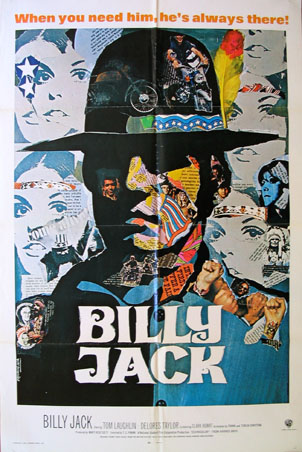
When Laughlin returned to the role in 1971’s Billy Jack, it was revealed that not only had Billy Jack lived but he was now residing in a cave with his wise Native American grandfather. Billy still had little use for civilization but he would occasionally emerge from his cave. Sometimes, it was to protect wild mustangs from being hunted the evil Old Man Posner (Bert Freed) and his sociopathic son Bernard (David Roya). Other times, it was to protect the Freedom School and, even more importantly, the Freedom School’s founder, Jean (played by Laughlin’s wife, Delores Taylor).
The local townspeople viewed the Freedom School with suspicion and whenever the students went into town, they would be harassed by Bernard and his friends. Fortunately, the students could always count on Billy to show up, say a few angry words, and then lose control. Billy may have been a liberal but he was no pacifist. Jean, however, fully embraced nonviolence and she always made it clear that she wasn’t comfortable with Billy providing her kids with a violent example.
Finally, both Jean and Billy’s convictions were put to the test. First off, the bigoted townspeople tried to close the school. Then, Jean was raped by Bernard. And finally, Billy found himself barricaded in an old mission, surrounded by police and national guardsmen. Even as Jean pleaded with Billy to lay down his weapons and to peacefully surrender, Billy made it clear that he was willing to die for his beliefs.
And, as the film ended, you would never guess that Billy Jack would eventually become a member of the U.S. Senate. But, in just a few years, that’s exactly what would happen in Billy Jack Goes To Washington!
Now, of course, Billy Jack is ultimately a product of its time and that’s both a blessing and a curse. To be honest, if anything could transform me from being the socially liberal, economically conservative girl that you all know and love into a card-carrying right-wing extremist, it would be having to spend any time with the students at the Freedom School. They are all so smugly convinced of their own moral superiority that the townspeople almost start to look good by default. Whether they’re attending improv class or disrupting a meeting at town hall, the majority of the students come across like a bunch of rich kids from the suburbs, playing hippy and slumming by hanging out with poor minorities. As you watch them, it’s difficult not to suspect that most of them are going to get bored with rebelling after a year or two and eventually end up growing up to be just like their parents.
Fortunately, the film is saved by the pure sincerity of Laughlin and Taylor. For all the attention that the film gets for the scenes of Billy Jack beating people up, the most compelling scenes are the ones where Jean and Billy Jack debate nonviolence. There’s an honesty and a passion to these scenes, one that proves that Laughlin and Taylor, as opposed to so many other self-styled counterculture filmmakers, were actually serious about their beliefs. Billy Jack is an essential film, not only as a time capsule of the era in which it was made but also as one of the few films to actually make a legitimate attempt to explore what it truly means to embrace nonviolence.
Billy Jack is also a historically important film. When American Independent Pictures withdrew from the production, Laughlin took Billy Jack to 20th Century Fox. When 20th Century Fox looked at the completed film and did not know how to market it, Laughlin distributed the film himself, without the support of a major studio. And, despite what all of the naysayers may have predicted, Billy Jack was a huge hit.
And every indie filmmaker since owes a huge debt of gratitude to Tom Laughlin.


 Through the Shattered Lens