Is it ever too early to start trying to predict what films will be nominated for Oscars next year?
In a word … yes.
After all, it’s only March. Grand Budapest Hotel has just now been released in New York and Los Angeles. Whiplash and Boyhood were acclaimed at Sundance. But otherwise, this is the time of year when the studios release films like The Legend of Hercules and Jack Ryan: Shadow Recruit.
Yes, it’s way too early and, quite frankly, a bit silly to try to predict anything right now.
But, a lot of us are still going to try.
Below you can find my way too early predictions for the 2015 Oscar nominations. Needless to say, these are blind guesses and should not be taken too seriously.
Some may notice that three films that are very popular with other award watchers are not listed on my list of best picture predictions. I have not listed Grand Budapest Hotel because the Academy, in the past, has not exactly been receptive to the films of Wes Anderson. As for David Fincher’s Gone Girl, I’m predicting it will have more in common with his rehash of The Girl With The Dragon Tattoo than The Social Network. Finally, I’m looking forward to seeing Paul Thomas Anderson’s Inherent Vice but I think the material will be too quirky for the Academy.
Best Picture
Birdman
Boyhood
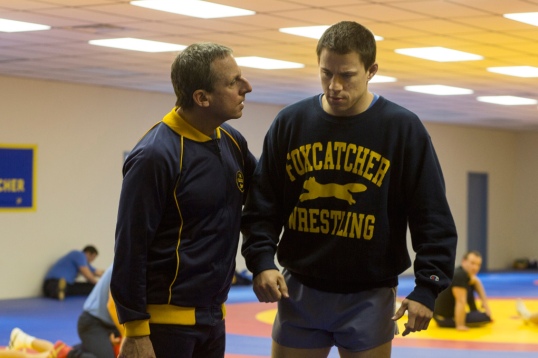
Foxcatcher
Get On Up
The Imitation Game
Interstellar
Unbroken
Whiplash
Wild
Best Director
Alejandro Gonzalez Inarritu for Birdman
Angelina Jolie for Unbroken
Richard Linklater for Boyhood
Morten Tyldum for The Imitation Game
Jean-Marc Vallee for Wild
Best Actor
Chadwick Boseman in Get On Up
Steve Carell in Foxcatcher
Benedict Cumberbatch in The Imitation Game
Brendan Gleeson in Calvary
Timothy Spall in Mr. Turner
Best Actress
Amy Adams in Big Eyes
Jessica Chastain in A Most Violent Year
Rosamund Pike in Gone Girl
Emma Stone in Magic in the Moonlight
Reese Whitherspoon in Wild
Best Supporting Actor
Robert Duvall in The Judge
Idris Elba in Beasts of No Nation
Mark Ruffalo in Foxcatcher
J.K. Simmons in Whiplash
Christopher Walken in Jersey Boys
Best Supporting Actress
Viola Davis in Get On Up
Amy Ryan in Birdman
Kristen Scott-Thomas in Suite Francaise
Meryl Streep in Suffragette
Jacki Weaver in Magic in the Moonlight
Those are my predictions for now. Come April, I’ll sit down and make (and post) another collection of blind guesses. If nothing else, these way too early predictions will give everyone something to laugh about when, next year, the actual Oscar nominations are announced.
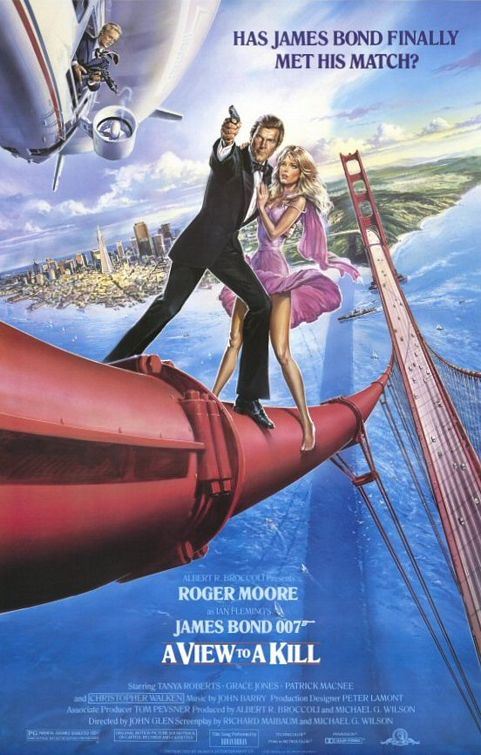
In the days leading up to the American premiere of Skyfall, the Shattered Lens has been revisiting the previous films in the James Bond franchise. Today we take a look at 1985’s A View To A Kill.
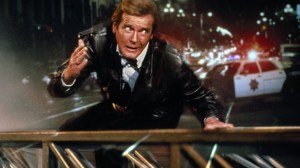
Along with bring the 14th “official” Bond film, it was also the last to star Roger Moore in the role of 007. On a personal note, it was also released the same year that I was born. I have to say that I hope I’ve aged better than this film has.
Much like The Spy Who Loved Me, A View To A Kill opens with a ski chase between Bond and a bunch of Russians. And while the chase itself isn’t all that exciting, it does lead to one of the better opening credits sequences of the Bond franchise.
Say what you will about A View To A Kill, it features the perfect theme song. I first heard Duran Duran’s title song long before I saw the actual film. After I graduated high school, I spent the summer in Italy and I can still remember hearing this song blaring from a loud speaker in Venice. With it combination of exuberant music and incoherent lyrics, the song is the perfect soundtrack for both an American girl abroad and a mid-80s spy flick.
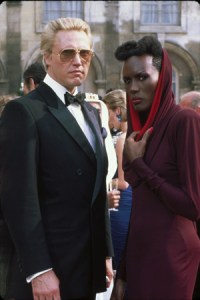
A View To A Kill finds James Bond investigating the mysterious industrialist Max Zorin (Christopher Walken). Though Zorin is one of the world’s richest men, MI6 is suspicious of him. Microchips manufactured by Zorin Industries are turning up in Russian submarines. Perhaps even worse, it’s become apparent that, much like Auric Goldfinger, Zorin is a cheater. He owns a champion racehorse but it’s rumored that the horse is somehow being given steroids. MI6 sends Bond and racehorse trainer Sir Godfrey Tibbets (played, quite wonderfully, by Patrick Macnee) to investigate.
These scenes, in which an undercover Bond sneaks around Zorin’s estate in France, are my favorites of the film. Moore and Macnee make for a likable team and it’s fun to watch the two veteran actors play off each other. As well, since these scenes are more about detection than action, it’s easier to ignore the fact that Moore was 58 years old when he made A View To A Kill.
Unfortunately, the rest of the film doesn’t work as well and that’s unfortunate because A View To A Kill starts to get seriously weird as things progress. It turns out that Zorin isn’t just a shady businessman. No, he’s actually the product of Nazi genetic experimentation and, as a result, he’s both a genius and a complete sociopath. What this means is that, opposed to previous Bond antagonists, Zorin spends a lot more time giggling and smiling as if even he can’t believe how evil he is.
Bond ends up following Zorin and his aide, May Day (Grace Jones), to San Francisco. It’s there that Bond discovers that Zorin is planning on setting off a massive underground explosion, in hopes of causing an Earthquake that will totally destroy California. This will allow Zorin to corner the world microchip market and make a lot of money but, for the most part, Zorin just seems to want to do it so that he’ll have something to talk about the next time he gets together with his fellow megalomaniacs.
Once everyone arrives in San Francisco, James Bond ends up teaming up with geologist Stacy Sutton (played by Tanya Roberts, better known as Donna’s mother on That 70s Show). As for Zorin, he divides his time between holding business meetings on his blimp and laughing like a maniac while gunning down random people.
Seriously, it’s an odd film.
Whenever film critics are looking over the Bond films, A View to A Kill seems to be the Bond film that’s destined to get the least amount of respect and admittedly, this is an uneven entry in the Bond franchise. In Sinclair McKay’s excellent look at the oo7 films, The Man With The Golden Touch, Roger Moore is quoted as having been uncomfortable with just how violent A View To A Kill eventually turned out to be and, watching the film, he definitely had a point. It’s odd to see Moore’s light-hearted approach coupled with scenes in which Zorin gleefully kills a thousand people in a thousand seconds. It also didn’t help that, in this film, Roger Moore looked every bit of his 58 years. Never have I been as aware of stuntmen then when I watched A View To A Kill. Finally, Moore and Tanya Roberts have next to no chemistry together.
With all that in mind, A View To A Kill is something of a guilty pleasure and that’s largely because of the bad guys.
If anyone was born to play a Bond villain, it’s Christopher Walken and Max Zorin is an enjoyably over-the-top villain. Whereas previous Bond villains were motivated primarily by greed, Zorin is the first Bond sociopath and Walken seems to be having a blast playing bad. As opposed to the grim bad guys of the past, Zorin laughs and grins through the whole movie and Walken is a lot of fun to watch. Regardless of whatever other flaws that the film may have, Max Zorin is rightly regarded as one of the best of the cinematic Bond villains.
As played by Grace Jones, May Day is one of the franchise’s most memorable and flamboyant villainous lackeys. Much like Richard Kiel in The Spy Who Loved Me, Jones is such a physical presence that she dominates every scene that she’s in. In their scenes together, Walken and Jones have the type of chemistry that’s so noticeably lacking between Moore and Roberts.
As I previously stated, A View To A Kill was Roger Moore’s final appearance as James Bond. Before we started our look at the Bond films, I spent some time researching the history of both the franchise and the men who have played 007. One thing that quickly became apparent was that nearly everyone agreed that Roger Moore is a nice, likable guy but that he didn’t bring much more than likability to the role of James Bond. Having now rewatched the Bond films, I can say that Roger Moore’s performance as James Bond was and is seriously underrated. Yes, Moore may have brought a light touch to the role but his interpretation of Bond was perfect for the films that he was starring in. Much as it’s difficult to imagine Roger Moore in From Russia With Love, it’s just as difficult to visualize Sean Connery in The Spy Who Loved Me. Moore’s greatest talent may have been likability but that likability kept the Bond franchise alive and Moore’s interpretation of the role deserves better than to be continually dismissed.
With Roger Moore leaving the franchise, the role of James Bond would next be played by an actor named Timothy Dalton. If Moore was the likable, fun Bond, Dalton was, in many ways, the complete opposite. We’ll be taking a look at The Living Daylights tomorrow.
Jonathan Hensleigh’s fact-based gangster film Kill The Irishman had a brief (and limited) theatrical run earlier this year and received generally mixed reviews. I myself didn’t see it in the theaters but instead, caught it OnDemand a few weeks ago and I was genuinely surprised to discover that this film, while far from being perfect, is also hardly the simple Goodfellas rip-off that I had originally been led to suspect. Instead, Kill The Irishman is a somewhat flawed but ultimately quite rewarding David-and-Goliath story about a real-life David who was known as “the Irishman.”
Kill The Irishman tells the true story of Danny Greene (played by Ray Stevenson), an Irish-American gangster who went from being a corrupt union boss to challenging the Sicilian mafia’s dominance of the criminal underworld of Cleveland, Ohio. In 1977, Greene became, for a brief period of time, a media celebrity when he survived several assassination attempts while fighting a war for control of the Cleveland rackets. As the film both informs and shows us, this violent, underground war led to a total of 35 bombings, all designed to kill either Greene or one of his allies. By surviving these attacks, Greene briefly appeared to be indestructible and seemed to be on the verge of reviving the long-dormant Irish mafia.
As a film, it takes a while for Kill The Irishman to really click. From the start director Hensleigh shows a real feel for capturing the feel of a once great city slowly dying but the 1st half of the movie still threatens to get bogged down in all the clichés of the modern gangster film — there’s a bit too much clunky narration from Val Kilmer (who sleepwalks through his role as a fictional police detective who grew up with Greene) and a few too many montages set to old rock tunes. It’s all watchable enough and there’s a few memorable sequences (my favorite being the early scenes of Greene on the job, slaving away under an oppressive sun) but on the whole, it just feels like the 100th low-budget remake of Goodfellas. The highlight of this part of the film is Christopher Walken’s typically eccentric yet genuinely sinister performance as an early Greene mentor-turned-enemy.
However, once Greene goes on his own and starts to blow up every inch of Cleveland, the film comes into its own and establishes its own rough identity. Hensleigh proves to be very adept at orchestrating chaos and, with the entire Mafia out to kill him, Greene goes from just being a thug to being a true underdog. It’s impossible not to root for him and, much like the film, it’s here where Ray Stevenson comes into his own. For the 1st half of the film, Stevenson seems like an adequate but uninspired choice for the role of Danny Greene. However, once Cleveland starts exploding around him, Stevenson comes into his own. He not only captures Greene’s cocky defiance but, as the film reaches its inetivable conclusion, he also captures Greene’s own growing paranoia and fear. By the end of the film, Stevenson has given a performance that has masterfully juggled pride and regret, defiance and fear. Regardless of whether it’s an accurate statement about the real Danny Greene, Ray Stevenson makes his version into a true tragic hero.
Along with Stevenson’s anchor of a performance and Walken’s scene-stealing characterization, Kill the Irishman is filled with familiar mob movie character actors, most of whom contribute some nicely realized turns as the various members of the Cleveland underworld. Tony Lo Bianco, Mike Starr, and Paul Sorvino are all convincingly brutish as the leaders of the local Mafia and Vincent D’Onofrio is wonderfully flamboyant as Greene’s one Italian ally. My personal favorite supporting performance came from character actor Robert Davi who was almost a little bit too believable as a cold-blooded murderer. Not to get too specific here but if I ever happen to hire a professional assassin, I hope he looks like Robert Davi.
I have to admit that one reason why I ultimately enjoyed this flawed but worthwhile film is because I’ve always wished that I could have been a member of the Irish mafia. (I wanted to be like Maggie from Gangs of New York and use my fingernails to rip open throats.) For many of us Irish-Americans, there’s just this romance to the whole idea of the Irish Mafia and we’re always looking for evidence that the organization wasn’t, more or less, wiped out by the Italians. (Fortunately, I happen to be a fourth Italian along with being a fourth Irish so the St. Valentine’s Day Massacre is a smidgen less traumatic for me). If nothing else, the Irish mafia epitomizes two things that every true Irish-American knows to be true: 1) the Irish will never stop fighting no matter how intimidating the odds and 2) we’re all ultimately doomed regardless. Kill the Irishman may not be a perfect film but it’s a fitting tribute to a better kind of criminal.
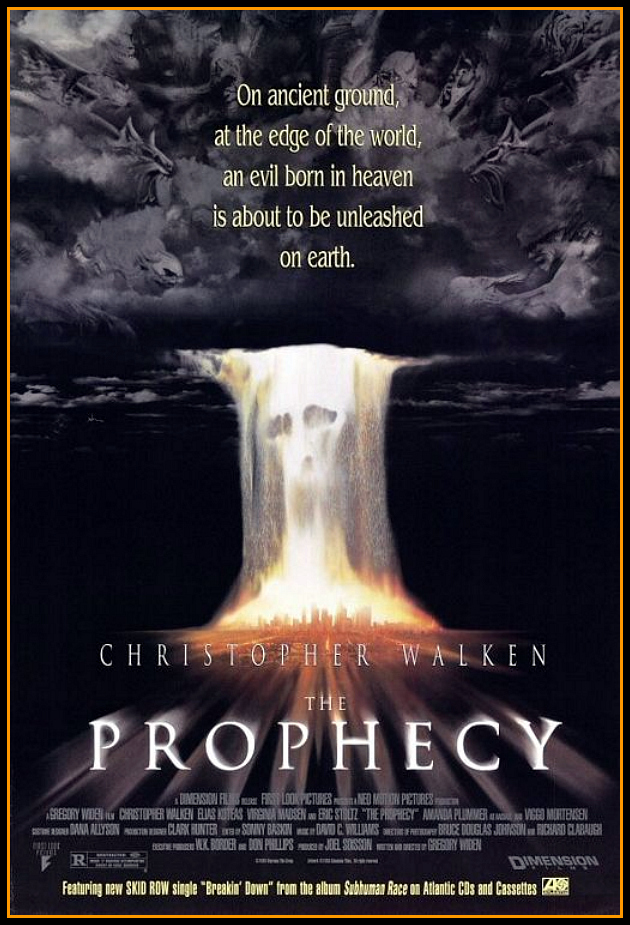
I first found out about this little cult film starring the very awesome Christopher Walken around 1993 or so when I was at the local Waldenbooks (yes there used to be bookstores not named Barnes & Noble or Borders back in the day) looking at the latest issue of Fangoria. Inside the magazine they were doing a brief feature on an upcoming horror film tentatively called God’s Army. All I saw was that it was to star Christopher Walken and it had gore and angels in it. That alone peaked my interest and I was looking forward to seeing it in the theaters. Almost two years passed and nothing about it was ever heard again until I visited the video rental place near my house and saw a VHS tape (yeah, those big videocassette thingies) with the title of The Prophecy and starring Christopher Walken.
This was the film I was so hyped to seeing in the theaters. The title had changed from it’s earlier (and much cooler) one of God’s Army. It would seem that it’s film distributor had little to no faith in the box-office potential of the film and just delayed it’s release to the point that when it did come out no one knew about it barely anyone saw it. It was a real damn shame since filmmaker Gregory Widen made such a good film that was able to mash-up horror, angels and a detective story all in one without creating a mess of things.
The Prophecy was about the war in heaven we were never taught about in Sunday school. We all know about the war in heaven where Lucifer and the rebel angels who followed him tried to overthrow God. That didn’t go over so well for Lucifer and he and his band of fallen angels were cast out into Hell by God and his right-hand man the Archangel Michael. This film talks about the second war in heaven soon thereafter which no one outside those who wrote little-known apocryphal texts about it (and being apocryphal they never were included in the Bible). This war now had a new group of angels led by the Archangel Gabriel rebelling against God for choosing humans (talking monkeys as these new rebels called them) above all living creatures including the angels themselves for God’s love. This war was now in a state of stalemate after countless millenia, but a prophecy about a soul so dark and evil was to be the tipping point for either side. This particular soul was to be found on Earth and whoever acquires it would break the stalemate and finally bring this second war to an end.
With this in mind we have Walken as the Archangel Gabriel coming down to Earth to look for this soul so he can finally win the war for his side (which also means the end of mankind). It’s the angel Simon (played by Eric Stoltz) who comes down to stop him from getting this soul or, at the very least, hide it from Gabriel. With these two factions of angels vying to acquire this soul we have a Detective Thomas Daggett smack in the middle of the case investigating all the weird happenings and deaths surrounding the battle between these two factions. The dead bodies of angels begin to appear on morgue slabs looking like eyeless, hermaphroditic specimens and angelic script found in crime scenes brings Daggett back to his time studying to be a priest before images of angels warring amongst themselves breaks him down and he quits the seminary to become a cop instead.
It would come down to these three factions racing against time to acquire this dark soul.
The film is not as gory as it’s feature in Fangoria made it out to be, but it is quite violent and bloody that I understand why it got the horror label attached to it. It’s more a dark fantasy thriller more than horror. It’s rare in today’s film that we see angels portrayed as the bloodthirsty beings that the really are. The film even points out this oft-ignored detail of God’s messengers. Angels are always the ones God sends to punish or send a very serious message to his chosen beings that is Man. The Prophecy shows this aspect of angels in full light and how their attitudes about humanity might lead some of them to hate God for raising Man above even them.
Christopher Walker does a great job conveying Gabriel’s hate and contempt for humans. His Gabriel is like one of those pundits always on tv (both liberal and consevative) who are so into their sides’ message that they never see the other side as anything but the enemy. One could almost say that Walken’s Gabriel is like then apocalypse-hungry version of Glenn Beck and Keith Olbermann in one body. This is not to say that Walken goes over-the-top with his performance. In fact, he’s quite subdued in how he uses those many tics and voice mannerisms a whole cottage industry has grown around in.
Walken’s portrayal of Gabriel infuses what could’ve become a one-note villain with lots of layers and complexities that the rest of the cast were able to play off from. His character would be terrifying one moment then smoothly switch over to being funny and charming then back to terror. It’s due to his great performance that the other cast members like Stoltz as the weary, loyal angel Simon and Koteas as the fallen religious cop Daggett were able to bring their own performance to another level. This is quite a feat since the dialogue in the film was a mixed bag of horror cliches and interesting Biblical-speak about secret wars, apocryphal books and prophecies. The film even has a nice appearance of the first fallen angel himself and none other than Viggo Mortensen plays Lucifer.
The Prophecy does have a feeling that it was always one misstep away from becoming an awful film. This had happened with 2010’s Legion and did that film about angels and the apocalypse turn out to be a huge steaming pile of shit-turd. But while Dimension Film saw the film fall over on the side of bad for myself and those who have come to admire and love this cult classic the film stayed balance between good and bad. Widen’s film never went over to the side of becoming a truly great film, but it also never fell on the side that Legion ended up on. What Prophecy ended up becoming was a film that was almost grindhouse in nature, but even then it still looked too good with too many good performances to be given that label. The fact that it contains one of Christopher Walken’s best performances speaks well of a film that many critics during it’s early days had dismissed as just another bad horror film.
In the end, this film became just one of the many little-gems that got lost in film studio money politics. I definitely would recommend this cult film to people who haven’t seen it, but I would tell them to stop at just this film and not even go near the four sequels which came after it.