Dallas Snubs Lisa Marie


I’m now officially bored with groups of people voting for and handing out awards.  However, I do have to mention one more film critics group that announced their “best-of-2010” selections earlier today.

The Dallas-Fort Worth Film Critics Association announced their picks and, while the winners are pretty much the same films and performances that everyone else has honored this year, I still find it fascinating that there is apparently a Dallas-Forth Worth Film Critics Association.  I mean, I live in Dallas and I love my city but it’s not like we’re Los Angeles or New York.  Dallas has two newspapers — the Dallas Morning News and the weekly Dallas Observer.  Forth Worth has the Star Telegram and that’s about it.  Of course, the towns surrounding the Dallas/Ft. Worth metroplex all have their own local papers but for the most part, everything is owned and published by the same company that puts out the Morning News.  So, regardless of whether its political endorsements or film reviews, we’re not exactly dealing with a lot of editorial diversity.

And, of course, I haven’t even start to get into the main issue — which is that I’m not a member!  I’m an opinionated, online film critic from North Texas!  Where’s my freaking membership!?  Is it because I’m a woman?  That’s it, isn’t it?  All you good old boys just don’t realize that the glass ceiling hasn’t just been cracked, it’s been shattered…

Oh, wait.  I just visited the official site of the Dallas/Ft. Worth Film Critics Association and apparently, 11 of the 32 members are female.  And apparently, once you join, you have to pay dues…

Never mind. 🙂

Plus, I noticed that Gary Cogill is a member and if you live in DFW then you know that Gary Cogill is just da man.
Anyway, here’s their list of winners:

TOP TEN:
1. The Social Network
2. The King`s Speech
3. Black Swan
4. 127 Hours
5. Winter`s Bone
6. Inception
7. The Fighter
8. True Grit
9. The Town
10. The Kids Are All Right

(Really?  The Town and The Kids Are All Right make the top ten?  I don’t know, maybe I should demand membership becaue it seems like they kinda need me…)

BEST PICTURE: The Social Network

BEST DIRECTOR: David Fincher, The Social Network

BEST ACTOR: James Franco, 127 Hours

BEST ACTRESS: Natalie Portman, Black Swan

BEST SUPPORTING ACTOR: Christian Bale, The Fighter

BEST SUPPORTING ACTRESS: Melissa Leo, The Fighter

BEST SCREENPLAY: The Social Network (Bleh, give a mainstream, elitist like Aaron Sorkin all the awards you want, he’s still going to hate on us for being from Texas…)

BEST FOREIGN FILM: Biutiful

BEST DOCUMENTARY: Waiting for Superman

BEST ANIMATED FILM: Toy Story 3

BEST CINEMATOGRAPHY: 127 Hours

RUSSEL SMITH AWARD: Winter`s Bone

Hey SAG! Where’s Jacki?


Is there any organization out there right now that isn’t handing out either awards or nominations?  Earlier today, The members of the Screen Actors Guild became the latest organization to join in the fun when they announced their nominations for the best film performances of 2010.

Here’s the nominees.  I apologize, in advance, for the lack of sarcastic commentary but I have a headache and, as a result, my wit is sleeping on the couch for now.

Ensemble:
Black Swan
The Fighter
The Kids Are All Right
The King’s Speech
The Social Network

Actress, Lead:
Annette Bening, The Kids Are All Right
Nicole Kidman, Rabbit Hole
Jennifer Lawrence, Winter’s Bone
Natalie Portman, Black Swan
Hilary Swank, Conviction

Actor, Motion Picture
Jeff Bridges, True Grit
Robert Duvall, Get Low
Jesse Eisenberg, The Social Network
Colin Firth, The King’s Speech
James Franco, 127 Hours

Supporting Actor
Christian Bale, The Fighter
John Hawkes, Winter’s Bone
Jeremy Renner, The Town
Mark Ruffalo, The Kids Are All Right
Geoffrey Rush, The King’s Speech

Actress, Supporting
Amy Adams, The Fighter
Helena Bonham Carter, The King’s Speech
Mila Kunis, Black Swan
Melissa Leo, The Fighter
Hailee Steinfeld, True Grit

Well, okay, maybe I’ll make a few comments along the lines of “Yay for the love shown to Natalie Portman, John Hawkes, James Franco, Jennifer Lawrence, and Mila Kunis!”

But seriously, SAG, where’s Animal Kingdom’s Jacki Weaver?  I mean, I can understand why Noomi Rapace was snubbed.  The Mainstream doesn’t want to remind people that there was a perfect Lisbeth Salander before Rooney Mara.  That’s how the game is played.  That’s why the people over at awardsdaily.com are already trying to claim David Fincher’s remake of The Girl With The Dragon Tattoo as the film to beat for best picture next year.

But nobody’s remaking Animal Kingdom.  There’s nothing wrong with admitting that, in a year of excellent female performances, few were as a note perfect and unexpected as Jacki Weaver’s.

The National Board Of Review: I Give Up!


The rather enigmatic National Board of Review announced their selections for the best films of 2010 today.  The NBR is traditionally considered to be the first precursor to how the actual Oscar race will shape up.  Typically, those honored by the NBR are, at the very least, nominated by the Academy.  Strangely, nobody seems to be sure just who exactly makes up the membership of the NBR.  As far as I can tell, it appears to be a collection of film professors and cable tv executives.  It wouldn’t surprise me to discover that the NBR is actually some sort of Illuminati conspiracy or MK-Ultra experiment designed to keep American filmgoers from thinking for themselves.

Anyway, as I look over this year’s award winners, all I can say is that I give up.  If my reaction to Avatar indicated to me that I’m totally out-of-step with mainstream opinion, then the current Pavlovian acclaim of the Social Network proves it.  I will never be a part of the mainstream and it’s not by choice.  It’s just I am apparently thoroughly incapable of understanding how the mainstream brain works. 

So, that’s what the National Board of Review taught me today.  I am destined to always be alone, railing against the dying of the light.  Thank you for the insight, assholes.

Anyway, here’s this year’s award winners:

Best Picture: The Social Network (Don’t get me wrong, the Social Network is a good movie.  It’s just not that good.) 

Best Director: David Fincher, The Social Network

Best Actor: Jesse Eisenberg, The Social Network (I am so sick of hearing that this is Jesse’s “breakthrough” role.  Jesse’s breakthrough was in Adventureland, long before the mainstream ever decided to embrace him.)

Best Actress: Lesley Manville, Another Year (Haven’t seen it yet)

Best Supporting Actor: Christian Bale, The Fighter (Another movie that I will see when it opens later this month.  Still, Bale should have been nominated for American Psycho back in the day.)

Best Supporting Actress: Jacki Weaver for Animal Kingdom (Yay!  This award gives me hope.)

Best Animated Feature: Toy Story 3 (yay!)

Best Documentary: Waiting For Superman (Yes, my favorite movie of the year —Exit Through The Gift Shop — was totally ignored.)

Best Ensemble Cast: The Town (Bleh.  So I guess that would include Jon Hamm, who gave such an amazingly bad performance in this film?)

Breakthrough Performance: Jennifer Lawrence, Winter’s Bone (Another yay but you know all the mainstream is going to offer her is a role in a Twilight rip-off and maybe a Maxim cover shoot.)

Best Adapted Screenplay: Aaron Sorkin for The Social Network (Fuck Aaron Sorkin and his elitist, sexist, technophobic script.)

Best Original Screenplay: Chris Sparling for Buried (which I didn’t see, mostly because I’m claustrophobic and the movie is called Buried.)

Ten Best Films Of The Year (in alphabetical order):

Another Year

The Fighter

Hereafter (which sucked!)

Inception (yay!)

The King’s Speech (I’m actually really looking forward to seeing this)

Shutter Island (kinda bleh but enjoyable)

The Town

Toy Story 3

True Grit (another one I can’t wait to see)

Winter’s Bone (yay!)

Yep, you read that right.  No awards for such presumed favorites as James Franco and 127 Hours, Black Swan, or The Kids Are All Right.  But you better believe they found room to honor a shallow, pandering film like Hereafter.

Finally, here are the Top Ten Independent Films of 2010, according to the toadsuckers at the National Board of Review:

Animal Kingdom (yay!)

Buried (Now I guess I have to see it)

Fish Tank (yay!)

The Ghost Writer (yay — kinda)

Greenberg (bleh)

Let Me In (another kinda yay)

Monsters (shrug)

Please Give (yay!)

Somewhere (going to see it when it opens down here, Sofia Coppola is my role model)

Youth in Revolt (shrug, it’s neither bleh nor yay)

You can read the full list of winners at The Wrap.

Anyway, in order to show just how exactly I feel when confronted with mainstream thought and opinion, here’s an old picture of me with a tampon stuck up my nose.

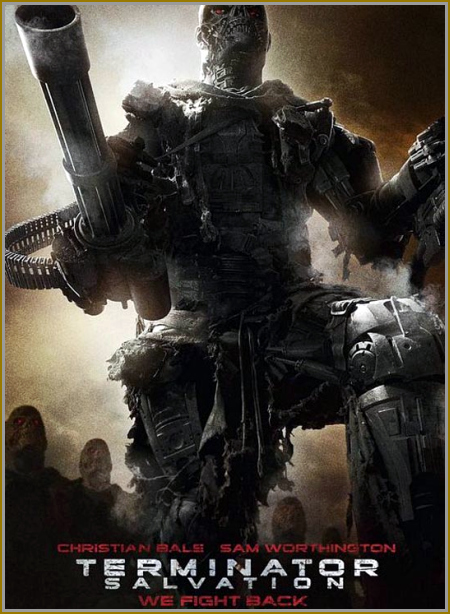
Review: Terminator Salvation (dir. by McG)


It has been 25 years since a certain James Cameron introduced the film-going public to the post-apocalyptic world of Judgement Day. While he’s never really fully shown the war-torn future ruled by the machines in the the two films he directed in the Terminator franchise he does show glimpses of it. It’s these glimpses of desperate humans fighting to survive against Skynet and its machine hunter-killing robots which have always intrigued and made its fans salivate at the thought of seeing it realized. Terminator 3: Rise of the Machines in 2003 tried to show how it all truly began, but again it just hinted at the future battlefield and not the full-blown war. It is now 2009 and the most unlikely filmmaker has finally shown what the future of Judgement Day looks like. McG’s Terminator Salvation succeeds and fails in equal amounts yet has laid the groundwork for the future of the franchise as a war series instead of of its past as installments of what really is one huge chase film.

There are many things which work in Terminator Salvation and one of them happen to be its director McG. A director who is much-maligned for his too campy Charlie’s Angels set of films would’ve been the last name to look to for a restart to the stalled franchise. His direction of this fourth entry in the series was actually very well-done. There’s none of the cartoony and way over-the-top action set-pieces of his Charlie’s Angels past. Instead he moves the film along in a brisk and energetic pace with very little downtime for much introspection. It is this pacing which makes this a good and, at times, an above-average action-film but also serves to make any of the scenes questioning what it is to be human (once again) and machine seem tacked on. The first three films in the series have delved into this theme and question too many times for a fourth attempt make it seem any more relevant than the previous times.

McG went out to make a war entry to the series and to an extent that’s what he did. While there are chases to be had it doesn’t necessarily mean its all about John Connor once again (though the film does make it a point of targeting him again in its own fashion). Terminator Salvation has finally shown what the world looks like after the events of the third film and what had been hinted and teased at in the first two. The world is a desolate place with ruins of landmarks to give the audience a reference point. We see Los Angeles a tumbling and crumbling wreck which looked eerily like something out of the recent Fallout 3 scifi-rpg game. Even San Francisco makes a post-apocalyptic appearance as a major Skynet headquarters. McG achieves this post-apocalyptic look by bleaching out the film’s color palette to the point that browns and greys dominate. He actually achieves to add grittiness to this film which his past films had never shown him having the ability to do. While this film won’t sway people to admiring his skill as a filmmaker it does show some  growth. Then again he does have a hold of a film series which is nothing but B-movies elevated through bigger budgets and access to the latest in film FX. If I have any gripe to point out about the action in the film it’s that there’s not enough of it to truly convey a “War Against the Machine” scenario. We get these tantalizing hints, but not something on par of what a fuure war should look.

The budget could be seen on the screen as the film uses a combination of CGI and practical effects to pull off a much more complex robotic army for Skynet. It’s the robots and machines which keeps bringing the audience back each and every time the series releases a new entry. We don’t just have the Human Resistance fighting the typical T-800 or even the more advanced T-1000 or T-X. We get the earlier versions of these human hunting and killing machines. From a brutish and zombie-like T-600 we see in the LA-scenes to newer and bigger specialized Skynet soldiers like the anime-inspired mech Harvester which towers several stories high and literally harvests humans it finds to take back to SKynet’s R&D bases. When the original Terminator does make an appearance it’s both a welcome and a surprise as McG’s technical wizards find a way to bring back the original exactly the way it’s supposed to look. I’m sure the Governator of California would want to have that physique and youth back.

As an action-film Terminator Salvation works well enough when the action appears on the screen. Now as a film that tries to delve into the philosophical trappings of the series it doesn’t so much as fail and sink the film, but almost does which would’ve been a shame. While not the worst in the series in terms of storytelling it does come across as very scattershot in what story it wants to tell. The film actually has three ideas which could’ve been used to make it’s own film. Is the film a story of John Connor and his rise to his prophesized leadership of the Resistance (he’s a leader of a branch of fighters, but not yet of the whole group in this film)? Or is this film about the search and attempt to make sure the person who will be Connor’s father stays alive to allow what transpired in the past to happen (time-travel can be a tricky and confusing thing to comprehend)? Or is Terminator Salvation the story of the new character Marcus Wright and his quest to find out just who, or what he is exactly? It’s all three of those and all three weren’t explored enough to make one care too much for the story being told. There’s great ideas in all three but trying to combine them into one coherent storyline mostly falls flat and uninsipiring for a film trying to be the war movie in the series. For what are war movies mostly but attempts to show inspiration in the face of desperation. There’s very little of that in this film. If the writers had been given a chance to further streamline the story into one major arc then this film would have benefitted greatly in the long run.

With acting very tightly tied-in with the story being told it’s only logical that the performances by the cast rarely go beyond acceptable. Christian Bale’s John Connor is always dour and brooding. He’s almost becoming a typecast for any role that requires for him to be the down man in any party. He does this ably, but he doesn’t bring anything to the role which hasn’t already been explored in past entries. His performance does show hints of mental instability as the weight of being the savior and prophet of the human race may be starting to get to him. The other two pivotal roles in the film have more meat to play around with. Anton Yelchin as the teenage Resistance fighter destined to become John Connor’s father in the past shines in the scenes he’s in as he elevates a bland script with some youthful energy and hints of the adult Kyle Reese fans of the series know so well. Then we arrive on the newest character in the series: Marcus Wright.

Little-known Australian actor Sam Worthington was recommended by James Cameron for the role of Marcus Wright. Like Anton Yelchin’s performance, Worthington’s work in the role of Wright saves the film from mediocrity. While it is not a start-turning performance by any means Worthington does make it difficult not to pay attention to him throughout the film. The man has presence and every scene he is in shows why Cameron himself has faith in being the latest to carry the Terminator torch. The rest of the cast is quite a throwaway in that we never really get to know any of them and invest anything in their well-being.

Terminator Salvation is a very frustrating film in that there’s so much great ideas to mine. The series has always tried to explore such themes as fate, predetermination and human free will. While the third film in the series was quite lacking in memorable action sequences this fourth entry makes a mess of trying to explore these themes. Again, it seems as if the film’s script was rushed into production with very little doctoring and as the production continued forward no one bothered to point out just how average and bland the storyline does sound despite being the most overly complex of the series.

One thing I am sure of is that the one person people thought would be the weakest link in this film instead happens to be its strongest. McG and some inspired acting from two newcomers keep the film from becoming a total failure. Terminator Salvation is an able and, for most of it’s running time, a very good action film with brisk pacing and energy in its action sequences. Enough of these elements keeps the film’s fractured and scattershot of a storyline from sinking the film into total failure. As a summer tentpole action film it delivers on some of what it promises, but it could’ve been more and better. Some would settle on calling this entry in the franchise a failure, but I am always an optimist and a fan of action thus I’ll land on calling this film a successful failure.

Past Review: The Prestige (dir. by Christopher Nolan)


2006 has been a quiet year for event films. The predicted blockbusters this past summer pretty much underperformed despite some being exactly as good as I thought they’d be. Other than Johnny Depp and the gang’s Pirates of the Caribbean: Dead Man’s Chest, every blockbuster didn’t blow the industry out of the water. It’s a very good thing that I had smaller films to tide me over. This year has been a very good ones for some independent-minded and smaller films which came out during the slow first couple months of the year and during the graveyard release months between the end of summer and the start of the late year holidays. I’ve already had the chance to see such very good films like Running Scared from Wayne Kramer and Hard Candy from David Slade to The Proposition from John Hillcoat. I am glad to say that Christopher Nolan’s film adaptation of Christopher Priest’s novel, The Prestige is another non-blockbuster that excites, entertains and, in the end, keeps the audience mystified but not confused.

I’ve read Christopher Priest’s novel about dueling late 19th-century London magicians. It’s a novel written in epistolary format with each chapter and section written as entries into the journal of one of the main characters in the story. The novel itself is pretty straightforward as it tells the story in near chronological order. I was hesistant to embrace this film adaptation when I first heard about it since alot of the mystery of of the story wouldn’t translate so well in film if they followed the strict order of how the story was told in the novel. For Christopher Nolan and his brother, Jonathan, to just adapt the novel straight-out would’ve made for a dull and boring mystery-thriller. I was glad that the Nolan brothers were inventive enough to borrow abit from Christopher Nolan’s first feature film, Memento. Their film adaptation of The Prestige doesn’t go backwards in its narrative, but it does mixes up the chronological order of the story somewhat, but not to the point that Tarantino does in Pulp Fiction and Kill Bill. The two Nolans fudges abit with the timeline to add some backstory filler to help give the characters that Christian Bale and Hugh Jackman portrays with the reason for their pathological obsession with each other.

Christopher and Jonathan Nolan’s screenplay for The Prestige was able to keep the mystery of the story intact, but it also keeps the amount of red herrings in such films to a minimum. Michael Caine’s character, Harry Cutter, opens up the film explaining just exactly what constitutes a magic trick on stage. How it’s divided into three parts. First, there’s “The Pledge” wherein the magician shows the audience something ordinary he or she will use in the trick. Soon, the magician will follow this up with “The Turn” where the abovementioned ordinary object does something extraordinary in front of the audience. The pay-off of the magician’s trick is “The Prestige” where the audience’s astonishment occurs as they fail to deconstruct and figure out the means of the trick. That’s pretty much the film in a nutshell. It’s one big magic trick. The clues are there for the audience to see, gather and extrapolate their answer to the mystery that is the story. The screenplay doesn’t treat the audience as if they need to be hand-held throughout the film. In fact, anyone who pays attention will be able to solve one-half of the mystery by the first hour. I won’t say exactly whose half of the mystery it will be but people will be kicking themselves afterwards if they don’t figure it out right away.

This magic trick of a film does have its many underlying layers of themes to add some complexity, drama and tension to the characters of Alfred Borden (Christian Bale) and Rupert Angier (Hugh Jackman). I’ve already mentioned that throughout the film their mutual obsession about each other is due to a backstory detailing their past. A past where they were initially friends — rivals even — and apprentices to the magician Milton (played by Ricky Jay) and Harry Cutter (excellently played by Michael Caine as the only voice of reason throughout the film) who creates and maintains the devices used in all the stage tricks. Borden and Angier’s obsession is not just in ruining and sabotaging each other’s magic tricks and lives, but also trying to find out each other’s secrets as they both learn magic tricks which amaze and thrill the gentry of London’s stage. From the beginning of the film these two characters begin a journey towards a path of destructive behavior which puts not just each other’s lives at risk, but those who they care about. All of it in the name of humiliating and upstaging the other due to a tragic incident early in their mutual careers. These two individuals were not sympathetic characters and I applaud Christopher Nolan and his brother for not softening up their hard edges.

Most adaptors will try to make a story’s characters more sympathetic and likable. They went the opposite in The Prestige. But even these two dark characters continue to exude the charisma and strong personalities that the audience will root for one or the other. Should they root for the charismatic and born shownman that Hugh Jackman’s Angier character plays or go for the perfectionist Borden character Christian Bale plays. A perfectionist whose technical skills surpasses that of Angier’s but whose introverted and brooding personality makes him little or no stage presence.

Both Jackman and Bale play their characters well. The film wouldn’t be so good if it wasn’t for the work of these two actors. It helps that they’re surrounded by quality supporting character like Michael Caine as the seasoned, veteran mentor to the dueling magicians. Even Scarlett Johansson does very well with the part she’s given. It’s a part that many sees as more of a throwaway character. A piece of very good-looking distraction for both the story and the audience. But she gamely plays the role of pawn for both Angier and Borden. Unlike Michael Caine’s character who remains the singular voice of sanity in the film, even Johansson’s character of Olivia gets pulled into the obsessions and betrayals that’s plagued both Angier and Borden. But in the end, she’s just part of the process of “The Turn” and if people have been watching the film closely right from the beginning then she’s also a clue as to the secret of one of the amazing magic tricks shown by the two magicians.

The Prestige also has a distinct look about it. The 19th-century London just before the start of the new millenium gives it a certain sense of Victorian-era familiarity. Production designer Nathan Crowley shows a London at the height of its Gilded Age, but soon gives way to a certain steampunk look as inventor Nikola Tesla makes an appearance during an integral part of the story. David Bowie portrays Tesla as an eccentric genius whose search for the secrets of the universe will lead to the discovery of what many of that era would consider magic. It’s the ingenius looking technology created for the Tesla sequence which finally gives The Prestige it’s root in fantasy and science-fiction. The film doesn’t dwell on this new development but from that part of the story and until the end, the film takes on a look and feel of a steampunk mystery-thriller. There’s not enough films that tries to mine this new subgenre and I, for one, am glad that Christopher Nolan added this new dimension to the film’s overall look.

In the end, The Prestige really needs to be seen to be appreciated and for people to make up their minds about the film. Some will see it as a thriller with twists and turns that doesn’t insult the intelligence of its audience. Some may see the film as just one large gimmick from start to end. Those people will probably be correct as well. The film at its most basic level is one long magic trick with all three acts. It has “The Pledge” which is then followed up by “The Turn” and then ends with “The Prestige”. It will be up to each individual who sees the film to make the final decision as to whether they’ve bought into all three acts of the magic trick that is The Prestige, or come away having felt like they’ve wasted their time. I’ve not come across many who felt like the latter, even those whose own feelings about the film don’t reach the same level of praise as I have for Christopher Nolan’s latest offering. All I know is that this is a film that delivers on its premise to confound and amaze. It also continues to validate my views that Bruce Wayne and Batman are in very good hands with Christopher Nolan at the wheel. The Prestige was easily one of the best film of 2006.