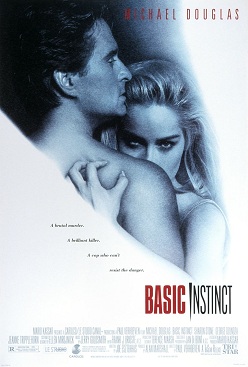
Basic Instinct (1992, directed by Paul Verhoeven)


Nick Curran (Michael Douglas) is a San Francisco police detective who, along with his jolly partner Gus (George Dzundza), finds himself investigating the ice pick-stabbing of a rock star.  The main suspect is glamorous writer Catherine Trammel (Sharon Stone), who is obviously guilty but manages to outsmart all of the men investigating her by not wearing panties during her interrogation.  Nick finds himself drawn to Catherine, despite his own relationship with with psychologist Elizabeth Garner (Jeanne Tripplehorn).  The more Nick digs into Catherine’s past, the more he becomes obsessed with her but also the more he suspects that she may be a serial killer.  This is mostly because Catherine obviously is a serial killer and anyone should have been able to figure that out.  Instead, Nick, an experienced homicide detective, just gets turned on.

It’s strange to remember how seriously people took Basic Instinct when it was released in 1992.  People debated whether it was a throwback to Hitchcock or just a dirty movie.  Feminists debated whether it was empowering or exploitive.  For several years afterwards, every show from The Simpsons to Seinfeld parodied the interrogation scene.  (In Seinfeld’s case, it helped that Wayne Knight appeared in the film as the district attorney who kept shifting in his seat to get a better view.)  Sharon Stone was described as being the new Grace Kelly and, for a period of years, was the subject of fawning profiles in which she was asked about the future of sex in movies.  For a while, she was inescapable.

Sharon Stone, to be fair, did make the role of Catherine her own.  It’s impossible to imagine some of the other actresses considered — Michelle Pfeiffer, Geena Davis, Mariel Hemingway, or Meg Ryan — in the role.  After a decade of not getting anywhere with her film career, Stone was hungry to be a star and was also willing to do things on camera that other name actresses would have refused.  Sharon Stone was not the next Grace Kelly and Catherine Trammel was ultimately more of a sexual fantasy than an actual character but Stone still deserves a lot of credit for her uninhibited performance in the role.  Though Stone later said that she didn’t realize what was actually being filmed during the interrogation scene, it’s her confidence and her unapologetic sensuality that makes the scene compelling.  Her performance has the energy that the sleepwalking Michael Douglas lacks.

Today, Basic Instinct is best-viewed as a satire.  Director Paul Verhoeven sends up both the cop film and the erotic thriller with a movie that turned everything to eleven.  The film’s sensibility is established by the fact that Michael Douglas’s “hero” is nicknamed Shooter because he killed two innocent people while high on cocaine.  The film’s main joke is an obvious one.  Everyone is too busy staring at Sharon Stone to notice that she’s about to stab them in the back with an icepick.  Joe Eszterhas’s script was vulgar to the point of parody and, fortunately, director Paul Verhoeven understood that even more than Eszterhas did.

Basic Instinct has been imitated countless times but it’s never been equaled.  To that, the credit is owed to Sharon Stone and Paul Verhoeven.
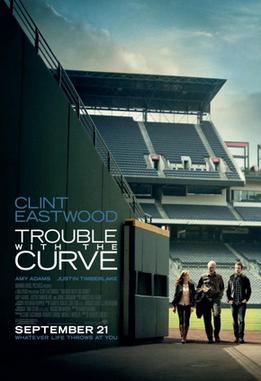
 

I Watched Trouble With The Curve (2012, Dir. by Robert Lorenz)


I love baseball  and all of its traditions.

I love the idea that a pitcher has a mental connection with his catcher.  I love the stories of the minor leaguers who get their chance in the majors and who stun the world by coming out of nowhere to hit a home run on their first at bat.  I love all the stories about which batters corked their bats and which pitchers could still manage to get away with throwing a spitball.  I love baseball because watching it is a relaxing way to spend an afternoon but at the same time, the game is unpredictable.  Just one hit can change the momentum of an entire game and, until that final out, the game could be won by anyone.  I especially have a place in my heart for the legendary baseball scouts, the grouchy old men who would drive out to the middle of nowhere to watch a game and search for the next great homerun hitter.

That’s one reason why I hated Moneyball.  I thought Brad Pitt, Philip Seymour Hoffman, Chris Pratt, and Jonah Hill all did a good job and I loved Brent Jennings’s performance as Ron Washington but I hated the idea that the scouts and their instincts weren’t necessary because everything could just be determined by sabermetrics.  The idea that an algorithm could tell you everything you needed to know about how to put a team together felt like a crime against everything that makes baseball special and it deeply offended me as a fan.  Moneyball may feature a baseball team but it’s a movie about business, not the game.

That’s why I’m thankful for Trouble With The Curve.

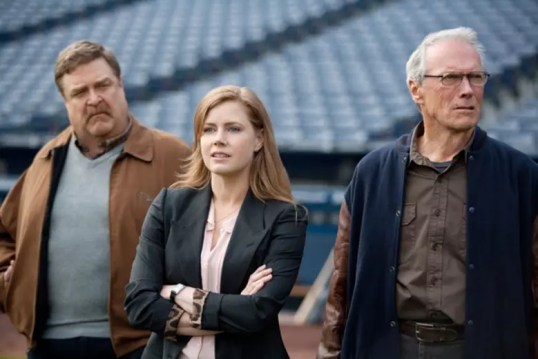
Clint Eastwood stars as Gus Lobel, one of those plain-spoken, no-BS scouts that I love so much.  All of the team owners might be into sabermetrics but Gus knows that the best way to scout a player is to actually hit the road and see him play.  For Gus, scouting is all about instincts and his own gut feeling.  Gus is everything that I love about baseball.  He’s knows the game, he knows the players, and he doesn’t need an algorithm to tell him whether or not someone should be on the field.

The movie is about Gus scouting a player who has trouble hitting the curve.  That’s something that Gus notices but the algorithm overlooks.  Accompanying Gus is his daughter, Mickey (Amy Adams), who is proud to have grown up surrounded by plain-spoken, unpretentious baseball scouts like her father and who doesn’t understand why Gus never took her on the road when she was younger.  Mickey falls for a younger scout named Johnny (Justin Timberlake), their love based on their shared knowledge of baseball.  I liked Mickey and Johnny as a couple and I appreciated the scenes where Mickey and Gus worked on their strained relationship but the best thing about this movie is that  Gus gets to prove that he knows more about baseball than all the young whipper-snappers who think they understand the game.

Trouble With The Curve is a tribute to everything that baseball is truly about.  It’s a movie that loves the game as much as I do.  Clint Eastwood and Amy Adams are a perfect father/daughter duo.  Who needs an algorithm when you’ve got Clint and Amy?

RUDY! RUDY! RUDY!! 


It’s Good Friday and I’ve taken the day off from work to relax and spend some time in reflection and prayer on this important day on the Christian calendar. I woke up this morning and wasn’t quite ready to get out of bed, so I started flipping through Netflix’s selection and came across RUDY (1993). I try not to overwatch RUDY because I love the way it makes me feel, and I don’t want it to become so familiar that I lose that feeling. But it’s been a couple of years, so I decided to give it another spin. 

As I’m sure most of you know, RUDY is based on the life of Daniel “Rudy” Ruettiger (Sean Astin), the 3rd of 14 children from a family in Joliet, IL, who dreamed of playing football at Notre Dame. There were a number of obstacles to that dream, namely that his family didn’t have much money, he didn’t have good grades, he was 5’6” tall and he didn’t have much football talent. What he did have was heart, and we watch Rudy persevere as he goes to school at neighboring Holy Cross while trying to get accepted in Notre Dame. Nothing ever comes easy for Rudy, but through determination, hard work, and sheer will he eventually makes his way to Notre Dame, joins the football team’s practice squad, and gets to suit up for one game in his senior year. 

RUDY is a movie that affects me deeply. It really shouldn’t come as a surprise as it was written by Angelo Pizzo and directed by David Anspaugh, the team behind HOOSIERS (1986), one of my very favorite movies of all time. While there will never be a movie about my life, I know all too well what it’s like to love something so much, but not really be designed for it. In RUDY, the character Fortune, played by Charles S. Dutton in an incredible performance, tells a discouraged Rudy, “You’re 5 foot nothin’, 100 and nothin’, and you have barely a speck of athletic ability. And you hung in there with the best college football players in the land for 2 years.” Those were basically my specs when I was a senior playing high school basketball in a small town in Central Arkansas (5’7,” 125 and I couldn’t jump). I loved the game so much and put everything I had into it during my pee wee, junior high and senior high years. In 1991, I was named to the Arkansas’ All-State high school basketball team. Due to my lack of athleticism, I would not be able to play at the collegiate level, but I’ve always felt pride that I was able to maximize what talent God did bless me with in the game of basketball. That hard work ethic has served me well throughout my life. It’s so inspiring to watch a movie where a person perseveres against difficult odds, faces disappointments, keeps moving forward, works harder than everyone else, faces more obstacles, and then finally gets to see that work pay off. In a day and time where so many want all the rewards that life has to offer, without putting in any of the work, the story of RUDY stands the test of time and needs to be seen and heard. 

THE UNTOUCHABLES (1987) – Happy 70th Birthday, Kevin Costner!


There was a time in my life, before I could drive, when I would beg my parents to stop at the video store every time we went to the neighboring town of Conway, Arkansas. The town I grew up in was too small to have more than just a gas station, so this movie buff had to take advantage of every trip to town. One night when we were headed home, my parents relented to my repeated requests, so we stopped off at Budget Video. I wanted to choose all the movies, but unfortunately mom and dad would also let my brother and sister choose movies from time to time as well. On this particular night, my brother wanted to rent THE UNTOUCHABLES (1987). I don’t remember what I was wanting, but I do remember that it was not THE UNTOUCHABLES. I probably pouted a little bit, but we ended up taking THE UNTOUCHABLES home with us. We turned it on that night, and I’ll gladly admit that I was 100% wrong. THE UNTOUCHABLES immediately became one of my favorite films. Great job, bro!

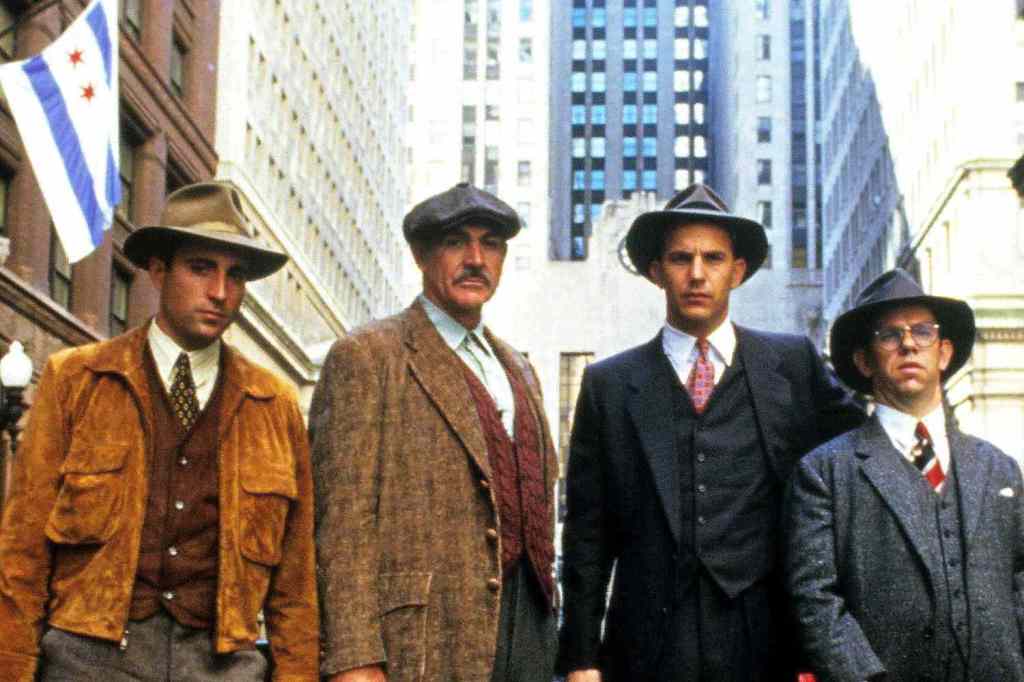
It’s 1930 and Prohibition is the law of the land in the United States of America. Treasury agent Eliot Ness (Kevin Costner) has been given the seemingly impossible task of bringing down notorious gangster Al Capone (Robert De Niro), who supplies booze to nearly all of Chicago. Capone doesn’t just supply the booze, he rules Chicago with an iron fist; and if you’re a local business who doesn’t want to buy his product, he just may blow your ass up! Ness’ job is made especially difficult due to the rampant corruption in Chicago, where everyone from the Mayor, to the judges, lawyers, and law enforcement officers are all on Capone’s payroll, making it pretty much impossible to trust anyone. In a complete stroke of luck, Ness encounters the honest Irish American policeman James Malone (Sean Connery) and asks him to join him in bringing down Capone. With Malone, Ness has found that honest and badass cop who’s not afraid to go up against Capone and his goons. Knowing that most of the police force is already compromised, the two men head to the police academy to try to find another honest cop. This turns out to be another great move as they come upon an Italian American trainee named George Stone (Andy Garcia), who’s a prodigy with a gun. Their last, and greatest move in this humble CPA’s opinion, comes when they accept accountant Oscar Wallace (Charles Martin Smith) to their team. Wallace is convinced that the key to bringing down Capone is trying to build a tax evasion case against him. He’s initially laughed at, but it’s soon apparent that this accountant knows his debits and credits, and his expertise may be just what’s needed to end Capone’s reign of terror once and for all.

I’ve always considered THE UNTOUCHABLES to be a near perfect film. One of the main reasons I find the film so perfect is the direction of Brian De Palma. I’ve been a fan of his “style” for so long, with films like DRESSED TO KILL (1980) and BLOW OUT (1981), but I think he just nails the material here. There are so many great scenes, but the “Union Station” sequence has to be one of the most perfectly choreographed sequences of all time. The building of the tension, the slow-motion shootout when the bad guys arrive, and finally the badass resolution all prove what an absolute master De Palma could be with the right material. De Palma claims that he made up the series of shots as he was filming the scenes at the train station, making the final product that much more impressive. And this all plays out against the background of a “lullaby theme” composed by the legendary Ennio Morricone (THE GOOD, THE BAD, AND THE UGLY). This is what “cinema” is all about.

THE UNTOUCHABLES has an amazing cast of actors to bring its “based on real events” story to life. Kevin Costner was just beginning to emerge as a movie star when this movie was made back in 1987. Especially as a younger actor, Costner was good at projecting both a certain innocence, tempered with the willingness to do what it takes to get the job done once his family and friends are put in danger. And what can you say about actors like Sean Connery and Robert De Niro?!! Connery is so charismatic, wise, and tough as the beat cop who shows Eliot Ness how to beat Capone… ”he sends one of yours to the hospital, you send one of his to the morgue!” He’s a beat cop because he’s incorruptible, and Connery projects that stubborn honesty perfectly. I’m so glad that Connery won an Oscar for this performance, as it would be the only time he would ever be nominated for an Academy Award. He’s amazing in this role, even if his accent is Scottish rather than Irish (a notable controversy at the time). Connery may have won the Oscar, but Robert De Niro matches him scene for scene. His ability to make Capone both charismatic and evil in equal measure is an example of what makes De Niro special as an actor. So many actors phone in these types of broad performances, but not De Niro. I also just think it’s cool that De Niro admitted that his performance was heavily influenced by Rod Steiger’s in 1959’s AL CAPONE. I love Steiger and consider this a wonderful tribute. Throw in a young Andy Garcia, the always underrated Charles Martin Smith, and a creepy Billy Drago as Frank Nitti, and you have one of the better casts ever assembled. I especially became a fan of Garcia based on his performance in THE UNTOUCHABLES.

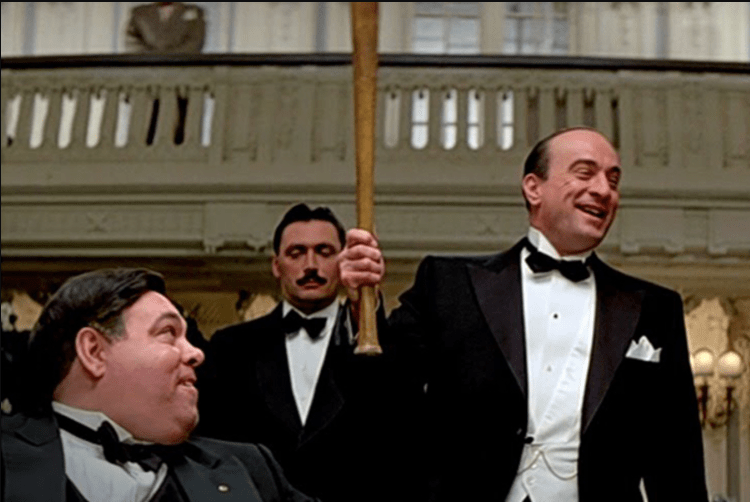
The last person I want to mention is the screenwriter, David Mamet. His screenplay is another perfect element of THE UNTOUCHABLES. The same man who has directed his own films like HOUSE OF GAMES (1987), HOMICIDE (1991), THE SPANISH PRISONER (1997), and SPARTAN (2004) knows how to write a great screenplay. There are so many amazing moments, from the “baseball bat” sequence to the “Stone recruitment” scene, and even Ness’ “he’s in the car” line about Frank Nitti, it’s a muscular screenplay full of big-time moments of audience satisfaction.

At the end of the day, THE UNTOUCHABLES is just a great movie. I still periodically thank my brother for picking it out that fateful day in the late 80’s, and it will always be one of my very favorites. It’s one of those movies that I recommend with zero reservations!

Check out the trailer below, and if you’re smart, you’ll watch one of the great movies of the 1980’s, Brian De Palma’s THE UNTOUCHABLES.

ABOVE THE LAW – Steven Seagal’s action star debut! 


Did any actor have a better opening act than Steven Seagal? His first five movies are all star turns in high quality, enjoyable action films, beginning with ABOVE THE LAW, and then moving forward to HARD TO KILL, MARKED FOR DEATH, OUT FOR JUSTICE and UNDER SIEGE. While UNDER SIEGE has been described as “Die Hard on a boat” and OUT FOR JUSTICE occupies the top spot as my personal favorite Steven Seagal film, today we will focus on the movie that started it all, ABOVE THE LAW, from 1988. 

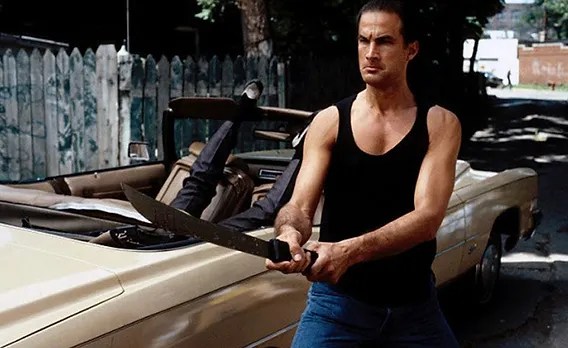
ABOVE THE LAW begins with Nico Toscani (Steven Seagal) providing a voiceover of his early years as a kid in Chicago who became obsessed with the martial arts and who found himself studying with the masters in the orient by the age of 17. He’s clearly a badass. By 22, he’s been recruited by the CIA and is completing missions in Viet Nam. While on a mission, he runs into Zagon (Henry Silva), a CIA torturer, who seems to be able to do whatever he wants with no consequences. After knocking the crap out of Zagon, Toscani quits on the spot and heads back to Chicago to become a tough cop and marry Sara (Sharon Stone). While working a touchy family situation in the Windy City, he stumbles upon a potential drug deal going down soon in the city. He and his partner Delores (Pam Grier) set up the bust, but the product of choice turns out to be C4 explosives, not drugs. Wouldn’t you know that the folks behind these C4 explosives are the CIA and Toscani’s old pal Zagon. Can he stop his old adversary this time and still protect his family?!! 

My favorite Chuck Norris film is from 1985 and is called CODE OF SILENCE. I mention that because there are quite a few similarities between ABOVE THE LAW and CODE OF SILENCE. First, Andrew Davis directed both films. He’s a talented filmmaker who would later direct such solid action films as THE PACKAGE (Gene Hackman & Tommy Lee Jones), UNDER SIEGE (Seagal & Tommy Lee Jones), and THE FUGITIVE (Harrison Ford and an Oscar winning Tommy Lee Jones). I wonder now how this film was made without Tommy Lee Jones?!! Second, both films feature a tough cop who practices martial arts and beats the crap out of corruption within law enforcement. In the case of CODE OF SILENCE, it was the police force itself; in ABOVE THE LAW, it’s the Central Intelligence Agency. It’s my personal opinion that CODE OF SILENCE is Chuck Norris’ finest hour. Steven Seagal gets this same kind of bravado and credibility in his very first film role. That’s truly unique. And finally, both movies feature the awesome Henry Silva as the bad guy. Silva has been a bad guy in so many movies, and he’s just damn good at it. I recently watched him in THE TALL T with Randolph Scott from way, way back in 1957. Damn, his Chink’s a psycho. Combine that with his turn as Billy Score in SHARKY’S MACHINE with Burt Reynolds, and you have a guy who deserves to be in the villain hall of fame. These tried and true elements all help produce a fine feature film debut for Seagal! 

Just one final comment about the movie’s theme… we all would like to think that no one is above the law in the real world. Unfortunately, all we have to do is watch the news to know that’s simply not the case. Our world is full of people who actually are above the law. One of the best things about a movie like ABOVE THE LAW is that we can watch the movie, munch our popcorn, and just pretend for 100 minutes that justice does exist. It may not be completely realistic, but it’s definitely a satisfying thought!

HOOSIERS and a son of a basketball coach!


HOOSIERS is based on the true story of a small high school winning the Indiana state basketball championship in 1954. Gene Hackman plays Coach Norman Dale, the once successful college coach who gets a second chance when he’s hired to coach high school basketball in the tiny town of Hickory, Indiana. It takes some time for Coach Dale to whip the talented, but undisciplined young men into a team, and it also takes a little time for local legend Jimmy Chitwood to decide that he will play basketball again. Chitwood had stopped playing prior to the arrival of Coach Dale, but after watching the way the coach goes about his business, he decides he’ll give it another go. After a rough start, the team starts playing good basketball and starts piling up wins as they make their way towards a potential state championship.

HOOSIERS was released when I was 13 years old, and it has been one of my favorite movies for almost 40 years. Why, you might ask? I’ll start by giving you a little Bradley Crain family history. First, basketball was my life growing up. My dad was a teacher and high school basketball coach. From the earliest days I can remember, my dad was teaching me how to play basketball. He taught me the proper techniques for shooting, and through lots of practice I became very good at it. I’m one of those people who could be referred to as a “gym rat.” The only things I wanted to do growing up were play basketball and go fishing. I have a brother who is one year and 5 days older than me, and he loved basketball too. The competition between the two of us made it difficult at times at home, but it also pushed us to get better. Second, I grew up in a small rural community in Arkansas known as Toad Suck, and I went to school in the small town of Bigelow, Arkansas. Bigelow was classified as a “Class B” school for sports purposes. This was the smallest classification that you could be in, and my class consisted of approximately 40 students. Finally, when HOOSIERS came out I was in junior high and my dream was to win a high school state basketball championship. Our teams were good, and I was still young and naïve enough to believe anything was possible. We even won the district championship my 9th grade year, which was the year after HOOSIERS was released. Alas, the chips didn’t fall our way, and even though we won a lot of basketball games over the next few years, there were no state championships. Now back to the movie!

One of my favorite things about HOOSIERS is the cast of young men hired to play the members of the team. So often in movies, the actors that are supposed to be good at basketball are clearly not. That’s not the case in HOOSIERS. These guys can act and are talented basketball players as well. And what can I say about the cast that includes a marvelous Gene Hackman as the coach, and Dennis Hopper as the friendly, but alcoholic dad of one of the players who “knows everything there is to know about the greatest game ever invented.” Hopper is phenomenal, and his work was recognized with an Oscar nomination.  Finally, as the team is making its way towards the championship, each player is given a moment to shine and do their part to help the team. I liked that. It all makes for an exciting and heartwarming true story that pretty much anyone can enjoy. I still love the movie now just thinking about it!

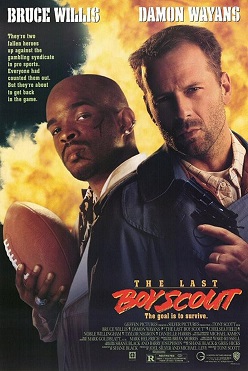
Holiday Film Review: The Last Boy Scout (dir by Tony Scott)


My God, what a violent holiday season!

Like the majority of the films that have been written and/or directed by Shane Black, The Last Boy Scout takes place in December.  It’s not quite as Christmas-y as some of Black’s other films.  I think that I may have spotted a few decorations in the background of some of the scenes.  And there’s a scene where private investigator Joe Hallenbeck (Bruce Willis) discovers that his daughter (played by a very young Danielle Harris) has been drawing pictures of “Satan Claus.”  Otherwise, there’s not a lot of Christmas to be found in this December-set film and perhaps that’s for the best.  Seriously, this movie is violent!  Not even the comedic relief characters are safe from getting a bullet to the head.  This is a film that actually begins with a football player shooting three other players during a game and then saying, “Ain’t life a bitch,” before shooting himself in the head.

The film’s plot isn’t always easy to follow.  Joe is a private investigator who drinks too much and whose partner has just been blown up in front of his house.  (His partner was also sleeping with Joe’s wife so guess who is now a suspect!)  Joe is also hired to act as a bodyguard for a stripper named Cory (Halle Berry).  Cory is dating Jimmy Dix (Damon Wayans), a former quarterback who used to be Joe’s hero.  Then Jimmy got kicked out of the league for gambling and Joe stopped watching football.  Cory says that she has a tape recording that will get Joe back into the NFL.  But then, Cory is brutally gunned down in the middle of the street and the tape is accidentally destroyed by Joe’s crappy tape player.  It’s time for Jimmy and Joe to team up, trade one liners, and uncover the conspiracy.

It all links back to the efforts of football team owner Shelley Marcuse (Noble Willingham) to legalize gambling.  Senator Calvin Baynard (Chelcie Ross) is standing in Marcuse’s way because Marcuse didn’t offer him a big enough bribe.  Marcuse is planning to assassinate the senator and he’s going to frame Joe for the crime because, in an amazing coincidence, Joe used to be a secret service agent until he caught Senator Baynard torturing a sex worker.  Of course, the actual assassination will be carried out by Marcuse’s chief henchman, Milo (Taylor Negron, who is absolutely chilling in the role).  Milo rarely shows emotion and always refers to everyone by their formal name.  (Joe is called Joseph.  Jimmy is called James.)  Milo is also a total sociopath, one who will shoot anyone in the head without a second thought.

Shane Black, who is a genius regardless of what I may think of this particular film, has said that he wrote The Last Boy Scout after he broke up with a longtime girlfriend and he was suffering from depression.  Disillusionment hangs over almost every frame of the movie.  Joe did the right thing and lost his career.  Jimmy lost his family on the same night that he played the best game of his career.  The Senator is opposed to Marcuse’s scheme solely because he’s not getting enough of a cut.  Marcuse is a respected businessman who thinks little of killing strangers.  Jimmy and Joe are heroes not because they’re particularly good but because everyone else around them is just so bad.  This is also very much a movie about guys doing guy things.  I watched it with my brother-in-law and I have to say that I think he got a bit more out of the film than I did.  Then again, I also think my sister Megan also got more out of it than I did so maybe I just wasn’t in the mood to watch so many people get shot in the head.  It happens.

The Last Boy Scout was directed by Tony Scott so, no matter what else you might want to say about it, the movie looks great.  Willis seems a bit bored with the film and Wayans sometimes struggles with the more dramatic moments.  In many ways, the film feels like a precursor to Shane Black’s The New Guys, though Willis and Wayans never have the same chemistry as Russell Crowe and Ryan Gosling did in that underrated film.  However, The Last Boy Scout’s action moves quickly and the screen is always full of neon lights.  It’s a well-made action movie though, unlike Lethal Weapon, Die Hard, and The Nice Guys, it’s not one that really sticks around in your head after the end credits roll.  Personally, I think it needed a little more holiday spirit.

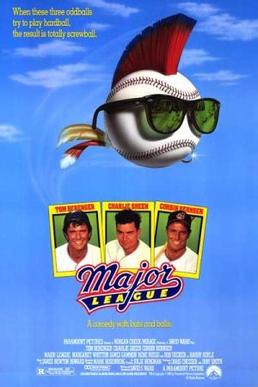
Major League (1989, dir. by David S. Ward) and Major League II (1994, dir. by David S. Ward)


I’m so excited that baseball’s back!

The 2020 regular season of Major League Baseball is going to start on July 22nd and it’s going to last until September 27th.  The teams will play 60 games and the World Series will be held in October.  It’s an abbreviated season but there was no way to avoid that.  I’m just happy that there will at least be some games played this year.

Of course, as excited and happy as I am, I can’t deny that baseball almost always breaks my heart.  Just a few years ago, I was so excited when a Texas team finally won the World Series.  Later, we all found out that the Astros won because they cheated, which will forever taint both the legacy of the team and the MLB.  It breaks my heart to say it but, as far as I’m concerned, no Texas team has yet to legitimately win the World Series.

And then there’s the Rangers.  I’m a Rangers fan.  I love the Rangers.  I was so excited the two times that they made it to the World Series and I’ve never gotten over their loss to the Cardinals.  (Their loss to the Giants I can accept because the Giants were a great team and they earned their wins.  The Cardinals, on the other hand…)  Ever since 2012, though, the Rangers have always broken my heart.  It’s been a while since we’ve had a great Rangers season.  At the start of every season, though, I say, “This is our season!”  And no matter how badly things end, I always say, “Next season, we’re going all the way!”

I guess that’s why I love Major League.

Major League is the ultimate underdog baseball movie.  It’s a film about a fictional version of the Cleveland Indians.  Rachel Phelps (Margaret Whitton), the new owner of the Indians, wants to move the team to Miami but to do that, she’s going to need to have the worst season ever, one where the team plays so badly and breaks so many hearts that even the most loyal fans stop coming to the games.  It shouldn’t be too hard since the Indians have’t even won a pennant in over 30 years.  But to make sure that it happens and that the team only wins 15 games over the entire season, Phelps recruits the worst players she can find.

The team that she puts together is made up of has-beens and never-weres.  Some of them have raw talent but none of them know how to play as a team.  Ex-con Ricky Vaughn (Charlie Sheen) has a killer fastball but is so near-sighted that he’s a danger whenever he steps on the mound.  Catcher Jake Taylor (Tom Berenger) is a veteran team leader but his knees are so bad that he can barely walk.  Willie Mays Hayes (Wesley Snipes) is fast but can’t hit worth a damn.  Pedro Cerrano (Dennis Haysbert) can hit home runs but only if the pitcher throws him a fastball.  Just as Rachel expected, the team struggles at first.  Even when they start to show signs of improvement, she cut back on their budget and sells their equipment, all to try to make winning impossible.  It’s only when their manager, ex-drywall salesman Lou Brown (James Gammon), tells them that Rachel wants them to lose that the team comes together and starts to win.

Everything that’s great about baseball can be found in Major League.  I love all the scenes with the fans slowly coming around to believing that maybe the Indians actually could win it all.  I’ve been through that so many times with the Rangers that I know exactly how they all felt.  I love the interactions between all the players on the team, from the new players eager to win to the veterans who just want to survive another season.  I love the scenes with the play-by-play announcer (Bob Uecker) trying to put a good spin on the way the team plays.  (All together: “Just a bit outside!”)  And mostly, I love that the film treats the game and its players with the respect that they deserve.  So many other films would have turned a character like born-again pitcher Eddie Harris (Chelcie Ross) into a punchline.  Instead, in Major League, he gets a standing ovation after he pitches his last game.  The best thing about Major League is that it loves baseball, both the games and the players.

Since Major League was a success at the box office, it was eventually followed by a sequel, Major League II.

Major League II picks up the season after the first movie ended and it tells the exact same story as the first film, just not as well.  Almost everyone from the first film is back (though Omar Epps takes over the role of Willie Mays Hayes from Wesley Snipes) but the charm and the chemistry from the first movie just aren’t there.  The players have to set aside their egos and learn how to play like a team all over again.  The main difference between the two movies is that it takes a lot longer for the Indians to start winning in the sequel than in the first film.  Plus, the sequel just isn’t as funny.

Even if the sequel is a let down, the first Major League is still one of the best baseball movies ever made.  If the Indians could win the pennant in Major League, maybe there’s hope for my Rangers yet!

A Movie A Day #68: Hoosiers (1986, directed by David Anspaugh)


I’m back!

Even though it has only been a week since I last did a movie a day, I feel like I’ve been gone forever.  Thank you to everyone who commented or messaged me while I was gone.  It turned out that I just had a bad sinus infection.  It was painful as Hell but, with the help of antibiotics and the greatest care in the world, I’m recovering.

Last week, I asked if anyone had any suggestions for what the 68th movie a day should be.  Case suggested Hoosiers and so it shall be.

In 1951, Norman Dale (Gene Hackman) arrives in the small Indiana town of Hickory.  He is a former college basketball coach who has been hired to coach the high school’s perennially struggling basketball team.  Emphasizing the fundamentals and demanding discipline from his players, Dale struggles at first with both the team and the townspeople.  When he makes an alcoholic former basketball star named Shooter (Dennis Hopper) an assistant coach, he nearly loses his job.  Eventually, though, the Hickory team starts winning and soon, this small town high school is playing for the state championship against highly favored South Bend High School.
For many people, Hoosiers is not just “a basketball movie.”  Instead, it is the basketball movie, the movie by which all other sport films are judged.  Hoosiers is inspired by a true story.  In 1954, small town Milan High School did defeat Muncie for the Indiana State Championship and they did it by two points.  Otherwise, Hoosiers is heavily fictionalized and manages to include almost every sports film cliché that has ever existed.  How good a coach is Norman Dale, really?  Almost every game that Hickory wins is won by only one basket.

Why, then, is Hoosiers a classic?  Much of it is due to director David Anspaugh’s attention to period and detail.  Some of it is due to Gene Hackman, who gives a tough and unsentimental performance.  Whenever Hoosiers starts to cross the line from sentimental to maudlin, Hackman is there to pull it back to reality with a gruff line delivery.  Even his romance with the one-note anti-basketball teacher (Barbara Hershey) works.  Hickory feels like a real place, with a real history and inhabited by real people.

And then there’s Dennis Hopper.  Along with Blue Velvet, Hoosiers was Hopper’s comeback film.  After spending twenty years lost in the Hollywood wilderness, better known for abusing drugs and shooting guns than acting, Hopper had just come out of rehab when he was offered the role of Shooter.  Amazingly, he turned the role down and told the producers to offer it to his friend, Harry Dean Stanton.

According to Peter L. Winkler’s Dennis Hopper: Portrait of an American Rebel, this is what happened next:

Stanton (who, ironically, was also considered for Hopper’s role in Blue Velvet) called Hopper up and asked, “Aren’t you from Kansas?”

“Yeah.”

“Didn’t you have a hoop on your barn?”

“Yeah.”

“I think you may be the guy that David Anspaugh’s looking for.”

Harry Dean Stanton was right.  Dennis Hopper, still very much in recovery, totally inhabited the role of the alcoholic Shooter and gave one of the best performances of his often underrated career.  Both Shooter and the actor playing him surprised everyone by doing a good job and Hopper received his only Oscar nomination for acting for his performance in Hoosiers.  (He had previously been nominated for co-writing Easy Rider.)

You don’t have to like basketball to enjoy the Hell out of Hoosiers.

Embracing the Melodrama Part II #96: A Simple Plan (dir by Sam Raimi)


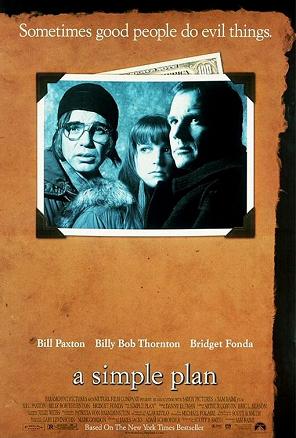
Simple_plan_poster

The 1998 film A Simple Plan reunites Bill Paxton and Billy Bob Thornton.  After previously playing adversaries in One False Move, they played brothers here.  However, it’s not just the cast that makes A Simple Plan feel like a spiritual descendant of One False Move.  Both One False Move and A Simple Plan deal with greed and violence.  Both One False Move and A Simple Plan take place in a small town where everyone thinks that they know all there is to know about each other.  Both One False Move and A Simple Plan feature Paxton as a man who turns out to be something more than what the viewer originally assumed.  Perhaps most importantly, both One False Move and A Simple Plan are meditations on guilt, greed, and community.

A Simple Plan takes place in Minnesota, in a world that seems to exist under a permanent layer of snow and ice.  While out hunting, Hank (Bill Paxton), his well-meaning but dim-witted brother Jacob (Billy Bob Thornton), and their redneck friend Lou (Brent Briscoe) stumble across an airplane that has crashed in the woods.  Inside the airplane, they find a dead pilot and a bag containing 4 million dollars.  At first, Hank says they should call the authorities and let them know what they’ve found but he rather easily allows Jacob and Lou to talk him out of it.  Instead, they agree that Hank will hide the money at his house until spring arrives.  They also agree to not tell anyone about the money but, as soon as he arrives home, Hank tells his pregnant wife Sarah (Bridget Fonda) everything that has happened.

Needless to say, this simple plan quickly get complicated.  Sarah is soon telling Hank that he should not trust Lou and Jacob.  The local sheriff (Chelcie Ross) saw Hank and Jacob leaving the woods after discovering the plane and may (or may not) be suspicious of what they found.  Alcoholic Lou starts to demand his share of the money early.  As things start to spiral, Hank finds himself doing things that he would have never thought he would ever do.  Or, as Sarah puts it, “Nobody’d ever believe that you’d be capable of doing what you’ve done.”

And then, one day, a mysterious FBI agent (Gary Cole) shows up and says that he’s looking for the plane.  Except that, according to Sarah, he’s not really with the FBI…

It’s appropriate that A Simple Plan takes place in a world that appears to be permanently covered in snow because it is a film that is both chilly and chilling.  Bill Paxton and Billy Bob Thornton are both perfectly cast.  (Thornton received an Oscar nomination for his performance.  Paxton undoubtedly deserved one.)  Bridget Fonda turns Sarah into a small town Lady MacBeth and Gary Cole, Brent Briscoe, and Chelcie Ross are all memorable in smaller roles.

(Brent Biscoe, in particular, is a redneck nightmare.)

The next time that you want to contemplate the evil that is done in the name of money, why not start off with a double feature of One False Move and A Simple Plan?