Long before he achieved holiday immortality by playing the father in A Christmas Story, Darren McGavin played journalist Carl Kolchak in the 1972 made-for-TV movie, The Night Stalker. Kolchak is investigating a series of murders in Las Vegas, all of which involve victims being drained of their blood. Kolchak thinks that the murderer might be a vampire. Everyone else thinks that he’s crazy.
When this movie first aired, it was the highest rated made-for-TV movie of all time. Eventually, it led to a weekly TV series in which Kolchak investigated various paranormal happenings. Though the TV series did not last long, it’s still regularly cited as one of the most influential shows ever made.
The Night Stalker is an effective little vampire movie and Darren McGavin gives an entertaining performance as the rather nervous Carl Kolchak.
In 1959, the Clutter Family was murdered in Holcomb, Kansas.
Herbert Clutter was a farmer and was considered to be prosperous by the standards of small-town Holcomb. Neither he nor his wife nor his teenage son and daughter were known to have any enemies. The brutality of their deaths took not just the town but the entire state by surprise. People like the Clutters were not supposed to be brutally murdered. They certainly weren’t supposed to be brutally murdered in a tight-knit community like Holcomb or in a state like Kansas.
The Clutters
The author Truman Capote traveled to Holcomb with his friend Harper Lee, looking to write a story about how the heartland was dealing with such a brutal crime. Six weeks after the murders, while Capote and Lee were still conducting their interviews, two small-time criminals named Dick Hickock and Perry Smith were arrested for the crime. Capote’s proposed article about Holcomb instead became the basis for his best-known book, In Cold Blood. Capote followed the case from the initial investigation to the eventual execution of both Hickok and Smith. He examined the backgrounds of the two criminals, especially Perry Smith’s. (Indeed, there were some who felt that Capote saw something of himself in the mentally-fragile Smith.) In Cold Blood was Capote’s most successful book and it also launched the entire “true crime” genre. It also may have been Capote’s downfall as Capote reportedly spent the rest of his life haunted by the feeling that he would never top the book and that he had potentially exploited Perry Smith while writing it. In Cold Blood may be critical of the death penalty but, if Smith and Hickok hadn’t gone to the gallows, Capote would never have had an ending for the book.
(The writing of In Cold Blood and Capote’s subsequent struggles are dramatized in the excellent Capote.)
When it was published in 1965, In Cold Blood shot up the best seller lists. A film version was an inevitability. Otto Preminger — who had already made films out of Anatomy of a Murder, Exodus, Advice and Consent, and The Cardinal — was eager to turn the book into a film and one can imagine him churning out some epic version with his usual all-star cast. (Sal Mineo as Perry Smith? Peter Lawford as Dick Hickok? With Preminger, anything was possible.) However, Capote sold the rights to Richard Brooks, an independent-minded director who was also an old friend. Brooks decided to duplicate Capote’s “non-fiction novel” approach by actually shooting his film in Holcomb and having several residents of the town play themselves. He also rejected Columbia’s suggestion that Smith and Hickok should be played by Paul Newman and Steve McQueen. Instead, he cast former child actor Robert Blake as Perry Smith and an up-and-coming character actor named Scott Wilson as Dick Hickok. The only “star” who appeared in the film was television actor John Forsythe, who played the Kansas detective who was placed in charge of the investigation.
The story plays out in deliberately harsh black-and-white. (Legendary cinematographer Conrad Hall made his debut with this film.) The opening contrasts scenes of Smith and Hickok, both recently released from prison, meeting up in Kansas with scenes of the Clutter family innocently going about their day. Perry Smith is neurotic and quick to anger, a wannabe tough guy who wears a leather jacket and whose greasy hair makes him look less like a cunning criminal and more like an understudy in a regional production of West Side Story. Dick Hickok is friendly and slick, a compulsive shoplifter who claims that his smile can get him out of anything. In jail, Hickok heard a story that suggested that Mr. Clutter kept a lot of money hidden away in a safe on his farm. Hickok’s plan is to tie up and rob a family of strangers, with the assumption being that, by the time the Clutters get loose and call the police, he and Smith will already be far out of town. Neither he nor Smith seem like natural-born murderers. Smith seems to be too sensitive. Hickok seems like the epitome of someone who brags but doesn’t follow through. And yet, the morning after the robbery, four of the Clutters are discovered murdered in their own home.
The film delves quite a bit into Perry Smith’s background. Throughout the film, he has flashbacks to his abusive father and his promiscuous mother. When Alvin Dewey (played by John Forsythe) investigates Smith’s family, the recurring theme is that Perry never really had much of a chance to become anything more than a criminal. We learn less about Dick Hickok’s background, beyond the fact that he was a popular high school jock who turned mean after a car accident. And yet, despite the fact that the film is clearly more interested in Perry Smith than Dick Hickok, it’s Scott Wilson who dominates the film. It’s not that Robert Blake gives a bad performance. It’s just that Perry is such a neurotic mess and Blake gives a performance that is so method-y that occasionally, you’re reminded that you’re just watching a movie. Scott Wilson, on the other hand, gives a very natural performance as Dick Hickok. There’s nothing particularly showy about his performance and that makes Hickok all the more disturbing as a criminal and a potential murderer. If you’ve spent any time in the country, you’ve met someone like Dick Hickok. He’s the friendly guy who always knows that right thing to say but there’s something just a little bit off about him. He’s likable without being trustworthy.
A few years ago, when I saw that In Cold Blood was going to be airing on TCM, I told my aunt that I was going to watch the film. She replied that I shouldn’t. She saw the film when it was originally released and she described it as being incredibly disturbing. Despite her warning, I watched the film and I have to admit that she was right. Even though it’s nearly 60 years old and not particularly explicit when compared to the true crime films of today, In Cold Blood is still a disturbing viewing experience. Towards the end of the film, we finally see the murders in flashback and the image of Smith and Hickok emerging from the darkness of the farmhouse will haunt you. There’s not a lot of blood. The camera often cuts away whenever the actual murders occur (we hear more gunshots than we see) but the Clutters themselves are sympathetic and innocent victims and their deaths definitely hurt. Indeed, considering that the film falls on the more liberal side of the question of root causes, In Cold Blood deserves a lot of credit for not shying away from the brutality of the crimes. After spending 90 minutes emphasizing Perry Smith’s terrible childhood, it was important to remind the audiences of what he and Dick Hickok actually did.
The murder scene is so nightmarish that it actually makes it a bit difficult to buy into the film’s anti-death penalty argument. The film may end with Smith remorseful and a reporter (Paul Stewart) talking about how revenge is never the answer but the film’s liberal talking points feel hollow after witnessing the murder of four innocent people. (Ironically, it turned out there was no safe so those four people died so Smith and Hickok could steal about forty dollars.) A few years ago, I probably would have been very moved by the film’s anti-death penalty message. While I’m still opposed to the death penalty because I think there’s too much of a risk of a wrongly convicted person being executed, I’m long past having much personal sympathy for the Perry Smiths of the world.
Overall, In Cold Blood remains a powerful and disturbing movie. It was a film that was nominated for several Oscars, though it missed out on Best Picture due to 20th Century Fox’s huge campaign for Dr. Dolittle. Neither Blake nor Wilson were nominated, which is evidence that they were perhaps too convincing as Smith and Hickok for the Academy’s taste. While Robert Blake would go on to have the more storied career, Scott Wilson was a dependable character actor up until his death in 2018. A whole new generation of fans knew him not as Dick Hickok but instead as The Walking Dead‘s beloved Herschel Greene.
One final note: Both the book and the film present the murders as being an aberration, something that neither Smith nor Hickok originally planned. In 2013, new evidence was released that revealed the Smith and Hickok were the number one suspects in the murder of Christine and Cliff Walker and their two children, a crime that occurred in Florida shortly after they fled Kansas. The two of them were questioned at the time and given a polygraph test, which they both passed. The bodies of Smith and Hickok were exhumed for DNA testing, The tests came back inconclusive.
Stacy Keach has always been an underappreciated actor. Despite his obvious talent and his ability to play both heroes and villains, he’s never really gotten the film roles that he’s deserved and he’s mostly made his mark on stage and on television. There have been a few good films that made use of Keach’s talents. I’ve always appreciated his performance as Frank James in Walter Hill’s The Long Riders. He was a morally ambiguous Doc Holliday in Doc. He played a boxer in John Huston’s FatCity. Horror fans will always remember him for RoadGames. The Ninth Configuration featured a rare starring role for Keach but it was treated poorly by its studio. He was chilling as a white supremacist in AmericanHistoryX. For the most part, though, Keach’s film career has been made up of stuff like Class of 1999. For all of his talent, he seems destined to be remembered mostly for playing Mike Hammer in a television series and a few made-for-TV movies. It’s too bad because Keach had the talent to bring certain character to life in a way that few other actors can.
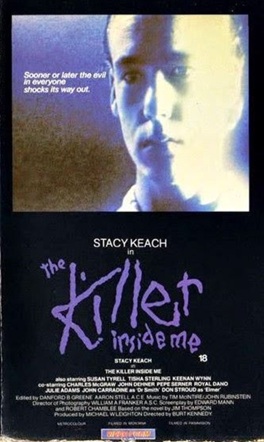
TheKillerInside Me features one of Keach’s best performances. Based on a pulp novel by Jim Thompson, TheKillerInsideMe stars Stacy Keach as Lou Ford. Lou is a small town deputy. Everyone thinks that he’s a good, decent man. He’s dating the local school teacher (Tisha Sterling). The sheriff (John Dehner) trusts him. Lou seems to be an expert at settling conflicts between neighbors. What everyone doesn’t know is that Lou is actually a psycho killer who is having a sado-masochistic affair with a local prostitute (Susan Tyrrell) and who has zero qualms about punching the life out of someone. When Lou finds out that Tyrrell is also involved with the son of a local businessman, it sets Lou on a crime and killing spree. Lou thinks he’s a genius but his main strength is that no one can imagine Lou Ford doing the terrible things that he does.
Burt Kennedy was an outstanding director of westerns and straight-forward action movies but he appears to have struggled with TheKillerInsideMe’s morally ambiguous tone. The end result is not a great film but it does feature a great performance from Stacy Keach. In both his performance and his narration, Keach captures both the arrogance and the detachment from normal society that defines Lou Ford’s character. He also shows how Ford coolly manipulates the people around him. Keach is believable and compelling whether he’s playing the fool or if he’s committing cold-blooded murder and he also subtly shows that Lou is not as smart as he thinks he is. Though Keach dominates the film, TheKillerInsideMe also features good performances from a gallery of 70s character actors, including John Carradine, Keenan Wynn, Don Stroud, Charles McGraw, and Royal Dano.
This version of TheKillerInsideMe didn’t do much at the box office. The movie was remade in 2010, with Casey Affleck miscast as Lou Ford. That version didn’t do much at the box office either. The secret to recreating the book’s mix of social satire and pulp action has proven elusive to filmmakers but at least we’ve got Stacy Keach’s performance as Lou Ford to appreciate.
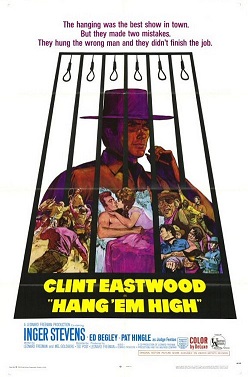
1889. The Oklahoma Territory. A former lawman-turned-cattleman named Jed Cooper (Clint Eastwood) is falsely accused of working with a cattle thief. A group of men, led by Captain Wilson (Ed Begley) lynch him and leave Cooper hanging at the end of a rope. Marshal Dave Bliss (Ben Johnson) saves Cooper, cutting him down and then taking him to the courthouse of Judge Adam Fenton (Pat Hingle). Fenton, a notorious hanging judge, is the law in the Oklahoma territory. Fenton makes Cooper a marshal, on the condition that he not seek violent revenge on those who lynched him but that he instead bring them to trial. Cooper agrees.
An American attempt to capture the style of the Italian spaghetti westerns that made Eastwood an international star, Hang ‘Em High gives Eastwood a chance to play a character who is not quite as cynical and certainly not as indestructible as The Man With No Name. Cooper starts the film nearly getting lynched and later, he’s shot and is slowly nursed back to health by a widow (Inger Stevens). Cooper is not a mythical figure like The Man With No Name. He’s an ordinary man who gets a lesson in frontier justice as he discovers that, until Oklahoma becomes a state, Judge Fenton feels that he has no choice but to hang nearly every man convicted of a crime. (Judge Fenton was based on the real-life hanging judge, Isaac Parker.) Over the course of this episodic film, Cooper becomes disgusted with frontier justice.
Hang ‘Em High is a little on the long side but it’s still a good revisionist western, featuring a fine leading performance from Clint Eastwood and an excellent supporting turn from Pat Hingle. The film’s episodic structure allows for Eastwood to interact with a motley crew of memorable character actors, including Bruce Dern, Dennis Hopper, L.Q. Jones, Alan Hale (yes, the Skipper), and Bob Steele. Hang ‘EmHigh has a rough-hewn authenticity to it, with every scene in Fenton’s courtroom featuring the sound of the gallows in the background, a reminder that justice in the west was often not tempered with mercy.
Historically, Hang ‘Em High is important as both the first film to be produced by Eastwood’s production company, Malpaso, and also the first to feature Eastwood acting opposite his soon-to-be frequent co-star, Pat Hingle. Ted Post would go on to direct MagnumForce.
Taking place over the course of one very long day and night in December, this 1964 made-for-television movie opens with the discovery of a murdered woman in Indiana. She is the latest victim of a killer that the press has nicknamed “Georgie Porgie.”
Georgie Porgie, who has killed five blondes in the Midwest, is actually a nondescript man named Myron Ellis (Philip Abbott). Myron is middle-aged, short, and fairly normal-looking. That, along with the fact that he’s always moving, is one reason why he has yet to be captured. The only thing that really stands out about Myron is that, due to a medical condition, he is extremely sensitive to light and always wears dark glasses, even at night. When Myron isn’t murdering someone or stealing a car, he’s haunted by the voice of his dead sister.
Because he is a nomadic killer, the authorities in Chicago are worried that Myron is coming to their town next and it turns out that they’re correct. Myron is already in Chicago and he’s looking for his next victim. In a rather disturbing scene, he strangles a woman that he meets at a strip club, managing to do so without any of the many people around them even noticing. Myron wanders up and down the streets of Chicago, looking for his next victim. With his polite manners and his bland appearance, no one suspects that the polite man on the street corner is actually a murderer.
Police Commissioner Lombardo (Ted Knight) and Detectives McVea (Robert Ridgley) and Brockman (Charles McGraw) decide that the best way to catch the killer would be to set up a dragnet on the highway, stopping cars and shining flashlights at the drivers to see who has the weakest eyes. The only problem is that there is also a nuclear missile convoy scheduled to move through the city at the same time. With the highways congested and the killer not above wrecking his own car to throw the police off his trail, Lombardo tries to both capture the killer and make sure nothing happens to the convoy.
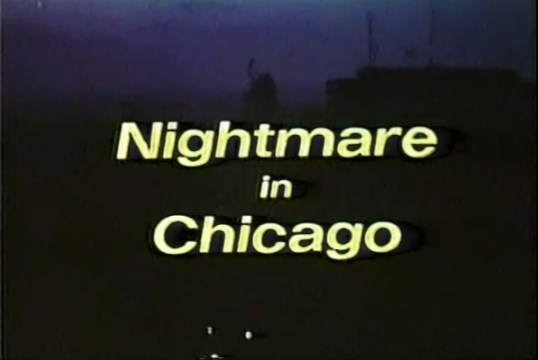
Nightmare In Chicago is a short and efficient thriller. It’s well-acted and rather serious in its approach. Especially when compared to more recent films with similar plots, Nightmare In Chicago deserves some credit for not trying to turn its serial killer into some sort of diabolical mad genius. Myron, like all serial killers in real life, is a maladjusted and rather stupid person who has only gotten away with his crimes due to pure luck. He’s not a Hannibal Lecter-style supergenius. Instead, he’s just a creep who has many, many issues. The film also does a good job of capturing the manic energy and eventual exhaustion of pulling an all-nighter. It’s an effective little film with a memorably sordid story.
For modern audiences, probably the most interesting thing about Nightmare in Chicago is that it was directed by Robert Altman and was, in fact, his second non-documentary film after The Delinquents. At the time he made this film, Altman was largely working in television. Nightmare In Chicago was one of the first made-for-TV movies and it was a ratings and critical success. Seen today, it’s easy to spot Altman’s trademark attention to detail in the film. While it’s far more straight-forward than the majority of his feature films, Nightmare in Chicago still displays the talent that eventually led to Robert Altman become one of Americas most important filmmakers.
For today’s horror on the lens, we have a real treat! (We’ll get to the tricks later…)
Long before he achieved holiday immortality by playing the father in A Christmas Story, Darren McGavin played journalist Carl Kolchak in the 1972 made-for-TV movie, The Night Stalker. Kolchak is investigating a series of murders in Las Vegas, all of which involve victims being drained of their blood. Kolchak thinks that the murderer might be a vampire. Everyone else thinks that he’s crazy.
When this movie first aired, it was the highest rated made-for-TV movie of all time. Eventually, it led to a weekly TV series in which Kolchak investigated various paranormal happenings. Though the TV series did not last long, it’s still regularly cited as one of the most influential shows ever made.
The Night Stalker is an effective little vampire movie and Darren McGavin gives a great performance as Carl Kolchak.
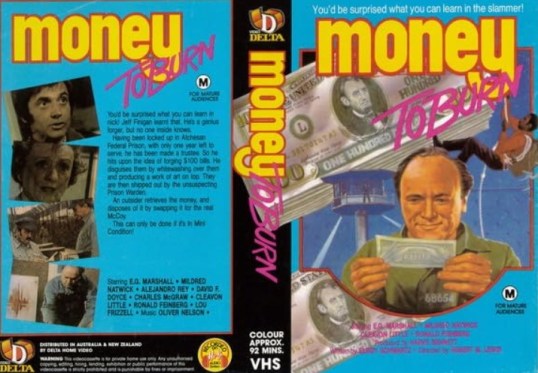
Welcome to Retro Television Reviews, a feature where we review some of our favorite and least favorite shows of the past! On Sundays, I will be reviewing the made-for-television movies that used to be a primetime mainstay. Today’s film is 1973’s Money To Burn! It can be viewed on YouTube.
For someone who has spent the past few years in prison, Jed Finnegan (E.G. Marshall) sure is a nice old man! He runs the prison print shop and all of the other prisoners love him. The guards trust him. The warden (David Doyle) is really impressed with Jed’s watercolors and is interested in helping Jed launch a career as an artist after he gets out of prison. Every weekend, Jed’s wife, Emily (Mildred Natwick), comes up to the prison with a picnic basket and she has lunch with her husband. Jed admits that his wife is not a particularly good cook but it’s obvious that he really looks forward to her visits.
Emily’s sweet nature keeps a lot of people from noticing that she is just as cunning and clever a criminal as Jed ever was. She knows that Jed had printed up one million dollars in counterfeit bills and she is looking forward to helping him exchange the fake money for real money. Jed’s plan is to steal the payroll of the local army base and just leave the fake money in place of the real money. However, Jed’s been in prison for so long that he doesn’t know that the military no longer pays anyone in cash. Everyone’s paying everyone by check!
(This film is very much from the 70s. While Jed and Emily were shocked to discover that people were no longer being paid in cash, I was shocked to discover that they were being paid by check.)
Working with two recently released ex-cons (played by Cleavon Little and Alejandro Rey), Emily tries to find a new way to switch out the money. She discovers that there’s an incinerator nearby where the government burns the currency that it no longer needs. But it won’t be easy to break in and make sure that the right money get burned….
And that’s not even mentioning the trouble of getting the fake money out of the prison in the first place!
Money to Burn is likable mix of comedy and (very mild) action. It’s a film about criminals but they’re very likable criminals who go out of their way not to hurt people. Emily is even happy about the idea of not only stealing a million dollars but also helping the government out by taking the old currency off their hands. Marshall, Natwick, Little, and Rey all give such warm and cheerful performances that you can’t help but hope that they get away with their scheme. The film, which deftly balances comedy and drama, clocks in at a brisk 73 minutes and it has an absolutely wonderful twist ending. This is definitely a heist film that deserves to be better known.
For today’s horror on the lens, we have a real treat! (We’ll get to the tricks later…)
Long before he achieved holiday immortality by playing the father in A Christmas Story, Darren McGavin played journalist Carl Kolchak in the 1972 made-for-TV movie, The Night Stalker. Kolchak is investigating a series of murders in Las Vegas, all of which involve victims being drained of their blood. Kolchak thinks that the murderer might be a vampire. Everyone else thinks that he’s crazy.
When this movie first aired, it was the highest rated made-for-TV movie of all time. Eventually, it led to a weekly TV series in which Kolchak investigated various paranormal happenings. Though the TV series did not last long, it’s still regularly cited as one of the most influential shows ever made.
Anyway, The Night Stalker is an effective little vampire movie and Darren McGavin gives a great performance as Carl Kolchak.
Though the Academy of Motion Picture Arts and Sciences claim that the Oscars honor the best of the year, we all know that there are always worthy films and performances that end up getting overlooked. Sometimes, it’s because the competition too fierce. Sometimes, it’s because the film itself was too controversial. Often, it’s just a case of a film’s quality not being fully recognized until years after its initial released. This series of reviews takes a look at the films and performances that should have been nominated but were, for whatever reason, overlooked. These are the Unnominated.
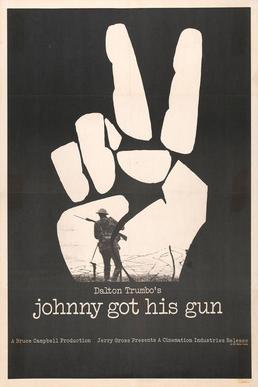
The 1971 anti-war film, Johnny Got His Gun, tells the story of Joe Bonham (played by Timothy Bottoms). When America enters World War I, Joe enlists in the Army. He leaves behind his small-town life. He leaves behind his patriotic father (Jason Robards) and his loving girlfriend (Kathy Fields). As he leaves, everyone tells him that he is doing the right thing to protect democracy. Joe’s a hero!
Joe expects war to be a glorious affair, one that will make a true man out of him. Instead, he’s hit by an artillery shell while huddled in a muddy trench. Though he survives the explosion, he loses his arms and his legs. He loses his face. He’s taken to a field hospital, where the doctors say that, though he’s alive, he’s incapable of feeling or thinking. He’s left alone in a room and is occasionally checked on by a sympathetic nurse (Diane Varsi).
The doctors are wrong. Joe can think. Even if he can’t see where he is now, he can still remember the life that he once had and the events that led him to the hospital. The film switches back and forth, from the black-and-white imagery of the hospital to the vivid color of Joe’s memories and fantasies. In his mind, Joe remembers his father, who encouraged him to go to war and perhaps was not the all-knowing figure that Joe originally assumed him to be. (The film makes good use of Jason Robards’s natural gravitas. Like Joe, the viewer initially assumes that Robards is correct about everything.) Joe also imagines several conversations with Jesus (a stoned-looking Donald Sutherland), who turns out to be surprisingly mellow and not always particularly helpful. Jesus suggest that Joe may just be naturally unlucky and he also suggests that Joe perhaps keep his distance from him because, sometimes, bad luck can rub off. Joe, meanwhile, wonders if he could be used as a traveling exhibit to portray the futility of war. When Joe finally realizes that a nurse has been checking on him, he tries to figure out a way to send a message to both her and the military that is keeping him alive in his captive state. S.O.S. …. help me….
Johnny Got His Gun is based on a novel by Dalton Trumbo. The novel was first published in 1939, at a time when the debate over whether the the U.S. should get involved in another war in Europe was running high. At the time, Trumbo was a Stalinist who opposed getting involved because Germany and Russia had signed a non-aggression pact. After the Germans invaded Russia in 1941, Trumbo and his publishers suspended reprinting of the book until the war was over with. Needless to say, this was all brought up in the 50s, when Trumbo was one of the more prominent writers to be blacklisted during the Red Scare. On the one hand, Dalton Trumbo does sound like he was more than a bit of a useful idiot for the Stalinists. On the other hand, if you’re going to suspend the printing of your anti-war polemic, it should definitely be because you want to help defeat the Nazis. In the end, what really matters is that Johnny Got His Gun is an undeniably well-written and effective book, one that works because it eschews the vapid sloganeering that one finds in so many works of left-wing literature and instead focuses on the emotions and thoughts of one human being.
The book was later rediscovered by the anti-war protestors of the 60s, which led to Dalton Trumbo directing a film adaptation. The film is a bit uneven. Dalton Trumbo was 65 years old when he directed the film and there are a few moments, especially in the scenes with Sutherland as Jesus, where he seems like he’s trying a bit too hard to duplicate the younger directors who were a part of the anti-war moment. However, the scenes in the military hospital are undeniably moving. The hospital scenes are shot in a noirish black-and-white and they effectively capture the stark horror of Joe’s situation. Left alone in his dark and shadowy room, Joe becomes the perfect symbol for all the war-related horrors that people choose to ignore. He becomes the embodiment of what war does to those who are scarred, both physically and mentally, by it. The scenes where Diane Varsi realizes that Joe is aware of what’s happened to him and that he can still feel are powerful and emotional. In fact, they work so well that it’s hard not to wish that the film could have done away with the fantasies and the flashbacks, despite the fact that Timothy Bottoms gives an appealing performance as the young and idealistic Joe.
Johnny Got His Gun didn’t receive any Oscar nominations. Should it have? The 1971 Best Picture line-up was a strong one, with the exception of Nicholas and Alexandra. Johnny Got His Gun was definitely superior to Nicholas and Alexandra. However, Dirty Harry is definitely superior to Johnny Got His Gun. (For that matter, Two-Lane Blacktop also came out in 1971 as well.) But, even if Johnny Got His Gun didn’t deserve to be one of the five Best Picture nominees, it did deserve some consideration for its cinematography and Diane Varsi’s performance. If the flashbacks and the fantasies were handled a bit more effectively, I would suggest that Jason Robards and Timothy Bottoms were worthy of consideration as well.
In conclusion, I should note that 1971 was a good year for Timothy Bottoms. Not only did he star in this film but he was also the star of The Last Picture Show.
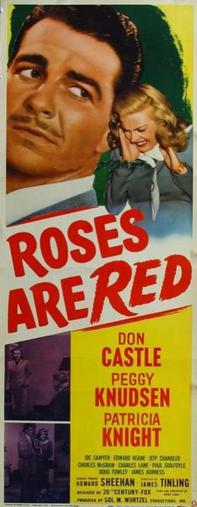
As the 1947 film, Roses Are Red, begins, Robert A. Thorne (Don Castle) has just been elected to the office of district attorney.
Now, being the horror fan that I am, the thing that I immediately noticed was that the new district attorney had the exact same name as the character played by Gregory Peck in The Omen. However, Roses Are Red has nothing to do with the son of Satan or the end of the world. Instead, it’s just a briskly paced tale of swapped identity.
Robert A. Thorne is not just a brilliant lawyer. He’s also an example of that rare breed, an honest politician. He ran on a platform of reform and that’s what he’s intending to pursue now that he’s been elected. As he tells his girlfriend, journalist Martha McCormick (Peggy Knudsen), cleaning up this country isn’t going to be easy but he’s determined to do it. And the first step is going to be taking down the local mob boss, Jim Locke (Edward Keane).
The wheelchair-bound Jim Locke is a man who prefers to stay in the safety of his penthouse, where he can feed his fish and give orders to his subordinates, all of whom have names like Duke (Charles McGraw), Knuckle (Jeff Chandler), Buster (Paul Guilfoyle), and Ace (Douglas Fowley). However, his man on the police force, Lt. Rocky Wall (Joe Sawyer), has warned him that this new district attorney might not respond to usual combination of bribes and intimidation. That’s not good news because there are men who might be willing to testify against Locke in return for a shorter prison sentence.
However, things start to look up when none other than Robert A. Thorne shows up at Locke’s penthouse and says that the honesty bit was all a sham and that he wants to be on Locke’s payroll. However, Locke soon figures out that he’s not talking to Thorne. Instead, he’s talking to Don Carney (also played by Don Castle), a career criminal who has recently been released from prison and who just happens to look exactly like Robert Thorne!
Locke and Don come up with a plan that seems foolproof. What if Knuckle kidnaps Thorne and holds him hostage for a few days? During that time, Don can study Thorne and learn how to perfectly imitate all of his movements and expressions. Once the two men are absolutely indistinguishable, Knuckle will murder Thorne and then Don will take his place.
Knuckle manages to kidnap Thorne with absolutely no trouble. The police, under the prodding of Lt. Wall, announce that Thorne has obviously run off to avoid dealing with the local gangsters. Don starts the process of studying Thorne but it turns out that the district attorney has a few tricks of his own….
With a running time of only 67 minutes, Roses are Red doesn’t waste any time jumping into its somewhat implausible plot. Fortunately, the film is so short and quickly paced that most viewers won’t really have time to worry about whether or not the film’s plot actually makes any sense. This is an entertaining, low-budget film noir, featuring a host of memorable performances and all of the hard-boiled dialogue that you could hope for. Don Castle does a good job playing both the sleazy Don Carney and the upright Robert A. Thorne. History nerds like me will immediately notice that, with his mustache and his slicked back hair, Castle bears a distinct resemblance to former Manhattan D.A. and two-time presidential candidate, Thomas E. Dewey.
All in all, Roses are Red is an enjoyable film for fans of old school gangster noir. Check it out below:


 Through the Shattered Lens