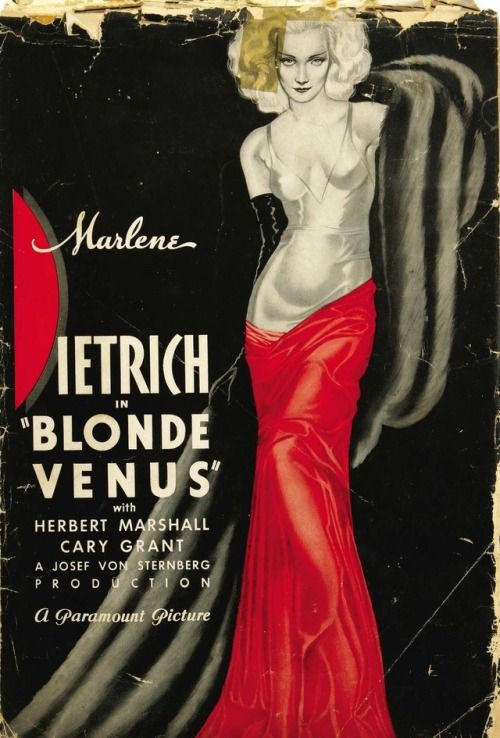
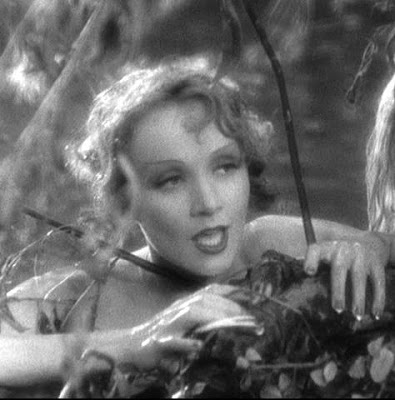
Pre Code Confidential #23: Marlene Dietrich in BLONDE VENUS (Paramount 1932)


gary loggins's avatarcracked rear viewer

Director Josef von Sternberg and his marvelous muse Marlene Dietrich  teamed for their fifth film together with BLONDE VENUS, a deliciously decadent soap opera that’s a whole lot of fun for Pre-Code lovers. Sternberg indulges his Marlene fetish by exploring both sides of her personality, as both Madonna and whore, and Dietrich plays it to the hilt in a film that no censor would dare let pass just a scant two years later.

How’s this for an opening: a group of schoolboys hiking through the Black Forest stumble upon a bevy of naked stage chanteuses taking a swim! The girls scream and try to hide, and beautiful Helen (Marlene) tries to shoo them away. Ned Faraday refuses until Helen agrees to meet him later. Flash forward to a scene of Helen and Ned now married with a young son named Johnny. Ned, a chemist by trade, has been poisoned by…

View original post 693 more words

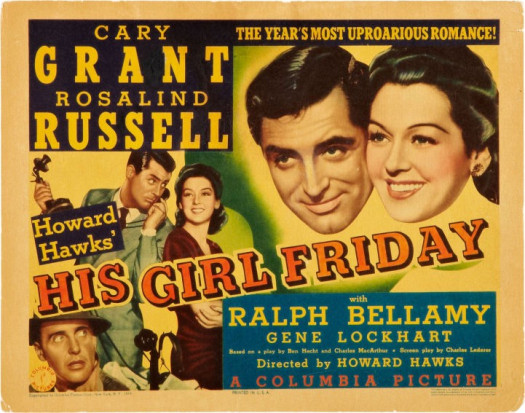
Stop the Presses!: Howard Hawks’ HIS GIRL FRIDAY (Columbia 1940)


gary loggins's avatarcracked rear viewer

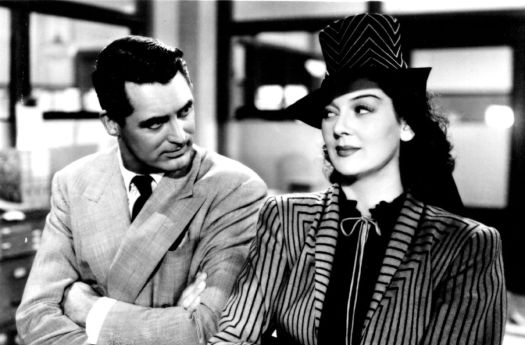
In my opinion, Howard Hawks’ HIS GIRL FRIDAY is one of the greatest screwball comedies ever made, a full speed ahead movie that’s pretty much got everything a film fan could want. A remake of the 1930 Lewis Milestone classic THE FRONT PAGE (itself an adaptation of Ben Hecht and Charles MacArthur’s Broadway smash), Hawks adds a delightful twist by turning ace reporter Hildy Johnson into editor Walter Burns’ ex-wife… and casting no less than Rosalind Russell and Cary Grant in the roles!

The two stars are in top form as the bickering ex-spouses, with their rapid fire banter nothing short of verbal dynamite. Grant in particular spouts off words quicker than a rapper (where did he get all that wind!) and his facial expressions and comic squeals (reminiscent of Curly Howard!) are simply priceless! Roz is more than his match as Hildy, with one lightning-fast zinger  after another. Miss…

View original post 438 more words

Spy in the House of Love: Alfred Hitchcock’s NOTORIOUS (RKO 1946) — cracked rear viewer


You won’t find a more glamorous pair of spies than Cary Grant and Ingrid Bergman in Alfred Hitchcock’s NOTORIOUS… except maybe in other films that feature Cary Grant as a spy! The Master of Suspense once again goes full speed ahead in bringing this exciting espionage caper to the screen loaded with the usual “Hitchcock Touches”, and […]

via Spy in the House of Love: Alfred Hitchcock’s NOTORIOUS (RKO 1946) — cracked rear viewer

Celebrate National Trivia Day With The Actors Who Could Have Been James Bond!


Today is National Trivia Day so I thought why not share some trivia?  I love film trivia.  I especially love trivia about who was considered for certain films.  Hell, one of my most popular posts on the Shattered Lens dealt with all of the actors who were considered for the Godfather!

(I even came up with an alternative cast for The Godfather, even though I consider the actual film to be the best cast film in history.)

I also happen to love the James Bond films.  (Well, not so much the recent Bond films.  I’ve made my feelings on SPECTRE clear.)  As a franchise, I absolutely love them.  So, with all that in mind, here is a look at the actors who could have been Bond.  I’ve compiled this article from many sources.  And yes, you could probably just find a lot of the information on Wikipedia but then you’d miss out on my editorial commentary.

Hoagy Carmichael

Ian Fleming himself always said that his pick for Bond would have been the musician, Hoagy Carmichael.  He even made a point, in Casino Royale, of having Vesper Lynd exclaim that Bond looked like Hoagy Carmichael.  Of course, the first actor to actually play Bond was Barry Nelson in a 1954 television adaptation of Casino Royale.  Nelson is probably best remembered for playing Mr. Ullman in Stanley Kubrick’s The Shining.

Barry Nelson, the first James Bond

When Dr. No went into production in 1961, many actors were considered for the role before Sean Connery was eventually cast.  Many of them were very well-known actors and, had they been cast, Dr. No would not have been remembered as a Bond movie.  Instead, it would be remembered as a star vehicle for … well, let’s take a look at some of the better-known possibilities:

Among the famous actors who were mentioned for Bond in 1961: Cary Grant, Richard Burton, James Mason, Trevor Howard, Stanley Baker, George Baker, Jimmy Stewart, Rex Harrison, and David Niven.  (Of that list, I think Burton would have made for an interesting Bond.  If the Bond films had been made in the 1940s, Grant would have been my first choice.  Trying to imagine Jimmy Stewart as a British secret agent is … interesting.)

Once it became obvious that a star was not going to play Bond, the role was offered to Patrick McGoohan and Rod Taylor.  McGoohan had moral objections to the character.  Rod Taylor reportedly felt that the film would flop.  Steve Reeves, the American body builder who became famous for playing Hercules in Italy, was reportedly strongly considered.  At one point, director Terrence Young wanted to offer the role to Richard Johnson, who later played Dr. Menard in Lucio Fulci’s Zombi 2.

Of course, the role went to Sean Connery and made Connery a huge star.  In 1967, after Connery announced that he would no longer play the world’s most famous secret agent, there was a huge and widely publicized search for his replacement.  Some of the names that were considered are intriguing.  Others are just bizarre.

Oliver Reed

To me, perhaps the most intriguing name mentioned was that of Oliver Reed.  Reed definitely would have brought a rougher edge of the role than some of the other actors considered.  However, that’s one reason why Reed wasn’t picked.  Apparently, it was felt that he did not have the right public image to play the suave Mr. Bond.

Somewhat inevitably, Michael Caine was sought out for the role.  Caine, however, refused to consider it because he had already starred in three back-to-back spy thrillers and didn’t want to get typecast.  Caine’s former roommate, Terrence Stamp, was another possibility but wanted too much control over the future direction of the Bond films.  Future Bond Timothy Dalton was considered to be too young.  Another future Bond, Roger Moore, didn’t want to give up his television career.  Eric Braeden has the right look for Bond but was German.  Rumor has it that producer Cubby Broccoli even considered Dick Van Dyke for the role, though I find that hard to believe.  An even more surprising possibility was the nobleman Lord Lucan, who was offered a screen test in 1967 and who, ten years later, would vanish after being accused of murdering his children’s nanny.

Lord Lucan

Among the actors who auditioned before George Lazenby was cast in On Her Majesty’s Secret Service: Michael Billington, Jeremy Brett, Peter Purves, Robert Campbell, Patrick Mower, Daniel Pilon, John Richardson, Anthony Rogers, Hans De Vries, and Peter Snow.

After the mixed reception of both Lazenby’s performance and On Her Majesty’s Secret Service, Lazenby was soon out as James Bond.  Even today, there’s a lot of controversy about what led to Lazenby being dismissed from the role.  Some say Lazenby demanded too much money.  Some say that Lazenby was merely used a pawn to try to get Sean Connery to return to the role.  Regardless, Lazenby only made one film as Bond.  (Of course, On Her Majesty’s Secret Service has retroactively been recognized as being one of the best of the series.)

With Connery still claiming that he would never return to the role, the film’s producers went through the motions of looking for a new Bond.  Once again, Roger Moore and Timothy Dalton were considered.  Connery suggested that a talk show host named Simon Dee should play the role.  An actor named Roger Green auditioned.  So did Michael Gambon, though he later said he was turned down because, in his own words, he “had tits like a woman.”  Interestingly, several Americans were mentioned.  Clint Eastwood as James Bond?  Burt Reynolds?  Adam “Batman” West? The mind boggles but their names were mentioned.

John Gavin

And interestingly enough, an American was cast.  John Gavin is best known for playing Sam Loomis in Psycho but he was also, briefly, James Bond.  After Gavin accepted he role and signed a contract, Sean Connery announced that he would be willing to return to the role.  Gavin was paid off and Connery went on to star in Diamonds are Forever.

After Diamonds, Connery left the role for a second time and, once again, Bond was recast.  This time, Roger Moore would finally accept the role.  However, before Moore was cast, several other actors were considered.  Some of the regular possibilities were mentioned again: John Gavin, Simon Oates, Timothy Dalton, and Michael Billington.  Others considered included Jon Finch, Ranulph Fiennes, Peter Laughton, and Guy Peters.  Some of those names are probably as unknown to you as they are to me but it’s intriguing to think that Guy Peters may not be a well-known name but, at one time, there was a possibility that he could suddenly become one of the biggest stars in the world.

Looking over the history of the Bond franchise, it’s interesting to see the number of times that Moore tried to leave the role, just to be talked into returning.  Every time that Moore considered quitting, a new group of actors would be considered for the role of Bond.  In 1979, when Moore said he might not return after Moonraker, Timothy Dalton, Michael Jayston, Patrick Mower (who was also considered for On Her Majesty’s Secret Service), and Michael Billington were all considered as replacements.  So was Julian Glover.  Ironically, when Moore did agree to return to the role, Glover was cast as the villain in For Your Eyes Only.

David Warbeck

To me, the most intriguing actor mentioned as a replacement for Roger Moore was David Warbeck.  Warbeck was a television actor and model who subsequently had a nearly legendary film career in Italy.  Not only did he play a key role in Sergio Leone’s Duck You Sucker!, but he also starred in Lucio Fulci’s The Black Cat and The Beyond.  He also appeared in the best of Italian Apocalypse Now rip-offs, The Last Hunter.  In interviews, Warbeck claimed that he was under contract to Cubby Broccoli to step into the role in case Roger Moore ever walked off the set.  The likable and rugged Warbeck would have been an interesting Bond.

In 1983, when Moore again said he might not return to the role, Michael Billington (who actually did appear in a Bond film when he played a KGB agent killed at the start of The Spy Who Loved Me) would be once more considered as a replacement.  British TV actors Lewis Collins and Ian Ogilvy were also considered for the role.  In a repeat of what happened with John Gavin in Diamonds are Forever, American actor James Brolin was actually put under contract until Moore agreed to play the role in Octopussy.

James Brolin, in a screen test for Octopussy

After A View To A Kill, Moore left the role for the final time.  Famously, future Bond Pierce Brosnan was actually cast as his replacement until the surge of interest created by his casting led to the renewal of Remington Steele, the American television show in which Brosnan was starring.  Once the show was renewed, Brosnan could no longer work the Bond films into his schedule.

Among the other names mentioned: Sean Bean, Simon MacCorkindale, Andrew Clarke, Finlay Light, Mark Greenstreet, Neil Dickson, Christopher Lambert, Mel Gibson, and Antony Hamilton.  Sam Neill was another possibility and reportedly came very close to getting the role.  Watch any of the films that Neill made when he was younger and you can definitely see hints of Bond.

Sam Neill

In the end, Timothy Dalton finally accepted the role.  Ironically, for an actor who spent 20 years being courted for the role, Dalton turned out to be a bit of a flop as Bond.  He made two movies (both of which were considered to be disappointing when compared to the previous Bond films) and then left the role.

Looking over the contemporary reviews of Dalton as Bond, one thing that comes through clearly is that a lot of people resented him for taking a role that they felt should have gone to Pierce Brosnan.  When the Bond films resumed production with Goldeneye in 1994, Brosnan finally stepped into the role.  Reportedly, if Brosnan had turned down the role, the second choice was Sean Bean.  Much like Julian Glover, Bean may have lost out on 007 but he did end up playing the villain.

Sean Bean

Among the other actors who were reportedly considered before Brosnan accepted the role: Mark Frankel, Paul McGann, Liam Neeson, Russell Crowe, and Lambert Wilson.  Ralph Fiennes, who has been M since Skyfall, was also considered.

As opposed to his predecessors, Brosnan seemed to be very comfortable with the idea of playing Bond and never threatened to leave the role.  Looking over the Bond-related articles that were published from 1995 to 2004, I found the occasional speculation about whether Rupert Everett would be the first gay James Bond or if Sharon Stone would be the first female James Bond but I found very little speculation about Brosnan actually leaving the role.  Indeed, when Brosnan officially retired as Bond in 2004, it was less his decision and more at the prodding of the franchise’s producers, who felt that the series needed to be rejuvenated with a new (and younger) actor.  After Brosnan left, the series was rebooted and Daniel Craig played the role in Casino Royale.

In the past, I’ve made it clear that Daniel Craig is hardly my favorite Bond.  I loved Skyfall (and I consider it to the 2nd best Bond film, after From Russia With Love) but, even in that case, I felt that the film succeeded despite Craig instead of because of him.  With Casino Royale, we were supposed to be seeing a young and inexperienced Bond.  That’s never come through to me, probably because Craig looked like he was nearly 50 years old when he made Casino Royale.

Among the actors who were mentioned for the role before Craig received the role: Ralph Fiennes (again), Colin Salmon, Ewan McGregor, Henry Cavill, Rupert Friend, Julian McMahon, Alex O’Laughlin, Clive Owen, Dougray Scott, and Goran Visjnic.  Dominic West, who I think would have been great in the role, reportedly ruled himself out because he heard a rumor that Brosnan would be returning to the role.

Dominic West

Daniel Craig, of course, has been talking about leaving the role ever since he was first cast.  I think Skyfall would have been a perfect movie for him to leave on.  (It would have saved the world from SPECTRE.)  However, Craig has apparently agreed to do at least one more Bond film.  Maybe two.

When Craig does leave, who will replace him?  Idris Elba, of course, is probably the most widely discussed possibility.  James Norton has also been named as a possibility.  Others that I’ve seen mentioned: Tom Hardy, Jack Huston, Aidan Turner, Tom Hiddleston, Michael Fassbender, Jamie Bell, and Henry Cavill (again).

My personal choice?  Dominic Cooper.  He’d be an off-center Bond but I think it would still be an intriguing pick.

Dominic Cooper

Who knows what the future may hold for 007?  All I know is that I look forward to the speculation.

Happy National Trivia Day, everyone!

4 Shots From 4 Films: The Awful Truth, Notorious, North By Northwest, Charade


4 Shots From 4 Films is just what it says it is, 4 shots from 4 of our favorite films. As opposed to the reviews and recaps that we usually post, 4 Shots From 4 Films is all about letting the visuals do the talking.

Happy birthday, Cary Grant!

4 Shots From 4 Films

The Awful Truth (1937, dir by Leo McCarey)

The Awful Truth (1937, dir by Leo McCarey)

Notorious (1946, dir by Alfred Hitchcock)

Notorious (1946, dir by Alfred Hitchcock)

North by Northwest (1959, dir by Alfred Hitchcock)

North by Northwest (1959, dir by Alfred Hitchcock)

Charade (1963, dir by Stanley Donen)

Charade (1963, dir by Stanley Donen)

Cleaning Out The DVR, Again #4: The Talk of the Town (dir by George Stevens)


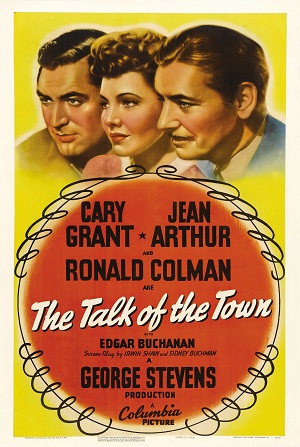
The_Talk_of_the_Town_dvd_cover

The fourth film on my DVR was the 1942 film, The Talk of the Town.  The Talk of The Town originally aired on TCM on March 20th and I recorded it because it was a best picture nominee.  As some of our regular readers undoubtedly know, it’s long been a goal of mine to watch and review every single film nominated for Oscar’s top prize.

The Talk of The Town is an odd little hybrid of comedy, melodrama, and a civics lecture.  Michael Lightcap (Ronald Colman) is a brilliant attorney and legal professor.  He’s been shortlisted for the Supreme Court and he’s also a widely read author.  In fact, he’s even rented a house for the summer, so that he may work on a book.  The owner of the house — teacher Nora Shelley (Jean Arthur) — will also be acting as his secretary.

As well-read as Prof. Lightcap may be, he’s also rather stuffy and out-of-touch with what’s going on outside of the world of academia.  He knows how the law should work but he has little understanding of how the law actually does work.  Fortunately, he gets a lesson in reality when he arrives at the house and eventually meets the gardener, Joseph (Cary Grant).  Joseph turns out to be surprisingly intelligent and very passionate about politics.  Lightcap and Joseph have many debates about whether or not the American legal system actually protects the working man.

What Lightcap doesn’t know is that Joseph is actually Leopold Dilg.  Leopold is a labor activist, the type who you always see in old documentaries, standing on a street corner and preaching about unions.  Leopold is also a fugitive.  He was accused of setting fire to a mill, a fire that apparently led to the death of the foreman.  Despite the fact that he loudly proclaimed his innocence, Leopold was arrested and prosecutors announced that they would seek the death penalty.  Convinced that he would never get a fair trial, Leopold escaped from jail and fled to Nora’s house.

Nora and Leopold went to school together.  They love each other, even though circumstances — mostly his political activism — conspired to keep them apart.  When Lightcap moves into the house, Nora and Leopold’s attorney, Sam (Edgar Buchanan), hope that they can convince him to take on Leopold’s case.  However, they also have to not only convince Leopold to reveal his true identity but also convince Lightcap to put his supreme court appointment at risk by defending a politically unpopular defendant.  Their solution is to trick Lightcap into falling in love with Nora and then convince him to take on the case for her.

However, Nora soons finds herself falling in love with Lightcap for real.  Who will she choose in the end?  Cary Grant or Ronald Colman?  Today, it seems like a pretty easy decision but apparently, in 1942, Columbia Pictures actually shot two different endings for the movie.

The Talk of The Town is an odd little movie.  For the most part, it’s a drama.  But it also has plenty of comedic elements, mostly dealing with the attempts to keep Leopold’s identity a secret.  In the end, it’s a little bit too preachy to really work as either a drama or a comedy.  That said, I still liked The Talk Of The Town because it made a strong case for the importance of due process, which is a concept that a lot of people take for granted.

(At the same time, The Talk of the Town was made in 1942 so you never have any doubt that Lightcap’s belief in the American legal system will eventually be vindicated.  With America having just entered World War II, 1942 was not a time for cynicism.  If Talk of the Town has been made in the 30s, it probably would have been a very different movie.)

Probably the best thing about Talk of the Town is the cast.  It may not be a great film but, when you’ve got Cary Grant and Jean Arthur in a scene together, it almost doesn’t matter.

The Talk of the Town was nominated for best picture but it lost to Mrs. Miniver.

The Fabulous Forties #44: His Girl Friday (dir by Howard Hawks)


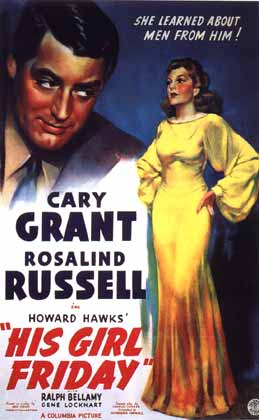
His_Girl_Friday_poster

The 44th film in Mill Creek’s Fabulous Forties box set was the classic 1940 comedy, His Girl Friday.

Earlier this week, when I mentioned that Cary Grant’s Oscar-nominated work in Penny Serenade was not the equal of his work in comedies like The Awful Truth and The Philadelphia Story, quite a few people took the time to let me know that their favorite Cary Grant film remains His Girl Friday.  And I can’t blame them.  Not only does His Girl Friday feature Cary Grant at his best but it also features Rosalind Russell at her best too.  Not only that but it’s also one of the best films to ever be directed by the great Howard Hawks.  There are a lot of career bests to be found in His Girl Friday, and that’s not even counting a supporting cast that is full of some of the greatest character actors of the 1940s.

The film itself is a remake of The Front Page, that classic story of an editor trying to keep his star reporter from leaving the newspaper in order to get married.  (Along the way, they not only manage to expose municipal corruption but also help to hide and exonerate a man who has escaped from death row.)  The action moves fast, the dialogue is full of quips, and the whole thing is wonderfully cynical about … well, everything.  The major difference between The Front Page and His Girl Friday is that the reporter is now a woman and she’s the ex-wife of the editor.  When Cary Grant’s Walter Burns attempts to convince Rosalind Russell’s Hildy Johnson to cover just one last story, he’s not only trying to hold onto his star reporter.  He’s also trying to keep the woman he loves from marrying the decent but boring Bruce Baldwin.

Bruce, incidentally, is played by Ralph Bellamy.  Bellamy also played Grant’s romantic rival in The Awful Truth.  To a certain extent, you really do have to feel bad for Ralph.  He excelled at playing well-meaning but dull characters.  As played by Bellamy, you can tell that Bruce would be a good husband in the most uninspiring of ways.  That’s the problem.  Hildy deserves more than just a life of boring conformity and Walter understands that.  Not only do Walter and Hildy save the life of escaped convict Earl Williams but, in doing so, Hildy is also saved from a life of being conventional.

As we all know, it’s fashionable right now to attack the news media.  Quite frankly, modern media often makes it very easy to do so.  For that matter, so do a lot of a movies about the media.  To take just two of the more acclaimed examples, there’s a smugness and a self-importance to both Good Night and Good Luck and Spotlight that becomes more and more obvious with each subsequent viewing.  (Admittedly, Edward R. Murrow was prominent way before my time but, if he was anything like the pompous windbag who was played by David Strathairn, I’m surprised that television news survived.)  Far too often, it seems like well-intentioned filmmakers, in their attempt to defend the media, end up making movies that only serve to remind people why the can’t stand the old media in the first place.

Those filmmakers would do well to watch and learn from a film like His Girl Friday.  His Girl Friday is a cheerfully dark film that is full of cynical journalists who drink too much and have little use for the type of self-congratulation that permeates through a film like Spotlight.  Ironically, you end up loving the journalists in His Girl Friday because the film never demands that you so much as even appreciate them.  There are no long speeches about the importance of journalism or long laments about how non-journalists just aren’t smart enough to appreciate their local newspaper.  Instead, these journalists are portrayed as hard workers and driven individuals who do a good job because deliberately doing anything else is inconceivable.  They don’t have time to pat themselves on the back because they’re too busy doing their job and hopefully getting results.

If you want to see a film that will truly make you appreciate journalism and understand why freedom of the press is important, watch this unpretentious comedy from Howard Hawks.

In fact, you can watch it below!

The Fabulous Forties #37: Penny Serenade (dir by George Stevens)


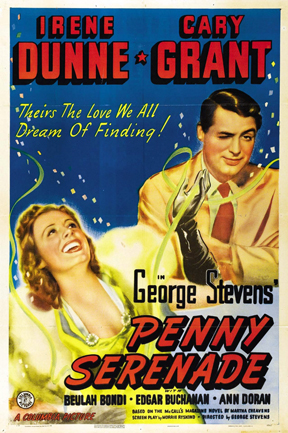
Penny_Serenade_1941_Poster

How many tears can be jerked by one tear jerker?

How melodramatic can one melodrama get?

These are the type of questions that I found myself considering as I watched the 36th film in Mill Creek’s Fabulous Forties box set, 1941’s Penny Serenade.

Penny Serenade opens with Julie (Irene Dunne) announcing that she’s planning on leaving her husband, Roger (Cary Grant).  Fortunately, before Julie goes through with her plan, she listens to a song called You Were Meant For Me.  Perhaps not coincidentally, the song is included on an album called The Story Of A Happy Marriage.  As she stares at the spinning vinyl, Julie starts to have flashbacks!

No, not flashbacks of the LSD kind.  (Though, interestingly enough, Cary Grant was reportedly a big fan of LSD…)  Instead, she has flashbacks of her marriage to Roger.  We see how she first met Roger while she was working in a music store.  Roger stopped by the store to tell her that a record was skipping and it was love at first sight.  However, Roger had no interest in getting married.  Or, at the least, he didn’t until Julie opened up a fortune cookie and read the fortune: “You get your wish — a baby!”

Julie continues to stare at the spinning record and we discover that eventually, she and Roger did get married.  Julie did get pregnant but, as the result of an earthquake, she lost the baby.  (Curse you, fortune cookie!  CURSE YOU!)  Meanwhile, Roger took over a small town newspaper and revealed himself to have absolutely no idea how to handle money.

Because of the earthquake, Julie will never be able to have a child.  (DAMN YOU, FORTUNE COOKIE!  DAMN YOU FOR YOUR LIES!)  However, they can still adopt!  She writes to Miss Oliver (Beulah Bondi), the head of the local orphanage.  Julie demands to be given a baby with “blue eyes and curly hair.”  Fortunately, Miss Oliver apparently has a surplus of curly-haired, blue-eyed babies but she’s still reluctant to approve the adoption.  After all, Julie is such a terrible housekeeper!  However, she is impressed by how much both Julie and Roger want a baby so Miss Oliver puts aside her concerns and allows them to have a baby for two years.

At the end of the two years, Roger and Julie have to go to an adoption hearing.  Unfortunately, the paper has gone out of business, the family has absolutely no money, and the fortune cookie has stopped giving advice.  Fortunately, Roger is Cary Grant and who can say no to Cary Grant?  Roger promises the judge that he’ll always love and take care of the baby…

But that’s not all!  The movie is not over yet.  And even as Roger makes his plea, we can’t help but think about the fact that this movie is being told in flashback and that present day Julie is still planning on leaving Roger.  Now, I’m not going to spoil the movie by going into why or revealing what happens in the end.  I’ll just say that it involves more tragedy and more melodrama.  In fact, it includes so much tragedy and so much melodrama, that it starts to get a little exhausting.  How much bad stuff can happen to Cary Grant!?

And the record just keeps spinning…because what goes up must come down, spinning wheel got to go round…

Over the course of his long career, Cary Grant only received two Oscar nominations.  Penny Serenade was his first nomination and, as a fan of Cary Grant’s comedies, it saddens me to say that Cary’s nominated performance really wasn’t that good.  Watching this film, you can tell that Cary felt that this was his chance to prove himself as a dramatic actor and, as a result, he acts the Hell out of every scene.  Of course, Cary’s undying popularity comes from the fact that he rarely seemed to be acting.  His charm was in how natural he was.  In Penny Serenade, he never seems natural.  He’s trying too hard and it’s just odd to see Cary Grant trying too hard.

If you want to see Cary Grant at his best, check out The Awful Truth.  Or maybe The Philadelphia Story.  Those are two great films that prove that Cary Grant was a great actor.  Even a rare misfire of a performance can’t change that fact.

Until next time…

Ride a painted pony, let the spinnin’ wheel spin. … Ride a painted pony, let the spinnin’ wheel turn.

Cleaning Out The DVR #19: The Awful Truth (dir by Leo McCarey)


(For those following at home, Lisa is attempting to clean out her DVR by watching and reviewing 38 films by this Friday.  Will she make it?  Keep following the site to find out!)

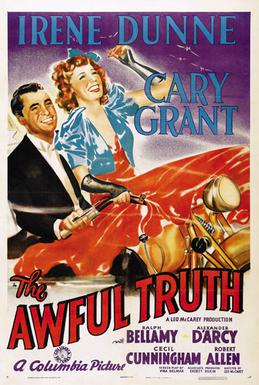
Theawfultruth1937

First released way back in 1937, The Awful Truth is one of the most delightful comedies that I’ve ever seen.  In fact, if I could recommend one movie for you to make an effort to see, it would be The Awful Truth.  This is definitely the best film to ever have the word “awful” in the title.

(Speaking of being the best, The Awful Truth is also the rare screwball comedy to receive a nomination for best picture.  However, it lost to the far more serious The Life of Emile Zola.)

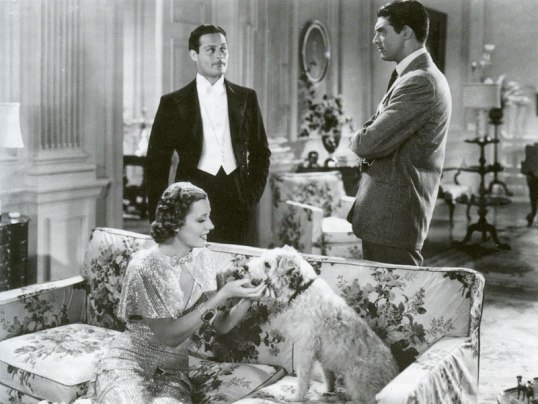
Jerry (Cary Grant) and Lucy Warner (Irene Dunne) are young, married, stylish, and rich.  They seem to have it all but, as the result of Jerry’s lies and a misunderstanding concerning Lucy and her music teacher (Alexander D’Arcy), they end up getting a divorce.  Fortunately, they still share a common bond.  They both love their dog, Mr. Smith (played by Skippy, the same adorable and incredibly talented dog who played Asta in The Thin Man).  Lucy wins custody of Mr. Smith and takes him with her when she moves in with her eccentric Aunt Patsy (Cecil Cunningham).

(It’s not a screwball comedy without an eccentric aunt.)

Jerry, however, has weekly visitation rights with Mr. Smith.  It’s during once such visit that Jerry discovers that, with only two months to go before the final divorce decree, Lucy has become engaged to her next door neighbor, Dan (Ralph Bellamy).  Dan is from Oklahoma and spends most of his time wistfully talking about tumbleweed, oil, and cattle.  He also can’t wait to marry Lucy so that they can both move back to Oklahoma City.  Dan is a nice guy but he’s no Cary Grant.  (He’s also dominated by his judgmental mother.)  Realizing that he still loves Lucy, Jerry wants to reconcile with her but complications and misunderstandings ensue.

(It’s not a screwball comedy without complications and misunderstandings.)

Eventually, in order to prove that he is over Lucy, Jerry starts to date a vacuous heiress, Barbara Vance (a hilariously shallow performance from Molly Lamont).  Suddenly, Lucy finds herself in the same situation that Jerry was in with her and Dan.  Now, it’s her turn to try to break up Barbara and Jerry…

Meanwhile, the day of the final divorce decree approaches…

There’s a lot of reasons to love The Awful Truth.  There’s the snappy dialogue, the physical comedy (at one point, three different men are scurrying around Aunt Patsy’s apartment, two trying to hide from each other and one totally oblivious to everything going on around him), and Leo McCarey’s fast paced direction.  There’s Mr. Smith, a dog so talented that even a confirmed cat person like me loved watching his performance.  There’s the wonderful supporting turns of Ralph Bellamy and Molly Lamont.

But the main reason to see the film is because of the wonderful chemistry between Cary Grant and Irene Dunne.  Grant is so smooth and effortless in his charm that it’s a lot of fun to watch him having to deal with the progressively strange world that he finds himself living in.  The Awful Truth works best when Grant simply reacts to all the craziness around him.  Grant could do more with one look than most actors could do with a Shakespearean monologue.  Meanwhile, Irene Dunne … well, who wouldn’t want to get in a time machine, go back to 1937, and be Irene Dunne for a day?  She’s lively, she’s beautiful, she’s witty, she’s classy, and she’s just neurotic enough to be relatable.

The Awful Truth is pure joy.  If you haven’t seen it, you’re missing out.  If you have seen it, watch it again.

http://www.youtube.com/watch?v=B0-euBr_vRU

Curiouser & Curiouser: ALICE IN WONDERLAND (Paramount 1933)


gary loggins's avatarcracked rear viewer

alice1

Lewis Carroll’s 1865 children’s classic ALICE IN WONDERLAND was turned into an all-star spectacular by Paramount in 1933. But the stars were mostly unrecognizable under heavy makeup and costumes, turning audiences off and causing the film to bomb at the box office. Seen today, the 1933 ALICE is a trippy visual delight for early movie buffs, thanks in large part to the art direction of William Cameron Menzies.

alice5

Menzies’ designs are truly out there, giving ALICE the surrealistic quality of the books themselves. He actually storyboarded his ideas right into the physical script, earning a co-writer credit along with Joseph L. Mankiewicz . Menzies was the cinematic wizard whose art direction brought the magical 1924 THE THIEF OF BAGDAD to life. He was co-director and special effects designer for 1932’s CHANDU THE MAGICIAN, and the title of Production Designer was invented for him on the classic GONE WITH THE WIND. Menzies also directed a few films; especially of…

View original post 494 more words