Film Review: Carnal Knowledge (dir by Mike Nichols)


First released in 1971, Carnal Knowledge is the story of two friends, Jonathan (Jack Nicholson) and Sandy (Art Garfunkel).

Jonathan and Sandy meet in the late 40s, when they’re both assigned to be roommates at Amherst College.  They’re both smart, handsome, and obviously from well-off families.  They both believe that they have a wonderful future ahead of them and why shouldn’t they?  World War II is over.  America is the leader of the world and Jonathan and Sandy both appear to be future leaders of America.  Sandy is shy and sensitive.  When he meets Susan (Candice Bergen), he struggles to talk to her and when they date, he doesn’t know how far he should go with her.  (When he tells Jonathan about getting a hand job from her, it’s obvious that Sandy didn’t previously realize such a thing was possible.)  Jonathan, on the other hand, is confident and aggressive.  He can be a braggart and he can be insensitive but there’s something undeniably attractive about someone who knows what he wants and is determined to get it.  Soon, Susan finds herself torn between the two roommates, though Sandy is clueless that Jonathan is even interested in her.

Carnal Knowledge is divided into three separate parts, each taking place in a different decade and each shot in its own individual style.  (The film was written by playwright Jules Feiffer and the script does very much feel like a three-act play.)  As a character, Susan disappears after the first act but her relationship with Jonathan and Sandy haunts every bit of the second and third acts.  By the end of the film, Sandy is no longer sensitive and Jonathan is no longer virile and one can’t help but feel that Susan, wherever she may be, is definitely better off without either one of them.

The second act is dominated by Jonathan’s relationship with Bobbie, played by Ann-Margaret.  Bobbie is beautiful and heart-breakingly insecure.  Her relationship with Jonathan starts with a dash of romance and then quickly becomes a trap for both of them.  Jonathan is not ready (or mature enough) to settle down.  Bobbie is desperate for him to marry her and willing to go to extremes to make that happen.  The scenes where Jonathan and Bobbie fight are some of the most powerful in the film, with both Nicholson and Ann-Margaret giving the viewer raw and honest portrayals of two insecure people who are totally wrong for each other but also incapable of getting away from each other.

By the time the third act comes around, Jonathan has been reduced to paranoid ruminations about “ball-breakers” and can only get it up when he’s feeling like he’s the one in power.  (Rita Moreno has a cameo as a very patient prostitute.)  Meanwhile, middle-aged Sandy is dating an 18 year-old (Carol Kane) and clearly trying to live the free-spirited youth that he never had.  Who is more pathetic?  Jonathan, who bitterly realizes he’s never going to be young again, or Sandy, who is trying to deny the fact that he’s getting older?

Carnal Knowledge is a dark film and indeed, it sometimes feels like it’s a bit too dark for its own good.  Even the worst people occasionally have a laugh.  The script is full of sharp lines and the characters are interesting, even if they are for the most part unlikable.  Still, there’s a staginess to the film’s narrative and director Mike Nichols never quite breaks free from it.  That said, I still highly recommend this film.  Not only is it a portrait of a culture-in-transition but it also features some wonderful performances, especially from Ann-Margaret and Jack Nicholson.  (In most ways, Jonathan is definitely worse than Sandy but we still have more sympathy for Jonathan because Jack Nicholson is a considerably better actor than Art Garfunkel.)  Ann-Margaret honestly portrays the heart-breaking insecurity that comes from being repeatedly told that you have nothing but your looks to offer.  Meanwhile, Nicholson throws himself into playing the charismatic but immature Jonathan.  We may not like Jonathan but we do, in the end, understand why he’s become the person that he has.  It takes a certain amount of courage to play a character like Jonathan and, in this film, Nicholson shows every bit of that courage.
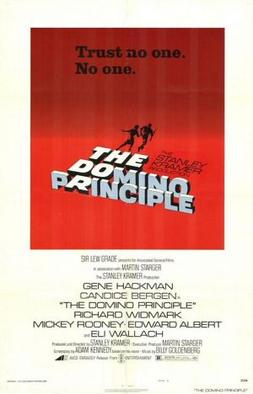
The Domino Principle (1977, directed by Stanley Kramer)


Roy Tucker (Gene Hackman) loyally served his country as a part of a “search and destroy” team in Vietnam but when he returned home, he discovered that America didn’t appreciate his sacrifice.  When he was convicted of murdering his wife’s abusive first husband, he was tossed in prison.  But now, two mysterious men (Richard Widmark and Edward Albert) have offered Tucker a chance to escape from prison and reunite with his wife (Candice Bergen) in Costa Rica.  The only catch is that they also expect Tucker to do a job for “the Organization” and assassinate an unidentified target.  As Tucker discovers, The Organization has been watching and manipulating him entire life, setting him up for this very moment.  Every small event in Tucker’s life led to another event that eventually sent him to both the war and to prison.  It’s almost like a game of dominos.  And we have a title!

The Domino Principle gets off to a good start, with a black-and-white montage of actual assassinations and then an opening credit sequence that features someone placing dominos over pictures of Roy Tucker at different ages.  (I am guessing that actual childhood photos of Gene Hackman were used because even the baby pictures feature the Hackman squint.)  However, the scene immediately following the credits features Gene Hackman and Mickey Rooney as cellmates and the film never really recovers.  Though they were both talented actors, Gene Hackman and Mickey Rooney don’t seem as if they belong on the same planet together, let alone sharing a prison cell in a grim and downbeat political thriller.  Hackman is his usual surly self, while Mickey seems like he’s going to try to get the entire prison to put on a show.  The film tries to do some unexpected things with Mickey’s character but it doesn’t change the fact that he’s Mickey Rooney and he just doesn’t belong here.

As for the rest of The Domino Principle, it’s slow and ponderous.  Best known for earnest social issue films like The Defiant Ones and Guess Whos’ Coming To Dinner, Stanley Kramer is the wrong director for a film that aspires to duplicate the conspiracy-themed atmosphere of other 70s thrillers like The Parallax View and Three Days of the Condor.  For all the time that film takes to build to its obvious conclusion, Kramer doesn’t even bother to identify who Tucker is supposed to kill or why the Organization wants him dead.  Though he seems like he should be a good choice for the lead role, Gene Hackman goes through the movie on autopilot.  Perhaps he was overwhelmed to be sharing a prison cell with Mickey Rooney or to be playing the husband of Candice Bergen, who the film unsuccessfully attempts to deglamorize.

Sadly, this would be one of Kramer’s last films.  He followed it up with The Runner Stumbles, which starred Dick Van Dyke (!) as a conflicted priest, and then went into semi-retirement.  (A few attempts to return to directing failed.)  Kramer spent his twilight years writing about movies for The Seattle Times.  Before his death in 2001, he also published a very entertaining autobiography, A Mad Mad Mad Mad World: A Life in Hollywood, which I recommend to anyone interested in the history of Hollywood.

The Films of 2020: Let Them All Talk (dir by Steven Soderbergh)


Let Them All Talk is the latest film from Steven Soderbergh.  Meryl Streep plays Alice Hughes, a novelist who is traveling to London on the Queen Mary so that she can accept a literary prize.  Accompanying her are two friends from college, Roberta (Candice Bergen) and Susan (Dianne Wiest), both of whom have far less glamorous lives than Alice’s.  Roberta is also still angry because she feels that Alice used details from Roberta’s life in one of her novels.

Also on board the Queen Mary are Alice’s nephew, Tyler (Lucas Hedges, who overacts to such an extent that it’s almost as if he’s daring the Academy to take back that nomination for Manchester By The Sea) and Karen (Gemma Chan), who is Alice’s new agent and who is trying to figure out what Alice’s next book is going to be about.  (Karen hopes that it’ll be a sequel to her first novel, the one that was full of details stolen from Roberta’s life.)  Though Alice keeps insisting that she wants Tyler to keep Roberta and Susan entertained while she works on her latest book, Tyler is far more interested in getting to know Karen.

The film was shot on the Queen Mary, while the ship was actually making the voyage across the Atlantic.  Though the actors had a story outline, the majority of the dialogue was improvised and Soderbergh essentially just sat in a wheelchair with his camera and followed the actors around.  In short, this is a film that you probably could have shot, the only difference being that you probably wouldn’t have been able to get Meryl Streep to agree to appear in it.  I’m tempted to say that the story of the production is actually more interesting than the film itself but, to be honest, Steven Soderbergh shooting an improvised film isn’t that interesting.  Soderbergh’s always had a weakness for gimmicks like improv.  You may remember that, decades ago, he and George Clooney insisted on trying to produce largely improvised television shows for HBO.  Though the shows got a lot of hype before they premiered, both K Street and Unscripted mostly served to prove that improv is often more interesting in theory than in practice.

That’s certainly the case with Let Them All Talk, which is one of the most mind-numbingly dull films that I’ve ever sat through.  I think the assumption was that Meryl Streep, Candice Bergen, and Dianne Wiest would automatically be interesting to watch no matter what they said but it doesn’t work out that way.  Meryl Streep, in particular, is so excessively mannered that she comes across like a retired drama teacher playing the lead in the community theater production of Mame.  Candice Bergen does a bit better but Dianne Wiest is stranded with a role and subplot that seems almost like an afterthought.  In the end, the film just isn’t that interesting.  The “just start filming and see what happens” approach has its limits.

To be honest, as I watched Let Them All Talk, I found myself wondering if maybe Steven Soderbergh was deliberately trolling everyone by seeing how bad of a film he can make before critics stop reflexively praising everything that he does.  Let Them All Talk currently has a score of 89% at Rotten Tomatoes so Soderbergh still has a ways to go.


Film Review: The Adventurers (dir by Lewis Gilbert)


The 1970 film, The Adventurers, is a film that I’ve been wanting to watch for a while.

Based on a novel by Harold Robbins, The Adventurers was a massively expensive, three-hour film that was released to terrible reviews and even worse box office.  In fact, it’s often cited as one of the worst films of all time, which is why I wanted to see it.  Well, three weeks ago, I finally got my chance to watch it and here what I discovered:

Yes, The Adventurers is technically a terrible movie and Candice Bergen really does give a performance that will amaze you with its ineptitude.  (In her big scene, she sits in a swing and, with a beatific look on her face, begs her lover to push her “Higher!  Higher!”)

Yes, The Adventures is full of sex, intrigue, and melodrama.  Director Lewis Gilbert, who did such a good job with Alfie and The Spy Who Loved Me, directs as if his paycheck is dependent upon using the zoom lens as much as possible and, like many films from the early 70s, this is the type of film where anyone who gets shot is guaranteed to fall over in slow motion, usually while going, “Arrrrrrrrrrrrgh….”  A surprisingly large amount of people get shot in The Adventurers and that adds up to a lot of slow motion tumbles and back flips.  Gilbert also includes a sex scene that ends with a shot of exploding fireworks, which actually kind of works.  If nothing else, it shows that Gilbert knew exactly what type of movie he was making and he may have actually had a sense of humor about it.  That’s what I choose to believe.

Despite the fact that The Adventurers is usually described as being a big-budget soap opera, a good deal of the film actually deals with Latin American politics.  For all the fashion shows and the decadence and the scenes of Candice Bergen swinging, the majority of The Adventures takes place in the Latin American country of Cortoguay.  If you’ve never heard of Cortoguay, that’s because it’s a fictional country.  Two hours of this three-hour film are basically devoted to people arguing and fighting over who is going to rule Cortoguay but it’s kind of impossible to really get to emotionally involved over the conflict because it’s not a real place.

Ernest Borgnine plays a Cortoguayan named — and I’m being serious here — Fat Cat.  Seriously, that’s his name.  And really, how can you not appreciate a movie featuring Ernest Borgnine as Fat Cat?

Fat Cat is the guardian of Dax Xenos (Bekim Fehmiu).  Dax’s father is a Cortoguayan diplomat but after he’s assassinated by the country’s dictator, Dax abandons his home country for America and Europe.  While he’s abroad, Dax plays polo, races cars, and has sex with everyone from Olivia de Havilland to Candice Bergen.  He also gets involved in the fashion industry, which means we get two totally 70s fashion shows, both of which are a lot of fun.  He marries the world’s richest heiress (Bergen) but he’s not a very good husband and their relationship falls apart after a pregnant Bergen flies out of a swing and loses her baby.

Throughout it all, Fat Cat is there, keeping an eye on Dax and pulling him back to not only Cortoguay but also to his first love, Amparo (Leigh Taylor-Young), who just happens to be the daugther of Cortoguay’s dictator, Rojo (Alan Badel).  In fact, when Fat Cat and Dax discover that an acquaintance is selling weapons to Rojo, they lock him inside of his own sex dungeon.  That’s how you get revenge!  And when Dax eventually does return to Cortoguay, Fat Cat is at his side and prepared to fight in the revolution.  Incidentally, the revolution is led by El Lobo (Yorgo Voyagis), who we’re told is the son of El Condor.

The Adventurers is melodramatic, overheated, overlong, overdirected, and overacted and, not surprisingly, it’s eventually a lot of fun.  I mean, the dialogue is just so bad and Lewis Gilbert’s direction is so over the top that you can’t help but suspect that the film was meant to be at least a little bit satirical.  How else do you explain that casting of the not-at-all-Spanish Bekim Fehmiu as a Latin American playboy?  Candice Bergen plays her role as if she’s given up any hope of making sense of her character or the script and the rest of the cast follows her lead.  Ernest Borgnine once said that The Adventurers was the worst experience of his career.  Take one look at Borgnine’s filmography and you’ll understand why that’s such a bold statement.

The Adventurers is three hours long but it’s rarely boring.  Each hour feels like it’s from a totally different film.  It starts out as Marxist agitprop before then becoming a glossy soap opera and then, once Fat Cat and Dax return home and get involved in the revolution, the film turns into “modern” spaghetti western.  It’s a film that tries so hard and accomplishes so little that it becomes rather fascinating.

And, if nothing else, it reminds us that even Fat Cat can be a hero….


Cleaning Out The DVR: The Day This Fish Came Out (dir by Michael Cocoyannis)


I recorded the 1967 film, The Day The Fish Came Out, off of FXM on May 11th, 2017!  It took me a while to get around to watching this one.

Ugh, what a mess.

The Day The Fish Came Out is kind of a comedy and kinda of a drama and it really doesn’t succeed as either.  It takes place on a Greek island that is populated by four goat herders and one village full of disgruntled people.  The biggest news of their lives comes when it’s announced that Greeks will now be allowed to immigrate to Greenland.  All of the people of the village stand up and run through the streets but — and this is typical of the film — we never actually see anyone go to Greenland.  A potentially funny joke is set up and then promptly abandoned.

Because the island is so remote, it seems like the perfect place for a damaged NATO plane to dump its nuclear payload.  Two nuclear missiles end up in the ocean.  Meanwhile, a radioactive crate known as Container Q ends up landing near a goatherd (Nicolas Alexios), who promptly takes it home and starts trying to pry it open.  Meanwhile, the plane’s pilot (Colin Wakely) and its navigator (Tom Courtenay) end up wandering around the island in their underwear, trying to retrieve the crate without letting anyone know that they’re there.  And while it may not sound like a bad thing that, for once, it’s the guys who spend the entire movie in their underwear, let’s just say that Wakely and Courtenay spend a lot of time rolling around in the dirt and it doesn’t take long for those tighty whities to get disgustingly grimy.  Bleh!

Meanwhile, a group of American secret agents have been sent to the island to look for the crate and the missiles and hopefully retrieve them without causing an international crisis.  The problem is that the Americans are pretending to be real estate developers and they think the pilot and the navigator are dead.  And the pilot and the navigator don’t know that the brash Americans are actually secret agents so they keep hiding from them.  In other news, everyone in this movie is really stupid.

The townspeople — or at least the ones who didn’t go to Greenland — assume that their island is now a hot tourist location because of all the interest from the “developers.”  Through an annoyingly complicated series of events, this leads to the discovery of an ancient statue.  Electra Brown (Candice Bergen) comes to the island to investigate the statue and pose in the latest 60s fashions.  She then gets on a boat and leaves the movie.

Meanwhile, the ocean starts to glow and fish start to show up dead on the beach, proof that the radiation is spreading.  However, the townspeople and the tourists who have recently arrived assume that it’s just a part of the island’s newfound charm…

The poster for The Day The Fish Came Out announces, “Dr. Strangelove, move over!” and that pretty much defines the approach this movie takes to its material.  It wants to be even more outrageous and satirical than Stanley Kubrick’s anti-bomb classic.  However, The Day The Fish Came Out lacks both Dr. Strangelove‘s focus and it’s chillingly detached world view.  (One reason why Dr. Strangelove works is because Kubrick isn’t scared to suggest that maybe the world would be better off if humanity did just blow itself up.)  The Day The Fish Came Out also lacks the right type of cast for this material.  There’s no equivalent to be found to the performances that Peter Sellers, George C. Scott, Slim Pickens, Sterling Hayden, and even Peter Bull gave in Kubrick’s film.  Among the members of The Day The Fish Came Out‘s ensemble, Sam Wanamaker, as the delusionally positive leader of the American agents, comes the closest to capturing the satirical feel that the film was obviously going for but the rest of the cast flails about in apparent confusion.

When the townspeople and the tourists blithely dance in the radioactive water and ignore the NATO man frantically yelling, “Attention!,” the film briefly achieves the satirical grandeur that it was going for.  But otherwise, The Day The Fish Came Out is almost as messy as the doctrine of mutually assured destruction.


A Movie A Day #258: The Hunting Party (1971, directed by Don Medford)


Old west outlaw Frank Calder (Oliver Reed) wants to learn how to read so he and his gang ride into the nearby town and kidnap Melissa Ruger (Candice Bergen).  Because he saw her reading to a group of children, Calder assumed that Melissa was a school teacher.  Instead, Melissa is the wife of a brutal cattle baron and hunter named Brandt Ruger (Gene Hackman).  Even after Calder learns the truth about Melissa’s identity, he keeps it a secret from his gang because he knows that they would kill her and then kill him as punishment for kidnapping the wife of a man as powerful as Brandt.  Stockholm Syndrome kicks in and Melissa starts to fall in love with Calder.  Meanwhile, Brandt learns that his wife has been kidnapped and, with a group of equally brutal friends, he sets out to get her back.  In Brandt’s opinion, Calder has stolen his personal property.  Using a powerful and newly designed rifle, Brandt kills Calder’s men one-by-one until there is a final, bloody confrontation in the desert.
Coming out two years after Sam Peckinpah redefined the rules of the western genre with The Wild Bunch, The Hunting Party owes a clear debt to Peckinpah.  Much as in The Wild Bunch, the violence is sudden, brutal, and violent.  What The Hunting Party lacks is Peckinpah’s attention to detail and his appreciation for the absurd.  Instead, The Hunting Party is just one shooting after another and, devoid of subtext or any hint of a larger context, it quickly gets boring.

Fans of Oliver Reed, however, will want to watch The Hunting Party because it features one of his best performance.  For once, Reed is actually playing the nice guy.  He may be an outlaw but he still cries when a mortally wounded member of his gang begs Calder to put him out of his misery.  Gene Hackman is also good, even though he’s playing one of his standard villain roles.  (The less said about Candice Bergen’s performance, the better.)  The Hunting Party may be dully nihilistic but Oliver Reed shines.

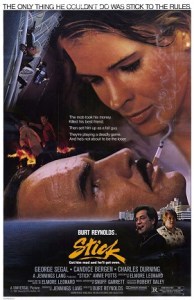
A Movie A Day #167: Stick (1985, directed by Burt Reynolds)


Stick (Burt Reynolds) is a veteran car thief who has just gotten out of prison.  No sooner has Stick arrived home in Florida then he accompanies his friend, Rainy (Jose Perez), on a drug deal that goes bad.  When Rainy is killed, Stick goes into hiding.  He manages to get a stable job, working as a chauffeur for an eccentric millionaire (George Segal).  He gets a new girlfriend (Candice Bergen) and starts to bond with his teenage daughter (Tricia Leigh Fisher).  Stick wants to go straight but, before he can, he knows that he has to confront the men who murdered Rainy.


Stick starts out strong.  The first half of the film finds Burt, who was often as underrated as a director as he was as an actor, in pure Sharky’s Machine mode, mixing the steamy Florida atmosphere with quirky character comedy and hardboiled action.  Adapting his own novel, Elmore Leonard wrote the screenplay and Stick seems like a classic Leonard hero, a criminal with his own moral code.  

But then Stick falls apart during the second half and it becomes obvious why both Reynolds and Leonard often cited this film as being one of the biggest disappointments of their careers.  Universal Studios disliked Burt’s first cut of the film and brought in a second screenwriter, who beefed up the action scenes and added the subplot with Stick’s teenage daughter.  Reynolds reshot the second half of the movie, no longer playing Stick as a tough criminal but instead as another variation on the Bandit.  The end result is a very disjointed movie, with Burt looking bored.

It does not help that the movie’s main villain is played by Charles Durning, who wears an orange fright wig and several Hawaiian shirts.  Durning was an actor who gave many great performances but never was he as miscast as when he played a drug dealer in Stick.

Lisa Reviews An Oscar Winner: Gandhi (dir by Richard Attenborough)


Gandhi-poster

I just finished watching the 1982 best picture winner Gandhi on TCM.  This is going to be a tough movie to review.

Why?

Well, first off, there’s the subject matter.  Gandhi is an epic biopic of Mohandas Gandhi (played, very well, by Ben Kingsley).  It starts with Gandhi as a 23 year-old attorney in South Africa who, after getting tossed out of a first class train compartment because of the color of his skin, leads a non-violent protest for the rights of all Indians in South Africa.  He gets arrested several times and, at one point, is threatened by Daniel Day-Lewis, making his screen debut as a young racist.  However, eventually, Gandhi’s protest draws international attention and pressure.  South Africa finally changes the law to give Indians a few rights.

Gandhi then returns to his native India, where he leads a similar campaign of non-violence in support of the fight for India’s independence from the British Empire.  For every violent act on the part of the British, Gandhi responds with humility and nonviolence.  After World War II, India gains its independence and Gandhi becomes the leader of the nation.  When India threatens to collapse as a result of violence between Hindus and Muslims, Gandhi fasts and announces that he will allow himself to starve to death unless the violence ends.  Gandhi brings peace to his country and is admired the world over.  And then, like almost all great leaders, he’s assassinated.

Gandhi tells the story of a great leader but that doesn’t necessarily make it a great movie.  In order to really examine Gandhi as a film, you have to be willing to accept that criticizing the movie is not the same as criticizing what (or who) the movie is about.

As I watched Gandhi, my main impression was that it was an extremely long movie.  Reportedly, Gandhi was a passion project for director Richard Attenborough.  An admirer of Gandhi’s and a lifelong equality activist, Attenborough spent over 20 years trying to raise the money to bring Gandhi’s life to the big screen.  Once he finally did, it appears that Attenbrough didn’t want to leave out a single detail.  Gandhi runs three and a half hours and, because certain scenes drag, it feels ever longer.

My other thought, as I watched Gandhi, was that it had to be one of the least cinematic films that I’ve ever seen.  Bless Attenborough for the nobility of his intentions but there’s not a single interesting visual to be found in the entire film.  I imagine that, even in 1982, Gandhi felt like a very old-fashioned movie.  In the end, it feels more like something you would see on PBS than in a theater.

The film is full of familiar faces, which works in some cases and doesn’t in others.  For instance, Gandhi’s British opponents are played by a virtual army of familiar character actors.  Every few minutes, someone like John Gielgud, Edward Fox, Trevor Howard, John Mills, or Nigel Hawthorne will pop up and wonder why Gandhi always has to be so troublesome.  The British character actors all do a pretty good job and contribute to the film without allowing their familiar faces to become a distraction.

But then, a few American actors show up.  Martin Sheen plays a reporter who interview Gandhi.  Candice Bergen shows up as a famous photographer.  And, unlike their British equivalents, neither Sheen nor Bergen really seem to fit into the film.  Both of them end up overacting.  (Sheen, in particular, delivers every line as if he’s scared that we’re going to forget that we’re watching a movie about an important figure in history.)  They both become distractions.

I guess the best thing that you can say about Gandhi, as a film, is that it features Ben Kingsley in the leading role.  He gives a wonderfully subtle performance as Gandhi, making him human even when the film insists on portraying him as a saint.  He won an Oscar for his performance in Gandhi and he deserved one.

As for Gandhi‘s award for best picture … well, let’s consider the films that it beat: E.T., Tootsie, The Verdict, and Missing.  And then, consider some of the films from 1982 that weren’t even nominated: Blade Runner, Burden of Dreams, Class of 1984, Fast Times At Ridgemont High, My Favorite Year, Poltergeist, Tenebrae, Vice Squad, Fanny and Alexander…

When you look at the competition, it’s clear that the Academy’s main motive in honoring Gandhi the film was to honor Gandhi the man.  In the end, Gandhi is a good example of a film that, good intentions aside, did not deserve its Oscar.

http://www.youtube.com/watch?v=6oWqlb_TlLQ

Lisa Watches An Oscar Nominee: The Sand Pebbles (dir by Robert Wise)


The_Sand_Pebbles_film_posterAfter watching Witness For The Prosecution, I continued TCM’s 31 Days of Oscar by watching the 1966 Best Picture nominee, The Sand Pebbles.

Considering that The Sand Pebbles is close to four hours long, it’s interesting how little there is to really say about it.  Taking place in 1926, The Sand Pebbles follows the crew of the USS San Pablo, a gunboat that patrols the Yangtze River in China.  The San Pablo is there to protect American business interests, which are in particular danger because China is caught up in a communist revolution.  For the most part, the crew of the San Pablo are portrayed as being lazy and racist.  They have little interest in understanding the culture of the people around them and they use Chinese laborer to do the work on the boat.

When Jake Holman (Steve McQueen) is transferred to the San Pablo, he upsets his fellow crewmen by insisting on working in the ship’s engine room himself, the fear being that if Holman is willing to work then the rest of them will be expected to work as well.  The ship’s commander, Lt. Collins (Richard Crenna), views Holman as being a threat to morale and starts to make plans to get Holman off of his boat.  But, first, the boat is going to have to get out of China…

The Sand Pebbles is an episodic film and some of those episodes are more interesting than others.  Typically, an episode will start out positively and then end with some sudden tragedy.  For instance, Holman trains one laborer (Mako) to be a boxer and then watches as he beats the most racist crewman on the ship.  However, just a few minutes later, the laborer is captured and savagely tortured by the communists and Holman is forced to perform a mercy killing.

In another subplot, Holman’s only friend, Frenchy (Richard Attenborough), marries a local prostitute (Emmanuelle Arsan, who would later write an autobiography that would serve as the basis for a very different type of film).  However, in order to see his wife, Frenchy has to continually swim to shore in the middle of the night.  Frenchy soon develops pneumonia and dies while his wife is dragged off and apparently executed.

And finally, Holman strikes up a romance with Shirley Eckert (Candice Bergen), an innocent missionary.  However, when her arrogant and naive boss, Jameson (Larry Gates), refuses to leave the country despite the revolution, the San Pablo is ordered to rescue them.  This, of course, leads to a final battle with the communists which leaves a good deal of the cast dead.

As I watched The Sand Pebbles, my main impression was that it was an extremely long movie.  The film’s climatic battle was exciting and Steve McQueen (not to be confused with the director of 12 Years A Slave and Shame) gave a good performance but otherwise, the film often seemed to drag.  While the movie’s theme of Americans struggling (and failing) to understand another country’s culture had a definite resonance, The Sand Pebbles did not seem to be quite sure what it truly wanted to say about it.

Let’s face it — over 500 films have been nominated for best picture.  And, while a good deal of them hold up surprisingly well and are still entertaining to watch, there’s also a handful like The Sand Pebbles, ambitious films that never quite reached their potential but were probably nominated because they seemed like the type of epic film that should be nominated.  Many of these films were nominated and a few even won.

However, in the case of The Sand Pebbles, a nomination would have to be enough.  That year, the Oscar for Best Picture was won by A Man For All Seasons.

What Lisa Watched Last Night #111: Beautiful & Twisted (dir by Christopher Zalla)


On Saturday night, I watched the latest Lifetime original movie, Beautiful & Twisted!

Why Was I Watching It?

Ever since I first saw the commercial during Whitney, I have been looking forward to seeing Beautiful & Twisted.  Not only was it true crime (which is one of my favorite Lifetime movie genres) but it also featured Rob Lowe.  Rob has appeared in a few Lifetime films and they always seem to bring out his best.

What Was It About?

The film is narrated by Ben Novack (Rob Lowe), who starts things off by telling us that he’s dead.  We see how Ben, the eccentric son of a millionaire hotelier, first met and subsequently married a stripper named Narcy (Paz Vega).  Ben likes collecting Batman memorabilia.  Narcy likes money.  They both like kinky sex.

However, Ben is often unfaithful to Narcy and finds himself on the receiving end of her often violent tempter.  When Narcy finds out that Ben is planning on leaving his fortune to his mother (Candice Bergen), Narcy has her murdered.  And when she worries that Ben might like her daughter (played by Seychelle Gabriel) more than her, Narcy has Ben brutally murdered.  Not only does she get her brother to beat him to death but she also demands that his eyes be gouged out of his head.

AGCK!

Amazingly enough, this is all based on a true story.

What Worked?

This is one of the best Lifetime films that I’ve seen in a while!  It was stylish, it was melodramatic, it was occasionally funny, and it was over-the-top in the best way possible.  The settings were opulent, the clothes were to die for, and the pace was relentless.  Even the music was great!  Seriously, if you’re going to make a movie about kinky sex and murder among the wealthy, you should at least have fun with it.  And, despite all of the grisly murders, Beautiful & Twisted was definitely fun.

Rob Lowe was sympathetically weird as Ben while, in the role of Narcy, Paz Vega gave a performance worthy of an old school femme fatale.

All in all, Beautiful & Twisted is exactly the type of movie that we Lifetime viewers have been hoping for.

What Did Not Work?

It all worked.  This one of the best Lifetime movies ever!

“Oh my God!  Just like me” Moments

Well, I have to admit that I’ve never had anyone killed and I doubt that I ever will.  I’m just not the murderous type, regardless of what you may have heard.  However, much like Narcy, I’m not above using my cleavage to get what I want.

Lessons Learned

If there’s any lesson to be learned from watching any of these Lifetime true crime films, it’s that you shouldn’t murder anyone because, regardless of how cute or clever you may be, you will eventually end up getting caught.  And then someone will make a movie about you and you’ll end up with a bunch of snarky people on twitter talking about how crazy you are.  It’s better to just get a divorce.

beautiful-and-twisted-lifetime-tv-review