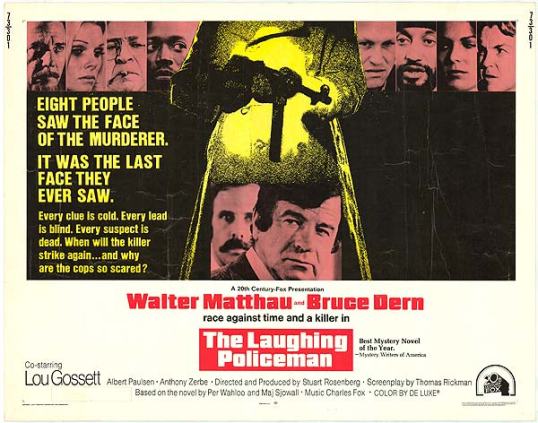
San Francisco in the 1970s. Revolution is in the air. Hippies are on every street corner. A man named Gus Niles knows that he’s being tailed by an off-duty cop, Dave Evans. Gus boards a city bus, knowing that Evans will follow him. On the bus, an unseen gunman suddenly opens fire with an M3 submachine gun, not only killing both Evans and Gus but six other people as well. After the bus crashes, the gunman calmly departs. At first, it is assumed that the massacre was another random mass shooting, like Charles Whitman in Austin or Mark Essex in New Orleans. But one San Francisco detective is convinced that it wasn’t random at all.
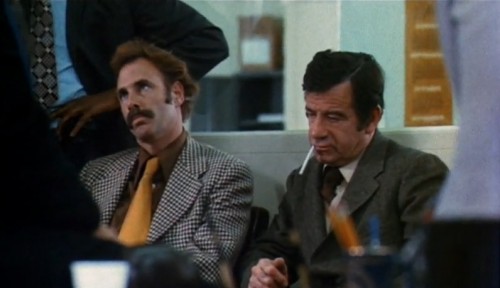
The Laughing Policeman was one of the many police procedurals to be released after the box office success of Dirty Harry and The French Connection and, despite the name, it’s also one of the grimmest. While the complex mystery behind why Evans was following Gus and who killed everyone on the bus is intriguing, The Laughing Policeman‘s main focus is on the often frustrating nitty gritty of the investigation, complete with false leads, uncooperative witnesses, unanswerable questions, and detectives who frequently make stupid mistakes. The movie’s first fifteen minutes are devoted to the police processing the bus, with Stuart Rosenberg (best known for directing Paul Newman in Cool Hand Luke) using overlapping dialogue to give the entire scene a documentary feel. As Detective Jake Martin, Walter Matthau is even more cynical and downbeat than usual while Bruce Dern provides good support as a younger, more volatile detective. The supporting cast is full of 70s character actors, like Lou Gossett, Anthony Zerbe, Gregory Sierra,and playing perhaps the sleaziest drug dealer ever seen in an American movie, Paul Koslo.
The Laughing Policeman was based on a Swedish novel that took place in Stockholm but, for the movie, Swedish Detective Martin Beck became world-weary Sgt. Jake Martin and Stockholm became San Francisco. Rosenberg directed the entire film on location, giving The Laughing Policeman the type of realistic feeling that would later be duplicated by TV shows like Hill Street Blues, NYPD Blue, and Law & Order. Though it may not be as well-known as either Dirty Harry or The French Connection, The Laughing Policeman is a dark and tough police procedural, an underrated classic of the genre.
Incidentally, The Laughing Policeman was one of the first films for which character actor Bruce Dern shared top billing. According to Dern’s autobiography, Matthau generously insisted that Dern be credited, with him, above the title.
Originally, I was planning on using the 2001 thriller The Glass House as one of my guilty pleasure reviews. Because, seriously, this film truly is one of the guiltiest of all guilty pleasures. I mean, there’s so much that you can criticize about the movie but it’s so much fun that I always feel rather bad for doing so. However, after giving it some thought, I decided to use The Glass House as one of my Back to School reviews. Seeing as how I just totally trashed a Leelee Sobieski film called Here On Earth, it only seems fair to now recommend one of her films.
In The Glass House, Leelee plays Ruby Baker, a 16 year-old whose parents are killed in a car accident. Though their uncle (Chris Noth) wants to adopt them, the will states that Ruby and her nine year-old brother (Trevor Morgan) will instead be looked after by their parents’ best friends, Erin (Diane Lane) and Terry (Stellan Skarsgard).
Now, here’s the thing. This is going to blow your mind. Guess where Erin and Terry live? They live in a big mansion in Malibu and the entire house is made out of … GLASS! We have a title, right!? But wait, there’s more! Guess what Terry and Erin’s last name is? That’s right — GLASS! So, the house is not only literally a glass house but it’s also the Glass house as well! And beyond that, there’s that old saying that people who live in glass houses shouldn’t throw stones and … well, that really doesn’t apply to this film.
Anyway, I’m making such a big deal about the title because it pretty much tells you everything that you need to know about The Glass House. There is not a single subtle moment to be found in this entire film. And really, this is not a film that requires or rewards subtlety. We know that Terry Glass is up to no good from the minute we meet him, largely because he’s played by Stellan Skarsgard and when was the last time Stellan Skarsgard played a trustworthy character? Skarsgard pretty much gives the same performance here that he’s given in almost every thriller that he’s ever appeared in (including David Fincher’s rehash of The Girl With The Dragon Tattoo — which I’m still ticked off about, by the way) but it works wonderfully because there’s not a hint of pretension to The Glass House. It just wants to entertain and it does just that. There’s little that can match the entertainment value of watching Stellan Skarsgard go totally over the top.
Sure, the film has all sorts of flaws. Ruby’s intelligence changes from scene to scene, depending on what the film’s story needs her to do. (For that matter, the same thing can be said about every character in the film.) But the film’s a lot of fun and Leelee Sobieski gives one of the best and most sympathetic performances of her career. Ruby may be an inconsistent character but she’s so well-played that you like her anyway. In a film that often threatens to go just a little bit too crazy, Leelee gives a performance of both believable grief and believable inner strength. She keeps the film grounded just enough that you’ll continue to watch even when the narrative hits a rough patch. As well, Bruce Dern is hilariously sleazy as a possibly duplicitous attorney. The only thing more entertaining than watching Stellan Skarsgard go over the top is watching Bruce Dern do the same thing in the same film.
The Glass House is one of those films that seems to show up on cable constantly. And, 9 times out of 10, I’ll at least watch at least a little bit of it. It’s just a fun movie.
(Lisa is currently in the process of trying to clean out her DVR by watching and reviewing all 40 of the movies that she recorded from the start of March to the end of June. She’s trying to get it all done by July 11th! Will she make it!? Keep visiting the site to find out!)
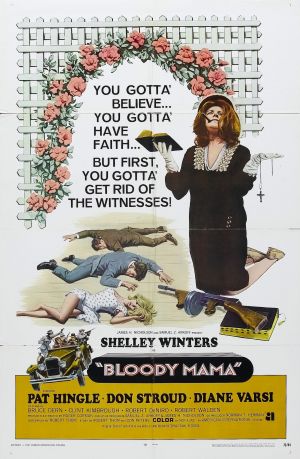
The 24th film on my DVR was the 1970 Roger Corman-directed gangster film, Bloody Mama. I recorded it off of TCM on May 27th.
Bloody Mama opens with a cheerful song that goes, “Maaaaaama…Bloody maaaaama….” and it’s such an unapolegetically over the top song that it perfectly sets the tone for what’s to follow. Bloody Mama is violent, occasionally perverse, and totally unashamed. It doesn’t pretend to be anything that it isn’t. It’s bloody and it’s about a mother and, in the best Corman tradition, it makes no apologies!
The film tells the heavily fictionalized story of the Barkers, a group of brothers who robbed banks and killed people in the 1920s and 30s. The majority of them were killed in a gunfight with the FBI. Also killed in the gunfight was their mother, Kate Barker. Always aware of the danger of bad publicity, the director of the FBI, J. Edgar Hoover, announced that Ma Barker was actually the mastermind of the Barker gang and that she was even more dangerous than her sons. Ever since, historians have debated whether Ma Barker was the criminal mastermind described by Hoover or if she was just the innocent woman described by … well, by everyone who actually knew her.
Bloody Mama, of course, leaves no doubt. From the minute that we discover that Shelley Winters will be playing Ma Barker, we know that she’s the most dangerous woman alive. As played by Winters, Ma Barker is a ruthless bank robber, one who has no fear of gunning down innocent bystanders and who never lets her love for her sons get in the way of ordering them to kill a witness. As opposed to a lot of gangster films made in the late 60s and early 70s, the film never attempts to portray its title character as being a heroic or particularly sympathetic character. Instead, what makes the character compelling is just how thoroughly Winters commits to the role. It doesn’t matter what Ma Barker is doing or saying, Shelley Winters totally sells it. When the gang is cornered by the police and one associate makes the mistake of yelling that he’s not a Barker, Ma reacts by gunning him down herself and you can’t help but appreciate the lengths that Ma will go to defend her family’s name.
As for her sons, they are an interesting group of perverts and drug addicts and they’re played some of the best character actors of the 1970s.
Herman Barker (Don Stroud) is a sadist but he’s also one of Ma’s favorites. He travels with a prostitute (played by Diane Varsi), who quickly tires of the Barkers’s violent way of life.
Arthur Barker (Clint Kimbrough) is the most practical of the Barkers and therefore, he’s also the least interesting.
Fred Barker (Robert Walden) is bisexual, which is a fact that the film handles with all the sensitivity that we’ve come to expect from a film made in 1970 (which is to say, not much at all). Fortunately, Fred’s lover is Kevin and Kevin is played by Bruce Dern and Bruce Dern is always a lot of fun to watch, especially when he’s appearing in a Corman film.
And then there’s Lloyd who sniffs glue and shoots heroin and who is played by an obscure young actor named Robert De Niro and … wait, Robert De Niro! That’s right! One of the pleasures of Bloody Mama is getting to see De Niro at the start of his career. Unfortunately, he doesn’t really get to do much, though he does occasionally flash the same unhinged smile that would later show up in Taxi Driver.
Roger Corman has repeatedly cited Bloody Mama as being one of his favorites of the many movies that he directed over the course of his long career. I don’t blame him. It’s a thoroughly shameless and totally entertaining film!
Keep an eye out for Bloody Mama!
Just remember, the real-life Ma Barker was probably innocent.
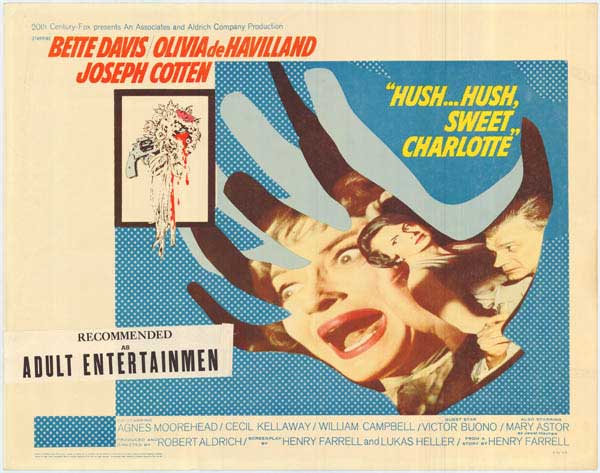
Today marks the 100th birthday of one of the last true Golden Age greats, Olivia de Havilland. Film fans across the globe are celebrating the life and career of this fine actress, who fought the Hollywood system and won. Olivia is the last surviving cast member of GONE WITH THE WIND (Melanie Wilkes), won two Academy Awards (TO EACH HIS OWN, THE HEIRESS), headlined classics like THE SNAKE PIT and THE DARK MIRROR, and costarred with dashing Errol Flynn in eight exciting films, including CAPTAIN BLOOD , THE ADVENTURES OF ROBIN HOOD, SANTA FE TRAIL, and THEY DIED WITH THEIR BOOTS ON.
Olivia moved to Paris with her husband in the 1950’s and was semi-retired, acting in a handful of films. In 1962 director Robert Aldrich scored a huge hit, a psychological horror thriller called WHATEVER HAPPENED TO BABY JANE?, starring screen veterans Bette Davis and Joan Crawford. A new genre was…
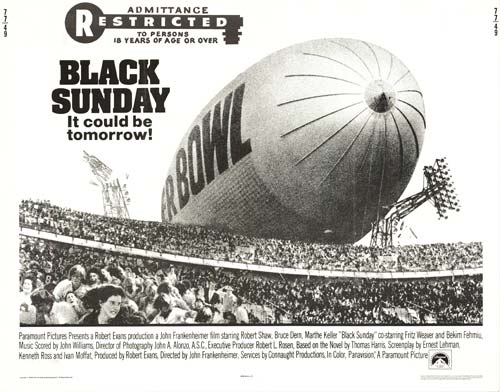
My New England Patriots aren’t in this year’s big game, and I can’t stand that big-headed Peyton Manning, so my interest in tonight’s Super Bowl is minimal. And the halftime show does nothing for me: Coldplay is probably one of my least favorite bands (Beyoncé’s OK, though). So if like me, you’re not planning on spending much time watching Roger Goodell’s season-ending spectacular (can’t stand Goodell, either) may I suggest an alternative, namely John Frankenheimer’s thriller BLACK SUNDAY.
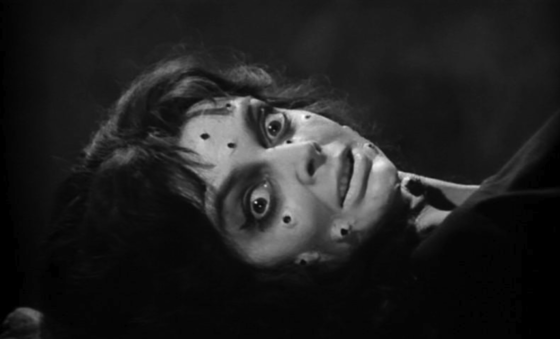
No, it’s not the 1960 Barbara Steele/Mario Bava horror classic, this BLACK SUNDAY is a rousing political thriller about terrorist organization Black September plotting a strike against America at the biggest game of them all, the Super Bowl. Beautiful but deadly terrorist Dahlia (Marthe Keller) has recruited the bitter, unstable blimp pilot Michael Lander (Bruce Dern at his 70’s psycho best) to turn the blimp into the ultimate suicide bomb, with plastique explosives setting…
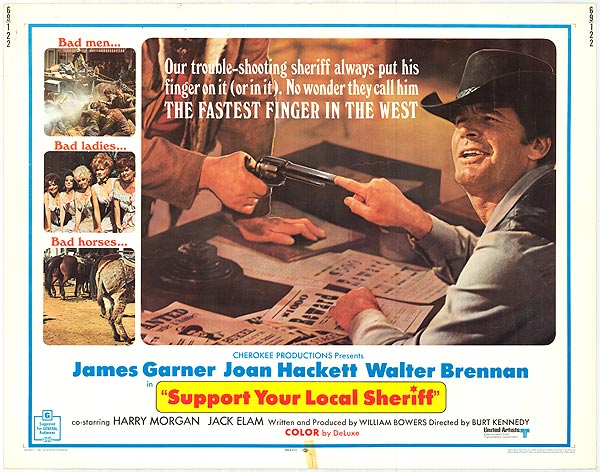
SUPPORT YOUR LOCAL SHERIFF! is played strictly for laughs. It’s broad performances and slapstick situations won’t strain your brain, but will give you an hour and a half’s worth of escapist fun. Easy going James Garner has the lead, with solid comic support from Joan Hackett, Walter Brennan, Harry Morgan, and Jack Elam. Director Burt Kennedy made quite a few of these, and this is probably the best of the bunch.
While burying an itinerant drifter, the townsfolk of Calendar, Colorado discover a mother lode of gold. The subsequent boom turns Calendar into a lawless, rowdy town that can’t keep a sheriff alive long enough to tame it. The town elders also can’t get their gold through without paying a 20% tribute to the mean Danby clan. Enter our hero Jason McCullough (Garner), who applies for the sheriff’s position “on a temporary basis…I’m on my way to Australia”. Jason is a crack shot and fast…
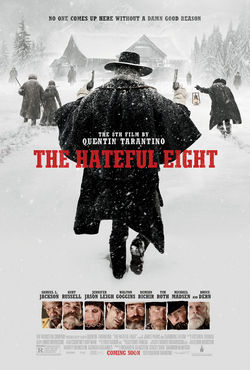
Remember how I said that it was intimidating to admit that The Big Short didn’t do much for me as a viewer? Well, it’s even more intimidating for me to admit that I felt much the same way about The Hateful Eight as well.
Nearly everyone I know loves The Hateful Eight and, going into it, I really wanted to love it as well. After all, this is — as the opening credits remind us — Quentin Tarantino’s 8th film! Tarantino is one of my favorite directors. I thought his last film, Django Unchained, was a masterpiece and one of the most important films ever made about slavery. Like many of you, I’ve followed all the details of the making of The Hateful Eight, from the initial script leak to the controversy over Tarantino’s comments on the police. I was excited because the cast looked great and was full of veteran actors — like Kurt Russell, Jennifer Jason Leigh, and Bruce Dern — who all seemed likely to benefit from the Tarantino touch. (Say what you will about Quentin Tarantino, it cannot be denied that he’s given good roles to talented actors who are rarely given the opportunities that they deserve.) When I heard that Ennio Morricone was going to be providing the score, I got even more excited. Morricone and Tarantino; it seemed like the perfect combination for greatness.
Well, Morricone’s score is spectacular. There’s talk that Morricone might finally win an Oscar for his work on The Hateful Eight and I certainly don’t have a problem with that. (Hopefully, Morricone will have learned a lesson from the Golden Globes and, if he is nominated, he will either come to the ceremony himself or arrange for someone other than Tarantino to accept for him.) And Jennifer Jason Leigh takes full advantage of her role, giving a truly ferocious performance.
But otherwise, The Hateful Eight just didn’t do much for me. It’s not that I disliked the film. There was a lot that worked but, for whatever reason, The Hateful Eight never enthralled me the way that past Tarantino films have. The Hateful Eight left me saying, “Is that it?”
A lot of my reaction to The Hateful Eight has to do with the film’s length. Taking place, for the most part, in only one location and structured more like a play than a film, The Hateful Eight would be a great 90 minute murder mystery. Instead, it lasts nearly 3 hours and, at times, the film drags interminably. As usual, Tarantino plays with time and, at one point, stops the action so that we can see what happened earlier in the day. Unfortunately, as opposed to other Tarantino films, we don’t really learn anything new from this flashback and you get the feeling that it was included most because flaskbacks are a Tarantino trademark and because he wanted to find a way to work a somewhat pointless Zoe Bell cameo into the film.
As for Tarantino’s widely acclaimed script, I have to admit that I got kind of bored with this talky film. Yes, the actors were all good and it’s always fun to listen to Samuel L. Jackson be a badass but the dialogue itself was largely repetitive and occasionally, the film itself threatened to turn into Tarantino-on-autopilot.
(Interestingly enough, Tarantino’s script features several creative euphemisms for oral sex and the characters come up with a handful of different ways to point out that Jackson is black but, when it comes to Jennifer Jason Leigh’s character, nobody can come up with anything more imaginative than repeatedly calling her a bitch. While, unlike some critics, I don’t think The Hateful Eight is a misogynistic movie, I do have to admit that I was rolling my eyes around the fifth time that Leigh’s character was called a bitch and kept rolling them for the entire movie. For a writer well-known for his ability to come up with colorful and memorable insults, Tarantino’s refusal to come up with anything more imaginative than “bitch” just felt lazy.)
What can I say? The Hateful Eight just didn’t do much for me. However, I do think that the film looked great and I certainly hope that Morricone and Leigh are at least nominated for their excellent work. I look forward to Tarantino’s next film but I doubt I’ll be revisiting The Hateful Eight any time soon.
(By the way, with this review, I am now officially caught up on reviewing the films of 2015!)
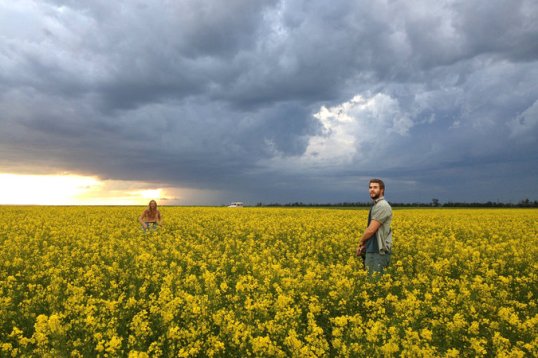
The image at the top of this post is taken from the film Cut Bank and features Teresa Palmer and Liam Hemsworth. It’s a striking picture, isn’t it? If there’s anything positive that can be said about Cut Bank, it’s that it’s a visually striking film. Some of the film’s images compare favorably with the work of the Coen Brothers in No Country For Old Men and Fargo.
(Perhaps not surprisingly, the film’s director, Matt Shakman, previously directed two episodes of the Fargo tv series.)
Of course, it’s not just the film’s visual style that will remind you of the Coens. The plot is full of Coen DNA as well and that’s a bit of a problem. The thing that sets the Coen Brothers apart from other directors is that only they seem to understand how to best pull off their unique brand of ironic quirkiness. It’s difficult to think of any other director who could have done A Serious Man,Burn After Reading, or any other Coen film. It’s telling that whenever other directors have attempted to film a Coen Brothers script — whether it was Angelina Jolie with Unbroken or Steven Spielberg with Bridge of Spies — the resulting film has almost always been overwhelmingly earnest. (If you try, you can imagine a Coen-directed version of Bridge of Spies, one with Josh Brolin in the Tom Hanks role, Steve Buscemi as Rudolph Abel, and maybe Bruce Campbell as a CIA agent.) The Coen style is one that has inspired many a director but ultimately, it seems to be something that only the Coens themselves are truly capable of pulling off.
(Though Ridley Scott came close with the underrated The Counselor…)
Plotwise, Cut Bank has everything that you would normally expect to find in a Coen Brothers film. For instance, it takes place in Cut Bank, Montana and, much as in Fargo and No Country For Old Men, a good deal of time is devoted to detailing the oddness of life in the middle of nowhere. Also, much as in Fargo and No Country For Old Men, the entire film revolves around an overly complicated crime gone wrong.
Dwayne McLaren (Liam Hemsworth) has spent his entire life in the Montana town of Cut Bank and is looking for a way to get enough money to move out to California with his beauty pageant-obsessed girlfriend, Cassandra (Teresa Palmer). Dwayne learns that the U.S. Postal Service will pay a reward to anyone who provides information about the death of a postal worker. One day, while filming one of Cassandra’s pageant audition videos, Dwayne accidentally films both the shooting of mailman Georgie Wits (Bruce Dern) and the theft of his mail truck.
Wow, what luck!
Sheriff Vogel (John Malkovich) throws up as soon as he hears about the murder. After all, he’s never had to investigate one before. Town weirdo Derby Milton (Michael Stuhlbarg) is upset that the stolen mail truck contained a parcel that he was waiting for. Meanwhile, Big Stan (Billy Bob Thornton), who happens to be both Cassandra’s father and Dwayne’s boss, seems to be suspicious about how Dwayne just happened to be in the field at the same time that Georgie was getting killed…
Dwayne’s efforts to collect his reward are stymied by the fact that postal inspector Joe Barrett (Oliver Platt) doesn’t want to hand over any money until Georgie’s body has been found. Unfortunately, it’s going to be difficult for anyone to find Georgie’s body because Georgie is still alive! That’s right — Georgie’s been working with Dwayne the whole time…
Meanwhile, it turns out that Derby is not someone you want to mess with. In fact, he’s just as efficient a killing machine as Javier Bardem in No Country For Old Men. And Derby is determined to retrieve his parcel…
Cut Bank got an extremely limited release in April of this year and it didn’t get much attention. To a certain extent, I can understand why. It’s a film that has its moments but ultimately, it’s never as good as you want it to be. The best thing about the film is that it features a lot of eccentric actors doing their thing. Any film that allows Bruce Dern to interact with Michael Stuhlbarg deserves some credit. Unfortunately, Dwayne and Cassandra are not particularly interesting characters and Hemsworth and Palmer give rather one-dimensional performances. Since you don’t care about them, you don’t really care if Dwayne’s scheme is going to work out. William H. Macy may have been a despicable loser in Fargo but you could still understand what led to him coming up with his phony plan and you felt a strange mix of sympathy and revulsion as everything spiraled out of his control. The same can be said of Josh Brolin in No Country For Old Men. Dwayne, however, just comes across like someone who came up with a needlessly complicated plan for no good reason.
In 2013, the script for Cut Bank was included as a part of the Black List, an annual list of the “best” unproduced scripts in Hollywood. What’s odd is that, for all the hype that goes along with being listed, Black List scripts rarely seem to work as actual films. Oh sure, there’s been a few exceptions. American Hustle was on the Black List, for instance. But a typical Black List film usually turns out to be something more along the lines of The Beaver or Broken City. Watching Cut Bank, I could see why the script generated excitement. The story is full of twists and all of the characters are odd enough that I’m sure readers had a lot of fun imagining which beloved character actor could fill each role. Unfortunately — as so often happens with Black List films — the direction does not live up to the writing. Yes, the plot is twisty and there’s a lot of odd moments but the film never escapes the long shadow of the films that influenced it.
Just one month ago, The Hateful Eight was a film that everyone was eagerly anticipating but which no one was expecting to be as controversial or as incendiary as Quentin Tarantino’s previous film, Django Unchained. I think a lot of us were expecting The Hateful Eight to be a bit like Kill Bill — i.e., a delirious homage to Tarantino’s favorite films and one that took place in a parallel universe. We were expecting The Hateful Eight to be an example of pure cinema, with little connection to the outside world.
But that was a month ago. Things have changed. As I sit here typing this, The Hateful Eight has suddenly become one of the most controversial films of 2015. Suddenly, deciding whether or not to see it has been transformed into a political decision. Following Tarantino’s public criticism of the police and his refusal to back down from his statements, there are suddenly calls to boycott Tarantino’s latest film.
Myself, I’m not a huge fan of boycotting anything. I may choose not to see something for whatever reason but that’s my choice and it certainly does not make me politically or morally superior to anyone who may choose differently. Ultimately, those who want to boycott Tarantino’s film because of his liberal politics need to realize that they’ll also be boycotting a film that stars Libertarian Kurt Russell and features Republican Bruce Dern. If you can’t stand Tarantino’s politics, don’t vote for him when he runs for President. Don’t vote for any candidate that he endorses. But leave his movies, and those of us who want to watch them, alone.
Add to that, The Hateful Eight looks really good! Check out the trailer below!
The Hateful Eight was never to be seen due to the unfortunate leak of the early draft of Tarantino’s screenplay for the film. It wasn’t meant to be seen outside of those he had trusted to become part of the film. Yet, the script still managed to leak and fanboys worldwide rushed to download and take a gander at what Tarantino had planned for his eight film.
After weeks and a couple months of cooling down from the betrayal of having his work leaked before it was time, Tarantino finally backed off from his promise that The Hateful Eight will never be filmed. With sighs of relief, fans, admirers and critics were glad to see Tarantino change his mind and put the script into production.
Months have gone by since that decision and the start of principal photography. Mini teasers were released and publicity shots were disseminated to the public, but a proper teaser trailer still hadn’t been released.
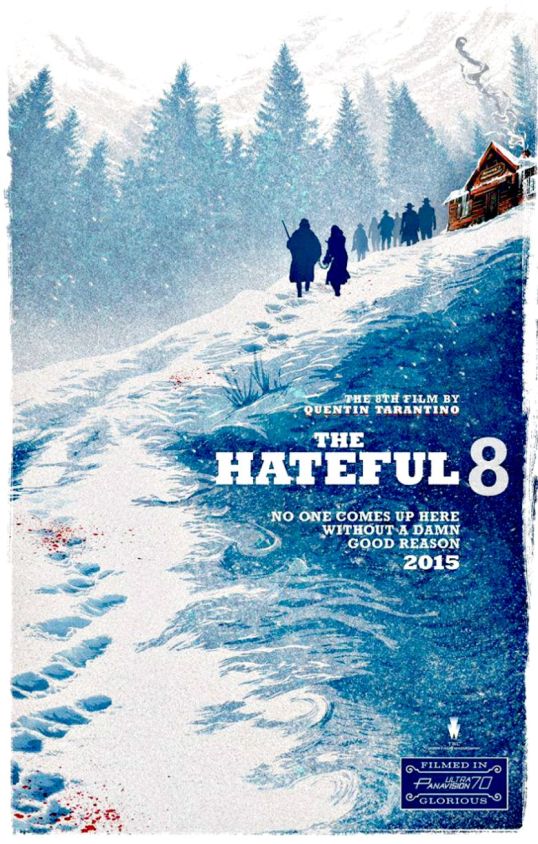
Now, the waiting has ended as The Weinstein Company has released the first official teaser trailer for Quentin Tarantino’s eight film, The Hateful Eight.
The Hateful Eight will be seen in limited release this Christmas 2015 and everywhere else on January 8, 2016.



 Through the Shattered Lens