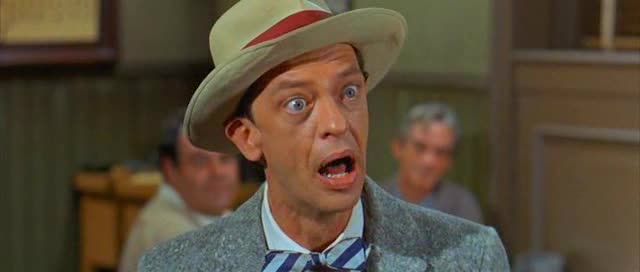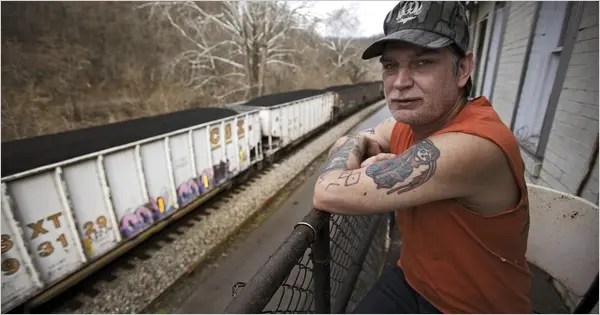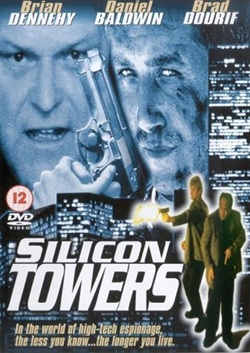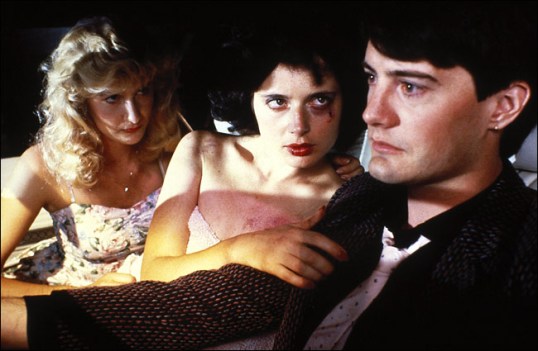
4 Shots of 4 Celebrities is just what it says it is, 4 shots of 4 of my favorite celebritiesconnected to the state I’m vacationing in. Where am I?!!
This week I’ll be getting some much needed R & R as I spend time away from work and exclusively with family and friends. My last post for the next nine days just happens to be coming from the state with strong connections to each of these unique performers. Y’all have a wonderful week and I’ll be back soon!
Brad Dourif in Mississippi BurningDon Knotts in The Ghost and Mr. ChickenTraci Lords in Not of This EarthJesco White in The Wild and Wonderful Whites of ____ ________!
Charlie (Jonathan Quint) gets a promotion to an executive job at Silicon Towers. After his promotion, he is sent an encrypted email that reveals that the company is manufacturing computer chips that it can use to drain money from the banks and to control the world. Charlie goes on the run, jumping from roof to roof as he tries to avoid the company’s security team and reveal the truth. Brian Dennehy plays the evil CEO. Daniel Baldwin plays another executive. Brad Dourif plays a paranoid tech expert and steals the movie. Robert Guillaume is the police detective who is investigating the strange things that are happening around the company. Be sure to hum the Benson theme song while watching.
There was a lot of movies like SiliconTowers in the late 90s. The internet was still exotic and people were still convinced that technology was going to destroy us all on Y2K. SiliconTowers was not the only paranoid tech thriller to come out in 1999 but it might have been the most inept. Serge Rodnunsky made a lot of movies back in the day and never let a lack of a budget stand in his way but he also never seemed to understand the importance of being able to hear dialogue or smooth editing. There are some good actors in Silicon Towers. Good luck understanding what any of them are saying.
This film is mostly memorable for the scenes of Charlie “hacking.” Charlie writes his hacking code in HTML. That’s pretty much all you need to know.
First released in 1986 and still regularly watched and imitated, Blue Velvet is one of the most straight forward films that David Lynch ever made.
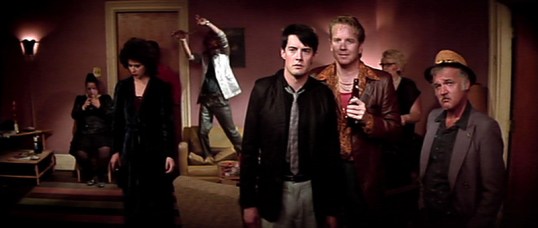
For all the talk about it being a strange and surreal vision of small town America, the plot of Blue Velvet is not difficult to follow. After his father has a stroke that leaves him confined to a hospital bed, Jeffrey Beaumont (Kyle MacLachlan) returns home from college. Lumberton appears to be a quiet and friendly little town, with pretty houses and manicured lawns and friendly people. Jeffrey, with his dark jacket and his expression of concern, appears a little out-of-step with the rest of the town. He’s been away, after all. One day, while walking through a field, Jeffrey discovers a rotting, severed ear. Jeffrey picks up the ear and takes it Detective Williams (George Dickerson). Detective Williams, who looks like he could have stepped straight out of an episode of Dragnet, is such a man of the innocent 1950s that his wife is even played by Hope Lange.
“Yes, that’s a human ear, alright,” Williams says, deadpan.
Blue Velvet (1986, dir by David Lynch, DP: Frederick Elmes)
With the help of Detective Williams’s blonde and seemingly innocent daughter, Sandy (Laura Dern), Jeffrey launches his own investigation into why the ear was in the field. He discovers that Lumberton has a teeming criminal underworld, one that is full of men who are as savage as the ants that we saw, in close-up, fighting over that ear in the field. Jeffrey discovers that a singer named Dorothy (Isabella Rossellini) is being sexually blackmailed by a madman named Frank Booth (Dennis Hopper). When Dorothy discovers Jeffrey hiding in her closet (where he had been voyeuristically watching her and Frank), it leads to Jeffrey and Dorothy having a sadomasochistic relationship. “Hit me!” Dorothy demands and both the viewer and Jeffrey discover that he’s got his own darkness inside of him. “You’re like me,” Frank hisses at Jeffrey at one point and, if we’re to be honest, it almost feels like too obvious a line for an artist like David Lynch. Lynch once described the film as being “The Hardy Boys in Hell,” and the plot really is as straightforward as one of those teenage mystery books.
That said, Blue Velvet also features some of Lynch’s most memorable visuals, from the brilliant slow motion opening to the moment that the camera itself seems to descend into the ear, forcing us to consider just how fragile the human body actually is. The film goes from showcasing the green lawns and blue skies to Lumberton to tossing Jeffrey into the shadowy world of Dorothy’s apartment building and suddenly, the entire atmosphere changes and the town becomes very threatening. We find ourselves wondering if even Detective Williams can be trusted. That said, my favorite visual in the film is a simple one. Sandy and Jeffrey walk along a suburban street at night and the camera shows us the dark trees that rise above them, contrasting their eerie stillness to Sandy and Jeffrey’s youthful flirtation.
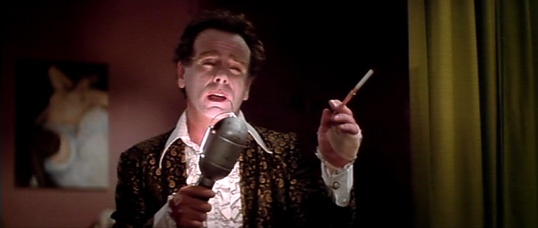
Dean Stockwell in Blue Velvet
Dean Stockwell shows up as Ben, an associate of Frank’s who lip-synchs to Roy Orbison’s In Dreams while Frank himself seems to have a fit of some sort beside him. In retrospect, Blue Velvet played a huge role in Dennis Hopper getting stereotyped as an out-of-control villain but that doesn’t make him any less terrifying as Frank Booth. Hopper, recently sober after decades of drug abuse and self-destructive behavior, summoned up his own demons to play Booth and he turns Frank into a true nightmare creature. Isabella Rossellini is heart-breaking as the fragile Dorothy. That said, the heart of the film belongs to Kyle MacLachlan and Laura Dern and both of them do a wonderful job of suggesting not only the darkness lurking in their characters but also their kindness as well. For all the talk about Lynch as a subversive artist, he was also someone who had a remarkable faith in humanity and that faith is found in both Jeffrey and Sandy. MacLachlan and Dern manage to sell moments that should have been awkward, like Sandy’s monologue about the returning birds or Jeffrey’s emotional lament questioning why people like Frank have to exist. Both Jeffrey and Sandy lose their innocence but not their hope for a better world.
BlueVelvet is a straight-forward mystery and a surreal dream but mostly it’s an ultimately hopeful portrait of humanity. The world is dark and full of secrets, the film says. But that doesn’t mean that it can’t be a beautiful place.
Blue Velvet (1986, dir by David Lynch, DP: Frederick Elmes)
Welcome to Retro Television Reviews, a feature where we review some of our favorite and least favorite shows of the past! On Mondays, I will be reviewing Miami Vice, which ran on NBC from 1984 to 1989. The entire show can be purchased on Prime!
This week, a guest star breaks Sonny’s heart.
Episode 3.16 “Theresa”
(Dir by Virgil W. Vogel, originally aired on February 13th, 1987)
Sonny is planning on asking his girlfriend, Dr. Theresa Lyons (Helena Bonham-Carter), to marry him. What Sonny doesn’t know is that Theresa is a junkie. Back surgery caused her to develop a dependence on painkillers and, after she got in trouble for writing her own prescriptions, Theresa started dealing with drug dealers. Theresa’s addiction has left her vulnerable to a long-haired drug lord named Wyatt (Brad Dourif). Sonny recently arrested Wyatt but Wyatt has one of his dealers tell Theresa that he’ll only give her a fix if she steals the four evidence tapes from Sonny’s houseboat. Theresa steals one tape. The other tapes are destroyed when Wyatt bombs a police evidence warehouse! Seriously, Wyatt doesn’t mess around and, when that warehouse goes up in flames, we’re reminded that Miami is not a place for the weak. The police are in a war and they have no possible path to victory. The bad guys are always willing to do what the police can not.
Most of this episode centers around Theresa and Sonny attempting to deal with her addiction and Sonny coming to realize that Theresa will have to return to the UK if she’s ever going to recover. Even after Sonny gets suspended from the force while Internal Affairs investigates the theft of the tape, Theresa remains Sonny’s main concern. It was actually kind of nice to see Sonny caring about someone again. Don Johnson has been a bit inconsistent this season. (There are several episodes were its obvious he was getting a bit bored with the part.) But he does a good job in this episode.
As for the guest stars, Brad Dourif is charismatically evil as the smug and New Age-y Wyatt. Helena Bonham Cater was only 20 when she appeared in this episode and she looked even younger. That doesn’t exactly make her the most believable trauma doctor in the world. Because of her youth, she’s miscast and there are a few times when she looks more like Crockett’s daughter than his girlfriend. That said, Bonham Carter really sells the scene where she reveals her addiction to Crockett and she definitely captures the desperation of someone in need of another fix.
“Life’s not easy when you’re a lover,” Tubbs says at one point, “….or a primary investigator.” With Sonny sidelined with his suspension and his personal drama, Tubbs got to play the role of concerned best friend and it’s one that Philip Michael Thomas always played well on the show. If nothing else, you believe that Tubbs would take a bullet for his partner. The show may end with Theresa returning to the UK and Sonny sadly looking down at the engagement ring that he’ll never give her but, fortunately, he’ll always have Tubbs.
1988’s Mississippi Burning opens on a lonely Mississippi backroad in 1964. A car is pulled over by the police. Inside the car are three young men, one black and two white. Judging from their nervous expressions and the sound of the people who stopped them and the fact that they’re in Mississippi during the 60s, we can guess what is about to happen to the people in the car.
With the three men, who were civil rights activists who were involved in voter registration efforts, officially considered to be missing, the FBI sends down two agents to find out what happened. The two agents are Alan Ward (Willem DaFoe) and Rupert Anderson (Gene Hackman). Ward is a Northerner who does things by the book and who resents having to deal with lax Southern law enforcement. He is serious-minded and, just in case we need a reminder of how serious he is, he wears bar-rimmed glasses that make him look like the world’s most fearsome IRS agent. Anderson is from Mississippi. He’s a talkative good ol’ boy who was a sheriff before he joined the FBI. “You know what has four eyes but can’t see?” Anderson asks, “Mississippi.” It’s a tense partnership, as Ward sometimes disapproves of Anderson’s methods and Anderson thinks that Ward doesn’t understand how things work in Mississippi.
From the first minute we meet local law enforcement, we know that they’re the killers. Just the fact that one of them are played by Brad Dourif is evidence enough. However, no one in town is willing to say a word against the police or their cronies. The white citizens are either too intimidated or they agree with what happened to the three civil rights workers. (The three men are often referred to as being “outside agitators.”) The black townspeople live in fear of the Klan and have no reason to trust the word of white FBI agents like Ward and Anderson.
Ward and Anderson investigate the case, hoping that they can find some bit of evidence that will prove the guilt of Sheriff Stuckey (Gailard Sartain), Deputy Pell (Brad Dourif), KKK leader Clayton Townley (Stephen Tobolowsky), and maybe even the town’s mayor (R. Lee Ermey). One advantage that the FBI has is that the murderers are incredibly stupid. Another is that Deputy Pell’s abused wife (Frances McDormand, giving the film’s best performance) might be persuaded to testify against her husband.
Mississippi Burning is an example of both powerful filmmaking and problematic history. Like Ridley Scott, director Alan Parker got his start making commercials and he brought the same sensibility to his movies. He knew what audiences wanted to see and he made sure to give it to them. Mississippi Burning looks fantastic and is full of memorable performances. (Both McDormand and Hackman received Oscar nominations). The action moves quickly and the villains are so hateful that watching them end up getting humiliated really does bring about a sort of emotional release.
At the same time, this is a film about the Civil Rights era that presents the FBI as being the heroes. And while it’s true that the FBI did investigate the real-life murders that inspired this film, Mississippi Burning leaves out the fact that the FBI was just a rigorous in harassing and wire tapping Martin Luther King as they were in keeping an eye on the leaders of the Klan. It’s a film about racism in which the heroes are as white as the villains. Gene Hackman gives a good performance as Rupert Anderson but the film never really delves all that deeply into Anderson’s feelings about racism in the South. We’re told that he was a sheriff in Mississippi but we never learn much about what type of sheriff Anderson was. He’s opposed to the Klan but, historically, the same can be said of many segregationists in the 60s, many of whom felt the Klan’s activities brought unwanted federal attention to what was happening in their home states. By not delving into Anderson’s own history as a member of Mississippi law enforcement or the FBI’s own more problematic history when it comes to the civil rights movement, the film provides viewers with the escape of viewing the bad guys as being aberrations as opposed to being the norm in 1964. In the end, Mississippi Burning is an effective thriller with strong heroes and hateful villains. Just don’t watch it for historical accuracy.
Mississippi Burning was nominated for Best Picture but it lost to Rain Man.
First released in 1981 and then re-released in several different versions since then, Heaven’s Gate begins at Harvard University.
The year is 1870 and the graduates of Harvard have got their entire future ahead of them. At the graduation ceremony, Joseph Cotten gives a speech about how, as men of cultivation, they have an obligation to help the uncultivated. Student orator Billy Irvine (John Hurt) then gives a speech in which he jokingly says the exact opposite. Amongst the graduates, Billy’s friend, Jim Averill (Kris Kristofferson), laughs at Billy’s speech. It’s a bit of a strange scene, if just because all of the graduates appear to be teenagers except for Hurt and Kristofferson, who are both clearly in their 30s. The graduates of Harvard sing to their girlfriends and dance under a tree and, for a fleeting moment, all seems to be right with the world.
Twenty years later, all seems to be wrong with the world. Averill is now the rugged and world-weary marshal of Johnson Country, Wyoming. Cattle barons are trying to force immigrant settlers to give up their land. Gunmen, like Nate Champion (Christopher Walken) and Nick Ray (Mickey Rourke), are accepting contracts to execute immigrants who are suspected of stealing cattle. When Averill stands up for the people of Johnson Country, the head of the Wyoming Stock Grower Association, Frank Canton (Sam Waterston), hires a group of mercenaries to ride into Johnson County and execute 125 settlers. Billy Irvine, who now is dissolute alcoholic who works with Canton, warns his old friend Averill. Averill, who has fallen in love with Ella (Isabelle Huppert), the local madam, announces that he will defend the immigrants. Nate, who is also in love with Ella, considers changing sides.
Heaven’s Gate is loosely based on an actual event. I actually have three distant ancestors who traveled to Wyoming to take part in the Johnson County War. All three of them survived, though one of them was shot and killed in an unrelated manner shortly after returning to Ft. Smith, Arkansas. That said, director Michael Cimino is clearly not that interested in the historical reality of the Johnson County War or the issues that it raised. Just as he did with Vietnam in The Deer Hunter, Cimino uses the Johnson County War as a way to signify a loss of national innocence. Averill and Irvine start the film as hopeful “young” men with the future ahead of them. By the end of the film, one is dead and the other is living on a yacht and dealing with what appears to be crippling ennui.
Heaven’s Gate is a bit of an infamous film. Though the film was pretty much a standard western, Cimino still went far over-budget and turned in a first cut that was over six hours long. A four hour version was briefly released in 1980 but withdrawn after a week, due to terrible reviews and audience indifference. A studio-edited version that ran for two hours and 35 minutes got the widest release in 1981. Since then, there have been several other versions released. Cimino’s director’s cut, which was released as a part of the Criterion Collection in 2012, runs for 212-minutes and is considered to now be the “official” version of Heaven’s Gate.
For years, Heaven’s Gate had a terrible reputation. It’s failure at the box office was blamed for bankrupting United Artists. After the excesses of the Heaven’s Gate production, studios were far more reluctant to just give a director a bunch of money and let him run off to make his movie. (They should have learned their lesson with Dennis Hopper and The Last Movie.) Described by studio execs as being self-indulgent and even mentally unstable, Michael Cimino’s career never recovered and the director of The Deer Hunter went from being an Oscar-winner to being an industry pariah. (Some who disliked The Deer Hunter’s perceived jingoistic subtext claimed that Heaven’s Gate proved The Deer Hunter was just an overrated fluke.) However, the reputation of Heaven’s Gate has improved, especially with the release of Cimino’s director’s cut. Many critics have praised Heaven’s Gate for its epic portrayal of the west and, ironically given the controversy over The Deer Hunter, its political subtext. It’s anti-immigrant villains made the film popular amongst the Resistance-leaning film historians during the first Trump term.
So, is Heaven’s Gate a masterpiece or a disaster? To be honest, it’s somewhere in between. Whereas it was once over-criticized, it’s now over-praised. Visually, it’s a beautiful film but those who complained that the film was too slow had a point. As with The Deer Hunter, Cimino takes the time to introduce us to and immerse us in a tight-knit immigrant community. Personally, I like the much-criticized scenes of the fiddler on skates and Averill and Ella dancing in the roller rink. Overall though, as opposed to The Deer Hunter, the members of the film’s victimized community still feel less like individual characters and more like symbols. As for the political subtext, I think that any subtext of that sort is accidental. (I feel the same way about The Deer Hunter, which I like quite a bit more than Heaven’s Gate.) Cimino is more interested in the loss of innocence than whether or not the Johnson County War can be fit into some sort of nonsense Marxist framework.
The main problem with the film is that there is no center to keep everything grounded. Kris Kristofferson had a definite screen presence but, as an actor who was incapable of showing a great deal of emotion, he lacks the gravitas necessary to keep from being swallowed up by Cimino’s epic pretensions. Isabelle Huppert, an otherwise great actress, also feels lost in the role of Ella and Sam Waterston is not necessarily the most-intimidating villain to ever show up in a western. Christopher Walken, as the enigmatic and intriguing Nate Champion, gives the best performance in the film but his character still feels largely wasted.
There are some brilliant visual moments to be found in Heaven’s Gate. I even like the Harvard prologue and the ending on the boat, both of which are not technically necessary to the narrative but still add an extra-dimension to both Averill and Irvine. But, in the end, Heaven’s Gate is big when it should have been small and epic when its should have been intimate. It’s a misfire but not a disaster. Even great directors occasionally have a film that just doesn’t work. Speilberg had his 1941. Scorsese has had a handful. Coppola’s career has been a mess but no one can take his successes away from him. Michael Cimino, who passed away in 2016, deserved another chance.
I was in a medically-approved Vicodin haze yesterday so I missed the fact that it was Gene Hackman’s birthday! Well, let’s make up for it today with a scene of Hackman being a righteous badass in 1988’s Mississippi Burning.
If you need any proof that Gene Hackman is one of our best actors, just consider that it’s been nearly 20 years since he retired from acting and he’s rarely seen out in public (reportedly due to just naturally being a very private man) yet he remains a popular performer who earns new fans every day. In this scene, Hackman plays an FBI agent who lets a bunch of racists know that just because he might share their accent, that doesn’t mean that he shares their beliefs. No one could go from friendly to intimidating with as much style as Gene Hackman.
(And yes, that is a young Michael Rooker getting put in his place, along with Brad Dourif.)
In 1993’s Trauma, Dario Argento tells a story of giallo horror, complete with a killer who wears black gloves, a camera that stalks through the streets of a rainy city, and plenty of eccentric red herrings. The story is set and was filmed in Minneapolis, Minnesota, making this one of the two Argento films to be completely shot in America.
Trauma was also the first of Argento’s films to star his daughter Asia Argento. Asia, who was 16 at the time of filming, plays Aura Petrescu, the daughter of Adriana (Piper Laurie) and Stefan (Dominique Serrand). Aura is a bulimic drug addict, with track marks up and down her arms. Having recently escaped from a mental hospital run by the eccentric Dr. Judd (Frederic Forrest), Aura is preparing to jump off a bridge and end her life when she’s grabbed by David (Christopher Rydell). David works as a headline writer and an artist for a local TV news station. David is also a recovering addict who takes sympathy on Aura and buys her breakfast. Aura thanks David by stealing his wallet and running out of the restaurant.
After being caught by the police, Aura is then returned to her home, a baroque mansion where Adriana works as a fake psychic. When Aura arrives, Adriana is preparing for a séance. She’s been hired to contact the spirit of a victim of The Head Hunter, a serial killer who has been chopping off people’s heads in Minneapolis. As a storm rages outside, Aura again flees from the house. Stefan and Adriana chase after her. Soon, while a terrified Aura screams in the rain (in a scene that will remind some of Asia’s mother, Daria Nicolodi, freaking out at the end of Tenebrae), the Head Hunter is holding up what appeas to be the heads of her parents.
Terrified for her life, Aura goes through David’s wallet, finds his number, and calls him. After setting Aura up at his house, David investigates who is chasing her and how those people are connected to The Head Hunter. David also falls in love with Aura and Aura falls for him. Unfortunately, as so often happens in the films of Dario Argento, the world is full of people who don’t care how in love two people are. The people who are after Aura are determined to get her and if that pushes David back into the world of drug abuse, so be it.
Trauma is middle-of-the-road Argento, featuring some scenes that are touched with genius and other scenes that just feel a bit bland. The cast is an interesting mix of veteran performers like Piper Laurie, Frederic Forrest, and Brad Dourif and younger actors like Christopher Rydell and Asia Argento. Dario Argento is known for being a director who prefers for his actors to come in, hit their marks, and deliver their lines with a minimum amount of fuss and he’s complained about American method actors (like Tenebrae’s Anthony Franciosa, with whom Argento had a notoriously difficult relationship) who want to discuss every little detail of their character and their performance. One can only imagine how he handled working with actors as outspoken and creative as Laurie, Forrest, and Dourif. It must be said that those three actors all give memorable performances but none of them seem to be acting in the same film as Rydell and Asia Argento. Rydell and Asia give rather earnest and straight-forward performances while Laurie, Forrest, and Dourif are all a bit more eccentric in the way they interpret their characters. Piper Laurie, in particular, rejects subtlety and delivers her lines with all of the melodramatic force she can summon. (It should be said that this is absolutely the right approach for the character that she’s playing.) That said, it’s Fredric Forrest who truly seems to be on a different planet from everyone else, giving a performance that can only be described as weird. Again, much as with Laurie’s self-aware melodrama, Forrest’s approach works well enough for his odd character, who I assume was named for the Dr. Judd who appears in Cat People.
The most controversial aspect of the film was the casting of Asia Argento as Aura, with some complaining of nepotism and others accusing Dario of exploiting his own daughter. Personally, I think Asia does a perfectly acceptable job in the lead role, even if it’s obvious that she still had room to develop as an actress. At the time the film was made, Asia was herself bulimic and the film’s most powerful scenes are the ones dealing with Aura’s own fragile sense of self-worth. Along with being hunted by a serial killer and having lost her entire entire family, Aura is also an outsider in America. The film paints a portrait of a society that doesn’t care about those living on the fringes. The only person that Aura has to look out for her is David, himself a former resident of the fringe. Christopher Rydell gives a good performance of David, playing him as someone who is trying to do the right thing and protect the victimized, even at the risk of his own sobriety.
(That said, there is one scene in which David receives a panicked phone call from Aura and Rydell’s underreaction suggests that the actor was not informed of just how desperate Asia Argento would sound when she later dubbed in her part of the conversation.)
Argento’s camera glides down dark hallways and through the streets of the city. He films Minneapolis in the same way that many directors would film New Orleans and, as such, the film becomes a vision of Middle America through European eyes. Because there’s a few issues with pacing and some clunky dialogue that was probably due to the Italian script being translated into English, Trauma is not Argento’s best. It’s middle-of-the-road Argento but it remains intriguing, nonetheless.
At the tail end of the 60s, the so-called king of acid rock, guitarist Billy Baltimore (Brad Dourif) was assassinated on stage. Or was he? When tabloid journalist Jane L. (Kirstie Alley) is told by her morally conflicted photographer, Hodie (Andy Summers of the Police), that he believes Billy Baltimore faked his own death and is actually living in a mansion and plotting his comeback, Jane L. decides to break into the mansion and find out for herself.
That turns out to be a big mistake. But, as badly as things go for Jane L. and Hodie, this is an entertaining episode that features Kirstie Alley at her most neurotic and Brad Dourif at his most off-beat. The ending might not make much sense but the journey is still worth it. For the record, the Hitchhiker (Page Fletcher) really does not like tabloid reporters.
A few months ago, I rewatched the original 1988 Child’s Play.
I have to say that I was surprised by just how well the film held up. Today, of course, everyone knows about Chucky. Everyone know that Chucky was originally Charles Lee Ray (Brad Dourif), a serial killer who was chased into a toy store by police detective Mike Norris (Chris Sarandon). Knowing that he had little chance of escaping and not wanting to go to back to prison or face the electric chair, Charles Lee Ray performed a quick occult ceremony. While lighting crashed all around the store, Charles transported his soul into a “Good Guy” doll.
That doll was later purchased by a hard-working, single mom named Karen Barclay (Catherine Hicks). She gave the doll to her six year-old son, Andy (Alex Vincent). There was nothing that Andy wanted more for his birthday than a talking Good Guy doll. Unfortunately, Good Guy dolls were also very expensive and Karen wasn’t sure if she’d ever be able to afford to buy one. But, when she ran into a homeless guy who happened to be selling stolen merchandise out of his shopping cart, Karen was able to make Andy’s birthday a happy one! Andy unwrapped the doll and smiled as the doll introduced himself as being “Chucky” and asked if he wanted to play.
Unfortunately, it soon turned out that Charles Lee Ray wasn’t going to stop killing people just because he was now trapped inside the doll. If anything, being trapped in the doll made Ray even more homicidal. It makes sense if you think about it. I’m sure that Charles Lee Ray didn’t realize that performing that voodoo curse would cause him to wake up as a plastic toy wearing overalls and being expected to be a 6 year-old’s best friend.
Anyway, Chucky went on a rampage, killed several people, and everyone blamed Andy. Not even Karen believed Andy when Andy explained that Chucky was the one killing people with toy hammers and blowing up houses. Or, at least, Karen didn’t believe Andy until she herself was attacked by Chucky. With Chucky freaking out about the prospect of being stuck in the doll’s body for the rest of his existence and wanting to possess his new owner instead, Karen and Mike teamed up to protect Andy from the world’s worst birthday present.
To be honest, Child’s Play shouldn’t work as well as it does. The story is ludicrous, even by the standards of late 80s horror. There’s no way that a doll should be able to do things like throw a hammer with enough force to send someone flying out of a window. (Making the scene even stranger is the fact that it’s not even a real hammer but instead a little plastic Good Guy hammer.) And yet, the film does work and not just as an example of nostalgic camp. This is a scary and emotionally effective story, even if you already know the truth about Chucky. It helps that Alex Vincent gives a totally natural, uncutesy performance as Andy. Your heart really breaks for him as he begs the adults in his life to understand that it’s Chucky who is doing all of the bad things and not him. As well, Catherine Hicks deserves a lot of credit for taking her role seriously. And finally, the great Brad Dourif does wonders with just his voice. At first, it’s undeniably funny to hear his angry voice coming out of Chucky but Dourif delivers his lines with such unhinged conviction that it’s actually rather frightening when he suddenly drops the act and starts cursing out Karen. After all of the sequels and the subsequent television shows, Chucky himself has become a bit of a pop cultural icon. He’s almost as lovable as Freddy and Jason combined. But in the first Child’s Play, that doll is seriously scary. He may be small but he has the energy and ruthlessness of a feral beast. When he attacks, you have no doubt that he’s not going to stop until he’s gotten what he wants and what he wants is usually for someone to die.
The first Child’s Play earns its status as a horror classic by being surprisingly scary and also surprisingly emotional. You really do end up caring about Karen and Andy. When Karen finally went after that smug, murderous doll, I definitely cheered a little. Take that, Chucky!