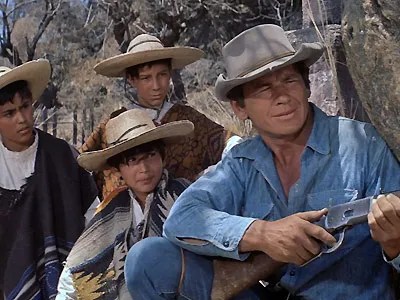
Way back in 1960, Director John Sturges took Akira Kurosawa’s timeless classic SEVEN SAMURAI (1954) and translated its themes of honor and sacrifice into the American western THE MAGNIFICENT SEVEN. A classic on its own, the film stars such cinematic legends as Yul Brynner, Steve McQueen, James Coburn, Eli Wallach, and Charles Bronson. The storyline of a small group of men protecting a village from bandits proved to be an irresistible subject once again, especially the way it was handled here. Its theme music by Elmer Bernstein is one of the most instantly recognizable pieces of music in western cinema. It’s not easy translating a masterpiece without suffering quite negatively in comparison, and I’ve always admired how Sturges and his team of writers were able to create a film that both honored the source material while successfully transferring its content to a different part of the world.
The lead performances of Yul Brynner and Steve McQueen anchor the film, and the screenplay masterfully takes the time to introduce us to each of the seven men and their myriad of reasons for taking on this mission. We care about the men because we get to know them. After Brynner and McQueen, we learn James Coburn is the most badass, Robert Vaughn is the most cowardly, Brad Dexter is the most money hungry, and Horst Buchholz is the most naive. Unsurprisingly, my favorite of the characters is Bernardo O’Reilly, played by Charles Bronson. In my opinion, the character of O’Reilly represents the heart of the story. His character is as tough as it gets and great with a gun, but it’s the way he cares for the actual people, especially the children of the village, that really stands out. It’s in these small moments and exchanges between Bronson and the kids, where the film seems to transcend the genre and become something even more reflective and meaningful. So when Bronson pays the ultimate price, it’s not for some grand purpose or ideal, it’s specifically for those kids, and the moment becomes powerful. For my money, Bronson gives one of the more moving turns in classic western cinema that remains under appreciated to this day.
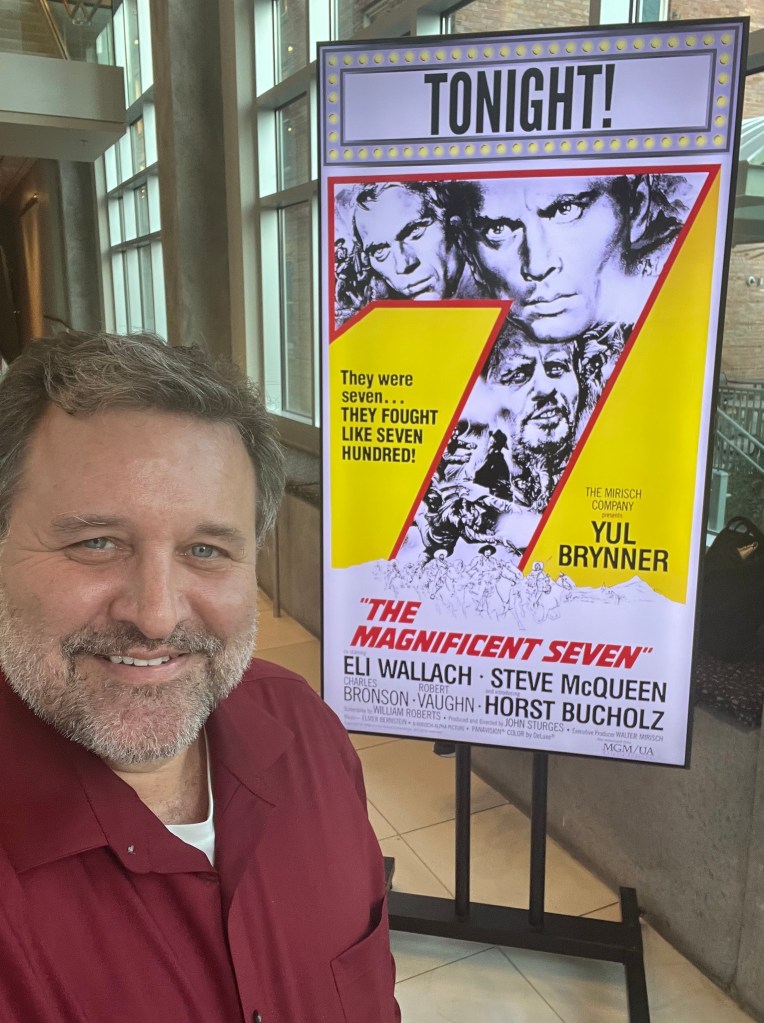
In 2025, THE MAGNIFICENT SEVEN celebrated its 65th anniversary, with many theaters around the country screening the film again. I was lucky enough to catch one of those screenings at a theater in downtown Little Rock. It was a wonderful night at the movies. Today, on what would have been his 116th Birthday, I celebrate Director John Sturges and this great film that has meant so much to me!
I’ve been a fan of actor Jan-Michael Vincent for about as long as I can remember. I was a grade schooler in the mid-80’s when AIRWOLF was playing on network TV. I loved the show and Vincent’s character, Stringfellow Hawke. It was also around that time that I began my obsession with Charles Bronson, and Vincent co-starred in the iconic 1972 Bronson film THE MECHANIC (1972). Fox 16 out of Little Rock played the movie often, further cementing my appreciation for his work. And I specifically remember renting his 1980 movie DEFIANCE where his character takes on a ruthless gang in New York. It was my kind of movie, and I still watch it every few years. There’s just something I’ve always liked about Jan-Michael Vincent. July 15th, 2025 would have been his 80th birthday so I decided to watch one of his movies that I’ve never seen, VIGILANTE FORCE from 1976. It was playing on Amazon Prime, so I fired it up for my initial viewing.
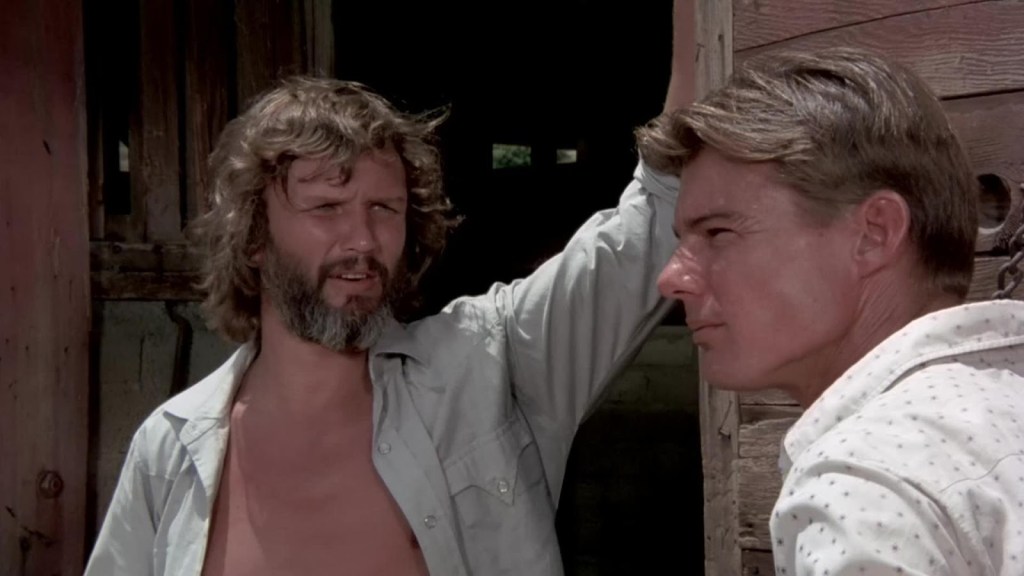
In VIGILANTE FORCE, Jan-Michael Vincent plays Ben Arnold, a guy from the small town of Elk Hills, California. It seems that the discovery of oil in the area has brought about a financial boom, but it’s also brought in a lot of rowdy out-of-towners and a surge in violent crime. Ben convinces the local community leaders to allow him to bring in his brother Aaron (Kris Kristofferson), a Vietnam war hero, to help restore order in town. Aaron assembles a group of ex-military types, friends of his, to help the local police restore order in town. Successful in cleaning out the riffraff at first, Aaron and his team of vigilantes eventually become the riffraff and use their law enforcement powers for their own corrupt, get-rich-quick schemes. Realizing that he made a horrible mistake in bringing in his brother, Ben is forced to confront Aaron and his team of murderous mercenaries in order to reclaim Elk Hills for its citizens.
I had not read anything beyond the title VIGILANTE FORCE and the basic cast list when I sat down to watch this film. I guess that’s a good thing, because I wasn’t expecting this movie to pit the brothers played by Vincent and Kristofferson against each other. I thought the two guys would be working together to get rid of a bunch of rednecks, and we do get that for the first half of the film, but when Kris goes bad, he really goes bad! And nobody is safe. This is one of those movies where he just kills whoever gets in his way, no matter how important or attractive they are. Writer-Director George Armitage, who would direct the excellent MIAMI BLUES (1990) fourteen years later, has said that he was trying to make a point about America’s involvement in the Viet Nam war with the Kristofferson character. Armitage apparently enjoys his references, as the film was made during the USA’s bicentennial year, but his two main characters are named after Benedict Arnold and Aaron Burr. While these ideas may have amused the director, his heavy-handed approach is not good for Kristofferson’s character in this film. His Viet Nam vet basically turns into an evil cartoon about halfway through the film and is no longer interesting, which is a shame because he gives a good performance.
Allegories aside, at its heart VIGILANTE FORCE is B-movie, drive-in fodder, and it’s pretty good at being that. It’s got that unpolished look and raw, energetic feel that I like in my low budget 70’s action movies. As you would expect in a film at this time, Jan-Michael Vincent is impressive and believable as the tough, good guy of the flick. Highly motivated due to the actions of our evil, out of control villain, Vincent handles the action scenes well in the film’s explosive finale. And I mean that literally, it seems that everything blows up big time at the end! Besides Kristofferson and Vincent, the film has a very recognizable supporting cast, which is one of the things I love about 70’s movies. Producer Gene Corman put together a cast that also includes Brad Dexter, Andrew Stevens, Victoria Principal, Bernadette Peters, Paul Gleason, Charles Cyphers, Loni Anderson and a host of other familiar voices and faces who add their unique talents to the proceedings. Principal, still a couple of years away from her career defining role as Pamela Ewing in the DALLAS TV series, is especially beautiful as Vincent’s girlfriend.
Overall, while VIGILANTE FORCE is not required viewing, I can definitely recommend it to anyone who likes 70’s redneck action cinema, or to fans of the main stars. I enjoyed it!
James Stewart, Charles Bronson, and Mary Tyler Moore!? All in a film directed by Richard Donner!?
Well, kind of.
James Stewart does not actually appear onscreen in 1961’s X-15. However, he does provide the narration, explaining to us the origins of the NASA’s X-15 project and why it’s important that America be the first to explore and conquer space. He talks about the men who risked their lives to test the rocket and the women who supported them and who started every day with the knowledge that they might never see their husband again after he left for work. There’s something undeniably comforting about hearing Stewart’s voice in this film. It’s the voice of an idealized America. It’s a little weary. There’s definitely a bit of age in the voice. It’s the voice of a man and a country that has had to survive a lot, especially over the past few years. But it’s also an incurably optimistic voice. You hear that voice and you know that everything is going to be okay.
Richard Donner’s directorial debut, X-15 is a docudrama that often plays out like a commercial for the X-15 and America’s young space program. The film mixes actual footage of the X-15 with scenes of the pilots returning (and sometimes not returning) home. The emphasis is on each man doing what needs to be done to make the program a success and each woman doing what she has to do to support her man. Throughout the film, there are scenes where the wives and the girlfriends of the pilots hear sirens and explosions and silently hope that they won’t be the one getting the call.
Making her film debut, Mary Tyler Moore plays Pamela, the girlfriend of pilot Matt Powell (played, in rather dull fashion, by David McLean). When Pamela first arrives at the base, the wives warn her about overreacting to every explosion. Major Rinaldi (Brad Dexter) warns her to not even try to get pregnant because that would take Powell away from the program. (When Rinaldi talks to Pamela, he comes across as more than just being a 50s-style sexist. That would be expected, considering that the film was made in 1961. Instead, Rinaldi actually comers across as being rather threatening. It’s kind of disturbing, to be honest.) Pamela comes to understand the importance of Matt’s work and Matt …. well, Matt’s kind of dull.
Actually, despite being played by wonderful character actors like James Gregory and Kenneth Tobey, just about every man in this film is kind of boring. This is one of those films that celebrates the idea of cold, hard professionalism. No one shows much emotion, even when one of the pilots is killed in an accident. No one is blamed. No one is shouted at. It’s just something that happens and everyone understands the risks. It’s actually an admirable attitude and one reason why I have a thing for pilots. But the deliberate blandness of the pilots in X-15 makes it difficult to keep track of who’s who. The only male actor who makes a real impression is Charles Bronson, playing Lt. Col. Brandon. Bronson’s incredible screen presence makes up for the fact that his character doesn’t have much of a personality.
That said, it’s a bit of a disappointment that Jimmy Stewart is not onscreen and Mary Tyler Moore has to share her scenes not with Bronson but instead with the dull David McLean. When the film was released in 1961, it was providing audiences with something that they hadn’t seen before and I imagine it was truly exciting to see a rocket fly, however briefly, into space. However, modern audiences have seen TopGun and TopGun: Maverick. I’ve seen TheRightStuff, which covers much of the same material as X-15. As a result, when viewed today, X-15 is a bit dull and features little of the flair that would characterize Richard Donner’s later directorial efforts. Today, the main reason to watch the film is for Stewart, Moore, and Bronson. Not having them acting opposite each other feels like a huge missed opportunity.
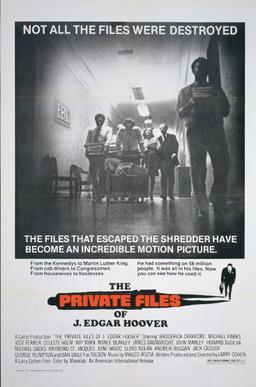
The 1977 film, The Private Files of J. Edgar Hoover, opens in 1972.
J. Edgar Hoover, the much-feared and long-serving director of the FBI, has just been found dead at his home and it seems like the entire city of Washington, D.C. is scrambling. Not only are people jockeying for Hoover’s job but they’re also wondering what might be found in his secret files. As quickly becomes apparent, Hoover had a file on everyone. While Presidents lauded him and the press portrayed him as hero, Hoover spent nearly 50 years building up a surveillance state. Hoover said it was to fight criminals and subversives but mostly, it was just to hold onto his own power. Even President Nixon is heard, in the Oval Office, ordering his men to get those files.
Hoover may have known everyone’s secrets but, the film suggests, very few people knew his. The film is narrated by a former FBI agent named Dwight Webb (Rip Torn). Dwight talks about how he was kicked out of the FBI because it was discovered that he not only smoked but that he was having an adulterous affair with a secretary. “You know how Hoover was about that sex stuff,” he says, his tone suggesting that there’s more to the story than just Hoover being a bit of a puritan.
We flash back to the 1920s. We see a young Hoover (James Wainwright) as a part of the infamous Palmer Raids, an early effort by the Justice Department to track down and deport communist subversives. Though Hoover disagrees with the legality of the Palmer Raids, he still plays his part and that loyalty is enough to eventually get him appointed, at the age of 29, to be the head of the agency that would eventually become the FBI. Hoover may start out as a relatively idealistic man but it doesn’t take long for the fame and the power to go to his head.
Hoover (now played by Broderick Crawford) serves a number of Presidents, each one worse the one who proceeded him. Franklin Delano Roosevelt (Howard Da Silva) is an avuncular despot while the Kennedy brothers (William Jordan as John and Michael Parks as Bobby) are two rich brats who think that they can control Hoover but who soon discover that Hoover is far more clever than they realize. Hoover finds himself a man out-of-place in the 60s and the 70s, Suddenly, he’s no longer everyone’s hero and people are starting to view the FBI as being not a force for law enforcement but instead an instrument of oppression.
Through it all, Hoover remains an enigma. He demands a lot of from his agents but he resents them if they’re too successful. Melvin Purvis (Michael Sacks) might find fame for leading the manhunt that took down Dillinger but he’s driven to suicide by Hoover’s cruel treatment. Unlike Clint Eastwood’s film about Hoover, The Private Files of J. Edgar Hoover suggests that Hoover was not gay but that instead, that he was so repressed that he was essentially asexual. When one woman throws herself at him, he accuses her of being a subversive and demands to know how anyone could find him attractive. He’s closest to his mother and when she dies, he shuts off his emotions. His own power, for better and worse, becomes the one thing that he loves. He’s married to the FBI and he often behaves like an abusive spouse.
The Private Files of J. Edgar Hoover is an interesting film. It’s an attempt to do a huge American epic on a less than epic budget. At the start of the film, the low budget is undeniably distracting. The 1920s are essentially represented by a back lot and two old cars. The scenes of the FBI dealing with gangsters like Dillinger and Creepy Karpis feel awkward and slapdash. But, as the film’s timeline gets closer to what was then the modern era, the film’s story tightens up and so does Larry Cohen’s direction. (One get the feeling that Cohen was, perhaps understandably, more interested in the Hoover of the 60s and the 70s than the Hoover of the 20s and 30s. There’s a sharpness to the second half of the movie that is just missing from the first half.) Broderick Crawford gives a chilling performance as a man who is determined to hold onto his power, just for the sake of having it. The scenes were Hoover and Bobby Kennedy snap at each other have a charge that’s missing from the first half of the film. Michael Parks does a great job portraying RFK as basically being a spoiled jerk while Crawford seems to relish the chance to play up the resentful, bitter old man aspects of Hoover’s personality. The film ultimately suggests that whether the audience previously admired RFK or whether they previously admired Hoover, they were all essentially duped.
Though the film never quite overcomes the limits of its low budget, it works well as a secret history of the United States. In 1977, it undoubtedly took guts to make a film that portrayed Roosevelt and Kennedy as being as bad as Nixon and Johnson. (It would probably even take guts today. One need only rewatch something like The Butleror Hyde Park on Hudson to see the ludicrous lengths Hollywood will go to idealize presidents like Kennedy and dictators like FDR.) While this film certainly doesn’t defend J. Edgar Hoover’s excesses, it often suggests that the president he served under were just as bad, if not even worse. In the end, it becomes a portrait of not only how power corrupts but also why things don’t change, regardless of who is nominally in charge. In the end the film’s villain is not J. Edgar Hoover. Instead, the film’s villain is the system that created and then enabled him. The man may be dead but the system remains.
The trio that brought you KANSAS CITY CONFIDENTIAL – star John Payne, director Phil Karlson, and producer Edward Small – teamed again for 99 RIVER STREET, and while it’s not quite on a par with their film noir classic, it’s crammed with enough sex’n’violence to hold your interest for an hour and a half. Karlson’s direction is solid, as is the cast (including a knockout performance by Evelyn Keyes), and the camerawork of the great Austrian cinematographer Franz Planer gives it a wonderfully brooding touch of darkness.
The story itself is highly improbable yet highly entertaining: ex-boxer Ernie Driscoll (Payne), once a heavyweight contender now reduced to driving a cab, is married to ex-showgirl Pauline (the delectable Peggie Castle), who’s two-timing him with crook Victor Rawlins (slimebag Brad Dexter ). Ernie catches them making out through the window of the flower shop Pauline works at, and his PTSD is triggered…
As a genre, film noir has always been associated with crime: murder, brutish gangsters, seductive femme fatales, and occasionally a cynical private detective doing the right thing almost despite himself. However, not all film noirs are about criminals. Some are just about desperate characters who have found themselves on the fringes, living in a shadow-filled world that appears to be monstrously indifferent to all human suffering.
That’s certainly the case with the 1951 noir, 14 Hours. The film centers around Robert Cosick (Richard Basehart, who previously played a murderer in another classic noir, He Walked By Night). Robert isn’t a gangster. He’s not a private detective. He doesn’t carry a gun and he doesn’t provide any sort of hard-boiled narration. In fact, for the majority of the film, Robert is defined by less who he is and more by what he’s doing. Robert Cosick, having earlier checked into a room on the 15th floor of a New York hotel, has climbed out of a window and is now standing on a ledge. Robert says that he’s going to jump.
What has driven Robert Cosik to consider such an extreme action? The film never settles on any one reason, though it gives us several clues. When his father (Robert Keith) and his mother (Agnes Moorehead) show up at the scene, they immediately start bickering about old family dramas. When Robert’s ex-fiancee (Barbara Bel Geddes) begs him to step in from the ledge, he listens a bit more to her than he did to his parents but he still refuses to come in from the ledge.
But perhaps the real reason that Robert Cosick is out on that ledge can be found in the film’s shadowy visuals. Directed in a semi-documentary fashion by Henry Hathaway and featuring harsh, black-and-white cinematography that’s credited to Joe MacDonald, Fourteen Hours emphasizes the indifference of the city. From the menacing landscape of concrete buildings to the crowds gathering below the ledge to see if Robert lives or dies, New York City is as much as a character in this film as Robert, his family, or the cop (played by Paul Douglas) who finds himself trying to talk Robert into reentering his hotel room. When night falls, the city may light up but it does nothing to alleviate the shadows that seem to be wrapping themselves around Robert. For the fourteen hours that Robert is on that ledge, he may be the center of the world but the film leaves little doubt that New York City will continue to exist in all of its glory and its horror regardless of how Robert’s drama plays out. Whether he lives or dies, Robert appears to be destined to be forgotten.
When the film isn’t concentrating on the cops trying to talk Robert into getting back in the hotel room, it shows us the reactions of the people who see him standing out on that ledge. (If this film were made today, everyone would be holding up their phones and uploading Robert’s plight to social media.) Some people are moved by Robert’s struggle. For instance, a young woman played by Grace Kelly (in her film debut) reaches a decision on whether or not to get a divorce based on what she sees happening on the ledge. Two office workers (played by Jeffrey Hunter and Debra Paget) even strike up a romance as they wait to see what will happen. Some people view Robert as being a madman. Others see him as being a victim. And then there’s the many others who view him as being either a minor distraction or a piece of entertainment. For them, it’s less important why Robert’s on the ledge or even who Robert is. What’s important to them is how the story is going to end.
It’s not a particularly happy film but it’s made watchable by Hathaway’s intelligent direction and the performances of Paul Douglas and Richard Basehart. With its theme of instant fame and hollow indifference, it’s a film that remains as relevant today as when it was initially released.
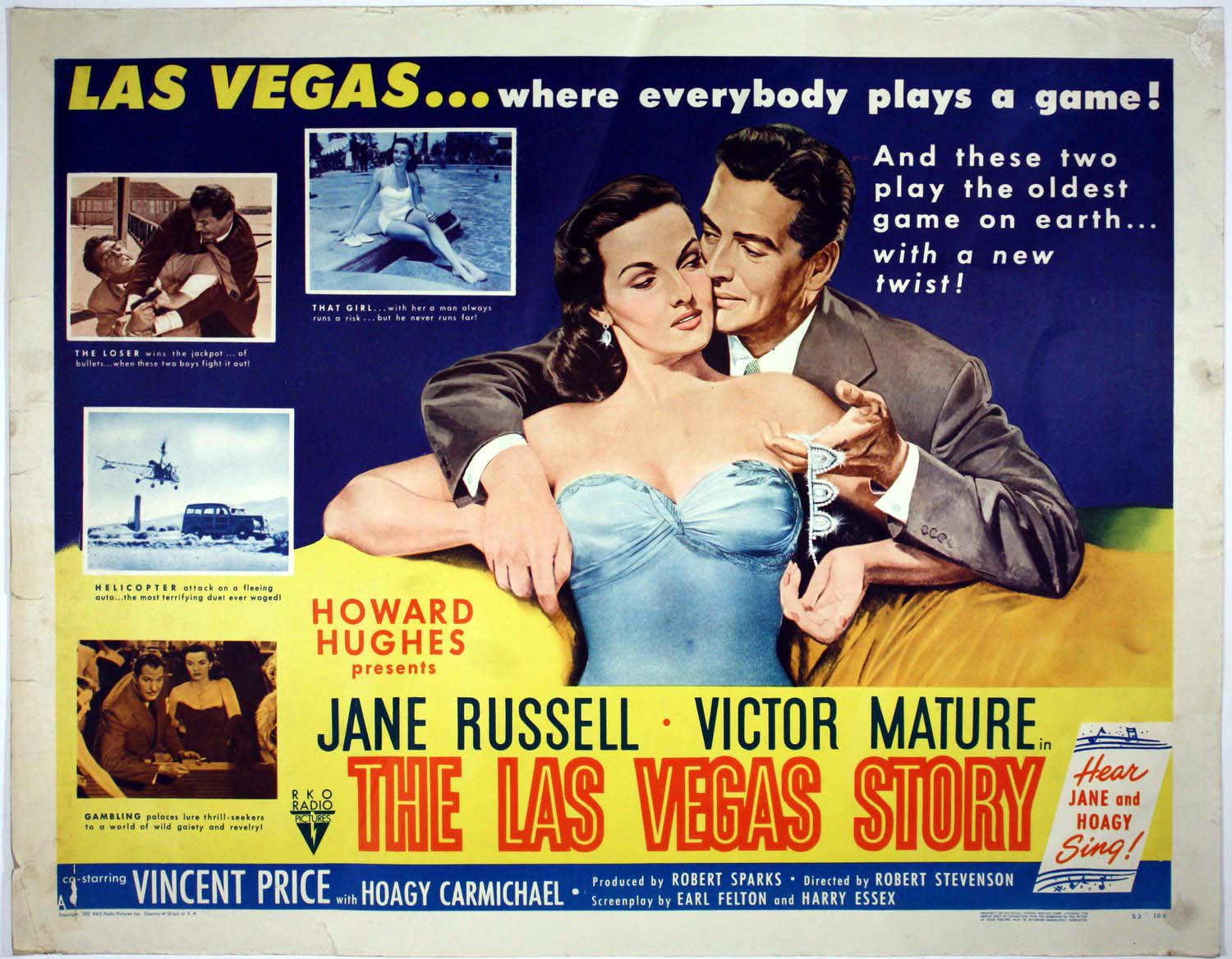
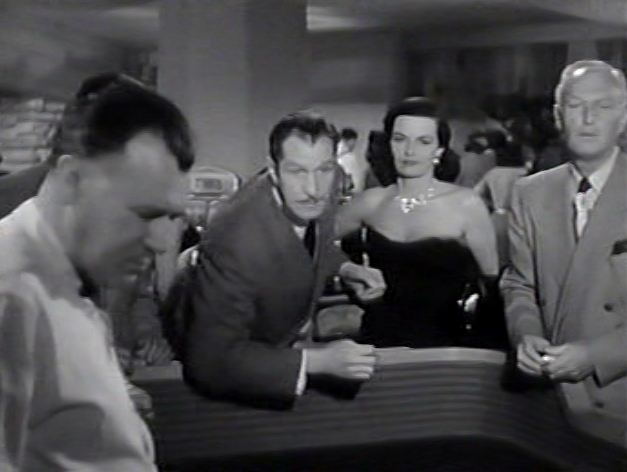
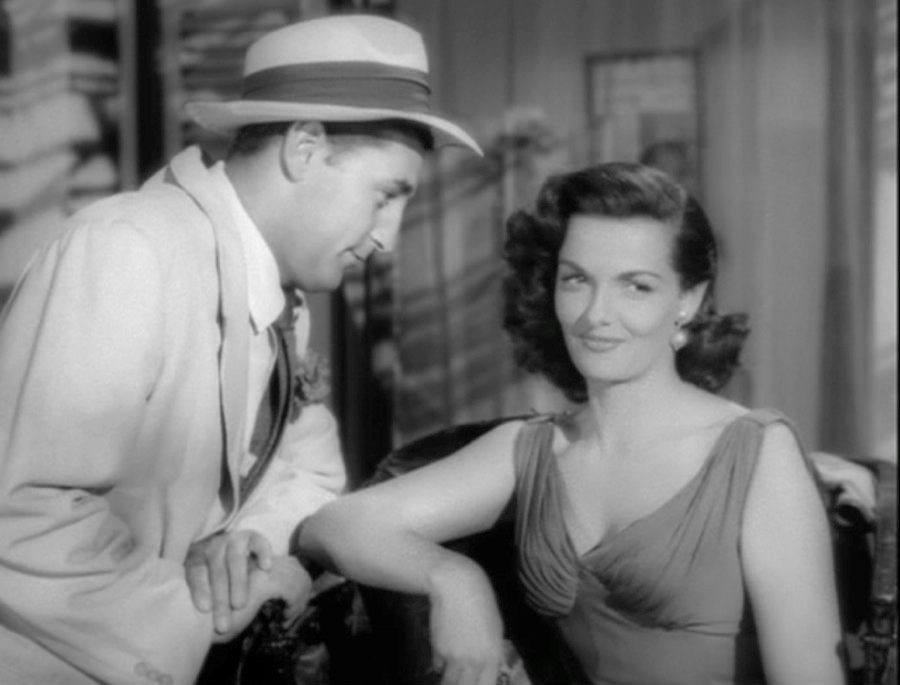
Jane Russell’s sexy as always, but THE LAS VEGAS STORY falls flatter than the proverbial pancake. This dull little crime drama boasts a good cast and some good moments, but on the whole doesn’t satisfy. One of the problems is Jane’s co-star Victor Mature, who tries but can’t match the cynicism frequent Russell co-star Robert Mitchum would’ve brought to the role of Jane’s jilted ex-lover, now a cop in the City of Sin. The most interesting thing about THE LAS VEGAS STORY is it’s screenplay credits, which we’ll get to later.
When ex-lounge singer Linda Rollins (Russell) returns to Vegas with husband Lloyd (a subdued but still sarcastic Vincent Price ), she visits her old stomping ground the Last Chance, where she’s greeted by piano player Happy (Hoagy Carmichael) and former boss Mike Fogarty (Will Wright), who’s been bought out by new owner Clayton (Robert J. Wilke). Police lieutenant Dave Andrews (Mature)…
There’s a large hue and cry about the upcoming remake of THE MAGNIFICENT SEVEN (and remakes in general) among classic film fans. “How dare they”, it kind of goes, “Why, that’s blasphemy!”. The truth is, Hollywood’s been cannibalizing itself since almost the beginning, and remakes have long been a staple of filmmakers. THE MAGNIFICENT SEVEN is a remake of Akira Kurasawa’s Japanese film SEVEN SAMAURI, moved to the American west by producer/director John Sturges . And while quite frankly most remakes can’t hold a candle to the originals, this 1960 action epic can stand on it’s own as one of the great Western adventures.
Sturges assembled a macho cast to tell the tale of bandits terrorizing a small Mexican village, and the seven hired guns who take on the job of defending them. Top billed is Yul Brynner as Chris, the black clad gunslinger who puts together the crew. First among them is
Even though 1951’s HIS KIND OF WOMAN lost money (mainly due to studio boss Howard Hughes’ meddling), Robert Mitchum and Jane Russell were reteamed the following year in MACAO. The film was actually sitting on the RKO shelf, having been completed in 1950. Once again, the autocratic Hughes wasn’t pleased with the original version, and fired credited director Josef von Sternberg, replacing him with Nicholas Ray. Mitchum himself even contributed to rewriting some scenes. The result is an entertaining noir that, while not quite as good as HIS KIND OF WOMAN, still manages to hold your interest.
On a boat from Hong Kong, drifter Nick Cochran (Mitchum) meets grifter Julie Benson (Russell), who lifts his wallet. The pair also meet Lawrence C. Trumble (William Bendix), a salesman specializing in “nylons, pearl buttons, coconut oil, and fertilizer”. The three are headed to Macao, “The Monte Carlo of the Orient” (actually the RKO backlot), for various reasons…




 Through the Shattered Lens