A Book To Read This Weekend (6/6/25)


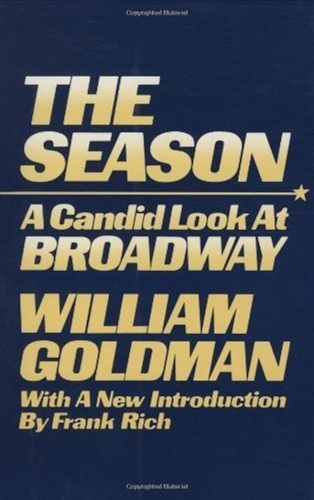
With the Tony Awards scheduled to be held and televised on Sunday, this weekend might be a good time to read William Goldman’s The Season.

First published in 1969, The Season was William Goldman’s very opinionated and very snarky look at the 1967-1968 Broadway season.  Best known as a screenwriter, Goldman took the money that he made from selling the script for Butch Cassidy and the Sundance Kid and spent a year going to Broadway show after Broadway show.  Many shows, he sat through multiple times.  The book features his thoughts on not just the productions but also the culture around Broadway.  Apparently, when the book was published, it was considered controversial because Goldman suggested that most Broadway critics played favorites and didn’t honestly write about the shows that they reviewed.  Goldman suggested that some performers were viewed as being untouchable while other worthy actors were ignored because they weren’t a part of the clique.  Today, that seems like common sense.  One need only look at a site like Rotten Tomatoes to see how pervasive groupthink is amongst film critics and also how carefully most reviews are written to ensure that no one loses access to the next big studio event.  In 1969, however, people were apparently a bit more naive about that sort of thing.

It’s an interesting book, especially if you’re a theater nerd like me.  That said, it’s also a bit of an annoying book.  There’s a smugness to Goldman’s tone, one that is actually present in all of Goldman’s books and essays and yes, aspiring screenwriters, that includes Adventures In The Screen Trade.  He clearly believed himself to be the smartest guy in the room and he wasn’t going to let you forget it.  It makes for a somewhat odd reading experience.  On the one hand, Goldman’s style is lively.  Goldman holds your interest.  On the other hand, there will be times when you’ll want to throw a book across the room.  When he hears two women talking about their confusion as to why they didn’t enjoy a show as much as they had hoped, Goldman describes walking up to them and offering to tell them.  It comes across as being very condescending.

That said, Goldman makes up for it in the chapters in which he explores some of the more troubled productions of the season.  His barbed dismissals of some of Broadway’s most popular performers still packs a punch and it remains relevant today as there are, to put it mildly, more than a few acclaimed performers who have been coasting on their reputations and their fandoms for more than a decade.  Goldman passed away in 2018.  One can only imagine what he would think of today’s celebrity-worshipping culture.

Finally, The Season does feature one beautiful chapter and it should be read by anyone who appreciates the character actors who carry movies and plays while the stars get all the credit.  Goldman’s look at play called The Trial of Lee Harvey Oswald features a powerful profile of actor Peter Masterson.  Goldman writes about a play that closed after 7 nights and which was not critically acclaimed but he turns the chapter into a celebration of truly good acting.  It’s the chapter that makes the rest of the book worth the trouble.
(Click here for last week’s Weekend Book!)

A Book To Read This Weekend (5/30/25)


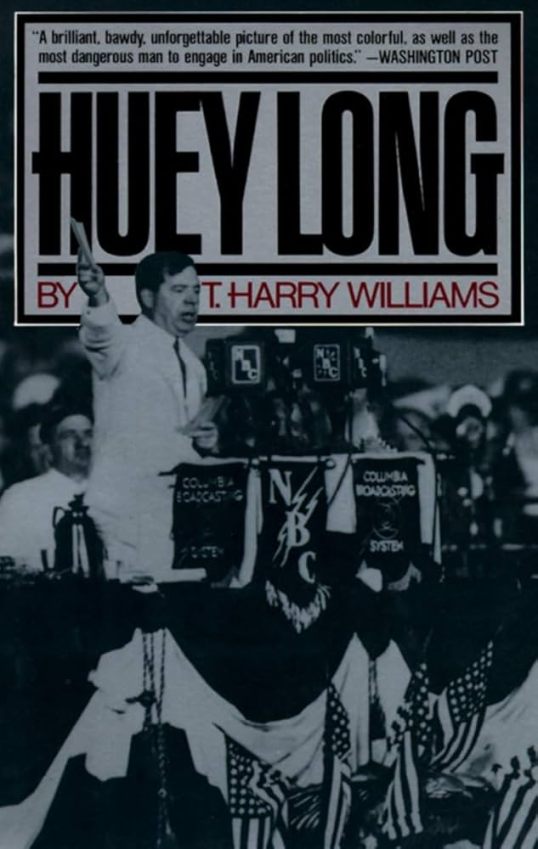
If you’ve got a lot of time to kill this weekend and if you’re interested in how a dictator could come to power in the United States of America, check out Huey Long by T. Harry Williams.

The winner of 1970’s Pulitzer Prize and the National Book Award, this 900-page book tells the story of Louisiana’s Huey Long.  Long went from being an outsider to being governor of his state to being a member of the United States Senate and finally, to the verge of running for the presidency.  The only that that stopped Huey from running for President in 1936 were multiple bullets, at least one of which was fired by the son of a political rival.  (The majority of them were probably fired by Long’s own bodyguards, with Huey falling victim to “friendly fire.”)  Huey was a controversial figure, a socialist who talked like a populist, a clever politician who pretended to be a buffoon, and a leader who was hates by many but who was also so beloved by many other that his family held control of Louisiana politics for decades after his death.

I first bought this book in high school.  My history teacher had assigned the class to write book reports about a political figure.  My teacher was impressed when I said that I would be writing about Huey Long.  Of course, I put off writing the report until the day before it was due.  I also put off reading (and, for that matter, even opening) the book.  When I mentioned this to my mom, she took one look at the 900-page biography that I hadn’t even started to read, and said, “Why did you pick such a long book!?”

(I always pick the longest books I can find.  I like to read and, when it comes to biographies, I like to get all the details.)

For the next few hours, I skimmed through the book as I wrote my report.  I wrote about his early political campaigns, the role he played in the elections of both Woodrow Wilson and Franklin Roosevelt, and the steady stream of corrupt flunkies that he brought into Louisiana’s government.  I included the details of Huey Long’s Share The Wealth plan and explained why Huey’s scheme was just a bunch of commie propaganda.  My teacher gave my report a 100 (and he added an “A++,” which he circled in red!), said that it was good enough for college, and commended me on my hard work.  My mom read my teacher’s comments and said I had more lives than a cat.

Even just skimming the book, I found Huey’s story to be fascinating.  He stood up to the power brokers.  He fought for the poor.  He took kickbacks from the same corporations that he claimed to despise.  He treated Louisiana like his own fiefdom.  He might have ordered a few murders.  And, years later, when I sat down and actually read the book, I discovered that Huey’s life was even more interesting than I initially realized.  Huey Long may be 900 words long but he lived his life in such an over-the-top fashion and the times in which he lived were so interesting that the book becomes a surprisingly quick read.  It helps that T. Harry Williams was a lively writer.  This isn’t some slow-moving, self-consciously scholarly tome.  This is a book that really captures the unique oddness of Louisiana and its politics.

If you’re looking for a long but rewarding read and if you’re a history nerd like me, check this book out.  And then watch All The King’s Men (the original, not the remake!).  Willie Stark, the governor at the heart of All The King’s Men, was based on Huey Long.  Somehow, Long lived a life that was even more dramatic than his fictional counterpart.

(Check out last week’s Books For The Weekend here!)


Two Books To Read This Weekend (5/23/25)


This weekend, I will be reading Jake Tapper and Alex Thomas’s Original Sin, their look at the Biden presidency and how Joe Biden’s (or really, Joe Biden’s aides and family’s) insistence that he run for a second term led to Donald Trump returning to the White House.  Actually, I will be continuing to read it as I started it last night.  So far, it’s an interesting read, even though I think that those who claim that Tapper is a bit too quick to let himself off the hook have got a point.  It’s definitely got me thinking about how many of our elected officials are “all there” and how many of them are just repeating whatever their staff tells them to say and do.

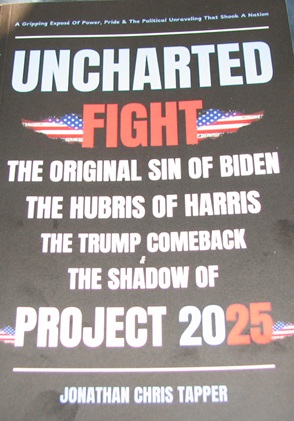
Now, if you feel that you don’t have time to read Tapper and Thompson’s 300-page book, you can always check out the Mockbuster version, Uncharted Fight: The Original Sin Of Biden, The Hubris of Harris, The Trump Comeback, & The Shadow of Project 2025 by — *ahem* — Jonathan Chris Tapper.  This 198 page book, which actually came out a month before Original Sin, basically just takes everything that was leaked about Original Sin and that was included in previous books by Chris Whipple and Jonathan Allen & Amie Parnes and repeats it.  The book was obviously put together quickly to capitalize on the interest around the books that hace been coming out about Biden’s withdrawal and the 2024 election.  There’s no original reporting, beyond the fact that somebody flipped through all of the other books and jotted down their main points.  If I had to guess, I’d say there is no “Jonathan Chris Tapper.”  It’s a grift, one that feels like a uniquely 2025 sort of thing.  The main reason any of these books are being published is to make money so why shouldn’t “Jonathan Chris Tapper” give it a shot?  And, to be honest, Uncharted Fight a quick read that gives you the basics so if you don’t want to spend money on four books about the election, it’s there for you, I guess.  Of course, you could probably just ask one of the many online AI programs to give you a quick summary and get the same information for far less money.  (In fact, I wouldn’t be surprised if “Jonathan Chris Tapper” is an AI system.)

(Personally, I went ahead and spent money on Original Sin, Uncharted History, Chris Whipple’s Unchartered, Alex Eistenstadt’s Revenge, and Jonathan Allen’s and Amie Parness’s Fight because I’m a history nerd and I think you can never have enough sources!)

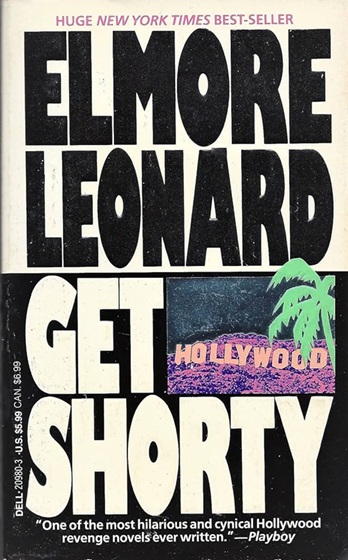
Book and Film Review: Get Shorty (by Elmore Leonard and dir by Barry Sonnenfeld)


In 1995’s Get Shorty, John Travolta stars as Chili Palmer.

Chili is a loan shark for the mob, an effortlessly cool guy who lives in Miami and who loves to watch old movies.  Chili may work for the Mafia and he may make his living by intimidating people but he doesn’t seem like such a bad guy, especially when compared to someone like Ray “Bones” Barboni (Dennis Farina).  Bones is an uncouth and rather stupid gangster who steals Chili’s leather jacket from a restaurant.  Chili reacts by breaking Bones’s nose with just one punch.  Bones reacts by trying to shoot Chili but instead, he gets shot by Chili himself.  (The bullet only grazes his forehead.)  Chili can do all this because he’s protected by Momo (Ron Karasbatsos) but, after Momo drops dead after having to walk up several flights of stairs just to then be given a surprise birthday party, Chili suddenly finds himself working for Bones.  (This all happens in the first few minutes of this perfectly paced film.)

Bones, eager to humiliate Chili, sends him to Vegas to collect on a debt owed by a dry cleaner named Leo (David Paymer).  Leo is thought to be dead but Bones wants to collect the money from Leo’s widow.  It’s not the sort of thing that Chili likes to do so instead, he ends up going to Hollywood to collect a debt from B-movie director Harry Zimm (Gene Hackman).  Chili  happens to like Harry’s movies.  He also likes Harry’s current girlfriend and frequent co-star, actress Karen Flores (Rene Russo).

Chili ends up in Hollywood, a town where everyone has some sort of hustle going.  Chili finds himself dealing with drug dealers (Delroy Lindo), egocentric film stars (Danny DeVito), stuntmen-turned-criminals (James Gandolfini), and the widow (Bette Midler) of a screenwriter.  Chili also finds himself looking to escape from the debt collection business by becoming a film producer.  Harry has a script that he wants to make.  Chili proposes a film based on the story of Leo the dry cleaner.  Danny DeVito’s Martin Weir wants to be a “shylock” in a movie just so he can show off his intimidating stare.  (“Is this where I do the look?” he asks while listening to the pitch.)  Get Shorty is a whip-smart satire of Hollywood, one in which the gangsters want to be film people and all of the film people want to be gangsters.  It features wonderful performances from the entire cast, with Travolta epitomizing cool confidence as Chili Palmer.  Hackman, Russo, DeVito, Gandolfini, and Lindo are all excellent in their supporting roles but I have to admit my favorite performance in the film is probably given by Dennis Farina, who turns Bones Barnobi into a very believable (and a believably dangerous) buffoon.

Get Shorty is based on a book by Elmore Leonard.  First published in 1990, the book is a quick and entertaining read, one that reminds us that Leonard was one of the best “genre” writers of his time.  When I read that book, I was surprised to see how closely the movie stuck to the book’s plot.  Much of the film’s dialogue is right there in the book.  It’s a book that practically shouts, “Turn me into a movie!” and fortunately, director Barry Sonnenfeld did just that.

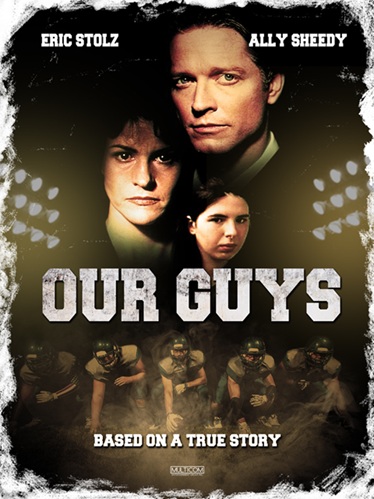
April True Crime: Our Guys by Bernard Lefkowitz and Our Guys (dir by Guy Ferland)


If there’s any true crime book that I recommend without hesitation, it’s Our Guys by Bernard Lefkowitz.

First published in 1997, Our Guys deals with a terrible crime that occurred in the leafy suburban community of Glen Ridge, New Jersey.  In 1989, it was an affluent community that loved its high school football team and where conformity and financial success were the most valued qualities the someone could have.  On March 1st, a 17 year-old girl was invited to a house party where, after she was convinced to head down to the basement, she was raped with a broomstick and a baseball bat by several members of the football team.  The girl was intellectually disabled and was later determined to have an IQ of 64.  Her name has never been revealed to the public.  In his book, Lefkowitz assigned her the pseudonym of Leslie Faber.

The crime was terrible.  So was the aftermath.  When one of the witnesses went to a teacher with what he saw happen in the basement, the town responded by rallying around the accused.  Initially, Leslie was accused of lying.  Then, as it became clear that something actually had happened in that basement, Leslie was accused of bringing it on herself.  Leslie, who was desperate to have friends and who was later determined to be psychologically incapable of saying “no” or even understanding what consent meant, was cast as a wanton seductress who led the members of the football team astray.  A girl who went to school with Leslie even tape recorded a conversation with Leslie in which Leslie was manipulated into saying that she had made the entire thing up.  It also undoubtedly didn’t help that some of the accused boys had fathers who were on Glen Ridge’s police force.

It’s a book that will leave you outraged.  Lefkowitz not only examined the crime itself but also the culture of the town and its general attitude that “boys will be boys.”  Despite the fact that they had a losing record and the fact that one of them was infamous for exposing himself every chance that he got, the football team was viewed as being made up as winners.  They were allowed to party every weekend with their parties becoming so legendary that they bragged about them in their yearbook quotes.  With a group of supportive girlfriends doing their homework for them, the football team was free to do whatever they wanted and, by the time they were seniors, they were infamous for being voyeurs.  While one football player would have sex, all the others would hide in a closet and watch.  When one of the football players stole $600 from one of his classmates, his father paid back the money and no one was ever punished.  In a town that valued material success above all else and viewed being different as a sign of weakness, Leslie and her family were treated as being outcasts.  In the end, three of the football players were sentenced to prison.  One was sentenced to probation.  A few others accepted plea deals and had their arrests expunged from the record.  Years later, one of the guys who was in the basement but not charged would murder his wife while home on leave from the military.

In 1999, Our Guys was adapted into a made-for-television movie.  Featuring Heather Matarazzo as Leslie, Ally Sheedy as the detective who investigated her rape, Eric Stoltz as the lawyer who prosecuted the case, and Lochlyn Munro as a cop who starts out on the side of the football team before realizing the truth, Our Guys simplifies the story a bit.  While the book focused on Glen Ridge and the culture of celebrating winners no matter what, the film focuses on Sheedy as the detective and her disgust with the suburbs in general.  Unfortunately, by not focusing on the culture of the town, the film presents the rape as being the bad actions of a group of dumb jocks as opposed to an expression of Glen Ridge’s contempt for anyone who was viewed as being on the outside.  What Lefkowitz showed through a precise examination of the town and its citizens, the film quickly dispenses by having Stoltz and Sheedy make a few pithy comments about how much the town loves it football team.  The story will still leave you outraged and Heather Matarazzo gives a heart-breaking performance as Leslie.  But, for those wanting the full story of  not only what happened in Glen Ridge but also how it happened, the book is the place to find it.

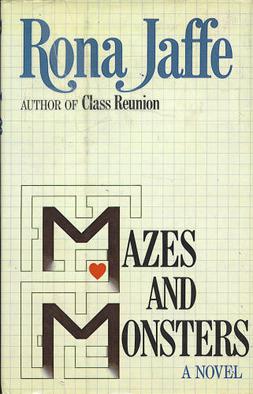
Novel Review: Mazes and Monsters by Rona Jaffe


The 1981 novel, Mazes and Monsters, tells the story of four wealthy college students who deal with the ennui of being rich and privileged by obsessively playing a role-playing game called Mazes and Monsters.

That’s right!  The game is Mazes and Monsters and most definitely not Dungeons and Dragons, even though both games are basically about people wandering around in dungeons and fighting monsters and searching for treasure.  (For the record, I’ve never played Dungeons and Dragons or any other role playing game and I’ve never really had any desire too.  That said, I did enjoy those episodes of Freaks and Geeks and Community.)  One of the four players is Robbie Wheeling, who has never recovered from the death of his brother.  When the players decide to move their game into the tunnels underneath their college, Robbie has a total break from reality and thinking that he actually is his M&M character, he flees to New York and lives on the streets.  Desperate for money and food, he turns to prostitution but ends up stabbing the first man who picks him up.  Agck!  He never should have played that game!

Mazes and Monsters is usually described as being one of the key works of the 80s Satanic Panic and there’s certainly an element of that to be found in the plot.  But the game is actually a fairly small part of the book.  The majority of the book just deals with teenagers struggling with the transition of adulthood and figuring out where they belong in the world.  The book isn’t quite as hysterical as its been described.  If anything, the book almost makes the case that the game is helpful to the players in that it gives them an escape from all the ennui.  Robbie was mentally unstable long before he played the game and it’s hard not to feel that something would have eventually set him off.

This is a rare case where the movie version is better than the book, if just because the movie features Tom Hanks as Robbie.  Robbie mistaking a man for a demon and stabbing him?  That’s really sad.  Tom Hanks doing it?  That’s cinematic magic!

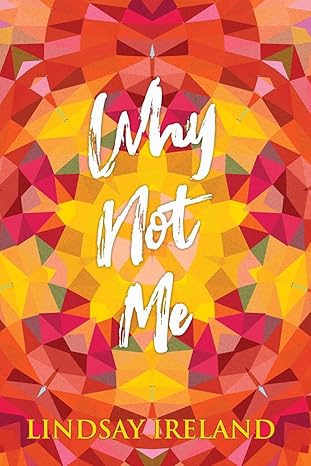
WHY NOT ME (by Lindsay Ireland) – Introducing Bradley’s Book Reviews!


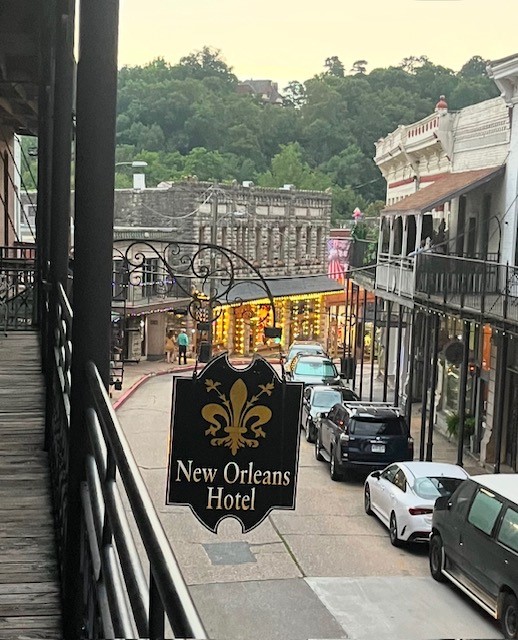
I don’t read that often for recreational purposes. When I do read, it’s usually books about my favorite actors, actresses, directors, or movies in general. But every now and then, a book will pique my interest, and I’ll pick it up. Back in the late spring of 2024, my partner on the “This Week in Charles Bronson” podcast, Eric Todd, made me aware of a book called WHY NOT ME, a memoir from Lindsay Ireland, the niece of Jill Ireland and Charles Bronson. Eric had made contact with Lindsay and the two had some preliminary discussion about her appearing on the podcast. Eric told me that she shared stories of her own life, which included her spending summers as a child on the Vermont ranch of her famous aunt and uncle. As a lifelong Bronson fan, it seemed the book could offer some valuable insight into the life of my movie hero. I figured I could spend some time trudging through Lindsay’s personal life if it allowed me to get those valuable nuggets of information on Bronson and Ireland. I went ahead and bought WHY NOT ME and took it with me when my wife, Sierra, and I were on a relaxing weekend in Eureka Springs, Arkansas. I settled in on the balcony of the New Orleans Hotel, which overlooks a section of the beautiful downtown area and started reading. Here’s a quick summary of the book taken directly from Amazon:

“Lindsay Ireland enjoyed an idyllic childhood. She spent her summers in Vermont with her movie-star relatives where she rode horses, played detective with her cousin, and drank ice-cold lemonade. After the summer months, Lindsay returned to her loving family where her biggest worry was getting good grades in school. Then one day Lindsay noticed blood in her stool. Suddenly instead of carefree afternoons swimming in a lake or dressing her Barbie doll, Lindsay spent months in a sterile hospital room receiving intravenous fluids and, eventually, a life-saving ostomy surgery. At age eleven, Lindsay was diagnosed with her first autoimmune disease, and her life was never the same. In this candid memoir, Lindsay evolves from a girl living with an autoimmune disease into a young woman struggling to love a body that has continuously failed her, and, eventually, into a mother and wife who has fought to make herself visible despite her invisible illnesses.”

As alluded to above, I was interested in WHY NOT ME because I wanted to read Lindsay Ireland’s stories about Charles Bronson & Jill Ireland. And I was certainly in awe as Lindsay spoke of her times with her Uncle Charlie, Aunt Jill and her cousins in Vermont. Reading about my movie hero from her perspective was something I appreciated tremendously. But what really blew me away with this book is how connected I became to Lindsay’s personal life events, struggles and triumphs. Lindsay funneled her memories and writings through a lens of “the power of perspective.” It’s through this perspective that Lindsay speaks of how important her family has been to her over the years as she’s faced the fear of serious health issues in both her childhood and again as an adult. She spoke of the importance of making a good match with a therapist, and how that has helped her over the years. She spoke of how important it has been for her to learn to speak of the difficult things in her life, even if they make her uncomfortable. Lindsay’s strength in writing is her ability to share her own insecurities, the ways that she has been able to overcome them, and then make you believe that you can overcome them to! I was able to relate to so many of the things she shared, and I can see how much my own life could have improved if I had done these things earlier.

The one thing that probably stuck with me the most, however, is when Lindsay spoke of how hard it was when she was dealing with some very difficult issues in her life, yet she felt unseen and unheard, even from those people who loved her, wanted the best for her and had good intentions. This is where I decided I need to make the most improvement in my own life. It seems we can get so caught up in our own feelings and concerns that the needs of others, even those we love, can be neglected. Sadly, I know that there are times that I don’t show the concern, empathy or compassion that I should to other people. After finishing WHY NOT ME, I am determined to make sure that the people I love never feel unseen or unheard, especially my wife. I fail at times, mainly because I can be a smartass, and my wife might even roll her eyes or tease me if she reads this, but I truly never want her to feel unseen or unheard again.

If you want to hear more directly from Lindsay, or maybe even hear me or my buddy Eric bare our own souls, I’ve attached our podcast episode again for your viewing / listening pleasure!

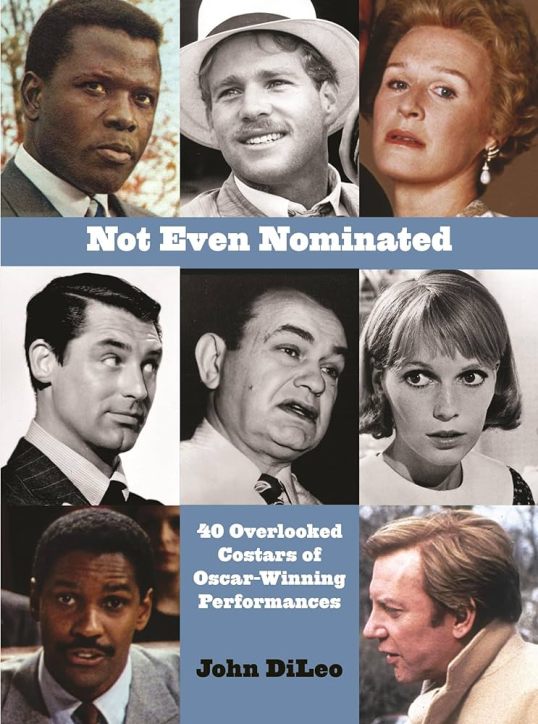
Book Review: Not Even Nominated by John DiLeo


Rod Steiger won an Oscar for playing Chief Gillipsie in In The Heat of the Night but his co-star, Sidney Poitier, wasn’t even nominated.  Despite the fact that Poitier delivered the line that everyone remembers — “They call me Mr. Tibbs!” — the Academy saw fit not nominate him alongside his co-star.

Timothy Hutton won an Oscar for his wonderful performance in Ordinary People but Donald Sutherland, cast against type as his conservative father and giving a heartfelt and heart-breaking performance, was not nominated.

In 1949, Walter Huston won a deserved Oscar for his performance in The Treasure of the Sierra Madre but, somehow, Humphrey Bogart was left out of the nominations.

Martin Landau was honored for playing Bela Lugosi in Ed Wood but Johnny Depp, playing the film’s title character, was ignored.

It’s something that has been happening since the announcement of the very first Academy Award nominations.  Someone will win an Oscar and usually, they very much deserve it.  Often, they’re a very popular winner because they’ve either overcome adversity or they’ve been nominated several times in the past without winning.  But, in all the excitement over their victory, their equally worthy co-stars are overlooked.

John DiLeo’s Not Even Nominated takes a look at forty overlooked co-stars of Oscar-winning performers.  Along with those that I mentioned at the start of this review, DiLeo also writes about performances from everyone from Charles Farrell in Seven Heaven to Cary Grant in The Philadelphia Story to Joseph Fiennes in Shakespeare in Love and Samuel L. Jackson in Django Unchained.  Some of DiLeo’s picks are familiar to film lovers.  The fact that Poitier wasn’t even nominated in 1968 despite starring in three popular and acclaimed films is something that has been discussed in many books and cultural histories.  But DiLeo also gives some time to some equally strong performances that aren’t always cited, like Ryan O’Neal’s performance in Paper Moon and Dirk Bogarde’s turn in Darling and Stephen Boyd’s brilliant (and rather brave) work in Ben-Hur.

It makes for interesting reading.  (It helps the DiLeo has an opinionated but enjoyable writing style.)  For Oscar obsessives like you and me, it’s a must-have.

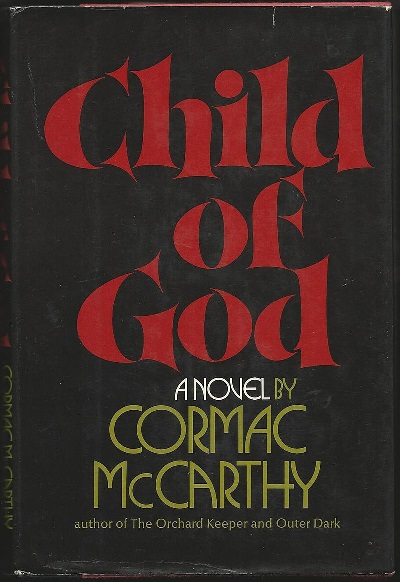
Book Review: Child of God by Cormac McCarthy


In 1960s, Lester Bullard lives alone in the mountains of Tennessee.  Abused as a child and scorned as an adult, Bullard is the type of person that most people try to ignore.  He’s angry, bitter, and not all that knowledgeable about the world outside of his own fevered imagination.  Having been evicted from his home, he moves into an abandoned shack where he spends his time voyeuristically watching the teenagers who sneak off to the isolated mountains so that they can fool around in their cars without being harassed by the grown-ups.  When Bullard stumbles across two dead bodies in a car, it doesn’t so much send him on a downward spiral as much as it just accelerates the only fate that can be waiting for someone like Lester Bullard.  Bullard does some truly disturbing things but, as the narrator reminds us, he’s “a child of God, much like yourself perhaps.”

(No, definitely not like me!  Though I do get the narrator’s point.)

First published in 1973, Child of God was Cormac McCarthy’s third novel.  It tells a disturbing story and one that will leave readers unsettled.  Inspired by the type of macabre tales that used to be told around campfires, it’s a novel of cold, gothic horror.  McCarthy’s prose creates such an atmosphere of darkness that it’s difficult to read the novel in one sitting.  You almost have to put the book down so you can step outside and take a deep breath after some of the more grotesque moments.  Child of God is also a character study of a man living on the fringes of what most people would already consider to be the fringe of society.  Just as the people living on the East and West Coasts have rejected the citizens of Appalachia, Appalachia has rejected Luster Bullard.  The book links Bullard to the violent history of Appalachia, with the Bullard family having been involved in many of the feuds that helped to define the region.  McCarthy’s matter-of-fact prose serves to make Bullard’s crimes all the more disturbing, with McCarthy refusing to give the reader the easy out of a traditional, guns-blazing ending.  Bullard’s ultimate fate feels almost as random as his crimes, challenging the idea of any sort of karmic justice.  In the end, Bullard is destined to become another barely-remembered regional legend, like Ed Gein or the Bloody Benders.  By telling his story without a hint of melodramatic excess, McCarthy leaves the reader with no choice but to consider that the world is full of real Lester Bullards.


Horror Novel Review: The Lifeguard by Richie Tankersley Cusick


I read 1988’s The Lifeguard earlier today.  It’s a fast read, which is always a good thing.

The book tells the story of teenage Kelsey, whose father has just died and whose mother is already getting ready to marry her new boyfriend, Eric.  Personally, I think mom is moving a bit too fast but then again, Eric’s rich and he invites Kelsey and her mom to spend the summer on Beverly Island.  Kelsey makes new friends.  She meets the people who might soon become her stepsiblings.  She develops a crush on two of her potential stepbrothers, shy Justin and the intimidating Neale.  And she gets involved in a potential murder when Beth, yet another of Eric’s children, disappears.  Did Beth drown or did she fall victim to the killer of Beverly Island?

This book was so silly.  Can Kelsey solve the mystery?  Even more importantly, can Kelsey decide which one of her future stepsibilings she wants to date?  Justin seems nice but Neal is so dark and mysterious.  Can Kelsey figure out why the mysterious old man keeps yelling at her?  Could he be the killer?  He seems like kind of an obvious choice but Kesley might as well go ahead and break into his boat just to be sure….

Apparently, this book is considered to be a bit of a cult classic, solely because of the cover.  And the cover is pretty cool.  The book itself is nothing special but I probably would have appreciated it more if I hadn’t already read countless old school YA books with the exact same plot.  I can only guess the R.L. Stine read The Lifeguard at some point.

This book also wins some points from me for having a ludicrously “happy” ending.  Everything works out even though, to be honest, nothing should have worked out.  Kelsey should have been traumatized for life and whatever plans her mom had to marry Eric should definitely have been cancelled!  Seriously, there’s some things that not even the best of relationships can survive!  That said, the ending was so over-the-top and — here’s that word again — silly, that I couldn’t help but appreciate it.