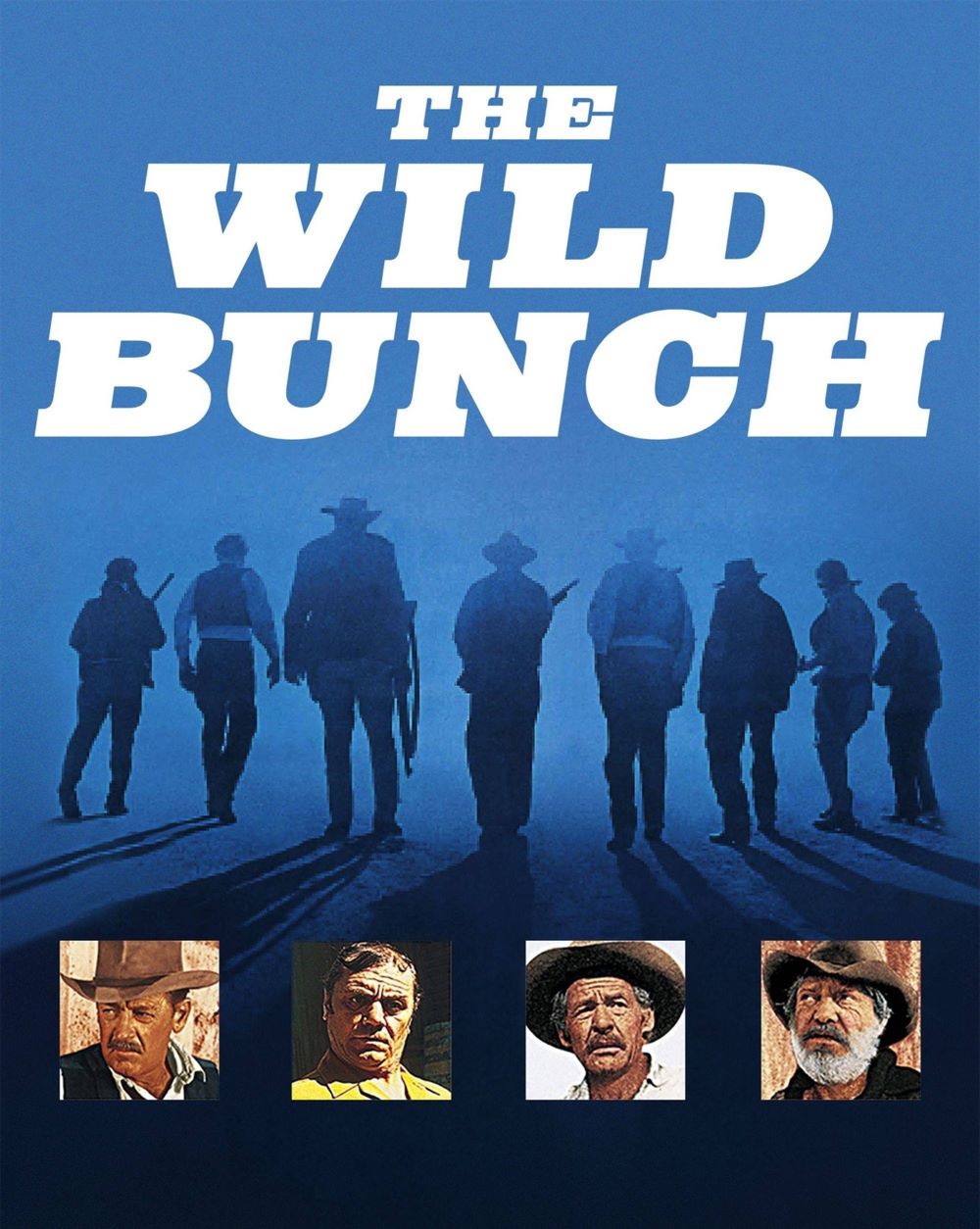
Review: The Wild Bunch (dir. by Sam Peckinpah)


“We’ve got to start thinking beyond our guns. Those days are closin’ fast.” — Pike Bishop

Sam Peckinpah’s The Wild Bunch stands out as a landmark in the Western genre, famous for its daringly harsh depiction of both violence and the fading mythos of the American West. Rather than following the traditions of earlier Westerns, the film presents a gritty portrait of aging outlaws on the edge of extinction, wrestling with a society that has evolved past them. It’s a movie that’s difficult to shake, both for its unapologetic style and the unresolved feelings it leaves long after the final shots ring out.

At its core, the story centers on Pike Bishop and his band—a crew of seasoned criminals aiming for one last grand heist as modernity encroaches on their world. Hoping to pull off a train robbery, they end up entangled in deeper complications after being betrayed and soon are thrust into the turbulence of the Mexican Revolution. Peckinpah builds a narrative where clear-cut morality falls away. The criminals and those pursuing them, supposed bringers of justice, are equally compromised and dangerous. This balancing act challenges the audience to reassess their sympathies, since the characters rarely line up as traditional heroes or villains.

The film’s notoriety is inseparable from its treatment of violence. In an era when Westerns often depicted gunfights as almost bloodless, The Wild Bunch arrived blazing with slow-motion fatalities, realistic wounds, and chaos that feels nearly documentary. Peckinpah didn’t intend to sugarcoat death; the film’s fight scenes are designed to unsettle rather than thrill, making viewers register the true cost of violence on screen. The movie’s most infamous sequences, particularly the opening and closing shootouts, still provoke debate over whether their artistry justifies their brutality. Peckinpah reportedly wanted to expose the real consequences of violence, not celebrate them, and the resulting imagery remains both striking and disturbing decades later.

Beyond its bloodshed, the film is packed with melancholy, exploring the futility and obsolescence of its central figures. The Wild Bunch themselves—Pike, Dutch, Lyle, Angel, and others—all feel the weight of their era’s end. They are not just outdated in terms of time; their entire way of life has been mechanized and modernized beyond their grasp. The film depicts this through powerful imagery, from horses being supplanted by cars and trucks to rifles giving way to machine guns. This mechanization highlights that Pike and his men live in a world that has moved on, leaving them behind. Their code of honor and rough camaraderie are relics in a brutal, mechanized landscape that favors efficiency and merciless violence. The emergence of rapid-fire weaponry and vehicles is more than a backdrop; it symbolizes their growing irrelevance and the passing of a wild, untamed frontier.

Technically speaking, The Wild Bunch is as impressive as it is influential. The cinematography captures wide Mexican landscapes with dust and sunlight, conveying both beauty and bleakness. The editing—particularly in the action scenes—was ahead of its time, with its expressive use of multiple camera angles and slow-motion adding an almost ballet-like rhythm to chaotic violence. The music, a mix of Jerry Fielding’s score and traditional Mexican songs, deepens the film’s sense of place and loss. All of this technical prowess merges in set pieces that are still studied by action directors today.

One of the film’s most enduring legacies is its profound influence on a slew of filmmakers in the years following its release. Directors like Martin Scorsese, Quentin Tarantino, and John Woo have all cited The Wild Bunch as a key inspiration, particularly in how it reshaped the depiction of violence and complex characters onscreen. Peckinpah’s innovative use of slow motion during action scenes transformed gunfights into sequences that feel almost balletic, bringing an eerie beauty to brutality. This technique became a hallmark of John Woo’s work, where slow-motion shootouts are choreographed with a dance-like precision, making the violence stylized yet emotionally impactful. Meanwhile, Scorsese and Tarantino embraced the moral ambiguity and character complexity Peckinpah championed, pushing their own stories beyond clear-cut good and evil. Through these directors and many others, The Wild Bunch continues to resonate and shape modern cinema.

The performances in The Wild Bunch are integral to its powerful impact, with its ensemble cast bringing layered humanity to otherwise rough, sometimes brutal characters. William Holden leads as Pike Bishop with a mix of weary charisma and existential urgency, embodying a man caught between the fading wild past and a ruthless present. Holden’s Pike is not just a leader of outlaws, but a man wrestling with his own moral contradictions—as loyal and protective as he is capable of cold violence. This complexity allows the character to stay compelling rather than becoming a cliché tough guy.

Ernest Borgnine as Dutch Engstrom offers a grizzled, weary presence, conveying the toll that years of violence have taken on his spirit, while Warren Oates imbues Lyle Gorch with a volatile and rebellious energy that adds tension within the gang. His brother, Tector Gorch, played by Ben Johnson, brings a contrasting steadiness, portraying a man caught between loyalty and survival. Robert Ryan’s portrayal of Deke Thornton, the relentless bounty hunter, stands out as a tragic figure torn between his past friendship with Pike and his duty. This character conflict gives the story a deeper emotional layer and adds weight to the relentless pursuit central to the plot.

Supporting performances by Edmond O’Brien as Freddie Sykes and Jaime Sánchez as Angel enrich the group dynamic, each adding distinct personality traits that feel authentic and lived-in. The chemistry between the cast helps ground the film’s heavy themes in real human experience, making the characters’ struggles with obsolescence and loyalty resonate beyond the screen.

However, despite the strong male performances, the film’s treatment of female characters is notably sparse and limiting. Women in the film often fall into marginal roles, lacking development or agency, which reflects the gender dynamics of many Westerns from the era but feels particularly dated today.

For viewers seeking straightforward heroism or moral clarity, The Wild Bunch can be a challenging experience. Its bleak, nihilistic worldview and refusal to deliver easy answers may leave some feeling drained. The story culminates in a violent, unresolved climax with no tidy resolution, emphasizing loss and the end of an era. But it is precisely this rawness and technical mastery that keep the film compelling and worthy of close viewing.

The Wild Bunch demands you shed simple notions of good versus evil and prepare for a rough, often brutal ride. It’s a story about men fighting not just other men but inevitability—caught between their own fading values and the relentless march of modernization and change. Peckinpah doesn’t offer comfort; instead, he forces the viewer to reckon with violence’s cost and the price of nostalgia. Even with all its grit and flaws, the film’s artistry and influence remain undeniable, securing its status as a masterwork that redefined Westerns and action cinema alike. It’s a wild ride that continues to inspire and provoke long after the credits roll.
The TSL Horror Grindhouse: The Fifth Floor (dir by Howard Avedis)


In 1977’s The Fifth Floor, Dianne Hull plays Kelly McIntyre.

Kelly is a college student by day and a disco dancer by night!  Unfortunately, after someone spikes her drink at the discotheque and she suffers an overdose, she becomes a full-time patient at a mental asylum.  Neither the head doctor (Mel Ferrer) nor the head nurse (Julia Adams, who once swam with The Creature From The Black Lagoon)  believes her claim that her drink was spiked.  Judged to be suicidal and delusional, Kelly is sent to the Fifth Floor!

While her boyfriend (John David Carson) tries to convince the authorities that she’s not insane, Kelly adjusts to life on the Fifth Floor.  She befriend Cathy (Patti D’Arbanville).  She encourages her fellow patients to dance and enjoy themselves.  She tries to escape on multiple occasions.  She draws the unwanted attention of a male orderly named Carl (Bo Hopkins, giving a wonderfully sinister performance).  A sadist equipped with down-home country charm, Carl has got all of his co-workers convinced that he’s a great guy.  The patients, though, know that Carl is a petty authoritarian who enjoys showing off his power.  (“I’m just doing my job,” is the excuse whenever he’s challenged.)  Carl takes an obsessive interest in Kelly and soon, Kelly is not only trying to get her life back but also trying to escape from Carl’s cruel intentions.

Most film directories list The Fifth Floor as being a horror film and certainly, there are elements of the horror genre to be found in the film.  The smooth-talking and nonchalantly cruel Carl is certainly a horrific character and Kelly’s attempts to escape from the asylum capture the very primal fear of not having any control over one’s life.  That said, The Fifth Floor owes greater debt to One Flew Over The Cuckoo’s Nest than to the typical slasher film.  Kelly is a rebel who brings the patients in the ward together.  Much as in Cuckoo’s Nest, the nurses and the orderlies use the threat of electro-shock treatment to keep the patients under control.

It’s not a bad film, though it definitely has its slow spots and I do wish the film had embraced its own sordidness with a bit more style.  I’m a history nerd so I appreciated the fact that The Fifth Floor was so obviously a product of its time.  Any film that features the heroine showing off her disco moves before being taken to a mental hospital is going to hold my interest.  That said, the most interesting thing about the film are some of the familiar faces in the cast.  For instance, Earl Boen — who played so many authority figures over the course of his career and appeared as a psychiatrist in the early Terminator films — plays a patient who wears a NASA jacket.  The always intimidating Anthony James plays the most violent patient.  Michael Berryman and Tracey Walter appear as background patients.

And then you’ve got Robert Englund, cast here as Benny.  Benny is the most gentle of the patients, a prankster who befriends Kelly.  It’s always so interesting to see the type of roles that Englund played before he was cast as Freddy Krueger in A Nightmare On Elm Street.  In this film, Englund is so goofy and friendly that you actually find yourself worrying about something happening to him.  Englund’s role is small but his amiable nerdiness definitely makes an impression.

The Fifth Floor opens and ends with a title card telling us that the film is based on a true story.  Sure, it was.

The Getaway (1972, directed by Sam Peckinpah)


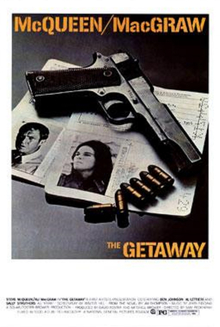
Doc McCoy (Steve McQueen) is doing a ten-year sentence in a Texas state prison when he’s offered a chance at parole.  The only condition that Jack Benyon (Ben Johnson) gives Doc is that, once out of prison, Doc is going to have to plan and carry out a bank robbery with two other criminals, Frank (Bo Hopkins) and Rudy (Al Lettieri).  Desperate for his freedom and to be reunited with his wife, Carol (Ali MacGraw), Doc agrees.  On the outside, Doc carries out the robbery but it turns out that no one can be trusted.  With everyone double-crossing everyone else, Doc and Carol head for the border, pursued by the police, Rudy, and Benyon’s brother, Cully (Roy Jenson).

Based on a novel by Jim Thompson, The Getaway is a fast-paced and violent heist film.  It was on this film that Ali MacGraw and Steve McQueen first met and famously fell for each other.  Married to producer Robert Evans, Ali MacGraw left him for McQueen.  Their very real chemistry gives the film its forward momentum and it is so palpable that it doesn’t matter that the stunningly beautiful Ali MacGraw couldn’t really act.  Steve McQueen, on the other hand, is at his coolest in The Getaway.  McQueen was an actor who didn’t need much dialogue to say a lot and The Getaway features him at his tough and ruthless best.  Doc is not one of the good guys.  He’s a bad guy but not as bad as Rudy, Frank, Jack, and Cully.

As was typical of Peckinpah, The Getaway is full of small moments and details that make the movie’s world come to life.  While Doc and Carol flee across Texas, Rudy has a twisted loves story of his own with Fran (Sally Struthers, in a role that will surprise anyone who only knows her as Gloria Stivic).  Jack Dodson plays Fran’s kindly husband and gives a performance that reminds us of the human cost of crime.  Slim Pickens has a wonderful cameo as an old cowboy whose truck is hijakced by Jack and Carol.  Those who thought of Peckinpah as just being a director of violent thrillers often overlooked the moments of humanity that regularly emerged amongst all the bloodshed.

The Getaway was not given the critical acclaim it deserved when it was released but today, it’s regularly recognized as a career best for both Sam Peckinpah and Steve McQueen.

Retro Television Review: Fantasy Island 5.22 “The Ghost’s Story/The Spoilers”


Welcome to Retro Television Reviews, a feature where we review some of our favorite and least favorite shows of the past!  On Tuesdays, I will be reviewing the original Fantasy Island, which ran on ABC from 1977 to 1984.  Unfortunately, the show has been removed from most streaming sites.  Fortunately, I’ve got nearly every episode on my DVR.

This week, season 5 comes to an end.

Episode 5.22 “The Ghost’s Story/The Spoilers”

(Dir by Don Chaffey, originally aired on May 8th, 1982)

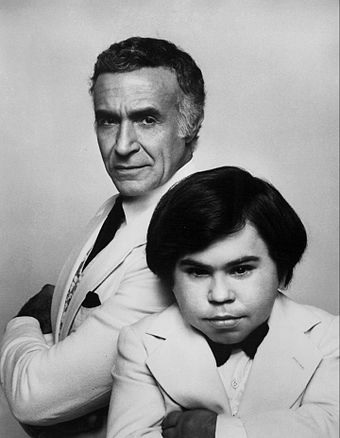
The latest batch of guests are arriving and Julie is nowhere to be seen!  Perhaps that’s because, as Mr. Roarke explains to Tattoo, Julie is helping out a guest who has an invisibility fantasy.  Tattoo and Roarke watch as the guest walks by.  His body may be invisible but his pants are not.

This is the final episode of the fifth season and it’s also the final episode in which Wendy Schaal will be credited as a part of the cast.  I wasn’t a huge fan of the Julie character but it still seems like a bit of a shame that she didn’t get to do anything in the finale.  Then again, this episode doesn’t really feel like a finale.  I don’t know what was going on behind the scenes during the fifth season but it’s hard not to feel, with the way that Julie and Tattoo have randomly shown up in different stories, that the season’s episodes were not shown in the order in which they were filmed.  Maybe all the Julie episodes were filmed at one time, while Herve Villechazie was off doing something else.  Who knows?  It’s just been a strange season.

That’s all wonderful and interesting, Lisa …. But what about this week’s fantasies!? you may be asking.

They both feel a bit familiar.  That’s not always a bad thing, of course.  Fantasy Island is a comfort show and a part of the comfort is knowing that things are always going to play out in a certain way.  But, with this episode, both fantasies felt as if they had been done better in the past.

Harry (Bo Hopkins) is a bounty hunter who comes to the Island to track down fugitive Nick Tanner (Robert Fuller).  Nick has been accused of robbing a bank and is hiding out on a nearby island.  Harry goes to the island but he soon discovers that Nick is innocent and that the real bank robbers have also come to the island in search of Nick.  Luckily, there’s a widow named Juliet (Jo Ann Pflug) who is also living on the island.  Harry and Nick hide out at her place before they all team up to defeat the real bank robbers.  Nick and Juliet fall in love and Mr. Roarke performs one of his trademark wedding ceremonies.  Nick and Juliet then board the plane back to America and …. wait a minute, what about Harry?  It was his fantasy!  We don’t ever see Harry leave Fantasy Island.  Maybe he’s still living there.

(Personally, I think he married Julie and that’s why she was no longer working there once season six began.  I like that.  Consider it to be canon.)

The other fantasy is a haunted house story.  Amanda Parsons (Tanya Roberts) comes all the way from Baltimore to spend 24 hours in one of Fantasy Island’s many haunted houses.  Two other paranormal investigators attempt to do it before Amanda but they end up fleeing after two minutes.  I’m not sure why.  The manor looks creepy but it turns out that the ghost is a rather wimpy and not at all frightening guy named Timothy Black (Dack Rambo).  Cursed by his own father after Timothy refused to fight a duel with Captain Fitzhugh Ross (John McCook), Timothy has spent two hundred years haunting the old manor.  Amanda takes sympathy on him.  It turns out that Ross’s descendant is also on the Island.  Timothy challenges him to a duel, causing the latest Ross to run in fear.  Timothy and his ghost dad (John Myhers) realize it’s okay to be scared of getting shot.  Ghost Dad asks Roarke to bring Timothy back to life so that he can pursue his romance with Amanda.  Roarke does just that, despite the fact that, in many previous episodes, Roarke has specifically said that he cannot bring the dead back to life.

Usually, I enjoy Fantasy Island‘s haunted house fantasies but this one didn’t do much for me.  I think it’s because the ghost was just too wimpy.  There’s nothing more annoying than a whiny a dead guy,

And so ends this very odd season.  Next week, we being season 6!

WHITE LIGHTNING – #ArkansasMovies, my celebration of movies filmed in the Natural State!


I love watching movies that are filmed in my home state of Arkansas. There’s something cool about seeing places I’ve been before showing up on the big screen, and if I haven’t been there before, I can go visit. We’ve had our share of big stars show up in the Natural State. Burt Reynolds, Billy Bob Thornton, Bill Paxton, Robert De Niro, Dennis Quaid, Matthew McConaughey, Tom Cruise, and Andy Griffith have all filmed really good movies here. Heck, Martin Scorsese directed one of his very first movies in southern Arkansas. It’s going to be fun revisiting some of my favorites and sharing them with you!

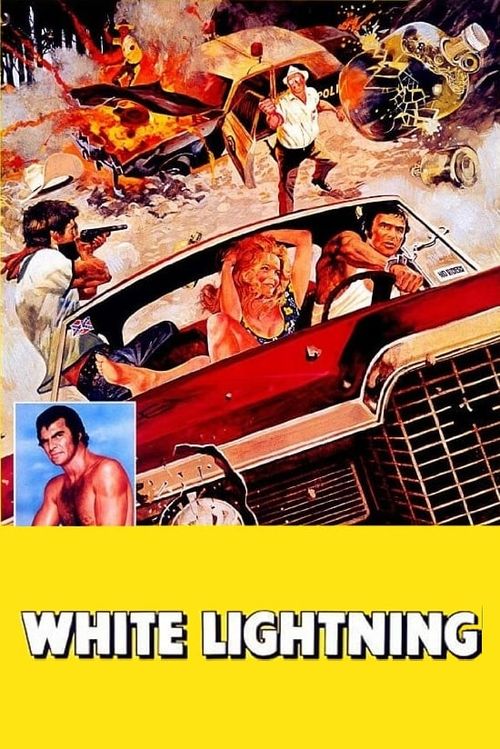
I’m kicking off #ArkansasMovies with WHITE LIGHTNING, the 1973 film from director Joseph Sargent that was filmed almost entirely within 30 minutes of my house in central Arkansas. Burt Reynolds is Gator McKlusky, a good ol’ boy who happens to find himself serving a stint in prison for “stealin’ cars, runnin’ cars, and runnin’ moonshine whiskey.” One day a cousin comes to visit him in prison and tells him that his younger brother Donny has been killed in Bogan County. Suspecting foul play, Gator first tries to escape. When that doesn’t work, he agrees to go stool pigeon and work with the federal authorities to infiltrate the world of illegal moonshining in Bogan County and provide them the names of the big money people in the area. This includes the crooked county Sheriff J.C. Connors (Ned Beatty), who Gator immediately zeroes in on as the key person responsible for his brother’s death.

In my opinion, WHITE LIGHTNING is one of the best of the good ‘ol boy, southern redneck films that were so popular in the 1970’s. One of the main reasons I like WHITE LIGHTNING so much is that while it does has some of the clowning that’s expected in these types of films, the tone gets deadly serious as McKlusky zeroes in on what happended to his brother. Reynolds is especially badass when he stops his signature laughing and goes into vengeance mode. And Ned Beatty is perfect casting as the small-town sheriff who is completely and irredeemably evil. The opening scene shows Beatty boating a couple of bound and gagged young men out into the middle of the lake, shooting a hole in the their boat, and then casually paddling away as the boat sinks. If you came up on him a little later, you’d think he was just heading in from a day of crappie fishing. For a guy that doesn’t look menacing at all on first glance, we know just how dangerous Sheriff J.C. Connors is. And so does Gator. We have a rooting interest in seeing Gator get his revenge.

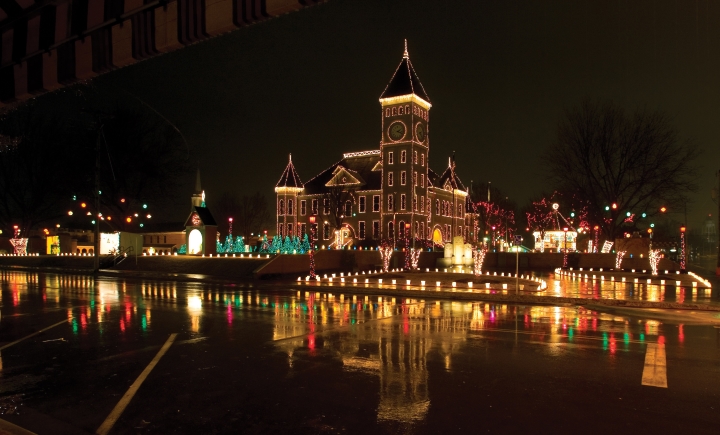
The primary filming locations in WHITE LIGHTNING are practically in my backyard. My wife and I got married at the Saline County Courthouse in downtown Benton, which is featured very prominently in the film. It’s a beautiful courthouse, with a distinctive clock tower. They decorate it so beautifully for the Christmas season (see picture below). Burt also spends time at the “Benton Speedway” in the film.  This is actually the old I-30 Speedway that was in operation in Little Rock for 66 years. Sadly, the Speedway held its final race on October 1, 2022, which is almost 50 years after filming completed. The rest of the locations used were also in central Arkansas in the towns of North Little Rock, Keo, Scott, Wrightsville, and Tucker. FYI, I don’t recommend poking around Tucker if you’re into film tourism. Tucker is the primary prison unit for the Arkansas Department of Corrections. If you do head that way, just don’t pick up any hitchhikers!

All in all, WHITE LIGHTNING is a movie I whole-heartedly recommend, and it’s especially meaningful to me since it’s so close to home. Billy Bob Thornton would be back in this same area in 1996 to film SLING BLADE.

October Hacks: Sweet Sixteen (dir by Jim Sotos)


1983’s Sweet Sixteen takes place in a small town in Texas.

Sherriff Dan Burke (Bo Hopkins) does his best to try to maintain the peace but it’s not always easy.  Not when a good majority of the town is prejudiced against the Native Americans living on a nearby reservation.  There’s a major archeological dig happening on the reservation, headed up by Dr. John Morgan (Patrick Macnee), but the town doesn’t care about any of the artifacts that Dr. Morgan and his team might discover.  They’re too busy harassing local activist Jason Longshadow (Don Shanks) for stepping into the wrong bar.

However, a distraction from all of the casual racism has arrived in the form of Dr. Morgan’s daughter, Melissa (Aleisa Shirley).  Soon, it seems like every teenage boy and young man in town is lusting after Melissa.  Melissa, for her part, is only fifteen years old and is struggling to deal with all of the attention.  Sometimes, she enjoys the attention.  Sometimes, she just wants to be left alone.  (Believe me, as someone who had adults hitting on her when she was 13, I could relate.)  Melissa’s birthday is coming up and her mother (Susan Strasberg) is planning on throwing a big party and inviting the whole town to come over and celebrate.  Sheriff Burke thinks it’s a great idea.  “This town could use something to celebrate.”

The only problem is that any boy who so much as looks at Melissa ends up getting brutally murdered.  When an old Native American man named Greyfeather (Henry Wilcoxin) is spotted near the scene of one of the crimes, the local redneck blame him for the murders and tragedy ensues.  Sheriff Burke has to find the real murderer and, whether he likes it or not, he’s going to get some help from his kids, Hank (Steve Antin) and Marci (Dana Kimmel).

Hank and Marci really are this film’s secret weapons.  In the past, I’ve been pretty critical of Dana Kimmel’s performance in Friday the 13th Part 3 and her insistence that her character be re-written to reflect her own religious beliefs and desire to be a good role model.  However, Kimmel is really likable (and perhaps more appropriately cast) as the fiercely intelligent but still relatively innocent Marci, who reads murder mysteries and is totally excited about the prospect of getting to solve a real murder.  Hank is perhaps a bit less enthusiastic about about crime-solving than Marci but he still helps out his sister because she’s his sister.  Awwwwww!

Sweet Sixteen is a bit of an untraditional slasher film, one that is as concerned with social issues as is it was stalking and slashing teenagers.  Perhaps that explains why it has a slightly better cast than the typical 80s slasher, with veteran actors like Patrick McNee, Susan Stasberg, and Bo Hopkins acting opposite equally capable but younger actors like Kimmel, Antin, and Aleisa Shirley.  It’s also a surprisingly likable slasher film, due to the Dana Kimmel and Steve Antin’s engaging lead performances.  Honestly, I think it’s kind of a shame that there weren’t a series of films featuring Marci and Hank solving crimes.  Dana Kimmel and Steve Antin make quite a team in this above average slasher.

Retro Television Reviews: Dawn: Portrait of a Teenage Runaway (dir by Randal Kleiser)


Welcome to Retro Television Reviews, a feature where we review some of our favorite and least favorite shows of the past!  On Sundays, I will be reviewing the made-for-television movies that used to be a primetime mainstay.  Today’s film is 1976’s Dawn: Portrait of a Teenage Runaway!  It  can be viewed on YouTube!

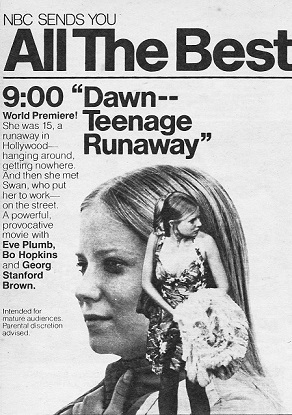
Dawn Wetherby (Eve Plumb) is fifteen years old.  She’s naive.  She’s innocent.  She’s …. well, let’s just be honest and admit that she’s not particularly bright.  Sick of being embarrassed by her alcoholic mom (Lynn Carlin), Dawn decides to hop on a bus and travel to Hollywood.  Maybe she can make a new life for herself in California.

Of course, it doesn’t take long for Dawn to discover that Los Angeles is not a city where dreams magically come true.  It’s a tough and harsh town and it’s not like Dawn has any money or any particular skills.  When she tries to get a job, she’s told that she’s too young.  When she tries to rent a room, she’s told that ten dollars is not enough to cover two weeks rent.  When she gives a dollar to a boy who says that he needs it, he responds by mugging her for the rest of her cash.  A prostitute named Frankie Lee (Marguerite DeLain) takes some sympathy on Dawn and tells her to call if she ever wants to make some money.

Eventually, a nasty cough leads to Dawn going to the free clinic.  That’s where she meets Alexander (Leigh McCloskey).  Alexander is a teen runaway, just like Dawn.  However, Alexander also can somehow afford an apartment and food to eat.  Alexander invites Dawn to live with him and Dawn, realizing she has no where else to go, agrees.  Alexander offers to look after her but, after Dawn discovers that Alexander makes his money by working as a male prostitute, Dawn decides that she needs a job of her own.

It’s time to call Frankie Lee!  And it’s time for Frankie Lee to introduce Dawn to Swan (Bo Hopkins), a pimp who lives in a nice house and who offers to put Dawn to work….

Dawn: Portrait of a Teenage Runaway is an earnest film that was obviously made with the best of intentions and which actually did have something say, in its melodramatic way, about the dangers of running away from home and trying to make it on your own when you’re not even old enough to drive.  That said, I imagine that most people who go through the effort to track down this film will do so because it stars The Brady Bunch‘s Eve Plumb as an underage runway who ends up walking the streets and taking men back to her motel room.  The movie might as well be called Jan Brady Goes Bad, because Eve Plumb does essentially give the same performance that she gave when she was playing the whiniest member of the Brady Bunch.  There’s nothing tough or streetwise about her, which works for the first half of the film but not during the second half.  Once Dawn has been on the streets for a bit, you would expect her to toughen up a bit but she still comes across like she’s mad at Greg and Bobby for tying up the phone.  Dawn goes through a lot and becomes a bit jaded as a result but, every time she speaks, you expect her to exclaim, “Why does Marcia get to runaway from home but I don’t?  It’s not fair!”  Far more impressive are the performances of Bo Hopkins and, in the role of Dawn’s probation officer, George Stanford Brown.  William Schallert also has a good bit as Dawn’s first client, who ends up feeling so sorry for Dawn that he just give her twenty dollars and then tells her to go back home.

Dawn: Portrait of a Teenage Runway is one of those film that was obviously designed to make parents worry about their kids.  It seems to be asking, “Do you know where your children are tonight?”  In 1976, I imagine they were busy watching Jan Brady try to make it on the mean streets of Hollywood.

Scenes That I Love: Bo Hopkins and Richard Dreyfuss Flip A Cop Car in American Graffiti


I just read that the veteran actor Bo Hopkins has passed away at the age of 84.  The last movie of note that I saw Hopkins in was Hillbilly Elegy, where he had a small role as Glenn Close’s husband.  However, if you’re a fan of older films, you will probably recognize Bo Hopkins, even if you don’t know the name.  He was a handsome but weathered actor with a Texas accent and a reckless attitude.  He was a doomed member of a gang of old west bank robbers in The Wild Bunch.  In Midnight Express, he played a mysterious government agent who turned out to be not as benevolent as he originally seemed.

And, in the 1973 classic American Graffiti, he played the leader of the Pharaohs, the local gang of small town James Dean wannabes.  Even though Hopkins didn’t get a lot of screentime in American Graffiti, he definitely made an impression as the intimidating but ultimately friendly aspiring delinquent.  In the scene below, he and Richard Dreyfuss flip a cop car.

RIP, Bo Hopkins.

The Films of 2020: Hillbilly Elegy (dir by Ron Howard)


Oh, Hillbilly Elegy.

This is a film that I think a lot of people expected to be an Oscar contender because it was directed by industry favorite Ron Howard, it was based on a genuinely moving best seller, and the cast included Amy Adams and Glenn Close, two actresses who are more than overdue for their first Academy Award.  I don’t think anyone expected it to win much, largely because Ron Howard isn’t exactly the most groundbreaking director working in Hollywood, but it was still expected to be contender.

Even before it was released, there were a few signs that Hillbilly Elegy might not be the award-winning film that some were expecting.  The first images from the film featured Glenn Close and Amy Adams looking like characters from some sort of ill-conceived SNL sketch.  Then the trailer came out and it was so obviously Oscar bait-y and heavy handed that it was hard not to suspect that the film was trying just a bit too hard.  By the time the film itself finally premiered in November, I think a lot of people were specifically waiting for their chance to skewer it.

Make no mistake about it, Hillbilly Elegy deserves a certain amount of skewering.  Its a bit of a tonal mess and, far too often, it feels as if Ron Howard is inviting us to gawk at the film’s characters as opposed to showing them any sort of real empathy.  Those critics who have claimed that the film occasionally feels like “poverty porn” have a point.

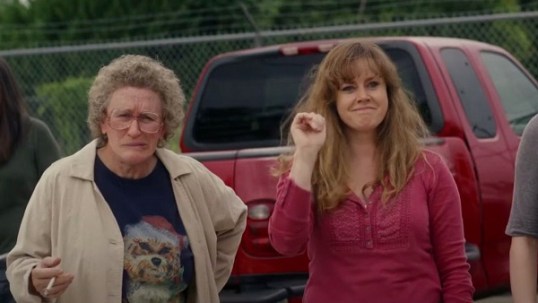
And yet, despite all of those legitimate complaints, I would argue that the film is partially redeemed by the performance of Glenn Close.  Close plays Meemaw, who always seems to be carrying a lit cigarette and who has no hesitation about threating to beat the Hell out of her children and her grandchildren.  Meemaw lives in a cluttered house that probably reeks of smoke.  The TV is almost always on.  Meemaw is a fan of Arnold Schwarzenegger.  If you’ve ever wanted to hear Glenn Close say, “Hasta la vista, baby,” this is the film for you.  Meemaw is a somewhat frightening character (during one flashback, she sets her drunk husband on fire) but she’s also the most caring character in the film.  When it becomes obvious that her drug addict daughter, Bev (Amy Adams), is incapable of taking care of J.D. (played by Owen Aszatlos as a teen and Gabriel Basso as an adult), Meemaw essentially kidnaps J.D. and take him home with her.  Close’s performance is undeniably theatrical but it works.  She communicates that underneath all the bluster and the profanity and the anger and the cigarette smoke, Meemaw truly does love her family.  Glenn Close transcends the film’s flaws and brings some real heart to the story.

Hillbilly Elegy opens with J.D. as a student at Yale Law School, hoping to get accepted for a prestigious summer internship.  Meanwhile, all the other Ivy Leaguers treat J.D. like some sort of alien on display because he’s originally from Kentucky, he served in the army, and he went to a state school.  Though ambitious and intelligent, J.D. still feels likes an outsider.  When he goes to a banquet and discovers that he’ll be required to use different forks throughout the meal, he calls his girlfriend (Frieda Pinto) and gets a quick lesson on which fork to use when.

Unfortunately, before the meal even starts, J.D. gets a call from his sister, Lindsay (Haley Bennett), telling him that Bev has overdosed on heroin and is at the hospital.  J.D. has to drive all the way to Ohio so that he can try to get his mother into a drug rehab.  Because Bev doesn’t have medical insurance and would rather just stay with her good-for-nothing boyfriend, that turns out to be a bit more difficult than J.D. was anticipating.  The film becomes a race against time to see if J.D. can get his mom taken care of and still make it back to Connecticut so that he can interview for a prestigious internship.  Along the way, there are frequent flashbacks to Meemaw telling the young J.D. that he can be something better than just a hillbilly.  All he has to do is try and not give up.

By structuring his film as a series of flashbacks, Ron Howard ensures that there’s really not any suspense about whether or not J.D. is going to be able to escape from Appalachia.  Since we’ve already seen that the adult J.D. is going to be end up going to Yale, it’s hard to get worried when we see the teen J.D. smoking weed and hanging out with a bunch of losers.  We know that J.D. is going to get over his adolescent rebellion and get his life straightened out.  The film tries to create some tension about whether or not J.D. is going to be able to make his internship interview but, again, J.D. is going to Yale and living with Frieda Pinto.  From the minute we see J.D., we know that he’s going to be just fine regardless of whether he gets that internship or not.  In fact, his constant worrying about missing his interview starts to feel a bit icky.  While Bev is dealing with her heroin addiction, Ron Howard is focusing on J.D. driving back to Connecticut as if the audience is supposed to be saying, “Oh my God, has he at least reached New Jersey yet!?”  This is the type of storytelling choice that could only have been made by a very wealthy and very comfortable director.  It reminded me a bit of The Post and Steve Spielberg’s conviction that, when it came to the decision to publish the Pentagon Papers, audiences would naturally be more interested in the owner of the newspaper than the people who actually did the work breaking the story.  Here, Howard seems to be saying, “Yes, Bev might overdose and die having never reconciled with her son but the real tragedy is that J.D. might have to settle for his second choice as far as prestigious summer internships are concerned.”

Along with the story’s structural issues, the film also suffers because the usually wonderful Amy Adams is miscast as Bev.  Adams acts up a storm as Bev but the performance itself a bit too obvious and on-the-surface.  While Glenn Close disappears into the role of Meemaw, you never forget that you’re watching Amy Adams playing a character who is a bit more troubled than the usual Amy Adams role.  You don’t think to yourself, “Oh my God, Bev is losing it.”  Instead, you think, “Amy Adams sure is yelling a lot in this movie.”  Somehow, Hillbilly Elegy makes Amy Adams feel inauthentic, which is something that, before I watched this film, I wouldn’t have believed to be be possible.

Aside from Glenn Close’s performance, Hillbilly Elegy doesn’t quite work and that’s a shame because I do think that a good film could have been made from Vance’s book.  Unfortunately, Ron Howard doesn’t bring any sort of grittiness to the film’s depiction of what it’s like to be poor and forgotten in America.  Instead, the film feels just a bit too slick.  It attempts to be both a film about poverty and a crowd pleaser.  When the movie should be showing empathy for its characters, it puts them on display.  When it should be challenging the audience, it pats us on the back as if we should feel proud of ourselves merely because we spent two hours watching J.D. and his family.  The film just doesn’t work.  No wonder Meemaw prefers watching The Terminator.

Cinemax Friday: Fever Lake (1997, directed by Ralph Portillo)


I’ve seen my share of bad slasher films but Fever Lake is definitely one of the worst.

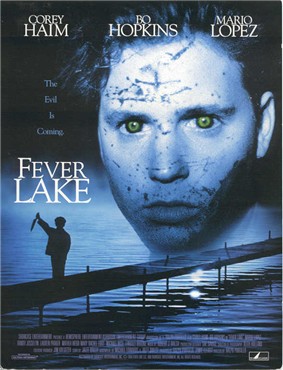
The plot is a familiar one.  Six college students (including Corey Haim, Mario Lopez, and Lauren Parker) head to the lake for the weekend.  The lake has a bad reputation and they’ll be staying at a house where a terrible murderer occurred ten years earlier.  The sheriff (Bo Hopkins) doesn’t want any foolishness.  The local Native American medicine man (stiffly played by Michael Wise) says that there is a demon in the lake and that it’s about to reawaken.  The students go to the lakehouse anyway.  Can you guess what happens?  It’s a 93 minute film where the killer doesn’t show up for 70 minutes. There’s not much gore and zero nudity and it has a twist that anyone will be able to see from a mile away.  Haim alternates between sleepwalking his way through the film and screeching unintelligibly and Mario Lopez comes across like he’s playing A.C. Slater on speed.  It’s thoroughly inept in almost every way that a film can be and, even worse, it’s boring.

Fever Lake is the type of film that, in the 90s, you always hated coming across on late night Cinemax.  Because you were watching 2 in the morning, you would expect something extreme and instead you ended up with an hour of Corey Haim and Mario Lopez driving up to the lake.   Late night connoisseurs held films like this in a special kind of contempt.  For the most part, we never asked much from more late night Cinemax offerings and when a movie like this couldn’t even deliver what little we did ask for, it was hard not to take it personally.  (To be honest, the PG-13 rating should have given the game away.  I’m not sure what the film did to rate the addition of that 13, though.  This film is a solid PG, all the way through.)

Today, of course, we can enjoy Fever Lake because of RiffTrax.  Mike, Kevin, and Jim ripped Fever Lake apart in 2015.  The film, with their commentary, is available on Prime.  It’s the best way to watch Fever Lake.