Happy birthday to the one and only, Billy Dee Williams!
I remember the first time I watched The Empire Strikes Back, I was shocked when Lando betrayed his friend Han Solo. Luckily, Lando was able to later redeem himself but the Cloud City betrayal scene remains one of the best moments in the original Star Wars trilogy.
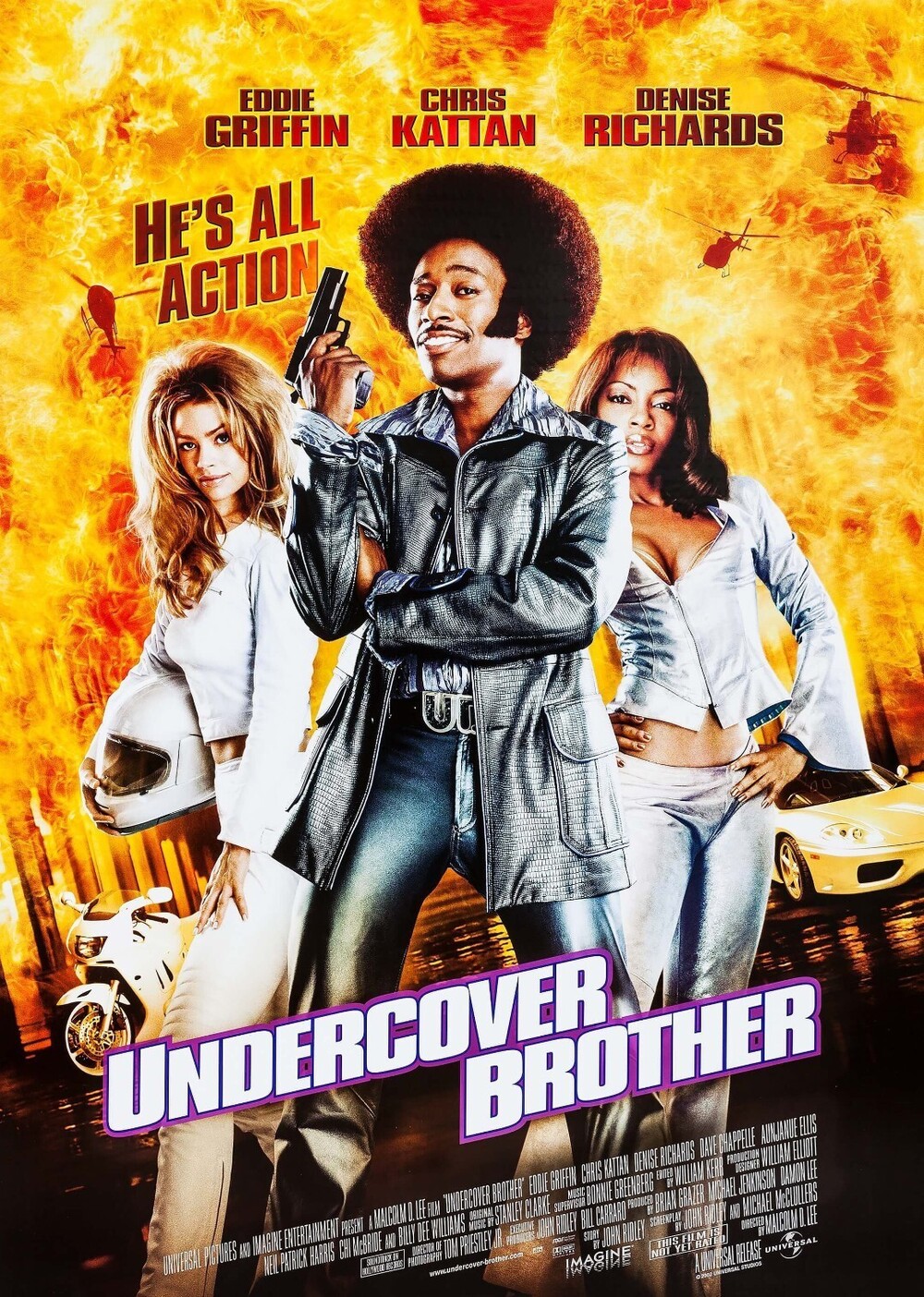
Undercover Brother is exactly the kind of movie that earns the phrase “guilty pleasure.” It is messy, broad, and often ridiculous, but it is also packed with enough energy, attitude, and sharp-enough satire to make its flaws feel like part of the joke rather than dealbreakers. The result is a comedy that may not always land cleanly, but it absolutely understands its own vibe and commits to it hard.
At the center of it all is Eddie Griffin, who gives the title character a big, swaggering, old-school cool that carries the movie through its shaggier patches. He plays Undercover Brother as a throwback spy hero with a giant Afro, loud fashion sense, and nonstop confidence, and that exaggerated persona is a big reason the film works as well as it does. Griffin’s performance is not subtle, but subtlety is not really the point here; he sells the movie’s cartoonish energy without making it feel lazy.
What makes Undercover Brother more than just a random parody is how committed it is to poking at both blaxploitation iconography and mainstream spy-movie clichés. The film was directed by Malcolm D. Lee and written from material based on John Ridley’s earlier animated series, and it leans into that satirical roots-and-gadgets formula with a lot of style. It clearly wants to be playful, but it also wants to say something about race, image, and the way Black identity gets packaged or watered down in pop culture.
That said, the movie is not exactly a model of precision. Some of the jokes are sharp and immediate, while others feel like they are still revving the engine long after the punchline should have arrived. The plot is basically an excuse to move from one set piece to another, and the film knows it, which helps, but it also means the whole thing can feel more like a high-speed sketch comedy than a fully shaped story. If you go in expecting airtight narrative logic, you will probably be annoyed; if you go in wanting a fast, funky send-up, you will have a much better time.
The supporting cast gives the movie a lot of its flavor. Dave Chappelle, Aunjanue Ellis, Billy Dee Williams, Chris Kattan, Denise Richards, and Neil Patrick Harris all add to the film’s chaotic mix, and the casting itself becomes part of the joke. Billy Dee Williams especially feels perfectly placed in a movie that is constantly riffing on cool, style, and old-school charisma, while Denise Richards gets a knowingly exaggerated role that plays into the film’s cartoonish battle between seduction and resistance.
What helps Undercover Brother age a little better than some early-2000s comedies is that it is not just throwing random nonsense at the screen for cheap laughs. There is a genuine satirical target here, and even when the movie gets clumsy, it still feels like it has a point of view. The movie clearly aims to be both goofy and observant, and even when the balance is uneven, it is hard not to appreciate the effort.
The best thing about Undercover Brother is its attitude. It moves like a movie that wants to be loud, stylish, and a little bit too much, and that confidence gives it a strange charm. The humor is often broad, sometimes cartoonish, and occasionally uneven, but the film’s willingness to fully commit to its bit makes it easy to forgive a lot. Even when the satire is more enthusiastic than elegant, the movie keeps its foot on the gas, and that momentum is a big part of its appeal.
Its biggest weakness is also the thing that makes it memorable: the movie can feel overstuffed with ideas, references, and gags, some of which work better than others. A few jokes feel a little dated now, and the film’s style of satire is not always as clean or as clever as it seems to think it is. Still, the movie has enough bite, personality, and goofy confidence that those rough edges become part of its charm instead of sinking it. That is the hallmark of a true guilty pleasure: you can see the flaws clearly, but you keep smiling anyway.
So Undercover Brother is not a perfect comedy, and it is not trying to be one. It is loud, silly, politically aware in a very pop-movie way, and shamelessly committed to its own funk. If you want polish, you will find plenty to criticize; if you want a movie with attitude, quotable energy, and the kind of swagger that makes its imperfections oddly lovable, this one delivers. It is a flawed satire, sure, but it is also a genuinely fun one, and that is why it still plays like a guilty pleasure worth revisiting.
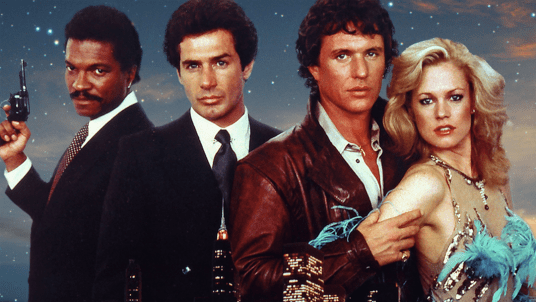
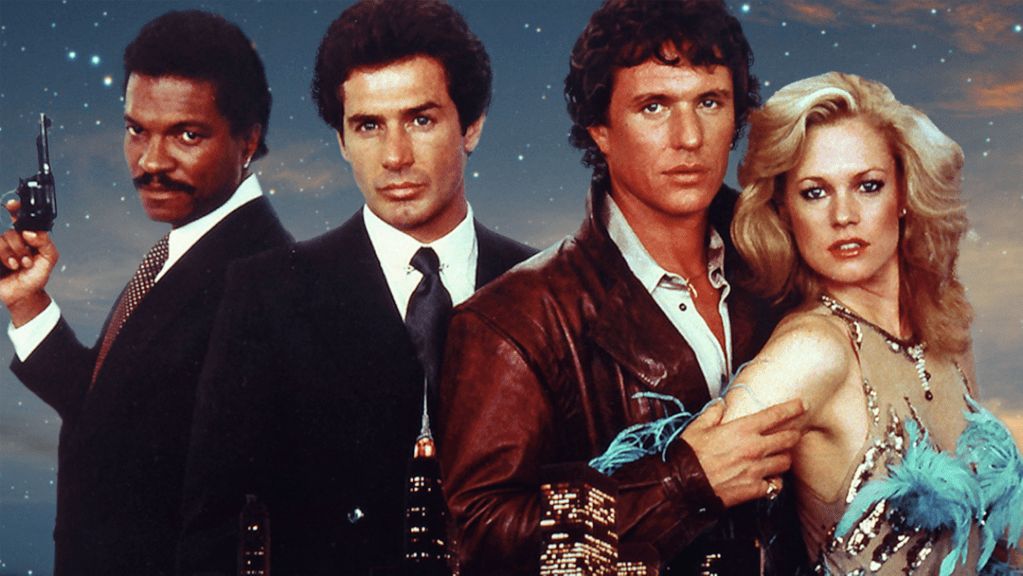
While self-righteous vice cop Al Wheeler (Billy Dee Williams) patrols the streets with the fury of an Old Testament prophet, men flock to seedy bars to watch women like Loretta (Melanie Griffith) dance and strip. Mobsters like Carmine (Rossano Brazzi) control the streets while club owners like Mike (Michael V. Gazzo) and Frank (Joe Santos) try to do business and make enough money to keep things open. Bookers like Nicky Parzeno (Jack Scalia) and Lou Goldstein (Jan Murray) compete to see who can place their girls in the most clubs. Nicky’s best friend and business partner, Matt Rossi (Tom Berenger), is haunted by his violent past as a boxer and his failed relationship with the drug-addicted Loretta.
Meanwhile, a nameless man (John Foster) practices nude tai chai in his warehouse apartment and writes feverishly in his journals. At night, he stalks the streets with a blade in his hand. He targets strippers, attacking them as they try to get home from the club. Honey (Ola Ray) is attacked on a subway platform. Loretta’s girlfriend, Leila (Rae Dawn Chong), is attacked on the streets. Obsessed with Loretta’s safety, Matt struggles with his own inner demons as he prepares for a final confrontation with the killer….
1985’s Fear City is another one of director Abel Ferrara’s heavily stylized fever dreams. In typical Ferrara fashion, the plot is so sordid that one might be tempted to think that the film is meant to be a self-parody and the dialogue mixes profane insults with bizarrely philosophical asides. As played by Billy Dee Williams, Al Wheeler is not just a cop who wants to clean up New York and Times Square. Instead, he’s a seething soldier to traditional morality and one who is so intense that it’s something of a shock that he doesn’t just walk around New York shooting people for jaywalking. Meanwhile, Tom Berenger’s Matt is a hulking brute who is haunted by the time he killed a man in the ring. He knows what he’s capable of and it scares him but, in order to save Loretta and his business, he’s going to have to become that deadly boxer once again. “I hate Matt Rossi because he’s arrogant,” Al Wheeler says through gritted teeth. Meanwhile, Matt deals with his own issues by trashing his office and then leaving the mess for someone else to clean up. I’m not sure what that was supposed to accomplish but it’s apparently something that Matt just has to do.
Abel Ferrara directed this film five years before King of New York and, in some ways, Fear City feels like a dry run for King of New York. Both films are highly stylized and both present New York as being a neon-lit Hell where the rich and the poor come together in mutual self-loathing and where the criminals often have more of a code of honor than the cops who are trying to stop them. Of course, King of New York had Christopher Walken’s magnetic performance as Frank White holding the film and its many storylines together. Fear City doesn’t really have that. Billy Dee Williams, Tom Berenger, Jack Scalia, and Melanie Griffith all give strong performance but none of their characters are really quite compelling or grounded enough to keep the film from spinning off into delirious excess.
In other words, Fear City is a mess but it’s one of those over-the-top, shamelessly sordid messes that you really can’t look away from. There’s enough philosophical dialogue to confirm that, as with King of New York, Ferrara was shooting at something more than just a typical exploitation film. Unlike King of New York, Ferrara doesn’t quite succeed in saying anything particularly deep about the human condition in Fear City. But that’s okay. It’s an entertainingly sordid film.
I love Billy Dee Williams. When I was a kid, I remember Florence from THE JEFFERSONS loving him. I also loved him as Lando Calrissian in the STAR WARS movies. I’m sure I had his action figure. As I got a little bit older, I started to appreciate his larger body of work in movies like NIGHTHAWKS with Sylvester Stallone and Rutger Hauer, and NUMBER ONE WITH A BULLET with Robert Carradine. On his 88th birthday, I wanted to take a moment to celebrate Billy Dee Williams, and one of my favorite action movie scenes. This scene from NIGHTHAWKS features three unbelievably cool actors in their prime!
Every Monday night at 9:00 Central Time, my wife Sierra and I host a “Live Movie Tweet” event on X using the hashtag #MondayMuggers. We rotate movie picks each week, and our tastes are quite different. Tonight, Monday January 27th, we’re watching FEAR CITY starring Tom Berenger, Billy Dee Williams, Jack Scalia and Melanie Griffith.
So why did I pick FEAR CITY, you might ask?
I’m a huge fan of Tom Berenger. SOMEONE TO WATCH OVER ME (1987 with Mimi Rogers), SHOOT TO KILL (1988 with Sidney Poitier), MAJOR LEAGUE (1989 with Charlie Sheen), and LAST OF THE DOGMEN (1995 with Barbara Hershey) are some of my very favorite films. He’s an outstanding actor and screen presence. Tom Berenger is one of those actors who I always enjoy seeing on screen.
FEAR CITY is directed by Abel Ferrara. Abel Ferrara is one of those directors who makes movies about the very worst in society. His films MS. 45 (1981), KING OF NEW YORK (1990), and BAD LIEUTENANT (1992) are all movies that intrigued me greatly as I was trying to discover who I was growing up in the 80’s and early 90’s.
The sleaze is off the charts in FEAR CITY, with so many big-time stars, and set in New York City of the 1980’s. From everything I’ve read, this a time capsule of a place that no longer exists. If I ever make it to New York City, I’ll be greeted with a place that’s designed more like Disney World. I think it’s interesting to see the city as presented here!
I also think it will be interesting to see what it’s like to experience a movie like FEAR CITY as part of a group. I discovered this film as a teenager in the 80’s. I remember being a little embarrassed as I watched the film, especially with its large serving of nudity (from big stars) and graphic violence. I’ve watched films in groups with the most extreme graphic violence imaginable and no one batted an eye. I’m looking forward to seeing how this plays out.
So join us tonight to for #MondayMuggers and watch FEAR CITY! It’s on Amazon Prime.
Since Sunday is a day of rest for a lot of people, I present #SundayShorts, a weekly mini review of a movie I’ve recently watched.
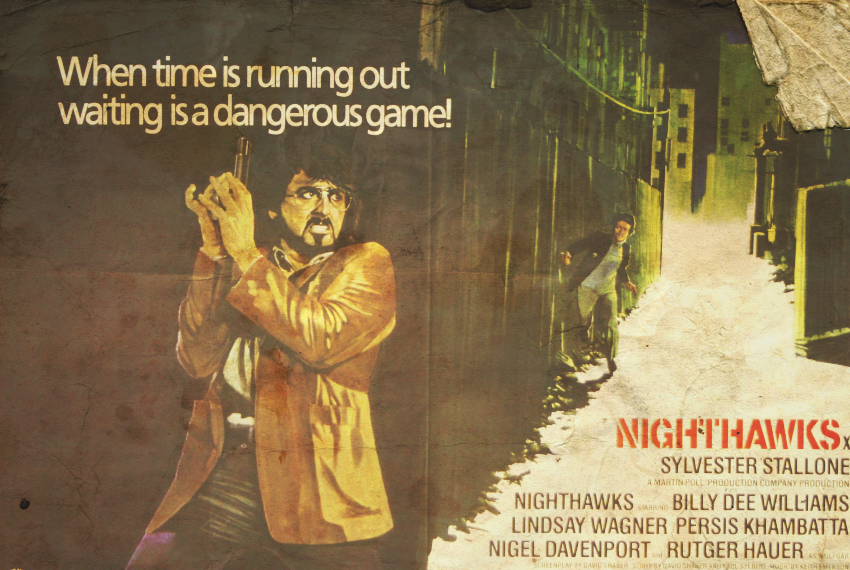
Deke DaSilva (Sylvester Stallone) and Matthew Fox (Billy Dee Williams) are two badass New York City Cops. Wulfgar (Rutger Hauer) is one of the most dangerous terrorists in the world. When it’s suspected that Wulfgar is in New York City, DaSilva and Fox are transferred to an elite anti-terrorist squad, led by the British expert Peter Hartman (Nigel Davenport). Will they be able to find Wulfgar and stop him before it’s too late?
I’m a big fan of NIGHTHAWKS. The performances from Stallone, Williams, and Hauer are all excellent. Hauer is especially good as the terrorist, Wulfgar. He knocks it out of the park. The action is hard hitting at times, and the tension builds nicely throughout the film, leading to its audience pleasing conclusion. Definitely recommended for fans of action movies and the stars!
Five Fast Facts:
Dutch actor Rutger Hauer was a huge star in the Netherlands when NIGHTHAWKS was made. This is his American film debut.
Sylvester Stallone and Rutger Hauer clashed early and often while making NIGHTHAWKS. The first day on the set, Rutger Hauer had to film a violent action scene. While filming the sequence, Hauer was injured when a cable that would yank him to simulate the force of being shot was pulled too hard, straining his back. Afterward, Hauer discovered that the cable was pulled with such force on Sylvester Stallone’s orders. Hauer threatened Stallone that he would “break his balls” if he ever did something like that again. Reportedly, they clashed often on the film from this point forward.
The director of NIGHTHAWKS, Bruce Malmuth, played the ring announcer of the All-Valley karate tournament at the end of THE KARATE KID. I was 12 years old when I saw THE KARATE KID, and I wanted to be the karate kid. It’s one of my favorite movies, leading to a lifetime crush on Elizabeth Shue.
Reportedly, during the exciting subway chase sequence, Rutger Hauer continually outran Stallone, who is known for his competitive streak. This is one of my favorite sequences in the film, and Hauer does look extremely fast.
If you’re looking for a reason to upgrade to the Shout! Factory blu ray…the Universal Pictures widescreen DVD omits the use of “Brown Sugar” by The Rolling Stones and “I’m a Man” by Keith Emerson. The 2016 Blu-ray release from Shout! Factory adds them back.
Welcome to Retro Television Reviews, a feature where we review some of our favorite and least favorite shows of the past! On Sundays, I will be reviewing the made-for-television movies that used to be a primetime mainstay. Today’s film is 1972’s The Glass House! It can be viewed on YouTube.
The Glass House starts with three men arriving at a location that will define the next few months of their lives.
Brian Courtland (Clu Gulager) is a veteran of the Vietnam War. He spent part of his service working as a guard in the brig. Now that he’s back in the United States and in need of a regular paycheck, he has gotten a job working as a prison guard. Courtland is not naive about where he’s going to be working or who he is going to be working with. But he is an idealist, one who tries to treat everyone fairly and who hopes that he will be able to do some sort of good in his new position.
Alan (Kristoffer Tabori) is a young man who has been arrested for selling marijuana. He is quiet and just hoping to serve his time and then get on with his life. His fellow prisoners have different plans for him.
Finally, Jonathan Paige (Alan Alda) is a liberal professor who, in a moment of rage, accidentally killed a man in a fight. Convicted of manslaughter, Paige enters the prison in a daze and cannot stop flashing back to the one moment that changed his life forever. Paige is assigned to work in the pharmacy, where he meets a prisoner-turned-activist named Lennox (Billy Dee Williams). Paige struggles to retain his humanity despite the harsh conditions.
All three of the men find themselves having to deal with the attentions of Hugo Slocum (Vic Morrow), the predatory “king” of the prison. Slocum expects Paige to help him run drugs though the the pharmacy. Slocum preys on Alan and sends his gang to punish him when Alan refuses Slocum’s advances. And Slocum expects that Courtland will just be another corrupt guard who agrees to look the other way when it comes to Slocum’s activities. Courtland, however, turns out to have more integrity than anyone was expecting.
The Glass House opens with a title card, informing the viewer that the film was shot at an actual prison and that the majority of the people in the film were actual prisoners. Not surprisingly, The Glass House does feel authentic in a way that a lot of other films about incarceration does not. The prison is claustrophobic and dirty, with every crack in the wall reminding the prisoners and the viewer that no one cares about what happens there. The extras have the blank look of men who understand that showing any emotion will be taken a sign of a weakness. Made in 1972, at a time when America was still struggling to integrate, The Glass House takes place in an almost totally segregated world. The black prisoners stick together. The white prisoners stick together. Everyone understands that’s the way that it will always be and, as we see by the end of the film, that’s the way the guards and the warden (Dean Jagger) prefer it because that means almost any incident can be written off as a being “a race riot.”
The real actors amongst the population do a good job of blending into the surroundings. Alda, Williams, and Tabori all give good performance while Vic Morrow is truly menacing in the role of the vicious Slocum. Slocum may not be particularly bright but, because he has no conscience, he is uniquely suited to thrive in a world with no morality. The film’s best performance comes from Clu Gulager, who does a great job of portraying Courtland’s growing disgust with how the system works.
Though it’s over 50 years old, The Glass House is a still a powerful look at life on the fringes. Society, for the most part, doesn’t really care much about what happens to the incarcerated. This film makes a strong case that we probably should. One is left with little doubt that, even if relatively harmless prisoners like Paige and Campbell survive being locked up with men like Slocum, they’ll still be incapable of returning to the “real world” afterwards. The viewer, like Brian Courtland, is left to wonder how much corruption can be tolerated before enough is enough.
Here on the Shattered Lens, the love for Batman is very strong. There are too many Batman related articles to fully list, but for a good start, go with Ryan’s Which Way Forward for the Batman Franchise.
This isn’t so much a review for Batman as it’s just me looking back on the film.
I spent the Saturday Morning of June 24th, 1989 standing on a line that snaked around the white walls of the Sunrise Multiplex Cinema in Valley Stream. Thankfully, by the time I arrived, there were only a few people there. Most of them were my friends, so we were close to the door. The following year, the Sunrise would go down in history as being the only movie theatre I’ve ever known with metal detectors after a shooting around the release of The Godfather Part III prompted tighter security. Before then, anyone going into the theatre had a free run of the place. From that incident to the theatre’s shutdown in 2015, you always had to pass the metal detectors.
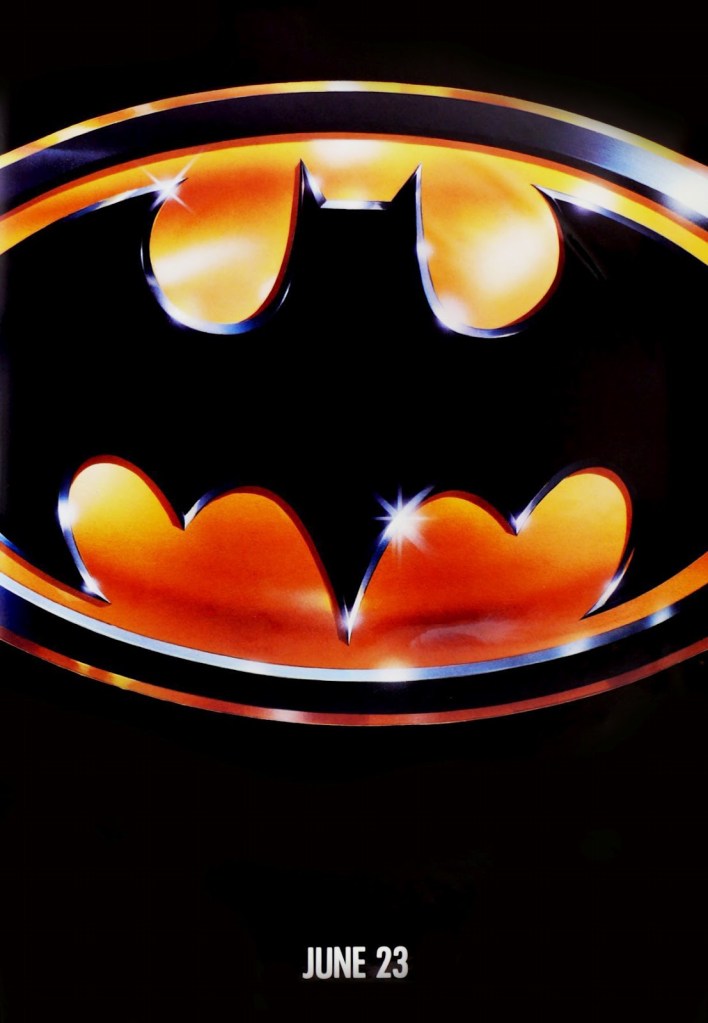
You knew Tim Burton’s Batman was going to be something grand when they first put up the posters in bus stations. The character was so well known that the poster was simply a black and gold Batsymbol with a date – June 23. In my neighborhood, the poster lasted a week before the bus stop’s glass was broken and it was stolen. This was how mad people were for the film. Although merchandise was already available, it moved at an incredible pace. For a film made before pre-Internet, the buzz was just amazing.
“Okay, Everyone, we know you’re looking forward to seeing the movie.”, came the announcement over the theatre’s loudspeaker, which caused a few murmurs from everyone. It was a smooth, business like voice, probably from someone who had never even heard of The Caped Crusader. “We’re going to open up the doors and we want everyone to proceed to the ticket booths in a nice, orderly fashion.”
I was 14 at the time. Batman was the first movie I ever saw without my family. My parents, a cop and a bartender, saw so much of the worst of NYC that they figured the best place for me was home. Still, since I was among friends they knew, I gave me a pass. It was a big deal. My friend Pierre and I had a plan, along with the 4 others that came with us. We’d head in, make for the ticket booth and go right in for our seats near the back right side.. No refreshments were necessary, since we could all go eat at the mall later on after the move was done. To make sure I didn’t miss anything, I had already read the novel for the story beforehand.
Anyone close to the door could see the theatre workers as they approached, keys in hand. The layout of the Sunrise was such that after stepping through the front door, you could cut to your immediate left or right down a open path to separate ticket booth. As the door unlocked, was pushed open and secured, someone from near the middle of the line decided it was time, declaring in a loud scream.
“Batman!!!!!”
It was madness. Utter madness. Bodies piled into the theatre in a mad scramble for the ticket booth. On the way there, I was shoulder blocked and fell to the floor. I instantly curled into a ball to keep from getting trampled, wondering if my parents were right about not letting me out. ‘Here lies Lenny…”, my epitaph would read. “…he died at the movies after being let outside on his own just once.”
Thankfully, I was scooped up to my feet a few seconds later by one of my friends.
“Go on! We’ve got your tickets! Head for the ticket guy, we’ll meet you there!” he yelled over the crowd passing us on sides.
“Okay!!” I’d been to the Sunrise tons of times, so I knew it well. I moved through the crowd, bypassing the concession stand, which was already developing a line of its own. I thought they were going to go in without me and leave me there. I don’t know they did it, but within a few minutes of reaching the ticket taker. most of my group caught up, tickets in hand for all of us.
The actual experience of Batman was a packed crowd with almost non-stop talking throughout. After all, the audience was made up of teens and DC fans that that were ravenous for anything Batman related. Superman had about four films by the time Batman premiered. I think the only real time the entire audience hushed was near the beginning when we first see Batman grab the one robber and they ask him what he is. After that, the crowd pretty much erupted in applause.
Of course, that line would become famous and reused over the years, such as it was with the WB’s Supernatural.
Even before the film was released, the buzz for Batman was immense.
Batman focuses on Gotham City, a grand town with a great deal of crime. Reports are coming in of a mysterious vigilante figure resembling a giant bat that’s taking down random criminals. Crime in Gotham is run by Boss Carl Grissom (Jack Palance, City Slickers), with his right hand man, Jack Napier (Jack Nicholson, The Departed). After discovering that Napier’s spent some quality time with his girl, Alicia (Jerry Hall, Urban Cowboy), Grissom sets him up so that he’ll be caught by the cops. Things don’t go as planned, and after falling into a vat of chemicals, Napier is reborn as The Joker. Can the Dark Knight defeat this new menace?
One of Anton Furst’s designs for Batman.
For me, one of the most interesting elements of Tim Burton’s Batman is how Jack Nicholson was the main draw for the film. Nicholson stands front and center in this film. If any real eyebrows were raised, it was over casting Michael Keaton as the Dark Knight. Keaton and Burton worked together on Beetlejuice, so there was some chemistry. However, when the announcement for Keaton being cast in Batman, most people were pretty skeptical. Keaton was known for playing more comedic roles, and playing the Batman required a more serious attitude. However, I’ve always felt that comedians are the most shocking when they take on a serious role. Some examples of this are Patton Oswalt in Big Fan, Robin Williams’ Academy Award winning performance in Good Will Hunting and most recently, Adam Sandler in Uncut Gems. I feel that worked for Keaton, and most viewers underestimated what he could bring to both Bruce Wayne and Batman. As Wayne, Keaton seems a bit subdued. As Batman, he’s a little scary simply because he doesn’t quite look like the kind of individual who would roam the streets at night dressed as a bat. My parents would later argue over Batman’s drop of Jack Napier at Axis Chemicals. I thought it was a situation where he just couldn’t hold on to him. My parents’ viewpoint was that Batman deliberately did it. We never really know for sure, but it did seem a little convenient that Batman couldn’t hold on to Napier. Overall, Keaton’s Batman plays second fiddle to Nicholson’s Joker, who also had a some sway in the design of the nemesis for the film.
Batman’s cast also includes Kim Basinger (L.A. Confidential) as Vicki Vale, Robert Wuhl (Bull Durham), Billy Dee Williams (Nighthawks) and Pat Hingle (Sudden Impact) as Commissioner Gordon, The cast is pretty perfect here, without anyone really falling out of step. Batman stories would grow more serious by the time Nolan would step in, but for the 1980s, it was just fine.
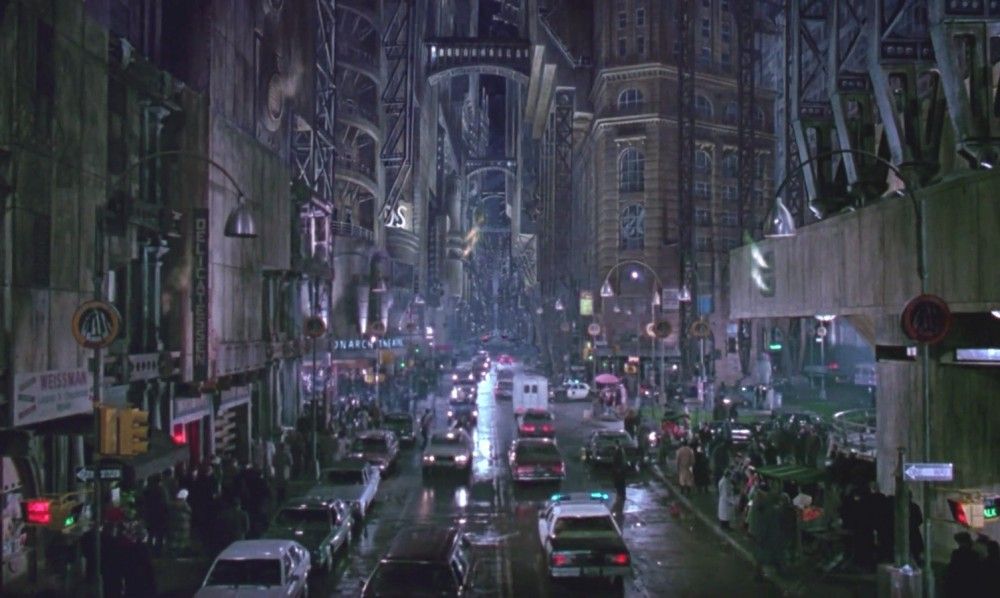
Anton Furst would win an Oscar for Best Art Direction for his design of Gotham City, which was for its time, quite dazzling. On par with some of the designs from Blade Runner and The Crow, Furst’s rendition of Gotham was dark and brooding, compared to the more modern backdrop of Batman Begins. In addition to Gotham’s look, Furst also helped design the Batmobile, which was based off the Chevy Impala (another Supernatural connection). When the film was released on home video, my family caught sight of the Batmobile up close on the street as it delivered VHS Copies to a video store in Manhattan. Although he died some years later, Furst’s work on Batman remains an influence on both the comics and future installments of the movies.
1989 was also a big year for Danny Elfman. His score for Batman would earn him a Grammy, and the main theme would become a definitive one for the Caped Crusader throughout the early 1990. Shirley Walker would build on the theme with her music from Batman: The Animated Series. It was also something of a surprise for Prince. With songs like Trust, Electric Chair and Vicki’s Waiting, Prince’s Batman Soundtrack is full of great hits that you really wouldn’t think would fit in a story like Batman. Still, they manage to do just fine, and even elevate scenes like the Joker’s entry in the Gotham Museum and the Balloon Parade.
Batman is not without a few problems. It gets a little long in the tooth in the film’s second half, particularly in the scenes leading up to the Monarch and Bruce losing his parents. It’s not a terrible slowdown, since it has to set the tone for some of the more spectacular fights later on. It could have been edited just a little tighter. Additionally, when compared to some of the modern versions, 1989’s Batman can feel a little bit dated (to me, anyway). That’s more of a nitpick, or where you stand on the Batman universe as a whole. Everyone has their favorite adaptation on the Caped Crusader.
Burton and Keaton would later reunite in 1992’s Batman Returns, and the franchise on a whole would take a different turn with Joel Schumacher’s takes in 1995’s Batman Forever and 1997 Batman & Robin.
Up until 1947, Major League Baseball was segregated. Though there was no written rule barring blacks from playing on major league teams, there was an agreement among the team owners that no blacks would be signed to a major or minor league contract. Instead, starting in the 1920s, black players could only play for the teams in the Negro League. It was in the Negro Leagues that future greats like Jackie Robinson and Willie Mays got their start. Josh Gibson, who spent his entire career playing in the Negro Leagues, is believed to have hit more home runs in a season than Babe Ruth ever did. For that reason, many baseball fans believe that any MLB records set before 1947 should come with an asterisk included. How can you determine who was the best when many of the best players in the game were never allowed to compete against each other?
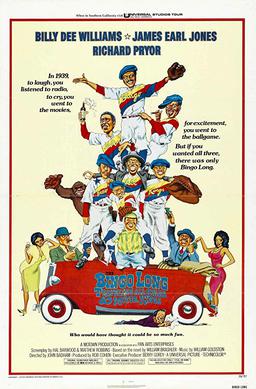
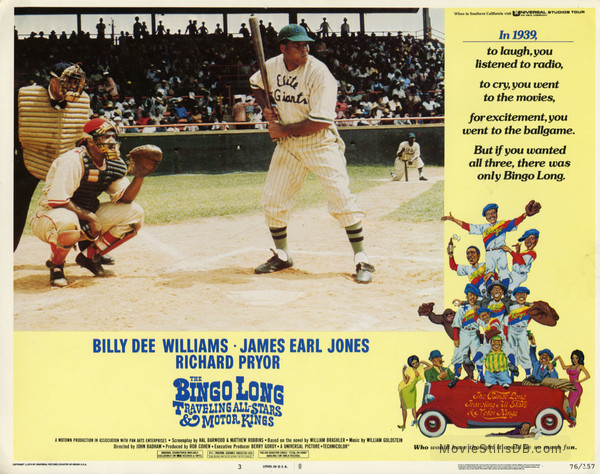
The Bingo Longo Traveling All-Stars & Motor Kings is a comedy that pays tribute to those players. Billy Dee Williams plays Bingo Longo, a charismatic pitcher who plays in the Negro Leagues but who, frustrated with the money that he’s earning and the owner’s callous attitude towards the players, breaks away and forms his own independent, barnstorming baseball team, the All-Stars Among the players that he recruits are catcher and power hitter Leon Carter (James Earl Jones) and Charlie Snow (Richard Pryor), who is constantly changing his name and lying about his background in an attempt to get signed to the major leagues. Bingo also steals a player named Esquire Joe (Stan Shaw) away from one of the teams that the All-Stars defeat.
Going across the country and playing other teams, the Bingo Longo Traveling All-Stars make a name for themselves as both players and showmen. Though Leon just wants to concentrate on playing the game, Bingo understands that importance of putting on a show for the people in the stands. They start out playing other independent black teams but soon, they’re even playing against amateur white teams. The games against the white teams are tense, as the All-Stars ever know how the people in the stands are going to react when the All-Stars win. The All-Stars usually do win, though. They’re the best and they’re not going to let the people watching forget it.
The Bing Longo Traveling All-Stars is a good film, especially if you’re interested in the history of baseball. It’s an episodic comedy with the emphasis on the various situations that the members of the All-Stars find themselves in as they travel from town to town but there’s also a serious subtext. The All-Stars are proving to a League that refuses to let them play that they are the best. At the same time, no matter how many games they win, the All-Stars still have to deal with living a society that treats them like second-class citizens. Even though they win on the field, they still have a hard time finding a hotel to stay at. It’s a movie that will make you laugh but it also makes you think. Billy Dee Williams is perfect in the role of Bingo Longo and James Earl Jones is the type of player that anyone would want on their team. The Bingo Longo Traveling All-Star & Motor Kings is a good film for both baseball fans and people who have never even heard of the designated hitter rule.
DaSilva (Sylvester Stallone) and Fox (Billy Dee Williams) are two tough New York cops who just want to be left alone so that they can arrest muggers and purse snatchers. However, because they both have a background in the military, they are assigned to work with an international anti-terrorism task force that is being headed up by Detective Inspector Peter Hartman (Nigel Davenport). Rumor has it that the notorious terrorist Wulfgar (Rutger Hauer) is coming to New York and Hartman tells DaSilva and Fox that they must be prepared to do whatever is necessary to take Wulgar down, even if it means taking a shot while he is hiding behind a hostage. DaSilva says he’s not sure that he could shoot an innocent person, even if it meant stopping Wulfgar from escaping.
Wulfgar has no such moral qualms. Wulfgar is a terrorist-for-hire who claims to be fighting for the people but whose main interest is remaining employable. Unfortunately, Wulfgar has become so ruthless and so cavalier about killing civilians (including children) that most terrorist groups have started to refuse to hire him. He brings too much bad publicity to his employers. Wulfgar has come to New York to lead a bombing campaign, with the hope of once again making himself employable. Wulfgar’s partner in all of this is the equally ruthless Shakka Kapoor (Persis Khambatta).
Nighthawks was one of the films that Stallone made after he found stardom as Rocky but before he redefined his career by playing John Rambo. Stallone actually gives a surprisingly good performance as DaSilva. DaSilva may be another tough cop who plays by his own rules but the script still gives the character some unexpected shadings and Stallone plays him as being more cerebral than you might expect. It’s interesting to see Stallone play a character who is worried about using excessive force to do his job and, to the film’s credit, it actually takes DaSilva’s conflicted feelings seriously. Billy Dee Williams, unfortunately, is not given as much to do as Stallone and his character is far more one-note than Stallone’s. He’s the loyal partner and, with his natural charisma, Williams deserved a role with more depth. Also appearing in small roles are Joe Spinell (as Stallone’s boss), Lindsay Wagner (as Stallone’s ex-wife), and the legendary pornographic actor Jamie Gillis (as Wagner’s boss).
Not surprisingly, the film is stolen by Rutger Hauer, who gives a performance that, in many ways, anticipates his more acclaimed work in Blade Runner. As played by Hauer, Wulfgar is a charismatic sociopath who knows exactly the right thing to say but who, because of his own arrogance, is still vulnerable to allowing his emotions to get the better of him. He and Stallone both play-off each other well and their face-to-face confrontations are intense. It probably helped that Hauer and Stallone did not personally get along during the filming. (Both, however, were very complimentary towards each other in the years that followed Nighthawks, with Hauer especially saying that there was nothing personal about their on-set arguments.)
Nighthawks is hardly an in-depth look at the realities of international terrorism but it has a handful of exciting action scenes and two excellent performances from Stallone and Hauer. It’s currently on Netflix and worth watching.


 Through the Shattered Lens
