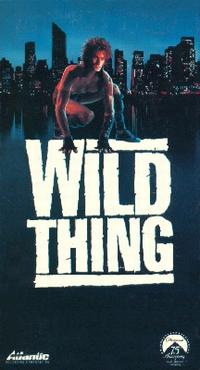
Wild Thing (1987, directed by Max Reid)


After his hippie parents are murdered by a drug dealer named Cutter (Robert Davi!), a young boy is taken in and raised by a homeless woman (Betty Buckley).  The boy eventually grows up to be Wild Thing (Robert Knepper), an urban Tarzan who jumps from rooftop to rooftop at night and who protects the neighborhood for evil doers (like Cutter).  A social worker (Kathleen Quinlan) hears the legend of Wild Thing and eventually finds him.  She continues his education, explaining to him why people do the “body bump.”  Carrying a bow and arrow and accompanied by a surprisingly loyal cat, Wild Thing fights the bad guys and seeks revenge for his parents.

Wild Thing is one of those movies that should be incredibly bad but somehow it isn’t.  John Sayles was one of three writers to work on the script (Sayles was the only one to get credit) and the film has a self-aware sense of humor similar to the scripts that Sayles wrote for films like Alligator, Battle Beyond The Stars, and Piranha.  A young Robert Knepper is probably about as convincing as anyone could be as an urban Tarzan who speaks broken English and who carries a bow and arrow as he makes his way across the rooftops of his neighborhood.  As always, Robert Davi is a good villain.  Davi knows that he’s appearing in a live action comic book and he gives an appropriate performance.

Wild Thing is a surprisingly enjoyable movie and yes, the song Wild Thing is heard in the movie but not as much as you might think.  There’s a few scenes where the song starts to play and is then cut off, as if the movie is teasing our expectations.  I just wish Sam Kinison had been invited to perform his version.


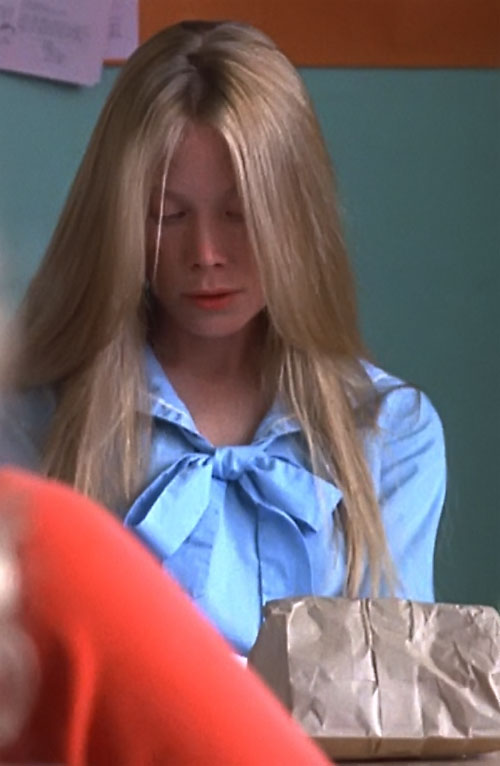
Horror Scenes That I Love: Sissy Spacek in Carrie


Sissy Spacek hasn’t appeared in many horror movies but the one in which she did appear is such a classic and Spacek’s performance was so strong that she qualifies as a horror icon regardless.  In 1976, Sissy Space played poor and victimized Carrie White, the shy high school student who ended up burning down the prom.  Her performance became one of the few horror performances to be Oscar-nominated and Carrie launched a series of Stephen King adaptations.

In one of the best scene from the film, Carrie is forced to deal with both an insensitive principal and a brat on a bicycle.

Lisa Reviews An Oscar Nominee: Tender Mercies (dir by Bruce Beresford)


The other day, on this very site, I mentioned that the 1983 film Tender Mercies was one of the films that David Lynch turned down.  

In his memoir, Room to Dream, Lynch wrote that he was sent the film’s script while he was looking for a project to serve as his follow-up to The Elephant Man.  Lynch wrote that he liked the script, which was written by Horton Foote (who had previously won an Oscar for adapted To Kill A Mockingbird), but that Lynch also felt that it just wasn’t the right project for him at the time.  Tender Mercies was eventually directed by Bruce Beresford and Lynch mentioned that he felt that Beresford did a “brilliant” job.

After I posted the article, it occurred to me that Tender Mercies is not a film that’s as well-known as it deserves to be.  It received five Oscar nominations, including one for Best Picture.  Robert Duvall won his first (and, to date, only) Oscar for playing the lead role.  It’s an acclaimed film but it also plays it in a rather low-key style, particularly when compared to some of the other films that were released in the early 80s.  (1983 may have been the year of Tender Mercies but it was also the year of Scarface, Flashdance, Return of the Jedi, and Risky Business.)  As such, it’s a film that’s been a bit overshadowed over the years.

Tender Mercies takes place in rural Texas.  Mac Sledge (Robert Duvall) is a former country-western star whose career has collapsed due to his alcoholism and his own self-destructive behavior.  One morning, a hungover Mac wakes up in a roadside motel.  Not having any money on him, Mac asks the motel’s owner — Rosa Lee (Tess Harper), who lost her husband in Vietnam — if he can work at the motel in return for a room.  Rosa Lee agrees, on the condition that Mac not drink while he’s working.

As the days pass, Mac and Rosa Lee grow closer and Mac becomes a surrogate father to Rosa Lee’s young son, Sonny (Allan Hubbard).  Eventually, Mac and Rosa Lee marry and Mac becomes an accepted member of the community.  However, Mac remains troubled.  His ex-wife, Dixie (Betty Buckley), has built a career on singing the songs that he wrote for her but she refuses to consider anything new that he’s written.  His teenage daughter (Ellen Barkin) stops by the motel and announces that she’s running away to get married.  There’s tragedy but there’s also hope and forgiveness.

Tender Mercies is a simple but affecting film about a good man who is struggling to deal with the fact that he was once a very bad man.  What makes Tender Mercies interesting is what doesn’t happen.  The first time I saw it, I spent the entire movie expecting Mac to fall off the wagon and break everyone’s heart.  Instead, Mac manages to keep his promise to his new family but what he discovers is that being sober doesn’t automatically exempt one from pain or guilt.  He still has to deal with sadness and disappointment but now, he has to do it without using alcohol as a crutch.  Instead of getting his strength from booze, he now gets it from love.

It’s a wonderfully sweet movie, featuring naturalistic performances from Harper, Hubbard, and especially Robert Duvall.  It seem appropriate that, after making his film debut as Boo Radley in a film written by Horton Foote, Duvall would win his first Oscar for another film written by Foote.  Duvall plays Mac as a plain-spoken and weary soul who is still just enough of a romantic to find some sort of redemption in the world.  It’s a great performance and it’s a good film and I’d suggest checking it out if you ever need a good cry.

Horror Scenes That I Love: Carrie Destroys The Prom


Today’s horror scene that I love comes from 1976’s Carrie.

This scene starts out on a note of happiness with Carrie (Sissy Spacek) and Tommy (William Katt) being named as Queen and King of the Prom.  Things, however, get a bit ominous when Sue (Amy Irving) notices that bucket of pig’s blood and Nancy Allen and John Travolta hanging out underneath the stage.  Things get even worse when the coach (Betty Buckley) refuses to listen to Sue and tosses her out of the gym.

And then suddenly, there’s blood everywhere and Piper Laurie’s chanting, “They’re all going to laugh at you …. they’re all going to laugh at you….”

Is everyone really laughing at Carrie?  I believe some of them are.  Norma is definitely laughing because I think the shot of the coach laughing is included to let us know that some of the laughter is strictly in Carrie’s mind.  Nothing about the character would lead us to suspect that the coach would laugh.  In fact, seeing as how the coach just threw out Sue, it’s debatable whether she would even be back among the crowd by the time the pig’s blood came down.

(Plus, would everyone be laughing even with Tommy, the most popular kid in school, lying dead on the stage?)

Anyway, regardless of whether they were all laughing or not, we all know what happens next!

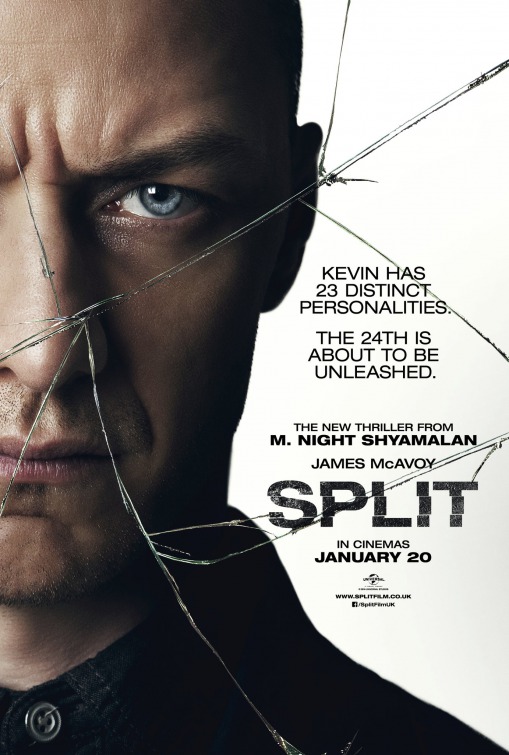
Horror Film Review: Split (dir by M. Night Shyamalan)


There are a lot of negative things that you can say about 2017.  In the future, when historians look back of the second decade of the 21st century, I imagine that they will point to 2017 as being one of the worst years in American history.  The country is divided.  The world seems like a scary and dangerous place.  The outlook for the future feels bleak.  It’s not so much that people are angry.  Instead, it’s that there doesn’t seem to be any end in sight for all the anger.  It’s difficult to imagine that the differences that currently divide the world are ever going to be resolved.

However, there is one thing that can be said about 2017.  It’s been a very good year for horror cinema.

Sure, there have been a few less-than-perfect films.  Rings left most people disappointed.  Does anyone remember The Bye Bye Man or have we said farewell to the memories of that unfortunate film?  While The Dark Tower was never specifically a horror movie, it’s still not easy to think of any other Stephen King adaptation that has been greeted with such indifference.  The less said about Tom Cruise’s The Mummy, the better.

But even with all that in mind, there have been some truly outstanding horror movies released this year.  Movies like Get Out, It, and The Belko Experiment will be well-remembered long after the more “traditional” films of 2017 have faded from the collective memory.  I would go as far as to argue that David Lynch’s revival of Twin Peaks should itself be considered an 18-hour horror movie.  Maybe it is because the world seems like such a dark place right now.  Maybe, at this point, horror movies are the only movies that accurately reflect the way many people are feeling about the present and the future.  For whatever reason, 2017 has been a great year for horror.

Really, we wouldn’t be surprised.  Way back in January, things got off to a good start with the release of Split.  Split was a film that not many people were expecting to be impressive.  Just consider: the film was coming out in January, which is when the worst films are usually released.  (The theory is that everyone’s too busy with the Oscars to notice that studios are desperately trying to write off all of the losers that they misguidedly greenlit for production the previous year.)  Split was directed by M. Night Shyamalan, a formerly respected director whose last few films had been disappointing.  Finally, the film’s plot just didn’t sound that good: James McAvoy plays a man with multiple personalities who kidnaps three teenage girls (Anya Taylor-Joy, Haley Lu Richardson, and Jessica Sula) and holds them captive.  Throughout the film, McAvoy cycles through his different personalities and the girls try to find a way to escape before McAvoy turns into the Beast.

And yet somehow, Split works.  It’s a genuinely scary and unsettling film, one that left me feeling paranoid for days after I watched it.  From the minute that the film started, it grabbed hold of me and it did not let go for two hours.  I watched the movie and I wondered what would happen if I ever found myself in the same situation as the kidnapped girls.  Would I be able to survive?  Would I be able to escape?  Or would I just be another victim of the Beast?  It’s a deeply frightening film, one that feels like a waking nightmare at its most intense.

Obviously, a lot of credit has to go to James McAvoy, who is brilliant in a role that would have brought out the worst instincts in a lesser actor.  It’s a showy role and there had to be considerable temptation to go overboard.  And there are a few times when McAvoy embraces the more theatrical possibilities of the role.  However, in his best scenes, McAvoy is surprisingly subtle.  Yes, he does a lot of different voices.  Yes, his body language alters from personality to personality.  But McAvoy is at his best when he just allows his facial expression to subtly suggest that he has turned into someone else.  McAvoy is frightening but, at times, he’s also rather pathetic.  Whenever McAvoy shows up, you never know what he’s going to do.  He keeps you off-balance.

As good as McAvoy is, M. Night Shyamalan also deserves a lot of credit for Split.  For a film about a man with 23 warring personalities, Split is refreshingly direct and straight forward.  There’s none of the cloying cleverness that cheapened some of Shyamalan’s other films.  Instead, Split is simply a good, scary film for a really scary world.

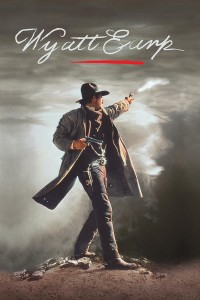
A Movie A Day #217: Wyatt Earp (1994, directed by Lawrence Kasdan)


Once upon a time, there were two movies about the legendary Western lawman (or outlaw, depending on who is telling the story) Wyatt Earp.  One came out in 1993 and the other came out in 1994.

The 1993 movie was called Tombstone.  That is the one that starred Kurt Russell was Wyatt, with Sam Elliott and Bill Paxton in the roles of his brothers and Val Kilmer playing Doc Holliday.  Tombstone deals with the circumstances that led to the Gunfight at the O.K. Corral.  “I’m your huckleberry,” Doc Holliday says right before his gunfight with Michael Biehn’s Johnny Ringo.  Tombstone is the movie that everyone remembers.

The 1994 movies was called Wyatt Earp.  This was a big budget extravaganza that was directed by Lawrence Kasdan and starred Kevin Costner as Wyatt.  Dennis Quaid played Doc Holliday and supporting roles were played by almost everyone who was an active SAG member in 1994.  If they were not in Tombstone, they were probably in Wyatt Earp.  Gene Hackman, Michael Madsen, Tom Sizemore, Jeff Fahey, Mark Harmon, Annabeth Gish, Gene Hackman, Bill Pullman, Isabella Rossellini, JoBeth Williams, Mare Winningham, and many others all appeared as supporting characters in the (very) long story of Wyatt Earp’s life.

Of course, Wyatt Earp features the famous Gunfight at the O.K. Corral but it also deals with every other chapter of Earp’s life, including his multiple marriages, his career as a buffalo hunter, and his time as a gold prospector.  With a three-hour running time, there is little about Wyatt Earp’s life that is not included.  Unfortunately, with the exception of his time in Tomstone, Wyatt Earp’s life was not that interesting.  Neither was Kevin Costner’s performance.  Costner tried to channel Gary Cooper in his performance but Cooper would have known better than to have starred in a slowly paced, three-hour movie.  The film is so centered around Costner and his all-American persona that, with the exception of Dennis Quaid, the impressive cast is wasted in glorified cameos.  Wyatt Earp the movie tries to be an elegy for the old west but neither Wyatt Earp as a character nor Kevin Costner’s performance was strong enough to carry such heavy symbolism.  A good western should never be boring and that is a rule that Wyatt Earp breaks from the minute that Costner delivers his first line.

Costner was originally cast in Tombstone, just to leave the project so he could produce his own Wyatt Earp film.  As a big, Oscar-winnng star, Costner went as far as to try to have production of Tombstone canceled.  Ironically, Tombstone turned out to be the film that everyone remember while Wyatt Earp is the film that most people want to forget.

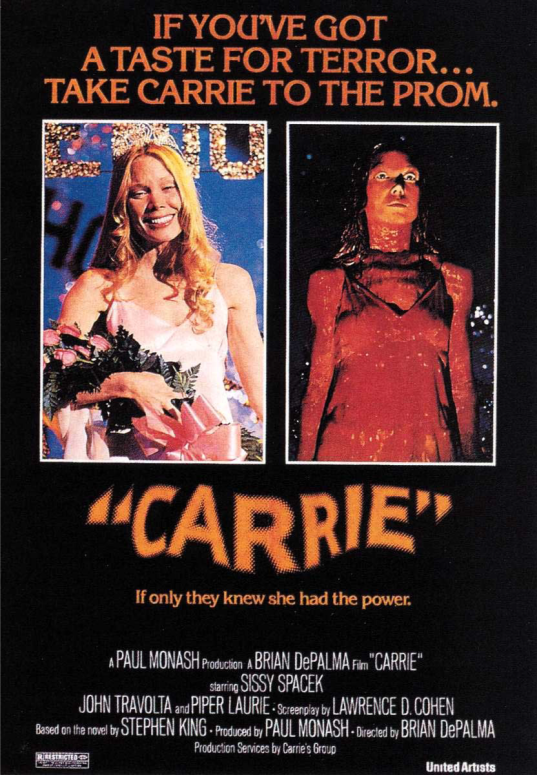
Halloween Horrors 2013 : “Carrie” (1976)


Carrie-Poster


Over at my “main” site — http://trashfilmguru.wordpress.com , for those who don’t know, don’t care, either, or both — I’ve been doing what every other goddamn movie blog in the universe does in the month of October: namely, review a bunch of random horror flicks. But come on — you didn’t think I was just gonna sit back and let Lisa Marie, Arleigh, Leonard Wilson, and everybody else have all the fun here on TTSL, did you?

Nah. I just had to muscle in and opine on a few macabre movie delights on these digital “pages” before the month was out, as well. And I might as well start with the one everybody’s talking about right now, Carrie, the 1976 classic directed, in his inimitable style, by Brain DePalma, based on the runaway best-seller by Stephen King, and starring Sissy Spacek as quite likely the most hapless horror heroine in history.

This film is significant for a number of reasons, not the least of which being that it was the first King “property” to be adapted for the big screen, thus announcing the arrival of a major new player on the scene who would go on, of course, to have a veritable industry of celluloid “translations” of his work sprout up over the ensuing decades, some of which were clearly — oh, wait, people these days are talking about a different Carrie altogether? One that just came out last week?

Well, I saw that one, too, but fuck it — I feel like reviewing this one first.

carrie_mother


Let’s backtrack to that “horror’s most hapless heroine” claim for a minute, shall we? It might sound like a bold claim, but I swear it’s true — think about it for a minute : poor Carrie White starts the movie by having her first period in the shower at school, she thinks she’s dying because her religious whack-job of a mom is too chickenshit to tell her about menstruation, she gets teased mercilessly by all the girls who witness her uncomfortable (to say the least) entry into womanhood, she has no friends to speak of, she’s stuck with a bunch of telekinetic powers that she doesn’t understand or know how to effectively control, she’s the butt of every cruel joke her classmates play, she has to listen to her idiot mother blather nonsense 24/7,  she gets invited to the prom as by the most popular kid in school strictly as an act of misguided charity, and then, just when she’s granted one moment of respite from the nonstop parade of tragedy that comprises her existence when she’s crowned world’s most unlikely  prom queen, she gets a bucket full of pig blood dumped all over her, freaks out and kills everybody with her “mind powers,” and goes home from the best/worst night of her life to find that mommie dearest has decided to kill her in Jesus’ name.

Talk about a gal who just can’t catch a break.

carrie1976-0372


Sure, it all seems a bit over the top — okay, it all is a bit over the top — but DePalma pulls out all the stops to draw you into this sordid little world of revival tent-reject parents (Piper Laurie), evil high school bitches (Nancy Allen), pussy-whipped wannabe-tough guys (John Travolta), well-meaning but ultimately ineffectual teachers (Betty Buckley), semi-guilt-ridden classmates (Amy Irving), jocks with out of control white-guy ‘fros (William Katt), and grounds the whole heady mixture in a turn-for-the-ages performance by Spacek that really makes you feel for the poor kid even — maybe especially — when she finally snaps. His always-stylish-and-inventive use of sound, split screen, and slow-burn tension keep you pretty well fixated on the proceedings throughout, and all in all you’ve just gotta say this still holds up as a pretty impressive cinematic achievement.

Of course, King hit on a fairly inventive little gimmick from the outset here — plenty of horror stories, fairy tales, fables, and probably even  nursery rhymes are little more than thinly-disguised metaphors for the onset of puberty and the scary transition from childhood into the ‘adult” world, but here he just dispensed with the pretense and doubled-down by ripping the mask off and piling the real, actual, non-metaphorical point on top of the , as we say in modern parlance, “genre trappings,” and as a result ended up penning a scary story for the ages.
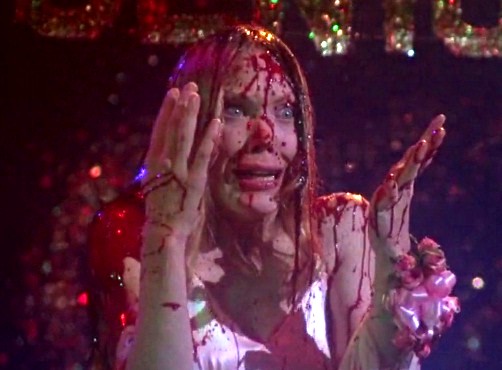
Sissy_Spacek_as_Carrie_White,_1976


Classic visuals — you know, like the one reproduced directly above — hammer the point home in memorable fashion, to be sure, and what Carrie lacks in subtlety it definitely makes up for in sheer, shock-ya-senseless power. Audiences went wild for this flick back in ’76, and while that might not be saying much because they also went apeshit for every cheesy “patriotic” bicentennial gimmick, knick-knack, gee-gaw, and useless item of “home decor” that came out that year, in this case they were absolutely right — this is a nifty little barnburner of a movie that has aged as well as any wine you care to mention.

Carrie is aviailable on DVD and Blu-Ray from MGM, and it’s also currently playing on Netflix’s instant streaming queue, where it can be found under no less than three category headers — “horror,” “Halloween favorites,” and “cult movies.” So go check it out already — or check it out again already, as the case may be — and we’ll talk about that other  movie with the same title next time around.