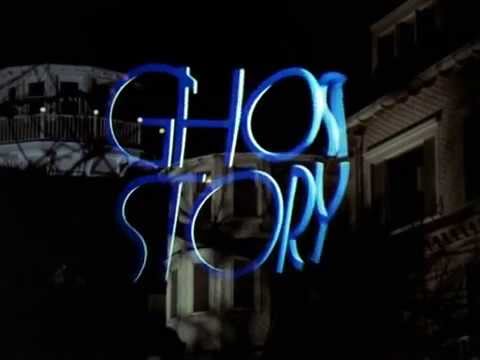
On tonight’s episode of Ghost Story, college co-eds are being drained of their blood! Who could the culprit be? Oddly, some say that they saw a recently deceased college professor near the scene of the crime. What was that professor studying when he died? Vampirism!
This one is kind of silly but I always enjoy a vampire story. This episode aired on December 1st, 1972.
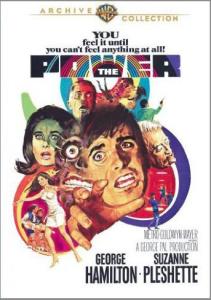
That is the mystery that Professors Jim Tanner (George Hamilton) and Margery Lansing (Suzanne Pleshette) have to solve. Someone is using psychic powers to kill their co-workers in a research laboratory. The police think that Tanner is guilty but Tanner knows that one of his colleagues is actually a super human named Adam Hart. Hart is planning on using his super powers to control the world and, because Tanner is the only person who has proof of his existence, Hart is methodically framing Tanner for every murder that he commits.
The Power is underrated by entertaining movie, a mix of mystery and science fiction with a pop art twist. It was also one of the first attempts to portray telekinesis on film. Similar films, like Scanners, may be better known but all of them are directly descended from The Power. George Hamilton may seem like an unlikely research scientist but he and Suzanne Pleshette are a good team and The Power makes good use of Pleshette’s way with a one liner. Also keep an eye out for familiar faces like Arthur O’Connell, Nehemiah Persoff, Michael Rennie, Gary Merrill, Yvonne DeCarlo, Vaughn Taylor, Aldo Ray, and even Forrest J. Ackerman as a hotel clerk.
NBC-TV tried to bring a horror anthology series back to prime time during the 1972-73 season with GHOST STORY, executive produced by the one-and-only William Castle . Sebastian Cabot played Winston Essex, introducing the tales from haunted Mansfield House hotel. GHOST STORY had great writers, including Richard Matheson (who helped develop the concept), Robert Bloch, Harlan Ellison, Henry Slesar, and Hammer vet Jimmy Sangster, some good directors (Richard Doner, John Llewelyn Moxey, Robert Day), and a plethora of Hollywood talent: Karen Black, Kim Darby, Angie Dickinson, Melvyn Douglas, Patty Duke, Jodie Foster, Helen Hayes, Tab Hunter, John Ireland, Janet Leigh, Patricia Neal, Jason Robards, Gena Rowlands, Martin Sheen, and William Windom.
Despite all this, the show got clobbered in the ratings by the CBS FRIDAY NIGHT MOVIE and ABC’s comedy duo of ROOM 222 and THE ODD COUPLE. A mid-season title change to CIRCLE OF FEAR (dropping the Cabot segments in the process) didn’t help, and…
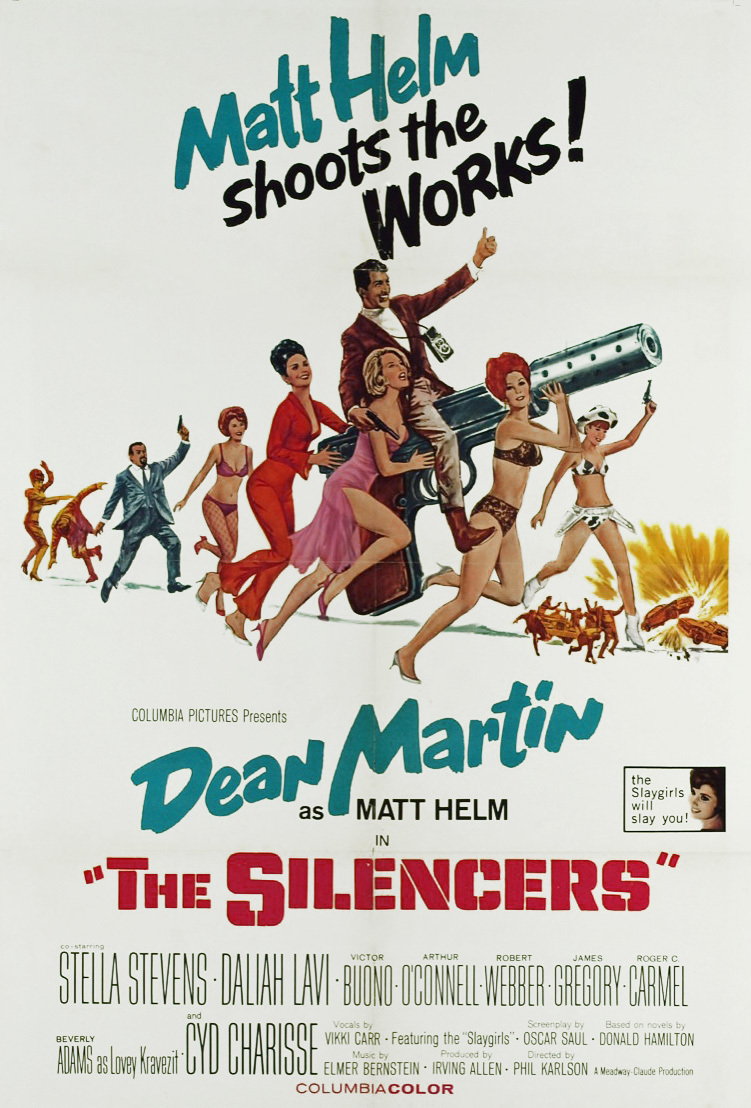
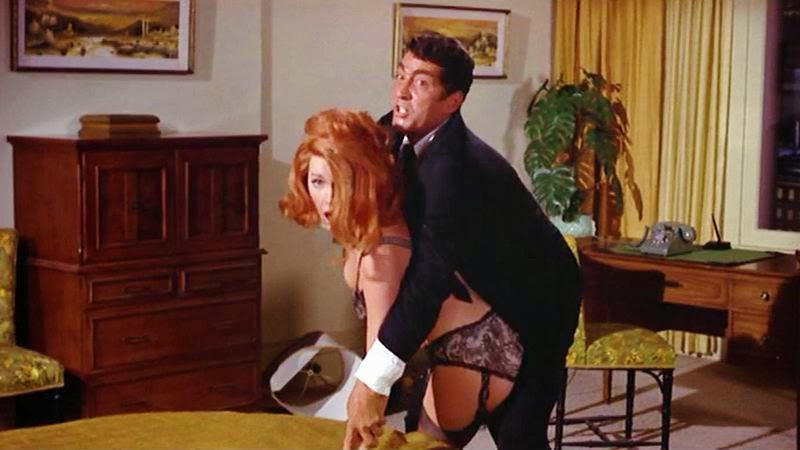
Out of all the James Bond-inspired spy spoofs made in the Swingin’ 60’s, one of the most popular was Dean Martin’s Matt Helm series. Based on the novels of Donald Hamilton, the films bore little resemblance to their literary counterparts, instead relying on Dino’s Booze & Girlies Rat Pack Vegas persona. First up was 1966’s THE SILENCERS, chock full of gadgets, karate chops, and beautiful babes, with sexual innuendoes by the truckload.
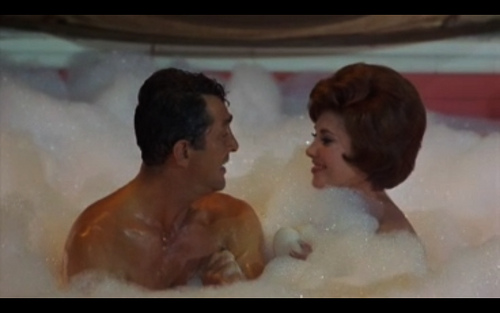
Our Man Matt is a semi-retired agent of ICE (Intelligence and Counter-Espionage) living in a Playboy Mansion-style pad, and working as a globe-trotting photographer. He’s luxuriating in his bubble bath pool with sexy secretary Lovey Kravezit (“Lovey Kravezit? Oh that’s some kinda name!”) when former boss Mac Donald calls. Evil spy organization Big O (Bureau for International Government and Order) is once again plotting world domination, and the reluctant Helm is pulled back into service.
Tonight, I continued to clean out the DVR by watching the 1955 film Picnic.
Now, Picnic is kind of a strange film. It’s one of those films from 50s that takes place in a small town where everyone is obsessed with sex but, since it’s the 1950s, nobody can just come out and say that they’re talking about sex. So, instead, all of the dialogue is very discreet. For instance, when Madge Owen (Kim Novak) talks to her mother, Flo (Betty Owens), about her date with her boyfriend, Alan (Cliff Robertson), Madge confesses that they spent the night kissing. Flo asks if Madge if they have done anything more than kiss but, of course, she never comes straight out and says what “more” would be. The audience knows what she’s talking about but it’s as if the world would actually end if anyone actually uttered the word. “Oh mom!” an embarrassed Madge says before confirming that she and Alan haven’t done anything more than kiss.
Flo desperately wants Madge to marry Alan because Alan is rich and his father owns the town’s grain elevator. Marrying Alan would allow Flo to move up in the town’s strict social hierarchy. However, Madge isn’t sure that she loves Alan. Certainly, Alan seems to be a good man with a good future but he’s not a romantic. Instead, he is someone who has his entire life already mapped out for him.
On Labor Day, a stranger comes to town. His name is Hal Carter and he shows up riding on a freight train. He’s come into town to see his old friend, Alan. It turns out that Hal and Alan went to college together and were members of the same fraternity. Hal was a star football player but he eventually flunked out of school and has spent the last few years drifting around the country. However, Hal is now ready to settle down and he wonders if his old roommate Alan can get him a job at the grain elevator.
Now, here’s the strange part. Hal is played by William Holden. When he made Picnic, William Holden was 38 years old and looked closer to being 45. (By contrast, Cliff Robertson, in the role of his former college roommate, was 32 and looked like he was 25.) Hal spends a lot of time talking about his traumatic childhood and how he is finally ready to settle down and start acting like an adult. In short, Hal talks like a 30 year-old but he looks like he’s nearly 50. It’s odd to watch. But even beyond the age issue, William Holden was an actor who always came across as being both confident and cynical. Hal is a secret romantic with a deep streak of insecurity. As great an actor as he may have been, William Holden is so thoroughly miscast here that it actually becomes fascinating to watch. It brings a whole new subtext to the film as you find yourself wondering why no one is town finds it strange that a middle-aged man is still struggling to deal with his childhood. When all the town’s young women ogle that shirtless Hal, it’s as if he’s wandered into a town populated only by teenagers with daddy issues.
(Paul Newman played the role of Hal in a Broadway production of Picnic. And really, that’s who the ideal Hal would have been, a young Paul Newman.)
The majority of the film takes place at the town’s Labor Day picnic, where almost every woman in town is driven to distraction by the sight of Hal dancing. Even the spinster teacher, Rosemary (Rosalind Russell), is so turned on by Hal’s masculinity that she makes a pass at him and accidentally rips his shirt. Of course, some of Rosemary’s behavior is due to the fact that she’s drunk. Her date, the befuddled Howard Bevans (Arthur O’Connell), made the mistake of being whiskey to the picnic.
Hal also dances with Madge’s 13 year-old sister, Millie (Susan Strasberg). I have to admit that, even though I related strongly to Madge, Millie was my favorite character in the film. Millie wears glasses and can recite Shakespeare from memory. She knows that everyone around her is full of it and she’s willing to call them on it. Of course, Millie herself ends up with a crush on Hal and it’s a dream for her when she finally gets to dance with him.
(Strasberg was 17 years old but is believable as a 13 year-old. At the same time, since Hal appears to be nearly 50, his sudden closeness to Millie carries an icky, if unintentional, subtext.)
But then Madge suddenly appears, wearing a pink dress and literally emerging from the black night. She starts to sway to the music. As she slowly approaches Hal, he forgets about Millie and soon is dancing with Madge. It’s actually a rather striking scene, one that so full of dream-like sensuality that it almost seems more like it was directed by surrealist David Lynch as opposed to the usually workmanlike Joshua Logan.
(In the video below, the scene freezes about 12 seconds in, before starting up again at the 16 second mark. This is a glitch with the upload and is not present in the actual film.)
Needless to say, a drifter can’t just come into town and steal his ex-roommate’s girlfriend without drama following. Picnic starts out as a slightly overheated examination of small town morality and then, after about an hour, it goes the full melodrama route, complete with police chases, stolen cars, a fist fight in an ornate mansion, and a lot of big speeches about the importance of love. Needless to say, it’s all a lot of fun.
Picnic was nominated for best picture of the year. However, it lost to the far more low-key Marty.
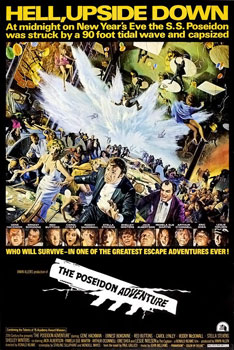
A few years ago, when I first told Arleigh that I had recently watched the 1972 film The Poseidon Adventure, I remember him as being a bit shocked and amazed that I had made it through the entire film. This was because Arleigh knows that I have a morbid obsession with drowning and that the mere sight of someone struggling underwater is enough to send me into a panic attack.
And The Poseidon Adventure is a film that is totally about drowning. The majority of the cast drowns over the course of the film. The few who survive spend all of their time trying not to drown. The main villain in The Poseidon Adventure is the ocean. The Poseidon Adventure is a film specifically designed to terrify aquaphobes like me.
And there are certain parts of The Poseidon Adventure that freaked me out when I first watched it and which continue to freak me out whenever I rewatch it.
For instance, just the film’s plot freaks me out. On New Year’s Day, an ocean liner is capsized by a huge tidal wave. With the boat upside down, a small group of survivors struggle to make their way up to the hull where, hopefully, they might be rescued. That involves a lot of fighting, arguing, climbing, and drowning.
It freaks me out whenever I see the huge tidal wave crash into the bridge and drown Captain Leslie Nielsen. That’s largely because it’s impossible for me to look at Leslie Nielsen without smiling. (I’ve already written about my reaction to seeing him in the original Prom Night.) When he suddenly drowns, it’s not funny at all.
It freaks me out when the boat turns over and hundred of extras are tossed around the ballroom. I always feel especially bad for the people who vainly try to hold onto the upside down tables before eventually plunging to their deaths. (Did I mention that I’m scared of heights as well?)
It freaks me out when Roddy McDowall plunges to his death because who wants to see Roddy McDowall die? Whenever I see him in an old movie, he always come across as being such a super nice guy. (Except in Cleopatra, of course…) Plus, Roddy had an absolutely chilling death scream. They need to replace the Wilhelm Scream with the Roddy Scream.
It freaks me out when survivor Shelley Winters has a heart attack right after swimming from one part of the ship to another. Because seriously, Shelley totally deserved the Oscar nomination that she got for this film.
And it really freaks me out when Stella Stevens plunges to her death because I related to Stella’s character. Stella was tough, she didn’t take any crap from anyone, and she still didn’t make it. If Stella Stevens can’t make it, what hope would there be for me?
And yet, at the same time, The Poseidon Adventure is such an entertaining film that I’m willing to be freaked out. The Poseidon Adventure was one of the first of the classic disaster films and it’s so well done that even the parts of the film that don’t work somehow do work.
For instance, Gene Hackman plays the Rev. Frank Scott, the leader of the group of survivors. And Hackman, who can legitimately be called one of the best actors ever, gives an absolutely terrible performance. His performance is amazingly shrill and totally lacking in nuance. When, toward the end of the film, he starts to angrily yell at God, you actually feel sorry for God. And yet, Hackman’s terrible performance somehow works perfectly for the film. It’s such an over-the-top performance that it sets the tone for the whole film. The Poseidon Adventure is an over-the-top film and, if Hackman had invested his character with any sort of nuance, the film would not have worked as well as it did.
And then there’s Ernest Borgnine, who plays Stella Stevens’s husband. Borgnine spends the entire film arguing with Gene Hackman. Whenever something bad happens, Borgnine starts acting like Edward G. Robinson in The Ten Commandments. He never actually says, “Where is your God now!?” but it wouldn’t have been inappropriate if he had. And yet, again, it’s exactly the type of performance that a film like this needs.
And finally, there’s that theme song. “There has to be a morning after…” It won an Oscar, defeating Strange Are The Ways Of Love from The Stepmother. And is it a good song? No, not really. It’s incredibly vapid and, while it does get stuck in your head, you don’t necessarily want it there. But you know what? It’s the perfect song for this film.
The Poseidon Adventure is not a deep film, regardless of how many times Hackman and Borgnine argue about the role of God in the disaster. It’s an amazingly shallow film about people drowning. But it’s so well-made and so perfectly manipulative that you can’t help but be entertained.
The Poseidon Adventure totally freaks me out. But I will probably always be willing to find time to watch it.
First off, a confession of my own. When I’m not reviewing movies or chattering away on twitter, I work in a law office. Before anyone panics, I’m not a lawyer, I just hang out with a couple of them. For the most part, I answer the phone, I schedule appointments, and I keep all the files in alphabetical order. On a few very rare occasions, I’ve accompanied my boss to court and the thing that has always struck me about real-life courtroom drama is how boring it all really is. There are no surprise witnesses, no impassioned closing statements, and those all trail rarely, if ever, jump to their feet and start yelling that they’re innocent. For the most part, real life lawyers are usually just as poorly groomed and bored with their work as the rest of us. Don’t even get me started on the judges, the majority of whom seem to have judgeships because they weren’t really making the grade as an attorney.
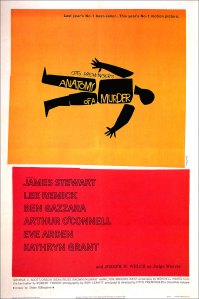
As a result, it’s rare that I get much out of seeing lawyer-centric movies or tv shows any more. After seeing the reality of it, I find fictionalized courtroom theatrics to be ludicrous and, for the most part, evidence of a lazy writer. However, I’m happy to say that last night, I discovered that — no matter how jaded I may now be about the legal process — Anatomy of a Murder is still one of my favorite movies.
Based on a best-selling novel and directed by the notorious Otto Preminger, Anatomy of a Murder tells the story of Paul Beigler (James Stewart), a former district attorney who is now in private practice after having been voted out of office. Having apparently fallen into a state of ennui, Beigler spends his time drinking with another alcoholic attorney (Arthur O’Connell) and trying to avoid his secretary’s (Eve Arden) attempts to get paid.
However, things change for Beigler when he is hired to defend an army officer named Frederick Manion (Ben Gazzara). Manion has been arrested for murdering a bar own named Barney Quill. Manion says that he was justified in committing the murder because Quill raped his wife, Laura (Lee Remick). Others claim that Manion is himself just a notoriously violent bully and that the openly flirtatious Laura was having an affair with Quill. Despite strongly disliking Manion and disturbed by Laura’s own obvious instability, Beigler takes on the case.
Beigler decides to argue that Manion was temporarily insane when he shot Quill and that he was acting on “irresistible impulse.” As shaky as that line of defense might seem, it’s not helped by the fact that Manion himself is a bit of a brute. Meanwhile, Beigler finds himself facing not the innefectual D.A. in court but instead a young, ambitious prosecutor from the State Attorney General’s Office, Claude Dancer (played by a young and obviously ambitious George C. Scott). As the trial begins, small hints start to appear that seem to indicate that there’s a lot more to the murder of Barney Quill than anyone realizes…
Director Otto Preminger is an odd figure in film history. Up until the early 60s, he was a consistently interesting director who made intelligent, well-acted films that often challenged then-contemporary moral attitudes. However, once the 60s hit, he became something of a parody of the egotistical, old school, autocratic filmmaker and his films seemed to suffer as a result. Like many of the film industry’s top directors, he found himself adrift once the 60s and 70s hit. His decline was so dramatic that, as a result, there’s a tendency to forget that he made some truly great and important films, like Laura, Carmen Jones, The Man With The Golden Arm, and, of course, Anatomy of a Murder.
Anatomy of a Murder represents Preminger at his best. His own natural tendency towards embracing melodrama and shock are perfectly balanced with an intelligent script and memorable performances. Whereas later Preminger films would often come across as little more than big screen soap operas, here he makes the sordid believable and compelling. Preminger has never gotten much attention as a visual filmmaker but here, he uses black-and-white to perfectly capture the grayness of the both the film’s location and the moral issues that the film raises. He keeps the camera moving without ever calling attention to it. As a result, the movie has an almost documentary feel to it.
As previously stated, Preminger gets a lot of help from a truly amazing cast. At first, it’s somewhat strange to imagine a Golden Age icon like Jimmy Stewart appearing in the same film as a dedicated method actor like Ben Gazzara. These are two men who represent not only different philosophies of acting but seemingly from two different worlds as well. However, Preminger uses their differing acting styles to electrifying effect. One of the joys of the movie is watching and contrasting the old style, “move star” turns of James Stewart, Arthur O’Connell, and Eve Arden with the more “naturalistic” approaches taken by their younger co-stars, Gazzara, Lee Remick, and especially George C. Scott. The contrast in style becomes a perfect reflection of the film’s contrast between what is legal and what is correct. All the actors, as both individuals and as an ensemble, give memorable performances. When you look at the cast, you realize that any one of their characters could have been the center of the story without the film becoming any less compelling.
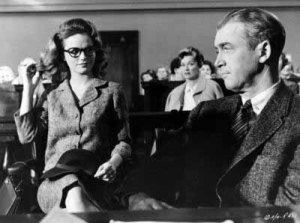
Lee Remick (a notoriously fragile actress who, for years, I knew solely as the poor woman who kept getting attacked by her adopted son in the original Omen) brings out the best in everyone she shares a scene with. Whether she’s making Stewart blush or breaking down on the witness stand, she dominates every scene as an insecure young woman who forces herself to be happy because otherwise, she’d have to confront the fact that she’s miserable. (I should admit that I related more than a bit to Remick’s character. To me, the movie was about her and therefore, about me.)
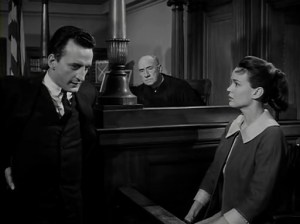
She is perhaps at her best towards the end of the film when she is on the witness stand and is cross-examined by George C. Scott. Starting out as flirtatious and seemingly confident, Remick slowly and believably falls apart as Scott methodically strips away every layer of defense that, until now, she’s spent the entire movie hiding behind. By the end of the scene, Remick has shown as every layer of pain that has built up in Laura Manion over the years. For his part, Scott is simply amazing in this scene. Determined and focused, Scott doesn’t so much cross-examine Remick but seduces her and the audience along with her. As a result, when he suddenly turns off the charm and lunges in for his final attack, it’s devastating for everyone watching. (And, as was correctly pointed out to me by a friend while I was watching the film last night, George C. Scott was quite the sexy beast when he was young.)
Lastly, the film’s judge is played by an actual lawyer by the name of Joseph Welch. Welch wasn’t a great actor but he did make for a great judge.
Of course, it wouldn’t be a Preminger film is a few contemporary morals weren’t challenged and, at the time it was released, Anatomy of a Murder was considered to be very daring because of its frank discussion of topics like rape and spousal abuse. It doesn’t seem quite so daring now but it does seem to be remarkably mature in a way that even most modern movies can’t match. That being said, the film does occasionally embrace the “she must have been asking for it” male viewpoint but still, it’s a remarkably advanced movie for the 1950s.
One of the wonderful things about watching a 51 year-old film is that it provides a chance to see what was considered to be shocking in the years before you or I was born. From watching this movie, I’ve discovered that, in the year 1959, “panties” was apparently a taboo phrase. A good deal of the film’s plot revolves around the panties Lee Remick’s character was wearing the night she was raped and their subsequent disappearance. At one point, there’s even a scene where Welch, Stewart, and Scott struggle to come up with a less offensive term to use when referring to them in the court. (Scott suggests employing a term he heard in France.) Seen 51 years later (in a time when we can not only say “thong” in polite conversation but specifically go out of our way to show off the fact that we’re wearing one), this scene, and the actors’ obvious discomfort whenever they have to say the word “panties”, never fails to amuse me.
Preminger’s other grand challenge to the 50s mainstream was in getting Duke Ellington to compose the film’s jazz soundtrack. At the risk of being called a heretic by some of my closest friends, I’ve never been a big fan of jazz but it works perfectly here. Ellington, himself, makes a cameo appearance and wow, is he ever stoned.
In conclusion, allow me to thank the readers of the site for “ordering” me to watch, once again, a truly classic film. Now, seeing as how close the vote was and that I know, for a fact, that some people voted more than once, I think it would be only fair for me to also rewatch and review the other 9 movies (Lost in Translation, Primer, Hatchet For the Honeymoon, Emanuelle in America, Starcrash, Darling, Sole Survivor, The Sweet House of Horrors, and The Sidewalks of Bangkok) in my poll over the next couple of weeks. I’m looking forward to each and every one of them (well, almost all of them) and, again, thank you for allowing me to start things off with a great film like Anatomy of a Murder.
 Who is Adam Hart?

 Through the Shattered Lens