Late Night Retro Television Review: Pacific Blue 3.1 “Inside Straight”


Welcome to Late Night Retro Television Reviews, a feature where we review some of our favorite and least favorite shows of the past! On Tuesdays, I will be reviewing Pacific Blue, a cop show that aired from 1996 to 2000 on the USA Network!  It’s currently streaming everywhere, though I’m watching it on Tubi.
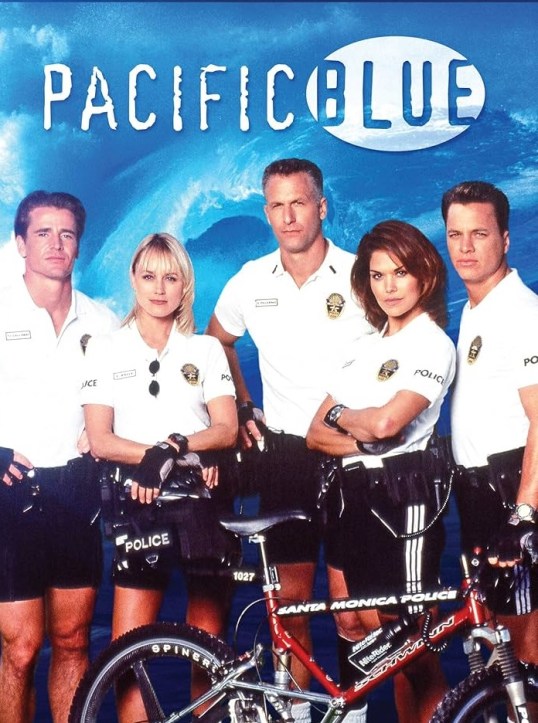
Everyone’s book for another season of bicycles and law-breaking.

Episode 3.1 “Inside Straight”

(Dir by Michael Levine, originally aired on August 3rd, 19997)

One night, while on a date with Chris, TC spots a man holding a gun.  TC draws his own gun and yells at the man to drop his weapon.  The man turns around.  He fires so TC shoots and the man goes down.  It turns out that the man was an undercover narcotics detective with a spotless record.

TC is suspended and the bike patrol basically stops doing their job and instead proceed to harass the dead man’s wife and his partner until they discover that the wife and the partner were having an affair and, conveniently, the cop was actually shot by someone who happened to be standing behind TC.  It seems like simple forensic evidence (like the amount of bullets on the scene) should have proven that without the bike patrol even getting involved but I guess the cops in Malibu or wherever this show takes place are extremely incompetent.

Meanwhile, the poker game of mobster Joseph Tataglia (Joseph Campanella) gets held up,  The thief is a degenerate gambler who tries to frame TC’s older brother, Teddy (Andy Buckley — how, it’s David Wallace from The Office!).  The real thief is easily exposed and captured.  I’m not really sure what the point of this story was.  Tataglia last appeared during the first season but this episode acts as if he’s been a continual presence in the show for the past two seasons.  I imagine viewers were confused as to who he was or why he had so much pull with Palermo.

There’s a scene where TC is subjected to an intense interrogation from Internal Affairs and I have to admit that it made me laugh because TC and Palermo were wearing their dorky bicycle cop uniforms while being yelled at by someone in a suit.

Another scene features Victor and Cory telling Chris and TC that there’s a huge crowd waiting to see the movie that they want to see.  Victor says TC might have to flash his badge to get tickets.  Police arrogance is annoying in general but it’s even worse coming from people who ride bicycles.

It appears that nothing had changed with the start of a new season.
Retro Television Review: Fantasy Island 7.2 “The Big Switch/Hooker’s Holiday”


Welcome to Retro Television Reviews, a feature where we review some of our favorite and least favorite shows of the past!  On Tuesdays, I will be reviewing the original Fantasy Island, which ran on ABC from 1977 to 1984.  Unfortunately, the show has been removed from most streaming sites.  Fortunately, I’ve got nearly every episode on my DVR.

This week, the tyranny of Laurence continues.

Episode 7.2 “The Big Switch/Hooker’s Holiday”

(Dir by Bob Sweeney, originally aired on October 15th, 1983)

Shelley James (Melinda Culea) is a high-priced call girl who comes to Fantasy Island looking for an escape from her life.  For one weekend, she wants not only a normal life but also a chance to meet a man who will love her without paying her for sex.  Luckily, Brad Jacobs (Richard Hatch) is also on the Island!

This is the type of fantasy that Fantasy Island handled well in the past.  It doesn’t work out quite as well this episode became Mr. Roarke’s new servant (there’s no other word for him), Laurence, makes some rather snarky and judgmental comments about Shelly and her profession (asking at one point whether she’s on the Island for a fantasy or to give someone a fantasy) and it just feels totally wrong.  One of the good things about Fantasy Island was that Roarke never judged the people asking for fantasies.  He may have warned them about what they would discover.  Sometimes, he manipulated them to help them discover something important about themselves.  But once you were allowed to come to the Island, Roarke didn’t judge you and neither did Tattoo.  In fact, Tattoo was probably even less judgmental than Roarke.  Tattoo knew what it was like to be judged.  Laurence, on the other hand, is a snooty British butler and seems personally offended by Shelley’s presence on the Island.  (Eventually, after she shares her tragic backstory, he comes around but still, it shouldn’t take a sad story to get people to treat each other with decency.)  Laurence is the type of employee who would keep me from wanting to visit the Island.  I fear he would tell me that my skirt was too short or something.

As for the other fantasy, Laura Walter (Katharine Helmond) feels that her husband George Walter (Vic Tayback) is a chauvinist and she’s right.  She wants him to experience what it’s like to be a woman so Roarke arranges for them to switch bodies.  Laura is in George’s body and George is in Laura’s body but for some reason, the show dubs their voices so, whenever George speaks, we hear Laura’s voice and whenever Laura speaks, we hear George’s voice.  It’s a bit awkward.  Why would their voice switch too?  Anyway, Laura discovers that women tend to toss themselves at George and George discovers that his business partner is a lech.

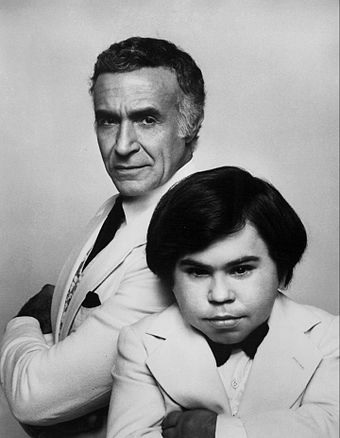
It’s the final season and final seasons often feel uninspired.  That was certainly the case with this episode.  Even the reliable Ricardo Montalban seemed bored with it all.  In the end, it’s just not as much fun without Herve Villechaize around.

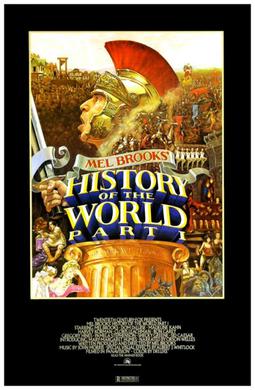
The History of the World, Part I (1981, directed by Mel Brooks)


Overlong, wildly uneven, gimmicky too a fault, and often laugh out loud funny with a mix of jokes that range from the crude to the sublimely clever to the surprisingly sentimental, The History of the World, Part I is the ultimate Mel Brooks films.

Narrated by Orson Welles and featuring five historical stories and a collection of coming attractions, The History of the World Part I follows man from his caveman origins to the French Revolution and the thread that ties it all together is that humanity always screws up but still finds a way to survive.  Moses (Mel Brooks) might drop and break one of the three tablets listing the 15 Commandments but he’s still able to present the other ten.  Stand-up philosopher Comicus (Mel Brooks) might make the mistake of poking fun at the weight of Emperor Nero (Dom DeLuise) but he still makes his escape with Josephus (Gregory Hines), Swiftus (Ron Carey), and Miriam the Vestal Virgin (Mary-Margaret Humes) and ends up serving as the waiter at the Last Supper.  (“Jesus!”)  The Spanish Inquisition may have been a catastrophe but it also gave Torquemada (Mel Brooks) a chance to show off his performance skills.  The French Revolution may have been a bloodbath but the future still held promise.  Ask for a miracle and he’ll show up as a white horse named Miracle, no matter what era of history you’re living in.

The humor is very Mel Brooks.  During the Roman Empire sequence, Madeline Kahn plays Empress Nympho.  Jackie Mason, Harvey Korman, Cloris Leachman, Spike Milligan, Jan Murray, Sammy Shores, Shecky Greene, Sid Caesar, Henny Youngman, and Hugh Hefner all make cameo appearances.  Carl Reiner is the voice of God.  John Hurt plays Jesus.  The film ends with the promise of a sequel that will feature “Jews in Space.”  Not every joke lands.  The entire caveman sequence feels forced.  But when the film works — like during The Inquisition production number — it’s hard not get caught up in its anything-goes style.  The entire Roman Empire sequence is probably more historically accurate than the typical Hollywood Roman epic.  That’s especially true of Dom DeLuise’s naughty performance as Emperor Nero.

Mel Brooks is 99 years old today and he says that he has at least one more film to give us, a sequel to Spaceballs.  I’m looking forward to it!  I’m also looking forward to rewatching and enjoying all of the films that he’s already given us.  The History of the World, Part I may not have initially enjoyed the critical acclaim of his earlier films but, in all of its anarchistic glory, it’s still pure Mel Brooks.

Retro Television Review: Fantasy Island 6.7 “Roller Derby Dolls/Thanks A Million”


Welcome to Retro Television Reviews, a feature where we review some of our favorite and least favorite shows of the past!  On Tuesdays, I will be reviewing the original Fantasy Island, which ran on ABC from 1977 to 1984.  Unfortunately, the show has been removed from most streaming sites.  Fortunately, I’ve got nearly every episode on my DVR.

This week, things get strange on the Island!

Episode 6.7 “Roller Derby Dolls/Thanks A Million”

(Dir by Don Weis, originally aired on December 4th, 1982)

Norman Hackett (Vic Tayback) is a sports fanatic who wants to coach his own athletic team.  Oddly, he doesn’t specify what type of team he wants to coach.  I would think that would be the first thing that a true sports fanatic would make clear.  “I want to coach the….”  Well, I can’t think of the names of any teams off the top of my head.  I’m not a sports person so …. okay, he could have said he wanted to coach the Cowboys.  You happy?  Yes, I’m from North Texas and our football team sucks,  Even I’m embarrassed by them and I don’t even follow football.  I’d be tempted to coach the Rangers except I know Erin would get mad at me if the team didn’t make it to the championship.  We also have a hockey team called the Stars but Leonard is the biggest hockey fan I know and, if anyone here at TSL deserves to coach hockey, it’s Leonard.  What’s that, you say?  The Mavericks?  Ehh.  I hate basketball.  Those squeaky shoes drive me nuts.  Plus Mark Cuban’s been kind of annoying ever since he decided to run for President in 2028.

Anyway, I’m rambling because this episode really wasn’t that interesting.  Because Norman didn’t make it clear what he wanted to coach, Mr. Roarke gives him a whistle and then introduces him to the Belles, an all-female roller derby team.  It turns out that roller derby is a big deal on Fantasy Island!  There’s a roller derby rink and everything.  It also turns out that Norman’s check bounced so, if he abandons the Belles, he’ll have to pay Mr. Roarke even more money …. wait, what?  Shouldn’t Norman just be sent home or something?  And doesn’t Roarke know enough to make sure the check clears before inviting someone to the Island?  No wonder Tattoo used to be in charge of the money.

Speaking of money, Suzanne (Janet Leigh), Roger (James Noble), and Eddie (Art Metrano) come to the Island to take part in a contest.  The winner will get $1.000.000 from a mysterious benefactor.  The benefactor, by the way, is actually Eddie and it turns out that the entire contest is a private bet between him and Mr. Roarke.  Eddie thinks that people will do anything to get money.  (This is largely true.  Up until a few weeks ago, this moronic woman was trying to sue my dead father’s estate for half a million.  Fear not, she got nothing.)  Roarke believes that people are good at heart.  Eddie puts Suzanne and Roger through a series of increasingly dangerous tests to see how far they’re willing to go.  In the end, both Roger and Suzanne prove themselves to be good people, though Suzanne is the one who gets the money.  Roarke wins his bet and we’re left wondering how all this came about in the first place.  (Seriously, how does Roarke even know Eddie?)

Anyway, this was kind of a strange trip to the Island.  I’m not really happy about an episode of Fantasy Island featuring a story that isn’t really a fantasy.  Still, at least the scenery was nice.  That’s a beautiful island!

Police Academy 3: Back in Training (1986, directed by Jerry Paris)


Police Academy 3 opens with a state in the middle of a fiscal crisis.  Money has to be saved somewhere and the governor (Ed Nelson) has decided that it’s not necessary for the state to have two police academies.  I am not sure why the governor would be the one to make that determination since the previous two Police Academy films established that the academies are run by the city but I guess I should remember that I’m watching a Police Academy film and not ask too many questions.

Which academy is going to be closed down?  Will it be the academy run by Commandant Lassard (George Gaynes) or the one run by Commandant Mauser (Art Metrano, returning from the second film)?  Mauser is willing to use any dirty, under-handed trick to keep his academy open.  Meanwhile, Lassard has his most recent graduating class returning to instruct his latest batch of recruits.  Can Mahoney (Steve Guttenberg) and Michael Winslow’s human sound effects machine save the academy?

When I watched Police Academy 3 this weekend, I was surprised to discover that it wasn’t as bad as I remembered.  Maybe it’s because I watched it immediately after the first two films and my senses were dulled but Police Academy 3 turned out to be an amiable and enjoyably stupid comedy. It helped that two of the new recruits were played by Tim Kazurinsky and Bobcat Goldthwait.  Returning to the roles that they first played in the second movie, Kazurinsky and Goldthwait make for a good comedic team.  As for the rest of the Police Academy regulars, they all do their usual comedy bits like pros and without any fuss.  It’s predictable and sometimes, funny.

Police Academy 3 was the first Police Academy film to have a PG-rating and, as a result, the jokes were still as juvenile and crude as the first two movies but, at the same time, Police Academy 3 seems to have made peace with the fact that it’s target audience was a bunch of adolescent boys dropped off at the theater by their mothers.  Mauser is still regularly humiliated but no one gets a blow job while standing in front of a podium.  This is a Police Academy for the entire family, assuming that your family is easily amused and not too demanding.

Police Academy 3 is a dumb movie and the recurring joke about policemen accidentally entering the Blue Oyster Bar is even less funny the third time that it’s used.  There’s also a Japanese recruit who only seems to be included because, back in the 80s, American films were obsessed with making fun of Japan.  Despite all that, Police Academy 3 is still not as bad as the usual Police Academy sequel.

But what about Police Academy 4?  Check in tomorrow to find out if it’s also better than I initially remembered.

(It’s not.)

Police Academy 2: Their First Assignment (1985, directed by Jerry Paris)


In an unnamed city that is probably meant to be Los Angeles but which looks like Toronto, a criminal gang known as the Scullions have taken over the 16th precinct.  Led by the loud, marble-mouthed Zed (Bobcat Goldthwait), the Scullions are terrorizing the citizens and harassing one shop owner, Carl Sweetchuck (Tim Kazurinsky), in particular.  The captain of the 16th precinct, Pete Lassard (Howard Hesseman), calls his brother, Eric Lassard (George Gaynes), and asks for the best cadets to have recently graduated from the police academy.

Carey Mahoney (Steve Guttenberg) and a few other of the cadets from the first Police Academy movie end up in the 16th.  Tackleberry (David Graf) is there and so is accident-prone Douglas Fackler (Bruce Mahler).  Bubba Smith is back as Hightower and so is Michael Winslow, the human sound effects machine.  They’re determined to help Lassard’s brother but it’s not going to be easy because they have to work with Lt. Mauser (Art Metrano) who is basically a dick who wants to be captain.  Mauser is exactly like Harris from the first film, except his name is Mauser and, instead of getting his head stuck up a horse’s ass, he gets his hands super-glued to his head.

Police Academy 2 is less raunchy than the first film but still not quite as family friendly as the films that would follow.  There’s still one f-bomb dropped and a few adult jokes, as if the film wasn’t fully ready to admit that it was destined to become associated with juvenile viewers who would laugh at almost anything involving a bodily function.  There is one funny moment where Steve Guttenberg goes undercover to join Zed’s gang, mostly because he’s Steve Guttenberg and he’s even less believable as a gang member than he was as a cop.  The closest thing that movie has to a highlight is Bobcat Goldthwait’s manic turn as Zed and Tim Kazurinsky’s desperation as he watches his store get repeatedly destroyed.  Tackleberry also gets an amusing romantic subplot, where he meets a police woman (Colleen Camp) who loves guns almost as much he does.  Unfortunately, Tackleberry’s romance gets pushed to the side by all of the gang activity.

Police Academy 2 is stupid but, depending on how much tolerance you have for Bobcat Goldthwait, sometimes funny.  It’s not as “good” as the first film but it’s still better than most of what would follow.  Speaking of which, tomorrow, I will be reviewing the first Police Academy film to get a PG-rating, Police Academy 3: Back in Training.

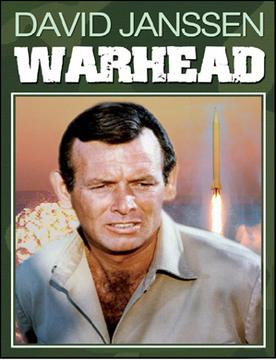
Warhead (1977, directed by John O’Connor)


Somehow, a nuclear bomb falls out of an American airplane that happens to flying over the border between Israel and Jordan.  Luckily, the bomb doesn’t explode but now it’s just sitting out in the desert where anyone can stumble upon it.  CIA operative Tony Stevens (David Janssen) just happens to be on vacation in the Middle East so he’s recruited and sent off to find the bomb before anyone else finds out about it.

At the same time, a group of Israeli soldiers, led by Captain Ben-David (Christopher Stone) and Lt. Liora (Karin Dor), are searching for a group of Palestinian terrorists, led by Malouf (Tuvia Tavi).  As soon as Tony finds the bomb, he is captured by Malouf.  He is then rescued by Ben-David but now Tony has to deal with two interested parties who want the bomb for themselves.

Warhead is a confusing movie that seems like it is trying to say something about the Middle East and America’s role as an international policeman.  Captain Ben-David feels that the Americans are being selfish with their refusal to allow other countries to develop their own nuclear missiles while Tony argues that the world would be plunged into war if everyone had the bomb.  (Remember, this film is from the 70s and was made at a time when the U.S. and the Russians were pretty much the only nuclear super powers.)  The film ends on a nihilistic note, with almost everyone either dead or disillusioned but why?  The acting is so bad and the production is so shoddy that it’s hard to figure out what this movie is trying to say.  Is Ben-David right about American arrogance or is Tony right to argue that deterrence is the only way to keep the world safe?  The movie doesn’t seem to know.  David Janssen was usually the ideal actor to play grizzled tough guys but, in this movie, he was clearly just collecting a paycheck and hopefully enjoying the chance to do some sight-seeing in the Holy Land.  The most intriguing character in the movie is a beautiful Israeli sniper played by Joan Freeman but she is killed off early and forgotten.

Warhead premiered on TV but was obviously originally intended for a theatrical release.  There’s a very gratuitous rape scene that is so awkwardly edited that it’s easy to see that it was cut down once it became apparent the movie was never going to play in theaters.  (The scene could have just as easily been removed from the film without effecting the narrative but I guess the networks wanted to give all of the dads and teenage boys a reason to not change the channel.)  According to the information I’ve found online, Warhead was filmed in 1973 but sat on the shelf for four years.  Watching the movie, it’s easy to see why.

Horror on TV: Kolchak: The Night Stalker 1.15 “Chopper” (dir by Bruce Kessler)


Tonight on Kolchak….

There’s a headless man riding a motorcycle, using a sword to behead members of a rival motorcycle gang!  And …. well, really what else do you need to know?  When a headless cyclists start killing people, you don’t worry about why.  There is a reason however and everyone’s favorite nervous journalist is going to find out what it is!

This episode originally aired on January 31st, 1975!

Enjoy!

http://www.youtube.com/watch?v=3raQnXP2s3s

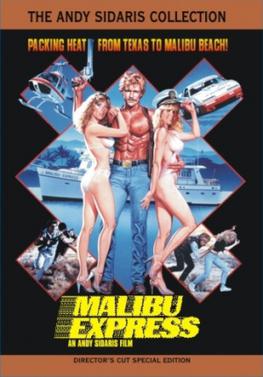
Film Review: Malibu Express (dir by Andy Sidaris)


Other than being the protagonist of the 1985 film Malibu Express, just who is Cody Abilene (played, in the film, by Darby Hilton)?

He’s a private investigator.  Judging from his accent, he’s from Texas.  He drives a red sports car and he lives on a houseboat that he’s named the Malibu Express.  He’s even got a painting of a caboose that stands on the docks next to his boat.  (It all goes back to an old friend of his and how he wanted to “remember her caboose.”)  He’s got nice hair and mustache and he looks like he could have had a career in 70s porn.  Literally everyone that he meets wants to have sex with him.  His best friend is a cop named Beverly (Lori Sutton).  His girlfriend is a race car driver named Judy Khnockers (Lynda Wiesmier).  “Khnockers … with an H.”  Cody says that about a thousand times over the course of the film.

Cody loves his cars.  Of course, it seems like he can’t go anywhere without running into three obsese rednecks who always demand that he race their son.  (Their son is apparently a mechanical genius.)  Cody always gives into their racing demands and he loses almost every time.

Cody also spends a lot of time talking to himself.  Nothing he says is that interesting.  I spent the entire movie waiting for him to say, “I hate pigs but yet I love bacon, what’s all that about?”  He never did.  I think the film would have been better if he had.

I should also mention that Cody is remarkably incompetent at his job.  The movie opens with him at the shooting range, firing his gun and continually missing the target.  Later on in the film, Cody’s accuracy will get better but he still always seem to be shocked whenever he actually hits his target.  From what we hear in the film, it appears that Cody has the respect of his peers but I’m really not sure why.  While he does solve the case, it’s mostly through dumb luck.  Cody doesn’t find clues through detective work.  Instead, he just kind of stumbles across them.

As for the case that Cody is investigating in Malibu Express … well, honestly, your guess is as good as mine.  I watched the film and I could hardly follow the plot.  Some of that is because this is one of those films that appears to have been edited with a chainsaw.  But a lot of it is because the film’s plot has a make-it-up-as-you-go-along feel to it.

It starts with Cody being hired by the mysterious Contessa Luciana (Sybil Danning) to investigate who has been selling computer secrets to the Russians.  Luciana has figured out that it has to be someone in the household of her friend, Lady Lillian Chamberlain (Niki Dantine).  (Apparently, every aristocrat in Europe has relocated to Bel Air.)  It doesn’t take long for Cody to discover that everyone in the house has a secret.  For instance, one daughter is having an affair with a butler.  A son-in-law is actually a drag queen.  Another daughter has gotten involved with a sinister computer mogul.

The computer mogul sounds like a good lead to pursue but, before it occurs to Cody to do that, there’s a murder and Cody shifts his attention to trying to figure out who did the killing.  But then suddenly, Cody’s being chased by three armed men so Cody shifts his attention yet again to trying to escape from them.  Fortunately, the actual murderer doesn’t really seem to care that much about remaining undetected, which certainly works out well for Cody…

Malibu Express is an Andy Sidaris film.  If you’ve ever seen a Sidaris film, you know better than to expect a nuanced or even narratively coherent film.  Sidaris specialized in over-the-top B-movies with nonsensical plots, frequent nudity, and dialogue that was heavy on groan-worthy double entendres.  Malibu Express was the first of his so-called triple “B” films (that stood for either Bullets, Bombs, and Babes or Bullets, Bombs, and Boobs, depending on who you ask).  It’s definitely a flawed film.  The plot makes no sense.  The dialogue is often cringe worthy.  The acting ranges from competent to awful.  The editing … oh my God, don’t even get me started on how messy this film is.

And yet, it’s also an oddly likable film.  If nothing else, the film seems to be aware of its flaws.  It knows that it makes no sense and that Cody is incompetent and no one in real life would ever say 75% of the lines that are uttered in Malibu Express.  It knows all of this but the film is determined to have fun and it’s hard to admire the film’s determination to full embrace the exploitation aesthetic.  Watching Malibu Express, you can tell that Sidaris probably enjoyed himself will directing it.  How much fun you have will depend on how much patience you have for Sidaris’s style of filmmaking.

Myself, I love over-the-top B-movies so I enjoyed it even if I couldn’t follow the plot.


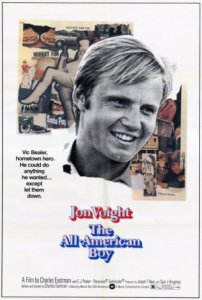
A Movie A Day #149: The All-American Boy (1973, directed by Charles Eastman)


Vic “The Bomber” Bealer is an amateur boxer who appears to be poised to escape from life in his dreary hometown.  He is such a good fighter that he is on the verge of making the U.S. Olympic Team and he is so good-looking that everyone, from his teenage girlfriend (Anne Archer) to his gay manager (Ned Glass) to a woman he meets at a gas station, automatically falls in love with him.  However, after his girlfriend tells him that she is pregnant, Vic abandons both her and boxing.  When she leaves town to have an abortion, Vic starts boxing again but then he learns that she may not have actually had an abortion and Vic leaves for Los Angeles, to see both her and his son.

Sadly, there is something about boxing that has always brought out the pretentious side of some filmmakers and that is the case with The All-American Boy.  This episodic film (which claims to portray “The Manly Art In Six Rounds”) tries to present Vic as being an anti-hero but mostly, he just seems to be vacant loser.  Vic sulks through the entire film, despite not really having much to sulk about.  When one of his conquests asks him what he is thinking, Vic replies, “I ain’t thinkin'” and the movie provides no reason to doubt him on this point.  I was not surprised to learn that The All-American Boy was filmed in 1969 and was deemed unreleasable until the combined success of Midnight Cowboy and Deliverance made Voight into a star.  On the plus side, when he made the film, Jon Voight looked like he could actually step inside the ring and throw a few punches.  On the negative side, the boxing scenes go heavy on the slow motion which, when overused, just looks stupid.  Raging Bull, this film is not.

When it comes to The All-American Boy, Duke has the right idea: