Over ten days ago we saw the release of the teaser trailer for Star Trek Into Darkness. This sequel by J.J. Abrams for the reboot of the storied scifi franchise looks to be one of the most-anticipated films of 2013 (if the world doesn’t end in a couple days of this posting that is). Today we get the release of the official trailer which adds in a couple of new scenes and images not included in the teaser.
Again there’s some debate as to which villain Benedict Cumberbatch is really portraying despite being listed in the cast as the character of John Harrison. The even money bet is that he plays a version of Kirk’s archenemy Khan Noonien Singh which is a strong possibility since the early draft for the Khan character was suppose to be a Nordic superhuman by the name of John Ericssen. Even Abrams himself has never said outright that he would never use the Khan character as the villain in this rebooted franchise. Whether he uses the classic Trek villain in this sequel or the next should get an answer as we get closer to the film’s release date.
Star Trek Into Darkess has a release date of May 17, 2013.
I’m not too overly fond of the title J.J. Abrams came up for the sequel to his 2009 blockbuster hit, Star Trek, but I will still admit that I’m eagerly anticipating this follow-up despite the title.
Star Trek Into Darkess still has months to go before it makes it’s premiere on the big-screen but it’s already one of the most-anticipated film for 2013. One of the things people have been very curious about the film and it’s tightly held storyline is just who exactly the villain is that Benedict Cumberbatch plays. Some have said it’s the classic Trek villain Khan and others say it’s a brand new character with Khan-traits.
If the film builds on the success and quality of the first film then it doesn’t matter who the villain is. Now the next question is whether Abrams has added more or less lensflare in this next film of his.
Star Trek into Darkness has a tentative release date of May 17, 2013.
Like Crazy tells the story of Anna (Felicity Jones) and Jacob (Anton Yelchin), two college students who start dating as graduation nears and eventually come to discover that they love each other “like crazy.” Unfortunately, U.S. immigration officials don’t care how much they love each other and when the British Anna overstays on her visa, she is promptly sent back home and told that she cannot reenter the U.S. While Anna continues to pursue her literary career in England, Jacob runs a succesful design business in America. Anna and Jacob struggle to maintain their long distance relationship, even while both of them are tempted by others (played quite well by Jennifer Lawrence and Charlie Brewley, both of whom give nuanced performances that make their characters into more than just romantic complications).
While the plot might sound like the formula for your standard romcom, Like Crazy is actually a surprisingly mature and realistic film that also manages to be gloriously romantic and just a little sad (yes, Lisa cried a lot). You really come to care about not only about Jacob and Anna but you also come to feel less like your watching a movie and instead like you’re literally eavesdropping on real life. This is director Drake Doremus’s third film and his work here is almost like a blue print of how to make a film like this work. When the film starts, his hand-held cameras is jittery and nervous, reflecting the rush of hope and fear that we all feel at the beginning of a new relationship. As the film progresses, Doremus’s camera also calms down and it makes it impossible for us to look away, even when it almost feels as if we’ve intruded too far on the lives and feelings of our two lovers.
Doremus is helped by the fact that his two lovers are perfectly cast and totally believable and likable delivering dialogue that was reportedly improvised during filming. I’ve seen Anton Yelchin in a few films but this is the first time that he ever truly impressed me as an actor. One need only compare his vulnerable performance here to his more showy (and less effective) performance in TheBeaver to see just how much Yelchin benefits from the improvised nature of Doremus’s film. As Anna, Felicity Jones proves that a previously unknown actress doesn’t need a gimmick (like a dragon tattoo) to give a breakthrough performance. Yelchin and Jones have a very real chemistry and you sincerely care about them.
The end result is a wonderful film that deserves to be seen. Like Crazy was one of the best films of 2011 and it’s a shame that it’s being overshadowed a bit by the bigger, more traditional films that have been released at the end of the year.
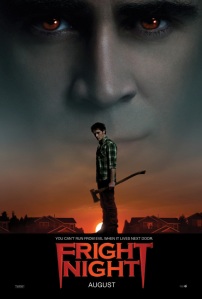
I want to say great things about Craig Gillespie’s remake of Fright Night. I want to say that it was worth seeing and it was full of awesome moments. I also wanted to be able to write this review without making so many comparisons to the 1985 Original by Tom Holland. Not that the original was a masterpiece by any means, but I dozed off (just a little) on this film.
If there’s only one reason I could give for recommending Fright Night, it would be to get a taste of what Vampires should be. Don’t read me wrong on this. I own all four Twilight books in hardcover, read them repeatedly, and have seen the three films that came out in the theatre. It’s just nice to see a vampire movie that shows vampires more as predatory creatures than sparkling A&F models. There’s an edge to this film that’s pretty fun in a lot of ways. Both Colin Farrell and David Tennant have great roles here and even Anton Yelchin holds his own, but there’s a weird breakdown that happens. Fright Night is a good film, as long as you don’t try to make any kind of direct comparisons to the source material.
The story focuses on Charlie Brewster (Yelchin), a teenager – the story being in Vegas this time – who discovers he has a vampire named Jerry Dandrige (Farrell) living next door to him. When the vampire confronts Charlie, Charlie is forced to seek out help in the form of Peter Vincent (Tennant) to defeat him. While there were a few scenes that really stood out for me and I found myself smiling more often than rolling my eyes, the pacing of this was off. Other audiences may find that the movie moved well. I felt like they were just throwing things to say “Well, wouldn’t it be cool if they did this, and then that.”
The two problems I had with Fright Night were it’s pacing and Chris Mintz-Plasse. Chris is fun to watch at the start, and I’d love to see him do more, but someone really has to give him something where he’s not playing the “token geek”. While I liked the movie overall, there’s a lot of verbal exposition in the beginning of the film, as Charlie doesn’t so much discover the truth about Jerry, but is pretty much told the entire scenario he’s in about 15 minutes into the start. I had a problem with that. Again, depending on the audience, the movie may move just fine.
Fright Night is one of those films could be a love it or hate it. I’m of the audience that will probably catch it again when it’s out on video, but it doesn’t feel like anything you really have to rush to the theatre for.
So, there’s this thing in Hollywood that they call the Black List. The Black List comes out at the end of each year and basically, it’s a list of the “best” unproduced screenplays of the year. The reason I put best in quotation marks is because the list is 1) determined by studio people and studio asskissers and we all know that those people are toadsuckers, 2) film is not a writer’s medium so the best screenplay in the world can still be ruined if the wrong director gets involved with it, and 3) the films made from the scripts on the blacklist always seem to end up sucking like I did during my sophomore year of high school. Seriously, that was a lot of sucking.
The Beaver (written by Kyle Killen) was at the top of the Black List in 2008 and now, 3 years later, it’s finally been made by Jodie Foster and released to mixed reviews and indifferent box office. I saw The Beaver on Saturday. So does, the Beaver continue the tradition of disappointing movies being produced from Hollywood’s “best” screenplays? Well, yes and no. The final 20 minutes of the Beaver are incredibly effective and almost moving. Unfortunately, they’re not effective enough to make up for the wildly uneven 90 minutes that come before.
One thing that films that top the Black List tend to have in common is that they almost always try to tell a very traditional, rather obvious story by using some quirky gimmick that becomes less and less clever the more you think about it. The Beaver continues that tradition. Mel Gibson plays a guy named Jerry who runs a toy company and who has become clinically depressed. After a unsuccessful attempt to commit suicide, he comes up with a novel solution to deal with his inability to communicate his feelings. He starts to walk around with a beaver hand puppet and whenever he has to talk to his estranged wife (Jodie Foster) or his angry son (Anton Yelchin), he does so through the puppet. And, as long as he has that beaver puppet, he has the strength to be a good husband and a good father. At first, Foster is happy — if confused — but soon she finds herself growing frustrated with always having to talk to the Beaver as opposed to speaking to her husband. However, Gibson has now grown so dependent on the Beaver that he can’t give it up, even though the Beaver has now started to insult Gibson whenever there’s no one else around.
Eventually, this leads Gibson to doing something very shocking and quite disturbing and it’s once that happens that The Beaver actually starts to work as a film. Unfortunately, by that point, there’s only 20 minutes left in the film and we’ve had to sit through a whole lot of subplots, none of which seem to belong in the same movie.
On the one hand, we have Gibson reviving his company by launching a toy line based on the Beaver. These scenes are probably the weakest in the film. Gibson shows up at work and tells everyone that the Beaver hand puppet is in charge and nobody quits. Apparently, nobody calls up the tabloids to tell them that CEO of a major toy company has apparently had a nervous breakdown. Instead, work goes on as normal. Every time I saw Gibson’s character sitting in his office with that hand puppet, I wondered, “Does this company not have shareholders?”
Meanwhile, Yelchin is dealing with the beginning stages of the same clinical depression that has crippled Gibson and (its implied) led to his grandfather killing himself years earlier. A high school senior, Yelchin has a lucrative career writing other students papers for them. He’s hired by Jennifer Lawrence who asks him to write her graduation speech. It also turns out that Lawrence is not only a popular cheerleader who is graduating at the top of her class but she’s also a graffiti artist as well who has a convenient family tragedy that she needs help getting through. Now, that’s not as impossible as it may sound because my sister Erin’s a truly talented artist who was also a cheerleader in high school but that doesn’t change the fact that Lawrence’s character still basically came across as just being a typical male fantasy, the nurturing madonna figure who only exists to justify and/or excuse the behavior of an obviously autobiographical male figure. Still, Lawrence and Yelchin’s subplot is probably the most compelling part of the movie.
As you can probably guess, the main problem with the movie is that it’s essentially about a guy walking around with a Beaver puppet. Neither Kellen’s screenplay nor Foster’s direction seems to be sure just how seriously we should take that beaver and as a result, it just comes across as being a really cutesy idea that never really works as well as the movie seems to think that it does. As well, it’s hard to take anything seriously once the word Beaver is introduced into the conversation. For instance, as we watched Gibson bonding with his employees, my friend Jeff suggested that all Gibson needed to do in order to feel better about his life was to “stick his hand up a beaver and move his fingers.” However, I have to admit that the worst beaver joke was made by me and it happened about halfway through the film when we see Gibson and Foster having sex, with Gibson keeping that beaver on his hand. After they finish, Foster turns her back to him and Gibson caresses her face with — yes, you guess it — the beaver. “I bet that’s not the first time she’s had a beaver in her face,” I said. All of this could have been avoided if the film just hadn’t been made in the first place.
Still, The Beaver is not a complete failure and when the film does work, it works so well that it makes it even more frustrating that the movie, as a whole, doesn’t. Even before the final 20 minutes, the film has the occasional intelligent line or knowing detail that indicates that, if not for the whole beaver thing, this could have been a very touching film about the pain of mental illness. Perhaps the film’s greatest strength is that it features a quartet of excellent performances. Yelchin and Lawrence have a real chemistry and watching them, you kinda wish that the movie would have just focused on them. Foster also does a good job as Gibson’s confused wife and, it must be admitted, that Mel Gibson is perfectly cast in the lead role. He looks like hell here and there’s next to no vanity to be found in his performance here. He actually probably gives the best performance of his career here but, I do have to admit, it was difficult to watch him onscreen without imagining some alcohol-soaked voice ranting and raving and spewing out a lot of anti-Semitic hate.
We saw the Beaver at the Plano Angelika and I have to admit that, even if the film didn’t really work, at least we had a good time seeing the film. On the Saturday afternoon that we went to see it, the Shops at Legacy (where the Plano Angelika is located) were having a street fair with live music and booths and everything. So, at the very least, I got to literally dance in the street both before and after seeing The Beaver.
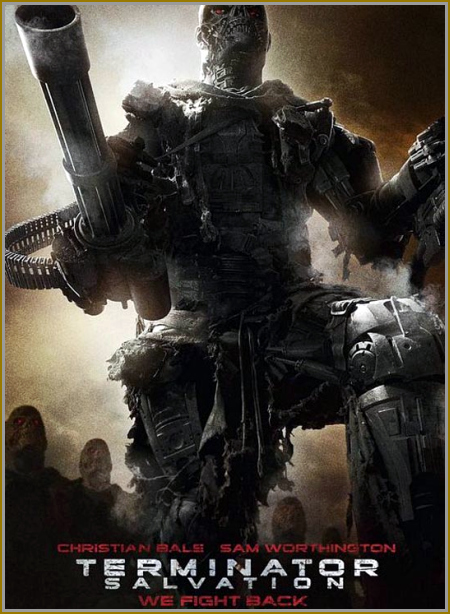
It has been 25 years since a certain James Cameron introduced the film-going public to the post-apocalyptic world of Judgement Day. While he’s never really fully shown the war-torn future ruled by the machines in the the two films he directed in the Terminator franchise he does show glimpses of it. It’s these glimpses of desperate humans fighting to survive against Skynet and its machine hunter-killing robots which have always intrigued and made its fans salivate at the thought of seeing it realized. Terminator 3: Rise of the Machines in 2003 tried to show how it all truly began, but again it just hinted at the future battlefield and not the full-blown war. It is now 2009 and the most unlikely filmmaker has finally shown what the future of Judgement Day looks like. McG’s Terminator Salvation succeeds and fails in equal amounts yet has laid the groundwork for the future of the franchise as a war series instead of of its past as installments of what really is one huge chase film.
There are many things which work in Terminator Salvation and one of them happen to be its director McG. A director who is much-maligned for his too campy Charlie’s Angels set of films would’ve been the last name to look to for a restart to the stalled franchise. His direction of this fourth entry in the series was actually very well-done. There’s none of the cartoony and way over-the-top action set-pieces of his Charlie’s Angels past. Instead he moves the film along in a brisk and energetic pace with very little downtime for much introspection. It is this pacing which makes this a good and, at times, an above-average action-film but also serves to make any of the scenes questioning what it is to be human (once again) and machine seem tacked on. The first three films in the series have delved into this theme and question too many times for a fourth attempt make it seem any more relevant than the previous times.
McG went out to make a war entry to the series and to an extent that’s what he did. While there are chases to be had it doesn’t necessarily mean its all about John Connor once again (though the film does make it a point of targeting him again in its own fashion). Terminator Salvation has finally shown what the world looks like after the events of the third film and what had been hinted and teased at in the first two. The world is a desolate place with ruins of landmarks to give the audience a reference point. We see Los Angeles a tumbling and crumbling wreck which looked eerily like something out of the recent Fallout 3 scifi-rpg game. Even San Francisco makes a post-apocalyptic appearance as a major Skynet headquarters. McG achieves this post-apocalyptic look by bleaching out the film’s color palette to the point that browns and greys dominate. He actually achieves to add grittiness to this film which his past films had never shown him having the ability to do. While this film won’t sway people to admiring his skill as a filmmaker it does show some growth. Then again he does have a hold of a film series which is nothing but B-movies elevated through bigger budgets and access to the latest in film FX. If I have any gripe to point out about the action in the film it’s that there’s not enough of it to truly convey a “War Against the Machine” scenario. We get these tantalizing hints, but not something on par of what a fuure war should look.
The budget could be seen on the screen as the film uses a combination of CGI and practical effects to pull off a much more complex robotic army for Skynet. It’s the robots and machines which keeps bringing the audience back each and every time the series releases a new entry. We don’t just have the Human Resistance fighting the typical T-800 or even the more advanced T-1000 or T-X. We get the earlier versions of these human hunting and killing machines. From a brutish and zombie-like T-600 we see in the LA-scenes to newer and bigger specialized Skynet soldiers like the anime-inspired mech Harvester which towers several stories high and literally harvests humans it finds to take back to SKynet’s R&D bases. When the original Terminator does make an appearance it’s both a welcome and a surprise as McG’s technical wizards find a way to bring back the original exactly the way it’s supposed to look. I’m sure the Governator of California would want to have that physique and youth back.
As an action-film Terminator Salvation works well enough when the action appears on the screen. Now as a film that tries to delve into the philosophical trappings of the series it doesn’t so much as fail and sink the film, but almost does which would’ve been a shame. While not the worst in the series in terms of storytelling it does come across as very scattershot in what story it wants to tell. The film actually has three ideas which could’ve been used to make it’s own film. Is the film a story of John Connor and his rise to his prophesized leadership of the Resistance (he’s a leader of a branch of fighters, but not yet of the whole group in this film)? Or is this film about the search and attempt to make sure the person who will be Connor’s father stays alive to allow what transpired in the past to happen (time-travel can be a tricky and confusing thing to comprehend)? Or is Terminator Salvation the story of the new character Marcus Wright and his quest to find out just who, or what he is exactly? It’s all three of those and all three weren’t explored enough to make one care too much for the story being told. There’s great ideas in all three but trying to combine them into one coherent storyline mostly falls flat and uninsipiring for a film trying to be the war movie in the series. For what are war movies mostly but attempts to show inspiration in the face of desperation. There’s very little of that in this film. If the writers had been given a chance to further streamline the story into one major arc then this film would have benefitted greatly in the long run.
With acting very tightly tied-in with the story being told it’s only logical that the performances by the cast rarely go beyond acceptable. Christian Bale’s John Connor is always dour and brooding. He’s almost becoming a typecast for any role that requires for him to be the down man in any party. He does this ably, but he doesn’t bring anything to the role which hasn’t already been explored in past entries. His performance does show hints of mental instability as the weight of being the savior and prophet of the human race may be starting to get to him. The other two pivotal roles in the film have more meat to play around with. Anton Yelchin as the teenage Resistance fighter destined to become John Connor’s father in the past shines in the scenes he’s in as he elevates a bland script with some youthful energy and hints of the adult Kyle Reese fans of the series know so well. Then we arrive on the newest character in the series: Marcus Wright.
Little-known Australian actor Sam Worthington was recommended by James Cameron for the role of Marcus Wright. Like Anton Yelchin’s performance, Worthington’s work in the role of Wright saves the film from mediocrity. While it is not a start-turning performance by any means Worthington does make it difficult not to pay attention to him throughout the film. The man has presence and every scene he is in shows why Cameron himself has faith in being the latest to carry the Terminator torch. The rest of the cast is quite a throwaway in that we never really get to know any of them and invest anything in their well-being.
Terminator Salvation is a very frustrating film in that there’s so much great ideas to mine. The series has always tried to explore such themes as fate, predetermination and human free will. While the third film in the series was quite lacking in memorable action sequences this fourth entry makes a mess of trying to explore these themes. Again, it seems as if the film’s script was rushed into production with very little doctoring and as the production continued forward no one bothered to point out just how average and bland the storyline does sound despite being the most overly complex of the series.
One thing I am sure of is that the one person people thought would be the weakest link in this film instead happens to be its strongest. McG and some inspired acting from two newcomers keep the film from becoming a total failure. Terminator Salvation is an able and, for most of it’s running time, a very good action film with brisk pacing and energy in its action sequences. Enough of these elements keeps the film’s fractured and scattershot of a storyline from sinking the film into total failure. As a summer tentpole action film it delivers on some of what it promises, but it could’ve been more and better. Some would settle on calling this entry in the franchise a failure, but I am always an optimist and a fan of action thus I’ll land on calling this film a successful failure.


 Through the Shattered Lens