Film Review: Fools’ Parade (dir by Andrew V. McLaglen)


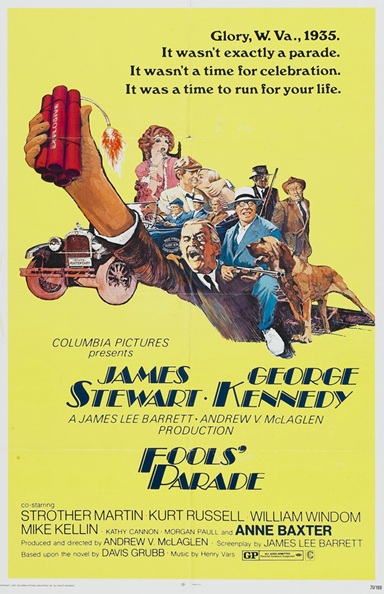
1971’s Fools’ Parade opens in 1935.

Three men are released from the West Virginia state penitentiary and given a train ticket out of town by the prison captain, Council (George Kennedy).  The men are a bank robber named Lee Cottrill (Strother Martin), a young man named Johnny Jesus (a young Kurt Russell), and a courtly older man named Mattie Appleyard (James Stewart).  Despite his polite tone of voice and his folksy manner, Appleyard is actually the most notorious of the three men being released.  Convicted of murdering two men, Appleyard has spent the past 40 years in prison.  Both Appleyard and Cottrill are looking to go straight.  Every day of his sentence, Appleyard worked and earned money.  Along with a glass eye, Appleyard leaves prison with a check for $25,000 dollars.  Appleyard plans to cash the money at the bank and then open a store with Cottrill.

Unfortunately, Appleyard has been released at the height of the Great Depression.  The streets are full men desperately looking for work.  People will do anything to feed their families or to make a little extra money.  Salesman Roy K. Sizemore (William Window) transports guns and dynamite.  Willis Hubbard (Robert Donner) works as a conductor on the train.  Aging prostitute Cleo (Ann Baxter) offers to sell the virginity of her adopted daughter, Chanty (Katherine Cannon).  Junior Killfong (Morgan Paull) sings on the radio and occasionally takes on deadlier work with his friend, Steve Mystic (Mike Kellin).  As for Captain Council, he’s decided that he’s going to make his money by ambushing the train carrying the three men that he has just released from prison.  After killing the men, Council will cash Appleyard’s check himself.

Of course, it doesn’t quite work out as simply as Council was hoping.  Willis Hubbard has a crisis of conscience and lets Appleyard, Cottrill, and Johnny know what Council is planning.  The three men narrowly make their escape but Council frames Appleyard for a murder that he didn’t commit.  Now wanted once again, the three men must not only get the money but also clear their names.  It won’t be easy because, as Hubbard explains, they may be free from the penitentiary but now, they’re trapped in “the prison of 1935.”

Fools’ Parade really took me by surprise.  I watched it because it featured two of my favorite actors, James Stewart and Kurt Russell.  And both Stewart and Russell give very good performances in the film.  Stewart was always at his best when he got a chance to hint at the melancholy behind his folksiness and the young Kurt Russell plays Johnny with a sincerity that makes you automatically root for him.  For that matter, the normally sinister Strother Martin is very likable as Lee Cottrill, a bank robber who is still struggling with the idea of going straight.  But, beyond the actors, Fools’ Parade is a genuinely sad portrait of desperate people trying to survive.  At one point, Sizemore and Cottrill watch as their train passes a camp of people who have been displaced by the Great Depression and it’s even implied that the villainous Council has some regret over what he’s become.  (There’s a small but poignant scene in which Council and Cleo acknowledge the passage of time and, for a minute, the viewer realizes these two people were, at one time, maybe as idealistic and optimistic as Johnny.)  It’s a well-acted film, one in which moments of humor are mixed with moments of true sadness.  I may have picked the film for Jimmy and Kurt but, in the end, the film’s story and performances drew me in.  The 63 year-old Stewart proved that he could still give a memorable performance and the 20 year-old Kurt Russell proved that he was a future star in the making.  If you haven’t seen it, this is definitely a film to check out.
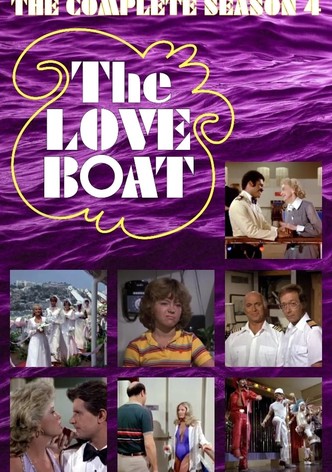
Retro Television Review: The Love Boat 4.25 & 26: “This Year’s Model/The Model Marriage/Vogue Rogue/Too Clothes for Comfort/Original Sin”


Welcome to Retro Television Reviews, a feature where we review some of our favorite and least favorite shows of the past!  On Wednesdays, I will be reviewing the original Love Boat, which aired on ABC from 1977 to 1986!  The series can be streamed on Paramount Plus!

This week, it’s time for the fashion festival!

Episode 4.25 and 4.26 “This Year’s Model/The Model Marriage/Vogue Rogue/Too Clothes for Comfort/Original Sin”

(Dir by Roger Duchowny, originally aired on May 2nd, 1981)

This week, the Love Boat sails to Acapulco for the International Fashion Festival!  Vicki, who hopes to grow up to be a fashion designer, is excited about meeting her idols.  Doc, Gopher, and Isaac are excited about the models.  Captain Stubing starts the cruise by reminding everyone to do their job for once.  It’s about time Stubing told them that.  Does Doc even keep office hours anymore?

This one of those two-hour episodes of The Love Boat that gets chopped into two episodes for syndication.  As such, it’s double-sized, with twice as many guest stars and the boat actually sailing to Acapulco during filming.  That doesn’t mean that the storyline are any more complicated than usual on this episode.  Despite being longer then usual, the episode follows the usual Love Boat pattern.  The extra time is largely taken up with a travelogue of Mexico (watch as a limo very slowly drives to a luxury hotel!) and the fashion show.

Fashion designers Gloria Vanderbilt, Bob Mackie, Halston, and Geoffrey Beene all appear as themselves.  They’re listed as guest stars but they don’t actually do anything other than board the ship and then show off their designs.  They don’t find love on the boat, nor do they search for it.  (Well, Halston probably did….)  Interestingly enough, none of them — not even the famous Halston — has much of a screen presence and in the scene where they introduce themselves to the crew, they’re all so stiff that it is somewhat difficult to watch.  It’s obvious that none of them were actors but it’s also interesting to consider that there was a time when someone could be internationally famous without being a natural on camera.

There are also a few fictional designers on the cruise.  They’re the one who actually have storylines.  Harvey Blanchard (Dick Shawn) is not aware that his daughter, Mandy (Debra Clinger), has married his nerdy assistant, Alvin Beale (Richard Gilliand).  Mandy wants Alvin to tell her father that they re married during the cruise but first, Alvin is going to have to figure out what to do after he accidentally dumps some designer clothes down a laundry chute and they end up shrinking in the dryer.  (“Have you ever considered designing children’s clothing?” Alvin asks his boss.)

Benita James (Elke Sommer) is an “up-and-coming” fashion designer who falls in love with Sidney Sloan (Mike Connors), despite the fact that he’s an industrial spy who has been hired to steal her designs.  Sid falls in love with Benita as well and decides that he can’t betray her.  But when Sid’s partner (Steve Franken) ransacks Benita’s cabin, will Sid be able to convince her that he wasn’t involved?

Charles Paris (Robert Vaughn, looking somewhat embarrassed) is a cosmetics tycoon who boards the boat looking for the new Ms. Paris, the model who will be the face of his company.  Will he pick Liz(Morgan Brittany) the model with whom he is falling in love, or will he pick Joanne Atkins (Carmilla Sparv), the model who has been told that, since she’s now over 35, her career is over?

Speaking of Joanne, she falls in love with Captain Stubing and Stubing falls in love with her.  Meanwhile, the married heads of her modeling agency (Anne Baxter and McClean Stevenson, who looks almost as embarrassed as Robert Vaughn) argue over whether or not Joanne is too old to continue on as a model.

Julie is excited because her former sorority sister, Melissa (Cristina Ferrare), is a model on the cruise.  Julie can’t wait to spend the whole cruise with her but Melissa meets and falls in love with Larry (Chris Marlowe).  When Melissa and Larry run off to get married, Julie takes her friend’s place in the fashion show.

And really, the fashion show is what this episode is all about.  The stories aren’t particularly important.  We’re here for the clothes!

Bob Mackie starts things off with a really cute collection of lingerie and pajamas, which happen to be my favorite things to wear.  I loved his collection.

Gloria Vanderbilt follows with sporty summer fashion, and watching her collection, I found myself wanting to go play tennis with my neighbors.

Geoffrey Beene follows with a collection of plaid suits that will be familiar to anyone who has ever binged a 70s sitcom.

“Up and comer” Benita James presents a collection of truly hideous cocktail dresses.

And Halston closes things out with evening wear.  “Red is my favorite color,” Halston says, “It’s so fun.”  This redhead appreciates the sentiment, even if it was kind of obvious that Halston didn’t bring his top designs on the cruise with him.

As the highlight of the episode, the fashion show was definitely entertaining though. it was impossible not to smile at just how ugly Benita James’s designs actually were.  Seriously, someone went to the trouble to hire two industrial spies to steal those designs?

As for everything else, it all works out.  This is The Love Boat.  Everything always works out.  Charles Paris announces that the new Ms. Paris will be Joanne but then he asks Liz to be “Mrs. Paris.”  Sid and Benita decide to get married as well.  Captain Stubing gets to have sex for once.  I think that may be the first time that’s happened since this show started.  Julie enjoys modeling.  Everyone either finds love or decides not to get divorced.  That’s a successful cruise!

This cruise was fun in its silly way.  Bob Mackie definitely won the fashion show.  Though the designers may not have been comfortable on camera and McClean Stevenson looked like he was on the verge of jumping overboard from embarrassment, this was The Love Boat at its most entertaining.


Retro Television Review: If Tomorrow Comes (dir by George McCowan)


Welcome to Retro Television Reviews, a feature where we review some of our favorite and least favorite shows of the past!  On Sundays, I will be reviewing the made-for-television movies that used to be a primetime mainstay.  Today’s film is 1971’s If Tomorrow Comes!  It  can be viewed on YouTube.

If Tomorrow Comes tells the story of a forbidden marriage.

In 1941, Eileen Phillips (Patty Duke) meets David Tayanaka (Frank Liu) and the two of them quickly fall in love.  David asks Eileen to marry him and Eileen says yes, even though they both know that it won’t be easy.  Eileen’s father (James Whitmore) and her brother, Harlan (Michael McGreevey), are both prejudiced against the Japanese and David’s parents (played by Mako and Buelah Quo) would both rather than David marry someone of Japanese descent.  Eileen and David decide to elope first and tell their parents afterwards.

On December 7th, Eileen sneaks out of the house and joins David at his church.  They are married by Father Miller (John McLiam), who agrees to keep their secret.  Eileen and David then drive over to the church attended by Eileen’s family but no sooner have they arrived than the local sheriff (Pat Hingle) pulls up and announces that the Japanese have bombed Pearl Harbor.  The sheriff instructs everyone to return home and to listen to their radios.  David slips his wedding ring off his finger.  Telling the parents will have to wait.

Eileen’s father and brother are convinced that every Japanese person in town, even though the majority of them were born in America and have never even been to Japan, is a subversive.  David and his family are harassed by government agents like the oily Coslow (Bert Remsen).  One morning, they discover that all of their farm animals have been killed and someone has written “REMEMBER PEARL HARBOR” with their blood.  When Franklin D. Roosevelt orders the internment of the Japanese, David’s father is among those taken away.  When Harlan continues to harass David, it eventually leads to not just one but two tragedies.

If Tomorrow Comes is a real tear-jerker, one that features a great performance from Frank Liu and a good one from Patty Duke.  Though it may seem a tad implausible that David and Eileen would get married just an hour before Japan attacked Pearl Harbor (and considering the attack occurred on a Sunday morning, I’m a little curious how they found a priest who was free to secretly marry them), the film does a good job of showing how fear can lead to otherwise good people doing terrible things.  One of the film’s strongest moments comes as David’s father is taken away to an internment camp and the Japanese prisoners try to prove their loyalty by spontaneously singing America, The Beautiful.  It’s a moment that reminds us of the danger of letting our fear destroy our humanity.

It’s a film that still feels relevant today, with its portrayal of heavy-handed government agents searching for subversives and ignoring the Constitution in order to save it.  When David visited his father at the internment camp, I thought about how, at the heigh of the COVID pandemic, it was not unusual to see people demanding that the unmasked and the unvaccinated by interned away from the rest of the world.  If Tomorrow Comes is a love story and a melodrama and tear-jerker but, above all else, it’s a warning about the destructive power of fear and prejudice.

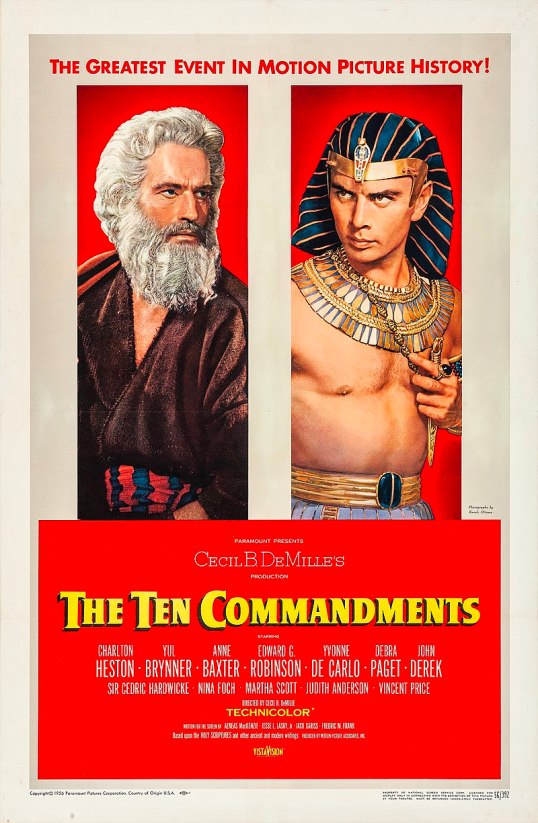
Film Review: The Ten Commandments (dir by Cecil B. DeMille)


Though you may not know it if you’ve only seen the film during one of its annual showings on television, the 1956 religious epic, The Ten Commandments, originally opened with director Cecil B. DeMille standing on a stage.  Speaking directly to the audience, DeMille explains that, though the film they’re about to see me take some dramatic license with the story of Moses, it still based on not just the Bible but also the accounts of Philo, Josephus and Eusebius.  He also tells us that The Ten Commandments is more than just an adaptation of the Book of Exodus.  Instead, it’s a film about every man’s desire to be free.

Demille concludes with: “The story will take 3 hours and 29 minutes to unfold.  There will be an intermission. Thank you for your attention.”

To be honest, it’s kind of a sweet moment.  Cecil B. DeMille is a name that is so associated with (occasionally overblown) epic filmmaking that it’s easy to forget that DeMille was one of the most important names in the artistic development of American cinema.  He was there from the beginning and, unlike a lot of other filmmakers, he was equally successful in both the silent and the sound era.  Say what you will about his films, DeMille was a showman and he handles the introduction like a pro.  At the same time, there’s a real sincerity to DeMille’s tone.  After you listen to him, you’d almost feel guilty if you didn’t sit through all 3 hours and 29 minutes of his film.

That sincerity extends throughout the entire film.  Yes, The Ten Commandments is a big, long epic and some members of its all-star cast are more convincing in their roles than others.  And yes, the film can seem a bit campy to modern viewers.  (In fact, it wouldn’t surprise me if it seemed a bit campy to viewers in 1956 as well.)  Yes, The Ten Commandments does feature Anne Baxter saying, “Oh Moses!  You sweet adorable fool!”  But it doesn’t matter.  Even the most ludicrous of dialogue just seem right.  The film is just so sincere that it’s difficult not to enjoy it.

In the Book of Exodus, Moses is described as having a speech impediment and even tries to use it as an excuse to get out of going to Egypt.  That’s actually one of the reasons why Moses brought Aaron with him to Egypt, so that Aaron could speak for him.  In the movie, Moses is played by Charlton Heston, who comes across as if he’s never felt a moment of insecurity over the course of his entire life.  But no matter.  Heston may not by the Moses of Exodus but he’s the perfect Moses for the DeMille version.  When Heston says that Egypt will be visited by plagues until his adopted brother Ramses (Yul Brynner) agrees to allow the Jews to leave Egypt, you believe every word.  (Aaron, incidentally, is played by the legendary John Carradine.  He doesn’t get too much other than respectfully stand a few feet behind Charlton Heston but still: John Carradine!)

And really, anyone who dismisses The Ten Commandments out-of-hand should go back and, at the very least, watch the scene where the Angel of Death descends upon Egypt.  The scene where Moses and his family shelter in place while the screams of distraught mothers echo throughout the city is chilling.  Ramses may spend most of the film as a petulant villain but you almost feel sorry for him when you see him mourning over his dead son.  When he sets off after Moses, it’s not just because he’s doing what villains do.  He’s seeking vengeance for the loss of his first born.  For that brief moment, Ramses goes form being a melodramatic bad guy to being someone with whom the viewer can empathize.  Brynner, with his burning intensity, gives a great performance as Ramses.

As I said before, this film has what, in 1956, would have been considered an all-star cast.  Watching the names as they show up during the opening credits — Cedrick Hardwicke!  Yvonne DeCarlo!  Woody Strode!  Debra Paget! — is like stepping into a TCM fever dream.  Some of the performers give better performance than others.  And yet, even the worst performer feels as if they just naturally belong in the world that DeMille has created.  John Derek may seem rather smarmy as Joshua but his callowness provides a good contrast to the upright sincerity of Heston’s performance as Moses.  Edward G. Robinson’s cries of, “Where is your God now!?” may have provided endless fodder for impersonators but just try to imagine the film without him.  Even Vincent Price is in this thing!  He doesn’t have his famous mustache but, as soon as you hear his voice and see that famous glare, you know that it’s him.

Of course, when you’re growing up and The Ten Commandments is on TV every year, you mostly just want to see the scene where Moses parts the Red Sea.  The Ten Commandments was nominated for seven Oscars but it only won one, for its special effects.  (The prize for Best Picture went to another epic, Around The World In 80 Days.)  Today, the film’s special effects may no longer amaze viewers but there’s still something rather charming about the Red Sea parting and then crashing in on the Egyptian army.  The scene where the Earth opens up and swallows those who worshiped the Golden Calf remains impressive, if just because all of the extras really look terrified that they might die.  And while the Pillar of Fire may look a bit cartoonish to modern eyes, that’s a huge part of the film’s appeal.

The Ten Commandments is a big, long, sometimes silly, sometimes effective, and always entertaining epic.  It’s a grand spectacle and one that I usually watch every year when it shows up on television.  I missed this year’s showing but, fortunately, I own it on DVD.  It’s a sincere epic and a difficult one not to like.


Cleaning Out the DVR #24: Crime Does Not Pay!


gary loggins's avatarcracked rear viewer

We’re way overdue for a Cleaning Out the DVR post – haven’t done one since back in April! – so let’s jump right in with 4 capsule reviews of 4 classic crime films:

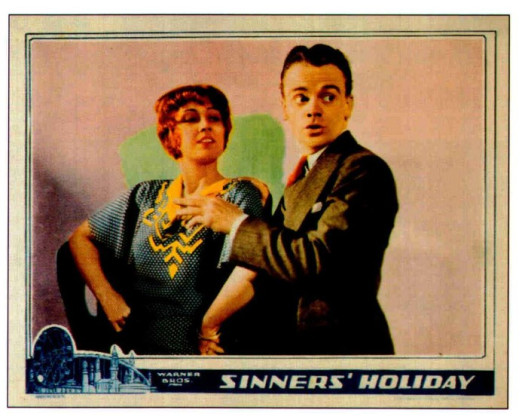
SINNERS’ HOLIDAY (Warner Brothers 1930; D: John Adolfi) – Early talkie interesting as the screen debut of James Cagney , mixed up in “the booze racket”, who shoots bootlegger Warren Hymer, and who’s penny arcade owner maw Lucille LaVerne covers up by pinning the murder on daughter Evalyn Knapp’s ex-con boyfriend Grant Withers. Some pretty racy Pre-Code elements include Joan Blondell as Cagney’s “gutter floozie” main squeeze. Film’s 60 minute running time makes it speed by, aided by some fluid for the era camerawork. Fun Fact: Cagney and Blondell appeared in the original Broadway play “Penny Arcade”; when superstar entertainer Al Jolson bought the rights, he insisted Jimmy and Joan be cast in the film version, and…

View original post 549 more words

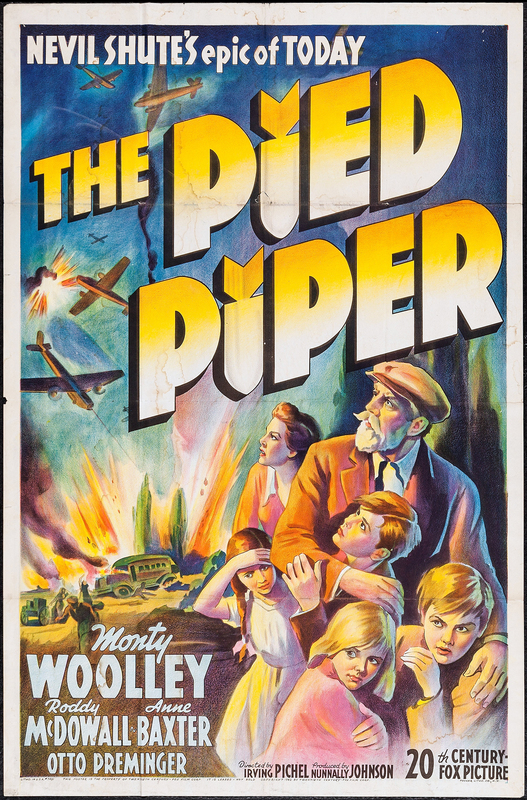
Lisa Reviews An Oscar Nominee: The Pied Piper (dir by Irving Pichel)


The 1942 Best Picture nominee, The Pied Piper, opens in Eastern France, shortly after the outbreak of World War II.

John Sidney Howard (played by Monty Woolley) is an Englishman on holiday.  He says that he just wants to enjoy some fishing before the entire continent of Europe descends into chaos.  He knows that France is going to be invaded at some point and he even suspects that the country will probably fall to the Nazis.  In his 70s and still mourning the death of his son (who was killed during an air battle over occupied Poland), Mr. Howard just wants to enjoy France one last time.  Despite the fact that the bearded Howard bears a resemblance to a thin Santa Claus, he’s quick to declare his dislike of both children and humanity in general.  He’s a misanthrope, albeit a rather friendly one.

Howard’s plans change when the Nazis invade France sooner than he expected.  With his vacation canceled, Howard just wants to get back to England.  Complicating matters is that a diplomat named Cavanaugh (Lester Matthews) has asks Howard to take his children, Ronnie (Roddy McDowall) and Sheila (Peggy Ann Garner), back to England with him.  Despite his self-declared dislike of children, Howard agrees.  However, it turns out that getting out of France won’t be as easy as Howard assumed.  After their train gets diverted by the Nazis, Howard, Ronnie ,and Sheila are forced to take a bus.  After almost everyone else on the bus is killed in a surprise Nazi attack, Howard and the children are forced to continue on foot and rely on the kindness of a young French woman, Nicole Rougeron (Anne Baxer).

Throughout the journey, Howard keeps collecting more and more children.  Everyone wants to get their children to a safe place and Howard soon has a small entourage following him.  Unfortunately, he also has Gestapo Major Diessen (an excellent Otto Preminger) watching him.  How far is Howard willing to go to ensure the safety of the children?

The Pied Piper is an interesting film, in that it starts out as something of a comedy but it then gets progressively darker as events unfold.  At the beginning of the film, it appears that the whole thing is just going to be Howard getting annoyed with the precocious Ronnie and Sheila.  But then that bus is attacked and Howard find himself accompanied by a young boy who has been left in a state of shock by the attack.  When the group is joined by a young Jewish child named Pierre, it’s a reminder that, though the film itself may have been shot on an American soundstage, the stakes and the dangers in occupied Europe were all too real.

The Pied Piper was nominated for Best Picture of the year.  Viewed today, it may seem like an unlikely nominee.  It’s a well-made movie and Monty Woolley gives a good performance as John Sidney Howard.  It’s the type of film that, due to the sincerity of its anti-Nazi message, should bring tears to the eyes of the most hardened cynic but, at the same time, there’s nothing particularly ground-breaking or aesthetically unique about it.  Still, from a historical point of view, it’s not a surprise that this competent but conventional film was nominated.  With America having just entered the war, The Pied Piper was a film that captured the national spirit.  Other World War II films nominated in 1942 included 49th Parallel, Wake Island, and the eventual winner, Mrs. Miniver.

In fact, one could argue that The Pied Piper is almost a cousin to Mrs. Miniver.  Both films are not only anti-German but also unapologetically pro-British.  Just as Greer Garson did in Mrs. Miniver, Monty Woolley is meant to be less of an individual and more of a stand-in for Britain itself.  When both Mrs. Miniver and Mr. Howard refused to surrender in the face of German aggression, these movies were proudly proclaiming that the British would never lose hope or surrender either.

Thankfully, the movies were correct.

Lisa Reviews An Oscar Nominee: The Razor’s Edge (dir by Edmund Goulding)


Oh, 1919!  What a year.  The Great War had ended, leaving much of Europe devastated.  American soldiers were coming home and, scarred by the horrors they had experienced, becoming members of a lost generation.  The Spanish Flu was infecting millions, on the way to eventually wiping out 3% of the world’s population.  It was a grim time so it’s no surprise that many chose to close their eyes and pretend like everything was fine.  Only a few people were willing to look at the world and say, “There has to be something more.”

The 1946 film The Razor’s Edge tells the story of one such man.  Before the war, Larry Darrell (Tyrone Power, Jr.) was like most of his friends back in Chicago.  He was carefree.  He was wealthy.  He was engaged to marry the beautiful but self-centered Isabel (Gene Tierney).  But then he went off to fight in World War I and the experience changed him.  On the final day of the war, another soldier sacrificed his life to save Larry and Larry is now haunted by that man’s death.  No longer sure about his place in the world, Larry announces that he’s rejecting his former life.

Of course, that’s an easy thing to do when you’re rich.  Larry is lucky enough to have an inheritance that he can live off for a few years.  All of his former friends think that Larry’s just struggling to adjust to being back home and they expect that he’ll get over it soon enough.  Isabel’s uncle, Elliott (Clifton Webb), thinks that Larry’s acting like a total fool.  For Larry’s part, he no longer cares what any of them think.  He’s going to travel the world, seeking enlightenment.

While Larry’s searching, life goes on without him.  Isabel ends up marrying one of Larry’s friends, Gray Maturin (John Payne).  Larry’s best friend from childhood, Sophie (Anne Baxter), suffers a personal tragedy of her own and, when Larry next meets her, she’s living as a drunk on the streets of Paris.  Larry keeps searching for the meaning of it all.  He works in a coal mine.  He discusses philosophy with a defrocked priest.  Eventually, he ends up in the Himalayas, where he studies under a Holy Man (Cecil Humphreys).

It’s an intriguing idea and still a relevant one.  Unfortunately, the movie doesn’t really work because Larry tends to come across as being a little bit full of himself.  I could imagine someone like Henry Fonda working wonders with the role but Tyrone Power seems totally miscast as Larry.  When you look at Power, you find it hard to believe that he’s ever had a bad day, much less a need to spend months hiding in the Himalayas.  He comes across as the last person you would necessarily want to take spiritual advice from.  The fact that Webb, Tierney, Payne, and Baxter are all perfectly cast only serves to enforce just how miscast Power is.  It’s a well-intentioned film with nice production values but it’s never quite compelling.

The Razor’s Edge was based on a novel by W. Somerset Maugham.  Interestingly, the film features Maugham as a character, played by Herbert Marshall.  Even more interesting is the fact that the film was apparently remade in 1984, with Bill Murray cast as Larry Darrell.  I’ve never seen the remake so I have no idea if Murray is an improvement on Power.

(Also, since I’ve been pretty critical of Power in this review, let me recommend Witness For The Prosecution, in which Power is much better cast.)

The Razor’s Edge was nominated for Best Picture but lost to another film about returning vets, The Best Years of Our Lives.

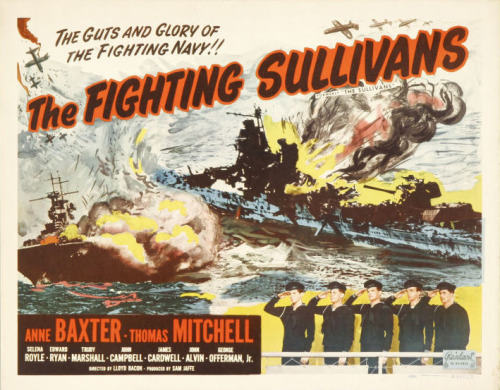
Special Memorial Day Edition: THE FIGHTING SULLIVANS (20th Century-Fox 1944)


gary loggins's avatarcracked rear viewer

War is hell, not only on the participants, but on those left home waiting for word on their loved ones, dreading the inevitable. THE FIGHTING SULLIVANS is based on the true story of five brothers who served and died together as shipmates, and their family. It’s a story of patriotism, of grief and loss, and its penultimate moment will rip your heart out. Finally, it’s an American story.

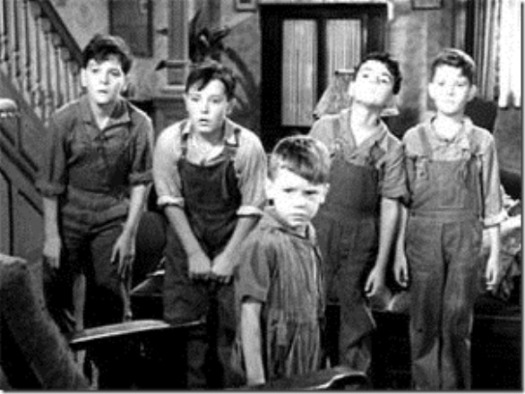
The Sullivans are a proud, close-knit Irish Catholic family living in Waterloo, Iowa. Patriarch Tom (played by Thomas Mitchell ) is a loyal railroad man whose five sons (George, Frank, Joe, Matt, and Al) climb the water tower every day to wave goodbye as the train pulls out. Mother Alleta (Selena Royale) keeps the family fires burning, with the help of daughter Gen. The scrappy brothers are a pint-sized version of the Dead End Kids, getting into mischief like a Donnybrook with neighborhood kids on little…

View original post 625 more words

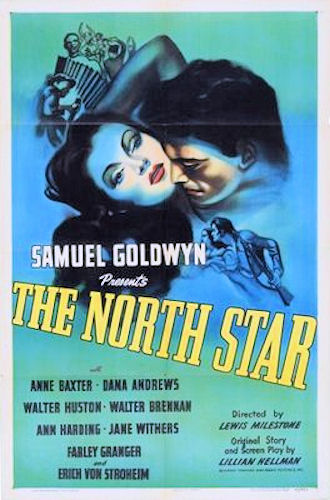
The Fabulous Forties #41: The North Star (dir by Lewis Milestone)


The North Star

The 40th film — wait a minute, I’m finally up to number 40!?  That means that there’s only ten more movies left to review!  And then I’ll be able to move on!  It’s always exiting for me whenever I’m doing a review series and I realize that I’m nearly done.

Anyway, where was I?

Oh yeah — the 40th film in Mill Creek’s Fabulous Forties box set was the 1943 war epic, The North Star.  This is one of the many war films to be included in the Fabulous Forties box set and I have to admit that they all kind of blend together for me.  Since these films were actually made at a time when America was at war, there really wasn’t much room for nuance.  Instead, every film follows pretty much the same formula: the Nazis invade, a combination of soldiers and villagers set aside their individual concerns and/or differences and team up to defeat the Nazis, there’s a big battle, a few good people sacrifice their lives, the Nazis are defeated, and the allies promise to keep fighting.

It’s a pretty predictable formula but that’s okay because it was all in the service of fighting the Nazis.  Could I legitimately point out that the villains in these movies are always kind of two-dimensional?  Sure, I could.  But you know what?  IT DOESN’T MATTER BECAUSE THEY’RE NAZIS!  Could I point out that the heroes are often idealized?  Sure, but again it doesn’t matter.  Why doesn’t it matter?  BECAUSE THEY’RE FIGHTING NAZIS!

That’s one reason why, even as our attitude towards war changes, World War II films will always be popular.  World War II was literally good vs evil.

Anyway, The North Star was a big studio tribute to America’s then ally, the Soviet Union.  When a farm in the Ukraine is occupied by the Nazis, the peasants and the farmers refuse to surrender.  They disappear into the surrounding hills and conduct guerilla warfare against the invading army.  It’s all pretty predictable but it’s also executed fairly well.  It doesn’t shy away from showing the brutality of war.  There’s a haunting scene in which we see the bodies of all of the villagers — including several children — who have been killed in a battle.

The Nazis are represented by Erich Von Stroheim.  Von Stroheim plays a German doctor who continually claims that he personally does not believe in the Nazi ideology and that he’s just following orders.  When wounded Nazi soldiers need blood transfusions, he takes the blood from the children of the village.  His rival, a Russian doctor, is played by all-American Walter Huston and indeed, all the Russians are played by American stars, the better to create a “we’re all in this together” type of spirit.  When Huston tells Von Stroheim that he is even worse than the committed Nazis because he recognized evil and chose to do nothing, he’s speaking for all of us.

Unfortunately, before the Nazis invade, The North Star devotes a lot of time to showing how idyllic life is in the communist collective and these scenes are so idealized that they totally ring false.  Everyone is so busy singing folk songs and talking about how happy they are being a part of a collective (as opposed to being an individual with concerns that are not shared by the other members of the collective) that it’s kind of unbearable.  Not surprisingly, The North Star was written by Lillian Hellman, who wrote some great melodramas (like The Little Foxes) but who was always at her most tedious when she was at her most overly political.

(Watching the opening of The North Star, I was reminded that I would be totally useless in a collectivist society.)

So, I have to admit, that I was rather annoyed with the villagers at first.  But then the Nazis invaded and I realized that we’re all in it together!  As I said earlier, you can forgive your heroes almost anything when they’re fighting Nazis.

The North Star is an above average war film and a below average piece of political propaganda.  See it as a double feature with The Last Chance.

The Fabulous Forties #5: Guest In The House (dir by John Brahm)


Guest_in_the_House_Poster

The fifth film in Mill Creek’s Fabulous Forties box set was 1944’s Guest In The House.  Before I get around to actually reviewing the film, there two important things that I need to share.

First off, according to the imdb, when Guest In The House was released into theaters, it ran a total of 121 minutes.  The version that was released on video — the version that I watched for this review — only runs 100 minutes.  Having watched the film, it’s hard for me to guess what could have been included in those 21 minutes.  There’s no major plot holes in the 100 minute version or any unanswered questions.  It’s hard for me to imagine that there could be anything in those 21 minutes that would have made Guest In The House a better film than the version that I watched last night.  If anything, even at just 100 minutes, the version that I saw still felt too long!

Secondly, Guest In The House was re-released several times.  At one point, the title was changed to Satan In Skirts!  That has got to be one of the greatest titles ever!  Seriously, Guest In The House is such a boring and mundane title.  But Satan in Skirts — I mean, that sounds like something that you just have to watch, doesn’t it?

Anyway, Guest In The House is about a guest in the house.  Shocking, right?  Evelyn (Anne Baxter, playing a character similar to her classic role in All About Eve) is a mentally unstable woman with a heart ailment and a morbid fear of birds.  She has recently become engaged to Dr. Dan Proctor (Scott Proctor) but she spends most her time writing nasty things about him in her diary.

Dan takes her to visit his wealthy Aunt Martha (Aline MacMahon).  Also staying at Martha’s is Dan’s older brother, an artist named Douglas (Ralph Bellamy).  Douglas is married to Ann (Ruth Warrick, who also played Kane’s first wife in Citizen Kane).  Also living at the house is Douglas’s model, Miriam (Marie McDonald).

(“I used to have to hire one model for above the neck and one model for below the neck,” Douglas explains as Miriam poses for him, “But you’re the whole package!”)

When Evelyn has a panic attack upon seeing a bird, Douglas calms her down by drawing a woman on a lampshade.  (Yes, that’s exactly what he does.)  This leads to Evelyn becoming obsessed with Douglas.  Soon, she is manipulating the entire household, trying to drive away Dan and Miriam while, at the same time, try to break up Douglas and Ann’s marriage….

So, does this sound like a Lifetime film to anyone?  Well, it should because Guest In The House is basically a 1940s version of almost every film that aired on Lifetime last year.  Normally that would be a good thing but, unlike the best Lifetime films, Guest In The House isn’t any fun.  It should be fun, considering how melodramatic the storyline is.  However, Guest In The House takes a prestige approach to its story, marking this as one of those films that was made to win Oscars as opposed to actually entertaining audiences.  Other than a few time when Evelyn imagines that she’s being attacked by invisible birds, the film never allows itself to truly go over-the-top.

Lovers of The Wizard of Oz might want to note that the Wicked Witch of the West herself, Margaret Hamilton, plays a maid in this film but, in the end, Guest In The House is mostly just interesting as a precursor to Anne Baxter’s performance in All About Eve.