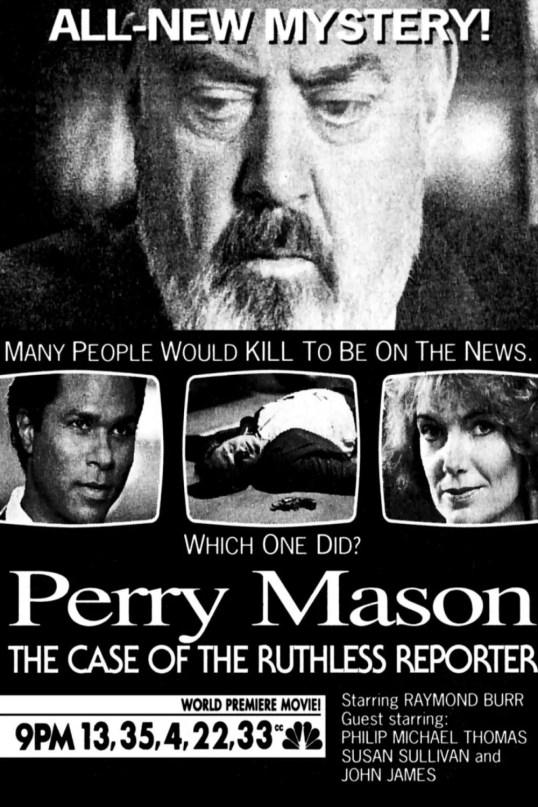
When arrogant news anchor Brett Huston (John James) is shot and killed, his co-anchor Gillian Pope (Kerrie Keane) is arrested and charged with the crime. It looks like an open-and-shut case because Brett was shot with Gillian’s gun. Luckily, Gillian is friends with Perry Mason (Raymond Burr) and soon Perry is on the case with Della Street (Barbara Hale) and Ken Malansky (William R. Moses).
Now this is how you do a Perry Mason movie! Brett’s murder is linked to a memo that he wrote in which he criticized the other members of the news team and argued that they should all be fired. All of the suspects are enjoyably eccentric. There’s a weatherman (Peter Jurasik) who wants to be a stand-up comedian. There’s the sports reporter (Philip Michael Thomas) who used and sold steroids. There’s the producer (Susan Sullivan), who was also Brett’s ex-wife. Brett even insulted the station manager (Jerry Orbach, who previously appeared as a different suspect in The Musical Murder). Ken, as usual, finds time for romance, this time with reporter Cassie Woodfield (Mary Page Keller) who appears to have someone trying to kill her as well. Along with a great cast of characters, this mystery had a solution that took me by surprise but which also made sense when I looked back on it. The final courtroom reveal was perfect. This is also probably the only Perry Mason film where the hours of a hamburger restaurant proved to be instrumental to the case.
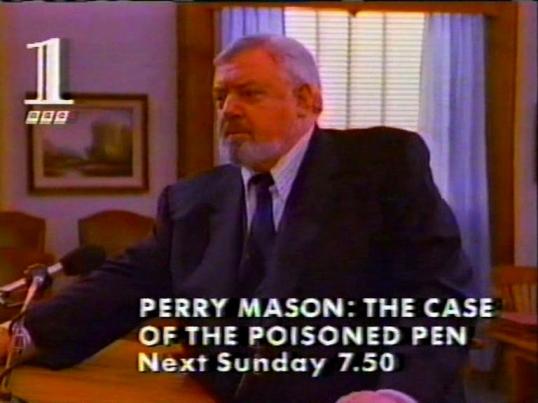
When an arrogant true crime writer named Bradley Thompson (David Warner) is poisoned while attending a writers conference, his ex-wife (Barbara Babcock) is arrested and charged with his murder. Perry Mason (Raymond Burr) and Ken Malansky (William R. Moses), who had their own run-in with Thompson, defend her in court and try to track down the real murderer.
This was a good whodunit. The mystery was pretty easy to solve but all of the suspects were memorable and the supporting cast, which included Cindy Williams, Tony Lo Bianco, and Earl Boen, were entertaining to watch. My favorite character was Max Mulgrew, a tough-guy crime writer who was played by Kiel Martin. When Mulgrew was asked if he hated Thompson enough to murder him, Mulgrew says yes but he would have shot him instead of poisoning him!
Amy Hastings, who Alexandra Paul played in the previous three movies, is not in this movie and nobody says anything about her so, hopefully, her character has moved on. Without Amy around, that means that Della (Barbara Hale) gets to help out with the investigation for once. It was nice to see Della showing why she was the best assistant that Perry could have ever hoped for.
I remember enjoying this movie when I watched it with my aunt a few years ago. I enjoyed it again when I watched it last night.
Welcome to Late Night Retro Television Reviews, a feature where we review some of our favorite and least favorite shows of the past! On Thursdays, I will be reviewing Highway to Heaven, which aired on NBC from 1984 to 1989. The entire show is currently streaming on Tubi and several other services!
This week’s episode is massively confusing.
Episode 4.18 “We Have Forever: Part Two”
(Dir by Michael Landon, originally aired on February 17th, 1988)
Picking up from last week, an embittered Jonathan is no longer an angel. Instead, he’s a mortal man who can’t get a job because he doesn’t have any references. (The idea is that Jonathan can’t explain that he’s spent the last 40 years working for God. But, over the past four and a half seasons, he’s had numerous jobs where he helped people out. Couldn’t he have listed some of those people are references?) However, Jonathan is happy because he’s fallen in love with Jennifer (Leann Hunley), the woman that he saved from drowning last week.
Meanwhile, Mark is actually making an effort to help people by working at the camp for the blind where he and Jonathan worked earlier in the season. (Actually, why couldn’t Jonathan ask for a job at the camp? The more I think about it, Jonathan not being able to get a job makes less and less sense.)
Jennifer, however, has a secret of her own. At the end of the episode, she leaves Jonathan a note, in which she explains that she’s actually Joan, Jonathan’s late wife. Jonathan was upset because he felt God was keeping him from seeing Joan in Heaven. Instead, it turns out that Joan — like Jonathan — has been assigned to work on Earth as an angel. So, the two months that Jonathan spent with Jennifer was actually God giving Jonathan a chance to spend time with Joan but, for some reason, no one told Jonathan that was what was happening so Jonathan got mad and walked out on God. But then, Jonathan changes his mind after learning that Joan is Jennifer but instead of asking to work with Joan/Jennifer, Jonathan goes back to working with Mark.
Seriously, I’m having a hard time following some of the logic here.
That said, despite all the lapses in logic, this episode still made me cry. Admittedly, I’ve been feeling under the weather today so maybe that’s why I was so emotionally susceptible to this episode. Or maybe it’s just the fact that Highway to Heaven is such an overwhelmingly earnest and sincere show that even the episodes that shouldn’t work somehow do. All I know is that I was sobbing by the end of this episode.
The important thing is that, at the end of the episode, Jonathan and Mark have a new assignment and drive off. Wait, I thought Mark had a job. Way to abandon all those blind children, Mark!
Perhaps it’s best not to think too hard about this episode and just accept it for being the tear jerker that it was.
Welcome to Late Night Retro Television Reviews, a feature where we review some of our favorite and least favorite shows of the past! On Thursdays, I will be reviewing Highway to Heaven, which aired on NBC from 1984 to 1989. The entire show is currently streaming on Tubi and several other services!
This week, Jonathan loses his powers.
Episode 4.17 “We Have Forever: Part One”
(Dir by Michael Landon, originally aired on February 10th, 1988)
When Jonathan’s former wife (Dorothy McGuire) dies, Jonathan assumes that God will release him of his duties and bring him to Heaven to be with her. Instead, Jonathan is told that he is still needed on Earth and that he has an assignment. Jonathan gets upset and uses some language that one doesn’t always expect to hear from an angel. God responds with thunder and lightning.
Long story short, Jonathan loses his angelic powers. He becomes a human again. But since Jonathan died 40 years ago, shouldn’t taking away his powers cause him to drop dead on the spot? I’m a bit confused on how this works but then again, it’s also pretty obvious that God is trying to teach him a lesson as opposed to just punishing him.
Jonathan runs away from Mark, refusing to speak to him. He sees a movie theater that is showing Heaven Can Waitand he proceeds to throw beer bottles at the marquee until all of the letters have fallen. Jonathan ends up in jail but Mark manages to track him down and gets him released. Jonathan borrows some money from Mark so that he can go get drunk.
Later, walking along the beach, Jonathan sees a young woman named Jennifer (Leann Hunley) who looks just like his wife did when they first got married. Jennifer attempts to commit suicide by walking into the ocean. Jonathan saves her life. It turns out that Jennifer is suicidal because her boyfriend dumped her. Jonathan tells her that her boyfriend isn’t going to care that she killed herself. In fact, he’ll probably brag about it to all of his friends.
Long story short, it’s obvious that Jonathan and Jennifer are falling in love. Meanwhile, Mark is looking for some way to occupy himself and considers accepting a job at the camp for the blind that he and Jonathan visited earlier in the season. Finally, this is a two-parter so we’ll see how everything works out next week!
I will say that this was a nice change-of-pace for the series. Seeing Jonathan finally get mad after four seasons of doing whatever he was assigned to do was interesting and Michael Landon’s anger and sadness felt very real. Victor French also did a good job of portraying Mark’s sadness over not being able to help his best friend. This was an episode where Highway to Heaven‘s unabashedly earnest and emotional approach really paid off.
In 1965’s The Ghost In The Invisible Bikini, the recently deceased Hiram Stokely (Boris Karloff) is informed that he has just 24 hours to perform a good deed and get into Heaven. He also has 24 hours to keep Basil Rathbone from stealing his estate. Hiram teams up with the ghost of his his dead girlfriend (Susan Hart) and together, they help Hiram’s real heir throw a pool party!
I know, I know. That makes no sense. Go with it, it’s the 60s and it’s a party. The film is silly even by the standards of the typical beach party film but it features Boris Karloff and Basil Rathbone somehow managing to maintain their dignity and Nancy Sinatra singing a song. (Dean Martin’s daughter, Claudia, also makes an appearance.) Even more importantly, this is a film that epitomizes an era. Released in 1965, this was the last AIP beach party movie and it’s a product of the innocent, fun-loving early 60s that would soon be replaced by the violent turmoil of the late 60s. Hiram was probably happy that he got out when he could.
Welcome to Late Night Retro Television Reviews, a feature where we review some of our favorite and least favorite shows of the past! On Thursdays, we will be reviewing Highway to Heaven, which aired on NBC from 1984 to 1989. The entire show is currently streaming on Amazon Prime, Tubi and other services!
Episode 4.8 “All the Colors of the Heart”
(Dir by Michael Landon, originally aired on November 18th, 1987)
This episode brings Jonathan (Michael Landon) and Mark (Victor French) to a summer camp for the blind, where they come into contact with two men. There is Frank Riley (Tom Sullivan), an athletic blind man with a great attitude who has high hopes of gaining his sight and being able to see for the first time in his life. In contrast, there is Scott (Peter Kowanko), a young man who is in the process of rapidly losing his sight and is in complete denial of his new reality. Jonathan and Frank, who also happens to be the man who started the camp, work with Scott in hopes of helping him to face both the physical and the emotional challenges of going blind. Will Frank actually be able to regain his sight? Will Scott be able to accept his condition and find a reason to embrace life again?
Our family watched HIGHWAY TO HEAVEN often during its run in the 80’s. My mom loved the series, and I remember its episodes going straight for the heart. I haven’t revisited it as an adult, and I must admit that I had an enjoyably nostalgic time when I watched this episode today.
While I personally had warm and fuzzy feelings based on the show’s connection to my youth, the content of the episode itself was quite serious. Scott, the young man who is going blind, is basically giving up on life, so much so that he contemplates killing himself. Peter Kowanko, who plays Scott and bears a striking resemblance to actor James Van Der Beek, is pretty good in the part. He spends most of his time screaming at people that they don’t understand what he’s going through. It’s not the most endearing performance, but I can’t help but wonder how I would react in the same position. Heck, I’ve had some of my own health issues recently, and the anxiety that has come along with that has definitely hampered my ability to put others first. I think Tom Sullivan is a little more successful in the role of Frank Riley, the man who has been blind since birth. Sullivan, who is blind in real life, receives a “Story By” credit for this episode, and is reportedly much like the man he portrays here. While some of his scenes do lean heavily into melodrama at the end, his inspiring sense of humor and overall outlook on life gives us glimmers of hope throughout the episode. I did want to point out that Kowanko and Sullivan do almost all of the heavy lifting in the acting department in this episode. While they had some fun interplay at the beginning, I was surprised by how little the characters played by Landon and French factored into the main storyline. I’m going to assume this is the exception and not the norm for the show.
Overall, I enjoyed revisiting this TV series from my youth. This specific episode contains a strong message about the importance of finding the joys in life under the most difficult of circumstances. I think we all need to be reminded of that from time to time, even when we’re not facing the types of challenges that these characters are being forced to deal with. Michael Landon, who directed this episode, got me at the end as I felt some moisture welling up in my own eyes. I’m definitely looking forward to taking a little deeper dive into the series in the near future.
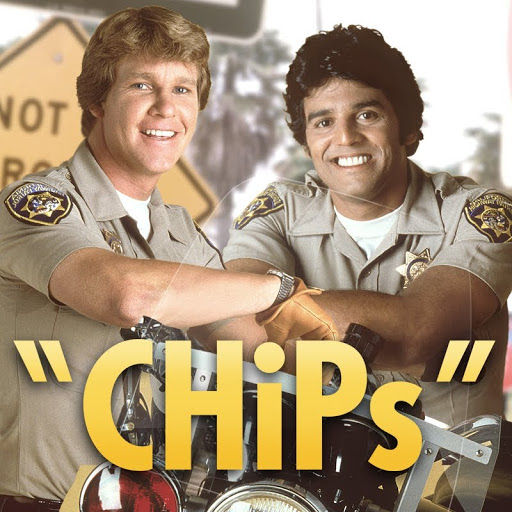
Welcome to Late Night Retro Television Reviews, a feature where we review some of our favorite and least favorite shows of the past! On Mondays, I will be reviewing CHiPs, which ran on NBC from 1977 to 1983. The entire show is currently streaming on Prime!
It’s a holiday week so tonight’s review is going to be a mini-review. Let’s quickly talk about the time two highway patrolmen ended up in jail!
But first….
Episode 3.16 “Jailbirds”
(Dir by Bruce Kessler, originally aired on January 12th, 1980)
Ponch and Baker go to jail!
Actually, Baker goes to jail twice. Ponch is only sent to jail once. It’s all because they refuse to reveal the name of the confidential informant that allowed them get the drop on and arrest a smuggler named Nick Ferris (Ray Duke). Getraer calls the Attorney General’s office. Officer Turner drops by to check on Baker. The Judge (Allan Rich) says that he sympathizes with the cops but unless they’re willing to name their informant, he’ll have to dismiss the charges and let Ferris go free due to insufficient evidence.
The idea of Ponch and Baker in jail has a lot of possibilities. Ponch is always going on and on about how he used to be a juvenile delinquent so I was half-expecting him to run into an old friend in the holding tank. That didn’t happen, though. Instead, CHiPs gave us a jail that was remarkably clean, well-run, and full of friendly prisoners and nice cops. I’ve often felt that CHiPs was essentially a commercial for Los Angeles tourism and the theme of this episode appeared to be, “L.A. …. even our jails are wonderful!”
Anyway. Getrear and the guys not in jail work to get more evidence so that they can put Ferris behind bars without revealing the name of Baker’s informant. Good for them! Teamwork, it’s what CHiPs is all about!
Welcome to Retro Television Reviews, a feature where we review some of our favorite and least favorite shows of the past! On Fridays, I will be reviewing St. Elsewhere, a medical show which ran on NBC from 1982 to 1988. The show can be found on Hulu and, for purchase, on Prime!
Usually, I review this show on Friday but, yesterday, my week of visiting Lake Texoma in freezing weather finally caught up with me and I spent most of the day congested and curled up in bed. As a result, St. Elsewhere got preempted until today. Now, let’s see what’s happening at St. Eligius….
Episode 1.13 “Family History”
(Dir by Kevin Hooks, originally aired on February 8th, 1983)
After being a background character for the past few episodes, Dr. Wendy Armstrong (Kim Miyori) finally gets her time in the spotlight with this episode. When Charlie Heller (Keenan Wynn) comes into the ER with a chronic nosebleed, Dr. Armstrong is too quick to assume that it’s nothing serious. Dr. Westphall, who is in an especially crappy mood this episode, reprimands her for not getting a family history before making her diagnosis. A chastened Armstrong gets Charlie’s family history and comes to suspect that he has a rare blood condition that only seems to effect Jewish men. A very expensive test confirms Armstrong’s diagnosis. Armstrong is excited. “I was right!” she says. Westphall again reprimands her, telling her that she now needs to tell Charlie that he has a chronic condition and will have to take medicine for the rest of his life.
Seriously, Westphall was not in a good mood during this episode! But I don’t blame him. From her first appearance on the show, Dr. Armstrong has been complaining nonstop. No matter what happens in the hospital, she seems to take it as a personal affront. Now, after several episodes of complaining about the other doctors, Armstrong fails to do a simple thing like get a family history. No wonder Westphall was all like, What are you bragging about?
That said, even if his mood was understandable, I would not want to get on Westphall’s bad side. Even after Armstrong makes the correct diagnosis, Westphall takes the time to say, “Next time, do what I told you to do.” Agck!
While Westphall was dealing with whatever was eating away at him, Dr. Chandler was getting annoyed by John Doe’s refusal to try to remember anything about his past. Even when John Doe’s real father showed up and explained that Doe was his son, Dave Stewart, he refused to try to remember anything. Eventually, Chandler snapped at Dave for refusing to even try. Chandler, of course, is played by a young Denzel Washington so, when he gets mad, it’s like having the voice of God call you out. After Chandler’s reprimand, Dave finally makes an effort to remember his past. He realizes that, when he was shot, he had a vision of his deceased mother welcoming him to heaven. Awwww!
Dr. Craig’s friend has his gender affirmation surgery. Crag met his friend’s lover, a trans man. Needless to say, this episode featured a lot of scenes of Craig rolling his eyes as he struggled to come to terms with everything he was learning about his old friend. It was all pretty predictable but William Daniels did a great job playing up Craig’s confusion and single-mindedness.
And finally, Peter was happy because his wife wanted to get back together. I get the feeling any happiness Peter feels is destined to always be temporary.
This episode was a bit uneven. Armstrong’s story would have been compelling if Armstrong herself was a more interesting character. The highlight of the episode were the scenes between Denzel Washington’s doctor and Tom Hulce’s amnesiac. It’s always enjoyable to watch two good actors perform opposite of each other.
Next week, the great Norman Lloyd takes center stage as Auschlander’s cancer returns.
Welcome to Retro Television Reviews, a feature where we review some of our favorite and least favorite shows of the past! On Fridays, I will be reviewing St. Elsewhere, a medical show which ran on NBC from 1982 to 1988. The show can be found on Hulu and, for purchase, on Prime!
This week, things get dark.
Episode 1.12 “Release”
(Dir by Victor Lobl, originally aired on February 1st, 1983)
The gunshot victim (Tom Hulce) who was saved by Samuels last week has woken up but he has no idea who he is. He is labeled John Doe #12, meaning there’s at least eleven other people at St. Eligius who are suffering from amnesia! That’s a scary thought. There’s a lot of things that I don’t want to suffer from and amnesia is high on the list. I can’t imagine how frightening that would be, not having any idea who you are or where you belong.
Dr. Chandler tries to help John Doe #12 get his memory back but, in this episode at least, neither has any luck. Even an attempt at hypnosis reveals that John can’t remember anything before being rolled into the ER. At one point, an older couple step into the room to discover if John is their son, who has been missing for two years. He’s not, which leaves the couple in tears.
As serious and as heart-breaking as this all is (and both Washington and Hulce give outstanding performances in this episode), there is one moment where Dr. Westphall makes a reference to a “Lt. Gerard,” who is searching for John’s parents. It seems like a throw-away reference, unless you’re familiar with either the 1950s television show The Fugitive or the subsequent 1993 film adaptation. Lt. Gerard was the name of the detective who was hunting for that show’s main character, Dr. Richard Kimble. Ed Flanders delivers the line solemnly and it occurs at a serious moment. There’s no winking at the audience. Instead, it’s simply a reward for the pop culture-literate who might be watching the episode.
For the most part, this was a grim episode. After losing a patient to cancer, Dr. Peter White was ordered to talk his family into signing a release for an autopsy. The autopsy was largely to protect the hospital from getting sued. The family didn’t want an autopsy. Peter didn’t feel the autopsy was necessary. But, having been bullied by his superiors, Peter proceeded to bully and manipulate the dead man’s son into signing the release. In the end, it turned out that Peter was correct. The man did die of cancer. The autopsy was not necessary. Upset over the whole process, Peter said that he felt like he had “raped” a mourning family. The doctor who ordered Peter to get the release merely smiled and said he would see Peter at rounds the next day.
Meanwhile, Dr. Craig was shocked and angered when he discovered that his old friend (played by Andy Romano) had checked into the hospital for gender-affirming surgery. This led to the episode final scene, in which Craig talked about not liking the way the world had changed since he was a young man. The scene was well-acted by William Daniels, who was one of the best when it comes to giving a monologue of frustration.
And finally, Dr. Samuels and Dr. Paxson disagreed on how to treat a patient and this storyline would have been interesting if either Samuels or Paxson had been an interesting character. But they’re not. I don’t care about them. I don’t care about their boring relationship. And, knowing that neither is going to be around once this season ends, I really didn’t care that much about their storyline. With all of the interesting stuff that happened in this episode, I groaned whenever I realized I was going to waste a few minutes watching Samuels and Paxson argue.
This episode left me feeling pretty depressed. Between Peter bullying that family and John Doe searching for his identity, there wasn’t much hope to be found. Still, I have faith that John Doe will find his identity and maybe Peter will even become a better doctor. (He certainly can’t get much worse.) If Lt. Gerard could find Richard Kimble, then anything’s possible!
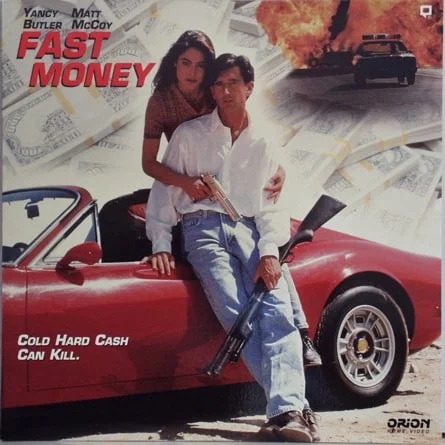
First released in 1996, Fast Money opens with Francesca March (Yancy Butler) stealing a car.
This is what Francesca does for a living. She steals cars and she’s good at it. She’s the type of who can look in any trashcan and find something that she can use to pick a lock. She’s master at hot-wiring a car. I personally have no idea how to hot-wire a car but, judging from the movies that I’ve seen, it appears to be the easiest thing in the world to do. Francesca doesn’t just steal cars for the money. She sincerely enjoys doing it, to the extent that it’s a compulsion for her. If she sees a car, she has to steal it.
This has not made her popular with the LAPD. In fact, an entire taskforce has been set up to stop her. Realizing that she has to get out of town, she rushes to the airport. It’s there that she runs into Jack Martin (Matt McCoy), a nerdy journalist who is working on a story that could take down a powerful U.S. Senator. Jack is looking to catch a flight to Reno. For reasons that aren’t particularly clear, Francesca rushes up to Jack and pretends to be his wife and the recently widowed Jack goes along with it.
Further complicating matters is that Francesca impulsively decides to seal one last car and the one that she picks just happens to have 3 million dollars in mob money and a bunch of counterfeit printing plates in the trunk. The evil Sir Stewart (Jacob Witkin) wants his money back and he sends Regy (Trevor Goddard) and corrupt detective Lt. Diego (John Ashton) to track down Francesca and Jack.
Soon, Francesca and Jack are desperately trying reach the Mexican border while dodging corrupt cops, FBI agents, and mobsters. It leads to a lot of car chases, explosions, helicopters, and shoot-outs. (The otherwise meek Jack turns out to be a surprising good shot. Neither he nor Francesca freaks out after he shoots multiple people, which is the sort of thing that I would probably freak out about.) Francesca and Jack also find themselves falling in love but wondering just how much they can trust each other. Stolen money does that to people.
Fast Money is a cheerfully dumb but entertainingly fast-paced movie, one in which the chase never stops long enough for the viewer to have too much time to try to figure out why the ultracool Francesa would be willing risk her freedom for a relationship with someone as whiny as Jack. Yancy Butler plays Francesca as being so confident and so fearless that it’s hard not to admire her but there’s also no way that she seems like she would ever have much use for someone as meek and repressed as Jack, regardless of how deadly his aim might be. One gets the feeling that the only thing keeping this couple together is the adrenaline rush of being hunted. If Jack and Francesca do make it to safety, their relationship will probably be over by the end of the week.
Though Fast Money is ultimately a fun but somewhat generic direct-to-video action film, I appreciated the film’s vision of a world where everyone from the mob to the police to the FBI were basically working together to track down one career criminal and one innocent man. When even the usually likable John Ashton is trying to murder you in a cheap motel, you know you have reached the other side of the looking glass. Jack learns what Francesca has always understood, which is that one should be suspicious of authority. Though it may not have been the film’s intent, Fast Money‘s ultimate message becomes, “Trust no one but yourself.”


 Through the Shattered Lens