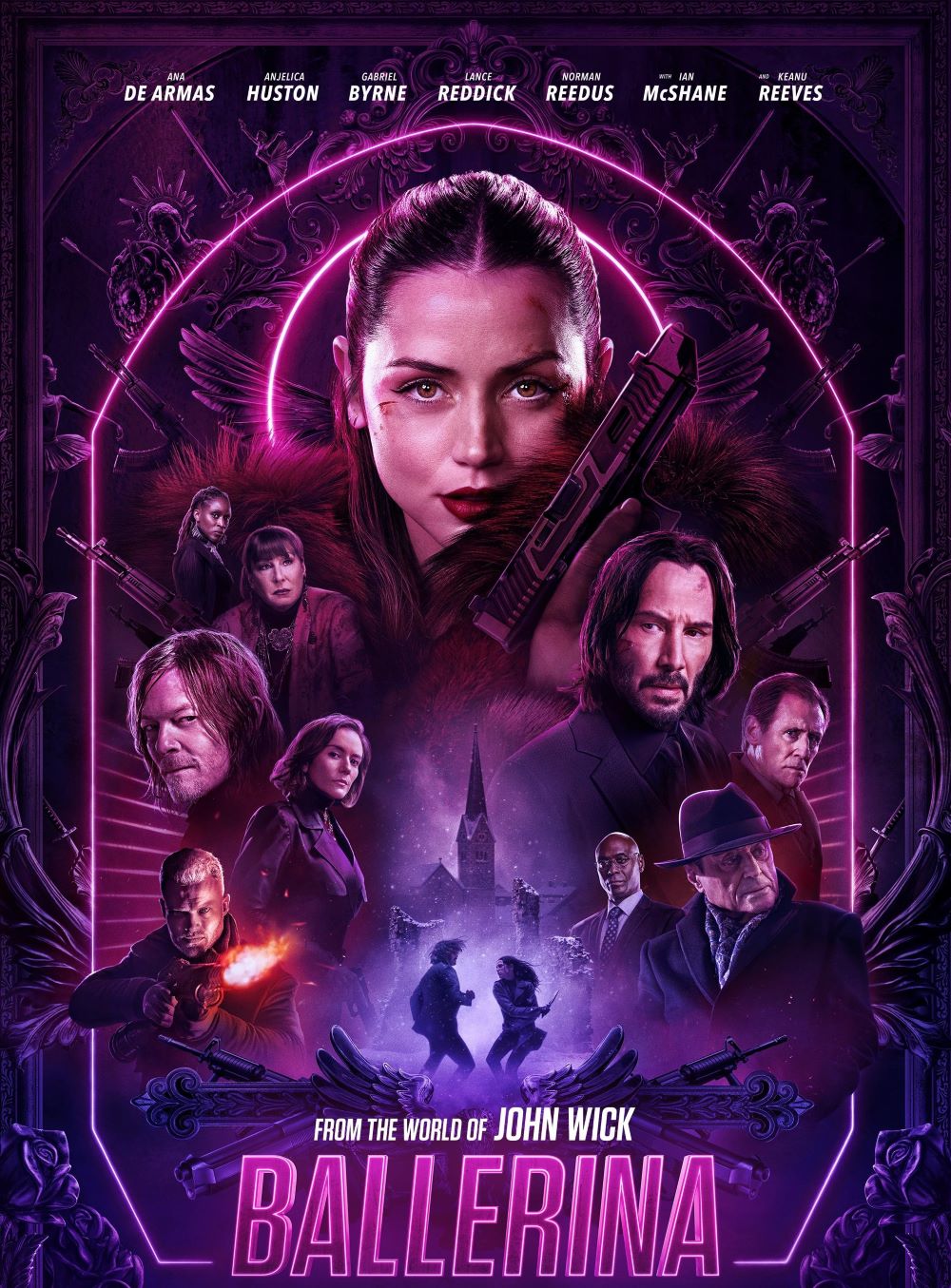
Review: Ballerina (dir. by Len Wiseman)


“You don’t choose to be a killer, you are chosen.” — The Chancellor

Ballerina lands in theaters feeling like someone finally turned the volume up on the quieter, more balletic side of the John Wick universe. Anchored by Ana de Armas’s poised, ferocious turn, the film doesn’t reinvent the neon‑lit, bullet‑cartoon rules of the franchise so much as rearrange them into a new rhythm. It’s still a very familiar kind of action movie—assassins, codes, bodies on the floor—but it carves out its own niche by centering a woman who’s not just another lethal accessory to John’s world, but someone the world has already trained into a weapon.

At the same time, Ballerina leans hard on the style and flourish of the later John Wick films, and that’s both its main selling point and its biggest limitation. The way shots linger on gun grips, the way the camera circles around bodies mid‑spin, the way every hallway fight feels like stage choreography—it’s all very familiar, very polished, and very much a continuation of the franchise’s visual language. That’s great if you’re here for the aesthetic, but it also means the film sometimes feels more like an extension of the Wick universe’s attitude than a story that confidently stands on its own two feet.

Ana de Armas plays Eve Macarro, a young assassin who grew up in the shadow of the Ruska Roma and the Continental, groomed to kill long before she fully understood what she was doing. The story unfolds in a loose “between films” slot in the Wick timeline, so fans who care about franchise continuity will get their little Easter eggs and cameos, but the film smartly never gets completely bogged down in explaining how this fits into every rulebook. Instead, it leans into the idea that the John Wick universe is big enough that other hunters can walk around in it, following their own grudges and grief. Eve’s motive is straightforward: she wants to track down the people she believes killed her father when she was a child, and along the way she has to square off against both the old guard of her upbringing and the cult‑like killers who seem to operate just outside the established order.

Like a lot of John Wick entries, though, Ballerina is ultimately more interested in expanding the world and reinforcing its rules than drilling deep into its own plot. Eve’s revenge‑driven quest gives the film its spine, but the mechanics of that revenge are often secondary to the chance to show off another assassin enclave, another weird code, or another showdown that feels like a set‑piece first and a character beat second. You can feel the priorities: where she travels, who she bumps into, and how this underworld operates often matter more than whether her arc is especially surprising or emotionally rich. The plotting starts to feel like connective tissue between bigger, more stylized sequences, and that’s where the reliance on franchise style starts to hurt more than help.

The film’s greatest strength is how it employs the language of ballet and violence in the same breath. The title Ballerina might make you expect a lot of literal tutus and pirouettes, and there’s a bit of that in the opening stretches, but the real choreography is in the fight scenes. Eve’s movement is light‑on‑her‑feet one moment—a few spins, a quick sidestep—and then suddenly brutal, close‑quarters savagery the next. The camera doesn’t just document her skills; it dances with them, letting wide‑angle shots show off the architecture of a fight before snapping into tight, impact‑heavy close‑ups. It’s unmistakably a Wick‑style approach, only dialed into a slightly more feminine, almost theatrical register.

De Armas deserves a lot of credit for making Eve feel like a real person, not just a killing machine with a pretty face. She’s cold, yes, but there’s weariness under the surface, the kind that comes from being raised in a world where emotions are a liability. The script doesn’t drown her in backstory; it just lets small moments—a hesitation, a glance at a photo, the way she holds a gun—do the work. When she finally loses her composure and starts to scream, grunt, and visibly struggle during later fights, the effect is more powerful than if she’d been effortlessly killing everyone from minute one. She sweats, she bleeds, she gets thrown around, and that makes her victories feel earned, not just cool.

Stylistically, Ballerina is very much in line with the rest of the franchise: glossy, slightly over‑the‑top, and hyper‑aware of its own aesthetic. The camera work is sleek, the color grading pops, and the score leans into synth textures that feel like a slightly more elegant cousin of the usual Wick pulse. There are also some deliberately playful musical choices—bits of Tchaikovsky and other classical motifs that echo in the background during key scenes—which tie the idea of ballet back to the film’s emotional core. The setting shifts from the familiar New York–style Continental spaces to a quieter, almost fairy‑tale European village that houses a different kind of assassins’ retirement community. It’s a neat trick: the filmmakers give us something that still feels like the same universe but just enough of a different flavor that it doesn’t feel like a rerun.

But that lush style also underlines how much the film is prioritizing world‑building over a tight narrative. Conversations about the Ruska Roma, the Continental, and the cult‑like assassins’ outpost are there less to advance Eve’s inner journey and more to remind us that the John Wick universe is vast, layered, and full of hierarchies. Fans who love the lore will probably eat that up, but if you’re hoping for a more self‑contained narrative, it can start to feel like you’re watching a very expensive lore compendium. The emotional core is there—it just has to fight for space amidst all the visual flexing and mythology maintenance.

Where Ballerina becomes a bit uneven is in its plotting. The basic “one girl, one very long night of revenge” template is solid, but the script doesn’t always give it enough depth or surprise. There are too many conversations where characters explain the rules of the world to each other, or recap what’s already been established, rather than using those moments to add nuance to the characters or relationships. The side figures—like various crime bosses, elders, and reluctant allies—do their jobs entertainingly enough, but they don’t all get the same level of interior life that Eve has. Some of the supporting performances are strong across the board, but the material doesn’t always push them to do anything more than punctuate the action beats.

Keanu Reeves drops in briefly as John Wick, and the cameo is handled with the kind of restraint that makes it feel like a favor rather than a stunt. He doesn’t hang around; he makes a sharp, efficient entrance, has a few quiet exchanges, and then exits, leaving the movie firmly in Eve’s hands. That’s crucial, because one of the criticisms of earlier spin‑off ideas was that they’d feel like vanity detours or glorified cameos. Here, John’s presence actually reinforces the idea that this is someone else’s story now, and that he’s just another player in a much larger ecosystem of killers.

The film’s worst moments are also some of its most visually striking: the bigger, more outlandish set‑pieces that lean fully into the franchise’s “go‑no‑go” action logic. The final third, in particular, is one long, almost goofy crescendo of fights, stunts, and absurdly lethal props. It’s a lot of fun in the moment, but it also underlines how thin the actual plotting can be. When the camera is spinning around a flamethrower‑wielding Eve or a hallway of assassins dropping in from the ceiling, the movie doesn’t always give us enough emotional context to care about who’s living or dying beyond the immediate spectacle. It’s the kind of sequence that will make fans cheer in the theater, but might look a bit clumsier on a second viewing.

One area where Ballerina arguably improves on the core series is its handling of gender dynamics. Eve isn’t fetishized; she’s allowed to be both emotionally grounded and physically dominant without being framed as some kind of fantasy object. The film nods to the idea of “girl power” in the assassin world, but it also lets the character operate within familiar constraints—tradition, hierarchy, and expectation—instead of pretending she’s a one‑woman revolution. She’s tough, but she’s also vulnerable, and that balance keeps the tone from tipping entirely into empty empowerment sloganeering. The way the movie treats her relationships—with her father’s memory, with her mentors, and with the people she’s ordered to kill—adds a layer of emotional sophistication that earlier entries in the franchise often glossed over for the sake of pure momentum.

If you’re coming into Ballerina expecting a radical reinvention of the series, you’ll probably leave a little underwhelmed. It doesn’t rip up the rulebook or deliver a huge thematic twist on what we already know about this universe. Instead, it refocuses the camera on a different kind of protagonist, lets the familiar style breathe a little differently, and proves that the world of John Wick is big enough to house more than just one lone wolf. It’s a stylish, violent, occasionally silly, definitely pulpy action film that knows exactly what it wants to be: a long, bloody ballet in which the lead is a woman who’s finally ready to dance on her own terms—even if the choreography sometimes matters more than the story it’s supposedly telling.

John Wick Franchise (spinoffs)
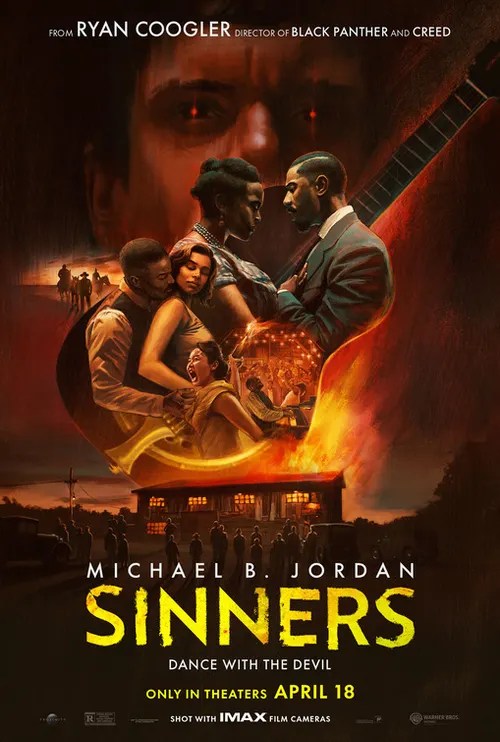
The Alliance of Women Film Journalists Honors Sinners


The Alliance of Women Film Journalists have announced their picks for the best of 2025!  The winners are in bold!

BEST FILM
FRANKENSTEIN
HAMNET
IT WAS JUST AN ACCIDENT
ONE BATTLE AFTER ANOTHER
THE SECRET AGENT
SENTIMENTAL VALUE
SINNERS
TRAIN DREAMS

BEST DIRECTOR
Paul Thomas Anderson – ONE BATTLE AFTER ANOTHER
Ryan Coogler – SINNERS
Jafar Panahi – IT WAS JUST AN ACCIDENT
Joachim Trier – SENTIMENTAL VALUE
Chloe Zhao – HAMNET

BEST SCREENPLAY, ORIGINAL
IT WAS JUST AN ACCIDENT – Jafar Panahi
JAY KELLY – Noah Baumbach
SENTIMENTAL VALUE – Joachim Trier
SINNERS – Ryan Coogler
SORRY, BABY – Eva Victor

BEST SCREENPLAY, ADAPTED
BUGONIA – Will Tracy
FRANKENSTEIN – Guillermo del Toro
HAMNET – Maggie O’Farrell & Chloe Zhao
ONE BATTLE AFTER ANOTHER – Paul Thomas Anderson
TRAIN DREAMS – Clint Bentley & Greg Kwedar

DOCUMENTARY
COME SEE ME IN THE GOOD LIGHT – Ryan White
MY MOM JAYNE – Mariska Hargitay
ORWELL 2+2=5 – Raoul Peck
THE LIBRARIANS – Kim A. Snyder
THE PERFECT NEIGHBOR – Geeta Gandbhir

ANIMATED FEATURE
ARCO – Ugo Bienvenu & Giles Cazaux
IN YOUR DREAMS – Erik Benson & Alexander Woo
KPOP DEMON HUNTERS – Chris Applehaus & Maggie Kang
LITTLE AMELIE OR THE CHARACTER OF RAIN – Liane-Cho Jin Kuang & Mailys Vallade
ZOOTOPIA 2 – Jared Bush & Simon Howard

BEST ACTRESS
Jessie Buckley – HAMNET
Rose Byrne – IF I HAD LEGS I’D KICK YOU
Renate Reinsve – SENTIMENTAL VALUE
Emma Stone – BUGONIA
Tessa Thompson – HEDDA

BEST ACTRESS, SUPPORTING
Nina Hoss – HEDDA
Inga Ibsdotter Lilleaas – SENTIMENTAL VALUE
Amy Madigan – WEAPONS
Teyana Taylor – ONE BATTLE AFTER ANOTHER
Wunmi Mosaku – SINNERS

BEST ACTOR
Leonardo DiCaprio – ONE BATTLE AFTER ANOTHER
Joel Edgerton – TRAIN DREAMS
Ethan Hawke – BLUE MOON
Michael B. Jordan – SINNERS
Wagner Moura – THE SECRET AGENT

BEST ACTOR, SUPPORTING
Benicio Del Toro – ONE BATTLE AFTER ANOTHER
Jacob Elordi – FRANKENSTEIN
Paul Mescal – HAMNET
Sean Penn – ONE BATTLE AFTER ANOTHER
Stellan Skarsgård – SENTIMENTAL VALUE

BEST ENSEMBLE CAST & CASTING DIRECTOR
HAMNET – Nina Gold & Lucy Amos
MARTY SUPREME – Jennifer Venditti
NOUVELLE VAGUE – Stéphane Batut
ONE BATTLE AFTER ANOTHER – Cassandra Kulukundis
SINNERS – Francine Maisler

BEST CINEMATOGRAPHY
FRANKENSTEIN – Dan Laustsen
HAMNET – Łukasz Żal
ONE BATTLE AFTER ANOTHER – Michael Bauman
SINNERS – Autumn Durald Arkapaw
TRAIN DREAMS – Adolpho Veloso

BEST EDITING
F1: THE MOVIE – Stephen Mirrione & Patrick J. Smith
HAMNET – Affonso Gonçalves & Chloe Zhao
MARTY SUPREME – Ronald Bronstein & Josh Safdie
ONE BATTLE AFTER ANOTHER – Andy Jurgensen
SINNERS – Michael P. Shawver

BEST INTERNATIONAL FEATURE
IT WAS JUST AN ACCIDENT – Jafar Panahi
NO OTHER CHOICE – Park Chan-wook
SENTIMENTAL VALUE – Joachim Trier
SIRÂT – Oliver Laxe
THE SECRET AGENT – Kleber Mendonça Filho

FEMALE FOCUS AWARDS
Presented Only to Women

FEMALE FOCUS: BEST FEMALE DIRECTOR
Kathryn Bigelow – A HOUSE OF DYNAMITE
Mary Bronstein – IF I HAD LEGS I’D KICK YOU
Mona Fastvold – THE TESTAMENT OF ANN LEE
Eva Victor – SORRY, BABY
Chloe Zhao – HAMNET

FEMALE FOCUS: BEST FEMALE WRITER
Mary Bronstein – IF I HAD LEGS I’D KICK YOU
Nia DaCosta – HEDDA
Hikari & Stephen Blahut – RENTAL FAMILY
Eva Victor – SORRY, BABY
Chloe Zhao & Maggie O’Farrell – HAMNET

FEMALE FOCUS: BEST VOICED PERFORMANCE IN ANIMATED FILM
Ginnifer Goodwin – ZOOTOPIA 2
Loïse Charpentier – LITTLE AMELIE OR THE CHARACTER OF RAIN
Arden Cho – KPOP DEMON HUNTERS
Fortune Feimster – ZOOTOPIA 2
Zoë Saldaña – ELIO

FEMALE FOCUS: BEST BREAKTHROUGH PERFORMANCE
Odessa A’Zion – MARTY SUPREME
Chase Infiniti – ONE BATTLE AFTER ANOTHER
Teyana Taylor – ONE BATTLE AFTER ANOTHER
Wunmi Mosaku – SINNERS
Eva Victor – SORRY, BABY

FEMALE FOCUS: BEST STUNTS PERFORMANCE
Ana de Armas – BALLERINA
Hayley Atwell – MISSION: IMPOSSIBLE – THE FINAL RECKONING
Chase Infiniti – ONE BATTLE AFTER ANOTHER
Teyana Taylor – ONE BATTLE AFTER ANOTHER
Pom Klementieff – MISSION: IMPOSSIBLE – THE FINAL RECKONING

Here Are The 2025 Nominations of the Alliance of Women Film Journalists


Here are the 2025 nominations of the Alliance of Women Film Journalists!

BEST FILM
FRANKENSTEIN
HAMNET
IT WAS JUST AN ACCIDENT
ONE BATTLE AFTER ANOTHER
THE SECRET AGENT
SENTIMENTAL VALUE
SINNERS
TRAIN DREAMS

BEST DIRECTOR
Paul Thomas Anderson – ONE BATTLE AFTER ANOTHER
Ryan Coogler – SINNERS
Jafar Panahi – IT WAS JUST AN ACCIDENT
Joachim Trier – SENTIMENTAL VALUE
Chloe Zhao – HAMNET

BEST SCREENPLAY, ORIGINAL
IT WAS JUST AN ACCIDENT – Jafar Panahi
JAY KELLY – Noah Baumbach
SENTIMENTAL VALUE – Joachim Trier
SINNERS – Ryan Coogler
SORRY, BABY – Eva Victor

BEST SCREENPLAY, ADAPTED
BUGONIA – Will Tracy
FRANKENSTEIN – Guillermo del Toro
HAMNET – Maggie O’Farrell & Chloe Zhao
ONE BATTLE AFTER ANOTHER – Paul Thomas Anderson
TRAIN DREAMS – Clint Bentley & Greg Kwedar

DOCUMENTARY
COME SEE ME IN THE GOOD LIGHT – Ryan White
MY MOM JAYNE – Mariska Hargitay
ORWELL 2+2=5 – Raoul Peck
THE LIBRARIANS – Kim A. Snyder
THE PERFECT NEIGHBOR – Geeta Gandbhir

ANIMATED FEATURE
ARCO – Ugo Bienvenu & Giles Cazaux
IN YOUR DREAMS – Erik Benson & Alexander Woo
KPOP DEMON HUNTERS – Chris Applehaus & Maggie Kang
LITTLE AMELIE OR THE CHARACTER OF RAIN – Liane-Cho Jin Kuang & Mailys Vallade
ZOOTOPIA 2 – Jared Bush & Simon Howard

BEST ACTRESS
Jessie Buckley – HAMNET
Rose Byrne – IF I HAD LEGS I’D KICK YOU
Renate Reinsve – SENTIMENTAL VALUE
Emma Stone – BUGONIA
Tessa Thompson – HEDDA

BEST ACTRESS, SUPPORTING
Nina Hoss – HEDDA
Inga Ibsdotter Lilleaas – SENTIMENTAL VALUE
Amy Madigan – WEAPONS
Teyana Taylor – ONE BATTLE AFTER ANOTHER
Wunmi Mosaku – SINNERS

BEST ACTOR
Leonardo DiCaprio – ONE BATTLE AFTER ANOTHER
Joel Edgerton – TRAIN DREAMS
Ethan Hawke – BLUE MOON
Michael B. Jordan – SINNERS
Wagner Moura – THE SECRET AGENT

BEST ACTOR, SUPPORTING
Benicio Del Toro – ONE BATTLE AFTER ANOTHER
Jacob Elordi – FRANKENSTEIN
Paul Mescal – HAMNET
Sean Penn – ONE BATTLE AFTER ANOTHER
Stellan Skarsgård – SENTIMENTAL VALUE

BEST ENSEMBLE CAST & CASTING DIRECTOR
HAMNET – Nina Gold & Lucy Amos
MARTY SUPREME – Jennifer Venditti
NOUVELLE VAGUE – Stéphane Batut
ONE BATTLE AFTER ANOTHER – Cassandra Kulukundis
SINNERS – Francine Maisler

BEST CINEMATOGRAPHY
FRANKENSTEIN – Dan Laustsen
HAMNET – Łukasz Żal
ONE BATTLE AFTER ANOTHER – Michael Bauman
SINNERS – Autumn Durald Arkapaw
TRAIN DREAMS – Adolpho Veloso

BEST EDITING
F1: THE MOVIE – Stephen Mirrione & Patrick J. Smith
HAMNET – Affonso Gonçalves & Chloe Zhao
MARTY SUPREME – Ronald Bronstein & Josh Safdie
ONE BATTLE AFTER ANOTHER – Andy Jurgensen
SINNERS – Michael P. Shawver

BEST INTERNATIONAL FEATURE
IT WAS JUST AN ACCIDENT – Jafar Panahi
NO OTHER CHOICE – Park Chan-wook
SENTIMENTAL VALUE – Joachim Trier
SIRÂT – Oliver Laxe
THE SECRET AGENT – Kleber Mendonça Filho

FEMALE FOCUS AWARDS
Presented Only to Women

FEMALE FOCUS: BEST FEMALE DIRECTOR
Kathryn Bigelow – A HOUSE OF DYNAMITE
Mary Bronstein – IF I HAD LEGS I’D KICK YOU
Mona Fastvold – THE TESTAMENT OF ANN LEE
Eva Victor – SORRY, BABY
Chloe Zhao – HAMNET

FEMALE FOCUS: BEST FEMALE WRITER
Mary Bronstein – IF I HAD LEGS I’D KICK YOU
Nia DaCosta – HEDDA
Hikari & Stephen Blahut – RENTAL FAMILY
Eva Victor – SORRY, BABY
Chloe Zhao & Maggie O’Farrell – HAMNET

FEMALE FOCUS: BEST VOICED PERFORMANCE IN ANIMATED FILM
Ginnifer Goodwin – ZOOTOPIA 2
Loïse Charpentier – LITTLE AMELIE OR THE CHARACTER OF RAIN
Arden Cho – KPOP DEMON HUNTERS
Fortune Feimster – ZOOTOPIA 2
Zoë Saldaña – ELIO

FEMALE FOCUS: BEST BREAKTHROUGH PERFORMANCE
Odessa A’Zion – MARTY SUPREME
Chase Infiniti – ONE BATTLE AFTER ANOTHER
Teyana Taylor – ONE BATTLE AFTER ANOTHER
Wunmi Mosaku – SINNERS
Eva Victor – SORRY, BABY

FEMALE FOCUS: BEST STUNTS PERFORMANCE
Ana de Armas – BALLERINA
Hayley Atwell – MISSION: IMPOSSIBLE – THE FINAL RECKONING
Chase Infiniti – ONE BATTLE AFTER ANOTHER
Teyana Taylor – ONE BATTLE AFTER ANOTHER
Pom Klementieff – MISSION: IMPOSSIBLE – THE FINAL RECKONING

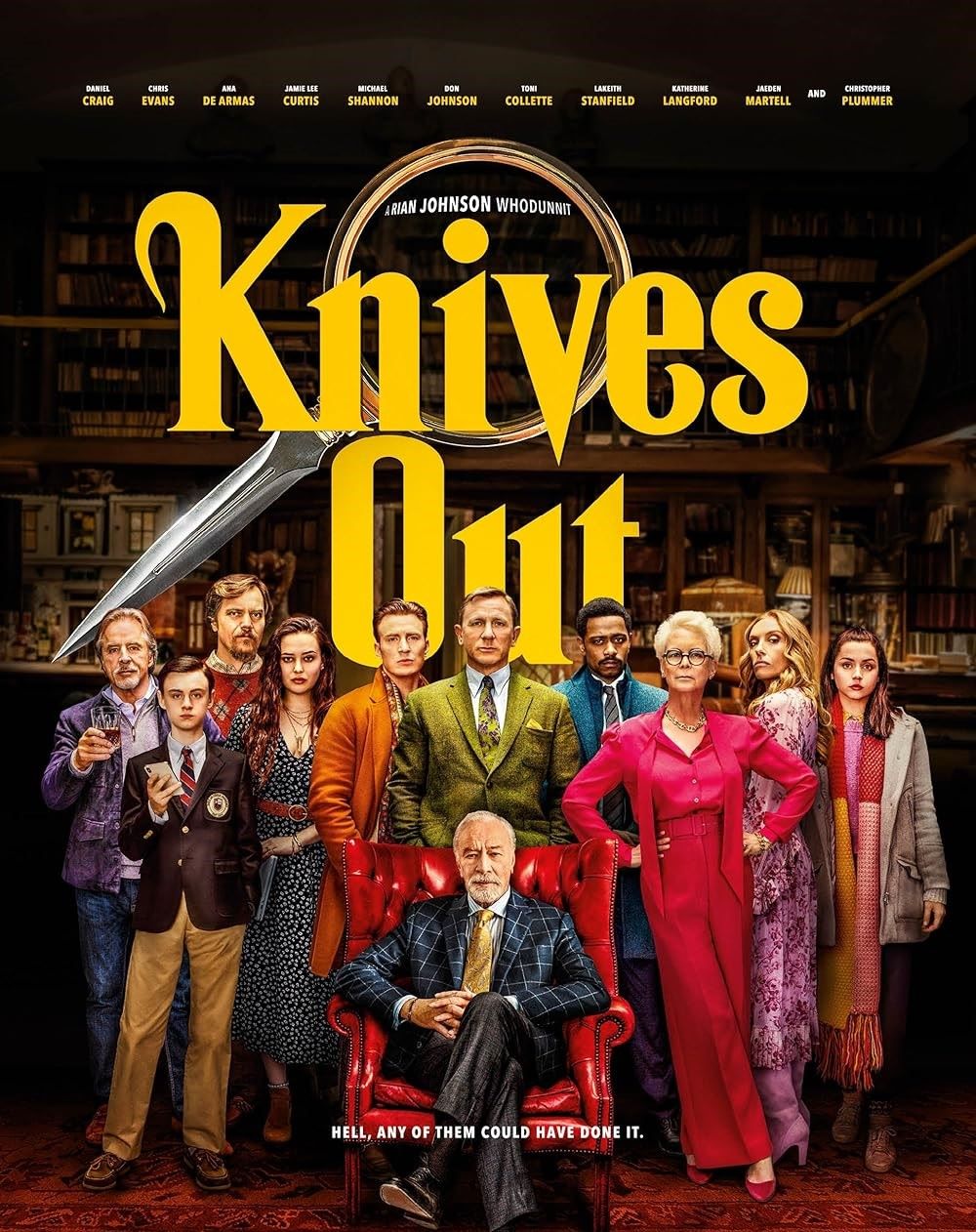
Review: Knives Out (dir. by Rian Johnson)


“The family is truly desperate. And when people get desperate, the knives come out.” — Benoit Blanc

After shaking up galaxies far, far away with Star Wars: The Last Jedi, Rian Johnson returned to solid ground in 2019 with Knives Out, a film so self-assured and inventive it practically felt like a director catching his breath while reminding the world what made him exciting in the first place. It was his first movie after that polarizing Star Wars entry, and he used the opportunity not to go bigger, but smarter—to take something intimate, character-driven, and refreshingly old-school and make it gleam again. Knives Out landed as a kind of palate cleanser for both him and the audience: a modern mystery that leaned into genre nostalgia while reinventing it with sharp humor and social bite. The result wasn’t just a change of pace—it was a confident display of craft from a filmmaker unbothered by his critics, operating with absolute control over every frame, every line, and every perfectly timed smirk.

The setup couldn’t be more classic: a wealthy family patriarch, Harlan Thrombey, turns up dead after his 85th birthday, leaving behind a tangled household of suspects, secrets, and strained smiles. His death looks like suicide, but something isn’t right. Enter Benoit Blanc, a Southern gentleman detective hired anonymously to snoop through the wreckage of lies and grievances. The scenario drips with vintage whodunit flavor, but Johnson’s genius lies in retooling that familiarity into something electrifyingly modern. The Thrombeys aren’t just eccentric millionaires—they’re avatars of American entitlement, each convinced of their own superiority while quietly dependent on the man they pretend to revere. By building his mystery around a clan that mirrors contemporary divisions of money, politics, and self-deception, Johnson injects wit and purpose into the genre without ever losing the fun of the game.

Jamie Lee Curtis plays the confident matriarch Linda, Michael Shannon the resentful son Walt, Toni Collette the spiritual grifter Joni, and Don Johnson the smirking son-in-law Richard—all of them playing heightened but recognizable shades of selfishness. Their sniping exchanges during the first act are among the film’s best sequences, packed with fast banter, political jabs, and casual hypocrisy. Johnson directs these moments like a verbal tennis match, letting personalities bounce and clash until the family’s shiny façade cracks enough for true frustrations to spill out. It’s sharp, funny, and chaotic, showing early on that no one in the Thrombey family is as self-made or self-aware as they claim to be.

Amid that colorful ensemble, the performance that most stunned audiences came from Chris Evans as Ransom Drysdale, Harlan’s playboy grandson and the family’s unapologetic black sheep. Coming off years of playing Marvel’s resolutely noble Steve Rogers, Evans dives into Ransom with visible glee, turning him into a figure of charm and mystery whose motives are never quite clear. He’s magnetic from the moment he appears—witty, cynical, a little dangerous—and Johnson clearly relishes using Evans’s clean-cut image to toy with expectations. Ransom strides into the story radiating confidence, but there’s a guarded, almost predatory intelligence behind his grin. His scenes crackle because the audience can’t quite decide where to place him: is he the rare Thrombey who sees through the family hypocrisy, or is he spinning his own kind of manipulation? That tension between self-awareness and deceit gives his every line an edge. Watching Evans in this role feels like a release for him and a thrill for viewers, a testament to both his range and Johnson’s intuitive casting.

Opposite that moral uncertainty stands Ana de Armas’s Marta Cabrera, Harlan’s kind and soft-spoken nurse who suddenly finds herself at the heart of the story. Marta grounds the entire film emotionally, her decency cutting through the Thrombeys’ arrogance like sunlight in a dusty room. She’s the migrant caretaker who everyone claims to love while casually condescending to, a detail Johnson uses to expose how often politeness masks prejudice. Marta’s inability to lie without vomiting, played initially for laughs, gradually becomes symbolic—a kind of moral honesty that makes her unique in a house ruled by deception. De Armas brings layered vulnerability to the role, balancing fear, guilt, and compassion with natural ease. Through her, Johnson turns the whodunit into something more human and emotionally resonant. She isn’t just a witness or a suspect; she’s the beating heart around which all the greed, paranoia, and privilege revolve.

Then there’s Daniel Craig’s Benoit Blanc, whose arrival shifts the film into another gear entirely. His Southern drawl—equal parts poetic and perplexing—sets the tone for what becomes one of Craig’s most playful performances. After years of portraying the stoic James Bond, he’s clearly having the time of his life as a detective who investigates with both intellect and intuition. Blanc operates less like a hard-nosed cop and more like a philosopher; he believes that solving a crime means understanding human weakness as much as evidence. His famous “donut hole” speech perfectly captures the balance Johnson strikes between earnestness and absurdity. Blanc may revel in his own melodrama, but he also brings heart to chaos, observing people’s contradictions without losing his sense of wonder. The result is a detective who’s less about revelation and more about revelation’s moral cost.

Visually, Knives Out belongs to a rare category of films that are so meticulously crafted they could be paused at any frame and still look compelling. Johnson and cinematographer Steve Yedlin transform Harlan’s mansion into a breathing character—an architectural echo chamber of secrets. The walls are lined with strange trinkets, elaborate paintings, and heavy mahogany furniture that suggest old money’s suffocating weight. There’s something both cozy and claustrophobic about the space, which mirrors the tension between family warmth and poisonous resentment. The camera glides through it with purpose, lingering on small details that gain meaning later, and the autumn-colored palette—deep reds, browns, and golds—wraps everything in an inviting melancholy. It’s as much a visual experience as it is a narrative one, and few modern mysteries feel as tactile.

Johnson’s writing keeps that sense of precision. The plot unfolds like clockwork, but the mechanics never feel mechanical. Instead, he keeps viewers off-balance by blending humor with genuine suspense. Instead of relying entirely on high-stakes twists, Johnson builds tension through empathy, giving us access to characters’ doubts and stakes rather than just their clues. The result is a mystery that keeps the audience guessing in emotional and moral dimensions, not just logical ones. Every revelation says as much about character as it does about the crime.

Underneath the quick humor and ornate mystery structure, Knives Out doubles as a satire of class and entitlement. Johnson sketches the Thrombeys as people who talk endlessly about fairness, morality, and self-reliance yet collapse into panic when their material comfort is threatened. Through them, he captures a peculiar American irony: the people most obsessed with earning their status are often those most insulated from real struggle. When the family gathers to argue over wealth and loyalty, Johnson doesn’t need to exaggerate—they expose themselves with every smug phrase and self-justified rant. It’s social commentary that’s biting but never heavy-handed because it plays out through personality instead of sermon.

Nathan Johnson’s score carries the story forward with playful precision, shifting from tension to whimsy in sync with the characters’ shifting loyalties. There’s something almost dance-like about the film’s rhythm: scenes of laughter can spiral into confession, and interrogations can dissolve into comedy without losing a beat. The editing supports that agility, cutting crisply between overlapping dialogue and close-ups that reveal just enough expression to keep us alert. Johnson’s sense of pacing feels theatrical in the best way—it’s about timing and tone rather than spectacle.

As with many of Rian Johnson’s works, contradiction fuels the story’s appeal. Knives Out is cynical about human greed but oddly hopeful about individual decency. It mocks arrogance but rewards empathy. Even when it toys with genre clichés, it does so out of affection, not scorn. Johnson clearly understands that mystery storytelling is as much about character and morality as deduction, and he uses humor and chaos as tools to explore who people become under pressure. The movie’s sophistication lies in how effortless it feels—its layers unfold smoothly, but the craft behind them is razor sharp.

The film’s ending closes with a visual that redefines power without needing words. After a story filled with deceit, pretension, and the scramble to control a legacy, it concludes on an image that says everything about perspective—who actually holds the moral high ground and how quietly dignity can win. Like the rest of the movie, it’s both playful and pointed, leaving you smiling while still turning the characters’ behavior over in your mind.

Looking back, Knives Out stands as a defining moment in Rian Johnson’s career. After the spectacle and dialogue storms of The Last Jedi, this lean, ensemble-driven mystery reaffirmed his strengths as a writer-director who thrives on structure, rhythm, and human contradictions. It’s a film that takes as much pleasure in observation as revelation, brimming with sly humor and performances that sparkle across the moral spectrum. Anchored by Ana de Armas’s poignant sincerity, Daniel Craig’s eccentric brilliance, and Chris Evans’s unpredictable charisma, it became one of the most purely enjoyable movies of its time. Witty without pretense, political without lecturing, and perfectly balanced between cynicism and heart, Knives Out remains proof that the old whodunit can still cut deep—and that Rian Johnson’s sharpest weapon is still his storytelling.

Film Review: From the World of John Wick: Ballerina (dir. by Len Wiseman)


It seems almost inevitable that Ana de Armas would make it into the John Wick franchise. Having worked with Keanu Reeves in multiple films since 2015’s Knock Knock, she has great chemistry with him on camera. De Armas has also proven she can handle action both with 2021’s No Time to Die and 2023’s Ghosted, with the latter also boasting a bit of comedy. From the World of John Wick: Ballerina (or just Ballerina for the sake of this writing) puts Ana in the mix of all the madness as Eve Maccaro. While it doesn’t have the tightest story in the world when compared to the rest of the John Wick saga, Ballerina does hold its own at least as a showcase for the stunt work. If you enjoyed Atomic Blonde or any of the Underworld films, you really won’t have any problems here.

The story for Ballerina takes place during the events of John Wick 3 – Parabellum. As a child, when Eve loses her father to a crew of armed men sporting a brand on their wrists, she is taken in by The Continental’s Winston (Ian McShane). Winston introduces her to the tribe of killers known as the Ruska Roma, lead by The Director (Anjelica Houston), who train her to become like them. Those familiar with the John Wick franchise will recall that the Ruska Roma was John’s tribe before some action caused a split between him and them.

In addition to her pointe practices (which look painful), she’s trained with knives, guns and other tactics. Unlike the assassins that normally frequent The Continental, the Ruska Roma aren’t fully ruthless and can be a force of good. After handling various tests, she discovers a clue leading to the people who killed her father and the man who leads them (ironically played by Point of No Return’s’ Gabriel Byrne, given the film moves in similar circles). Can Eve get her vengeance in the shadow of the legendary Baba Yaga?

While Eve’s story is a still a tale of vengeance as much as Wick’s, there are two distinct differences. As taught by her trainer Nogi (Sharon Duncan Brewster, Dune: Part One), being a girl has some merits and flaws. She might not have the strength to go toe to toe with some of her male opponents (and try telling Ana this, she throws herself deep into the stuntwork), she can move for weakpoints and cheat her way though to victory. “Fight like a girl” becomes the motto. The other difference is that Eve has to work within both the rules of the Ballerinas as well as those the High Table puts on their Hotels. I thought that was an interesting touch to things.

With those stunts, I really would like to know if Ana or any of the stunt team were hurt in any way making this film. Eve goes through a lot and doesn’t have that protective Armani suit of Wick’s. Into walls, over dressers, through glass and even fire, but she keeps getting up and giving that damage right back to her targets. I hope this becomes a contender for the Academy’s new award for stunts. It’s an easy lock for a Nomination.

Casting-wise, you’ll see some familiar faces. Winston and Charon (the late Lance Reddick) are both on hand, as well as stuntman/actor Daniel Bernhardt (The Matrix Reloaded, Nobody, that awesome “ronny/lily’ episode of HBO’s Barry). Some new faces include Norman Reedus (The Walking Dead) and Anne Parillaud (Innocent Blood, La Femme Nikita).

Len Wiseman hasn’t directed a feature film since 2012’s Total Recall, but watching Ballerina you really couldn’t tell. Some of the locales do look like they were borrowed from Wiseman’s Underworld films, but that actually works in Ballerina‘s favor. The film flows well from scene to scene and the action is visible enough that there’s little to miss. There are very few lulls in the action. Though the film was written by both Derek Kolstad and Shay Hatten, who both previously worked on pretty much the entire Wick Franchise along with Nobody, it’s a different flavor to things. You won’t any any major info on the High Table and how all that works, though. This more of a contained story that flutters through the rest of the universe.

I only had one major problem with Ballerina, which was the way in which they chose to cameo Keanu Reeves as John Wick. Unless I’m wrong, I think the story makes a mistake in the John Wick timeline at some point by bringing Wick and Eve face to face (and the trailers already alluded to this). Their meeting appears to occur after Wick’s branding and ex-communication from the Ruska Roma (“You can never come back.”, she told him in John Wick 3), so the events leading up to the meeting didn’t entirely make sense to me (though it was wonderful to watch). It doesn’t mar the film, it’s still enjoyable. It’s just that tiny question that digs in the back of your skull like “If Old Biff gave young Biff the Almanac, and Young Biff changed the future, how did Old Biff exist long enough to return the DeLorean back to a 2015 timeline that shouldn’t exist anymore?” – a question I still ask every now and then.

Overall, Ballerina is a pretty good addition to the John Wick franchise. Ana de Armas gives it her all and deserves all the kudos for that work she puts in. Here’s hoping that we get a bit more of her action (and of that universe) down the road.

Ana de Armas visits the Continental in the Ballerina Trailer!


It seems rather fitting to see Ana de Armas taking the lead in a story within John Wick’s universe. After all, she’s has a knack for action with films like No Time to Die and Ghosted, and she’s worked with Keanu Reeves in both Knock Knock and Exposed. The real question with Ballerina is whether audiences will want to see a John Wick-like film with a female lead. I can already imagine the incel crowd chirping about how John Wick is now tainted with the touch of – (Ick!! Dare I say it….) – Women. That same crowd may also have forgotten about Adrianne Palicki’s assassin in the first film, and Halle Berry’s character with her dogs in the third. Female Assassins are as old at the Kunoichi. Perhaps even far older than that. There are so many tales to be told, especially in this universe.

I’m excited to see how this turns out. With a look that mirrors Le Femme Nikita and Point of No Return, de Armas’ Eve looks to be just as dangerous as her predecessor, possibly as one of the Ballerina assassins referenced in John Wick 3. The trailer has the feel of the other movies, but we’ll have to wait and find out when it releases. Len Wiseman has the directing duties on this one. It’s been a while since he made a movie, but I did enjoy the style of 2012’s Total Recall. Hopefully, he’ll do good here.

The only thing that I find odd is the name – audiences all know it has to do with John Wick. Does it have to have that whole “From the World of John Wick” in the title? I’m pretty sure your average movie viewer will put things together once they see the Continental, Winston (Ian McShane) or Charon (Lance Reddick, in one of his final roles). Also on hand are Norman Reedus (The Bikeriders) and of course, Keanu Reeves, which could just be a cameo.

From the World of John Wick: Ballerina will be in cinemas in 2025.

The Internet Film Critics Society Honors Tar


The Internet Film Critics Society has announced their picks for the best of 2022!

And here they are:

Best Drama: Tar
Best Comedy: The Banshees of Inisherin
Best Horror or Science Fiction: Crimes of the Future
Best Action Film: Top Gun: Maverick
Best Actor: Brendan Fraser in The Whale
Best Actress: Ana de Armas in Blonde
Best Director: Steven Spielberg for The Fabelmans
Best Experimental Film: Everything Everywhere All at Once
Most Underrated Film: The Outfit
Worst Film: The Munsters

Lisa Marie’s Early Oscar Predictions For July


Little by little, the Oscar race is starting to become just a little bit clearer.  It’s still early, of course.  Really, it’s way too early to say anything for sure.  But it’s also hard to deny that certain films are now much more in the conversation than others.

The biggest development this month was the announcement that Martin Scorsese’s Killers of the Flower Moon will not be released until 2023.  That takes it out of Oscar contention …. for now.  (For those who may have forgotten, it was originally announced, halfway through 2013, that The Wolf of Wall Street would not be ready until sometimes in 2014.  Everyone dutifully updated their Oscar predictions, striking The Wolf of Wall Street from their lists of likely best picture nominees.  Then, at the last minute, Scorsese announced that the film actually would be ready for 2013.  If something similar happens this year, Killers of the Flower Moon will go right back to being a huge contender because it’s Scorsese and he’s one of the best, regardless of what certain Marvel fans would have you believe.)  With Scorsese apparently out, it would now appear that Steven Spielberg is going to be the only member of the old guard with a film in the Oscar race.  Considering that many people believe that Spielberg’s West Side Story was snubbed last year when it only took home one Oscar (out of a total of sever nominations), The Fabelmans seems like it will be a major contender.  Admittedly, my hope that David Lynch will earn an acting nomination for playing John Ford in The Fabelmans may be a longshot but it can not be denied that it would be a cool development.

As for the other contenders, Top Gun: Maverick, Elvis, and Everything Everywhere All At Once all seem poised to ride a combination of critical acclaim and box office success into the Oscar race.  Todd Field has finally returned with TarThe Whale has the potential to be a comeback vehicle for the always likable Brendan Fraser.  She Said, Till, and Women Talking all stand to take advantage of the current political climate.  And Babylon will presumably give Hollywood a chance to celebrate itself.

The Oscar picture is still a bit cloudy but, with so many major festival on the horizon, those clouds should be parting soon.

Be sure to check out my predictions for February, March, April, May, and June!

Best Picture

Babylon

Elvis

Everything Everywhere All At Once

The Fabelmans

She Said

Tar

Till

Top Gun: Maverick

The Whale

Women Talking

Best Director

Damien Chazelle for Babylon

Daniel Kwan and Daniel Scheinert (The Daniels) for Everything Everywhere All At Once

Todd Field for Tar

Sarah Polley for Women Talking

Steven Spielberg for The Fabelmans

Best Actor

Austin Butler in Elvis

Tom Cruise in Top Gun: Maverick

Adam Driver in White Noise

Brendan Fraser in The Whale

Harry Styles in My Policeman

Best Actress

Cate Blanchett in Tar

Viola Davis in The Woman King

Ana de Arms in Blonde

Danielle Deadwyler in Till

Michelle Yeoh in Everything Everywhere All At Once

Best Supporting Actor

Tom Hanks in Elvis

Woody Harrelson in Triangle of Sadness

David Lynch in The Fabelmans

Tobey Maguire in Babylon

Ke Huy Quan in Everything Everywhere All At Once

Best Supporting Actress

Jessie Buckley in Women Talking

Patricia Clarkson in She Said

Jamie Lee Curtis in Everything Everywhere All At Once

Sally Field in Spoiler Alert: The Hero Dies

Michelle Williams in The Fabelmans

Here’s The Trailer For Blonde!


There are some people out there (mainly on Twitter) who are convinced that Andrew Dominik’s film adaptation of Blonde will be the first NC-17 film to win the Oscar for Best Picture.

Well …. maybe.  If I’m skeptical, it’s because I can still remember suffering through Dominik’s previous non-documentary film, Killing Them Softly.  That said, Ana de Armas seems like she’s destined to be nominated some day and playing the lead role of Marilyn Monroe in a controversial film adapted from a controversial Joyce Carol Oates novel seems like the sort of thing that will get the Academy’s attention.

Here’s the trailer for Blonde:

Here’s The Trailer For The Gray Man!


Pity The Gray Man.

The trailer for this upcoming Netflix spy thriller had the misfortune to drop as the same time as the trailer for the new Mission: Impossible film.  Needless to say, The Gray Man has been a bit overshadowed, despite being directed by the Russo Brothers and starring Ryan Gosling, Chris Evans, and Ana de Armas.

As for the trailer itself, it looks like a standard Netflix action flick but, if you’ve seen The Iceman, you know that Chris Evans can be an entertainingly eccentric villain.  And I think the Russo Brothers do have the potential to be a force outside of the MCU, even if Cherry did fall a bit flat.  So, we’ll see!   

Here’s the trailer!