Today’s horror song of the day really needs no introduction.
From 1960, here is the main theme from Alfred Hitchcok’s Psycho, composed by Bernard Herrmann.
Today’s horror song of the day really needs no introduction.
From 1960, here is the main theme from Alfred Hitchcok’s Psycho, composed by Bernard Herrmann.
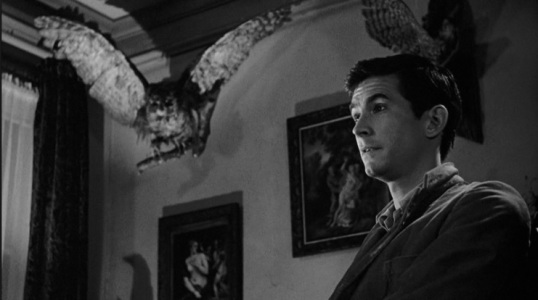
You have to feel a bit bad for Anthony Perkins, who was an Oscar-nominated star of film and Broadway and something of a teen idol before he was cast as Norman Bates in Alfred Hitchcock’s 1960 masterpiece, Psycho. Perkins was so convincing in the role that he pretty much spent the majority of his career either playing variations of the character or appearing in small roles where his macabre screen image would not be too much of a problem. Perkins gave one of the best film performances of all time and his career never really recovered from it.
Unfortunately, there’s a tendency to overlook just how good Anthony Perkins was in this first Psycho. People look at his later, less-compelling performances and they make the mistake of thinking those performance were the best that Perkins was capable of giving. Perkins was a fine actor and never better than when he played Norman. The scene below highlight how Perkins managed to make Norman Bates both poignant and creepy at the same time.
4 Shots From 4 Films is just what it says it is, 4 shots from 4 of our favorite films. As opposed to the reviews and recaps that we usually post, 4 Shots From 4 Films lets the visuals do the talking!
Today, we celebrate the birthday of one of the greatest American actors of all time, the wonderful James Stewart! It’s time for….
4 Shots From 4 James Stewart Films
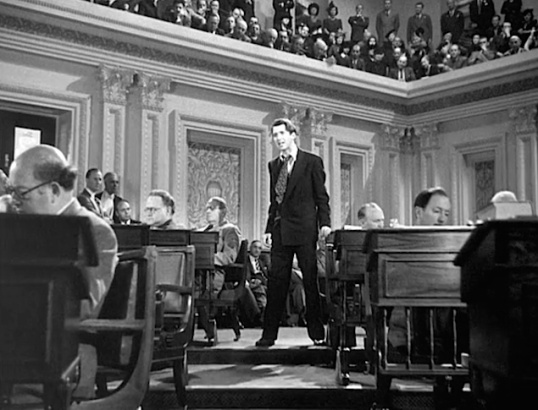
Mr. Smith Goes To Washington (1939, dir by Frank Capra, DP: Joseph Walker)

It’s A Wonderful Life (1946, dir by Frank Capra, DP: Joseph Walker and Joseph Biroc)

Rear Window (1954, dir by Alfred Hitchcock, DP: Robert Burks)
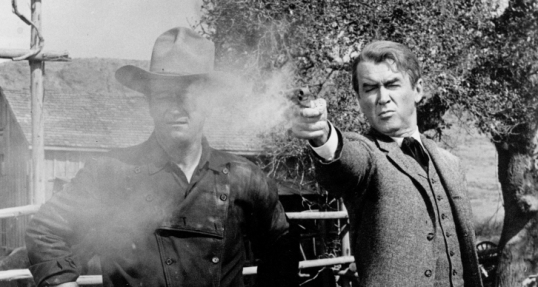
The Man Who Shot Liberty Valance (1962, dir by John Ford. DP: William H. Clothier)
On this date in 1905, the great actor Joseph Cotten was born in Petersburg, Virginia. A longtime friend and collaborator of Orson Welles, Cotten was one of the most dependable leading men of the 40s and 50s, an actor with the charisma of star and the talent of an artist.
Today’s scene that I love comes from Alfred Hitchcock’s 1943 masterpiece, Shadow of a Doubt, and it features Teresa Wright and Joseph Cotten. Wright plays Charlie. Cotten plays her beloved uncle, who is also named Charlie and who might very well be a serial killer. In this scene, Uncle Charlie drags his niece to a seedy bar, where he confesses that, as she earlier deduced, he is a suspect in a murder investigation. With a mixture of charm and intimidating, Charlie tries to convince his niece to keep his secret to herself.
4 Shots From 4 Films is just what it says it is, 4 shots from 4 of our favorite films. As opposed to the reviews and recaps that we usually post, 4 Shots From 4 Films lets the visuals do the talking!
Today, I’m using this feature to take a look at the history of the Academy Award for Best Picture. Decade by decade, I’m going to highlight my picks for best of the winning films. To start with, here are 4 shots from 4 Films that won Best Picture during the 1940s! Here are….
4 Shots From 4 Best Picture Winners: The 1940s

Rebecca (1940, dir by Alfred Hitchcock, DP: George Barnes)

Casablanca (1942, dir by Michael Curtiz, DP: Arthur Edeson)

The Best Years Of Our Lives (1946, dir by William Wyler, DP: Gregg Toland)

Hamlet (1948, dir by Laurence Olivier, DP: Desmond Dickinson)
The great Cary Grant was born 120 years ago today.
In honor of Cary Grant’s legendary career and screen charm, today’s scene that I love comes from one of my favorite Cary Grant movies. This is also one of my favorite Ingrid Bergman films and one of my favorite Alfred Hitchock films and even one of my favorite Claude Rains films. 1946’s Notorious is a favorite all-around!

Poor Anthony Perkins!
Anthony Perkins did not start his career as a horror icon. A talented young actor, Perkins started his career on Broadway and eventually, he started to appear in films. From the start, he was usually cast as nervous young men, the type who awkwardly smiled and struggled to talk to people. Perkins was promoted as a romantic lead, with the Studios and his agents making sure that Perkins was regularly photographed dating Hollywood starlets like Natalie Wood. As witty off-screen as he was nervous on-screen, Perkins was a popular figure in Hollywood. He received his only Oscar nomination for his performance as a young Quaker in 1956’s Friendly Persuasion.
Perkins’s entire career changed when Alfred Hitchcock cast him as the seemingly timid motel owner in 1960’s Psycho. Perkins was reportedly Hitchcock’s first choice for the role, with Hitchcock saying that he felt only Perkins or Dean Stockwell was capable of bringing Norman to life. Perkins was not nominated for Best Actor but the role pretty much defined him in the eyes of many. Perkins spent the rest of his career trying to first escape the shadow of Psycho and then eventually embracing his status as an icon of horror.
Perkins’s performance has been imitated so many times that there’s a tendency to forget just how good he is in the role. In this episode, Perkins-as-Norman discusses his mother with Janet Leigh.
The 1945 Best Picture nominee, Spellbound, tells the story of Dr. Constance Petersen (Ingrid Bergman), a psychoanalyst at a mental hospital in my least favorite state, Vermont.
Constance has fallen in love with a man (Gregory Peck) who she believes to be Dr. Anthony Edwardes, the newly appointed director of the hospital. Dr. Edwardes is youngish and handsome and idealistic and authoritative …. well, he’s Gregory Peck. However, he also has an intense phobia about seeing any set of parallel lines. Curious to discover the reason for Edwardes’s phobia, Constance does a little digging on her own and discovers that Dr. Anthony Edwardes is not a doctor at all! Instead, he’s a guilt-stricken amnesiac who is convinced that he murdered Dr. Edwardes and took his place!
Constance, however, doesn’t believe that the Amnesiac is a murderer. She thinks that he is suffering from some sort of deep-rooted guilt that had led him to believe that killed the doctor. She wants a chance to psychoanalyze him and discover the truth about his background. Unfortunately, the police do think that the Amnesiac is a murderer and their determined to arrest him.
Constance and the Amnesiac go on the run, heading to the home of Constance’s mentor, Dr. Alexander Brulov (Michael Chekhov, the nephew of Anton Chekhov). With Brulov’s help, Constance analyzes a dream that the Amensiac had, one involving curtains decorated with eyes, the faceless proprietor of a casino, and a man falling off a mountain. Can Constance and Brulov solve the mystery of the Amnesiac’s identity before the police take him away to prison?
Spellbound was the last of the four Hitchcock best picture nominees and it was also the last film that Hitchcock made for producer David O. Selznick. Selznick was quite a fan of psychoanalysis and he insisted that Hitchcock not only make a movie about it but that he also use Selznick’s own therapist as a technical advisor on the project. Hitchcock, for his part, was able to bring in the surrealist Salvador Dali to help design the Amnesiac’s dream sequence but Selznick felt that the 20-minute sequence was too long and too weird and, as a result, it was cut down to two minutes for the final film. All this considered, it’s not a surprise that, despite the fact that Spellbound was a hit with critics and audiences, Hitchcock himself didn’t care much for it and considered it to be more of a Selznick film than a Hitchcock film. And it is true that the film’s total faith is psychoanalysis feels more like something one would expect to hear from a trendy producer than from a director like Hitchcock, who was known for both his dark wit and his rather cynical attitude towards anyone in authority.
For a film like Spellbound to truly work, there has to be some doubt about who the Amnesiac is. For the suspense to work, the audience has to feel that there’s at least a chance, even if it’s only a slight one, that the Amnesiac actually could be a murderer, despite the attempts of Constance and Brulov to prove that he’s not. And Spellbound is full of scenes that are meant to leave the audience wondering about whether or not the Amnesiac should be trusted. However, because the Amnesiac is played by Gregory Peck, there’s really no doubt that he’s innocent. Hitchcock was not particularly happy with Gregory Peck as his leading man. Peck projected a solid, middle-American integrity. It made him ideal for heroic and crusading roles but made him totally wrong for any role that required ambiguity. It’s difficult to believe that the Amnesiac is suffering from a guilt complex because it’s difficult to believe that Gregory Peck has ever done anything for which he should feel guilty. Cary Grant could have played the Amnesiac. Post-war Jimmy Stewart could have done an excellent job with the role. But Peck is just too upstanding and stolid for the role. In a role that calls from neurosis, Peck is kind of boring.
That said, the rest of the cast is fine, with Ingrid Bergman giving one of her best performance as Constance and Michael Chekhov bringing some needed nuance to a role that could have turned into a cliché. Leo G. Carroll has a small but pivotal role and he does a good job keeping the audience guessing as to his motivation. Even at a truncated two minutes, the Dali dream sequence is memorably bizarre and the famous shot of a gun pointed straight at the camera still carries a kick. This is a lesser Hitchcock film but, that said, it’s still a Hitchcock film and therefore worth viewing.
As I mentioned previously, this was the last of Hitchcock’s films to be nominated for Best Picture. Ironically, his best films — Rear Window, Vertigo, and Psycho among them — were yet to come. Spellbound was nominated for six Oscars but only won for Miklos Rozsa’s score. (Ingrid Bergman was nominated for Best Actress that year, not for her role in Spellbound but instead for The Bells of St. Mary’s.) The big Oscar winner that year was Billy Wilder’s The Lost Weekend.

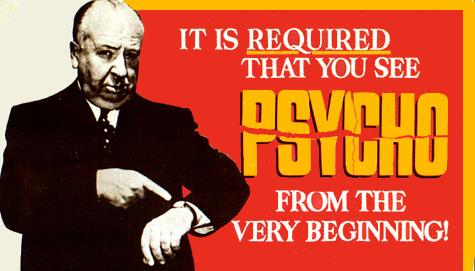
For Hitchcock’s birthday, today’s scene that I love is the final scene of 1960’s Psycho! Do I really have to give a spoiler warning for this?
4 Or More Shots From 4 Or More Films is just what it says it is, 4 shots from 4 of our favorite films. As opposed to the reviews and recaps that we usually post, 4 Shots From 4 Films lets the visuals do the talking!
124 years ago, the master of suspense was born in England. Today, we honor the career and legacy of the great Alfred Hitchock with….
6 Shots From 6 Alfred Hitchcock Films
Rebecca (1940, dir by Alfred Hitchcock, DP: George Barnes)

Shadow of a Doubt (1943, directed by Alfred Hitchcock, DP: Joseph A. Valentine)

Notorious (1946, dir by Alfred Hitchcock, DP: Ted Tetzlaff)

Vertigo (1958, dir by Alfred Hitchcock, DP: Robert Burks)
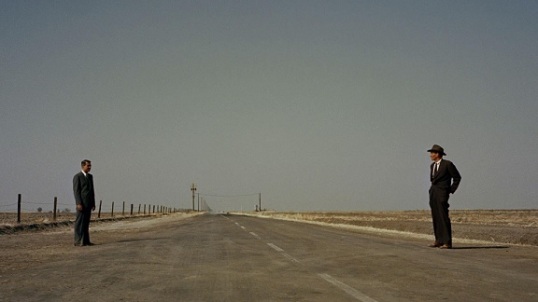
North by Northwest (1959, dir by Alfred Hitchcock, DP: Robert Burks)

Psycho (1960, dir by Alfred Hitchcock, DP: John L. Russell)
 Through the Shattered Lens