Icarus File No. 14: Last Exit To Brooklyn (dir by Uli Edel)


Welcome to Brooklyn!

The year is 1952 and one neighborhood in Brooklyn is on the verge of exploding.

A thug named Vinnie (Peter Dobson) holds court at a local bar.  (His associates include the moronic Sal, who is played by a very young Stephen Baldwin.)  Some nights, Vinnie and his associates mug people for money.  Sometimes, they just attack people for fun.

A strike at the local factory has entered its sixth month, with management showing no sign of compromising and Boyce (Jerry Orbach), the head of the union, showing little concern for the men who are now struggling to feed their families.  The local shop steward, Harry Black (Stephen Lang), is a self-important braggart who never stops talking about how he’s the one leading the strike.  At home, Harry ignores his wife, with the exception of a violent quickie.  On the streets, Harry embezzles money from the union and uses it to try to impress the men that he would rather be spending his time with.  But even the men who Harry considers to be friends quickly turn on him when he is at his most pathetic.

Big Joe (Burt Young) is a proud union member who is shocked to discover that his teenage daughter (Ricki Lake) is 8-months pregnant.  Despite being out-of-work and not caring much for Tommy (John Costelloe), Joe puts together the wedding that appears to be the social event of a shabby season.  But even at the reception, violence lurks below the surface.

Georgette (Alexis Arquette) is a transgender prostitute who loves Vinnie, even after he and his idiot friends stab her in the leg while playing with a knife.  Beaten at home by her homophobic brother (Christopher Murney), Georgette sinks into drug addiction.

Tralala (Jennifer Jason Leigh) is an amoral prostitute, one who specializes in picking up military men and then arranging from them to be mugged by Vinnie and his gang.  Sick of being exploited by Vinnie, Tralala heads to Manhattan and meets Steve (Frank Military), an earnest soldier from Idaho.  For the first time, Tralala is treated decently by a man but Steve is set to ship out to Korea in a few days and, as he continually points out, there’s a chance that he might not return.  For all of the happiness she finds in Manhattan, Tralala is continually drawn back to her self-destructive life in Brooklyn.

First released in 1989 and directed by Uli Edel (who directed another film about desperation, Christiane F.), Last Exit To Brooklyn is based on a controversial novel by Hubert Selby, Jr.  In fact, it was so controversial that the novel was banned in several countries and, for a while, was listed as being obscene by the U.S. Post Office.  I read the novel in the college and it is indeed a dark and depressing piece of work, one that offers up very little hope for the future.  It’s also brilliantly written, one that sucks you into its hopeless world and holds your interest no matter how bleak the stories may be.  Due to its reputation, it took over 20 years for Last Exit to Brooklyn to be adapted into a film.

The film is actually a bit more positive than the book.  One character who appears to die in the book manages to survive in the film.  The wedding subplot was a minor moment in the book but, in the film, it’s made into a major event and provides some mild comedic relief.  That said, the film is definitely dark.  Almost every character is greedy and angry and those who aren’t are victimized by everyone else.  Unfortunately, the film lacks the power of Selby’s pungent prose.  As a writer, Selby held your attention even when you want to put the book away.  When it comes to the film, the lack of Selby’s voice makes it very easy to stop caring about the characters or their stories.  Even with the attempts to lighten up the story, the film is still so dark that it’s easy to stop caring.  The non-stop bleakness starts to feel like a bit of an affectation.

And that’s a shame because there are some brilliant moments and some brilliant performances to be found in Last Exit To Brooklyn.  An extended sequence where the police fight the striking workers is wonderfully directed, with the police becoming an invading army and the men on strike being transformed from just factory workers to rebels.  The scene where Boyce informs Harry that he’s not as important as he thinks is wonderfully acted by both Jerry Orbach and Stephen Lang.  As Tralala, Jennifer Jason Leigh gives a raw and powerful performance, whether she’s shyly accepting Steve’s kindness or drunkenly exposing herself to a bar full of lowlifes.  In many ways, Tralala is the most tragic of all the characters to be found in Last Exit to Brooklyn.  She’s tough.  She’s angry.  But, in the end, she’s ultimately the victim of men who are too stupid to understand anything other than aggression.  The neighborhood applauds her when she confidently walks past a line of cops and strikebreakers but the same people who cheered for her later try to destroy her.

The film ends on an ambiguous note, with a peace that feels very temporary.  The message seems to be that men are at their worst when they’re bored so perhaps it’s best to keep them busy, whether with a job or perhaps a wedding.  It’s a flawed film but it sticks with you.

Previous Icarus Files:
  1. Cloud Atlas
  2. Maximum Overdrive
  3. Glass
  4. Captive State
  5. Mother!
  6. The Man Who Killed Don Quixote
  7. Last Days
  8. Plan 9 From Outer Space
  9. The Last Movie
  10. 88
  11. The Bonfire of the Vanities
  12. Birdemic
  13. Birdemic 2: The Resurrection 

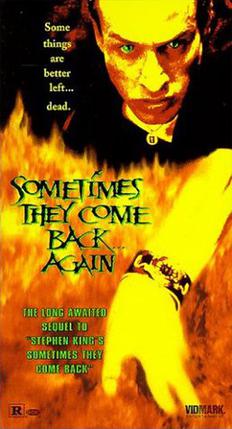
Sometimes They Come Back… Again (1996, directed by Adam Grossman)


When Jon Porter was a child, he witnessed the murder of his sister by three delinquents named Tony (Alexis Arquette), Vinnie (Bojesse Christopher), and Sean (Glen Beaudin).  The three thugs would have killed Jon too except that they were electrocuted by an electrical wire in a puddle of water.  Years later, the now adult Jon (Michael Gross) returns to his hometown for the funeral of his mother.  Jon is now a psychologist and has a daughter named Michelle (Hillary Swank).

The death of Jon’s mother was no accident.  Tony has come back to life and Michelle, not knowing that he’s a demon, has a crush on him.  Tony soon brings Vinnie and Sean back to life and they seek revenge on the man who they blame for their deaths.

This straight-to-video sequel to Sometimes They Come Back is slightly better than the first film, mostly because Tony and his gang are more intimidating than the ghost greasers that haunted Tim Matheson and Michelle wanting to date the man that her father killed adds a new wrinkle to the story.  There’s nothing about Hillary Swank’s performance that would make you think she was a future Oscar winner but she is likable and sympathetic.  The member of the cast who make the biggest impression is Jennifer Elise Cox, playing Michelle’s Tarot card-reading friend.  (Cox is probably best known for playing Jan Brady in The Brady Bunch movies.)  Cox brings a lot of kooky charm to the movie and is featured in the film’s most memorable scene.  Sometimes They Come Back… Again may not reinvent the horror genre but it’s a passably entertaining straight-to-video horror film.

Horror Film Review: Buffy the Vampire (dir by Fran Rubel Kuzui)


Watching this movie was such a strange experience.

Now, of course, I say that as someone who grew up watching and loving the television version of Buffy the Vampire Slayer.  Back when Buffy was on TV, I was always aware that the character had first been introduced in a movie but every thing I read about Buffy said that the movie wasn’t worth watching.  It was a part of the official Buffy mythology that Joss Whedon was so unhappy with what was done to his original script that he pretty much ignored the film when he created the show.

So, yes, the 1992 movie version of Buffy the Vampire Slayer showed how Buffy first learned that she was a slayer, how she fought a bunch of vampires in Los Angeles, and how her first watcher met his end.  But still, Joss Whedon was always quick to say that the film should not be considered canonical.  Whenever anyone on the TV show mentioned anything from Buffy’s past, they were referencing Joss Whedon’s original script as opposed to the film that was eventually adapted from that script.  (For instance, on the tv series, everyone knew that Buffy’s previous school burned down.  That was from Whedon’s script.  However, 20th Century Fox balked at making a film about a cheerleader who burns down her school so, at the end of the film version, the school is still standing and romance is in the air.)  In short, the film existed but it really didn’t matter.  In fact, to be honest, it almost felt like watching the movie would somehow be a betrayal of everything that made the televisions series special.

Myself, I didn’t bother to watch the film version of Buffy the Vampire Slayer until several years after the television series was canceled and, as I said at the start of the review, it was a strange experience.  The movie is full of hints of what would make the television series so memorable but none of them are really explored.  Yes, Buffy (played here by Kristy Swanson) has to balance being a teenager with being a vampire slayer but, in the film, it turns out to be surprisingly easy to do.  Buffy is just as happy to be a vampire slayer as she is to be a cheerleader.  In fact, one of the strange things about the film is just how quickly and easily Buffy accepts the idea that there are vampires feeding on her classmates and that it’s her duty to destroy them.  Buffy’s watcher is played by Donald Sutherland and the main vampire is played by Rutger Hauer, two veteran actors who could have played these roles in their sleep and who appear to do so for much of the film.  As for Buffy’s love interest, he’s a sensitive rebel named Oliver Pike (Luke Perry).  On the one hand, it’s fun to see the reversal of traditional gender roles, with Oliver frequently helpless and needing to be saved by Buffy.  On the other hand, Perry and Swanson have next to no chemistry so it’s a bit difficult to really get wrapped up in their relationship.

I know I keep coming back to this but watching the movie version of Buffy is a strange experience.  It’s not bad but it’s just not Buffy.  It’s like some sort of weird, mirror universe version of Buffy, where Buffy starts her slaying career as a senior in high school and she never really has to deal with being an outcast or anything like that.  (One gets the feeling that the movie’s Buffy wouldn’t have much to do with the Scooby Gang.  Nor would she have ever have fallen for Angel.)  Kristy Swanson gives a good performance as the film version of Buffy, though the character is not allowed to display any of the nuance or the quick wit that made the television version a role model for us all.  Again it’s not that Buffy the movie is terrible or anything like that.  It’s just not our Buffy!

Music Video of the Day: She’s A Beauty by The Tubes (1983, dir. Kenny Ortega)


Happy Birthday, Erin! If it weren’t for your Artwork of the Day posts, then these posts probably wouldn’t exist. I can’t thank you enough.

Okay, so why did I pick out this particular music video?

  1. The title fits with Erin’s handle on here.
  2. It starts off with a big picture of something you would find on a pulp novel that she would post. The mermaid later on also looks like something I would expect to see on an Artwork of the Day post.
  3. Just like The Warrior by Scandal that I featured for Lisa’s birthday, this was also shot by Texas Chainsaw Massacre cinematographer Daniel Pearl.
  4. Also, it connects exploitive artwork together with dancing thanks to director Kenny Ortega.

Speaking of Kenny Ortega, he has racked up an impressive list of accomplishments over the decades.

  1. Recently he brought us what I have been told is an abomination of a remake of The Rocky Horror Picture Show.
  2. He also brought us the nightmare fuel that is the High School Musical films.
  3. He choreographed Material Girl for Madonna.
  4. A year before this music video he choreographed what has been deemed in recent years to be one of the most homoerotic music videos of the early-80s. That being the one for Billy Joel’s Allentown. Billy Joel himself is quoted in the book I Want My MTV about the video. He said that when it blew up on the Internet, he went back and took a look at it. He sees it too, but said that he honestly didn’t notice at the time. I believe him. It does look like a David DeCoteau 1313 movie at times except with dance and set to music. However, it still looks like a good representation of what Joel is singing about. I can see the homoeroticism going over Joel’s head.
  5. Oh, and he is credited with single-handedly destroying Billy Squier’s career with his music video for Squier’s song Rock Me Tonite that he made a year after this one. If you read this Lisa, anytime you want, just tell me, and you can take one of the days to do a post on that music video. I would love to see you tear it apart by talking about everything wrong with the horrifying dancing in it.

There was some justice on that fifth one. Based on his music video credits on mvdbase, it appears that after Rock Me Tonite, almost nobody wanted to work with him. That wouldn’t matter too much though since he was also working on films like St. Elmo’s Fire (1985), Pretty In Pink (1986), and Dirty Dancing (1987), to name a few, before also going on to direct Newsies (1992) for Disney.

As for The Tubes, they are a San Francisco band that has important connections to the formation of MTV.

In the early days of MTV, one of the things they were in desperate need of was cable subscribers. One of the most successful ways they spread cable was through the infamous “I Want My MTV” slogan. That goes back to the funny $1 story with Mick Jagger. Another way they got cable subscribers was by proving the network was having an effect on the record industry rather than just being a curiosity. This is where The Tubes play a big part.

John Sykes and Tom Freston were sent by Bob Pittman to Tulsa, Oklahoma because that was where they had the highest concentration of subscribers according to Freston. One night Pittman got a call from them with some news. They noticed that a record store in the area was sold out of The Tubes. Since they were the only one playing The Tubes, according to Pittman, they knew it had to be them. Pittman said that was the first evidence they had that they were causing records to be sold.

The music video for their song Prime Time was played on the first day of MTV. They also had a few more made in 1981 before having a big hit with She’s A Beauty. It was in heavy rotation on the network. It’s a prime example of the kind of music The Tubes made. They were known for things like What Do You Want From Life? (consumerism/media), Talk To Ya Later (sex/politics/media), and the song White Punks On Dope, which is about their own fans.

That’s the one where their lead singer would come out as the character named Quay-Lewd wearing ridiculously high platform heels while being dressed like some combination between a classical musician and a punk. In the performances I have seen on YouTube, they would have him get pinned down by a falling stack of amps during the instrumental portion. You can see a reference to that when “Beauty” and the kid plow through a stack of amps.

Chuck, my new concert correspondent, has this to say about seeing them live (you can also read it in the comments below):

There are very few bands I haven’t seen in concert at least once. The Tubes in concert were right at the top of my “best” list. They were absolutely incredible. If you didn’t love them when it started, you certainly did when it ended. They weren’t really concerts, but life changing, spectacular events.

At one of their concerts in Santa Monica, the ensemble on stage during their last song of the night included a full choir, three or four high school cheerleader squads, the UCLA drum corps and marching band, around 70 jugglers, dancers, acrobats, various musicians, circus animals, (including an elephant) The Tubes themselves, and gawd knows what else. Everyone in the audience was jumping on their seats, which isn’t easy in folding theater seats. We were all hoarse from singing along (screaming along?) during “WPOD”

… and all this was AFTER most of the audience had the crap scared out of them during a way too real “terrorist takeover” lead-in to “Funky Revolution.” Something no band would dare attempt nowadays.

The kid was played by the late Alexis Arquette. It was her first acting job at the age of 13.

Enjoy! Also, Happy Thanksgiving!

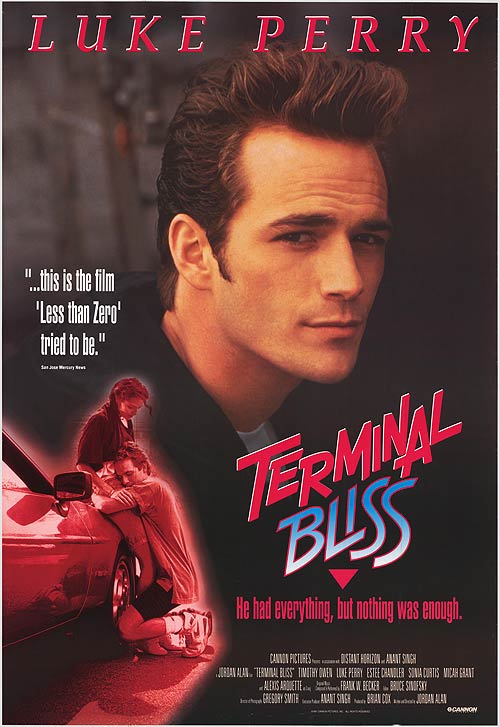
Back to School Part II #26: Terminal Bliss (dir by Jordan Alan)


mpw-59133

There’s been a long-standing rumor floating around the internet that, before she became a star, Sandra Bullock appeared in the 1992’s Terminal Bliss, a film about decadent, upper class teenagers.  Well, having watched the film on YouTube, I can tell you that, unless she’s an extra, Sandra Bullock is not in the film.

That said, she does have a connection to Terminal Bliss.  In 1987, when a 17 year-old aspiring director named Jordan Alan was attempting to raise the money for his film debut, he shot a few scenes and put together a promotional trailer for his unmade film.  Sandra Bullock does appear in that trailer.  Watch it below:

On the strength of the trailer, Alan was able to raise 3 million to make his movie.  (Charmingly, Alan has written that he raised the money while “playing hooky.”)  Alan shot the film in 1989 and there was even some news coverage about this teenager making his directorial debut.

As for the film itself, it appears that it wasn’t released until 1992, presumably to capitalize on the performance of Luke Perry, who, at that time, was starring on Beverly Hills 90210.  According to Wikipedia, the film was not particularly embraced by critics, nor did it do much at the box office.  It’s never been released on DVD or Blu-ray.

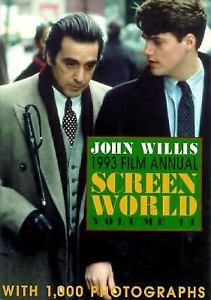
The only reason I knew about Terminal Bliss is because I like to collect those old Screen World Annuals and I came across Terminal Bliss in the back of the 1992 edition.  The name immediately caught my attention, largely because I once used the phrase “terminal bliss” in a poem and was rather unfairly criticized by a creative writing professor who felt I was “trying too hard.”

John Willis's Screenworld Annual (It may say 1993 on the cover but it actually covered the film released in 1992)

John Willis’s Screenworld Annual (It may say 1993 on the cover but it actually covered the film released in 1992)

However, Terminal Bliss is not an easy film to track down.  As I mentioned earlier, I finally found the movie on YouTube but it was the French-language version.  Though I do speak French (though, admittedly, with a Texas accent), I would hardly call myself fluent and, as I watched Terminal Bliss, I came to realize just how rusty my French has gotten.  (I’m definitely going to have to brush up on it, if I end up fleeing to Canada after the presidential election.)  Fortunately, I was able to follow the film enough to review it.

Terminal Bliss tells the story of two teenage friends.  They’re both rich.  They’re both neglected by their parents.  At the start of the film, they both seek escape through drugs.  Alex (Timothy Owen) is the one who often hides his sensitivity behind a wall of cynicism.  John (Luke Perry) is the charming and sociopathic one, the one who lives his entire life seeking to satisfy his own urges.  When he finds out that Alex has a crush on Stevie (Estee Chandler), John responds by introducing Stevie to cocaine and getting her pregnant.  When Stevie has an abortion, an angry Alex checks into drug rehab.  When Alex comes out of rehab, he’s still as angry and as cynical as he ever was.  He continues to hang out with his friends, the most recognizable of which is a drug dealer played by Alexis Arquette.  Alex also continues to be friends with John, despite the fact that John seems to be getting more and more out-of-control in his behavior.  Alex refuses to intervene, saying that John is responsible for his own decisions.  After John rapes Stevie’s sister, he invites Stevie and Alex to join him out at his family’s lake house.  When, over the course of the weekend, John drowns, Alex can only coldly watch.  Why help?  As Alex sees it, John would probably be happier dead anyway…

So, yeah, Terminal Bliss is not exactly a cheerful movie.  In fact, it’s such a dark and borderline nihilistic film that it reminded me of the type of stories that I used to write when I was 17 years old.  Terminal Bliss has “teen trying to be edgy” written all over it but you know what?  That actually works to the film’s advantage.  This is a film about teenagers that was actually made by a teenager and, while it may not be a perfect movie, it is a pretty good example of what the world looks like when you’re 19 and trying to be a cynic.  Say what you will about the film’s storyline, there’s an honesty to its outlook.  Only when you’re 19 would you have the guts to make a commercial movie that was this relentlessly bleak.  That bleakness sets Terminal Bliss apart from a lot of other films that I’ve reviewed for this series.

Because I was watching a dubbed version, I’m not going to try to judge the performances.  But I will say that I really liked the look of Terminal Bliss.  Jordan Alan — who, according to his Wikipedia page, is still working as an independent filmmaker — creates and maintains an almost oppressive atmosphere of ennui.  This is a film that often seems to take place in the shadows and even the liveliest of scenes (a party, a wedding reception) seem to be overcast.  When, at the start of the film, we see Timothy Owen and Luke Perry’s shadowy forms, playing lacrosse on a sunny morning, we’re put right into the proper existential mood.  When the camera focuses on Owen’s often passive face, we feel as if we are looking straight into the heart of ennui.

So, Terminal Bliss does not feature Sandra Bullock but it’s still an interesting artifact of the time in which it was made.

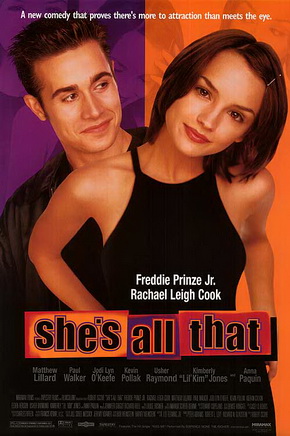
Back to School #58: She’s All That (dir by Robert Iscove)


Shes_All_That

She’s All That, a 1999 high school-set adaptation of My Fair Lady, has a lot to answer for.

When I, as an impressionable 13 year-old first saw this film, I left the theater believing that high school would be full of random, fully choreographed dance-offs.  That, after all, is what happened towards the end of She’s All That.  After watching as handsome jock Zack (Freddie Prinze, Jr.) spent almost the entire movie changing Laney (Rachael Leigh Cook) from an artist into a Prom Queen, the great prom dance-off made for the perfect climax.

I mean, just check it out:

Imagine how disappointed I was, once I finally did reach high school, to discover that it was actually nothing like She’s All That.  There were no big dance numbers for no particular reason.  I went to five different proms and none of them were ever as much fun as the prom at the end of She’s All That.

So thank you, She’s All That, for getting my hopes up.

As for the rest of the film, it’s a guilty pleasure in much the same way as Never Been Kissed.  I was recently doing some research over at the imdb and I was surprised to discover just how many films Freddie Prinze,Jr. made between 1999 and 2002.  For the most part, they’ve all got rather generic names.  What’s funny is that I probably saw most of them because, back then, I would get excited over almost any PG-rated movie that featured a cute guy and had a hint of romance about it.  But, with the exception of She’s All That, I can’t really remember a single one of them.  But you know what?  Freddie Prinze, Jr. may not be a great actor and his films may have basically all been the same but he had a certain something that, when you were 13 or 14, made him the perfect crush.  There was a hot blandness to Freddie Prinze, Jr. that prevented him from being compelling but did make him the perfect star for a film like She’s All That.

Along with featuring that prom dance-off and being the epitome of a Fredde Prinze, Jr. movie, She’s All That is also remembered for featuring Rachael Leigh Cook as one of the most unlikely ugly ducklings in the history of the movies.  Rachael plays Laney and the entire film’s starting off point is that Zack has made a bet with Dean (Paul Walker, as handsome here as he was in Varsity Blues) that he can turn Laney into a prom queen.  However, it should be a pretty easy bet to win because all Laney has to do is let her hair down, start wearing makeup, and stop wearing her glasses.

Myself, I’m severely myopic.  Usually, I wear contact lenses but occasionally, I may be running late or may not feel like putting my contacts in or maybe I just want to try a different look.  So, occasionally, I’ll wear my glasses and I have to say that, other than a few guys who always make “hot librarian” jokes, everyone pretty much treats me the same regardless of whether I’m wearing my glasses or not.  I do have to admit though that, when I take off my glasses and dramatically let my hair down, I always say that I’m having a She’s All That moment.

Anyway, She’s All That is okay.  I like it but I don’t love it and, to be honest, the film’s main appeal is a nostalgic one.  Freddie Prinze, Jr. and Paul Walker both look good, Rachael Leigh Cook and Jodi Lynn O’Keefe will keep the boys happy, and Matthew Lillard has a few good scenes where he plays an obnoxious reality tv celeb.

And there’s always that dance number!

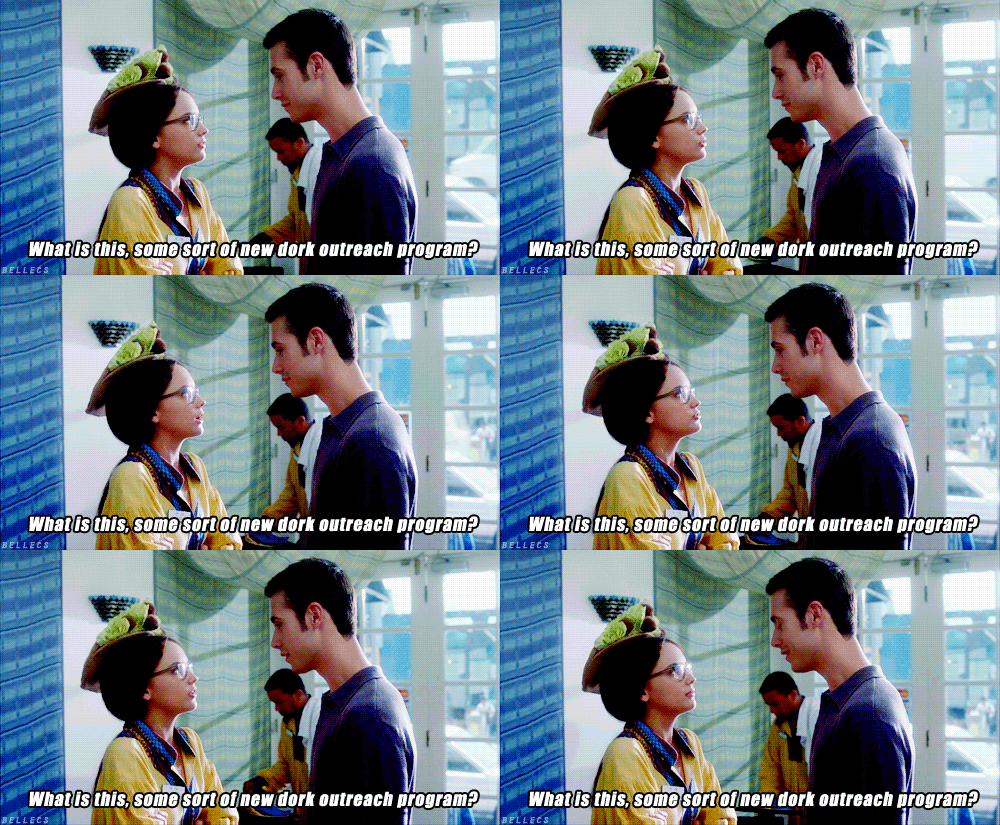
shes-all-that-dork-outreach-program-rachael-leigh-cook-freddie-prinze-jr