Retro Television Review: St. Elsewhere 2.3 “Newheart”


Welcome to Retro Television Reviews, a feature where we review some of our favorite and least favorite shows of the past! On Fridays, I will be reviewing St. Elsewhere, a medical show which ran on NBC from 1982 to 1988.  The show can be found on Hulu and, for purchase, on Prime!
This week, things get dark.

Episode 2.3 “Newheart”

(Dir by Mark Tinker, originally aired on November 9th, 1983)

What a depressing episode!

It doesn’t start out on a particularly depressing note.  It opens with a bachelor part for Dr. Vijay Kochar, who is about marry a woman that he’s never actually met.  (It’s an arranged marriage.)  The bachelor party, which appears to have been held in Fiscus’s apartment, is a bust.  Dr. White shows up with a sex doll.  Victor Ehrlich shows up with a short film called “Sally Takes a Ride,” which turns out to be not the pornography he was expecting but instead, a short film about astronaut Sally Ride.  Vijay mentions that he’s a virgin and soon, with the help Dr. White and Nurse Daniels, the news is all over the hospital.  Kathy Martin decides to give Vijay an early wedding gift by having sex with him.

Since this episode aired in 1983, there’s a random aerobic class being held in the hospital, which leads to a lengthy scene of spandex and dancing.  It’s a bit of a silly scene for what was, for the first half hour, shaping up to be a silly episode.

Fran and Jerry Singleton finally check out of the hospital.  Fran has regained the ability to speak and can stiffly walk.  Jerry has learned to stop being such an overbearing jerk.  Dr. Morrison is not there to say goodbye to the Singletons because….

…. and here’s where things start to get dark….

….his wife is in another hospital!  Jack Morrison’s wife has an offscreen cerebral hemorrhage and, as evidenced by Morrison’s tears at the end of the episode, she does not survive.  At the same time that she’s dying, Dr. Craig gets a call telling him that there is finally a heart available for the transplant.  And, though it wasn’t explicitly stated, it seems pretty obvious that the heart in question belonged to Morrison’s wife.

AGCK!

Seriously, how much more depressing can one episode get?  And for all this to happen to Jack Morrison, who is probably the most decent character on the show, it’s just not fair!  I mean, he was literally the only married intern who had a happy marriage.  He has a newborn son.  And now, he’s going to have to balance being a single father with being a resident.

Poor guy!  I hope next week finds some sort of relief for him.
Retro Television Review: St. Elsewhere 2.2 “Lust Et Veritas”


Welcome to Retro Television Reviews, a feature where we review some of our favorite and least favorite shows of the past! On Fridays, I will be reviewing St. Elsewhere, a medical show which ran on NBC from 1982 to 1988.  The show can be found on Hulu and, for purchase, on Prime!

This week, St. Eligius gets a new plastic surgeon.

Episode 2.2 “Lust Et Veritas”

(Dir by Mark Tinker, originally aired on November 2nd, 1982)

This episode sees the addition of two new doctors to the hospital’s staff and they’re both played by familiar actors.  Elliott Axlerod is played by Stephen Furst.  He’s a new resident and obviously terrified of screwing up in the ER.  He asks Ehrlich and Fiscus for advice.  When told that he’s required to perform a rectal exam on every patient, he asks, “Is it too late to go to law school?”  Ehrlich assures him that it is.

(It’s never too late!)

Secondly, Mark Harmon joins the cast as plastic surgeon Bobby Caldwell and not even a porn star mustache can obscure the fact that young Mark Harmon was amazingly hot.  (Actually, old Mark Harmon isn’t that bad either.  He aged well.)  Bobby, we learn, was brought to St. Eligius by Dr.  Craig.  He’s cocky and confident and it’s obvious that he loves being lusted after by Dr. Armstrong and Nurse Daniels.  However, he already has a secret lover as this episode finds him showering with Joan Halloran, the city hall bureaucrat who spends most of her time arguing with Dr. Craig about whether or not to shut down one of the hospital’s non-profit programs.

Dr. Craig is nervous because he’s waiting for a heart to become available so he can perform his first transplant on Eve Leighton (Marian Mercer), a teacher who wants to get back into her classroom as soon as possible.  Ehrlich is nervous because Craig is taking all of his frustrations. and his nervousness out on him.

Meanwhile, Jerry Singleton (Alan Arkin), the demanding husband of stroke-victim Fran (Piper Laurie), continued to push his wife to recover until finally, at the end of the episode, she yelled that he was pushing her too hard.  It was a heart-breaking moment.  Jerry thinks that he’s helping his wife but, as this episode showed, he’s actually been torturing her with his overbearing demands that she hurry up and get better.

Finally, a former resident named Barry Dorn (Peter Horton) returns to the hospital to try to convince Dr. Cavanero to change her negative evaluation of his job performance.  Everyone acts as if Barry was a character on the show during the previous season, even though he wasn’t.  It’s even revealed that he is Wendy Armstrong’s former boyfriend.  When Cavanero refuses to change her evaluation, Armstrong accuses her of not having any feelings.  (Seriously, Armstrong is the worst!)  Even worse, when Cavanero heads to the doctor’s lounge, she finds Barry waiting for her.  Barry punches her, busting open her lower lip.  Armstrong stitches up the cut and then says that Cavanero is lucky because now, she’ll have an excuse to meet Dr. Caldwell!  Armstrong then offers a half-hearted apology for previously accusing Cavanero of being heartless.  (Again, Armstrong is the worst!!!!)

This wasn’t a bad episode.  Mark Harmon and Stephen Furst seem like they’ll be good additions to the show’s ensemble.  The Barry story felt a bit odd, just because Barry was apparently present but 0ff-camera during the entire first season.  It sounds like Barry went through a lot of the same things that Peter White went through during the first season and Peter was not present in this episode.  There’s a part of me that suspects that Barry was originally meant to be Peter but the show’s producers obviously decided they wanted to keep Peter around for a bit longer.

Next week …. well, I have no idea how things are going to develop.  There’s a lot going on in this hospital.  We’ll see what happens.

Retro Television Review: St. Elsewhere 2.1 “Ties That Bind”


Welcome to Retro Television Reviews, a feature where we review some of our favorite and least favorite shows of the past! On Fridays, I will be reviewing St. Elsewhere, a medical show which ran on NBC from 1982 to 1988.  The show can be found on Hulu and, for purchase, on Prime!

This week, we start season 2!

Episode 2.1 “Ties That Bind”

(Dir by Bruce Paltrow, originally aired on October 26th, 1983)

The second season is here and there are changes to be found in the opening credits.

David Birney and G.W. Bailey are no longer listed in the opening credits.  I’m not sorry to see Birney go as Dr. Samuels was never that interesting of a character.  I will miss Bailey’s performance as Dr. Beale.

Norman Lloyd is now listed in the credits, appearing right after Ed Flanders.  Ellen Bry, Kim Miyori, and Eric Laneuville are also now listed in the opening credits.  That’s good.  Last season, Shirley Daniels (played by Ellen Bry) was one of the most important characters on the show and it always seemed strange that she was left out of the opening.  Mark Harmon, sporting a mustache, appears in the credits, though he didn’t appear in this episode.  The final addition to the opening credits is Nancy Stafford, who does appear in this episode.

Stafford plays Joan Halloran, the new city budget advisor who has been assigned to cut St. Eligius’s budget.  She tells Westphall and Auschlander that St. Eligius is not popular downtown.  “They call you St. Elsewhere,” she says.  Joan wants to do away with the animal research lab, which is a part of the hospital that has never been mentioned before.  (And with good reason.  Boo, animal research, boo!)  Westphall finally agrees, on the condition that the city fund Dr. Craig’s attempt to perform a heart transplant on teacher Eve Leighton (Marian Mercer).

Wisely, Dr. Craig gets a lot of screentime in this episode.  If the first season seemed to often be unsure of just how abrasive the show should allow Craig to be, the second season premiere would seem to suggest that the show’s writers realized that the more abrasive Craig is, the better.  Of course, Dr. Craig has good reason to be in a bad mood.  As he confesses to Nurse Rosenthal, he caught his son doing drugs.  Craig explains he kicked him out of the house and now, he wants nothing to do with him.

Speaking of drugs, orderly Luther (played by Eric Laneuville) finally manages to capture the thief who has been stealing all the drugs from the hospital.  Dr. White is no longer under suspicion!  Yay, I guess.  I don’t know.  Dr. White wasn’t in much of this episode but he still cames across as being a jerk.  I have to admit that I groaned a little when I saw he was still on the show.  A part of me is hoping he’ll get a redemption arc this season but, from his behavior during rounds, he still seems to be a jackass.

Speaking of jackasses, when Jerry Singleton (Alan Arkin) discovers that his wife, Fran (Piper Laurie), has had a stroke, he responds by crashing his car into the ER and then refusing to leave the doctors along while they try to save his wife’s life.  Jerry is convincing that he knows everything and he’s very demanding.  Naturally, Fran’s doctor is Jack Morrison because Morrison always gets the really depressing cases.  Fran does wake up from her coma but she neither speaks no seems to hear anything anyone says to her.  I can’t imagine this is going to end well, mostly because she’s Morrison’s patient and things never seem to go well when Morrison is involved.  (What’s really sad is that Morrison, unlike Peter White, is a good doctor!  He just has rotten luck.)

Shirley Daniels finds out that Fiscus is cheating on her with Kathy Martin, who spends most of this episode promoting cryogenics.  Shirley responds by dumping Fiscus and telling him that he’s a pig.  Fiscus tells Kathy that they no longer have to sneak around, just for Kathy to say that the sneaking around was the whole point.  She promptly dumps Ficus.

Finally, Dr. Ehrlich meets a woman, Bobbi (Jean Bruce Scott) at the laundromat.  They go back to her apartment.  She strips down to her underwear.  She has Ehrlich tie her to the bed.  Ehrlich realizes that he has to get something from his car so he runs outside and …. gets locked out.  And then he nearly gets arrested while trying to use his credit card to open the building’s door.  However, the next day, Bobbi shows up at the hospital for her “encounter group,” and the two of them are reunited.  Again, I have a feeling this is not going to end well, just because it involves Dr. Ehrlich.

Hey, this episode was pretty good!  It moved quickly, it reintroduced us to the cast, and all of the stories were actually fairly interesting.  It’s obvious that show’s producers paid attention with what didn’t work during season one and they made an effort to improve things with season two.  Compared to the majority of this first season’s episodes, the pace was quicker, the humor was sharper, and just about everyone got a moment or two to shine.  I’m looking forward to next week!

Days of Paranoia: Glengarry Glen Ross (dir by James Foley)


“Always be closing!” Alec Baldwin shouts at a group of seedy salesman in 1992’s Glengarry Glen Ross and, as tempting as it can be to be snarky about Alec Baldwin, I have to admit that he delivered that line so well that even I briefly worried about my job and I was just watching the movie!

Baldwin plays Blake, the top salesman at a company that sells worthless real estate to people who are dumb enough or trusting enough to believe what its salesmen tell them about always pursuing their dreams.  Murray and Mitch, the never-seen but often-mentioned owners of the company, send Blake to the New York office to try to inspire its salesmen to stop whining about their terrible leads and to actually start selling.  Blake inspires through bullying.  Coffee isn’t for losers, he hisses.  The salesman who makes the most money will win a car.  The salesman who makes the second-most money will get a set of steak knives.  (Blake even brings the knives with him.)  Everyone else will get fired.  Blake’s speech and Baldwin’s cameo are justifiably famous.  Baldwin is only in the film briefly but he’s unforgettable, whether he’s bragging about how much his watch costs or if he’s holding up a pair of brass balls to tell the salesmen (and they are all men) what they’re lacking.  He not only attacks them for not being good at their jobs.  He also attacks their masculinity.  It’s a totally ludicrous speech but it works because the film is taking place in a ludicrous world, one where desperate men try to appear confident as they sell worthless land.

The only salesman who misses Blake’s speech is Ricky Roma (Al Pacino), who is busy conning a friendly but nervous fellow named James Lingk (Jonathan Pryce) out of his money.  Roma is probably the only salesman who could have stood up to Blake and that’s because Roma is the only one who has any confidence.  Roma’s on a streak.  Roma’s winning that car!

Dave Moss (Ed Harris) isn’t going to win that car.  Moss is steak knife bound.  Moss is bitter and angry and won’t stop talking about how he’s not being treated with enough respect by Murray and Mitch.  When the hated office manager, John Williamson (Kevin Spacey), hands out a bunch of leads, Moss is quick to point out that the leads are worthless.  When Williamson refuses to hand out the leads identifying prospective customers for the “Glengarry Heights Development,” Moss tells another salesman, the neurotic and weak-willed George Aaronow (Alan Arkin), that they should break into the office, steal them, and sell them to a competitor.  Aaronow isn’t a thief but Moss insists that, just because he listened to Moss talk about it, Aaronow is now legally considered to be an accomplice.

And then there’s Shelley Levene (Jack Lemmon), who used to be the top salseman but who is now a desperate mess, begging people to listen to his pitch and insisting that he’s only hit a temporary dry spell.  He has a sick daughter.  He needs the job and he needs the money and he needs the good leads.  Williamson offers to sell them to Levene but the two men then get caught up in arguing about the specifics.

Welcome to Mamet World.  Glengarry Glen Ross is a film adaptation of a David Mamet play so it’s not surprising that the film is about a group of men who can argue about anything.  The characters in this film talk a lot and the dialogue is so profane, angry, and desperate that it can be easy to overlook that it’s often very funny as well.  Roma is having fun.  He loves his job, even when he’s yelling at Williamson for ruining a possible sale.  Even when the salesmen come to the office and discover that someone has robbed the place and that they’re now all suspects, they continue to try to outhustle everyone around them.  Roma tries to sell Lingk on some worthless land.  Aaronow, Levene, and Moss try to sell the cops on their innocence.  Williamson tries to sell the salesmen on the idea that he’s a boss who is worthy of respect.  They’re all born salesmen, even if some of them aren’t very good at it.

Glengarry Glen Ross is very much a filmed play, dialogue-heavy and largely confined to that office and the restaurant nearby.  (Levene does visit one prospective investor at home but it doesn’t reduce the film’s staginess.)  Fortunately, the combination of Mamet’s dialogue and the performances of the amazing cast holds our interest.  Pacino was nominated for an Oscar for his performance.  Jack Lemmon should have been as well.  (Lemmon’s tendency to overact works well with Levene’s character.)  Alec Baldwin and Kevin Spacey, problematic as they may be for modern audiences, both give outstanding supporting performances.  You’ll want to hug Alan Arkin.  You’ll want someone to punch Ed Harris.  Glengarry Glen Ross holds up as a darkly humorous examination of desperate men.

#SundayShorts presents ESCAPE FROM SOBIBOR (1987) – Rutger Hauer helps lead another great escape during World War II!


Since Sunday is a day of rest for a lot of people, I present #SundayShorts, a mini review of a movie I’ve recently watched.

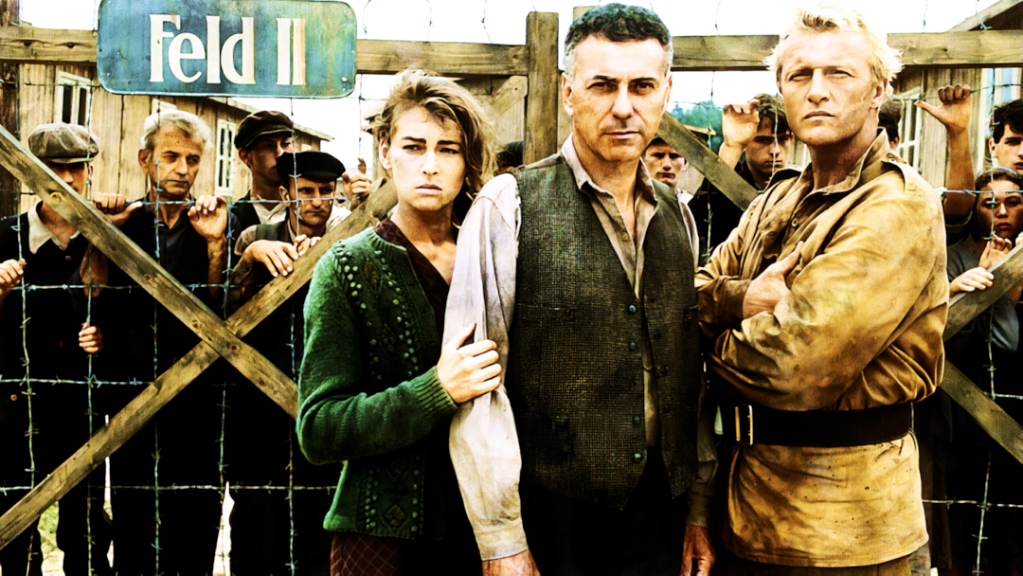
The 1987 movie ESCAPE FROM SOBIBOR is the historical re-creation of the escape from the Nazi Death Camp Sobibor, where approximately two hundred fifty thousand Jews were executed. Of the approximately six hundred prisoners who attempted to escape, around three hundred succeeded with somewhere between 50 and 60 surviving to see the end of the war.

The plot of ESCAPE FROM SOBIBOR revolves around Leon Feldhendler (Alan Arkin), the leader of the Jewish prisoners at Sobibor, who eventually comes to realize that they are being held in nothing more than a death camp. He figures out that the only people being allowed to live are the goldsmiths, seamstresses, shoemakers, and tailors; these are the people who are able to repair the shoes, recycle the clothing, and melt down any silver or gold for the Nazis. He also knows that once the trains stop coming in, all the remaining Jews will be murdered. As such, he and a group of men devise a plan for every prisoner to escape by luring the Nazi officers into the prisoners’ barracks and killing them as quietly as possible. With the help of a group of highly skilled Jewish, Russian soldiers, led by Sacha Pechersky (Rutger Hauer), their plan was put into action on October 14th, 1943, leading to the largest escape from a prison camp of any kind in Europe during World War II. 

ESCAPE FROM SOBIBOR is an excellent film, and it’s currently streaming on Amazon Prime and TUBI as I type this. If you enjoy THE GREAT ESCAPE (1963), I promise you will enjoy this film. It’s very hard to watch at times, as most Nazi concentration camp movies are, but you can’t help but be completely invested when the prisoners attempt their escape at the end. It’s always important to remind ourselves of the levels of evil and heroism that our fellow humans are capable of. ESCAPE FROM SOBIBOR does an excellent job of that. 

Here are five interesting facts about the film:

  1. Y’all know how much I love Rutger Hauer. He won a 1988 Golden Globe for his performance as Sasha Pechersky.
  2. Not only did Hauer win a Golden Globe for his performance, the movie itself won as the “Best Miniseries or Motion Picture Made for Television.”
  3. Over 30 million Americans saw this movie when it premiered on CBS on April 12th, 1987.
  4. Shortly after the revolt depicted in the film, Camp Sobibor was closed down and any trace of its existence was removed. Pine trees were later planted on the site.
  5. The movie ends with famed newscaster Howard K. Smith narrating the fates of the survivors on whose accounts the film was based. It’s an amazing, uplifting, and sometimes heartbreaking way for the outstanding movie to end. 

I highly recommend ESCAPE FROM SOBIBOR. It’s an important film and one of the greatest films that Rutger Hauer ever worked on. Enjoy the trailer below!

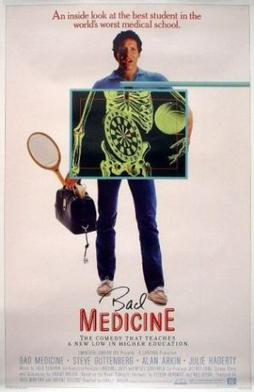
Bad Medicine (1985, directed by Harvey Miller)


Jeff Marx (Steve Guttenberg) is a smart but lazy pre-med student whose grades are so bad that he can’t get accepted to any of the good medical schools.  His father (Bill Macy), who is also a doctor and who wants Jeff to one day take over the family practice, arranges for Jeff to attend medical school in a fictional Central American country.  The head of the school, Dr. Ramon Madera (Alan Arkin), is also the country’s dictator.  Dr. Madera is happy to make money off of desperate Americans but he still enforces strict rules of behavior at the school.  He also makes it clear that none of the medical students are to treat the poor villagers who live near the school.

When Jeff arrives at his new school, he discovers that his classmates are, like him, all screw-ups.  They’re also played by a cast of actors who, like Guttenberg, epitomize the 80s ensemble comedy craze.  Curtis Armstrong, of Revenge of the Nerds and Risky Business, plays Jeff’s best friend.  Fast Times At Ridgemont High‘s Robert Romanus is the Italian medical student who is loved by all the ladies.  Airplane!‘s Julie Haggerty is the idealistic medical student who wants to take care of the local villagers.  Even Gilbert Gottfried is in this movie!  He plays Dr. Madera’s main assistant and hatchet man.

Bad Medicine was released in between the first and the second Police Academy films and it basically tells the same sort of story that made those two films unlikely hits.  Guttenberg and his fellow students start out as a screw-ups but, by the end of the movie, they’ve proven themselves as doctors.  Perhaps because it was based on a novel that was written by an actual doctor, Bad Medicine is a little more sincere than Police Academy.  In Police Academy, the scenes of the recruits doing police work were the biggest jokes of all and, even after he helped to save the city, you still never bought the idea that Steve Guttenberg would have stuck around after graduation so that he could wear a uniform and walk a beat everyday.  Though Bad Medicine is full of the usual Police Academy-style hijinks, it doesn’t treat the work that the doctors are doing as a joke.  Though regrettable stereotypes abound (this is a film that features Gilbert Gottfriend playing a character named Tony Sandoval, after all), Bad Medicine treats the villagers with respect.  Guttenberg gives a relaxed and likable performance, without making Jeff into as much of a wiseass of Police Academy‘s Cary Mahoney.  Julie Haggerty brings her usual spacey charm to her role.  Not surprisingly, it’s Alan Arkin who steals the film, though you do have to wonder how Dr. Madera has time to run both a country and a medical school while also falling in love with Julie Haggerty.  Give the man some credit for knowing how to multitask.

It ends, much like Police Academy, with the med students giving a chance to prove themselves in a crisis situation.  Unlike Police Academy, Bad Medicine was not a hit at the box office, though it did make a small profit.  As a result, there was never a Bad Medicine 2, which is unfortunate because we could always use more good doctors.

Film Review: Spenser Confidential (dir by Peter Berg)


Spenser Confidential, which is currently streaming on Netflix, is the latest Mark Wahlberg/Peter Berg collaboration.

It’s a crime film and it’s set in Boston and it will probably remind you every other Boston-set crime film that you’ve ever seen.  It’s got all the usual ingredients.  People sing Sweet Caroline.  A fat gangster wears a tracksuit.  We get a long overhead shot of the streets of Southie and there’s a scene set in an Irish bar.  One of the film’s big scenes takes place at what appears to be a deserted racing track.  (I’ve never been to Boston but, just from the movies, I know that the city is basically made up of Harvard, Southie, and hundreds of deserted race tracks.)  The Red Sox get a shout-out.  And, of course, the movie stars Mr. Boston himself, Mark Wahlberg.  Seriously, if your Boston movie doesn’t feature Mark Wahlberg or an Affleck brother, it might as well just be a St. Louis movie.

In this one, Mark Wahlberg plays Spenser.  Spenser was a cop until a gangster in a tracksuit murdered someone from the neighborhood and the head of homicide tried to bury the case.  This led to an angry Spenser beating the man up in front of his own house.  Spenser was sent to prison, where he served five years as an ex-cop in the general population.  That’s right!  He wasn’t even put in protective custody but somehow, he survived.  Right before Spenser is released from prison, he’s attacked by a Neo-Nazi who is played by Post Malone.  It’s not really that relevant to the overall plot but it does give viewers a chance to say, “Wait a minute …. is that Post Malone?”

Anyway, once he gets out of prison, Spenser moves in with his mentor and former boxing coach, Henry Cimoli (Alan Arkin).  He also gets a new roommate, an aspiring MMA fighter named Hawk (Winston Duke).  After Captain Boylan,  the head of homicide — yes, the same guy that Spenser beat up five years ago, is decapitated by 20 sword-carrying assailants, Spenser is the number one suspect.  Fortunately, for Spenser, another cop commits suicide and it’s quickly announced that the cop who killed himself also killed Boylan.  It’s a murder/suicide!  So, Spenser’s off the hook and I guess the movie’s over, right?

Nope, it doesn’t work like that.  It turns out that Spenser has his doubts about the whole story and he wants to investigate because he has “a strong moral code.”  Unfortunately, as a convicted felon, Spenser is not allowed to become a private investigator.  So, Spenser and Hawk conduct an unofficial investigation, which largely amounts to talking to Spenser’s former partner, Driscoll (Bokeem Woodbine) and getting into a brawl while Sweet Caroline plays in the background.

It’s a Boston thing.

The mystery are the heart of the film pretty much leads exactly where you think it’s going to lead.  For a 2-hour crime thriller, there aren’t exactly a lot of twists and turns to be found in Spenser Confidential, which is a problem.  The mystery’s solution is so obvious that it’s hard not to resent the fact that Spenser is apparently too stupid to figure it out on his own.  There’s an extended scene where he gets attacked by a dog and you know what?  That would have never happened to any other movie detective because every other detective would have figured out who the murderer was long before getting attacked by that dog.

On the plus side, Peter Berg knows how to stage a fight scene and he also knows how to make the best use of Wahlberg’s mix of sensitivity and working class arrogance.  Unfortunately, the rest of the cast is let down by a script that doesn’t give them much to do.  Winston Duke is physically imposing as Hawk but he spends too much of the film standing around and waiting for Spenser to take the lead.  Alan Arkin appears to be having fun in the role of Henry but again, his character is underwritten.  About the only person, other than Wahlberg, who gets to make much of an impression is Iliza Shlesinger, who is cast as Spenser’s ex-girlfriend.  Shlesinger may be playing a stereotype (she’s loud, crude, and has a thick Boston accent) but she fully embraces the character and makes her seem like the only person in the film who actually has a life beyond what’s happening onscreen at any given moment.

Anyway, Spenser Confidential isn’t terrible as much as it’s just forgettable.  It’s a generic Boston crime film and you can probably safely watch it if you’re not looking for something to which you would actually have to pay attention.  Some of the action scenes are well-shot.  If you liked Mark Wahlberg in other films, you’ll probably like him in this.  Whether you enjoy it or not, you’ll probably forget about this film about an hour after watching it.

Film Review: Dumbo (dir by Tim Burton)


Tim Burton’s remake of Dumbo actually wasn’t that bad.

I know!  I’m as shocked as anyone.  Usually, I’m against remakes on general principle and I’m certainly not a fan of the current trend of doing live-action versions of classic animated films.  (There’s a reason why I haven’t seen the new The Lion King.)  Dumbo is one of my favorites of the old Disney films, one that’s always brought tears to my mismatched eyes so I was naturally predisposed to be critical of the remake.  Add to that, I’m not particularly a huge fan of Tim Burton, a director who too often seems to be coasting on his reputation for being a visionary as opposed to actually being one.

And yet, I have to admit that I enjoyed this new version of Dumbo.  To call it a remake is actually a mistake.  It’s a reimagining, as I suppose any live action remake of an animated film about a flying elephant, a talking mouse, and a group of sarcastic crows would have to be.  So, the crows are gone, which is understandable as I doubt you could get away with a bird named “Jim Crow” today.  And sadly, Timothy the Mouse is gone.  He’s been replaced by several human characters, including Colin Farrell as a one-armed, former equestrian, Eva Green as a French trapeze artist, and Danny DeVito as the rough-around-the-edges but good-hearted ringmaster.  However, Dumbo’s still present and he’s still got the big ears.  He can still fly, as long as he’s holding a feather.

Dumbo’s only a CGI elephant but he’s still adorable.  Of course, I should be honest that I’ve always loved elephants.  I even rode one at Scarborough Fair once!  It was like a totally bumpy and somewhat uncomfortable ride but, at the same time, it was also totally cool because I was on top of an elephant!  The other thing I love about elephants is that elephants form real families.  They love each other.  They look out for each other.  They mourn their dead, which is one of many reasons why ivory poachers are some of the worst people in the world.  Elephants may not fly but there’s a sweetness to them that makes the story of Dumbo and his mother extra poignant, regardless of whether it’s animated, CGI, or live-action.  Anyway, the remake’s version of Dumbo is absolutely lovable, from the minute he reveals his ears to the triumphant moment when he soars through the circus tent.

As a director, Tim Burton has always struggled with pacing.  Watching his films, you always dread the inevitable moment when he gets distracted by a red herring or a superfluous storyline because you know that, once it happens, the entire film is going to go off the rails.  Dumbo starts out slowly and it seems like forever before the baby elephant actually shows up.  Fortunately, once Dumbo does show up, Burton’s direction becomes much more focused.  The story stops meandering and, for once, Burton actually manages to maintain some sense of narrative momentum.

Visually, the film’s a feast for the eyes.  Even though it’s a live-action film, the sets and the costumes are all flamboyantly and colorfully over-the-top, giving the film the feeling of being a child’s imagination come to life.  I mean, when you’re making a film about a flying elephant, there’s no point in trying to go for gritty realism.  While the film does mention some real-world tragedies — Farrell lost his arm in World War I and his wife to Spanish Flu — Burton plays up the fantasy elements of the story.  He’s helped by Danny DeVito and Michael Keaton who both give cartoonishly broad performances.  Fortunately, they’re both good enough actors that they can get away with it.

So, the live-action reimagining of Dumbo is not that bad.  It has its slow spots and it really can’t match the emotional power of the original animated version.  But, with all that taken into consideration, it’s still an undeniably entertaining two hours.

Music Video of the Day: Blister in the Sun by Violent Femmes (1997, directed by Evan Bernard)


When Blister in the Sun was first released in 1983, there were no music video.  In fact, there weren’t many listeners.  While the song was an immediate hit on college radio, it wasn’t until the late 80s and the 1990s, when all of those people who worked at the college stations got jobs programming “alternative” and “modern rock” stations, that Blister in the Sun really became a radio mainstay.

It wasn’t until John Cusack decided that he wanted to use the song in Grosse Pointe Blank that Blister in the Sun finally got a music video.  The video combines clips of John Cusack and Alan Arkin from the film with a totally new story involving the lead singer of Violent Femmes, Gordon Gano, attempting to assassinate Socks the Cat.  Socks was the White House pet during the Clinton years and it says something about the difference between 1997 and 2019 that this video could be made at all.  At the end of the video, Gano is arrested in a theater showing Grosse Pointe Blank, in much the same way that Lee Harvey Oswald was arrested in a theater that was showing War Is Hell.

As for the song’s lyrics, Gano has said that they were about drug abuse and not, as many listeners speculated, masturbation.  The famous “Big Hands” line was a reference to Gano’s insecurity about his small hands and his fear that his girlfriend would leave him for someone who had bigger hands.  As Gano once told the Village Voice, “I don’t think there’s a whole lot to understand with the lyrics.”

Enjoy!

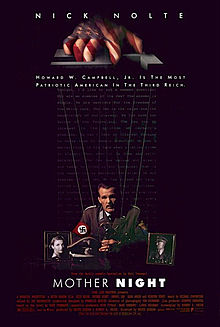
A Movie A Day #113: Mother Night (1996, directed by Keith Gordon)


Four years after she played the mysterious (and dead) Laura Palmer in Twin Peaks, Sheryl Lee starred as another mysterious (and possibly dead) woman in Mother Night.

Lee is cast as Helga Noth, the German wife of American expatriate Harold W. Campbell (Nick Nolte).  Harold is a playwright, living in Berlin and doing propaganda broadcasts for the Nazis.  Working with Frank Wirtanen (John Goodman), a military intelligence officer, Campbell has developed a series of verbal tics that are meant to secretly deliver information to the Allied Forces.  It is never clear whether Harold’s information serves any real purpose just as it is left ambiguous as to whether Harold believes any of the anti-Semitic propaganda that he broadcasts over the airwaves.  Working as both a propagandist and a double agent, Harold serves both the Allies and the Axis.

In the final days of the war, Helga is reportedly killed on the Eastern Front and Harold is captured by the Americans.  Frank arranges for Harold to be quietly sent to New York City but tells him that the government will never admit that they used him as a double agent.

Harold spends the next fifteen years living an isolated life in New York.  His only friend is an elderly painter, Kraft (Alan Arkin), with whom he plays chess.  Eventually, Harold opens up to the painter and talks about his past.  Kraft, for his own shady reasons, reveals Harold’s identity to a group of neo-Nazis.  Though Harold initially wants nothing to do with them, this changes when they reveal that they have Helga.

Or do they?  Almost no one in Mother Night is who they claim or what they seem to be, especially not Harold.

Based on a novel by Kurt Vonnegut, Mother Night suffers from the same uneven quality that seems to afflict most films based on Vonnegut’s work.  It is easy to go overboard when it comes to bringing Vonnegut’s unique mix of drama and satire to the screen and Mother Night does that in a few scenes, especially once Harold reaches New York.  It is still an intriguing and thought-provoking film, though.  Nick Nolte gives one of his best performances as Harold and Sheryl Lee does a good job in a difficult role.

The pinnacle of Vonnegut films remains George Roy Hill’s version of Slaughterhouse-Five but Mother Night is still superior to something like Alan Rudolph’s adaptation of Breakfast of Champions.