2010’s Kick-Ass was one of those films that you either loved or hated. It was a film adapted from the Mark Millar and John Romita, Jr. comic book of the same name that also had a similar reputation of having extreme opposites in regards to how people perceived it.
I, for one, loved the film despite just being “meh” when it came to the comic. Where the film by Matthew Vaughn was a darkly comic deconstruction of the superhero story the comic book that gave birth to it was just an exercise in shocking the readers without working for it. Yet, despite that the film was a hit with both the fans of the comic book and those who didn’t even know it was a comic book. That popularity allowed the film to make enough profit that a sequel was greenlit even before a second volume of the comic book was even started by Millar and Romita, Jr.
Kick-Ass 2 sees the return of both Hit-Girl and Kick-Ass with Red Mist now calling himself The Motherfucker and the film’s main antagonist. The sequel sees Matthew Vaughn return as producer with Jeff Wadlow stepping in as director.
Kick-Ass 2 is set for an August 16, 2013 North American release date with the film premiering earlier on July 19, 2013 in the UK.
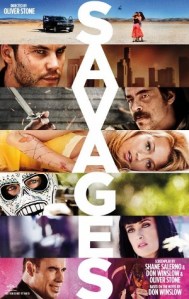
For the past 5 months, every time I’ve gone to the movies, I’ve seen the trailer for Oliver Stone’s new film, Savages. It’s a pretty exciting trailer, featuring sex, violence, and Taylor Kitsch’s abs. Despite Oliver Stone’s recent track record of making preachy, boring films, that trailer got a lot of people excited about the prospect of seeing Savages.
Well, the film has been released, I’ve seen it, and you know what? Sometimes, trailers lie.
Savages is the story of Chon, Ben, and O. Chon (Taylor Kitsch) and Ben (Aaron Johnson) sell the greatest weed in the world and O (Blake Lively) is the woman who loves both of them at the same time. O, by the way, is short for Ophelia and she narrates the film in such a monotonous style that I have to admit that I was shocked to discover that she actually knew she was named after Hamlet’s doomed girlfriend. Chon is a violent former Navy SEAL while Ben is a laid-back buddhist who wants to get out of the drug business so he can devote his time to environmental activism. (Zzzzzzzzzz….)
Ben’s marijuana becomes so legendary that soon, a Mexican drug cartel led by Salma Hayek decides that both Ben and Chon are going to work exclusively for them. Ben and Chon refuse so Hayek sends Benicio Del Toro to kidnap O and hold her hostage until Ben and Chon come around. Ben and Chon, however, have plans of their own…
On the positive side, Hayek, Del Toro, and John Travolta (playing a corrupt DEA agent) all give excellent performances that would seem to indicate that they — as opposed to everyone else involved with Savages — understand that they’re appearing in an expensive B-movie. They openly devour every piece of scenery in the film and have a fun time wringing every ounce of melodrama out of their pulpy dialogue. These three actors are fun to watch and it’s a shame that the same can’t be said for the other half of the film’s main cast.
Jennifer Lawrence was originally cast in the role of O but she dropped out of Savages so that she could star in The Hunger Games. The role was recast with Blake Lively, who looks like she could be Jennifer Lawrence’s older sister but who, as an actress, has never exhibited the type of wounded determination that has become Lawrence’s trademark. As played by Lively, O is such a passive character that it’s difficult to really care that much about whether she survives or doesn’t. Instead of being a strong, independent woman who is unashamed of her lifestyle, O just comes across as a spoiled and vapid pawn, a possession who is traded between the film’s various players. It doesn’t help that Lively delivers her heavy-handed narration in a flat monotone that makes her come across less like a hard-boiled survivor and more like a spoiled rich girl trying to sound jaded. Every time I heard her refer to Chon and Ben as being “my guys,” I just wanted to scream at the screen, “No, you stupid bitch, you belong to them! They don’t belong to you!”
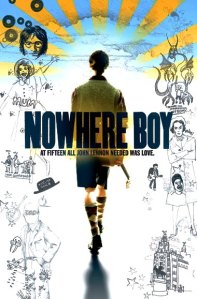
As for “her guys,” Taylor Kitsch is believable as a killer but not as a stoner. (Kitsch’s character comes across as if he’s been snorting cocaine as opposed to smoking weed.) Aaron Johnson, meanwhile, is a very believable stoner but he’s a lot less believable once his character becomes a killer. Unfortunately, neither Kitch nor Johnson show much in the way of charisma in this film and that’s a shame because both of them have shown in the past that they are capable of giving good performances. (Seriously, just check out Aaron Johnson’s performance in the criminally underrated John Lennon biopic, Nowhere Boy.) With neither Chon nor Ben being all that interesting, the film ultimately becomes a rather empty display of style.
And there’s no denying it — Savages has got style to burn. Oliver Stone shows here that — despite such anemic recent films as Wall Street: Money Never Sleeps — he still knows how to film an explosion. Unfortunately, there’s not much going on beneath all of that style and the end result is a film that mostly succeeds in making both sex and violence boring.
At first glance, Sam Taylor-Wood’s Nowhere Man sounds just a little bit too cutesy. The movie, which covers the youth of John Lennon, starts with the death of John’s Uncle George, covers both his attempts to reconcile with his mother Julia (portrayed here as being bipolar) and his troubles relationship with the aunt who actually raised him, details how John came to form his own band (The Quarrymen) and first met Paul McCartney and George Harrison, and ends with John preparing to leave for Germany. Yet the movie works surprisingly well and, by the end, is actually quite touching regardless of whether you idolize John Lennon or if you think Imagine is one of the most overrated songs of all time. By refusing to indulge in any easy sentimentality about either John Lennon or the iconic figure he would eventually become (the word “Beatles” is never uttered at any point in the film), Taylor-Wood crafts a touching coming-of-age story about an alienated teenager trying to find peace with his dysfunctional existence. The fact that the teen is going to grow up to be the John Lennon is secondary to the plot.
The film works mostly because of the cast. The young John Lennon is played by Aaron Johnson who, earlier this year, was the lead in Kick-Ass. I have to admit that I didn’t care much for Johnson in Kick-Ass. His performance seemed generic and bland and he was overshadowed by Nicolas Cage, Chloe Grace Moretz, Mark Strong, Christopher Mintz-Plasse, and just about everyone else in the movie. Here, however, Johnson gives a strong, sympathetic performance as a character who often comes across as being neither. He both manages to capture the young Lennon’s sensitivity as well as his anger and cocky arrogance.
However, the movie truly belongs to the two actresses playing Lennon’s aunt and mother, Kristen Scott Thomas and Anne-Marie Duff. Scott Thomas has an especially difficult job as her character is far less flamboyant and, at first sight, a lot less interesting as Duff’s. However, as the film progresses, Scott Thomas starts to subtly reveal the dry humor that lies underneath her character’s serious expression. As for Duff, she dominates the film as surely as Julia dominated her son’s life. Duff doesn’t resort to any of the easy (and insulting) clichés that are usually used to represent bipolar disorder on film. Instead, she captures both the exhilarating high of being manic along with the constant fear of the depressive episode that we always know is destined to follow. It’s a spot-on performance that elevates this film above the standard coming-of-age story.
Wisely, neither the director nor her actors ever get caught up in the fact that their film is about the John Lennon. There’s no portentous foreshadowing or awkwardly staged moments designed to specifically make you go, “Hey, that’s John Lennon!” Even the first time that Lennon meets Paul McCartney and, later, George Harrison is handled in a casual, off-hand manner. Taylor-Wood has enough faith in her audience to believe that we’ll be able to understand the importance of John being introduced to a younger guitar player named Paul without bashing us over the head with the fact that this is the Paul McCartney. As such, while you’re always aware that this is a movie about John Lennon, you can also see the movie as simply being the story of an alienated teenager who finds salvation through music.
Comic books which have been adapted for the big-screen have had an uneven track record. For every excellent film-incarnations like Spider-Man 2, X-Men 2, The Dark Knight and Iron-Man we get dregs like Elektra, Ghost Rider and Daredevil. The last couple years filmmakers have gravitated towards the deconstruction side of comic book superheroes. Christopher Nolan’s The Dark Knight was as much an action-thriller as it was a meditation on the superhero psyche and mythmaking. Then there was 2009’s Watchmen which tried admirably (though failed in the end) to adapt Alan Moore’s epic deconstruction of the superhero archetypes.
It’s now 2010 and we get the first comic book film of the year. The film is an adaptation of Mark Millar (writer) and John Romita, Jr.’s (artist) ultraviolent comic book title from Marvel’s Icon Comics (their creator-owned publishing line). Kick-Ass was optioned and adapted by British-director Matthew Vaughn and screenwriter Jane Goldman. Unlike most comic book films of the past decade, Vaughn’s Kick-Ass was independently-financed (with help from Brad Pitt and his Plan B Studio) and made which was the best thing that could’ve happened to this project. With a free rein to make the film he wanted without corporate studio meddling, Matthew Vaughn was able to craft a fun and violent romp of a film mashup that collides superhero archetypes and conventions with “real world” grounding.
The story and premise for Kick-Ass is actually quite simple enough to follow. We have high-schooler and avid comic book fan Dave Lizewski asking his best friends and fellow comic book fans why no one has actually tried to be a superhero. The answer he gets from his like-minded friends doesn’t instill hope in his dream. While they are huge fans of superheroes and comic books they stop at actually trying to be one in real-life. Dave, on the other hand, knows that it’s possible for one to try and be a superhero even without powers. He believes that determination, conviction and the need to help those in need would be all that someone requires to become a superhero. With these criteria in mind he sets off to do the very thing he had asked his friends about. He accomplishes this by ordering (for the amount of $99.99) a green and yellow wet-suit and head cover plus a pair of batons and a taser gun. His first attempt at superherodom fails spectacularly as he’s stabbed and violently run over in the street. This near-fatal introduction to the world of superheroes doesn’t deter Dave when deep down even he knows that he’ll get killed if he continues on his quest to become the next Spider-Man.
The story moves on to Dave finally getting his superhero fame by stopping a beatdown of a stranger and having this event caught on a bystander’s camera phone and uploaded said video on Youtube. With this amateur video on Youtube getting millions of hits and views, plus Dave’s own creation of a MySpace page for his alter-ego the world finally gets it’s real-life superhero in the form of Kick-Ass. A name that spurs not just tens of thousands of fans on Kick-Ass’ MySpace page but also a boom in sudden Kick-Ass merchandise in Dave’s local comic book shop. Through it all Dave revels in the attention his alter-ego has been getting even the unexpected attention of the girl of his dreams, Katie Deauxma (played by the lovely Lyndsy Fonseca). An attention born out of a misunderstanding where Katie believes Dave to be gay because of circumstances revolving around his near-death experience of his very first attempt at crimefighting.
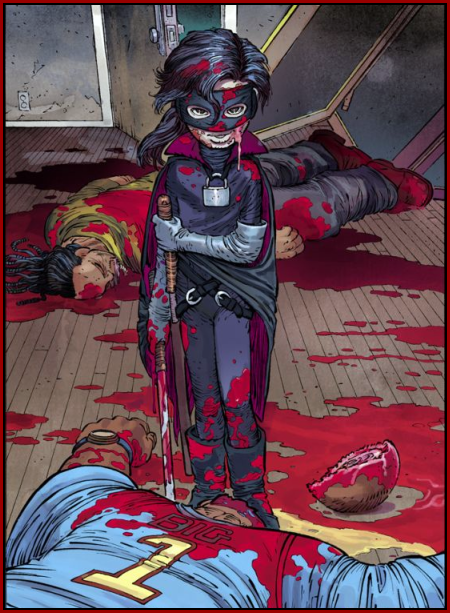
On the sidelines of all this we get introduced to the film’s real “superheroes” in the form of Big Daddy (played by Nicolas Cage) and his sidekick and 11-year old daughter, Hit-Girl (Chloe Moretz). We see early on that both Big Daddy and Hit-Girl are the real thing though calling them superheroes would be a stretch since they seem to be more vigilantes who happen to wear costumes and with no compunction at all about killing the criminals. These two are definitely not Batman and Robin (one of many easter egg-like references to comic book characters and storylines). Their story parallels that of Kick-Ass’ but where Dave seems to enjoy just playing at being a superhero and the adoration such role-playing gives him both Big Daddy and Hit-Girl actually have a focus and mission in their own attempts. These are two individuals who believe in the superhero roles they’ve taken on themselves and have prepared and trained themselves well for the violent consequences and ramifications of their mission.
The rest of the film takes the audience on a peculiar coming-of-age journey for one Kick-Ass. As stated earlier he’s pretty much all talk with a rose-tinted view of a superhero’s life. What he has read in his comic books doesn’t prepare him for the reality of actually trying to act and become a true superhero. While writer Mark Millar takes a dim and cynical view of what Kick-Ass is trying to figure out and accomplish (most of the comic’s morality ends up being that bad things happen to good people with the best of intentions), director Matthew Vaughn and screenwriter Jane Goldman take a more hero’s journey approach (sprinkled liberally with foul language and bloody violence). While Dave Lizewski’s attempts to live up to his hero persona of Kick-Ass range from succeeding through luck to failing miserably and at times fatally, by the end of the film circumstances (which have spiralled out of his own control) forces him to finally face up to the fact that if he really wanted to be a superhero he needed to finally do more than just talk and pretend to be one and actually act and perform like one.
This is in contrast to Hit-Girl’s own journey which doesn’t start her off as clumsy and unsure of herself. Instead we see in Hit-Girl the type of individual Kick-Ass wants to be but is unable to through most of the film. Where Kick-Ass suddenly realizes that he’s way over his head once the bodies start dropping in bloody ways, Hit-Girl doesn’t lack in confidence but is in control of every situation she’s confronted with. Whether it’s rescuing Kick-Ass from death (more than once) or finally launching the climactic assault on her and Big Daddy’s focus and reason for being. Hit-Girl is the true superhero with Big Daddy really her sidekick. Everyone else, from Kick-Ass to Red Mist (Christopher Mintz-Plasse), just pretend and play at being costumed superheroes. Hit-Girl is the personification of the female antihero of the recent comics, but unlike most female characters in comic books she’s not the fringe character or the one in need to help. She’s the one who rescues everyone and willing to sacrifice her very life to live up to the ideals (however twisted they may be to the audience) she has set for herself.
Kick-Ass may have been an post-modern exercise in trying to deconstruct and then acknowledge the superhero archetype and themes, but first and foremost it is a very fun and exhilarating rollercoaster ride of an action film. Vaughn and Goldman were able to capture the exciting and fun side of the original comic despite leaving behind some of the meanspiritedness of Millar’s writing. Goldman definitely has an ear for inserting comedy beats into the film to keep the story from becoming too serious and thus slowing down the film. In fact, I would say that Kick-Ass was a very fast-paced two-hour film that would alternate between comedy and action with a tender moment spliced in at the last third of the film. Much of the comedy in Kick-Ass come at the expense of Kick-Ass himself as he stumbles his way through most of the film either out of his league or just pantshitting scared of what he’s gotten himself into. Nicolas Cage’s characterization of Big Daddy also drew some major laughs as he alternated from a twisted version of Mr. Rogers as Damon MacReady to channeling Adam West’s “Batman” when dressed up as Big Daddy.
One thing which Matthew Vaughn has shown with is third feature-length film was the ability to create and shoot some very good action sequences. He even made an interesting stylistic choice to film his action sequences differently depending on whether it was Kick-Ass who was the focal point in the fight or whether it was Hit-Girl or Big Daddy doing the mayhem. Vaughn chose to shoot Kick-Ass’ fight sequences with comedy in mind as the character clumsily fought his way through his opponents. Even when he finally finds his inner superhero in the final fight with his newly discovered nemesis Kick-Ass still fought more on instinct and blindly swinging away instead of actually fighting like an expert. The same couldn’t be said about when Hit-Girl or Big Daddy were the main focus in the action scenes. These two characters were trained killers pure and simple. Their fight choreography was the exact opposite of Kick-Ass’. Hit-Girl’s was especially well-choreographed to show just how honed a fighter and killer Big Daddy’s 11-year old daughter really was even when confronted by over a dozen heavily-armed gangsters and drug dealers. It’s the Hit-Girl action scenes which drew the biggest positive reactions from the audience and rightfully so. Chloe Moretz truly sold the idea of an 11-year old costumed vigilante killer and the film was better for it.
Chloe Moretz star-making performance brings us to the overall performances of the film’s cast. While pretty much everyone who sees this film will agree that Chloe Moretz as Hit-Girl pretty much steals every scene she’s in Aaron Johnson as Dave Lizewski/Kick-Ass also does a very good job in his performance. He anchors the film as the everyman, or everyboy for this film, the audience will gravitate towards. He’s believable as the stumbling and naive teen whose dream of becoming a superhero turns his life upside-down and rightside-up. We can sympathize with his teen need to be accepted and, ultimately, find his identity. It just happens that he find it in the midst of playing at being his dream girl’s fake gay BFF and then as the superhero he finally became in the end. Nicolas Cage, Clark Duke and Lyndsy Fonseca were good at their “sidekick” roles. On the other side of the superhero spectrum we have Mark Strong as mob boss Frank Dimico doing a wonderful job. Christopher Mintz-Plasse as Chris Dimico/Red mist makes for a great counterpoint and mirror to Dave Lizewski/Kick-Ass. But where Dave finally learns to be a hero and take the role seriously, Mintz-Plasse’s Chris never learns the true meaning of what a hero is and just continues to be the wannabe that Dave started off as but finally shed in the end.
Kick-Ass does a better job at deconstructing the superhero world of comic books than Zack Snyder’s Watchmen of 2009. While the comic book version of Kick-Ass will never be in the same league and level as Alan Moore’s Watchmen the film version flip-flop and shows that sometime the simpler story makes for a better film. Vaughn and Goldman did a great job in adapting the darker and more nihilistic writing of Millar. But while changes were made to allow the story to be more accesible to the general public, the film still manages to keep the spirit of the original source material intact but minus the cuckolding the story’s intrepid hero gets hit with twice to end the story.
Even with the controversy over the Hit-Girl character and of Chloe Moretz protrayal of this blood-soaked and foul-mouthed killer it shouldn’t diminish the fact that Kick-Ass set out to be both thought-provoking, fun and entertaining and succeeds in accomplishing all three. While the film has flaws they’re not so glaring or even distracting that they take away from one’s enjoyment of the film. Even for an “origins” tale Kick-Ass manages to escape being too overly reliant on dialogue to explain everything that’s going on to the audience. The fact that a sequel was already being talked about even before the film’s release shows confidence in both Millar and Vaughn that there’s further adventures and stories to show and tell about Kick-Ass and Hit-Girl. I, for one, will be there to see what they will be up to next.


 Through the Shattered Lens