44 Days of Paranoia #10: The Intruder (dir by Roger Corman)


For today’s entry in the 44 Days of Paranoia, we take a look at one of the most underappreciated films of all time, Roger Corman’s 1962 look at race relations, The Intruder.

Despite the fact that he’s regularly cited as being one of the most important figures in the development of American cinema, Roger Corman remains an underrated director.  Many critics tend to focus more on the filmmakers that got their start working for Corman than on Corman himself.  When they talk about Roger Corman, they praise him for knowing how to exploit trends.  They praise him as a marketer but, at the same time, they tend to dismiss him as a director.

I would suggest that those critics see The Intruder before they presume to say another word about Roger Corman.

The Intruder opens with a young, handsome man named Adam Cramer sitting on a bus.  The first thing that we notice about Cramer is that he’s wearing an immaculate white suit.  The second thing we notice is that he’s being played by a very young (and, it must be said, rather fit) William Shatner.

I know that many people will probably be inclined to dismiss The Intruder from the minute they hear that it stars William Shatner.  Based simply on Shatner’s presence, they’ll assume that this film must be very campy, very Canadian, or both.  Well, they’re wrong.  Shatner gives an excellent performance in this film, bringing to life one of the most evil characters ever to appear on-screen.

Adam Cramer, you see, is a representative on a Northern organization known as the Patrick Henry Society and he’s riding the bus because he’s heading to a small Southern town.  The high school in that town has just recently been desegregated and Cramer’s goal is to make sure that no black students attend class.  As Cramer explains it, he’s a “social worker” and his goal is to help preserve Southern society.

To achieve this goal, Cramer partners up with the richest man in town, Verne Shipman (who is played, rather chillingly, by Robert Emhardt).  With Verne’s sponsorship, Cramer gives an inflammatory speech in the town square and then later returns with a group of Klansmen.  As opposed to recent films like Django Unchained (which scored easy laughs by casting Jonah Hill as a Klansman and playing up the group’s ignorance), The Intruder presents the Klan as figures that have stepped straight out of a nightmare, making them into literal demons who appear at night and disappear during the day.  In a genuinely disturbing scene, the Klansmen set a huge cross on fire.  As the flames burn behind him, Cramer seduces the wife of a local salesman.
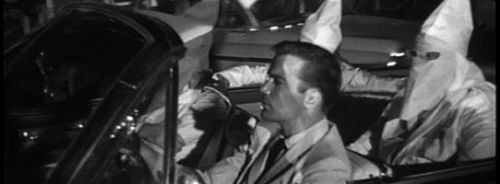
intruder-shatner-klan

After Cramer delivers his speech, the local black church is blown up and a clergyman is killed.  The editor of the town newspaper — who, before Cramer showed up, was opposed to desegregation — changes his mind and publishes an editorial strongly condemning Cramer.  Cramer’s mob reacts by nearly beating the editor to death.  Realizing that he’s losing the power to control the mob that he created, Cramer frames a black student for rape which leads the film to its powerful and disturbing conclusion.

Particularly when compared to other films that attempted to deal with race relations in 1962, The Intruder remains a powerful and searing indictment of intolerance and a portrait of how demagogues like Adam Cramer will always use fear, resentment, and ignorance to build their own power.  Corman filmed The Intruder on location in Missouri and used a lot of locals in the cast.  Judging from the disturbing authenticity of some of the performances that Corman got from some of these nonprofessionals, it’s not unreasonable to assume that quite a few of them agreed with everything that Adam Cramer was saying.

As opposed to most films made about the civil rights era in America, The Intruder doesn’t shy away from showing the ugliness of racism.  The Intruder casually tosses around the N word (and yes, it is shocking to not only hear Shatner use it but to see him smile as he does so) but, unlike a lot of contemporary films, it does so not just to shock but to show us just how naturally racism comes to the film’s characters.  The scene in which Verne repeatedly strikes a black teenager who failed to call him sir is also shocking, not just for the violence but because of how nobody seems to be particularly surprised by it.  As a result, The Intruder is not necessarily an easy film to watch but then again, that’s the point.  The hate on display in The Intruder should never be easy to watch.

The Intruder was written by Charles Beaumont, who also wrote several classic episodes of The Twilight Zone.  I think it can be argued that The Intruder represents the best work of Beaumont, Corman, and Shatner.  Unfortunately, but not surprisingly, The Intruder was the only film directed by Roger Corman to not be a box office success.

However, in a world where people are patting themselves on the back for sitting through The Butler, The Intruder is an important film that deserves to be seen now more than ever.
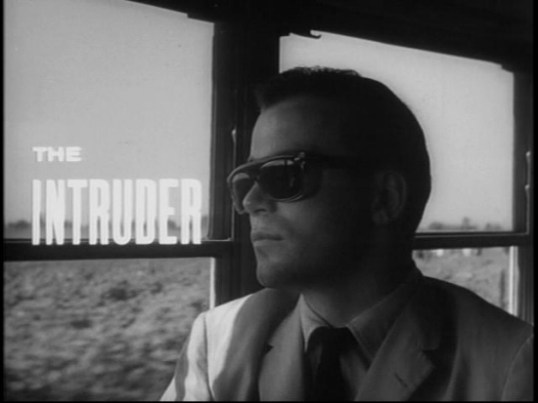
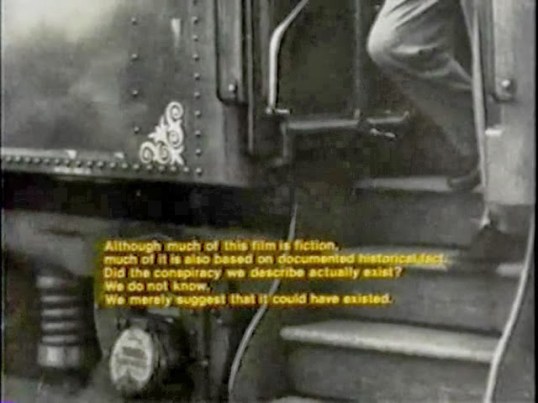
intruder (1962) title capture

44 Days of Paranoia #9: They Saved Hitler’s Brain (dir by David Bradley)


hitlerbrain6

When I started the 44 Days of Paranoia, I said that I was going to not only look at some of the best conspiracy-themed films but some of the worst as well.  With that promise in mind, today’s film is 1963’s They Saved Hitler’s Brain.

Beyond what’s obvious from the film’s title, what exactly is They Saved Hitler’s Brain about?

Your guess is as good as mine.

The film starts with a Mr. Van Pelt, who is a top official at the Central Intelligence Division.  It turns out that Mr. Van Pelt is also a part of a shadowy conspiracy that operates out of the South American country of Mandoras.  The conspiracy is developing a poison named as “G-gas” but a scientist named Dr. Bernard has developed an antidote to G-gas.  So Van Pelt orders his henchmen to blow up Dr. Bernard in his car.

Van Pelt then assigns two CID agents to investigate Dr. Bernard’s death.  Vic Gilbert is a real man’s man who is upset at having to work with a woman.  Toni Gordon wears an extremely short miniskirt, demands to be taken seriously as a CID agent, and — well, that’s about the extent of her characterization.  Anyway, Vic and Toni spend some time exchanging some cutesy dialogue and reading a lengthy dossier about Mandoras.  It turns out that Mandoras is full of Nazi war criminals which, of course, brings us back to the film’s title.

Also, it turns out that Dr. Bernard told his colleague, Dr. Coleman, about the antidote.  So, Van Pelt sends his henchmen to kidnap Coleman but fortunately, Toni just happens to be driving by at the same time that Coleman is kidnapped.  Toni follows the henchmen and Coleman to Van Pelt’s secret hideout.  The henchmen spot Toni and end up shooting her as she flees to a phone booth but not before Toni manages to call Vic.

Vic then shows up and discovers that Van Pelt is a traitor.  Fortunately, Toni isn’t quite dead yet so she manages to shoot Van Pelt before she expires but then Vic dies anyway, the result of driving his car into a power station.

And then, suddenly, an entirely new movie begins!

That’s right — They Saved Hitler’s Brain is one of those films that was essentially created by editing two unrelated movies together.  All of the Vic and Toni footage was apparently filmed in the late 60s by a bunch of students at UCLA who were hired by the film’s distributor to lengthen the original 1963 film so that it could be sold into television syndication.  Considering that the original film (which was titled Madmen of Mandoras) was a thorough mess, the addition of the equally confusing prologue serves to make They Saved Hitler’s Brain into one of the most completely incoherent films ever made.

Anyway, the “second” part of They Saved Hitler’s Brain deals with Coleman’s daughter and her boyfriend (who, we find out, is yet another CID agent) going down to Mandoras and searching for her father.  It turns out that the government of Mandoras has been secretly taken over by a bunch of Nazi war criminals who take their order from — wait for it — Hitler’s Brain!

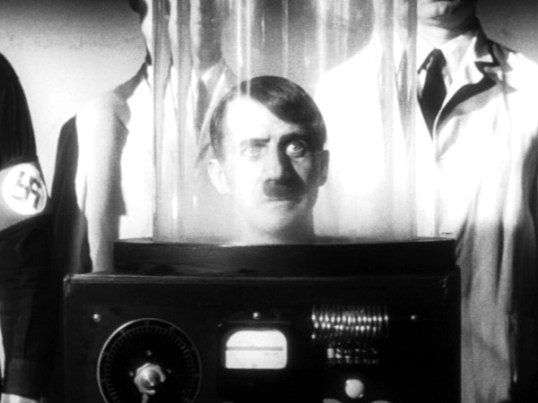
It turns out that Hitler’s head has been preserved in a jar and, despite no longer having a body, he’s still capable of plotting, ordering people about, and dramatically rolling his eyes.  From his hiding place in Mandoras, he’s come up with Plan G, a scheme that will allow him to conquer the world.  Unless, of course, the CID can stop him…

(Were the filmmakers worried about getting sued by the CIA?  Seriously, CID just doesn’t have the same ring to it…)

Now, I have to admit that I have a soft spot for terrible films like They Saved Hitler’s Brain.  There are a lot of bad movies out there but there are only a few movies that are so bad that they’ve managed to become classics of ineptitude.  To the filmmakers behind movies like They Saved Hitler’s Brain, I would say that if you can’t take pride in making one of the best films ever made, why not take some pride in making one of the worst?

You can judge for yourself below.

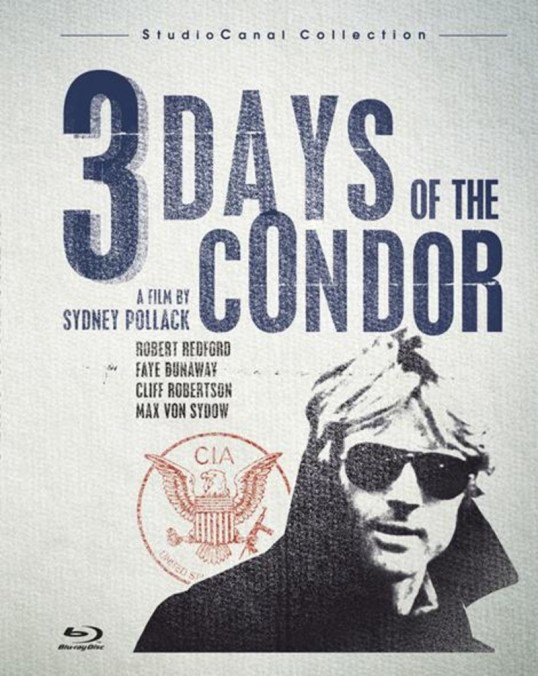
44 Days of Paranoia #8: Three Days of the Condor (dir by Sydney Pollack)


3DaysofTheCondor

When I first decided that I wanted to do the 44 Days of Paranoia, I went on Facebook and I asked my movie-loving friends to name some of their favorite conspiracy-themed films.  As the replies came flooding in, one thing that I quickly noticed was that a lot of them were naming films that had been made in the 1970s.

Usually, when I think about the 70s, I tend to assume that everyone in Texas was smoking weed in a high school parking lot, everyone in New York was snorting cocaine in Studio 54, and everyone in America was dancing nonstop.  And, to be honest, that doesn’t sound too bad to me.  If the 70s were just ten years straight of Dazed and Confused and Saturday Night Fever, then I would be the first one to hook up with anyone who could build a time machine.

However, the 70s were apparently also a very paranoid time.  When one looks over the most acclaimed and best-remembered films of the 70s, one is struck by the feeling that nobody trusted anyone and all official institutions were suspect.

Case in point: 1975’s Three Days of the Condor.

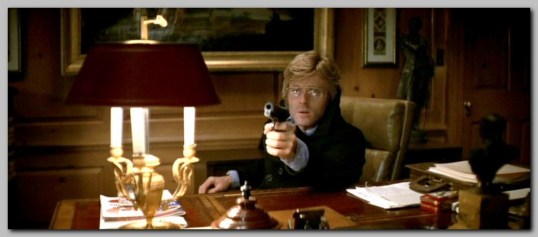
Robert Redford plays Joe Turner, a mild-mannered guy who works for the American Literary Historical Society in New York City.  The Society, however, is a CIA front and Turner’s job is to read cheap spy novels and analyze them to see if any real intelligence leaks might be found between the lines.  As the film opens, Turner arrives late for work.  He jokes with the chain-smoking secretary, shares a few curt words with his superior Martin, and flirts with fellow researcher Janice.  Then, Joe goes to lunch and, while he’s gone, Max Von Sydow shows up with a bunch of killers and guns down everyone else at the safe house.

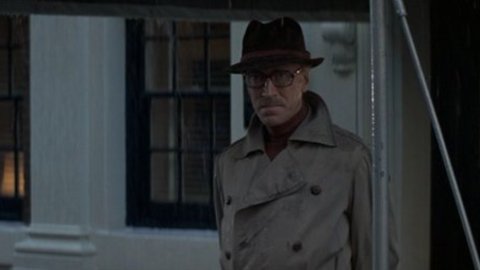
Max Von Sydow's courtly killer

Max Von Sydow’s courtly killer

The scene in which Von Sydow calmly kills all of Joe’s co-workers is one of the most disturbing that I’ve ever seen.  As directed by Sydney Pollack, the film’s violence comes in short, brutal bursts that are all the more nightmarish for lacking any of the flashy choreography that we, as viewers, have been conditioned to expect whenever we’re confronted by violent death on-screen.  Pollack also makes good use of Von Sydow’s kindly eyes and courtly manner, letting us know that, for him, murder is just a job.  Even though we’ve only spent a few minutes with Joe’s co-workers, we’ve still grown to like them and that makes Von Sydow’s matter-of-fact attitude all the more disturbing.

(It’s been a few days since I saw the film and I have to admit that I’m still haunted by the close-up of the burning cigarette still held in the dead secretary’s hand or the way that Martin’s toupee falls off his head after he’s shot.  Small as these details may seem, they stick in the mind and create a sickening feeling of life interrupted.)

When Joe returns from lunch, he finds all of his co-workers dead.  Fleeing the safe house, Joe calls the New York regional director of the CIA, Higgins (Cliff Robertson).  Higgins arranges for Joe to meet up with another agent and to be taken to safety.  However, when Joe arrives for the meeting, the other agent attempts to kill him.

Realizing now that the CIA specifically hit its own safe house and is now looking to kill him, Joe ends up kidnapping Kathy Hale (Faye Dunaway), a neurotic photographer, and forcing her to hide him while he desperately tries to figure out why he’s been targeted.

Thanks largely to Sydney Pollack’s thoughtful direction, Three Days of the Condor is an excellent, exciting, and thought-provoking thriller and, despite having been released close to 40 years ago, it features one major plot that’s probably even more relevant today than when the film was first released.  Redford and Dunaway both give excellent performances but the film really belongs to Max Von Sydow’s menacing and charming assassin.  Most of today’s “action” filmmakers could learn a lot from watching Three Days of the Condor.

end_office

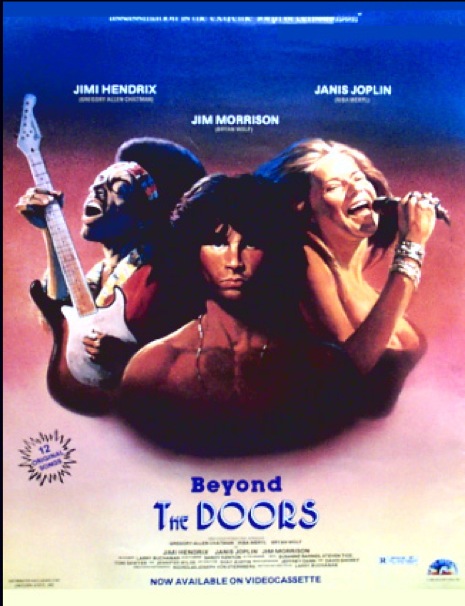
44 Days of Paranoia #7: Beyond the Doors (dir by Larry Buchanan)


beyondthedoorsomrfrfgrg

While I was researching The Trial of Lee Harvey Oswald last week, I came across another film directed by Larry Buchanan.  Beyond the Doors (also known as Down On Us) sounded like one of those truly odd films that I simply had to see for myself.  Fortunately, it turned out that this rare and hard-to-find movie was available (in 13 parts!) on YouTube.

First released in either 1983 or 1984 (sources vary), Beyond the Doors tells the story of a FBI agent who, as the film begins, is out hunting with two friends who proceed to gun him down.  Staring down at the agent’s dead body, one of the assassins sneers, “Rock and Roll is dead.  Long live Rock and Roll.”  The agent’s son then goes through his father’s files and discovers that, during the late 1960s and early 70s, his father was responsible for murdering “the three pied pipers of rock and roll” — Jimi Hendrix, Janis Joplin, and Jim Morrison.  The film then enters into flashback mode and we discover both why the U.S. government was determined to kill Hendrix, Joplin, and Morrison and how exactly they attempted to do it.

What can I say about Beyond the Doors?  If The Trial of Lee Harvey Oswald seemed oddly respectable for a Larry Buchanan film, Beyond the Doors reminds us of why Larry Buchanan remains a cult figure for bad film lovers.  Everything that Buchanan is known for is present in this film: unknown actors playing real-life characters, melodramatic dialogue, one set continually redecorated to look like a dozen different rooms, and plenty of conspiracy theories.   As is typical of a Larry Buchanan film, it was shot with a lot of ambition but next to no money or actual talent.  Hendrix, Morrison, and Joplin are played by lookalikes who give performances that don’t so much resemble their real-life counterparts as much as they seem to literally be Wikipedia entries brought to life.  Hendrix worries that he’s sold out to the man, Joplin questions what fame’s all about, and Morrison makes pretentious observations.  Buchanan couldn’t actually afford the rights to any songs from Joplin, Hendrix, or the Doors so instead, the soundtrack is full of music that’s designed to sound as if it could have been written by one of the “three pied pipers of rock and roll” even though it wasn’t.  (And yes, the end result is just as silly as it sounds.)  In short, Beyond the Doors is one of those films (much like Tommy Wiseau’s The Room) that is so amazingly bad and misguided that it becomes perversely fascinating.

In short, it’s a film that, like me, you simply have to see for yourself.

44 Days of Paranoia #6: JFK (dir by Oliver Stone)


JFK-John-F-Kennedy-DVD-Yon-OLIVER-STONE__76044126_0When I first decided to do this series of reviews of conspiracy-themed films, I knew that I would eventually have to review the 1991 Oliver Stone film JFK.

JFK is one of those films that continues to divide audiences.  Those who think that John F. Kennedy was killed by a conspiracy tend to love this film and are given to describing JFK as being “one of the most important films ever made.”  Those who believe that Lee Harvey Oswald was the lone assassin dismiss Stone’s film as being left-wing propaganda.  Just check out  the message board at the imdb if you need evidence of just how worked up people get over this film and its subject matter.

It seems that very few of the people who criticize or praise JFK ever review it as a work of cinema.  Instead, they focus on the film’s politics.  If I criticize the film for wasting the talents of Sissy Spacek or featuring one of Kevin Costner’s least interesting performances then I’m running the risk of having to deal with angry conspiracy theorists telling me that I need to open my eyes to the reality of American history.  On the other hand, if I praise Tommy Lee Jones’s wonderfully decadent turn as one of the film’s conspirators, chances are that someone is going to accuse me of being a naive leftist.

Then again, perhaps that reaction is to be expected.  Oliver Stone is one of our most political and least subtle filmmakers.  His movies are specifically designed to challenge the status quo.  For that reason, it’s not surprising to discover that Stone considers JFK to be the best of all of his films.

JFK is based (rather loosely, some claim) on the true story of New Orleans District Attorney Jim Garrison (played by Kevin Costner) and how, in 1967, he charged businessman Clay Shaw (played by Tommy Lee Jones) with being a part of a conspiracy to kill John F. Kennedy.  Shaw was eventually acquitted and both Jim Garrison and his investigation remain controversial to this day.

JFK courts controversy immediately with its portrayal of Jim Garrison.  I’ve read several accounts of the Garrison investigation and the one thing that they all seem to agree on is that Jim Garrison was a flamboyant, bigger-than-life figure who enjoyed publicity.  Even among those who believe that Garrison uncovered some valuable evidence as a result of his investigation, there is a good deal of ambiguity about Garrison’s motives.  However, in Stone’s film, Jim Garrison is played by Kevin Costner and is portrayed as being an incorruptible, all-American idealist.  It’s not that Costner gives a bad performance.  Instead, it’s just a rather uninteresting one, especially when one compares Costner’s Garrison to some of the stories about the real-life Garrison.

However, as the film unfolds, it becomes obvious that Stone is using Costner’s blandness to the film’s advantage.  Over the course of three hours, JFK slowly peels back layers of secrecy and cover-ups and reveals the shadow world that, according to Stone, lurks underneath everyday reality.  Costner’s Garrison might not be interesting but he is a stable presence.  He anchors the film, giving us someone to relate to while the film itself grows more and more bizarre.

While Costner’s might give the least interesting performance of his career in this film, the same cannot be said of the rest of the cast.  JFK is full of familiar faces, many of whom are only on-screen for a few minutes but all of which play an important role in creating Stone’s shadow universe.  Kevin Bacon, Gary Oldman, Joe Pesci, Michael Rooker, Donald Sutherland, and Tommy Lee Jones; they all have small roles but every single one of them makes an undeniable impression.  Whether you agree with the film’s conclusions are not, it’s impossible not to enjoy JFK for the chance to spot a bunch of familiar faces giving memorably bizarre performances.

But ultimately, its impossible to review JFK without considering the film’s conclusions.  JFK makes the case that John F. Kennedy was killed as the result of a massive right-wing conspiracy that involved the military, business interests, the CIA, the FBI, anti-Castro Cubans, and the mafia.  By the end of the film, the question becomes less who killed JFK and more who didn’t kill JFK.

Myself, I’m not going to claim to be enough of an expert on the Kennedy assassination to argue whether JFK is accurate or if it’s just propaganda.  However, as a film reviewer, I can say that it’s a very well-made and powerful film but it’s also one of those films that works better the first time you see it than the second time.

The first time you see it, the film overwhelms you.  It leaves you convinced that yes, there was a conspiracy and yes, everyone was involved and yes, Jim Garrison was right!  It convinces you so thoroughly that you end up using exclamation points, just to make sure everyone knows how convinced you are.

However, with each subsequent time that you view JFK, you became a bit more aware of just how manipulative and one-sided it truly is.  You become a bit more aware of the technique underneath the outrage and, if you’re a smart film watcher, you remember that JFK is a recreation as opposed to being a historical document.  You become more and more aware that Stone approached the material with a destination in mind and, like any good director, he has specifically shaped the material to make sure that you reach that destination at the end of the journey.

That was certainly my experience with JFK.  I first saw it in high school and it convinced me that JFK was the victim of a conspiracy.  Then, when I was in college, I watched it for a second time and, though I still believed the film’s conclusions, I also found myself much more aware of how the film’s length and Stone’s direction were designed to beat the audience into submission.  When I saw the film a third time, I found myself resenting the film’s manipulative nature and, as a result, I found it a lot more difficult to accept Stone’s conclusions.

However, when I rewatched the film last night for this review, I was surprised to discover that JFK actually holds up pretty well.  It’s still way too long (and, unlike a lot of other reviewers, I am not impressed by the droning speech that Costner delivers at the end of film) and Stone’s lack of subtlety does backfire on a few occasions.  However, perhaps because I was finally watching the film as entertainment as opposed to judging the film on its political or historical merits, I discovered that JFK is a watchable and entertaining film, one that does a pretty good job of making Stone’s case.  If nothing else, it’s worth watching just for the chance to see the wonderfully snarky performances of Tommy Lee Jones, Kevin Bacon, and Gary Oldman.

Perhaps the best thing that I can say about JFK is that its the type of film that will inspire smart people to do their own research and come to their own conclusions, which may or may not be the same conclusions that Oliver Stone reaches.

And, honestly, isn’t that the most that we can ask of any film?

JFK

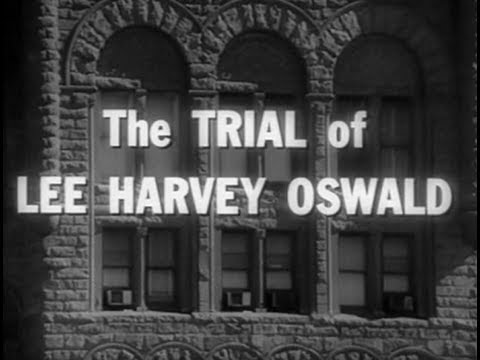
44 Days of Paranoia #5: The Trial Of Lee Harvey Oswald (dir by Larry Buchanan)


The Trial of Lee Harvey Oswald

Today has been a strange day to live and work in Dallas, Texas.  It is, of course, the 50th anniversary of the day that President John F. Kennedy was assassinated in my hometown.

As I mentioned in my review of Executive Action, those of us who live in Dallas are still expected to live in the shadow of something that happened before a lot of us were even born.  Today, the city of Dallas did everything that it could to embrace that shadow.  Despite the fact that it was cold and rainy today, a lot of people attended the memorial ceremony at Dealey Plaza.  (Despite the weather, nobody was allowed to open an umbrella during the ceremony.  Having been raised Catholic, I appreciate a little self-punishment as much as the next girl but considering how bad the weather  was, it all seems a bit much to me.)  One of the local talk radio stations spent today rebroadcasting all of its programming from November 22nd, 1963.  I guess the idea was to give people a chance to experience a terrible day in real time.  That seems a bit creepy to me but it does illustrate just how much the Kennedy assassination continues to overshadow life here in Dallas.

Considering just how much my city is identified with it, it’s perhaps appropriate that the very first film ever made about the Kennedy assassination was made by a Dallas filmmaker, the infamous Larry Buchanan.  As a filmmaker, Buchanan specialized in exploitation films that claimed to either be ripped-from-the-headlines or were presented as being lurid dramatizations of real-life events.  Hence, it’s not surprising that, in 1964, Buchanan gathered together a group of local (and obscure) Dallas actors and filmed The Trial of Lee Harvey Oswald.

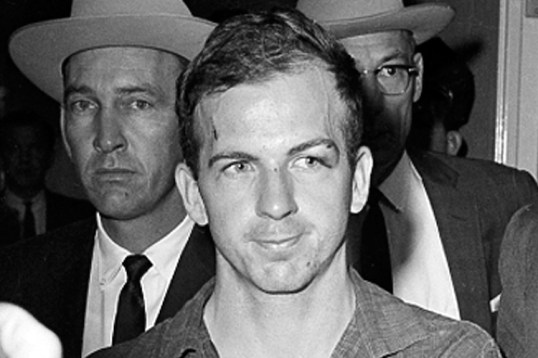
Lee Harvey Oswald

The eyes of a killer?

The Trial of Lee Harvey Oswald takes place in an alternative reality in which Lee Harvey Oswald was not murdered by Jack Ruby and, instead, actually stood trial for the assassination of John F. Kennedy.  The prosecution pretty much presents the case that was made by the infamous Warren Commission.  The defense argues that the evidence against Oswald is circumstantial and that, even if Oswald did fire the fatal shots, he should still be found “not guilty for reason of existing insanity.”  The film’s audience is meant to serve as the trial’s jury.

As I watched this film, two things stood out for me.  One is the fact that Buchanan never allows us to get a good view of the defendant.  Instead, we simply see his eyes.  While this was probably due to the fact that actor Charles Mazyrack didn’t bear a strong resemblance to the real-life Oswald, it’s still an occasionally striking effect that allows the character to remain a troubling enigma.

Secondly, and this surprised me as a contemporary viewer, next to no accusations of conspiracy are made during the trial.  There’s no talk of the grassy knoll or the military-industrial complex or any of the other things that one naturally expects when it comes to a film about the Kennedy assassination.  Instead, The Trial of Lee Harvey Oswald is based solely on the information that was available to the general public in 1964.  As such, it remains an interesting historical document, a chance to get a genuine look at what people actually knew and thought in the days immediately following the Kennedy assassination.

(Interestingly enough, Buchanan’s later films would often feature shadowy government conspiracies.)

When Larry Buchanan died in 2004, The New York Times summarized his career as follows: “One quality united Mr. Buchanan’s diverse output: It was not so much that his films were bad; they were deeply, dazzlingly, unrepentantly bad.”  For the majority of Buchanan’s films, that’s true but it’s not exactly true for The Trial of Lee Harvey Oswald.  Considering that  Buchanan is best remembered for directing a film called Mars Needs Women, The Trial of Lee Harvey Oswald feels almost respectable.

In fact, the film is a bit too respectable.  The dialogue and direction are often rather dry and the mostly amateur cast alternates between overacting and not acting at all.  If there was ever a film that could have benefited from some ludicrous melodrama, it’s this one.

That said, I enjoyed The Trial of Lee Harvey Oswald because I’m a history nerd and, if nothing else, this film remains an interesting historical curio.   As well, it was filmed on location in Dallas and I can’t complain about any film that features a close-up of my favorite downtown building, the old red courthouse.

Enjoy The Trial of Lee Harvey Oswald!

44 Days of Paranoia #4: Interview With The Assassin (dir by Neil Burger)


InterviewDAS062810

Continuing with the 44 Days of Paranoia, we today take a look at one of the best films to have been inspired by the assassination of John F. Kennedy, 2002’s Interview With The Assassin.

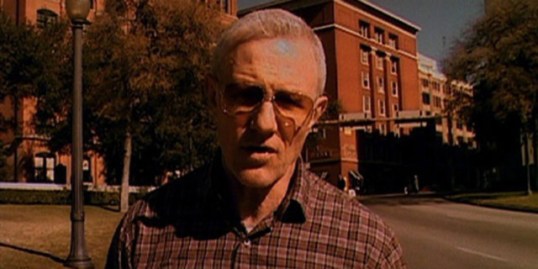
Interview With The Assassin tells the story of Ron (Dylan Haggerty), a cameraman who, at the beginning of the film, has recently lost his job.  His gruff neighbor, an ex-Marine named Walter (a brilliantly menacing Raymond K. Barry), approaches Ron and tells him that he’s dying of cancer and he wants Ron to film him confessing to a crime.  After Ron sets his camera up, Walter proceeds to state that he was the second gunman and that he — and not Lee Harvey Oswald — was the sniper who killed President Kennedy.  When Ron asks Walter who hired him to kill Kennedy, Walter says that he was approached by a man named John Seymour but that he’s not sure who Seymour was working for.

Ron, not surprisingly, is initially skeptical of Walter’s claims.  However, Walter gives Ron a spent shell casing that he claims he grabbed off the ground after he shot Kennedy.  Walter explains that the only reason he’s been allowed to live is because he has that shell casing and, therefore, can prove that there was a second gunman.  Ron gets the shell casing analyzed and is informed that it was probably fired in 1963.

Still skeptical but now intrigued, Ron agrees to make a documentary about Walter and his claims.  Walter and Ron drive across the country to find John Seymour and confront him.  Along the way, they stop in Dallas and Walter shares more of his memories of killing Kennedy.

As Ron becomes more and more convinced that Walter is telling the truth, he also finds himself becoming more and more immersed in Walter’s secretive and fatalistic worldview.  However, as their paranoid road trip continues, Ron also starts to find reasons to doubt whether or not Walter is telling the truth about anything.  It all leads to a genuinely surprising finale that forces us to reconsider everything that we had previously assumed about both Ron and Walter.

I usually hate found footage films but Interview With The Assassin is a wonderful exception.  In his directorial debut, Neil Burger (who would later direct the brilliant Limitless) makes good use of the faux documentary format.  As opposed to many other found footage films, Interview With The Assassin actually provides a believable reason for why the characters are filming everything and, even more importantly, it’s willing to both explore and question the motives of the man holding the camera.  As a result, even though he spends much of the film off-screen, Ron becomes as interesting a character as Walter.

The genius of Interview With The Assassin is to be found in the film’s ambiguity.  While the film creates a believable atmosphere of conspiracy and paranoia, it also forces the viewer to interpret what she’s seen and heard for herself.  Is Walter crazy or is he telling the truth?  Is Ron a hero trying to uncover the truth or is he a frustrated journalist who is exploiting a dying and mentally disturbed man?  Convincing arguments can be made for any of those interpretations as well as a dozen more.  I’ve seen the film a handful of times and I’m still conflicted on just how I feel about both Walter’s claims and the initial assumption that Ron is meant to be the film’s hero.

Interview With The Assassin is a film that invites its audience to think.  As a result, it’s a film that deserves to be seen.

Raymond Barry in Interview With The Assassin

Raymond Barry in Interview With The Assassin

44 Days of Paranoia #3: Winter Kills (dir by William Richert)


MPW-39279Yesterday, I took a look at Executive Action, a 1973 docudrama about the assassination of John F. Kennedy.  Today, I want to take a look at another film inspired by the Kennedys, the 1979 satire Winter Kills.

As the film opens, it’s been 16 years since a popular and dynamic President named Tim Kegan was assassinated in Philadelphia.  Despite constant rumors of conspiracy, the official story is that Kegan was killed by a lone gunman and that gunman was subsequently killed by another lone assassin.  The President’s half-brother, Nick (played by Jeff Bridges, who looks so impossibly young and handsome in this film), has disappointed his father (John Huston) by declining to follow his brother into politics.  Instead, he spends most of his time sailing on corporate oil tankers and dating fashion editor Yvette (Belinda Bauer).  This all changes when a dying man named Fletcher (and played, underneath a lot of bandages, by Joe Spinell) asks for a chance to speak to Nick.  Fletcher reveals that he was the 2nd gunman and that he was hired by to kill President Kegan.  Before dying, Fletcher tells Nick where he can find the rifle that was used to kill the President.

Following Fletcher’s directions, Nick finds both the rifle and proof that his brother’s death was the result of a conspiracy.  Determined to find out who was truly behind the conspiracy, Nick goes to see his father, the flamboyant tycoon Pa Kegan (John Huston) who, we discover, is only alive because he frequently gets blood transfusions from young women.  With Pa’s encouragement, Nick is sent on an increasingly bizarre odyssey into the darkest shadows of America, a world that is populated by militaristic businessmen, sinister gangsters, and an unemotional man named John Cerutti (Anthony Perkins) who very well may be the most powerful man in the world.

The martyred President might be named Tim Kegan, his accused assassin might be named Willie Abbott, and the man who shot Abbott might be named Joe Diamond (and might be played by Eli Wallach) but make no mistake about it — Winter Kills is a thinly disguised look at both the Kennedy assassination and the Kennedy family.  Based on a novel by Richard Condon (who also wrote the conspiracy classic, The Manchurian Candidate), Winter Kills takes all of the various Kennedy conspiracy theories and intentionally pushes them to their most ludicrous extremes.  The end result is a film that tries (and occasionally manages) to be both absurd and sincere, a portrait of a world where paranoia is the only logical reaction.

As I discovered from listening to director William Richert’s commentary on the Anchor Bay DVD, Winter Kills had a long and complicated production history.  The film was produced by two marijuana dealers, one of whom was murdered by the Mafia shortly after the film premiered while the other would later be sentenced to 40 years in prison on federal drug charges.  The production actually went bankrupt more than a few times, which led to Richert, Bridges, and Bauer making and releasing another film specifically so they could raise the money to finish Winter Kills.

When Winter Kills was finally released, it got a good deal of attention because of its spectacular cast.  Along with Bridges, Huston, Perkins, and Wallach, the film also features cameo appearances by Tomas Milian, Elizabeth Taylor, Ralph Meeker, Richard Boone, Sterling Hayden, Dorothy Malone, Toshiro Mifune, and a host of other actors who will be familiar to those of us who enjoy watching old movies on TCM.  And yet, according to Richert, the film itself was barely released in to theaters, the implication being that Winter Kills was a film about conspiracies that fell victim to a conspiracy itself.

Given the film’s history and the subject matter, I was really hoping that Winter Kills would turn out to be a great movie.  Unfortunately, it really doesn’t work.  The film struggles to maintain a balance between suspense and satire and, as a result, the suspense is never convincing and the satire is ultimately so obvious that it ends up being more annoying than thought-provoking.  The cast may be impressive but they’re used in such a way that film ultimately feels like it’s just a collection of showy celebrity cameos as opposed to being an actual story.

That said, Winter Kills remains an interesting misfire.  Jeff Bridges is a likable and compelling lead (and he gives the film much-needed focus) and, playing a role that has a lot in common with his better known work in Chinatown, John Huston is a always watchable if not necessaily likable.  Best of all is Anthony Perkins, who plays a role that, in light of what we now know about the NSA, seems oddly prophetic.

Finally, best of all, Winter Kills remains an interesting time capsule.  If nothing else, it reminds us that mistrust and paranoia are not unique to this century.

3260389_l1

44 Days of Paranoia #2: Executive Action (dir by David Miller)


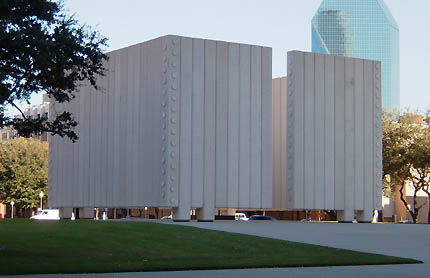
The Kennedy Memorial in Downtown Dallas

The Kennedy Memorial in Downtown Dallas

Even though it happened 22 years before I was born, I sometimes feel as if it was only yesterday that President John F. Kennedy was assassinated.

A lot of that is because I’m from Dallas.  When I was born, my family lived in Oak Cliff, a few blocks away from where the accused assassin Lee Harvey Oswald once lived.  I drive by the Kennedy Memorial several times a week.  I’ve gone to the Sixth Floor Museum.  I’ve made out on the Grassy Knoll.  On a daily basis, I see tourists who have come down here from up north with their preconceived prejudices, their unwieldy copies of Stephen King’s 11/22/63, and their overactive sweat glands.  (“How do you handle the heat!?” they ask when the temperature is barely above 90.)  With the 50th anniversary of the assassination approaching, the Dallas Morning News has been running daily stories examining every detail of that terrible event.

The rest of the nation, of course, will never let us forget that JFK was assassinated in Dallas.  Just last week, there was an idiotic and bitter opinion piece in The New York Times, written by James McAuley, in which he claimed that Dallas was a “city of hate” that should feel more guilt over the JFK assassination.  As McAuley (who is studying history at Oxford and is not a resident of that city that he apparently feels qualified to judge) put it, “For 50 years, Dallas has done its best to avoid coming to terms with the one event that made it famous: the assassination of John F. Kennedy on Nov. 22, 1963.”

This, of course, is bullshit.

There are two competing schools of thought about the assassination of John F. Kennedy.  One says that Lee Harvey Oswald was solely responsible.  The other is that Kennedy was killed as the result of a complex conspiracy.

JFK Assassination Bullets

Let’s say, for the sake of argument, that Lee Harvey Oswald acted alone.  Well, Oswald was born in New Orleans but he was raised up north in New York City.  He was also a communist with a history of mental instability.  Hence, if you accept that Oswald was the lone assassin than you also have to be willing to accept that Oswald would have tried to kill Kennedy regardless of what city he was living in.

IMF Head-Perp Walk

Things get a bit more complicated if you believe that Kennedy was killed as the result of a conspiracy.  But let’s consider the usual suspects that come up whenever people start talking about the possibility of conspiracy.  The Mafia was based in the north.  The CIA was based in Washington, D.C.  The anti-Castroites were based in Miami.  Again, all of these conspirators would have killed Kennedy regardless of what city he went to in November.

It’s easy for the rest of the country, in a fit of jealousy, anger, and delusion, to blame Dallas and Texas for the assassination of John F. Kennedy but, regardless of whether you believe in the lone assassin or a larger conspiracy, the truth is far more complex.

Over the next few days, as part of the 44 Days of Paranoia, I’ll be taking a look at some of the many films that were inspired by this assassination.  Let’s start things off with one of the lesser known entries in the JFK genre, 1973’s Executive Action.

Executive Action opens with a series of grainy, black-and-white photographs of both America in the 1960s and the men who, over the course of the film, will be portrayed as having plotted and carried out the assassination of President Kennedy while a mournful piano plays in the background.  It’s a low-key but eerily effective opening and it also lets the viewers know exactly what type of film they are about to see.  As opposed to Oliver Stone’s far better known JFK, Executive Action is a low-key, almost deliberately undramatic film.   Despite the fact that there are some familiar faces in the cast (or, at the very least, familiar faces to those of us who watch TCM), Executive Action almost feels as if it could have been a documentary.

blogger-image--1805315534

As the film opens in 1963, we see a group of very rich men talking about the future of America.  Ferguson (Will Geer) and Foster (Robert Ryan) are concerned that President Kennedy’s policies are going to destroy America.  Foster is worried that Kennedy is planning on cutting back on military spending.  Ferguson is upset by Kennedy’s support of the Civil Rights movement.  (In one memorable scene, we see Martin Luther King delivering his Dream speech on TV before the camera pulls back to reveal Ferguson watching in disgust.)  Their associate, the shadowy Farrington (Burt Lancaster), argues that the only way to stop Kennedy is to assassinate him and put the blame on a lone gunman.

With the support of Ferguson and Foster, Farrington recruits a group of gunmen (led by Ed Lauter and including Roger Corman regular Dick Miller) and works to set up the perfect patsy.  A man (James MacColl) goes around Dallas, acting obnoxious and telling anyone who will listen that his name is Lee Oswald.  At Ferguson’s insistence, a picture is doctored to make it appear as if Lee Harvey Oswald is posing in his backyard with a rifle.  As all of this goes on, the date of November 22nd steadily approaches…

ex3

As I stated before, Executive Action is an almost obsessively low-key film.  That, however, works to the film’s advantage.  Ferguson, Foster, Farrington, and the other conspirators are chillingly believable because they are presented almost as being anonymous.  Instead of being portrayed as being super villains, they are instead men who approach assassination as just another part of doing business.  The impression one gets is that Kennedy isn’t the first leader they’ve had killed and he probably wasn’t the last.  Director David Miller seamlessly mixes historical footage with film reenactments and the end result is a disturbingly plausible film.

Unfortunately, Executive Action is less well-known than some of the other films that have argued that a conspiracy was responsible for the assassination for John F. Kennedy.  However, it may very well be the best.

executive-action-movie-poster-1020681901

44 Days of Paranioa #1: Clonus (dir by Robert S. Fiveson)


clone

We live in paranoid times.

When I first started at the University of North Texas, I lived in the Bruce Hall Dormitory and every day, I could count on the fact that there would be at least one fat and bearded resident in the lobby talking about how 9-11 was an inside job and how the only reason we were in Iraq was so Dick Cheney’s buddies could get rich.

By the time I graduated, everyone was convinced that the Republicans were going to steal the election from Barack Obama.  Some people, of course, were hoping that was exactly what would happen because they were convinced that Obama was actually a Muslim from Kenya.

With each passing year of the Obama administration, there’s been a new conspiracy theory.  Some people claimed that Obamacare was actually a Socialist plot.  Others said that the Koch Brothers were behind the Tea Party.  Meanwhile, Occupy Wall Street spoke ominously of how 1% of the population exploited the other 99%.  As I sit here typing this, there is undoubtedly a desperate Obama partisan somewhere who is writing up his 100th blog post claiming that the Republicans somehow sabotaged the Obamacare website.

And, of course, living and working in Dallas, I am constantly reminded of the biggest conspiracy theory of all time.  In just a few days, it will be the 50th anniversary of the assassination of John F. Kennedy and you better believe that my hometown is currently being invaded by wild-eyed men who are incapable of uttering a sentence without including terms like “grassy knoll,” “military-industrial complex,” and “coup d’etat.”

Yes, these are paranoid times.  Nobody trusts anyone.  All motives are suspect.  With each passing day, it seems that more and more people are convinced that their daily failures and fortunes can all be blamed on shadowy forces.  The world is a random place where a billion stories play out at once and not a single one of them is going to have a happy ending.  People cling to their paranoia for much the same reason that some people cling to their concept of God.  It gives them a false sense of security and reason in an otherwise chaotic universe.

As for me, I may not be a believer in conspiracies but, at the same time, I do find myself fascinated by both the theories and the films that they occasionally inspire.  If movies ultimately serve as a reflection of society’s secret fears, insecurities, and desires, can it be any surprise that so many movies seem to be just as a paranoid as the audiences that go to see them?

For that reason, I am proud to announce that today is Day One of the 44 Days of Paranoia!  For the next 44 days, we will be taking a look at some of the best and worst conspiracy-themed and paranoia-inducing films ever made.

Let’s start things off by taking a look at the 1979 sci-fi conspiracy film, Clonus (a.k.a. Parts, the Clonus Horror).

Clonus opens on a compound the looks a lot like a community college.   Living on the compound is a group of people who all appear to be extremely friendly and trusting.  Every single one of them has a permanent smile plastered across his or her fresh faces.  They spend their spare time jogging, working out, and — well, that’s about it.  At the same time, none of them smoke, drink, or do anything else that could possibly cause any damage to their bodies.

So, at this point, you can probably guess that they’re either Mormons or they’re clones.  (If you’re not sure, take another look at the film’s title…)

When the clones aren’t busy jogging, they’re talking about how much they hope that, one day, they will be allowed to go to “America.”  There’s actually something rather touching about how excited they all get whenever they hear that one of them is getting sent to America.  They’re a bit like the rubber aliens in Toy Story, putting all of their faith in “The Claw” and its ability to lift them up to a better life.  Of course, what the clones don’t realize is that “going to America” is just a euphemism for being put under sedation and having their organs forcibly removed.

Eventually, one clone (played to awkward blank-faced perfection by Tim Donnelly) starts to question just why exactly he and his friends are being kept on the compound.  He eventually escapes and discovers that not only has he been in America all along but that he only exists so that the rich and powerful can harvest his organs.  Donnelly meets an idealistic journalist (Keenan Wynn) who happens to be acquainted with the family of a sinister presidential candidate (played by Peter Graves).  When Wynn and Donnelly threaten to expose the truth, they find themselves targeted by the U.S. government which, in typical conspiracy-film style, is more than willing to kill to protect its secrets.

If the plot of Clonus sounds familiar, that’s because Michael Bay pretty much remade the film in 2005.  In fact, Clonus director Robert Fiveson felt Bay’s The Island was so similar to his film, that he filed a lawsuit for copyright infringement.  But whereas The Island was the epitome of a film that was more expensive than memorable, Clonus is an effectively creepy little film that, though dated, is still occasionally even thought-provoking.  Though it may have been the result of the film’s budgetary limitations, Clonus eschews flashy effects for atmosphere and even the blandness of some of the locations adds to the film’s sense of low-key but palpable menace.  If ever one needed proof that a low budget can occasionally be the best thing to ever happen to a film, Clonus is that proof.  The film is generally well-acted and, best of all, it all builds up to one of those wonderfully downbeat endings that appear to have been so popular in the 70s.

Much like another recent and similar film — the excellent Never Let Me GoClonus works because it’s disturbingly plausible.  It’s a bit of a cliché to say that a film makes science fiction feel like science fact but Clonus is one of those films that accomplishes just that.

title