Icarus File No. 20: Tough Guys Don’t Dance (dir by Norman Mailer)


The 1987 film, Tough Guys Don’t Dance, opens with Tim Madden (Ryan O’Neal) talking to his father, tough Dougy (Lawrence Tierney).  Dougy has stopped by Tim’s New England home to let Tim know that he has decided stop chemotherapy and accept his eventual death from cancer because, as Dougy puts it, “Tough guys don’t dance.”  The tone of Dougy’s voice is all we need to hear to know that, in his opinion, his son has spent way too much time dancing.

Tim is an ex-convict turned writer and, when we first see him, he’s obviously had a few rough nights.  He explains to Dougy that he woke up after a bender with his ex-girlfriend’s name tattooed on his arm, blood all over his jeep, and two heads dumped in his marijuana stash.  Tim says that he’s hopeful that he’s not the murderer but he can’t be sure.  He’s been drinking and doping too much.  He suffers from blackouts.  He’s not sure what happened.

The majority of the film is made up of flashbacks, detailing Tim’s affairs with a number of women and also his odd relationship with the town’s police chief, Luther Regency (Wings Hauser).  Luther is married to Tim’s ex-girlfriend, Madeleine (Isabella Rossellini), who long ago accompanied Tim on a trip to North Carolina where they hooked up with a fundamentalist preacher (Penn Jillette) and his then-wife, Patty Lariene (Debra Sundland).  (Tim found their personal ad while casually skimming the latest issue of Screw, as one does I suppose.)  Patty Lariene eventually ended up married to Tim, though she has recently left him.  As for Madeleine, she has never forgiven him for a car accident that they were involved in.  Is Tim capable of loving anyone?  Well, he does say, “Oh God, oh man,” repeatedly when he discovers that his wife has been having an affair.

Tim tries to solve the murders himself, finding that they involve not only him and Luther but also Tim’s old prep school friend, Wardley Meeks III (John Bedford Lloyd) and also some rather stupid drug dealers that Tim hangs out with.  The plot is almost ludicrously convoluted and it’s tempting to assume that the film is meant to be a parody of the noir genre but then you remember that the film is not only based on a Norman Mailer movie but that it was directed by Mailer himself.  Mailer, who was the type of public intellectual who we really don’t have anymore, was blessed with a brilliant mind and cursed with a lack of self-awareness.  There’s little doubt that we are meant to take this entire mess of a film very seriously.

And the film’s theme isn’t hard to pick up on.  By investigating the murders, Tim faces his own troubled past and finally comes to understand why tough guys, like his father, don’t hesitate to take action.  Tough guys don’t dance around what they want or need.  That’s a pretty common theme when it comes to Mailer.  Tim Madden is not quite an autobiographical character but he is, by the end of the story, meant to represent the type of hard-living intellectual that Mailer always presented himself as being.  Unfortunately, Ryan O’Neal wasn’t exactly an actor who projected a good deal of intelligence.  And, despite his lengthy criminal record off-screen, O’Neal’s screen presence was somewhat docile.  That served him well in films like Love Story and Barry Lyndon.  It serves him less well in a film like this.  It’s easy to imagine O’Neal’s Tim getting manipulated and, in those scenes where he’s supposed to be a chump, O’Neal is credible enough in the role.  It’s far more difficult to buy the idea of Tim actually doing something about it.

Indeed, it’s hard not to feel that co-star Wings Hauser would have been far more credible in the lead role.  But then, who would play Luther Regency?  Hauser gives such a wonderfully unhinged and out-there performance as Luther that it’s impossible to imagine anyone else in the role.  Maybe Hauser could have played both Tim and Luther.  Now that would have made for a classic film!

Tough Guys Don’t Dance is weird enough to be watchable.  The dialogue is both raunchy and thoroughly humorless, which makes it interesting to listen to, if nothing else.  The moments that are meant to be funny are so obvious (like casting noted atheist Penn Jillette as a fundamentalist) that it’s obvious that the moment that feel like clever satire were actually all a happy accident.  As far as Norman Mailer films go, this one is not as boring as Wild 90 but it also can’t match the unhinged lunacy of a frustrated Rip Torn spontaneously attacking Mailer with a hammer at the end of the unscripted Maidstone.  It’s a success d’estime.  Mailer flew too close to the sun but the crash into the ocean was oddly entertaining.

Previous Icarus Files:

  1. Cloud Atlas
  2. Maximum Overdrive
  3. Glass
  4. Captive State
  5. Mother!
  6. The Man Who Killed Don Quixote
  7. Last Days
  8. Plan 9 From Outer Space
  9. The Last Movie
  10. 88
  11. The Bonfire of the Vanities
  12. Birdemic
  13. Birdemic 2: The Resurrection 
  14. Last Exit To Brooklyn
  15. Glen or Glenda
  16. The Assassination of Trotsky
  17. Che!
  18. Brewster McCloud
  19. American Traitor: The Trial of Axis Sally
The Trail Beyond (1934, directed by Robert N. Bradbury)


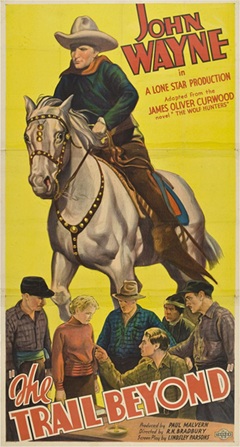
Falsely accused of murder, Rod Drew (John Wayne) and his buddy Wabi (Noah Beery, Jr.) jump off a train and end up in the Canadian wilderness, where they eventually find a deserted cabin, a map to a gold mine, and plenty of trouble when French-Canadian outlaw Jules LaRocque (Robert Frazer) decides that he wants the map and kidnaps Wabi’s girlfriend, Felice (Verna Hillie), to get it.

This was one of the many B-westerns that John Wayne made in between 1930’s The Big Trail and 1939’s Stagecoach.  The film finds the youngish Wayne playing a slightly less upright character than usual.  He’s still the hero but he’s also wanted by the police and spends much of the film fleeing from them.  The movie is only 55 minutes long and the action moves quickly.  The film’s Canadian locations and Robert Frazer’s over-the-top villain gives The Trail Beyond a slightly different and quirkier flavor than most the Duke’s 1930s output.  I think this might be the only film to feature Wayne working with the Mounties.  Even in this low-budget production, John Wayne is a strong hero who just looks like he belongs on a horse and traveling across the frontier.  For someone who was the president of his high school’s Latin Club., Wayne had an automatic authenticity when it came to playing cowboys, even in the years before Stagecoach made him one of the biggest stars in the world.  This is also one of the few films to feature both Noah Beery Sr. and Noah Beery Jr.  While Beery Jr. plays Wayne’s sidekick and is in the film almost as much as John, Berry Sr.’s role is much smaller.  He’s the store owner who is also Felice’s father.

Obviously, this is a film for fans of the genre only but it’s a good example of how John Wayne could make even his Poverty Row productions entertaining and watchable.

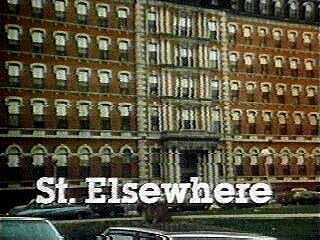
Retro Television Review: St. Elsewhere 1.16 “The Count”


Welcome to Retro Television Reviews, a feature where we review some of our favorite and least favorite shows of the past! On Fridays, I will be reviewing St. Elsewhere, a medical show which ran on NBC from 1982 to 1988.  The show can be found on Hulu and, for purchase, on Prime!

It’s time to go under the knife in Boston.

Episode 1.16 “The Count”

(Dir by Kevin Hooks, originally aired March 8th, 1983)

Harold Beaumont (Michael Halsey), an adult film actor better known as The Count, has checked into St. Eligius.  Of course, Dr. Samuels immediately recognizes him because Samuels is obsessed with porn.  Dr. Annie Cavanero does not recognize him but, once she learns what he does for a living, she has to tell him that she finds his work to be offensive because Dr. Cavanero’s entire personality pretty much revolves around getting offended by stuff.

It’s not much of a plot.  There’s a process server (William G. Schilling) who wants to serve the Count with a courts summons so Samuels and Cavanero help the Count hide and disguise his identity.  It’s silly and dumb story that involves the two of the least likable members of the show’s regular cast.

Meanwhile, Dr. Wendy Armstrong (Kim Miyori) comes to suspect that one of the hospital’s heart surgeons, Dr. Larry Andrews (Peter Michael Goetz), is giving pacemakers to people who don’t actually need them.  She takes her concerns to Dr. Craig.  Craig, an old friend of Dr. Andrews, is initially dismissive but he later confronts Dr. Andrews and finds out that Armstrong was correct.  Dr. Andrews explains that it takes a lot of money to fund his lifestyle.  This story was an improvement over the Count but it perhaps would have had more power if it had been someone like Dr. Ehrlich who suspected that Dr. Andrews was giving people pacemakers that they don’t need.  Ehrlich actually has a complicated relationship with Dr. Craig and his own less-than-stellar record as a resident would have added some ambiguity to storyline.  Dr. Armstrong, on the other hand, has been portrayed as being hypercompetent and a bit self-righteous and, if we’re going to be honest, she’s kind of a boring character.

Speaking of Dr. Ehrlich, he is getting fed up with living with Fiscus.  Howie Mandel is driving someone crazy?  Who could have seen that coming?

This week’s episode was pretty forgettable.  The story involving Dr. Andrews had potential but choosing to make the show’s least interesting characters the center of an entire episode was a decision that really didn’t pay off.

Live Tweet Alert: Join #FridayNightFlix for Road House!


As some of our regular readers undoubtedly know, I am involved in a few weekly watch parties.  On Twitter, I host #FridayNightFlix every Friday and I co-host #ScarySocial on Saturday.  On Mastodon, I am one of the five hosts of #MondayActionMovie!  Every week, we get together.  We watch a movie.  We tweet our way through it.

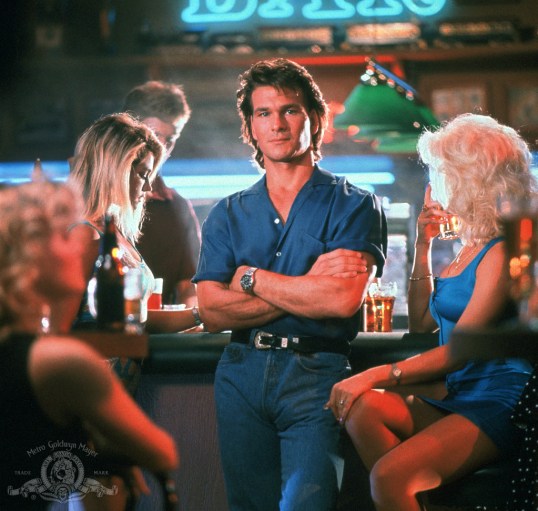
Tonight, at 10 pm et, I will be hosting #FridayNightFlix!  The movie?  1989’s Road House!

The name is Dalton!  Everyone thought that Dalton would be bigger but he’s the second best bouncer in the world and if anything happens to Wade Garrett, he’ll be the absolute best.  He’s a legend but can he clean up the wildest bar in Missouri?  Will Ben Gazzara convince him to switch sides?  Will Doc convince him to give peace a chance?  And will Tinker ever get over his fear of polar bears?  Just remember, pain don’t hurt.  Be nice until it’s time not to be nice.  And always check the boots for blades.

If you want to join us this Friday, just hop onto twitter, start the movie at 10 pm et, and use the #FridayNightFlix hashtag!  I’ll be there tweeting and I imagine some other members of the TSL Crew will be there as well.  It’s a friendly group and welcoming of newcomers so don’t be shy.

Road House is available on Prime!

See you there!

Scenes That I Love: Gary Oldman in Oppenheimer


Today, the Shattered Lens wishes a happy birthday to actor Gary Oldman!

My scene that I love features Gary Oldman as Harry S Truman in Oppenheimer.  Oldman doesn’t get a lot of screentime in Oppenheimer but he shows what a brilliant actor can do with a small role.  His casual dismissal of Oppenheimer’s guilt is one of the strongest moments in the film.  (And, for those of us who found Oppenheimer, as a character, to be a bit self-asborbed, it’s a cathartic moment, as well.)

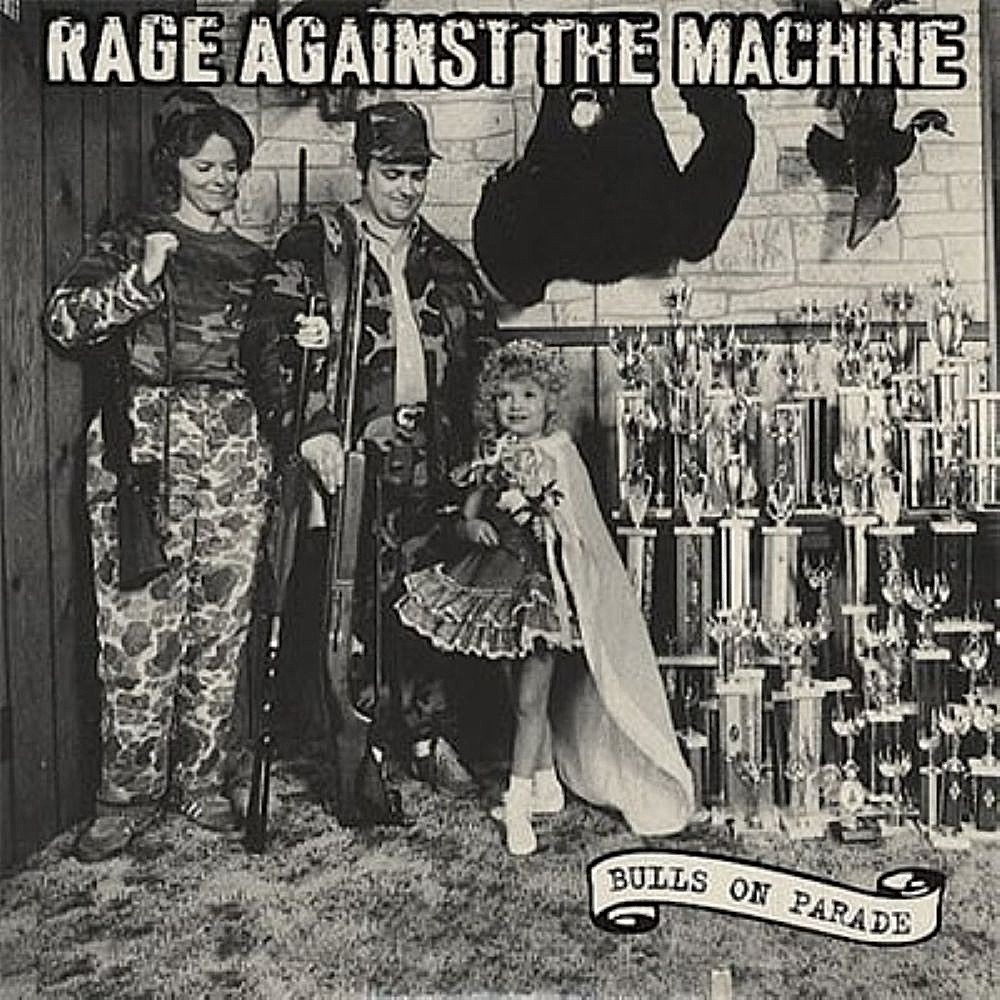
Song of the Day: Bulls on Parade (by Rage Against the Machine)


Anyone who lived through the mid-1990’s cannot say that they have never heard of Rage Against the Machine. They ushered in the rap metal/rap rock/alternative metal scene which would include such acts as Linkin Park, Limp Bizkit, Kid Rock and Body Count just to name a few.

While the genre itself had some early beginnings with such metal and rap groups as Anthrax and Cypress Hill, respectively, it was with Rage Against the Machine that the scene really came into its own. As Scott Ian would later say, it was with Rage Against the Machine that rap metal as a genre was born.

Today’s “Song of the Day” with Rage Against the Machine’s 1996’s second single from Evil Empire, the band’s second studio album. That song is “Bulls on Parade”. The band released their self-titled album in 1992 that gave birth to the rap metal scene with “Killing in the Name” the birth cry of the genre. While success would follow the band pretty quickly with this debut album and their subsequent festival appearances it would be with “Bulls on Parade” that they would also achieve their most mainstream success.

A song decrying the military-industrial complex that the United States has become through the decades, the song was a mainstream-friendly calling card (as mainstream as RATM could ever be seen as) for the band known for it’s anti-establishment, anti-authoritarian and revolutionary lyrics. The band would be the boogeyman for the traditional and conservative movement many years even after the band’s break-up in 2000.

It is at the 2:30min mark that one of the most inventive and unique sounding guitar solos that signifies “Bulls on Parade” as having reached legendary status. Lead guitarist Tom Morello replicates the vinyl scratching typically heard with DJ artists in rap and club records. It is not your typical rock guitar solo, but a rock guitar solo it is nonetheless.

Bulls on Parade

Come wit’ it now
Come wit’ it now

The microphone explodes, shattering the molds
Either drop the hits like De La O or get the fuck off the commode
Wit’ the sure shot, sure to make the bodies drop
Drop and don’t copy yo, don’t call this a co-op
Terror rains drenchin’, quenchin’ the thirst of the power dons
That five sided fist-a-gon
The rotten sore on the face of mother earth gets bigger
The triggers cold empty ya purse

Rally ’round the family with a pocket full of shells
They rally ’round the family with a pocket full of shells

Weapons not food, not homes, not shoes
Not need, just feed the war cannibal animal
I walk the corner to the rubble that used to be a library
Line up to the mind cemetery now
What we don’t know keeps the contracts alive and movin’
They don’t gotta burn the books they just remove ’em
While arms warehouses fill as quick as the cells
Rally ’round the family, pockets full of shells

Rally ’round the family with a pocket full of shells
They rally ’round the family with a pocket full of shells

Bulls on parade

Come wit’ it now
Come wit’ it now
Bulls on parade
Bulls on parade
Bulls on parade
Bulls on parade
Bulls on parade

Great Guitar Solos Series

4 Shots From 4 Films: Special Russ Meyer Edition


4 Or More Shots From 4 Or More Films is just what it says it is, 4 shots from 4 of our favorite films. As opposed to the reviews and recaps that we usually post, 4 Shots From 4 Films lets the visuals do the talking!

103 years ago, on the very day, Russ Meyer was born in San Leandro, California.  Meyer would get his start filming newsreels during World War II, with much of his newsreel footage later showing up in films like the 1970 Oscar winner, Patton.  When he returned to the United States, he continued to make films, though the subject matter changed a bit.  Meyer was one of the pioneers of the adult film industry, though his once controversial films now seem rather quaint and innocent when compared to the industry’s later films.  Meyer’s strong visual sense and his intentionally over-the-top plots made him a favorite amongst underground critics.  In the 70s, he was briefly embraced by mainstream Hollywood but, unhappy with having to deal with the studio bosses, Meyer returned to making the type of independent, grindhouse films that made him famous.

Russ Meyer was 82 years old when he died in 2004.  He was acclaimed as one of America’s first and most iconic independent filmmakers.

Here are 4 Safe-For-Work Shots From 4 Russ Meyer Films.

4 Shots From 4 Films

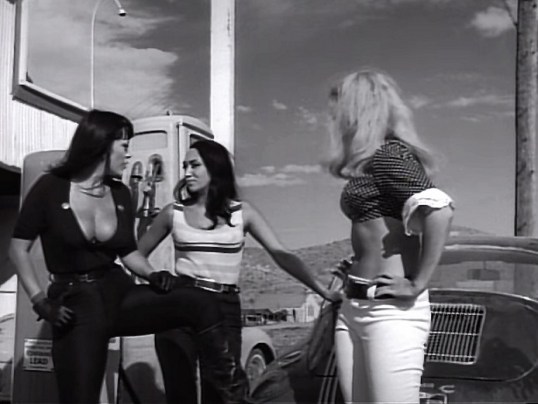
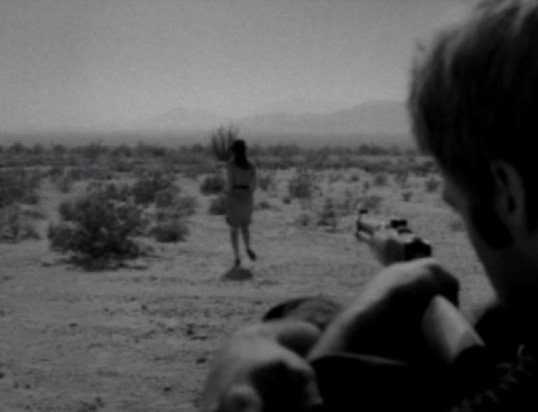
Faster, Pussycat! Kill! Kill! (1965, dir by Russ Meyer, DP: Walter Schenk)

Motorpsycho (1965, dir by Russ Meyer, DP: Russ Meyer)

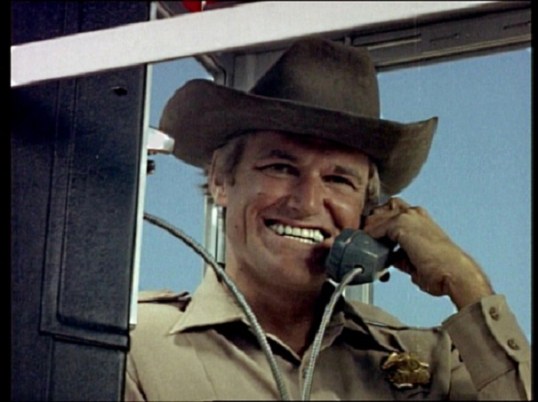
Cherry, Harry, & Raquel! (1970, dir by Russ Meyer, DP: Russ Meyer)

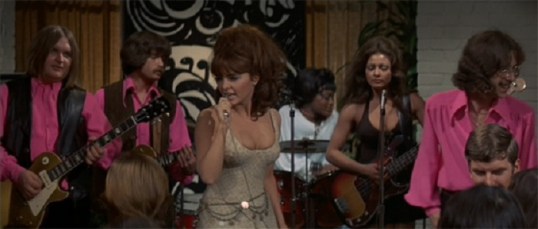
Beyond The Valley Of The Dolls (1970, dir by Russ Meyer, DP: Fred J. Koenekamp)

Late Night Retro Television Reviews: Highway to Heaven 3.17 “A Night To Remember”


Welcome to Late Night Retro Television Reviews, a feature where we review some of our favorite and least favorite shows of the past!  On Thursdays, I will be reviewing Highway to Heaven, which aired on NBC from 1984 to 1989.  The entire show is currently streaming on Tubi and several other services!

This week, Jonathan and Mark go back to high school, just in time for prom!  I went to four proms over the course of my high school years and I loved every one of them.  There is no greater American tradition!

Episode 3.17 “A Night To Remember”

(Dir by Michael Landon, originally aired on January 28th, 1987)

It’s time for the prom!

Danny (Mitchell Anderson) wants to ask out Melanie (Kimberly MacArthur) but can’t bring himself to do it because he’s feeling insecure about the fact that his father lost his engineering job and is now working at a gas station.  Danny makes extra money working at the local pizza joint but he loses his job when he throws a punch at bully Richard Davies (J. Eddie Peck, future star of Lambada).

Sammy (Joel Hoffman) wants to ask his lifelong friend, Kate (Susan Savage).  But Sammy feels insecure because he’s short.  When he tries to buy lifts to make himself taller, Richard calls him out right when he’s about to ask out Kate.  Sammy is an aspiring stand-up comedian and he’s on the verge of dropping out of school all together.  “I can be a comedian or a teenager but I can’t be both!”

Don’t worry, though.  Jonathan is their new social studies teacher.  And Mark is the coach of the girl’s volleyball team because every assignment is designed, in some way, to humiliate Mark.  In this case, Mark takes a volleyball to the nose and spends the entire episode worrying that it’s broken.  Mark really can’t catch a break (heh) on this show.  He has to drive everywhere.  He’s usually the one who has to do all of the hard physical work while Jonathan just appears wherever he wants.  Unfortunately, there doesn’t appear to be a union for human angel helpers but then again, it’s not like Mark ever seems to get paid for all of his hard work.

Anyway, the stakes aren’t particularly high in this episode.  Both Danny and Sammy eventually find the courage to ask their dates to the prom, though Danny doesn’t do it until he’s actually at the prom.  And both of them take some time to tell off Richard.  “Still wearing your mother’s underwear?” Sammy asks and Richard turns a dark shade of red as if Sammy has accidentally guessed his greatest secret.

I actually always like these episodes where Jonathan and Mark become teachers.  They’re not as depressing as the ones where they end up working at a shelter or a retirement home.  This episode was just about giving the students the best prom ever and that’s okay.  Not everything needs to be a huge drama!  Sometimes, you just need a night to remember.