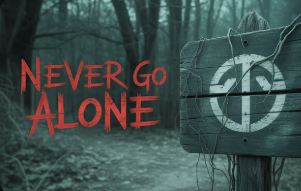
There’s the Summer of the Shark; so, this is the Horrorthon of the Terrible AI shorts. Technically, I don’t need to review these things, BUT I feel like we at the beginning of a new way to tell stories and if the technology gets better and it will, maybe it will attract some people who are good at things? Maybe?
I’m not saying that the people who create these films should be parachuted into an actively shark-infested section of the ocean wearing a meat-based wetsuit and slathered in a blood-based suntan oil, but if you’ve already left with these people and you had parachutes, the suits, and lotion ready; then, I’m not getting in your way. Who knows? Maybe stopping bad AI art could bring us together? Also, the market share for meat wetsuits is wide open for the taking!
So, let’s determine if “Whisper in the Woods” is cause for shark-time!
There is a car driving in a haunted forest. A woman sees a spooky woman standing in the road. The driver investigates. Then, a hooded figures presumably kill her. Technically, it had a beginning, middle, and an end. So, it’s as good as anything Alex Magana ever made, but I’m Team Shark!
“You cannot win a nuclear war! Now just suppose the Russians win this war… What exactly would they be winning? All major centres of population and industry would have been destroyed. The Russians would have conquered a corpse of a country.” — Peace Speaker
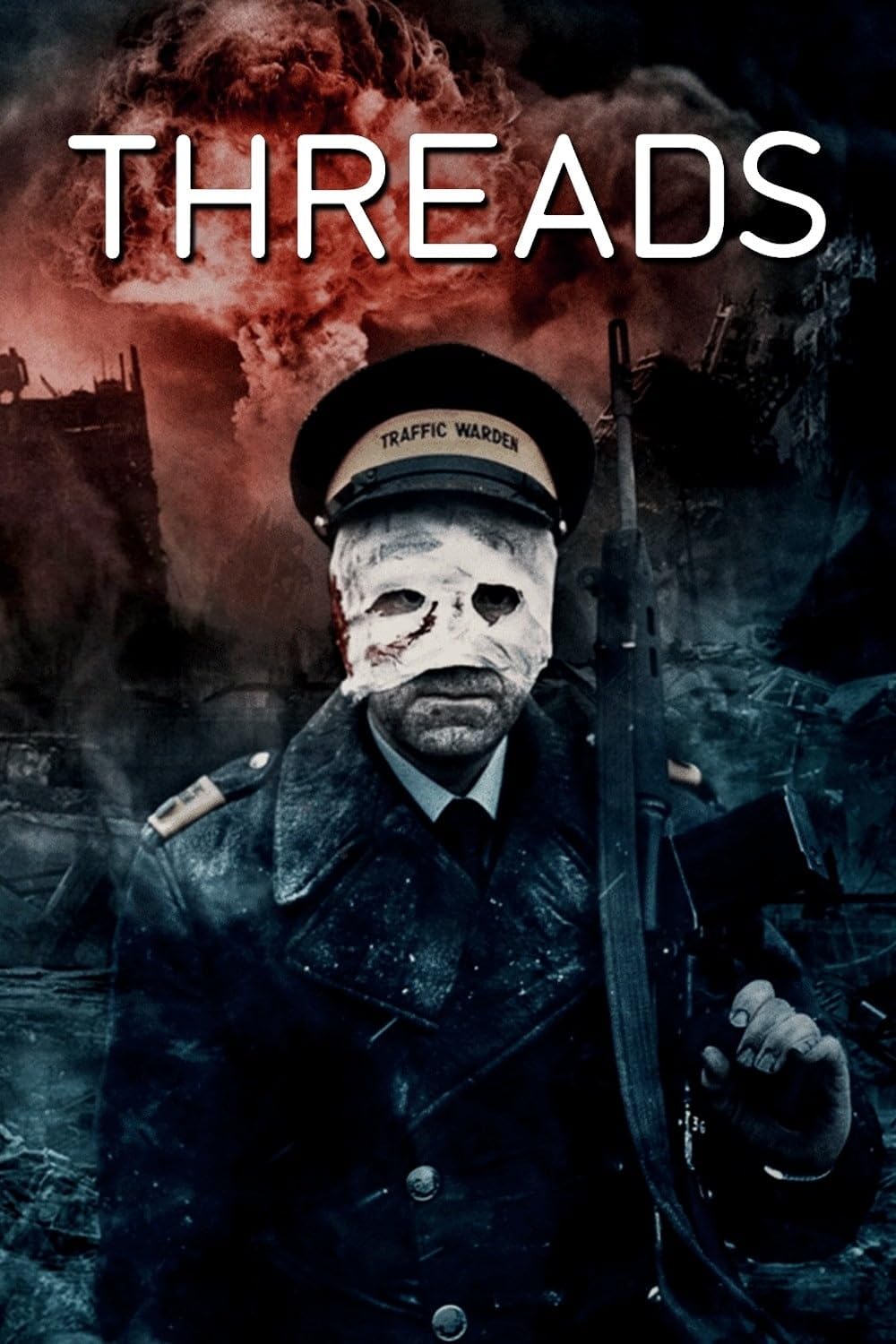
Mick Jackson’s Threads remains one of the most devastating and singular experiences in the history of horror cinema. Made for British television in 1984, it presents the end of the world without spectacle, sentiment, or escape. It is horror pared down to elemental truth—an autopsy of civilization staring directly into the void. What it reveals isn’t an invasion or a curse but something far more intimate and plausible. The apocalypse here is homemade.
The film’s dread begins in familiarity. Sheffield in the early 1980s looks ordinary, even dull. We meet young people planning families, moving furniture, going to work. Everyday life rolls forward in its small, reassuring cycles. But the news keeps playing in the background, and the background starts to change. Political tension builds quietly, buried inside the calm language of diplomacy and deterrence. The repetition of these news bulletins—so mundane at first—becomes unnerving because this is precisely how horror entered real life during the Cold War: through information, not imagination. The end of all things doesn’t announce itself with thunder or sirens. It arrives exactly the way it did in history—through headlines, warnings, updates, and comfortable denial.
What makes Threads so frightening is that it removes the supernatural shield that most horror films rely on. There are no vampires in the night, no zombies clawing at the door, no ancient curses waiting for foolish mortals to uncover. The threat here is invisible, mathematical, already built into the fabric of daily existence. The horror is bureaucratic and omnipresent: wires humming, missiles waiting, politicians rehearsing meaningless statements. Jackson’s approach traps viewers in the reality that haunted the Cold War decades—the understanding that extinction wasn’t a mythic event but a possibility hanging over breakfast tables and factory shifts alike. The monsters were human hands resting on launch buttons.
When the bombs finally fall, the destruction plays out without warning or beauty. The light is so intense it erases faces, streets, even color itself. There’s no music to prepare the viewer, nothing to stylize the moment. It looks less like cinema than an interference signal—white noise flooding the world. And when the noise fades, time stops. The air is grey and silent. This is where every cinematic idea of horror—jump scares, final girls, raging beasts—collapses. What’s left isn’t fiction but aftermath. Humanity’s extinction is not delivered by some otherworldly force. It’s the logical consequence of its own inventions.
In the post-blast silence, Sheffield turns into a landscape of wandering ghosts—ordinary people stripped of memory and meaning. The city becomes an enormous grave where speech and thought slowly decay. Threads spends the rest of its running time documenting how civilization erodes, not in minutes but in years. Crops fail, radiation poisons the newborn, and eventually language itself thins out until the survivors grunt out half-words. Watching it feels like witnessing evolution run backward. And all of it happens without villains or intent. The horror is simply that there’s no one left to blame, only ashes where institutions used to be.
That’s the heart of what makes Threads such a distinct kind of horror film. Its terror isn’t supernatural but logistical. The Cold War, for all its abstract politics, becomes the perfect horror setting because its apocalypse was designed, built, and maintained by bureaucrats and citizens who believed they were preserving peace. The film internalizes that historical anxiety and turns it against the viewer. Watching it now reveals how modern the fear remains—the quiet knowledge that our existence can still be undone by systems we built and barely understand.
This level of realism transforms ordinary images into nightmare language. The gray sky, the still streets, the cracked glass—all look completely real because they are. The production relied on weathered locations, handheld cameras, and non‑actors to erase any cinematic polish. That choice doesn’t just increase believability; it removes emotional distance. The audience isn’t safe behind the screen. It’s the same realism people felt in their bones during the Cold War years when the thought of nuclear annihilation hung above every ordinary activity—from going to school to buying groceries. Threads doesn’t invent horror; it recalls one that was already shared by millions, a psychological climate instead of a plot.
What follows after the detonation is not chaos in the traditional sense, but entropy. The world doesn’t explode; it unravels. Government collapses in slow motion, social order dissolves quietly, and hunger becomes the only law. By the time years have passed and humanity has regressed to primitive barter and suspicion, viewers understand that the true monster in Threads isn’t radiation or politics—it’s the continuity of existence stripped of meaning. The worst possible outcome is survival without civilization. Every journal entry and every voice-over that marks the passage of years feels like the universe keeping record of its own disappearance.
The film’s tone never changes. It stays cold, methodical, and precise, as if narrated by the last bureaucrat left alive. That neutrality becomes unbearable after a while, more suffocating than screaming terror. The dispassionate narration reporting the number of dead or the decline in literacy level is as unnerving as any demonic whisper. It’s the voice of civilization reduced to an algorithm, describing its own end with perfect grammar. That was perhaps the truest evocation of Cold War horror imaginable: the notion that when the world ended, it would sound exactly like a news broadcast.
For all its austerity, there’s also a strange poetry in Jackson’s imagery. The empty fields where ash falls like snow, the distant hum of wind through broken windows, the silhouettes trudging through a gray dusk—they linger like haunted photographs. It feels less like humanity has died than that it has become part of the landscape. The apocalypse in Threads isn’t theatrical fire but the slow bleaching of everything living. In a way, it makes the viewer complicit: this is what our collective imagination produced when fear became policy.
The final scene still carries the force of a psychological detonation. The young woman who has grown up in this ruin gives birth to a stillborn child, the last link of continuity severed. There’s no dialogue, no reaction—just a freeze-frame that seems to suspend time at its bleakest point. For a moment, the world stops existing altogether. Few films end so harshly, with no fade‑out or reflection, because Threads doesn’t need metaphor. It closes the loop on its own warning: the horror never came from outside, it came from within—from the quiet machinery of our collective choices and the weapons we built to enforce them.
Seen today, Threads remains deeply relevant because the foundation of its terror hasn’t disappeared. While new anxieties have replaced the Cold War, the sense of self-made extinction still lingers. Watching it feels like eavesdropping on a civilization rehearsing its own burial. Its power lies in showing that the apocalypse isn’t cinematic fantasy. It’s civic policy, historical precedent, and shared human guilt wrapped into the shape of a mushroom cloud. The film’s real horror is how close it remains.
Threads exposes the simplest and most terrifying truth of horror: that sometimes there is no invader, no contagion, no supernatural imbalance waiting for correction. There is only us. The apocalypse that consumed Sheffield was never distant or mythic. It was the reflection in the mirror, the sound on the news, the thing every citizen of that decade tried not to think about while going about ordinary life. That proximity—horror without distance—makes the film feel eternal. It tells us that the end of the world has always been near, not because of monsters waiting outside the window, but because of everything we’ve built inside it.
Today, I present to you one of the most important films in horror history. Though it wasn’t appreciated when it was first released back in 1964, The Last Man On Earth was not only the 1st Italian horror film but George Romero has also acknowledged it as an influence on his own Night of the Living Dead.
It’s easy to be a little bit dismissive of The Last Man On Earth. After all, the low-budget is obvious in every scene, the dubbing is off even by the standards of Italian horror, and just the name “Vincent Price” in the credits leads one to suspect that this will be another campy, B-movie. Perhaps that’s why I’m always surprised to rediscover that, taking all things into consideration, this is actually a pretty effective film. Price does have a few over-the-top moments but, for the most part, he gives one of his better performances here and the black-and-white images have an isolated, desolate starkness to them that go a long way towards making this film’s apocalypse a convincing one. The mass cremation scene always leaves me feeling rather uneasy.
The film is based on Richard Matheson’s I Am Legend and no, it’s nowhere as good as the book. However, it’s still a worthy adaptation and one that stays true to the tone of the text, including the fact that Price’s main tormenter was also once his neighbor and best friend. This is one of those films that just hits differently in the wake of 2020’s COVID hysteria.
And now, it’s time for The Last Man On The Earth….
Last night’s game lasted for 18 innings! You know that I was cheering for the Dodgers but, after the 17th inning, I really just wanted someone to get a run so I could get some sleep! It finally happened during the 18th inning, with the most beautiful homerun of the entire season.
The Dodgers are now leading the series 2-1! Keep going, Dodgers! Game 4 is tonight!
“Alone. Yes, that’s the key word, the most awful word in the English tongue. Murder doesn’t hold a candle to it and hell is only a poor synonym.” ― Stephen King
L.A. Guns is a band that has had a long and storied history, from their initial formation in 1983 to the brief moment when they joined with Axl Rose and became known as Guns N’ Roses to Tracii Guns leaving Guns N’ Roses after conflict with Rose and then forming a second version of L.A. Guns. At the same time that Guns N’ Roses were releasing their first music videos and making their mark on MTV, L.A. Guns released their video for One More Reason, one of the most apocalyptic looks at Los Angeles ever put on film.
Director Ralph Ziman also worked with Ozzy Osbourne, Toni Braxton, and Faith No More.
That, in itself, isn’t a surprise. Eric Roberts was also in the first RevelationRoad. He plays the same role in the 2013 sequel. Roberts is Sheriff Jenson, the not particularly religious sheriff who has to deal with a town that’s gone mad in the wake of the Rapture. Over the course of one night, dozens of people (including Jenson’s mother) vanished as their souls flew into the air. Jenson isn’t sure what happened but he knows that there is panic in the streets and that there is also a crazed motorcycle gang to deal with. In the first film, Roberts was onscreen for maybe two minutes. He gets closer to five minutes in RevelationRoad2 and you know what? it’s always nice to see Eric Roberts!
As for the rest of the film, it picks up where the previous one ended. Josh McManus (David A.R. White) is trying to get home to his family while also resisting the urge to become a killer. It’s not easy. Flashbacks reveal that Josh was actually brainwashed by the CIA to be a remorseless killer. He’s haunted by a mission in the Middle East and the amount of people he killed over there. He’s joined in his drive home by Beth (Noelle Coet), a teenage girl who has been sent by Jesus himself (Bruce Marchiano) to help guide Josh in the right direction. Pursuing Josh is the fearsome Hawg (Brian Bosworth), a motorcycle gang leader who is haunted by his own personal tragedy. Hawg’s daughter, Cat (Andrea Logan White), struggles to understand her father’s anger and hatred.
RevelationRoad2 is a definite improvement over the first film. If the first film seemed to take forever to go nowhere, RevelationRoad2 is all about Josh’s determination to get back home. Once he starts that car up, nothing is going to stop him. If the first film seemed to be a bit too eager to show off Josh’s talent for killing people, RevelationRoad2 features Josh trying to hold back on his murderous instincts. Flashbacks to Hawg’s past life bring some much-needed nuance and context to his actions and they keep him from being just a one-dimensional villain. I would dare say that Bosworth actually gives a legitimately good performance in this film.
Though the film wears its influences on its sleeve (Hi, MadMax!), Revelation Road 2 is still a surprisingly well-done action film.
Previous Eric Roberts Films That We Have Reviewed:
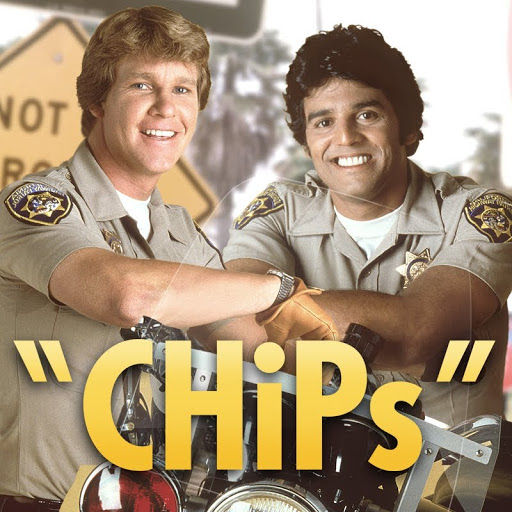
Welcome to Late Night Retro Television Reviews, a feature where we review some of our favorite and least favorite shows of the past! On Mondays, I will be reviewing CHiPs, which ran on NBC from 1977 to 1983. The entire show is currently streaming on Prime!
It is time to leave the Bronx….
Episode 4.19 “Vigilante”
(Dir by Arnold Laven, originally aired on May 3rd, 1981)
A citizen’s patrol has taken to the streets of Los Angeles and, despite their good intentions, they’re getting in the way of the Highway Patrol. They’re supposed to call the cops if they actually see anything but one member of the group is trying to take the law into his own hands. If that wasn’t bad enough, Getraer has someone sending threatening messages to his house. Getraer thinks that he can handle things on his own but apparently, he’s forgotten the name of the show that he’s on.
This episode wasn’t bad. I actually appreciate any episode that gives Robert Pine a chance to do more than just bark out orders as Pine was one of the better actors on the show. Because Getraer was under so much pressure, he ended up snapping at a lot of the officer during the morning briefing and one got the feeling that Pine enjoyed getting to yell. Still, at one point, Getraer punishes Grossman by giving him desk duty and you have to wonder if maybe that’s why Los Angeles now needed vigilantes to keep the streets safe.
The vigilantes themselves reminded me a bit of New York’s Guardian Angels. I checked and the Guardian Angels were themselves formed in 1979 so I guess it’s possible that this episode was inspired by them. I can’t say for sure because I don’t know how prominent the organization actually was in 1981. Today, of course, the Guardian Angels are once again very prominent because their founder, Curtis Sliwa, is running for mayor of New York. Apparently, he’s stuck in third place, which is a shame when you consider who is in first and second place. Personally, I would vote for Sliwa because he owns six cats and I happen to be collector of berets but I’m also not a New Yorker.
As for vigilante justice, I don’t condone it but I certainly see the appeal.
Produced by Gene Roddenberry and directed by Clive Donner, 1977’s Spectre was a pilot film for a television series about an occult detective (Robert Culp) who solved supernatural mysteries while dealing with a curse that had been put on him by the demon, Asmodeus.
In this film, Culp’s William Sebastian and his associate, Dr. Ham Hamilton (Gig Young) travel to the UK to investigate a supernatural case involving an old family. Despite the efforts of a succubus and a cursed airplane, Sebastian and Ham are determined to solve the mystery. John Hurt appears as a member of the cursed family.
This pilot was not picked up and developed into a series but it was popular enough that it was released as a theatrical film in Europe.



 Through the Shattered Lens