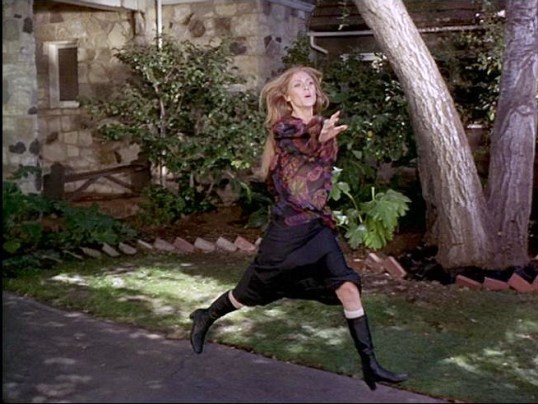
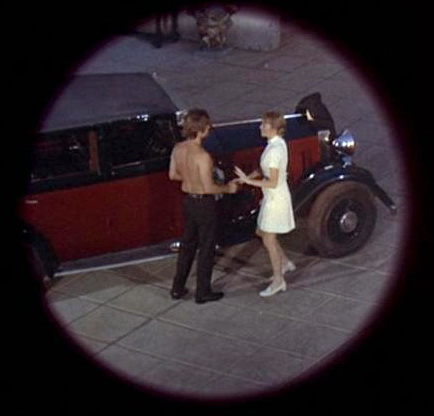
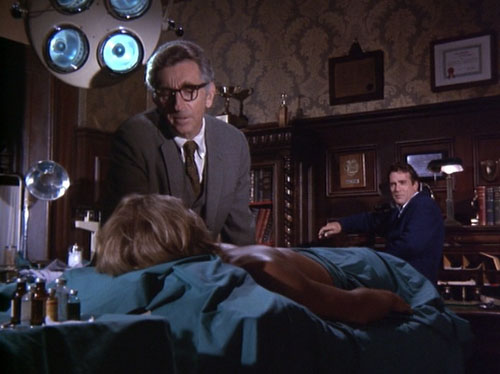
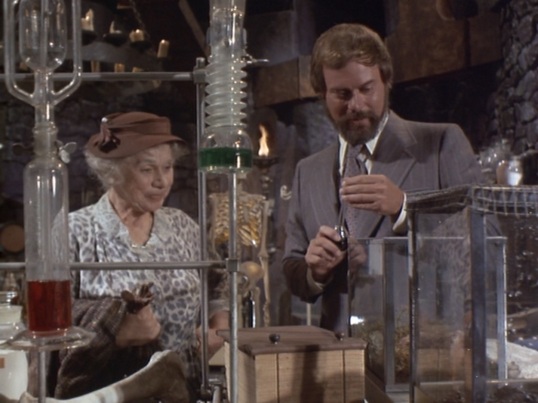
Night Gallery 1.4 “Make Me Laugh/Clean Kills And Other Trophies”


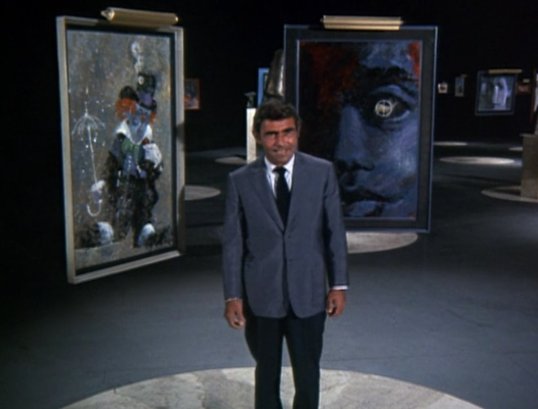
The fourth episode of Night Gallery originally aired on January 6th, 1971.  It was the first episode of the new year and it continued to open with Rod Serling walking through a most curious museum, inviting us to take a look at the macabre paintings on display and consider the stories behind them.

This episode featured two stories.

Make Me Laugh (dir. by Steven Spielberg, written by Rod Serling)

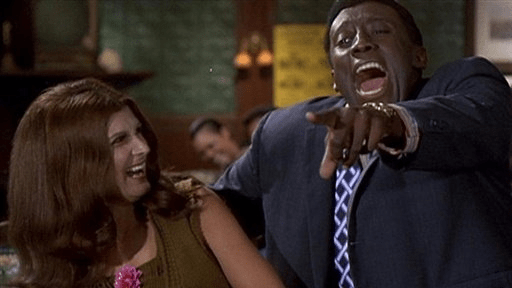
Jackie Slater (Godfrey Cambridge) is a comedian who can’t make anyone laugh.  He’s just been fired from his latest job and even his loyal agent (Tom Bosley) is suggesting that it might be time to throw in the proverbial towel.  While Jackie drowns his sorrows at a bar, he’s approached by a man named Catterje (Jackie Vernon).  Chatterje explains that he can cast miracles but, because he’s not very good at his job, the miracles often have unintended consequences.  “I don’t care!”  Jackie says, “I’ll take the risk!”  Jackie wants people to laugh at him.  Jackie gets his wish but it turns out that he should have listened to Chatterje’s warning.

This segment was directed by Steven Spielberg, back when he was just starting his career and he was largely working in television.  Spielberg also directed Eyes, which was a highlight of the Night Gallery pilot.  Unfortunately, his direction of Make Me Laugh is a bit less successful than his work on Eyes.  Spielberg’s direction features none of the inspired touches that made Eyes so successful.  Part of the problem may be that this story takes place in the word of comedy and comedy has never been a topic for which Spielberg has shown much affinity.

Make Me Laugh does feature a good lead performance from Godfrey Cambridge.  Otherwise, this segment is largely forgettable.

Cleans Kills And Other Trophies (dir by Walter Doniger, written by Rod Serling)

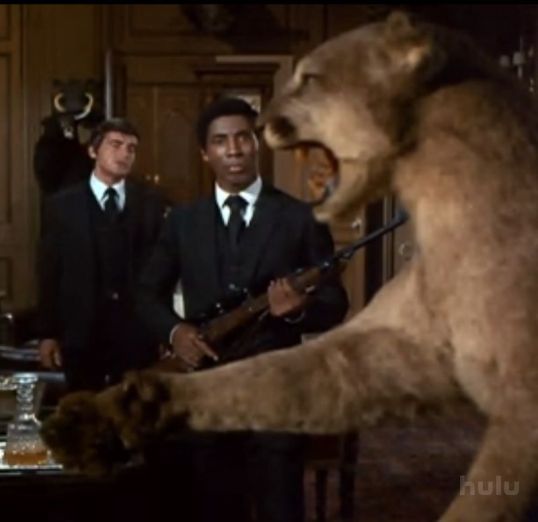
Raymond Massey plays Col. Archie Dittman, a wealthy racist who is obsessed with hunting and killing.  He even has a study full of the mounted heads of all of the animals that he’s killed.  Archie’s son, Archie, Jr. (Barry Brown), has just graduated from college and has no interest in hunting.  Col. Dittman demands that his son go on a hunt or risk being disinherited.  What the colonel fails to take into consideration is that both his bloodlust and his racism has offended his butler (Herbert Jefferson, Jr.) and that his butler has a magic-related revenge in mind.

Clean Kills and Other Trophies is hardly subtle but it does create and maintain a properly ominous atmopshere.  Raymond Massey gives a wonderfully villainous performance and it’s hard not to be amused by the fact that his son is wearing a peace signal prominently on his lapel, as if the segment’s director took one look at it and said, “What’s one thing that we can do to make the themes of this segment even more heavy-handed?”  The segment ends on a note that is so entertainingly over-the-top that it’s hard not to love it.

This episode was uneven.  Make Me Laugh does’t quite work but Cleans Kills and other Trophies is good enough to make up for the disappointing segment that precedes it.

Previous Night Gallery Reviews:

  1. The Pilot
  2. The Dead Man/The Housekeeper
  3. Room With A View/The Little Black Bag/The Nature of the Enemy
  4. The House/Certain Shadows on the Wall

TV Review: Night Gallery 1.3 “The House/Certain Shadows on the Wall”


The third episode of Night Gallery aired on December 30th, 1970.  While Americans were undoubtedly finalizing their plans for a wild New Year’s Eve (because, after all, Nixon was president and every day was a party), NBC and Rod Serling invited viewers to take a tour through a darkened museum, one where every painting told a story.

This episode of Night Gallery featured two stories:

The House (dir by John Astin, written by Rod Serling)

The House opens with Elaine Latimer (Joanna Pettet) talking about a recurring dream.  She’s driving her car through the countryside when she comes across a large house.  Though she’s never seen the house, she finds herself drawn to it, as if she somehow belongs in the house.  As Elaine describes her dream, we come to realize that she’s talking to a psychiatrist (Steve Franken) and that Elaine is recovering from mental breakdown.  Her doctor tells Elaine that the dream is nothing to worry about.

However, when Elaine is driving home, she realizes that the countryside looks familiar.  Soon, she’s pulling up in front of the house from her dreams!  When Elaine gets out of the car, she’s greeted by a real estate named Peugeot (Paul Richards) who asks her if she’s interested in buying the house.  As Peugeot gives her a tour of the estate, he mentions that the house is thought to be haunted….

I liked The House.  It was an atmospheric little tale and, from the minute that Elaine started talking about her dream, the story captured my attention.  (I should admit that I also have recurring dreams about a house that I’ve never actually seen before.)  Admittedly, the story does play out at a very deliberate pace and requires a bit of patience but the dream sequences are effectively surreal and Joanna Pettet gives an empathetic performance in the lead role.

Certain Shadows On The Wall (dir by Corey Allen, written by Rod Serling)

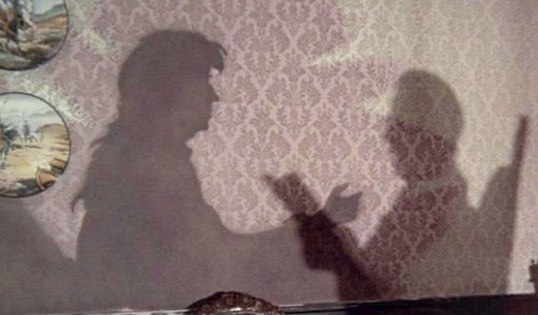
This segment features Agnes Moorehead as the sickly Emma, who is poisoned by her own brother, the despicable Stephen (Louis Hayward).  After Emma’s death, Stephen is shocked to discover that, even though Emma is gone, her shadow remains on the wall.  While Stephen is trying to make sense of that, his other two sisters (played by Grayson Hall and Rachel Roberts) have plans of their own for how to deal with their duplicitous brother.

Like The House, Certain Shadows On The Wall is appropriately atmospheric.  The ending is a bit weak as Stephen gets what he deserves but the shadow itself doesn’t have much to do with his actual fate.  Just when you’re waiting for Agnes Moorehead to make a sudden, ghostly appearance, the story comes to an end.  Still, this is an effective segment and it features excellent work from its ensemble.  I especially liked the performance of Grayson Hall, which features one of the most frightening glares that I’ve ever seen.

The third episode of Night Gallery was a definite improvement over the two that came before it.  Both segments tell intriguing stories, though it’s obvious that the show was still better at coming up with good premises than effective endings.

Previous Night Gallery Reviews:

  1. The Pilot
  2. The Dead Man/The Housekeeper
  3. Room With A View/The Little Black Bag/The Nature of the Enemy

Chilling Adventures of Sabrina, Ep 3.6, (Dir. Michael Goi)


sabrina

I couldn’t totally tell if I was being entertained by this episode. I’m gonna say no because it’s taken me a week to write this. I have to review Sabrina in stages like getting oral surgery. They root canal you- Sabrina Season Opener, They put bone and hardware up into your gums – mid-season Sabrina, and finally you get a new fake tooth and it’s over- Sabrina Season Finale.

If it weren’t the live tweet sessions with Lisa, I would’ve lost it long ago.  Those banter sessions make the show pretty fun; it’s a shame that the writers and directors can’t achieve that on their very own. In that same vein, if Harvey gets to be any more boring, he’s just going to be recapping his favorite scenes from “How it’s Made” on the Science Channel.  Hey Sabrina, you know what’re swell? Diving Helmets!

At least in this episode, Sabrina didn’t have to find anything. FFS, every episode has been

I miss Nick. But, Sabrina the Town. NIIIIIIIICK!  Sabrina wait….

NO, I’ve to find Judas’ silver, a stop sign, and an Easter basket and have it back at the rec center by Midnight!

Meanwhile courtly intrigue, Caliban is proposing to Sabrina to be his Queen of Hell and he’ll prove he’s on the up and up by making a crappy spell to turn Roz back from stone.  To do this, Harvey has to give up the thing he loves most – his 19th Century Danish Coin Collection.  He actually had to kiss Roz and it would make her not want to have anything to do with him anymore.  They should’ve just had Harvey try express a fully formed thought- she would’ve rolled her stone body the hell out of Greendale lickity split! The kiss didn’t work because he supposedly still loves Sabrina.  Instead, they just capture Circe and she changes everyone back from stone. Oh well.

Hilda is super-gross and nearly full-on spider. She puts a glamour on and decides to hang out with Dr Cee.  Unfortunately, she losses her glamour and he sees all of her spiderness.  He does what any fiance would do and gets her some fast food.  Why not?  While he’s gone, she eats a guy who must be 90% balloon, given the blood splatter.  When he does return, Hilda corners Dr Cee, has him fertilize her eggs (somehow yeech), and kills him.  Hilda tells her sister to come and bring a gun and Zelda kills Hilda.  Afterall, Zelda used to kill Hilda once a month; so, Zelda puts Hilda in the resurrection plot device out front and waits for Hilda’s return.

Lastly, Lilith seduces father Blackwood so that she will have a Satan baby to keep Lucifer from killing her.  Why not?

This episode was not terrible, but not great.  It kind of made me sad for Hilda and the actress herself because she rarely gets to show any range.  In this episode, we find out that she has a broadway quality voice. Oh well, Lisa’s got the next one. Tag, you’re it!

TV Review: Night Gallery 1.2 “Room With A View/The Little Black Bag/The Nature of the Enemy”


The second episode of Night Gallery originally aired on December 23rd, 1970 and it featured three stories, two of which were written by Rod Serling.  Serling, himself, introduced all three of the stories by inviting us to look at the paintings that may or may not have been inspired from them.

Room With A View (dir by Jerrold Freedman, written by Hal Dresner)

When a cranky, bed-bound man (Joseph Wiseman) discovers this his wife (Angel Tompkins) is cheating on him, he comes up with an elaborate scheme to get revenge.  It all hinges on his somewhat nervous nurse (Diane Keaton), who has no idea that she’s being manipulated.

This short segment is well-done but it doesn’t really feel like it belongs on an episode of Night Gallery.  There’s no elements of horror or science fiction to be found in this story.  Instead, it’s just about a manipulative man seeking revenge on his wife.  It’s actually easy to imagine this segment as being a flashback on a Monk-style detective show.  You just need a detective saying, “I finally figured out how you did it!”

For most viewers, probably the most interesting thing about this segment will be the presence of a young Diane Keaton, playing the nurse and laughing nervously at her patient’s rather intrusive questions.

The Little Black Bag (dir by Jeannot Szwarc, written by Rod Serling)

In the 30th Century, a careless accident at a time travel station sends a black medical bag into the past.  It arrives in 1971, where it’s discovered by two homeless gentlemen.  One of the men is a disgraced former doctor named William Fall (Burgess Meredith).  The other, Hepplewhite (Chill Wills), has no medical experience but he does have a greedy spirit.  Fall wants to use the bag to do good,  Hepplewhite wants to use the bag to make money.  Meanwhile, in the future, poor put-upon Gillings (George Furth) is just trying to figure out what to do about the missing bag.

The Little Black Bag is this episode’s high point, featuring good performances from Meredith, Wills, and Furth and also ending with properly macabre twist.  This is another Rod Serling story about how terrible, at heart, most people are but Jeannot Szwarc’s direction is fast-paced and he never allows things to get too heavy-handed.

The Nature of the Enemy (dir by Allen Reisner, written by Rod Serling)

NASA’s latest expedition to the Moon has run into trouble.  The astronauts have discovered that there is something living on the lunar surface.  On Earth, the director of NASA (Joseph Campanella) tries to keep everyone calm while also figuring out the nature of the enemy.

This segment has an intriguing premise but it’s let down by a so-so execution.  Like a lot of less-than-effective Night Gallery segments, this one features a story that doesn’t so much conclude as it just stops after a somewhat weak punchline.

So, the second episode of Night Gallery was not an improvement on the first and it was nowhere close to matching the pilot.  Watching this episode, it was hard not to feel that the show had a few growing pains.  Did it want to be a horror anthology or a collection of short skits?  The 2nd episode reveals a show that was still trying to find it’s voice.

Previous Night Gallery Reviews:

  1. The Pilot
  2. The Dead Man/The Housekeeper


TV Review: Night Gallery 1.1 “The Dead Man/The Housekeeper” (dir by Douglas Heyes and John Meredyth Lucas)


As I wrote yesterday, I recently decided to sit down and watch every episode of the horror anthology series, Night Gallery.  Yesterday, I watched and reviewed the pilot movie.  Tonight, I watched the first episode of the weekly series.

Though the pilot originally aired in 1969, Night Gallery did not start to air as a regular series until December of 1970.  The first episode of season one was broadcast on December 16th, 1970.  As all of the episodes did, it stated with Rod Serling walking through a dimly lit museum and inviting the audience to look at a macabre painting.  Each painting was inspired by a different story.  Or were the stories inspired by the paintings?  To be honest, I don’t think the show ever made that clear.

The first episode featured two stories, both of which dealt with mad scientists.

The Dead Man (written and directed by Douglas Heyes)

The first segment was The Dead Man, an enjoyably atmospheric if somewhat difficult-to-follow story about a scientist, a young man with an amazing ability, and the woman who is torn between the two of them.

Carl Betz plays Max Redford, a doctor who has discovered that, under hypnotic suggestion, John Michael Fearing (Michael Blodgett) can simulate any medical condition, no matter how severe.  When Max reveals his discovery to his associate, Dr. Talmadge (Jeff Corey), Talmadge is concerned that Fearing will suffer permanent damage as a result of Max’s experiments.  Nonsense! Max explains.  All he has to do is give Fearing the proper signal and he’ll pop right out of his condition, as good as new.

Max decides to put Fearing to the ultimate test by having him simulate death.  However, when Fearing goes under, he dies for real.  Was it just an accident or did Max — who suspects that Fearing was having an affair with his wife (Louise Sorel) — secretly mean for Fearing to die?

The Dead Man raises some intriguing questions about life, death, and medical ethics.  It also has a quartet of good performances with Carl Betz doing an especially good job as Max.  Michael Blodgett showed up in a lot of early 70s films and TV shows and he was always convincing as a decadent hedonist.  The entire segment is full of creepy atmosphere but the ending is a bit of a let down.  After a great set-up, the segment just kind of fizzles out.

The Housekeeper (written by Heyes, directed by John Meredyth Lucas)

In the second segment, our mad scientist is named Cedric Acton (Larry Hagman).  Whereas Max Redford, in the previous segment, was misguided, Cedric Acton is just crazy.  Through the use of black magic (it involves a frog), Cedric has been experimenting with soul and brain transference.  (There’s an oinking chicken and a clucking pig in his laboratory, just in case anyone’s wondering how the experiments are going.)

Because Cedric loves his wife’s body but hates her personality, he wants to put the soul of his kindly housekeeper (Jeanette Nolan) into the body of his wife, Carlotta (Suzy Parker).  At first, the experiment is a success but things get complicated and …. well, I’m not really sure what it all leads to because this is one of those stories that just kind of ends without really offering up any type of resolution.

The Housekeeper is meant to be a comedy but it’s a bit too mean-spirited to really work.  This segment really calls out for karma to intervene and for Cedric’s soul to end up in something else’s body but instead it just ends with Cedric continuing his experiments.  It’s more than a little dissatisfying.  Larry Hagman does a good job playing Cedric, though.  He’s convincingly crazy.

Especially after the pilot, it’s hard not to be disappointed by the first episode of Night Gallery.  Both stories had potential but they were let down by weak endings.  Oh well.  Hopefully, tomorrow’s episode will be an improvement!

Film Review: Night Gallery (dir by Boris Sagal, Barry Shear, and Steven Spielberg)


Night Gallery was a horror anthology series that aired on NBC in the early 70s.  Each episode featured Rod Serling, of Twilight Zone fame, serving as the curator of a museum where all of the paintings have a somewhat macabre theme.  (One could even say that the museum was a …. wait for it …. night gallery!)  Serling would give each painting a properly pithy introduction and then the audience would see the story behind the artwork.  It was a bit like the Twilight Zone, except the Night Gallery episodes were in color, they were all horror-themed, and, for the most part, they steered away from social commentary.  The series ran from 1970 and 1973 and it still airs in syndication and on some of the retro stations.  (I believe it currently airs on Comet TV.)  Even if it wasn’t as consistently good as Twilight Zone, it’s still a pretty fun little series.

Two Christmases ago, I was gifted  Night Gallery: The Complete Series on DVD.  Though I’ve watched several episodes from the DVD, I recently realized that I have never actually sat down and watched every episode in order.  With the world currently shut down due to the pandemic (a development that, if we’re going to be honest, sounds like something Rod Serling would have used on the Twilight Zone), I figured what better time to watch the entire series then now?

I started out by watching the Night Gallery pilot film.  This originally aired on November 8th, 1969, a full year before Night Gallery became a weekly series.  It features three different stories (all written by Rod Serling) of the macabre.  As with every episode of the subsequent series, each story is introduced by Serling standing in front of a painting.  In the pilot, though, the museum is rather bare and the painting’s are a bit minimalist.  I have to admit that, as a lover of the baroque, I was a bit disappointed in that aspect of the pilot.

But what about the stories themselves?  Read on!
The Cemetery (dir by Boris Sagal)

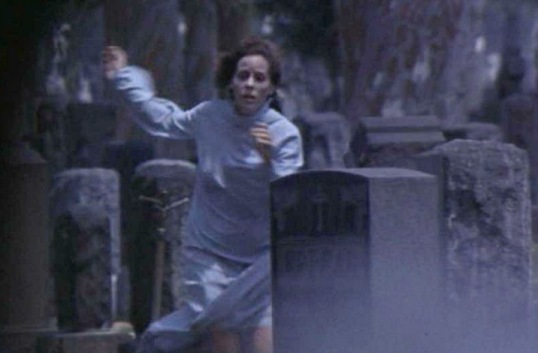
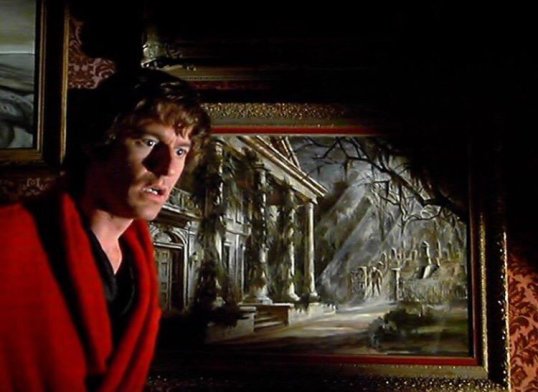
The first story was The Cemetery, a cheerfully gruesome little tale that featured Roddy McDowall and Ossie Davis.  McDowall plays Jeremy, a spoiled young man who murders his uncle so that he might inherit the dead man’s estate.  At first, it looks like McDowall’s plot is a complete success but then McDowall notices a painting of the family graveyard hanging above a staircase.  (To be honest, it seems odd to hang a painting of a graveyard in the foyer but I guess that’s something old rich people do.)  The painting keeps changing.  One minute, the painting looks normal.  The next minute, it features a newly dug grave.  And then something emerging grave.  And then something heading towards the house….

Is Jeremy losing his mind or is the painting warning him that his uncle has risen from the dead and is seeking revenge!?  You’ll probably be able to guess the answer long before poor Jeremy but no matter.  This is a fun little horror story and it benefits from two enjoyably arch performances, from McDowall and, in the role of a butler who may have an agenda of his own, Ossie Davis.

Eyes (dir by Steven Spielberg)

Of the three stories presented in the pilot, Eyes probably gets the most attention from critics because it not only stars Joan Crawford in one of her final performances but it was the professional directorial debut (if you don’t count Amblin’) of 22 year-old Steven Spielberg.  Spielberg apparently had some issues dealing with the veteran crew members, many of whom didn’t like the idea of taking orders from a 22 year-old.  (It probably didn’t help that pictures from that era suggest that Spielberg looked several years younger than his age.  Let’s just say that it’s easy to understand why he eventually grew that beard.)  I’d like to think that Joan Crawford yelled at everyone and defended Spielberg and maybe even Rod Serling came down with Luca Brasi and said, “You’re going to the give this kid the respect he deserves or your brains are going to be all over that union contract.”  I don’t know if that’s true but it’s a nice thought.

That said, Eyes is pretty good.  Even if the crew doubted him, Spielberg proved himself as a director with this story.  It’s about a hateful and selfish woman (Joan Crawford) who happens to be both rich and blind.  She has manipulated a doctor into performing an experimental operation that will allow her to see.  The only catch is that the operation will only be good for 22 hours and a donor (Tom Bosley, as a bookie who is in trouble with the mob) will be required to give up his eyes so that Crawford can have those 22 hours.

On the one hand, this is very-much a Rod Serling-type tale.  It’s easy to imagine Eyes, with its belief in karma and its final macabre twist, as a Twilight Zone episode.  At the same time, Spielberg very much brings his own signature style to the film, livening up dialogue-heavy scenes with interesting camera angles and getting good performances from Crawford, Barry Sullivan, and Tom Bosley.  Eyes is a clever story but, for modern viewers, the most interesting thing about it will be discovering that, even at the age of 22, Spielberg already had a clear directorial style.
The Escape Route (dir by Barry Shear)

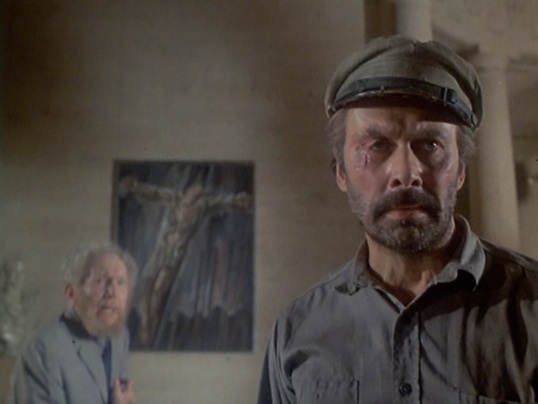
The Escape Route is about an Nazi war criminal named Joseph Strobe (played by Richard Kiley) who is hiding out in South America and spending all of his time nervously looking over his shoulder.  One day, he enters a museum where he finds himself drawn to two paintings.  One painting features a man who has been crucified in a concentration camp, which we learn was Strobe’s trademark back when he, himself, was a camp commandant.  The other painting features a fisherman in a peaceful setting.  Even though Strobe imagines himself as the peaceful fisherman, his attention keeps getting redirected to the painting of the concentration camp.  Soon, Strobe realizes that a survivor of the camp (played by Sam Jaffe) is also in the museum and that he is studying the painting as well.

Compared to Eyes and especially The Cemetery, The Escape Route may seem like a rather low-key story but it has a power that sneaks up on you.  Hiding out (as many real-life Nazi war criminals did) in South America, Strobe is full of excuses for his past and he may indeed be sincere in his wish that he had just become a fisherman as opposed to a brutal Nazi.  But, in the end, Strobe can neither escape his past nor his final punishment.  Justice cannot be escaped, no matter how hard Strobe tries to outrun it.  In the end, there is no escape for the wicked.  Richard Kiley and Sam Jaffe both give excellent performances.  The Escape Route will stick with you.

As a series, Night Gallery was a bit uneven but the pilot stands as a classic of its type, featuring three short films that all deserve to be remembered.

As for me, I’m going to try to watch an episode or two a day.  I may review a few more Night Gallery episodes here on the Shattered Lens.  As I said, the series itself was a bit uneven and not every episode is as good as the pilot.  Still, there’s definitely some gems to be found in the Night Gallery and I’ll share them as I come across them.

TV Review: Chilling Adventures of Sabrina 3.4 “The Hare Moon” (dir by Viet Nguyen)


I have to admit that I groaned a bit when I discovered that the fourth episode of part 3 of Chilling Adventures of Sabrina was going to center around yet another holiday.  Seriously, how many holidays do these witches have to celebrate over the course of year?  This time, the holiday was the Hare Moon, which involves everyone dressing in white, going on a picnic, and not killing a rabbit.  The holiday itself doesn’t make much sense and, to the show’s credit, this episode opens with Sabrina telling her aunts that it doesn’t make much sense.

So, I wasn’t expecting much from The Hare Moon but, to my surprise, it actually turned out to be a pretty good episode.  At the very least, it held my interest and that’s more than I can say for the episode that came immediately before this one.  I think it helped that a good deal of this episode took place in the woods during the day, which meant that I could, for once, actually see what was happening without having to strain my eyes.  I know that I spend a lot of time complaining about how underlit and dark the majority of Sabrina‘s interior scenes are but I think this episode proved my point.  When I could actually see who was talking, it was a lot easier for me to actually care about what they were talking about.

The highlight of this episode came when, during the Hare Moon ceremony, the witches ran into the pagan carnival people, who were all celebrating a holiday of their own.  The interaction between the two groups was wonderfully awkward and, even more importantly, the carnival people seem like worthy adversaries to the witches.  The carnival people worship the Green Man and, by the end of the episode, they had delivered an ultimatum to the witches.  The witches can either worship the Green Man or they can die.  Since the covens powers have been weakened by a petulant Satan, the witches are momentarily at a disadvantage.

In other developments, Harvey and Roz decided to investigate the carnival on their own, which led to Roz getting turned into a statue and …. well, I mean, it’s Harvey and Roz.  If either one of them had a personality beyond Harvey being amiably stupid and Roz having an overprotective father, it might be interesting but they don’t so who cares?  Nick also ended up setting Satan free because Nick’s main reason for being on the show is to do stuff like that.  Of course, the Spellmans were going to free Satan anyway so that they could get back their powers but Nick decided to go ahead and do it so now the Spellmans are still weak and even more screwed than before.  Way to go, Nick!

Anyway, this was actually a pretty entertaining episode.  The carnival people are wonderfully sinister and Will Swenson was well-cast as their leader. Kiernan Shipka remains the show’s greatest strength and even Miranda Otto and Lucy Davis got a few good lines in this episode.  There was still a bit too much filler but all in all, this was one of the better episodes.  If only every episode was this good.

TV Review: Chilling Adventures of Sabrina 3.3 “Chapter Twenty-Three: Heavy Is The Crown” (dir by Alex Pillai)


What’s this?, you ask.  Just now, you’re finally getting around to reviewing Chapter 23 of Chilling Adventures of Sabrina?

Admittedly, it has taken me a while.  The third season or third part or whatever the Hell you want to call it of this show was released on Netflix all the way back in January.  That’s a long time ago even by normal standards.  In May of 2020 (this is May, right?), January seems as if it might as well have been a decade ago.  You remember what the world was like in January — Iowa caucuses, open movie theaters, strong economy, and no social distancing — and it feels like some sort of lost age.  Case reviewed the first two episodes of Sabrina‘s third season back in February.  I was supposed to review episodes three and four as soon as I got back from my vacation in March.  Of course, as soon as I got back, the entire world went into lockdown and it was easy to get distracted from the latest Greendale drama.

Plus, I have to be honest.  So far, for the most part, I just haven’t enjoyed Chilling Adventures of Sabrina.  There have been a few tolerable episodes and Kiernan Shipka deserves to be a bigger star but the show itself often feels like a dead end.  The pace is often maddeningly slow and, other than Sabrina, almost all of the characters are rather flat and dull.  With the exception of Sabrina, everyone gets one defining trait and the show tends to beat viewers over the head with that trait.  As such, Aunt Zelda is always going to be arch and dismissive.  Hilda is always going to be naive and neurotic.  Ambrose is always going to decadent in the most boring ways possible.  Harvey is always going to be a dullard.  Roz is always going to be boring.  Beyond the one-dimensional characters, the whole look of the show bugs me.  Why does no one in Greendale ever turn on a light?  Why do I always have to strain my eyes trying to see what’s happening?  It gets frustrating.  Working up any enthusiasm to sit through another one of Sabrina’s adventures can be a struggle.

And yet, I will continue to watch the show because I do think that it has potential.  Now, to be honest, some of that is because the show is often so bad that it has nowhere to go but up.  But occasionally, there will be an interesting twist or a line of dialogue that doesn’t crash to the ground with a thud.  It doesn’t happen often but it does happen enough that I keep hoping Chilling Adventures will get things together.  My main hope is that, someday, the show will actually be worthy of Kiernan Shipka’s consistently excellent lead performance.

Just take the third episode of Part Three for example.  On the plus side, this episode features a trip to a wonderfully creepy carnival.  And even though the carnival itself is pretty obviously borrowed from Something Wicked This Way Comes and The Seven Faces of Dr. Lao, it’s still a lot of fun and effectively surreal and ominous.  However, to get to the carnival, we have to suffer through a lot of underlit drama featuring one-note characters.  We have to sit through Roz and Harvey having the least interesting relationship ever to appear in a Netflix drama.  We have to deal with Nick and his PSTD.  We have to deal with Miranda Otto delivering all of her lines in the same monotonous style.  We also have to sit through yet another quest.  In this case, Sabrina has to find three artifacts to hold onto the title of the ruler of Hell.  She manages to find Herod’s Crown but she still loses it to her rival for the throne, Prince Caliban.  So, I guess Sabrina is going to have to find the other two artifacts over the course of the season. I’d probably care more if Hell, as presented on this show, wasn’t so damn boring.  Presenting witchcraft as being tedious might make for an effective short film but making an entire series out of it is another thing all together.

And yet, Kiernan Shipka gives such a good performance in the lead role that you can almost overlook how annoying the show itself tends to be.  Shipka brings so much sincerity to her role that you want Sabrina to succeed.  I just wish the show was more often worthy of the talents of its star.

Oh well.  Fear not!  I actually liked the episode that came after this one.  I’ll be rewatching and reviewing it soon!


Did You See The Sun Rise? (1982, directed by Ray Austin)


Ivan (Bo Svenson) is a KGB colonel who, working under the guise of being a diplomat, has set up operations on Hawaii.  During the Vietnam War, Ivan tortured and brainwashed an American POW named TC (Roger E. Mosely), placing a hypnotic suggestion in his brain on just the off-chance that Ivan would need a Manchurian candidate to do some dirty work at some point in the future.  With the help of another former POW, Sebastian Nuzo (James Whitmore, Jr.), Ivan plans to activate TC and then use him to assassinate the visiting prime minister of Japan.  What Ivan hasn’t counted on is that TC has two friends looking out for him, a club owner named Rick (Larry Manetti) and a laid-back, Hawaiian-shirt loving private investigator named Magnum (Tom Selleck).

Did You See The Sun Rise?  Is it a movie or is it just a two-hour episode of the original Magnum P.I.?  I think it’s both because, while it’s definitely an episode of TV series (it was, in fact, the premiere episode of Magnum‘s third season and the fact that it was a special, extra-long episode shows how popular Magnum was back in the 80s), it’s also good enough that it can stand on its own and be viewed and appreciated even by those who have never seen any other episodes of the show.  For the most part, Magnum P.I. was a breezy detective show that mixed comedy and mystery-solving.  Occasionally, though, the show would do a more serious episode and, more of than not, that episode would deal with Magnum, T.C., and Rick’s time in Vietnam.  (At the time it premiered, Magnum was unique in that it was one of the only shows to feature characters who had served in Vietnam without portraying them as being unhinged, unemployable, or potential threats to society.  Magnum and his friends had been effected by their experiences in Vietnam but, unlike someone like Rambo, they were not solely defined by their status as being veterans of what was then America’s least popular war.)  Of those serious shows, Did You See The Sun Rise? is the best example.

There’s a lot to recommend Did You See The Sun Rise?  It’s well-acted by series regulars Selleck, Manetti, Mosely, and John Hillerman.  Bo Svenson plays a great villain and even his Russian accent is more credible than you’d probably expect it to be.  The Vietnam flashbacks are handled well.  The episode has an unexpected twist, one that daringly kills off one of the show’s semi-regular supporting characters.  Even the entire Manchurian candidate plot, even if it is a little more out there than Magnum usually got, is handled well.

And then there’s that final scene.  Did You See The Sun Rise? ends with a freeze frame of Magnum doing something that TV show heroes didn’t normally do in 1982.  You can’t blame him, of course.  It’s a satisfying ending but it still leaves you knowing that nothing is ever going to be same for any of these characters ever again.  In that final scene, Did You See The Sun Rise? takes things further than most shows would have the guts to do.  The ending may not seem as shocking today but you have to remember that this episode aired long before networks like HBO regularly challenged the assumptions of what a show’s main character could or could not do on television.

The original Magnum P.I., including Did You See The Sun Rise?, is available for free on Amazon Prime.