Song of the Day: The Man Comes Around (by Johnny Cash)


We’ve now reached the final day of what has been a week-long horror-themed “Song of the Day” feature for the site. It’s quite appropriate that this final day also lands on Halloween and I’m sure many will approve of this final choice to cap off the week.

A week which has seen Italian film composers and prog-rock bands chosen for creating and contributing some of the best and most memorable themes to horror films which will stand the march of time. We’ve seen an epic song from a Montreal band whose music has the apocalyptic sound to it. There’s also two entries from films created by a master of the horror genre in John Carpenter.

The week began with Goblin’s main title theme for George A. Romero’s original Dawn of the Dead. With Halloween night the premiere of the long-awaited and heavily-hyped tv adaptation of Robert Kirkman’s The Walking Dead comic book series (by none other than Frank Darabont himself) I thought what better way to bookend Goblin’s theme for the Romero zombie epic than by picking Johnny Cash’s song “The Man Comes Around”. One of the last songs penned and sang by The Man In Black himself and properly used by filmmaker Zack Snyder to  be the intro music for his remake of Dawn of the Dead.

This song with its gospel-like (though not as hopeful as most) sound and it’s apocalyptic and Biblical lyrics just speaks of the apocalypse like no other song from this past week has done. It comes off almost like a prophecy come down and spoken by one of God’s main dudes. This song when paired with the scenes of the zombie apocalypse crashing down on an unsuspecting world in Snyder’s film instantly made it a favorite with all zombie fans everywhere and introduced The Man In Black to a whole new set of fans.

I would like to think that when the zombie apocalypse does arrive it would be to this song as I and those who share my belief in how to survive such an event ready ourselves for whatever may come.

The Man Comes Around

And I heard as it were the noise of thunder
One of the four beasts saying come and see and I saw
And behold a white horse

There’s a man going around taking names
And he decides who to free and who to blame
Everybody won’t be treated all the same
There’ll be a golden ladder reaching down
When the Man comes around

The hairs on your arm will stand up
At the terror in each sip and in each sup
Will you partake of that last offered cup?
Or disappear into the potter’s ground
When the Man comes around

Hear the trumpets, hear the pipers
One hundred million angels singing
Multitudes are marching to the big kettledrum
Voices calling, voices crying
Some are born and some are dying
It’s Alpha and Omega’s kingdom come

And the whirlwind is in the thorn tree
The virgins are all trimming their wicks
The whirlwind is in the thorn tree
It’s hard for thee to kick against the pricks

Till Armageddon no shalam, no shalom
Then the father hen will call his chickens home
The wise man will bow down before the throne
And at His feet they’ll cast their golden crowns
When the Man comes around

Whoever is unjust let him be unjust still
Whoever is righteous let him be righteous still
Whoever is filthy let him be filthy still
Listen to the words long written down
When the Man comes around

Hear the trumpets, hear the pipers
One hundred million angels singing
Multitudes are marching to the big kettledrum
Voices calling and voices crying
Some are born and some are dying
It’s Alpha and Omega’s kingdom come

And the whirlwind is in the thorn tree
The virgins are all trimming their wicks
The whirlwind is in the thorn tree
It’s hard for thee to kick against the pricks

In measured hundredweight and penneypound
When the Man comes around.

Close (Spoken part)
And I heard a voice in the midst of the four beasts
And I looked and behold, a pale horse
And his name that sat on him was Death
And Hell followed with him.
Song of the Day: Halloween Theme (by John Carpenter)


The penultimate choice for this week’s horror-themed “Song of the Day” feature brings one of the best theme songs ever composed and put on film. I am talking about the Main Title theme for John Carpenter’s classic horror film (also one of the best grindhouse films ever made) and one which launched a whole new horror subgenre with Halloween. This theme would become synonymous with the “slasher film” that when the many copies and imitators of the film came out in droves a year later they would try to replicate this keyboard synthesizer-based theme and fail miserably.

It’s actually a pretty simple theme. Carpenter composed the theme as a piano melody played in a 5/4 meter that even the most novice piano player could play with ease. This theme could be heard throughout the film whenever Michael Myers appears and/or in the vicinity. Some have even started calling it the Michael Myers theme and they wouldn’t be far off. It’s become the film’s leitmotif that Carpenter ends up relying on it to set the mood and tension in the film. Other kids of songs could be heard throughout the film but outside of the Blue Oyster Cult’s “Don’t Fear the Reaper” the rest of the score is forgettable until this theme kicks in.

This theme will be the final of the instrumental themes for the week. With one more day left in this special week-long horror-themed week for “Song of the Day” the last one will definitely usher in another awesome Halloween and help kick off the premiere of what will probably be the best thing to ever grace the tv screen past, present and future.

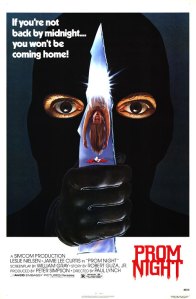
A Quickie With Lisa Marie: Prom Night (Directed by Paul Lynch)


As I mentioned in another post, my sister Erin and I spent Tuesday night watching the Killer Party Marathon on Chiller.  One of the movies we saw was the original 1980 Prom Night, starring Jamie Lee Curtis and directed by Paul Lynch.  Prom Night, of course, was remade two years ago with cross-eyed dumbfug Brittany Snow as the star.  If, like me before Tuesday night, you’re only familiar with the tepid and bland remake than the original Prom Night is a surprise indeed.

The original Prom Night is an old school slasher film, one of the many that came out in the two years immediately after Halloween.  It even stars the star of Halloween, Jamie Lee Curtis.  Prom Night also stars a lot of Canadians because it was one of the many low-budget B-movies that was made in Canada in the early 80s.  Apparently, Canada was offering tax breaks to film companies willing to shoot up north.  Several web sites have said that the setting is obviously Canadian but I couldn’t really tell.  Of course, I’m from Texas.  Anything above Arkansas looks like Canada to me.

Plotwise, the film is pretty much your traditional old school slasher film.  There’s a terrible tragedy in the past, an innocent man is blamed for it, and ten years later, teenagers end up getting killed at some communal event.  In this case, the tragedy is the death of a young girl who is killed during a truly demonic game of tag.  The children responsible for her death lie about what happened and a disfigured drifter is convicted and imprisoned for her murder.  As for the communal event, in this case, it’s prom night.  The killer stalks the prom, which is what I suggested my classmates call our prom way back when.  They disagreed and that’s their loss.  The Killer Stalks The Prom would have been a story to remember.

Anyway, here’s a few random thoughts about the original Prom:

1) As with all old school slasher films, it’s interesting to see just how much of the early products of this all-American genre borrowed from the Italian giallo genre.   Everything from the elaborate, past tragedy to the black gloves worn by the killer to the attempts to keep audiences guessing who the killer actually is to even the supporting character of the burned out cop simply screams giallo.  The main thing that the Americans brought to the giallo format was the idea of having the murders revolve around a previously innocent gathering or holiday.

2) Especially when compared to recent “slasher” films, Prom Night is a relentlessly grim film.  Prom Night’s killer doesn’t waste any time with comic relief or one-liners.  He’s too busy savagely killing people.  And our victims aren’t the usual collection of bimbos and soulless jocks.  No, this is the type of movie where even the token virgin ends up getting her throat ripped out with a gigantic shard of glass.  There’s not a lot of deaths in Prom Night, just six.  But they all hurt.

3) I usually just think of Jamie Lee Curtis as the crazy woman selling Activia on Lifetime but this movie shows that she’s actually a pretty good actress.  Even working with a script that isn’t exactly full of brilliant dialogue or multi-faceted characters, Curtis is a sympathetic, likable, and most of all, believable heroine (which is all the more remarkable when you consider that she, like everyone else in this film, appears to be far-too old to still be worrying about the prom).  She even manages to make the film’s ending rather touching and even poignant.  And how many slasher films can you say that about?

4) Prom Night is as much about tacky — yet insanely catchy — disco music as it is about spilling blood.  Seriously, if I owned the soundtrack to this film, I would listen to it 24/7 for two years straight.  I’d force all of my friends to listen to it too and eventually we’d all go insane and just spend the rest of our lives wandering around going, “Prom night!  Everything is alright!”

5) One last thing — Prom Night showcases what has to be the most believable, cheap, and tasteless prom ever put on film.  The theme is Disco Madness and the students are all very chic in that way that even they know will be painfully dated in another two years.  Indeed, this is one of the rare films that understands that the perfect prom is nothing less than an unintentional camp spectacular.  For someone like me who, as the result of seeing too many episodes of Saved By The Bell: The New Class, grew up with an unrealistic expectation of what the senior prom would be, the original Prom Night remains a refreshing breath of fresh air even 30 years after it was made.

And always remember: “Prom Night!  Everything is all right…”

…And the Great Cold Death of the Earth: Music for October (part 5)


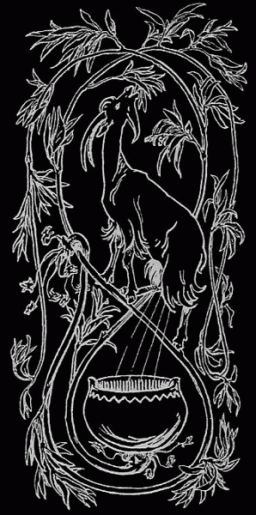
I don’t think I could have possibly stumbled upon a more appropriate image for this penultimate entry in my music column than the goat Heiðrún feeding on Yggdrasil. (Well, technically Læraðr.) I’ll today be concluding my compilation of songs that, while still being “black metal” in some sense, extend well beyond the boundaries of the genre.


10. Hardingrock – Faens Marsj
In 2007, Ihsahn and his wife Ihriel teamed up with Hardinger fiddler Knut Buen to merge Ihsahn’s evolving progressive black metal with Norwegian folk music. If the vocals are the only real trace of black metal remaining in this particular track, I think the appeal is no less apparent.


9. Temnozor – Busov’ Vran’
(Темнозорь – Бусовы Враны)
Temnozor’s 2010 release is easily their best in my opinion, and certainly their most folk-infused. That this Russian band in 2007 released a split with Nokturnal Mortum might be telling. Their ability to harness folk as a sort of primitivism has evolved tremendously, and it herein shows. The gripping dynamics of Russian vocalization are inseparable from the overall sound. It’s no wonder this is a predominantly Eastern European movement.


8. Boris – Luna
Pretty much any obsessive Boris fan will tell you they’re the most innovative band in existence, and I totally buy into the hype. Boris has, over the years, consistently denied all forms of classification, seeming to incorporate a new style of music on practically all of their myriad releases while remaining always recognizably Boris. In 2009 they contributed one track to a split with stoner metal band Torche, and in doing so gave black metal a unique new form. It’s an unfortunate shame that the last two minutes of this song, in which they transition into an Electric Wizard-esque doom metal outro, aren’t available on youtube. But for the purposes of this column, this song’s significance still comes through. Boris eat musical styles and shit roses. This is one of them.


7. Agalloch – Limbs
Where were you the first time you heard Ashes Against the Grain? I think a lot of people can actually answer that. Pale Folklore and The Mantle were brilliant and unique albums, but THIS, this was something innovative on a whole new level. I remember the thought striking me almost immediately: “Woah, post-black metal exists.” Any use I’ve ever made of the term originated from my first listen to Ashes Against the Grain. Isis’s Oceanic was probably my favorite album at the time, and here was everything I liked about it taken to by the best band at creating musical imagery that I’d to that point known. The marriage couldn’t have gone better. Ashes Against the Grain will go down in history as groundbreaking and unique, one of those albums that predicts the future without ever wholly conforming to it. It always was a stretch to associate Agalloch with black metal, but in so far as musical genres are merely generalizations, the most unique bands always seem to fit into all and none simultaneously.


6. Ulver – Hymn VI: Of Wolf and Passion
The first 18 seconds of this song are about a decade ahead of their time. They’re absolutely beautiful–downright uplifting. I guess I never really thought of unadulterated black metal as something that could be triumphant. Sure, bands put it to positive use by incorporating folk and the like, but here you have nothing but blast beats and tremolo, a basic Norwegian breakfast, speaking of something glorious. Perhaps black metal’s origin naturally associates it with the dark and devilish, but very briefly, in 1996, Ulver showed that the same unbridled intensity could turn itself towards any honest end. Of Wolf and Passion. An apt title.


5. Nokturnal Mortum – In the Fire of Wooden Churches
I said you hadn’t seen the last of them. Another NeChrist masterpiece, In the Fire of Wooden Churches is an eclectic, constantly transitioning song that almost never repeats and ends triumphant. This video extends a few minutes beyond the end of the song. Its proper length is about 7:11.


4. Peste Noire – Ballade Cuntre Les Anemis De La France
Ballade cuntre lo Anemi francor got my 2009 album of the year vote. To quote my brief review of it, “This is brilliant, fascinating, unlike anything I’ve ever heard before. As has been said, the ambiance of hate is gone. What replaces it is something I can’t quite define, but it’s captivating. If Famine hadn’t coined it “Black’n’Roll” I think the term still might have popped up, but it’s a whole lot more than that. The 60s-70s rock and roll styles it incorporates, while similar in construct, conjure nothing of the sort to mind. Instead, it gives this sort of disturbingly lively essence to a dismal, filthy Dark Age. Track three feels like I’m dancing circles around someone in a torture chamber randomly sticking hot pokers into them and really enjoying it.” You are listening to track three.


3. Krallice – Wretched Wisdom
Listening to Wretched Wisdom while driving through a barren pillar-studded wasteland in Arizona was one of the most amazing experiences of my life. This is the gut-wrenching scream of an absolute desolation stumbling hopeless at last into the depths of insanity. And here the term post-black applies more than ever.


2. Nokturnal Mortum – NeChrist: The Dance of Swords
Alright, this is my last Nokturnal Mortum entry. Honest. I’ve very little left to say about this band, but I hope you can see why I chose this as their best song. I said of their first entry “this isn’t just a statement about the past, it is a violent declaration of war on the present.” NeChrist might be the celebratory feast on the night of that declaration.


1. Alcest – Le Secret
In 2005, Neige decided it was time to take a new approach with his black metal project. He wanted to write something beautiful, and that he did. The album Le Secret is 27 minutes long and consists of two songs. Neige himself regarded the work as widely misunderstood, and seems to have concluded since that black metal just isn’t a compatible medium for some things. His next album was more on the order of shoegaze, with little in the way of black metal remaining, and his 2010 release, while significantly heavier, largely distinguished the black metal from the shoegaze elements as a sort of contrast between dark and light.
Souvenirs d’un autre monde and Écailles de Lune are both fabulous albums, make no mistake. But Le Secret is so much more. It’s one of those works that can never be repeated, because beyond musical genius it requires a sort of innocence. Those 18 seconds for which I glorified Ulver… here they stand on their own, independent and beautiful.

Song of the Day: Tubular Bells (by Mike Oldfield)


I remember being very young and getting the chills and scares whenever I heard the opening notes to the fifth entry to the week-long horror-themed “Song of the Day” feature for the site. Even now into my third decade I still get a bit of the willies whenever this song comes on TV, cable or I happen to click on the video on YouTube. The song I’m speaking of is the opening theme to William Friendkin’s horror masterpiece, The Exorcist.

The theme was composed by English musician Mike Oldfield in 1973. “Tubular Bells” is actually an epic piece of progressive rock music which is actually split into two parts. It’s the first part which was chosen and slightly reworked by Oldfield himself to become the opening theme to The Exorcist. This particular theme has become one of the most iconic film themes in cinema history. I’m not just talking about in the horror genre but in all of film.

A person who has never seen Friedkin’s masterpiece about a young girl possessed by the Devil and the ritual which happens soon after will know the theme once they hear it. The theme is literally played on the same name musical intruments. While the original has a more baroque sound with some synth manipulation added to the overall tone, the one used for the film definitely has a more progressive/synth rock to its tempo and tone.

In the end, this chosen theme for the day will be continue to scare and terrify old and new audiences of The Exorcist. Just looking at the video above with just the fog-shrouded Georgetown brownstone in the foreground and Father Merrin just standing there looking up at the home then having the theme playing would make even the most God-less person want to start praying for their eternal soul.

An Interlude to the Outermost: Music for October (part 4)


Before proceeding to the two concluding posts of this column, I thought I’d turn off the distortion for a day and present an assortment of haunting little tunes that really serve the season well.

I actually encountered a lot of trouble finding what I was looking for on youtube and had to settle for a few secondary options, but a few dismal video accompaniments aside, I think this turned out rather nicely.


Tenhi – Kielo
This Finnish track is a case in point. The only Tenhi album I’ve heard is their 1998 release, Kauan. Someone sent it to me a good ten years ago, and I’d have all but forgotten them save for this song. Unfortunately the album version, which features a much more morbid arrangement, was not available, but this piano rendition certainly has its merits.


Kiss the Anus of a Black Cat – Sevenfold
I love Kiss the Anus of a Black Cat for so many more reasons than their name alone. One of the few bands I know hailing from Belgium, Kiss the Anus released their first album, If The Sky Falls, We Shall Catch Larks, in 2005. It’s impressively dark. They’ve managed four more releases since, incorporating a variety of styles, but none of them struck me so much as their first. I had hoped to showcase the song Sevenfold, but at least my second favorite on the album was available. Enjoy, and check them out. They just put out a new album earlier this month.
And please excuse the video image. Neither I nor the band had any part in it. >_>


Death in June – Runes and Men
“Apocalyptic folk” has such a nice ring to it, though “neofolk” might be a bit more practical. Douglas Pearce met David Tibet in 1983. Both artists had formed their associated projects, Death in June and Current 93, by then, but it was when their complementary ideas mingled that the style really came into its own. Their mutual fascination in the arcane left a grand mark on music for decades.


Current 93 – Whilst the Night Rejoices Profound and Still
And on that note, here is a sample from the album that really got me into David Tibet’s music, 1998’s Soft Black Stars. This video replaces the last instrumental 30 seconds or so with a minute of silence, but it’s what I could find.


Current 93 – Anti-Christ and Barcodes
Though I may be deemed a bit uncreative for posting two consecutive songs by the same artist, off the same album no less, I think this intensely bleak, desperate number should serve as a fitting end to the first half of my list. From here I’ll be shifting focus a bit. Again, this song ends about 1 minute before the actual video does.


Steve Von Till – The Spider Song
Steve Von Till, better known as a member of Neurosis, has written some absolutely brilliant solo material, but not this song. The credit goes to Townes Van Zandt, a country/folk tragedy who died of a drug overdose in 1997. Where Van Zandt’s song was peculiarly upbeat for its moving lyrics, I think Steve Von Till really captured its true essence. He brings American folk alive in a way that just wouldn’t quite fit in anywhere else.


Of the Wand & the Moon – Raven Chant
This Danish band debuted in 1999 with Nighttime Nightrhymes and, after an impressive eleven releases over the next six years, stopped recording rather abruptly in 2005 and haven’t released anything since. I think Raven Chant, off their first album, is the highlight of their short history.


Matt Uelmen – Tristram
If I measured by last.fm play counts alone, this would be my all-time favorite song by a landslide. I never even played Diablo, but whatever spark of genius brought this to Matt Uelmen’s head is equally appreciable out of context. There’s not much I can say about it, but I’ve been known to leave it on repeat for hours and not get bored.


Burzum – Han Som Reiste
I read once that Varg Vikernes intended each of his albums to be a sort of spell, attempting to first invoke a trance-like state and then communicate to the listener subconsciously through music over the remainder of the album. I also read once that Varg Vikernes thinks Hitler is part of an enlightened alien race hiding out beneath Antarctica. But whatever you might say of the guy, Han Som Reiste, appearing in the middle of Det Som Engang Var, certainly left its mark on me, the first time I heard it and every time since.


And lastly:
Summoning – Menegroth
I think this song best captures what I had in mind today, if it breaks thoroughly with the criteria I started from.

Enjoy your Halloween week; I’ve still got two more posts to follow.

Song of the Day: East Hastings (by Godspeed You! Black Emperor)


We’re now halfway through the week-long horror-themed “Song of the Day” feature and the first three days has been all Italian composers. Two of them were known for working in the grindhouse film scene while the other has been more well-renowned for having worked in spaghetti westerns and more mainstream, albeit very artful, film projects. The fourth selection in this fourth day of the series is the epic song “East Hastings” by the Montreal-based eclectic band Godspeed You! Black Emperor.

“East Hastings” was chosen because of not just its apocalyptic sound and tone, but also how it was used in an excellent way to highlight the desolation in Danny Boyle’s “zombie-faux” film, 28 Days Later.

The song begins after a brief prologue and shows Cilliam Murphy’s character walk the deserted and silent streets of London after waking up from a coma. His lost and dazed travel through the empty streets and by-ways of England’s capital was quite haunting and the song by GY!BE just added to the tension building up on the screen. If there ever was a song that typified the British viewpoint about how the world ends it would be “East Hastings”.

De Mysteriis Dom Sathanas: Music for October (part 3)


Welcome to the next installment of my little month of metal countdown. This time I’ll kick off my list of more traditional black metal material. Again, don’t regard this as any sort of ordering of favorites so much as the order I happened to settle on after a number of considerations.


21. Satyricon – Mother North
I’ve got to confess, I could never get into Satyricon. Most of their music never quite hit home for me. In fact, after some consideration they lost out to a band which I couldn’t really start my list with and retain any hope of people taking this seriously. So in recognition of their significance, I present to you the 21st entry of my top 20, and the one song by them I’ve heard that really strikes me.


20. Dimmu Borgir – Mourning Palace
That band that I couldn’t bear to start my list with is Dimmu Borgir. I don’t care what anyone says, they’ve written some pretty kickass music over the years and have no business being placed alongside Cradle of Filth as “fake” black metal. This song shows it best. Released in 1997, it’s certainly got some competition as the most worthy Borgir song for this list (Puritanical Euphoric Misanthropia has some rather impressive ones), but the melody that kicks off at 0:48 has been stuck in my head for a good ten years now and I just couldn’t resist including it.


19. Venom – Countess Bathory
Alright, enough of that. I’ll transition into more common fair with the ultimate proto-black metal band, the group that started it all, and the song by them that appeals to me most. What distinguishes it from thrash is not so much the music itself as the message and mood it presents. Their monumental 1982 release that gave black metal its name really marks the transition from a show of force to an uninhibited glorification of evil.


18. Dark Funeral – The Dawn No More Rises
In 1995, Dark Funeral emerged with a great Swedish-style black metal album, The Secrets of the Black Arts. In 1996, they inexplicably decided that it was too raw and rerecorded the whole thing with an eye towards better production. They haven’t been very good ever since. Unfortunately I could only find the re-recording on youtube, and that is why this song is in 18th place and not much higher. If you can by any means find a copy of the original Secrets of the Black Arts (they’re packaging it as a bonus disc with the re-recording these days), pick it up and recognize what a solid band Dark Funeral briefly were. (Ok, I still like them and their new album is pretty good stuff if you’re into the Swedish style, but their transition is still irritating.)


17. Gehenna – The Shivering Voice of the Ghost
In 1994, often forgotten Gehenna released one of the most unique albums in the early history of black metal. Completely forgoing brutality, First Spell captures the sinister element of black metal that excessive blast beats and crushing guitars have a tendency to disguise.


16. Possessed – The Exorcist
I’m not sure why this song isn’t on more black metal charts. Maybe it’s because by 1985 Bathory had really stolen the show. Maybe it’s because Seven Churches is such a monumental thrash and death album that its black metal significance gets overlooked. But between the most sinister introduction I’ve ever heard and the first fully developed use of tremolo picking in metal I can think of (granted I’m no expert on death or thrash metal, hell, maybe bands had been doing it for years), The Exorcist is, in my mind, as much a black metal song as anything Venom or Bathory were writing at the time. I mean, the album cover says it all.


15. Marduk – Christraping Black Metal
I earlier hinted that I’m not a fan of Swedish black metal, and you won’t see much of it in this list. But Marduk (who I’ll finally get to see live this Friday!) are an amazing exception. Every word they write delights me. (True story: I had an idiotic TA once who said she’d give us a bonus point if we named our next paper after a song. It mentioned environmental reforms a few times, so I asked her if “Fistfucking God’s Planet” would be acceptable.)


14. Ulver – Hymn I: Of Wolf and Fear
Nattens Madrigal isn’t the most raw black metal album I’ve ever heard by accident, and given where Ulver turned afterwards I’m always inclined to think it’s a gimmick until I listen to it again. If this stuff didn’t honestly give me a headache it might be among my most listened-to albums. Every track on it is a masterpiece.


13. Emperor – Cosmic Keys to My Creations & Times
And speaking of masterpieces, Emperor are second only to Noktunal Mortum as my favorite black metal band. Not much really need be said about this album, or Emperor in general for that matter. It’s black metal 101, and it’s incredible.


12. Darkthrone – Kathaarian Life Code
This song might not be quite as memorable as some of Darkthrone’s later works. But when, in August 1991, in a studio in southern Norway, “we are… a blaze… in the northern… sky…” was choked forth into a microphone, the second wave of black metal had begun.


11. Nattefrost – Sluts of Hell
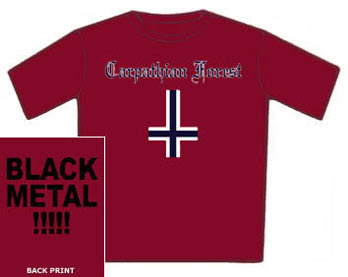
“Filthy bitches of hellish sin.” … If I have a black metal idol it’s Nattefrost. Carpathian Forest is the most underrated band in the scene, and his solo work is just as entertaining.

Seriously. You can’t not love this shit.

Hope you’ve enjoyed. I’ve got three more posts to come. Hopefully I’ll get the last one up by Halloween.

Song of the Day: Humanity Part II (by Ennio Morricone)


Day Three of the week-long horror-themed “Song of the Day” feature brings us one of the greatest pieces of film music ever composed. I’m talking about the score for John Carpenter’s remake of The Thing from Another World. The remake retains only the first two words of the original’s title, and that alone speaks volumes.

At first listen, one might mistake this music as being composed by John Carpenter himself—an accomplished film composer in his own right, known for scoring most of his own films. Its similarity to his iconic Halloween theme and even his earlier work on Assault on Precinct 13 makes the connection understandable. But one would be wrong to assume Carpenter had a hand in writing it. For the first time, Carpenter allowed someone else to compose the score, and for the task he selected none other than the Italian maestro Ennio Morricone.

By the time he collaborated with Carpenter on this sci-fi horror masterpiece, Morricone was already firmly established as one of the great masters of film composition. Audiences knew him best for his legendary work on Sergio Leone’s “spaghetti westerns” as well as numerous classics of Italian cinema. While Morricone’s full score for The Thing deserves a complete discussion of its own, I’ll focus on the one track that most powerfully captures the themes of horror, isolation, dread, and paranoia that make Carpenter’s film such a landmark: “Humanity (Part II).”

The piece opens with a heartbeat-like sequence that pulses steadily through most of its length. Strings layer on top of this rhythm, creating a mournful, dirge-like quality, while the bass thump lurks ominously just beneath the surface, as though danger is present but unseen. For much of its runtime, the music exudes a stark sense of emptiness, forcing the listener into the same suffocating isolation as the characters onscreen, stranded in the vast Arctic wasteland. The repetition and looping structure almost feel like a trap, with no release or resolution, mirroring the crew’s paranoia as suspicion and fear close in tighter than the snowstorms outside. Each cycle draws the listener deeper into a psychological cage, heightening the dread with its unrelenting stillness.

It isn’t until the final two minutes that the track breaks from its oppressive restraint. Here, Morricone channels Carpenter’s trademark minimalism with unsettling synthesizer tones, jagged and piercing against the steady backdrop. The music shifts from mournful to dissonant, almost alien, capturing the horrifying essence of the creature in its most grotesque form. This sharp intrusion is not just an auditory shock but a symbolic transformation—the moment when the lurking horror finally emerges from shadow into focus, confirming that the paranoia has been justified all along. It is this careful build, held back until the very end, that demonstrates Morricone’s mastery at fusing Carpenter’s sensibilities with his own, delivering a piece that is both restrained and devastatingly effective.

There’s a reason so many film aficionados cite Carpenter’s The Thing as one of their all-time favorites. Its reputation owes much to Carpenter’s skill as a filmmaker and editor, but Morricone’s score plays an equally crucial role in shaping the film’s atmosphere. “Humanity (Part II)” stands as one of the finest pieces of horror film music ever written.

Scenes I Love: Prom Night (1980)


So, it was Tuesday night and me and Erin were watching the Killer Party movie marathon on Chiller and what should happen to come on but Prom Night?  No, not the really crappy Brittany Snow film that came out two years ago.  This was the original Prom Night, the one from 1980 that starred Jamie Lee Curtis.

As we watched this movie, me and Erin discovered two things.  Number one, the original Prom Night is seriously one grim movie.  And number two, there’s an awful lot of dancing.  It makes sense.  The movie only kills about four people so obviously, there had to be some serious padding to get this thing up to 90 minutes.  And most of that padding is musical.

Included below is one of my favorite new scenes that I love.  As Jamie Lee says, “Let’s show them what we can do…”